Environmental Acoustics
Speech interference level
Acoustics calibrator
Dr. Priyanka Tabhane
Department of Physics
Rashtrasant Tukadoji Maharaja Nagpur University,
Nagpur
SPEECH INTERFERENCE LEVEL
• Speech is our primary method of communication. It is therefore important that
after speech received intelligibility.
• The intelligibility of speech depend on the acoustical properties of the
enclosure in which the speech is transmitted from speaker to listener.
• Another important factor determining the speech intelligibility is the
background noise level.
• The easiest noise environment to rate that are steady and slowly varying both
in level or spectral content.
• Acoustic is science is to defined as generation, transmission and reception of
energy as the vibrational wave in matter and effect of sound.
• The main application of acoustic is to make the music and speech as good as
possible.
Dr. Priyanka Tabhane
Department of Physics
RTM Nagpur University, Nagpur
• SIL is a measure of the degree to which background noise interferes with or masks
speech.
• Speech interference level is an acoustical parameter calculated from sound pressure level
measured in Octave band.
• It is used to characterize a noise signal in the frequency range where the human ear has
highest sensitivity.
• Noise decreases the intelligibility of a speech by raising the listener’s threshold of
hearing while, at the same time, masking the information.
• This loss of information may be partially compensated for by moving closer, talking
louder or using electronic amplification.
Dr. Priyanka Tabhane
Department of Physics
RTM Nagpur University, Nagpur
• Speech is highly redundant, much of a sentence can be lost without seriously affecting
intelligibility, meaning can still be extracted from context.
• To measure intelligibility, trained talkers recite clearly and distinctly, Specially
selected words or sentences to trained listeners.
• Intelligibility is then rated according to the percent of correct response
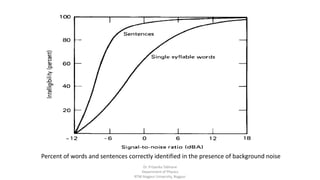
• Figure one shows the Intelligibility of sentences and words as a function of relative A
weighted sound levels of speech and noise.
• For a sentence Intelligibility of better 95%, the signal level must at least equal to the
noise level. since it is difficult to Reconstruct proper name from contexts, of paging
system should have word intelligibility over 85%.
• This requires a signal to noise ratio of 6 decibel. this specification Is achieved at bus
depot.
Dr. Priyanka Tabhane
Department of Physics
RTM Nagpur University, Nagpur
Percent of words and sentences correctly identified in the presence of background noise
Dr. Priyanka Tabhane
Department of Physics
RTM Nagpur University, Nagpur
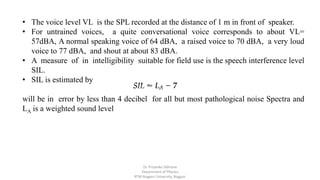
• The voice level VL is the SPL recorded at the distance of 1 m in front of speaker.
• For untrained voices, a quite conversational voice corresponds to about VL=
57dBA, A normal speaking voice of 64 dBA, a raised voice to 70 dBA, a very loud
voice to 77 dBA, and shout at about 83 dBA.
• A measure of in intelligibility suitable for field use is the speech interference level
SIL.
• SIL is estimated by
will be in error by less than 4 decibel for all but most pathological noise Spectra and
LA is a weighted sound level
Dr. Priyanka Tabhane
Department of Physics
RTM Nagpur University, Nagpur
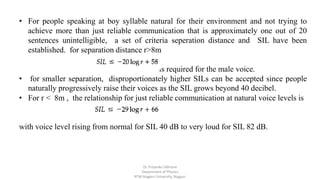
• For people speaking at boy syllable natural for their environment and not trying to
achieve more than just reliable communication that is approximately one out of 20
sentences unintelligible, a set of criteria seperation distance and SIL have been
established. for separation distance r>8m
is required for the male voice.
• for smaller separation, disproportionately higher SILs can be accepted since people
naturally progressively raise their voices as the SIL grows beyond 40 decibel.
• For r < 8m , the relationship for just reliable communication at natural voice levels is
with voice level rising from normal for SIL 40 dB to very loud for SIL 82 dB.
Dr. Priyanka Tabhane
Department of Physics
RTM Nagpur University, Nagpur
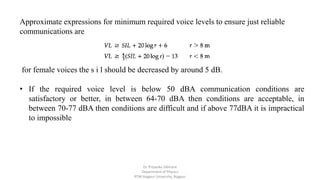
Approximate expressions for minimum required voice levels to ensure just reliable
communications are
for female voices the s i l should be decreased by around 5 dB.
• If the required voice level is below 50 dBA communication conditions are
satisfactory or better, in between 64-70 dBA then conditions are acceptable, in
between 70-77 dBA then conditions are difficult and if above 77dBA it is impractical
to impossible
Dr. Priyanka Tabhane
Department of Physics
RTM Nagpur University, Nagpur
ACOUSTICS CALIBRATION
• Calibration is the is the process of adjusting an instrument or an equipment to meet the
manufacturer’s specification.
• It is the process of comparing a reading on one piece of equipment or system with
another piece of equipment that has been calibrated and referend to a known set of
parameters.
• It can also be defined as the process of issuing data including a report or certificate of
calibration that assure an end user of product’s performance with its specifications.
• Acoustics calibrator are used to set off the sensitivity of the microphone of the sound
level meter for a field work.
• It is recommended just as with air sampling pumps, that calibration should be made
before and after a series of measurements.
Dr. Priyanka Tabhane
Department of Physics
RTM Nagpur University, Nagpur
• Class 1 calibrator produce a tone at the same frequency at two different SPL.
• Class2 calibrator produce at a single frequency(typically 1KHz) at specific SPL.
• The calibration should meet the standard ICE 60942 to either Class 1 or Class 2 .
• The Class 1 calibrator is little more accurate than Class 2.
• In general, if you have a class one sound level meter then you should use a class
one calibrator, If you have a class 2 SLM ,you can use either class one or Class 2
calibrator.
Dr. Priyanka Tabhane
Department of Physics
RTM Nagpur University, Nagpur
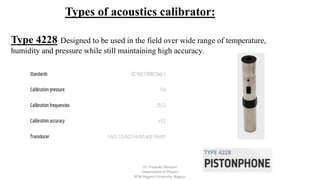
Types of acoustics calibrator:
Type 4228: Designed to be used in the field over wide range of temperature,
humidity and pressure while still maintaining high accuracy.
Dr. Priyanka Tabhane
Department of Physics
RTM Nagpur University, Nagpur
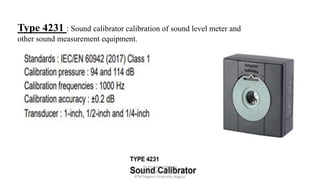
Type 4231 : Sound calibrator calibration of sound level meter and
other sound measurement equipment.
Dr. Priyanka Tabhane
Department of Physics
RTM Nagpur University, Nagpur
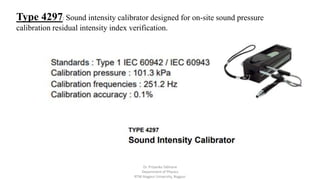
Type 4297: Sound intensity calibrator designed for on-site sound pressure
calibration residual intensity index verification.
Dr. Priyanka Tabhane
Department of Physics
RTM Nagpur University, Nagpur
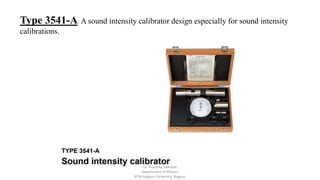
Type 3541-A: A sound intensity calibrator design especially for sound intensity
calibrations.
Dr. Priyanka Tabhane
Department of Physics
RTM Nagpur University, Nagpur
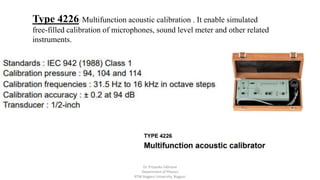
Type 4226: Multifunction acoustic calibration . It enable simulated
free-filled calibration of microphones, sound level meter and other related
instruments.
Dr. Priyanka Tabhane
Department of Physics
RTM Nagpur University, Nagpur
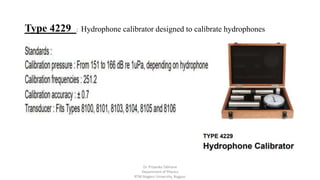
Type 4229 : Hydrophone calibrator designed to calibrate hydrophones
Dr. Priyanka Tabhane
Department of Physics
RTM Nagpur University, Nagpur

Environmental Acoustics- Speech interference level, acoustics calibrator.pptx

  • 1.
    Environmental Acoustics Speech interferencelevel Acoustics calibrator Dr. Priyanka Tabhane Department of Physics Rashtrasant Tukadoji Maharaja Nagpur University, Nagpur
  • 2.
    SPEECH INTERFERENCE LEVEL •Speech is our primary method of communication. It is therefore important that after speech received intelligibility. • The intelligibility of speech depend on the acoustical properties of the enclosure in which the speech is transmitted from speaker to listener. • Another important factor determining the speech intelligibility is the background noise level. • The easiest noise environment to rate that are steady and slowly varying both in level or spectral content. • Acoustic is science is to defined as generation, transmission and reception of energy as the vibrational wave in matter and effect of sound. • The main application of acoustic is to make the music and speech as good as possible. Dr. Priyanka Tabhane Department of Physics RTM Nagpur University, Nagpur
  • 3.
    • SIL isa measure of the degree to which background noise interferes with or masks speech. • Speech interference level is an acoustical parameter calculated from sound pressure level measured in Octave band. • It is used to characterize a noise signal in the frequency range where the human ear has highest sensitivity. • Noise decreases the intelligibility of a speech by raising the listener’s threshold of hearing while, at the same time, masking the information. • This loss of information may be partially compensated for by moving closer, talking louder or using electronic amplification. Dr. Priyanka Tabhane Department of Physics RTM Nagpur University, Nagpur
  • 4.
    • Speech ishighly redundant, much of a sentence can be lost without seriously affecting intelligibility, meaning can still be extracted from context. • To measure intelligibility, trained talkers recite clearly and distinctly, Specially selected words or sentences to trained listeners. • Intelligibility is then rated according to the percent of correct response • Figure one shows the Intelligibility of sentences and words as a function of relative A weighted sound levels of speech and noise. • For a sentence Intelligibility of better 95%, the signal level must at least equal to the noise level. since it is difficult to Reconstruct proper name from contexts, of paging system should have word intelligibility over 85%. • This requires a signal to noise ratio of 6 decibel. this specification Is achieved at bus depot. Dr. Priyanka Tabhane Department of Physics RTM Nagpur University, Nagpur
  • 5.
    Percent of wordsand sentences correctly identified in the presence of background noise Dr. Priyanka Tabhane Department of Physics RTM Nagpur University, Nagpur
  • 6.
    • The voicelevel VL is the SPL recorded at the distance of 1 m in front of speaker. • For untrained voices, a quite conversational voice corresponds to about VL= 57dBA, A normal speaking voice of 64 dBA, a raised voice to 70 dBA, a very loud voice to 77 dBA, and shout at about 83 dBA. • A measure of in intelligibility suitable for field use is the speech interference level SIL. • SIL is estimated by will be in error by less than 4 decibel for all but most pathological noise Spectra and LA is a weighted sound level Dr. Priyanka Tabhane Department of Physics RTM Nagpur University, Nagpur
  • 7.
    • For peoplespeaking at boy syllable natural for their environment and not trying to achieve more than just reliable communication that is approximately one out of 20 sentences unintelligible, a set of criteria seperation distance and SIL have been established. for separation distance r>8m is required for the male voice. • for smaller separation, disproportionately higher SILs can be accepted since people naturally progressively raise their voices as the SIL grows beyond 40 decibel. • For r < 8m , the relationship for just reliable communication at natural voice levels is with voice level rising from normal for SIL 40 dB to very loud for SIL 82 dB. Dr. Priyanka Tabhane Department of Physics RTM Nagpur University, Nagpur
  • 8.
    Approximate expressions forminimum required voice levels to ensure just reliable communications are for female voices the s i l should be decreased by around 5 dB. • If the required voice level is below 50 dBA communication conditions are satisfactory or better, in between 64-70 dBA then conditions are acceptable, in between 70-77 dBA then conditions are difficult and if above 77dBA it is impractical to impossible Dr. Priyanka Tabhane Department of Physics RTM Nagpur University, Nagpur
  • 9.
    ACOUSTICS CALIBRATION • Calibrationis the is the process of adjusting an instrument or an equipment to meet the manufacturer’s specification. • It is the process of comparing a reading on one piece of equipment or system with another piece of equipment that has been calibrated and referend to a known set of parameters. • It can also be defined as the process of issuing data including a report or certificate of calibration that assure an end user of product’s performance with its specifications. • Acoustics calibrator are used to set off the sensitivity of the microphone of the sound level meter for a field work. • It is recommended just as with air sampling pumps, that calibration should be made before and after a series of measurements. Dr. Priyanka Tabhane Department of Physics RTM Nagpur University, Nagpur
  • 10.
    • Class 1calibrator produce a tone at the same frequency at two different SPL. • Class2 calibrator produce at a single frequency(typically 1KHz) at specific SPL. • The calibration should meet the standard ICE 60942 to either Class 1 or Class 2 . • The Class 1 calibrator is little more accurate than Class 2. • In general, if you have a class one sound level meter then you should use a class one calibrator, If you have a class 2 SLM ,you can use either class one or Class 2 calibrator. Dr. Priyanka Tabhane Department of Physics RTM Nagpur University, Nagpur
  • 11.
    Types of acousticscalibrator: Type 4228: Designed to be used in the field over wide range of temperature, humidity and pressure while still maintaining high accuracy. Dr. Priyanka Tabhane Department of Physics RTM Nagpur University, Nagpur
  • 12.
    Type 4231 :Sound calibrator calibration of sound level meter and other sound measurement equipment. Dr. Priyanka Tabhane Department of Physics RTM Nagpur University, Nagpur
  • 13.
    Type 4297: Soundintensity calibrator designed for on-site sound pressure calibration residual intensity index verification. Dr. Priyanka Tabhane Department of Physics RTM Nagpur University, Nagpur
  • 14.
    Type 3541-A: Asound intensity calibrator design especially for sound intensity calibrations. Dr. Priyanka Tabhane Department of Physics RTM Nagpur University, Nagpur
  • 15.
    Type 4226: Multifunctionacoustic calibration . It enable simulated free-filled calibration of microphones, sound level meter and other related instruments. Dr. Priyanka Tabhane Department of Physics RTM Nagpur University, Nagpur
  • 16.
    Type 4229 :Hydrophone calibrator designed to calibrate hydrophones Dr. Priyanka Tabhane Department of Physics RTM Nagpur University, Nagpur