Sound Level Meters
Presented by Roba Fikadu
WHAT IS SOUND LEVEL METER?
 A Sound Level Meter (SLM) is an instrument
(commonly hand-held) that is designed to
measure sound levels in a standardized way.
 It responds to sound in approximately the
same way as the human ear and gives
objective, reproducible measurements of
sound pressure levels.
What is Sound Pressure?
 Sound pressure (p) is the average variation in
atmospheric pressure caused by sound.
 The unit of pressure measurement is the Pascal
(Pa).
 Since it is not intuitive to use Pascal (Pa) to refer to
the volume of sound in our daily lives, it is easier to
describe them in decibels.
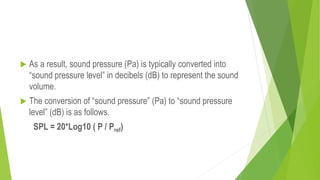
 As a result, sound pressure (Pa) is typically converted into
“sound pressure level” in decibels (dB) to represent the sound
volume.
 The conversion of “sound pressure” (Pa) to “sound pressure
level” (dB) is as follows.
SPL = 20*Log10 ( P / Pref)
Classes of Sound level meters
 According to the International Standards (IEC
60942:2017), Sound Level Meter is categorized into
two different classes based on its accuracy
Classes
 Class 1—Precision grade with a tolerance of ±0.5 dB.
 It is ideal for industrial and laboratory use.
 Class 2—General purpose grade with a tolerance of
±1.0 dB.
 It is ideal for basic noise environmental
measurements.
WHAT IS A SOUND LEVEL METER USED FOR?
 Sound level meters are used to measure
and manage noise from a variety of
sources, including
Industrial plants,
Road and rail traffic,
Construction work, etc
What is a normal sound level?
 The World Health Organization (WHO) defines a
“normal” sound level as anything below 35
decibels (dB).
 This is roughly equivalent to the noise of a
whisper or rustling leaves.
 Above this threshold, any increase in loudness can
cause stress, fatigue, and even hearing loss over
time.
How will you measure the sound level?
 Measuring the sound level is essential to evaluate the
acoustic environment of a particular space.
 Many different techniques and instruments are used to
measure sound levels, including sound level meters,
sound analyzers, and noise dosimeters.
 Sound level meters measure the instantaneous
sound pressure level in decibels (dB) and are
usually used to determine the overall sound
pressure level in a given area
 By measuring the sound levels of a particular
area, it is possible to determine if the noise levels
are suitable for workers and occupants
How will you measure the sound level?
HOW DOES A SOUND LEVEL METER WORK?
 A sound level meter comprises
a microphone, a preamplifier, signal
processing, and a display.
 The microphone converts the sound signal
to an equivalent electrical signal.
 The most suitable type of microphone for
sound level meters is the condenser
microphone, which combines precision with
stability and reliability.
 The electrical signal produced by the
microphone is at a very low level, so it is
made stronger by a preamplifier before it is
processed by the main processor.
 Signal processing includes applying
frequency and time weightings to the signal
as specified by international standards such
as IEC 61672 – 1, to which sound level
meters conform.
TIME WEIGHTING
 Time weighting specifies how the SLM
reacts to changes in sound pressure.
 It is an exponential averaging of the
fluctuating signal, providing an easy-to-
read value.
TYPES OF TIME WEIGHING
 The analyzer applies Fast, Slow, and Impulse (or ‘F’,
‘S’ and ‘I’) time weightings, which are the required
weightings according to most international and
national standards and guidelines.
 Environmental assessment standards usually specify
which time weighting to use.
 The signal is processed through the weighting filters,
and the resulting sound pressure level is displayed in
decibels (dB) referenced to 20 μPa on the analyzer’s
screen.
 The sound pressure level values are updated at least
once per second.
FREQUENCY WEIGHTING
 Frequency weighting adjusts how the
sound level meter responds to different
sound frequencies.
 This is necessary because the human
ear’s sensitivity to sound varies
according to the sound’s frequency.
TYPES OF FREQUENCY WEIGHTING
 IEC 61672-1 defines frequency weightings A, C and Z,
but other frequency weightings are occasionally used
in specialized applications.
A-weighting – dBA/dB(A)
 A-weighting adjusts a signal in a way
that resembles the human ear’s
response at medium-range levels.
 It is based on the 40 dB equal
loudness curve.
 The symbols for the noise parameters
often include the letter ‘A’ (for
example, LAeq) to indicate that
frequency weighting has been included
in the measurement.
 A-weighting is required for nearly all environmental
and workplace noise measurements and is specified
in international and national standards and guidelines.
 A-weighting filters cover the full audio range, 10 Hz to
20 kHz.
C-weighting – dBC/dB(C)
 The response of the human ear varies with the sound
level.
 C frequency weighting corresponds to the 100 dB
equal loudness curve, that is to say, the human ear’s
response at fairly high sound levels.
 C-weighting is mainly used when assessing peak
values of high sound pressure levels.
 It can also be used, for example, for entertainment
noise measurements, where the transmission of bass
noise can be a problem.
Z-weighting – dBZ/dB(Z)
Zero’ frequency weighting is a flat
frequency response between 10 Hz and
20 kHz ±1.5 dB excluding microphone
response.
 Today, the A-weighting network is the most widely used
frequency weighting.
 C-weighting does not correlate well with subjective tests
because the equal loudness contours were based on
experiments that used pure tones — and most common
sounds are not pure tones, but very complex signals made up
of many different tones
FREQUENCY ANALYSIS
 When more detailed information about a
complex sound is required, the frequency
range can be divided up into sections or
bands.
 This is done with electronic or digital filters,
which reject all sound with frequencies
outside the selected band.
 These bands usually have a bandwidth of
either one octave or a third of an octave.
Octave
 An octave is a frequency band where the highest frequency is
twice the lowest frequency.
 For example, an octave filter with a center frequency of 1 kHz
admits frequencies between 707 and 1414 Hz but rejects all
others.
 The name octave stems from the fact that an octave covers
eight notes of the diatonic musical scale.
 A third octave covers a range where the highest frequency is
1.26 times the lowest frequency.
spectrogram
spectrogram
 The process of thus dividing a complex sound is termed
frequency analysis and the results are presented on a chart
called a spectrogram.
 After the signal has been weighted and/or divided into
frequency bands, the resultant signal is amplified, and the
Root Mean Square (RMS) value is determined in an RMS
detector.
RMS
 The RMS is a special kind of mathematical average
value.
 It is of importance in sound measurements because
the RMS value is directly related to the amount of
energy in the sound being measured.
THE DISPLAY
 The display shows the sound level in decibels,
typically with a descriptor showing the selected
combination of time and frequency-weighting (eg;
LAeq or LCpeak).
 The signal may also be available at output
sockets, in either AC or DC form, for connection
to external instruments such as a data acquisition
system, to provide a record and/or for further
processing.
CALIBRATION
 Calibration is an adjustment of your SLM to
measure and display correct values.
 The sensitivity of the transducer, as well as
the response of the electronic circuitry, can
vary slightly over time or could be affected
by environmental conditions such as
temperature and humidity.
THANK YOU!!

Sound level meter.pptx

  • 1.
  • 2.
    WHAT IS SOUNDLEVEL METER?  A Sound Level Meter (SLM) is an instrument (commonly hand-held) that is designed to measure sound levels in a standardized way.  It responds to sound in approximately the same way as the human ear and gives objective, reproducible measurements of sound pressure levels.
  • 4.
    What is SoundPressure?  Sound pressure (p) is the average variation in atmospheric pressure caused by sound.  The unit of pressure measurement is the Pascal (Pa).  Since it is not intuitive to use Pascal (Pa) to refer to the volume of sound in our daily lives, it is easier to describe them in decibels.
  • 5.
     As aresult, sound pressure (Pa) is typically converted into “sound pressure level” in decibels (dB) to represent the sound volume.  The conversion of “sound pressure” (Pa) to “sound pressure level” (dB) is as follows. SPL = 20*Log10 ( P / Pref)
  • 6.
    Classes of Soundlevel meters  According to the International Standards (IEC 60942:2017), Sound Level Meter is categorized into two different classes based on its accuracy
  • 7.
    Classes  Class 1—Precisiongrade with a tolerance of ±0.5 dB.  It is ideal for industrial and laboratory use.  Class 2—General purpose grade with a tolerance of ±1.0 dB.  It is ideal for basic noise environmental measurements.
  • 8.
    WHAT IS ASOUND LEVEL METER USED FOR?  Sound level meters are used to measure and manage noise from a variety of sources, including Industrial plants, Road and rail traffic, Construction work, etc
  • 9.
    What is anormal sound level?  The World Health Organization (WHO) defines a “normal” sound level as anything below 35 decibels (dB).  This is roughly equivalent to the noise of a whisper or rustling leaves.  Above this threshold, any increase in loudness can cause stress, fatigue, and even hearing loss over time.
  • 10.
    How will youmeasure the sound level?  Measuring the sound level is essential to evaluate the acoustic environment of a particular space.  Many different techniques and instruments are used to measure sound levels, including sound level meters, sound analyzers, and noise dosimeters.
  • 11.
     Sound levelmeters measure the instantaneous sound pressure level in decibels (dB) and are usually used to determine the overall sound pressure level in a given area  By measuring the sound levels of a particular area, it is possible to determine if the noise levels are suitable for workers and occupants How will you measure the sound level?
  • 12.
    HOW DOES ASOUND LEVEL METER WORK?  A sound level meter comprises a microphone, a preamplifier, signal processing, and a display.  The microphone converts the sound signal to an equivalent electrical signal.  The most suitable type of microphone for sound level meters is the condenser microphone, which combines precision with stability and reliability.
  • 13.
     The electricalsignal produced by the microphone is at a very low level, so it is made stronger by a preamplifier before it is processed by the main processor.  Signal processing includes applying frequency and time weightings to the signal as specified by international standards such as IEC 61672 – 1, to which sound level meters conform.
  • 14.
    TIME WEIGHTING  Timeweighting specifies how the SLM reacts to changes in sound pressure.  It is an exponential averaging of the fluctuating signal, providing an easy-to- read value.
  • 15.
    TYPES OF TIMEWEIGHING  The analyzer applies Fast, Slow, and Impulse (or ‘F’, ‘S’ and ‘I’) time weightings, which are the required weightings according to most international and national standards and guidelines.  Environmental assessment standards usually specify which time weighting to use.
  • 17.
     The signalis processed through the weighting filters, and the resulting sound pressure level is displayed in decibels (dB) referenced to 20 μPa on the analyzer’s screen.  The sound pressure level values are updated at least once per second.
  • 18.
    FREQUENCY WEIGHTING  Frequencyweighting adjusts how the sound level meter responds to different sound frequencies.  This is necessary because the human ear’s sensitivity to sound varies according to the sound’s frequency.
  • 19.
    TYPES OF FREQUENCYWEIGHTING  IEC 61672-1 defines frequency weightings A, C and Z, but other frequency weightings are occasionally used in specialized applications.
  • 21.
    A-weighting – dBA/dB(A) A-weighting adjusts a signal in a way that resembles the human ear’s response at medium-range levels.  It is based on the 40 dB equal loudness curve.  The symbols for the noise parameters often include the letter ‘A’ (for example, LAeq) to indicate that frequency weighting has been included in the measurement.
  • 22.
     A-weighting isrequired for nearly all environmental and workplace noise measurements and is specified in international and national standards and guidelines.  A-weighting filters cover the full audio range, 10 Hz to 20 kHz.
  • 23.
    C-weighting – dBC/dB(C) The response of the human ear varies with the sound level.  C frequency weighting corresponds to the 100 dB equal loudness curve, that is to say, the human ear’s response at fairly high sound levels.  C-weighting is mainly used when assessing peak values of high sound pressure levels.  It can also be used, for example, for entertainment noise measurements, where the transmission of bass noise can be a problem.
  • 24.
    Z-weighting – dBZ/dB(Z) Zero’frequency weighting is a flat frequency response between 10 Hz and 20 kHz ±1.5 dB excluding microphone response.
  • 25.
     Today, theA-weighting network is the most widely used frequency weighting.  C-weighting does not correlate well with subjective tests because the equal loudness contours were based on experiments that used pure tones — and most common sounds are not pure tones, but very complex signals made up of many different tones
  • 26.
    FREQUENCY ANALYSIS  Whenmore detailed information about a complex sound is required, the frequency range can be divided up into sections or bands.  This is done with electronic or digital filters, which reject all sound with frequencies outside the selected band.  These bands usually have a bandwidth of either one octave or a third of an octave.
  • 27.
    Octave  An octaveis a frequency band where the highest frequency is twice the lowest frequency.  For example, an octave filter with a center frequency of 1 kHz admits frequencies between 707 and 1414 Hz but rejects all others.  The name octave stems from the fact that an octave covers eight notes of the diatonic musical scale.  A third octave covers a range where the highest frequency is 1.26 times the lowest frequency.
  • 28.
  • 29.
    spectrogram  The processof thus dividing a complex sound is termed frequency analysis and the results are presented on a chart called a spectrogram.  After the signal has been weighted and/or divided into frequency bands, the resultant signal is amplified, and the Root Mean Square (RMS) value is determined in an RMS detector.
  • 30.
    RMS  The RMSis a special kind of mathematical average value.  It is of importance in sound measurements because the RMS value is directly related to the amount of energy in the sound being measured.
  • 31.
    THE DISPLAY  Thedisplay shows the sound level in decibels, typically with a descriptor showing the selected combination of time and frequency-weighting (eg; LAeq or LCpeak).  The signal may also be available at output sockets, in either AC or DC form, for connection to external instruments such as a data acquisition system, to provide a record and/or for further processing.
  • 32.
    CALIBRATION  Calibration isan adjustment of your SLM to measure and display correct values.  The sensitivity of the transducer, as well as the response of the electronic circuitry, can vary slightly over time or could be affected by environmental conditions such as temperature and humidity.
  • 33.