Environmental Acoustics:
Noise
Decibels and levels
dB Scales
Acoustic power
Intensity and Pressure
Dr. Priyanka Tabhane
Department of Physics
Rashtrasant Tukadoji Maharaja Nagpur
University, Nagpur
Noise
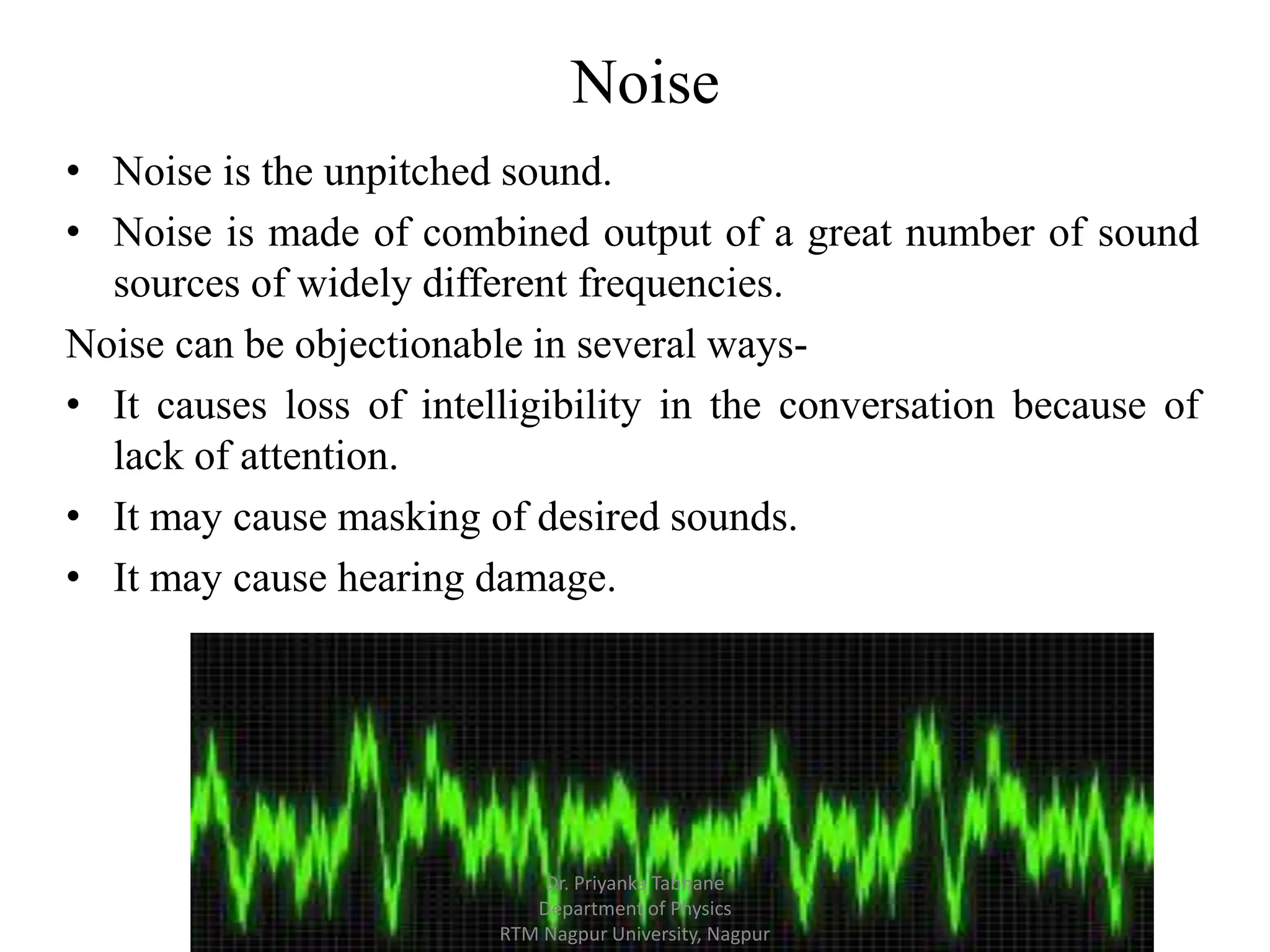
• Noise is the unpitched sound.
• Noise is made of combined output of a great number of sound
sources of widely different frequencies.
Noise can be objectionable in several ways-
• It causes loss of intelligibility in the conversation because of
lack of attention.
• It may cause masking of desired sounds.
• It may cause hearing damage.
Dr. Priyanka Tabhane
Department of Physics
RTM Nagpur University, Nagpur
What are Decibels (dB)?
• Decibel deci (1/10th) + bel (Alexander Graham Bell)
• A decibel (dB) is a ratio between two quantities that has been
reported on a logarithmic scale.
• dB allows a realistic modeling of human auditory perception,
since the ear reacts to relative changes in noise level.
• It is used to express the ratio of one value of a power or root-
power quantity to another, on a logarithmic scale.
• A logarithmic quantity in decibels is called a level.
Dr. Priyanka Tabhane
Department of Physics
RTM Nagpur University, Nagpur
Dr. Priyanka Tabhane
Department of Physics
RTM Nagpur University, Nagpur
Dr. Priyanka Tabhane
Department of Physics
RTM Nagpur University, Nagpur
dB Scales in acoustics
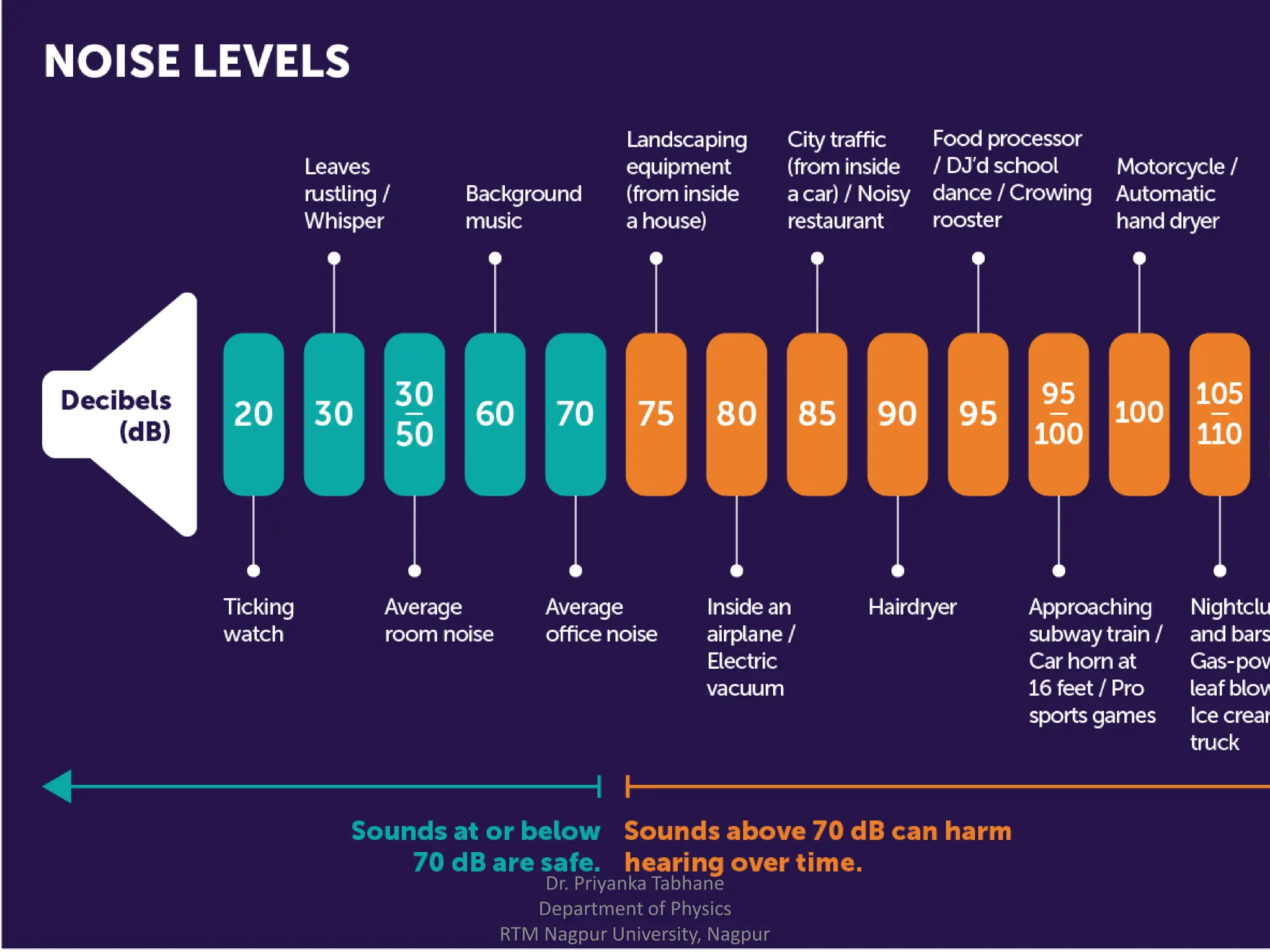
• Sound is measured in units called decibels (dB).
• The higher the decibel level, the louder the noise.
• On the decibel scale, the level increase of 10 means that a
sound is actually 10 times more intense, or powerful.
• The ear mechanism is able to respond to both very small and
very large pressure waves by virtue of being nonlinear.
• Ear responds much more efficiently to sounds of very small
amplitude than to sounds of very large amplitude.
• Because of the enormous nonlinearity of the ear in sensing
pressure waves, a nonlinear scale is convenient in describing
the intensity of sound waves.
• Such a scale is provided by the decibel level of a sound wave.
Dr. Priyanka Tabhane
Department of Physics
RTM Nagpur University, Nagpur
• The human ear is more sensitive to the sound in the frequency
range 1kHz to 4kHz.
• The knowledge about the human ear is important in acoustic
design and sound measurements.
• To compensate for human hearing, sound meters are normally
fitted with filters that adapts the measured sound response to
human sense of sound. The common filters are dB(A), dB(B)
and dB(C).
‘A’ Weighting-
• The decibel A filter roughly corresponds to inverse of 40 dB
(at 1kHz) equal loudness curve for human ear.
• With dB(A) filter, the sound level meter is less sensitive to
very high and very low frequencies.
Dr. Priyanka Tabhane
Department of Physics
RTM Nagpur University, Nagpur
• The measurement made with this scale is called as dB(A).
• ‘A’ Weighting is standard weighting of the audible frequencies
designed to reflect the response of the human ear to noise.
• At low and high frequencies, the human ear is not very sensitive,
but between 500 Hz and 6 kHz the ear is much more sensitive.
• The ‘A’ weighting filter covers the full frequency range of 20 Hz
to 20 kHz, but the shape approximates to the frequency
sensitivity of the human ear.
• So the A-weighted value of a noise source is an approximation
to how the human ear perceives the noise.
Dr. Priyanka Tabhane
Department of Physics
RTM Nagpur University, Nagpur
‘C’ Weighting-
• The decibel C filter is linear over several octaves
and is suitable for subjective measurements at
very high sound pressure levels.
• Measurements made using ‘C’ weighting are
usually shown with dB(C) to show that the
information is ‘C’ weighted decibels.
‘B’ Weighting-
• The decibel B filter is between C and A. The B
and C filters are seldom used.
• ‘B’ weighting is a flat frequency response
between 10Hz and 20kHz.
Dr. Priyanka Tabhane
Department of Physics
RTM Nagpur University, Nagpur
Dr. Priyanka Tabhane
Department of Physics
RTM Nagpur University, Nagpur
• Compared with dB, A-weighted measurements underestimate the
perceived loudness, annoyance factor and stress-inducing capability
of noises with low frequency components, especially at moderate
and high volumes of noise.
• A fundamental feature of this type of logarithmic scale is that each
unit of increase in the decibel scale corresponds to an increase in
absolute intensity. Thus, an increase in absolute intensity from 10−12
to 10−11W/𝑚2 corresponds to an increase of 10 decibels, as does an
increase from 10−1 to 1 W/𝑚2.
• The correlation between the absolute intensity of a sound wave and
its decibel level along with examples of sounds at each level is
shown in Table.
• When the defining level of 0 decibel (10−12W/𝑚2) is taken to be at
the threshold of hearing for a sound wave with a frequency of 1kHz,
then 130 decibels (10 W/𝑚2) corresponds to the threshold of feeling,
or the threshold of pain.
• Although the decibel scale is nonlinear, it is directly measurable, and
sound-level meters are available for that purpose.
• Sound levels for audio systems, architectural acoustics, and other
industrial applications are most often quoted in decibels.
Dr. Priyanka Tabhane
Department of Physics
RTM Nagpur University, Nagpur
Dr. Priyanka Tabhane
Department of Physics
RTM Nagpur University, Nagpur
Sound Power or Acoustic Power
• Sound power is the energy rate, or energy of sound per unit of time (W
in SI-units) - emitted by a source.
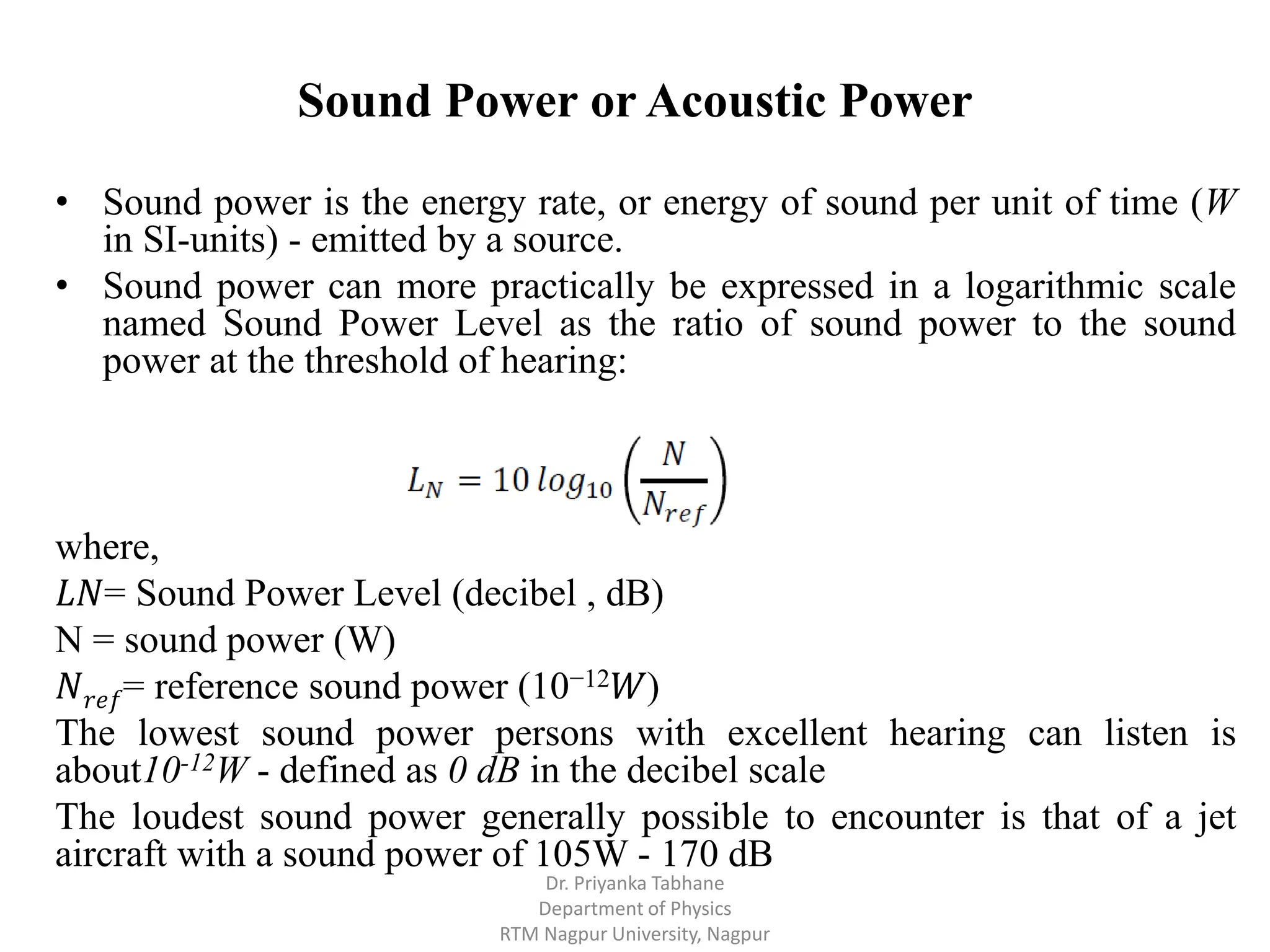
• Sound power can more practically be expressed in a logarithmic scale
named Sound Power Level as the ratio of sound power to the sound
power at the threshold of hearing:
where,
𝐿𝑁= Sound Power Level (decibel , dB)
N = sound power (W)
𝑁𝑟𝑒𝑓= reference sound power (10−12𝑊)
The lowest sound power persons with excellent hearing can listen is
about10-12W - defined as 0 dB in the decibel scale
The loudest sound power generally possible to encounter is that of a jet
aircraft with a sound power of 105W - 170 dB
Dr. Priyanka Tabhane
Department of Physics
RTM Nagpur University, Nagpur
Sound Intensity or Acoustic Intensity
• Sound intensity is defined as the power carried by sound waves per
unit area in the direction perpendicular to that area. The unit is watts
per square meter W/𝑚2.
• Human hearing is directly sensitive to sound pressure which is
related to sound intensity. Sound intensity level is a logarithmic
expression of sound intensity relative to a reference intensity.
• Sound intensity I is
𝐼=𝑃𝑣
where, P is the sound pressure and v is the particle velocity.
• The sound intensity level is given by the formula
Where, 𝐼𝑟𝑒𝑓=10−12 𝑊/𝑚2 which is also audible to human ear.
Dr. Priyanka Tabhane
Department of Physics
RTM Nagpur University, Nagpur
Sound Pressure or Acoustic Pressure
• The sound pressure is the force of a sound on a surface area
perpendicular to the direction of the sound. The SI-unit for the
Sound Pressure is Pa.
• A variation in pressure above and below atmospheric pressure
at the ear is called sound pressure.
• The normal ear is most sensitive at frequencies between 1kHz
to 4kHz, and a young person can detect pressures as low as
about 20𝜇Pa, which, when compared to the normal
atmospheric pressure (101.3×10³𝑃𝑎) around which it varies, is
a fractional variation of 2×10⁻¹⁰.
Dr. Priyanka Tabhane
Department of Physics
RTM Nagpur University, Nagpur
The Sound Pressure Level in decibel can be expressed as
Where,
𝐿𝑝= sound pressure level (dB)
p = sound pressure (Pa)
𝑝𝑟𝑒𝑓=2×10⁻⁵ - reference sound pressure (Pa)
Dr. Priyanka Tabhane
Department of Physics
RTM Nagpur University, Nagpur

Environmental Acoustics- noise decible scale intensity pressure

  • 1.
    Environmental Acoustics: Noise Decibels andlevels dB Scales Acoustic power Intensity and Pressure Dr. Priyanka Tabhane Department of Physics Rashtrasant Tukadoji Maharaja Nagpur University, Nagpur
  • 2.
    Noise • Noise isthe unpitched sound. • Noise is made of combined output of a great number of sound sources of widely different frequencies. Noise can be objectionable in several ways- • It causes loss of intelligibility in the conversation because of lack of attention. • It may cause masking of desired sounds. • It may cause hearing damage. Dr. Priyanka Tabhane Department of Physics RTM Nagpur University, Nagpur
  • 3.
    What are Decibels(dB)? • Decibel deci (1/10th) + bel (Alexander Graham Bell) • A decibel (dB) is a ratio between two quantities that has been reported on a logarithmic scale. • dB allows a realistic modeling of human auditory perception, since the ear reacts to relative changes in noise level. • It is used to express the ratio of one value of a power or root- power quantity to another, on a logarithmic scale. • A logarithmic quantity in decibels is called a level. Dr. Priyanka Tabhane Department of Physics RTM Nagpur University, Nagpur
  • 4.
    Dr. Priyanka Tabhane Departmentof Physics RTM Nagpur University, Nagpur
  • 5.
    Dr. Priyanka Tabhane Departmentof Physics RTM Nagpur University, Nagpur
  • 6.
    dB Scales inacoustics • Sound is measured in units called decibels (dB). • The higher the decibel level, the louder the noise. • On the decibel scale, the level increase of 10 means that a sound is actually 10 times more intense, or powerful. • The ear mechanism is able to respond to both very small and very large pressure waves by virtue of being nonlinear. • Ear responds much more efficiently to sounds of very small amplitude than to sounds of very large amplitude. • Because of the enormous nonlinearity of the ear in sensing pressure waves, a nonlinear scale is convenient in describing the intensity of sound waves. • Such a scale is provided by the decibel level of a sound wave. Dr. Priyanka Tabhane Department of Physics RTM Nagpur University, Nagpur
  • 7.
    • The humanear is more sensitive to the sound in the frequency range 1kHz to 4kHz. • The knowledge about the human ear is important in acoustic design and sound measurements. • To compensate for human hearing, sound meters are normally fitted with filters that adapts the measured sound response to human sense of sound. The common filters are dB(A), dB(B) and dB(C). ‘A’ Weighting- • The decibel A filter roughly corresponds to inverse of 40 dB (at 1kHz) equal loudness curve for human ear. • With dB(A) filter, the sound level meter is less sensitive to very high and very low frequencies. Dr. Priyanka Tabhane Department of Physics RTM Nagpur University, Nagpur
  • 8.
    • The measurementmade with this scale is called as dB(A). • ‘A’ Weighting is standard weighting of the audible frequencies designed to reflect the response of the human ear to noise. • At low and high frequencies, the human ear is not very sensitive, but between 500 Hz and 6 kHz the ear is much more sensitive. • The ‘A’ weighting filter covers the full frequency range of 20 Hz to 20 kHz, but the shape approximates to the frequency sensitivity of the human ear. • So the A-weighted value of a noise source is an approximation to how the human ear perceives the noise. Dr. Priyanka Tabhane Department of Physics RTM Nagpur University, Nagpur
  • 9.
    ‘C’ Weighting- • Thedecibel C filter is linear over several octaves and is suitable for subjective measurements at very high sound pressure levels. • Measurements made using ‘C’ weighting are usually shown with dB(C) to show that the information is ‘C’ weighted decibels. ‘B’ Weighting- • The decibel B filter is between C and A. The B and C filters are seldom used. • ‘B’ weighting is a flat frequency response between 10Hz and 20kHz. Dr. Priyanka Tabhane Department of Physics RTM Nagpur University, Nagpur
  • 10.
    Dr. Priyanka Tabhane Departmentof Physics RTM Nagpur University, Nagpur
  • 11.
    • Compared withdB, A-weighted measurements underestimate the perceived loudness, annoyance factor and stress-inducing capability of noises with low frequency components, especially at moderate and high volumes of noise. • A fundamental feature of this type of logarithmic scale is that each unit of increase in the decibel scale corresponds to an increase in absolute intensity. Thus, an increase in absolute intensity from 10−12 to 10−11W/𝑚2 corresponds to an increase of 10 decibels, as does an increase from 10−1 to 1 W/𝑚2. • The correlation between the absolute intensity of a sound wave and its decibel level along with examples of sounds at each level is shown in Table. • When the defining level of 0 decibel (10−12W/𝑚2) is taken to be at the threshold of hearing for a sound wave with a frequency of 1kHz, then 130 decibels (10 W/𝑚2) corresponds to the threshold of feeling, or the threshold of pain. • Although the decibel scale is nonlinear, it is directly measurable, and sound-level meters are available for that purpose. • Sound levels for audio systems, architectural acoustics, and other industrial applications are most often quoted in decibels. Dr. Priyanka Tabhane Department of Physics RTM Nagpur University, Nagpur
  • 12.
    Dr. Priyanka Tabhane Departmentof Physics RTM Nagpur University, Nagpur
  • 13.
    Sound Power orAcoustic Power • Sound power is the energy rate, or energy of sound per unit of time (W in SI-units) - emitted by a source. • Sound power can more practically be expressed in a logarithmic scale named Sound Power Level as the ratio of sound power to the sound power at the threshold of hearing: where, 𝐿𝑁= Sound Power Level (decibel , dB) N = sound power (W) 𝑁𝑟𝑒𝑓= reference sound power (10−12𝑊) The lowest sound power persons with excellent hearing can listen is about10-12W - defined as 0 dB in the decibel scale The loudest sound power generally possible to encounter is that of a jet aircraft with a sound power of 105W - 170 dB Dr. Priyanka Tabhane Department of Physics RTM Nagpur University, Nagpur
  • 14.
    Sound Intensity orAcoustic Intensity • Sound intensity is defined as the power carried by sound waves per unit area in the direction perpendicular to that area. The unit is watts per square meter W/𝑚2. • Human hearing is directly sensitive to sound pressure which is related to sound intensity. Sound intensity level is a logarithmic expression of sound intensity relative to a reference intensity. • Sound intensity I is 𝐼=𝑃𝑣 where, P is the sound pressure and v is the particle velocity. • The sound intensity level is given by the formula Where, 𝐼𝑟𝑒𝑓=10−12 𝑊/𝑚2 which is also audible to human ear. Dr. Priyanka Tabhane Department of Physics RTM Nagpur University, Nagpur
  • 15.
    Sound Pressure orAcoustic Pressure • The sound pressure is the force of a sound on a surface area perpendicular to the direction of the sound. The SI-unit for the Sound Pressure is Pa. • A variation in pressure above and below atmospheric pressure at the ear is called sound pressure. • The normal ear is most sensitive at frequencies between 1kHz to 4kHz, and a young person can detect pressures as low as about 20𝜇Pa, which, when compared to the normal atmospheric pressure (101.3×10³𝑃𝑎) around which it varies, is a fractional variation of 2×10⁻¹⁰. Dr. Priyanka Tabhane Department of Physics RTM Nagpur University, Nagpur
  • 16.
    The Sound PressureLevel in decibel can be expressed as Where, 𝐿𝑝= sound pressure level (dB) p = sound pressure (Pa) 𝑝𝑟𝑒𝑓=2×10⁻⁵ - reference sound pressure (Pa) Dr. Priyanka Tabhane Department of Physics RTM Nagpur University, Nagpur