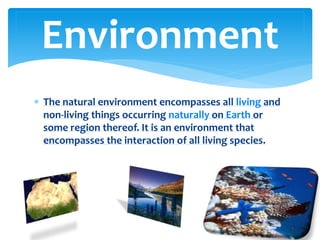
 The natural environment encompasses all living and
non-living things occurring naturally on Earth or
some region thereof. It is an environment that
encompasses the interaction of all living species.
Environment
 Global Warming
 Pollution
 Cutting Down of trees
 Vehicles
 Overgrazing
 Increased fertilizers and
pesticides
Risk to our enviroment
 Global warming, the phenomenon of increasing average
air temperatures near the surface of Earth over the past
one to two centuries. Climate scientists have since the mid-
20th century gathered detailed observations of various
weather phenomena (such as temperatures, precipitation,
and storms) and of related influences on climate (such as
ocean currents and the atmosphere’s chemical composition).
These data indicate that Earth’s climate has changed over
almost every conceivable timescale since the beginning of
geologic time and that the influence of human activities
since at least the beginning of the Industrial Revolution has
been deeply woven into the very fabric of climate change.
Global Warming
 Giving voice to a growing conviction of most of the scientific community, the
Intergovernmental Panel on Climate Change (IPCC) was formed in 1988 by the World
Meteorological Organization (WMO) and the United Nations Environment Program (UNEP).
In 2013 the IPCC reported that the interval between 1880 and 2012 saw an increase in global
average surface temperature of approximately 0.9 °C (1.5 °F). The increase is closer to 1.1 °C (2.0
°F) when measured relative to the preindustrial (i.e., 1750–1800) mean temperature. The IPCC
stated that most of the warming observed over the second half of the 20th century could be
attributed to human activities. It predicted that by the end of the 21st century the global mean
surface temperature would increase by 0.3 to 4.8 °C (0.5 to 8.6 °F) relative to the 1986–2005
average. The predicted rise in temperature was based on a range of possible scenarios that
accounted for future greenhouse gas emissions and mitigation (severity reduction) measures and
on uncertainties in the model projections. Some of the main uncertainties include the precise role
of feedback processes and the impacts of industrial pollutants known as aerosols which may
offset some warming.
Voice Against Global warming
 A vigorous debate is in progress over the extent and seriousness
of rising surface temperatures, the effects of past and future warming
on human life, and the need for action to reduce future warming and deal
with its consequences. This article provides an overview of the scientific
background and public policy debate related to the subject of global
warming. It considers the causes of rising near-surface air
temperatures, the influencing factors, the process of climate research
and forecasting, the possible ecological and social impacts of rising
temperatures, and the public policy developments since the mid-20th
century. For a detailed description of Earth’s climate, its processes, and
the responses of living things to its changing nature, see climate. For
additional background on how Earth’s climate has changed throughout
geologic time, see climatic variation and change. For a full description of
Earth’s gaseous envelope, within which climate change and global warming
occur, see atmosphere.
Process to remove global warming
 The scenarios referred to above depend mainly on future concentrations of
certain trace gases, called greenhouse gases, that have been injected into the
lower atmosphere in increasing amounts through the burning of fossil fuels for
industry, transportation, and residential uses. Modern global warming is the
result of an increase in magnitude of the so-called greenhouse effect, a warming
of Earth’s surface and lower atmosphere caused by the presence of water
vapour, carbon dioxide, methane, nitrous oxides, and other greenhouse gases. In
2014 the IPCC reported that concentrations of carbon dioxide, methane, and
nitrous oxides in the atmosphere surpassed those found in ice cores dating back
800,000 years. Of all these gases, carbon dioxide is the most important, both
for its role in the greenhouse effect and for its role in the human economy.
Green House Effect
 Pollution is the introduction of contaminants
into the natural environment that cause
adverse change.[1] Pollution can take the form
of chemical substances or energy, such as
noise, heat or light.
Pollution
ENVIRONMENT POLLUTION
Types of
pollution
Soil pollution
Water pollution
Air pollution
Noise pollution
AIR POLLUTION
 Air pollution comes from
both natural and human-
made (anthropogenic)
sources. However,
globally human-made
pollutants from
combustion, construction,
mining, agriculture and
warfare are increasingly
significant in the air
pollution equation.
WATER POLLUTION
When unwanted
things and
chemicals added
in the which
harms the
aquatic life is
called water
pollution.
SOIL POLLUTION
 Soil contamination
occurs when chemicals
are released by spill or
underground leakage.
Among the most
significant soil
contaminants are
hydrocarbons, heavy
metals, MTBE,[10]
herbicides, pesticides
and chlorinated
hydrocarbons
EFFECTS OF POLLUTION
 It considers the causes of rising near-surface air temperatures, the
influencing factors, the process of climate research and forecasting, the
possible ecological and social impacts of rising temperatures, and the
public policy developments since the mid-20th century. For a detailed
description of Earth’s climate, its processes, and the responses of living
things to its changing nature, see climate. For additional background on
how Earth’s climate has changed throughout geologic time, see climatic
variation and change. For a full description of Earth’s gaseous envelope,
within which climate change and global warming occur, see atmosphere.
Way to remove pollution and a
happy enviroment
HOW TO CONSERVE ENVIRONMENT
 By:-
 Ecofriendly Bags
 Afforestation
 Following 3R
System
 Using eco friendly
fuels
Such as
CNG,LPG etc.
AFFORESTATION
 A greater number or
variety of species or
biological diversity of an
ecosystem may
contribute to greater
resilience of an
ecosystem, because there
are more species present
at a location to respond
to change and thus
"absorb" or reduce its
effects.
Pollution control
 To protect the
environment from the
adverse effects of
pollution, many nations
worldwide have enacted
legislation to regulate
various types of pollution
as well as to mitigate the
adverse effects of
pollution
Thank You

Environment ppt

  • 2.
     The naturalenvironment encompasses all living and non-living things occurring naturally on Earth or some region thereof. It is an environment that encompasses the interaction of all living species. Environment
  • 3.
     Global Warming Pollution  Cutting Down of trees  Vehicles  Overgrazing  Increased fertilizers and pesticides Risk to our enviroment
  • 4.
     Global warming,the phenomenon of increasing average air temperatures near the surface of Earth over the past one to two centuries. Climate scientists have since the mid- 20th century gathered detailed observations of various weather phenomena (such as temperatures, precipitation, and storms) and of related influences on climate (such as ocean currents and the atmosphere’s chemical composition). These data indicate that Earth’s climate has changed over almost every conceivable timescale since the beginning of geologic time and that the influence of human activities since at least the beginning of the Industrial Revolution has been deeply woven into the very fabric of climate change. Global Warming
  • 5.
     Giving voiceto a growing conviction of most of the scientific community, the Intergovernmental Panel on Climate Change (IPCC) was formed in 1988 by the World Meteorological Organization (WMO) and the United Nations Environment Program (UNEP). In 2013 the IPCC reported that the interval between 1880 and 2012 saw an increase in global average surface temperature of approximately 0.9 °C (1.5 °F). The increase is closer to 1.1 °C (2.0 °F) when measured relative to the preindustrial (i.e., 1750–1800) mean temperature. The IPCC stated that most of the warming observed over the second half of the 20th century could be attributed to human activities. It predicted that by the end of the 21st century the global mean surface temperature would increase by 0.3 to 4.8 °C (0.5 to 8.6 °F) relative to the 1986–2005 average. The predicted rise in temperature was based on a range of possible scenarios that accounted for future greenhouse gas emissions and mitigation (severity reduction) measures and on uncertainties in the model projections. Some of the main uncertainties include the precise role of feedback processes and the impacts of industrial pollutants known as aerosols which may offset some warming. Voice Against Global warming
  • 6.
     A vigorousdebate is in progress over the extent and seriousness of rising surface temperatures, the effects of past and future warming on human life, and the need for action to reduce future warming and deal with its consequences. This article provides an overview of the scientific background and public policy debate related to the subject of global warming. It considers the causes of rising near-surface air temperatures, the influencing factors, the process of climate research and forecasting, the possible ecological and social impacts of rising temperatures, and the public policy developments since the mid-20th century. For a detailed description of Earth’s climate, its processes, and the responses of living things to its changing nature, see climate. For additional background on how Earth’s climate has changed throughout geologic time, see climatic variation and change. For a full description of Earth’s gaseous envelope, within which climate change and global warming occur, see atmosphere. Process to remove global warming
  • 7.
     The scenariosreferred to above depend mainly on future concentrations of certain trace gases, called greenhouse gases, that have been injected into the lower atmosphere in increasing amounts through the burning of fossil fuels for industry, transportation, and residential uses. Modern global warming is the result of an increase in magnitude of the so-called greenhouse effect, a warming of Earth’s surface and lower atmosphere caused by the presence of water vapour, carbon dioxide, methane, nitrous oxides, and other greenhouse gases. In 2014 the IPCC reported that concentrations of carbon dioxide, methane, and nitrous oxides in the atmosphere surpassed those found in ice cores dating back 800,000 years. Of all these gases, carbon dioxide is the most important, both for its role in the greenhouse effect and for its role in the human economy. Green House Effect
  • 8.
     Pollution isthe introduction of contaminants into the natural environment that cause adverse change.[1] Pollution can take the form of chemical substances or energy, such as noise, heat or light. Pollution
  • 9.
    ENVIRONMENT POLLUTION Types of pollution Soilpollution Water pollution Air pollution Noise pollution
  • 10.
    AIR POLLUTION  Airpollution comes from both natural and human- made (anthropogenic) sources. However, globally human-made pollutants from combustion, construction, mining, agriculture and warfare are increasingly significant in the air pollution equation.
  • 11.
    WATER POLLUTION When unwanted thingsand chemicals added in the which harms the aquatic life is called water pollution.
  • 12.
    SOIL POLLUTION  Soilcontamination occurs when chemicals are released by spill or underground leakage. Among the most significant soil contaminants are hydrocarbons, heavy metals, MTBE,[10] herbicides, pesticides and chlorinated hydrocarbons
  • 13.
  • 14.
     It considersthe causes of rising near-surface air temperatures, the influencing factors, the process of climate research and forecasting, the possible ecological and social impacts of rising temperatures, and the public policy developments since the mid-20th century. For a detailed description of Earth’s climate, its processes, and the responses of living things to its changing nature, see climate. For additional background on how Earth’s climate has changed throughout geologic time, see climatic variation and change. For a full description of Earth’s gaseous envelope, within which climate change and global warming occur, see atmosphere. Way to remove pollution and a happy enviroment
  • 15.
    HOW TO CONSERVEENVIRONMENT  By:-  Ecofriendly Bags  Afforestation  Following 3R System  Using eco friendly fuels Such as CNG,LPG etc.
  • 16.
    AFFORESTATION  A greaternumber or variety of species or biological diversity of an ecosystem may contribute to greater resilience of an ecosystem, because there are more species present at a location to respond to change and thus "absorb" or reduce its effects.
  • 17.
    Pollution control  Toprotect the environment from the adverse effects of pollution, many nations worldwide have enacted legislation to regulate various types of pollution as well as to mitigate the adverse effects of pollution
  • 18.