
THE POLLUTION
The pollution in the enviroment
The pollution is an international journal that seeks to publish papers that report
results from original, novel research that addresses significant environmental
pollution issues and problems and contribute new knowledge to science.
The pollution present in some place:


In the land



In the water



In the air



In the light



In the thermal
Land pollution
Is the degradation of earth's land surfaces often caused by human activities and
its misuse. Haphazard disposal of urban and industrial wastes, exploitation of
minerals, and improper use of soil by inadequate agricultural practices are a few
of the contributing factors.
Water pollution
Is the contamination of natural water bodies by chemical, physical, radioactive
or pathogenic microbial substances. Adverse alteration of water quality presently
produces large scale illness and deaths, accounting for approximately 50 million
deaths per year worldwide, most of these deaths occurring in Africa and Asia. In
China, for example, about 75 percent of the population (or 1.1 billion people)
are without access to unpolluted drinking water, according to China's own
standards. Widespread consequences of water pollution upon ecosystems include
species mortality, biodiversity reduction and loss of ecosystem services.
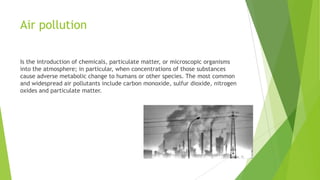
Air pollution
Is the introduction of chemicals, particulate matter, or microscopic organisms
into the atmosphere; in particular, when concentrations of those substances
cause adverse metabolic change to humans or other species. The most common
and widespread air pollutants include carbon monoxide, sulfur dioxide, nitrogen
oxides and particulate matter.
Light pollution
Is the intrusion of unwanted or unneeded artificial light into a man-made or
natural environment. A variety of somewhat separate phenomena comprise the
overall issue of pollution due to excess artificial light: Overillumination, glare, light trespass and skyglow. Adverse impacts of light pollution
include human annoyance, interference with ecosystems, human health
effects, interference with astronomical observation and wasteful consumption of
energy.
Thermal pollution
Is the act of altering the temperature of a natural water body, which may be a
river, lake or ocean environment. This condition chiefly arises from the waste
heat generated by an industrial process such as certain power generation plants.
Source:
http://www.eoearth.org/view/article/169860/
http://www.eoearth.org/view/article/156599/
http://www.eoearth.org/view/article/154247/
http://www.eoearth.org/view/article/169860/
http://www.eoearth.org/view/article/156920/

The pollution

  • 1.
  • 2.
    The pollution inthe enviroment The pollution is an international journal that seeks to publish papers that report results from original, novel research that addresses significant environmental pollution issues and problems and contribute new knowledge to science. The pollution present in some place:  In the land  In the water  In the air  In the light  In the thermal
  • 3.
    Land pollution Is thedegradation of earth's land surfaces often caused by human activities and its misuse. Haphazard disposal of urban and industrial wastes, exploitation of minerals, and improper use of soil by inadequate agricultural practices are a few of the contributing factors.
  • 4.
    Water pollution Is thecontamination of natural water bodies by chemical, physical, radioactive or pathogenic microbial substances. Adverse alteration of water quality presently produces large scale illness and deaths, accounting for approximately 50 million deaths per year worldwide, most of these deaths occurring in Africa and Asia. In China, for example, about 75 percent of the population (or 1.1 billion people) are without access to unpolluted drinking water, according to China's own standards. Widespread consequences of water pollution upon ecosystems include species mortality, biodiversity reduction and loss of ecosystem services.
  • 5.
    Air pollution Is theintroduction of chemicals, particulate matter, or microscopic organisms into the atmosphere; in particular, when concentrations of those substances cause adverse metabolic change to humans or other species. The most common and widespread air pollutants include carbon monoxide, sulfur dioxide, nitrogen oxides and particulate matter.
  • 6.
    Light pollution Is theintrusion of unwanted or unneeded artificial light into a man-made or natural environment. A variety of somewhat separate phenomena comprise the overall issue of pollution due to excess artificial light: Overillumination, glare, light trespass and skyglow. Adverse impacts of light pollution include human annoyance, interference with ecosystems, human health effects, interference with astronomical observation and wasteful consumption of energy.
  • 7.
    Thermal pollution Is theact of altering the temperature of a natural water body, which may be a river, lake or ocean environment. This condition chiefly arises from the waste heat generated by an industrial process such as certain power generation plants.
  • 8.