Entity Relationship Diagrams
Introduction to Entity-Relationship
Modeling
• Notation makes use of three primary constructs
– Data entities
– Relationships
– Attributes
• Entity-Relationship (E-R) Diagram
– The detailed, logical representation of the entities,
associations and also data elements with an organization
or business.
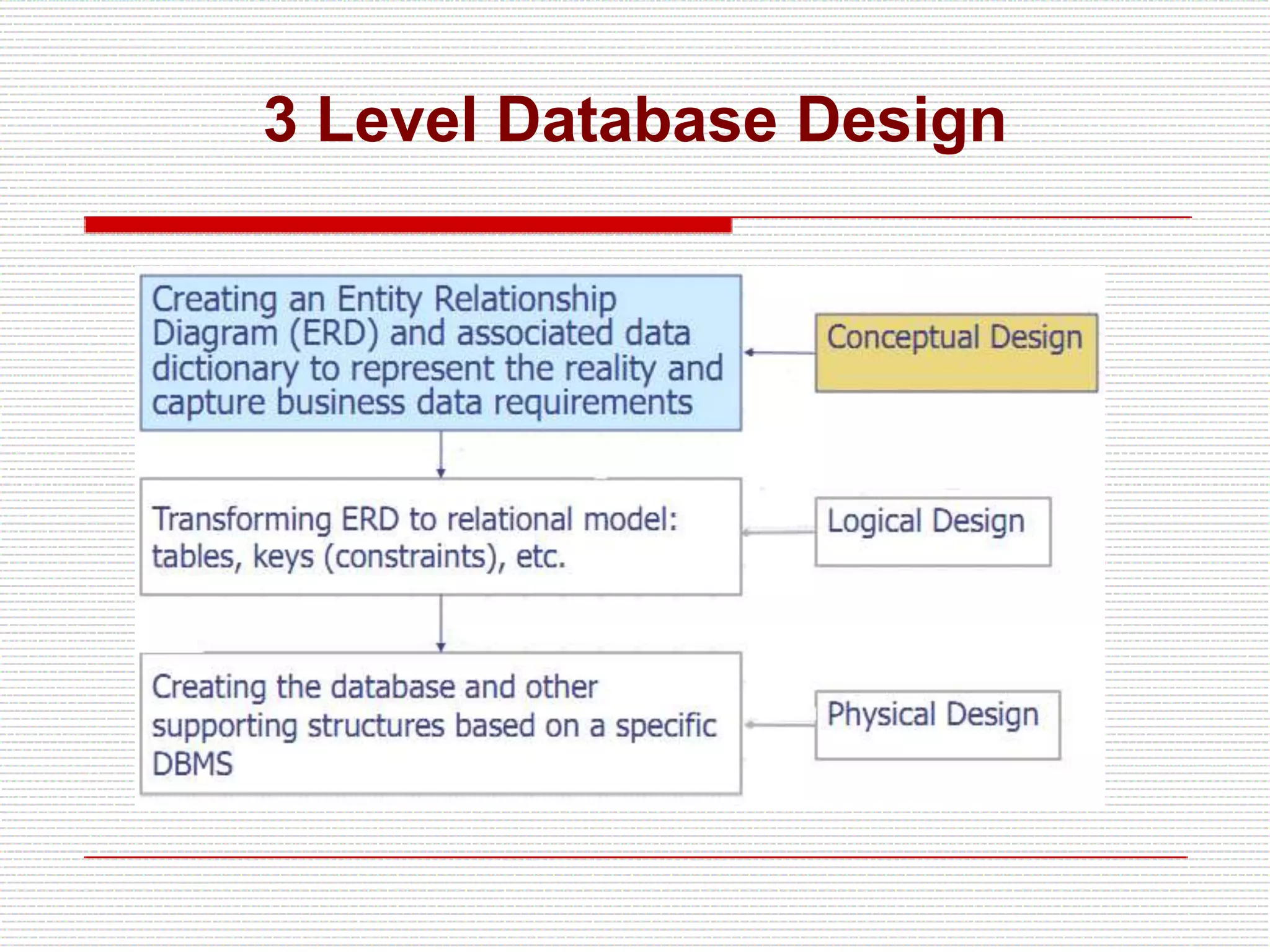
3 Level Database Design
Key Terms
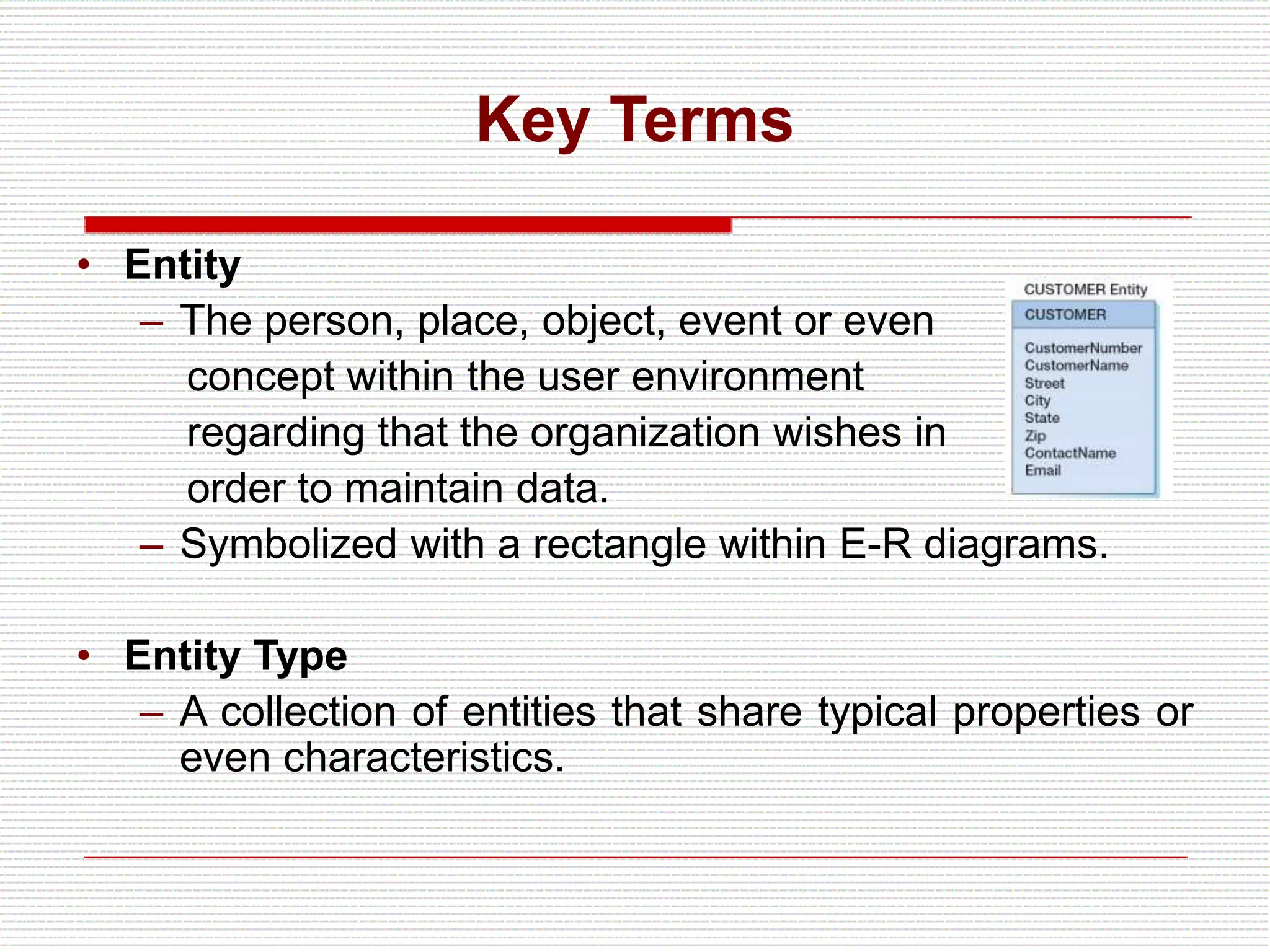
• Entity
– The person, place, object, event or even
concept within the user environment
regarding that the organization wishes in
order to maintain data.
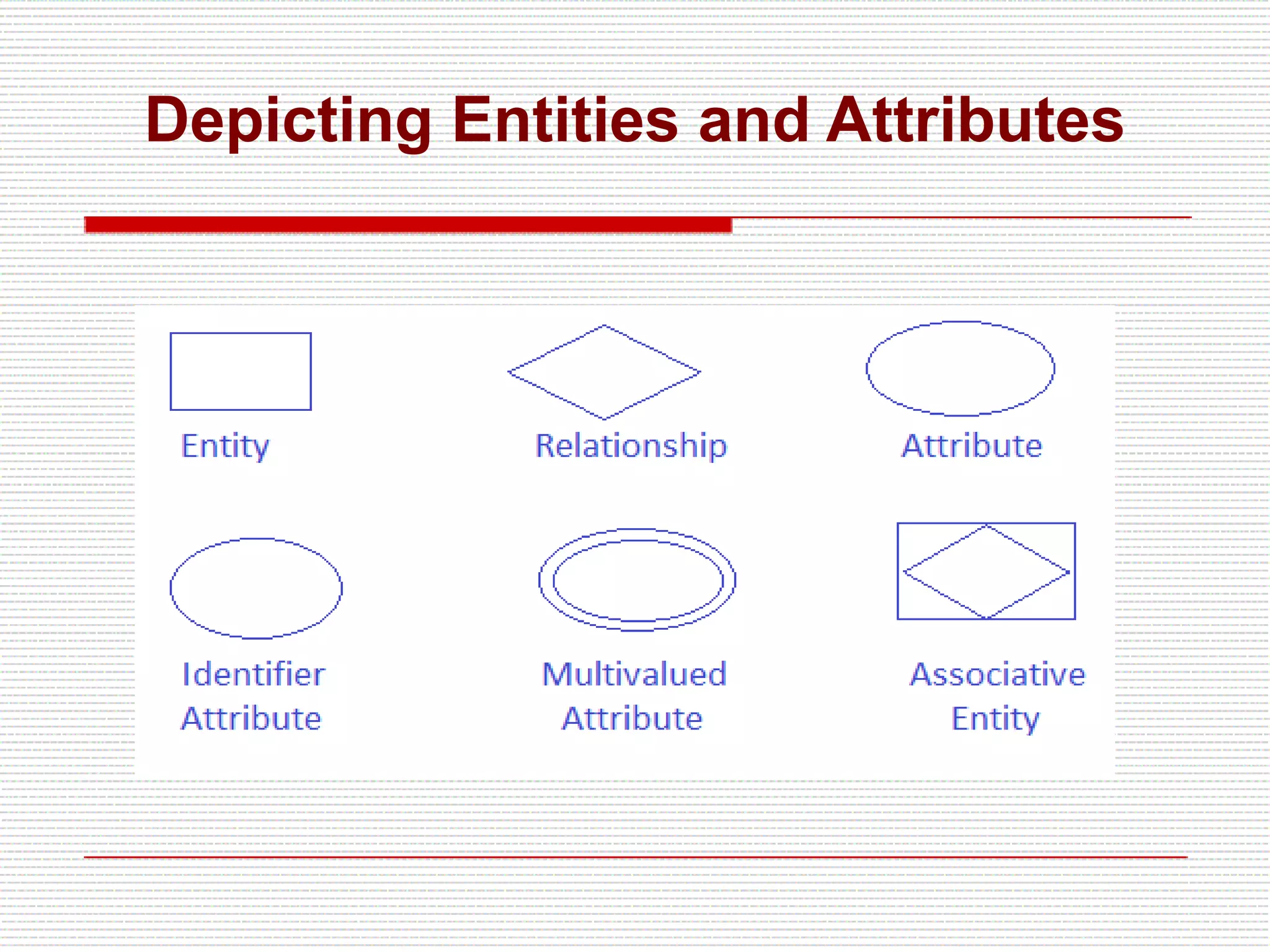
– Symbolized with a rectangle within E-R diagrams.
• Entity Type
– A collection of entities that share typical properties or
even characteristics.
Depicting Entities and Attributes
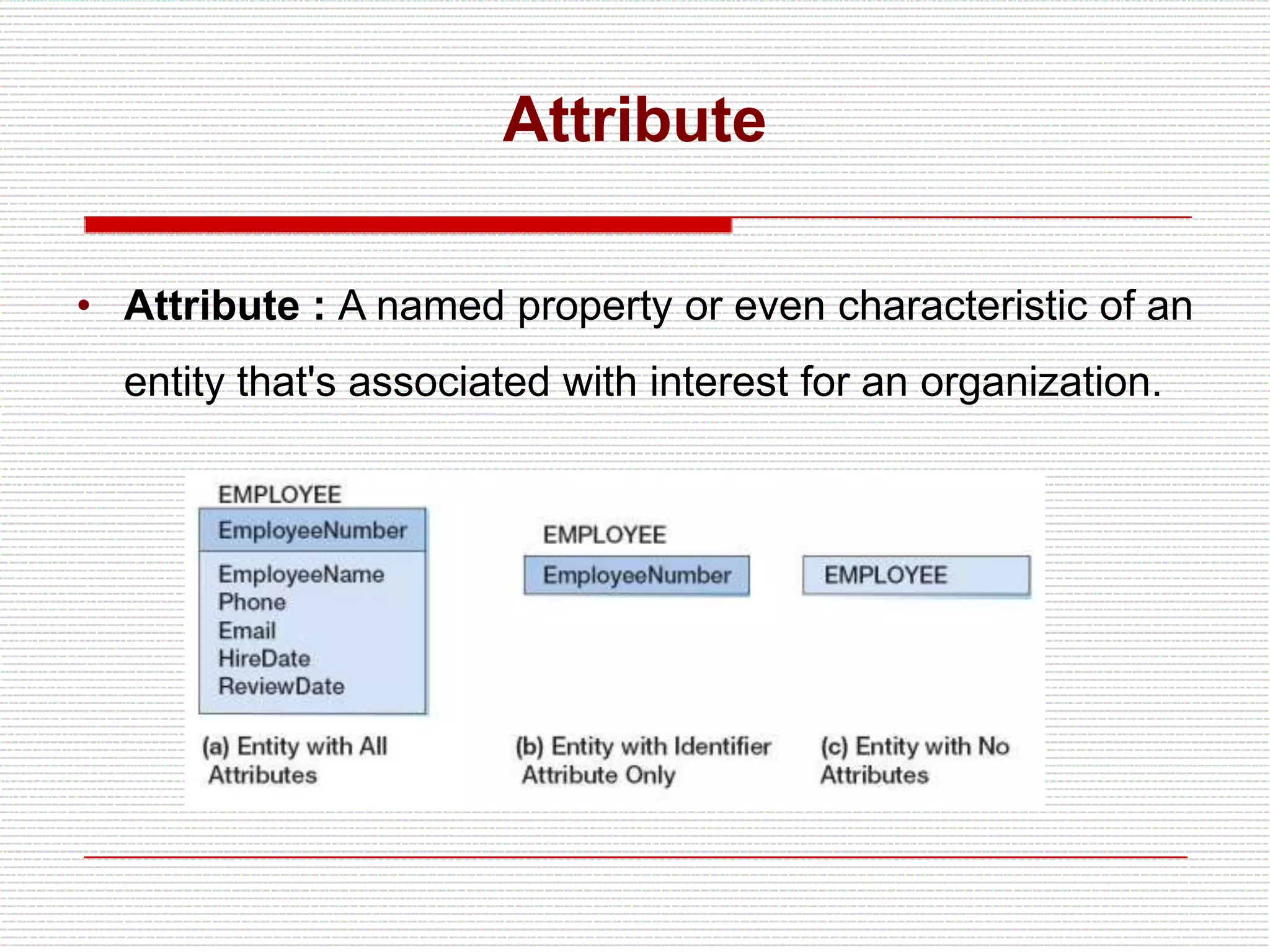
Attribute
• Attribute : A named property or even characteristic of an
entity that's associated with interest for an organization.
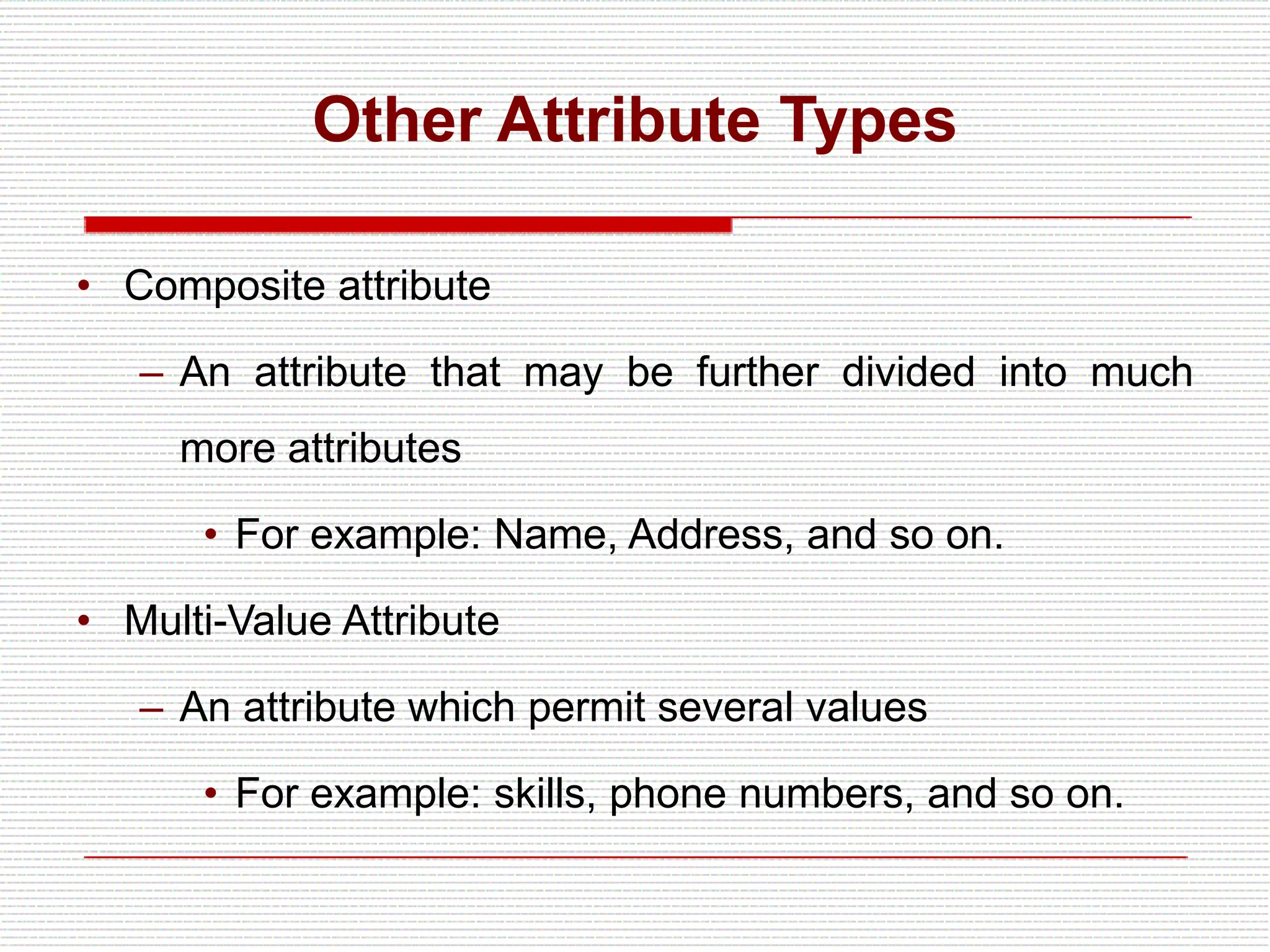
Other Attribute Types
• Composite attribute
– An attribute that may be further divided into much
more attributes
• For example: Name, Address, and so on.
• Multi-Value Attribute
– An attribute which permit several values
• For example: skills, phone numbers, and so on.
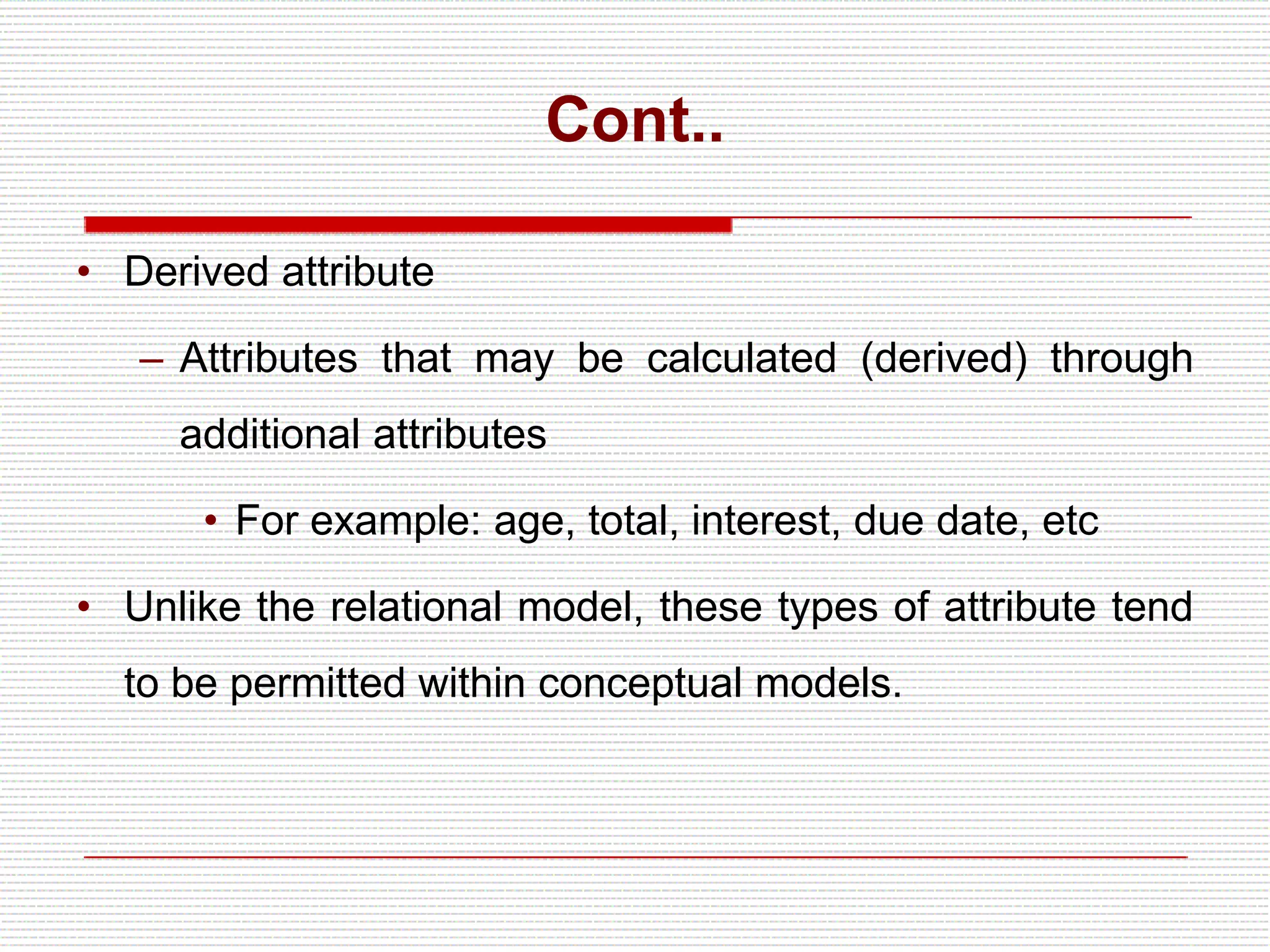
Cont..
• Derived attribute
– Attributes that may be calculated (derived) through
additional attributes
• For example: age, total, interest, due date, etc
• Unlike the relational model, these types of attribute tend
to be permitted within conceptual models.
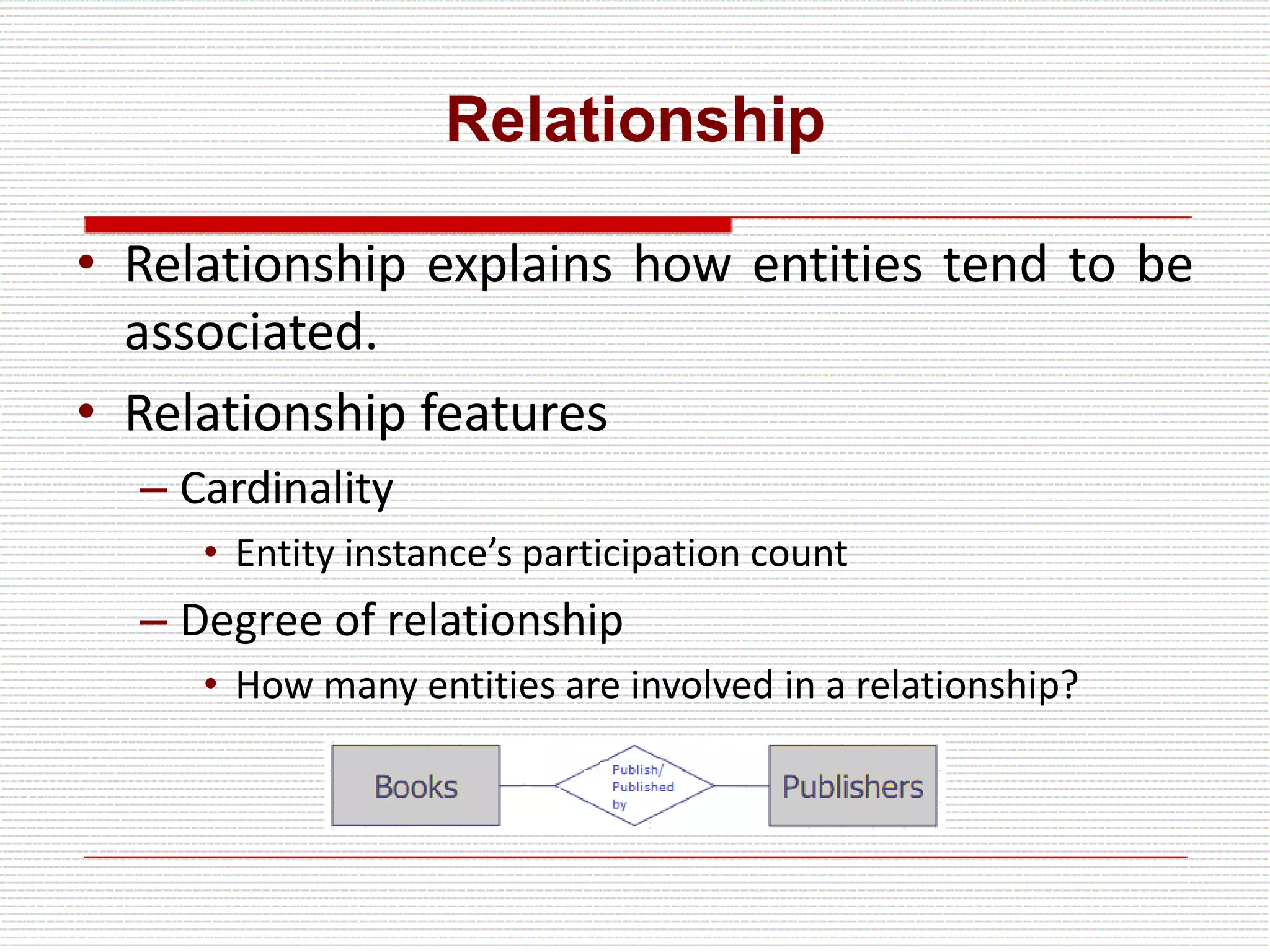
Relationship
• Relationship explains how entities tend to be
associated.
• Relationship features
– Cardinality
• Entity instance’s participation count
– Degree of relationship
• How many entities are involved in a relationship?
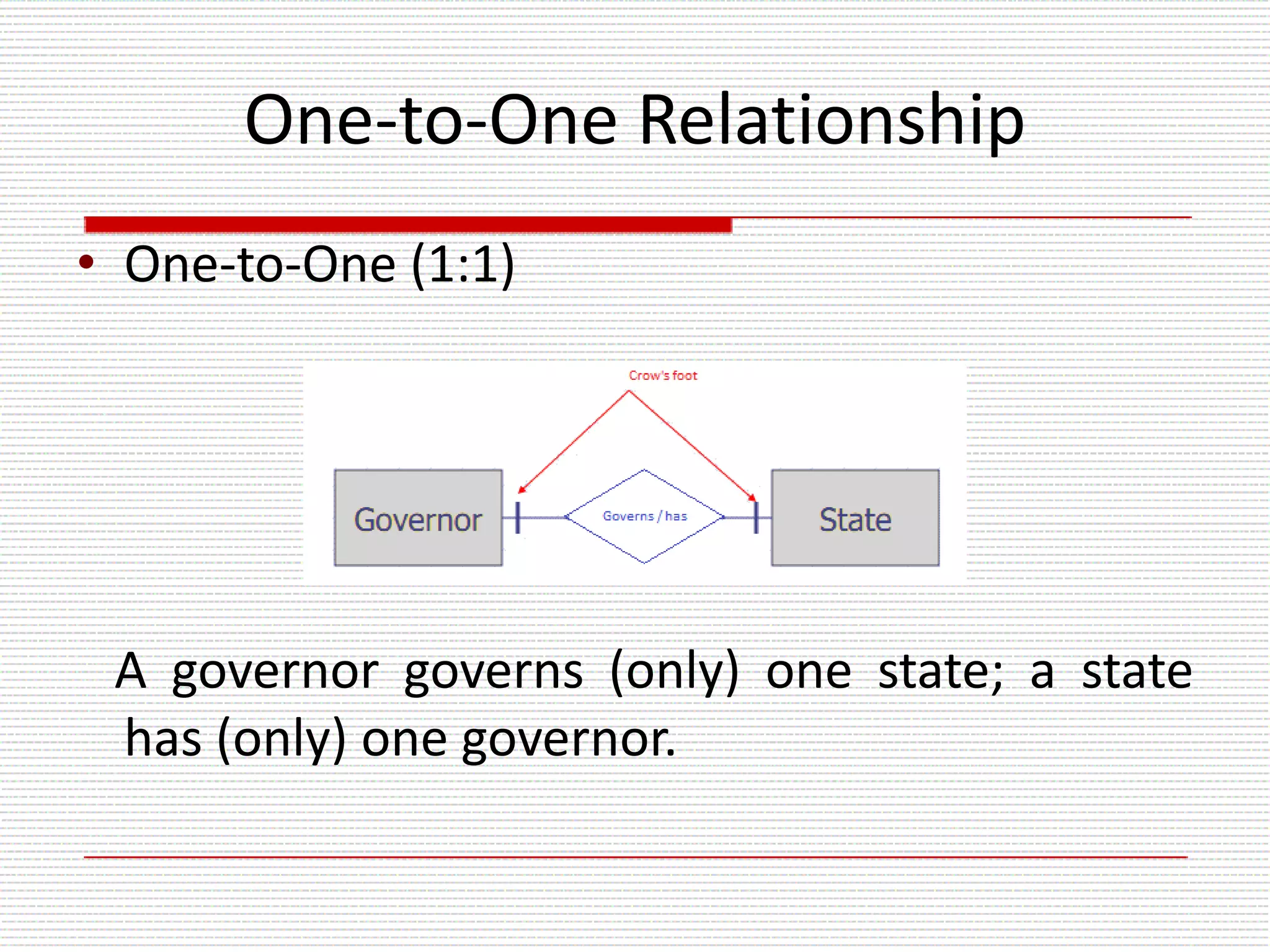
One-to-One Relationship
• One-to-One (1:1)
A governor governs (only) one state; a state
has (only) one governor.
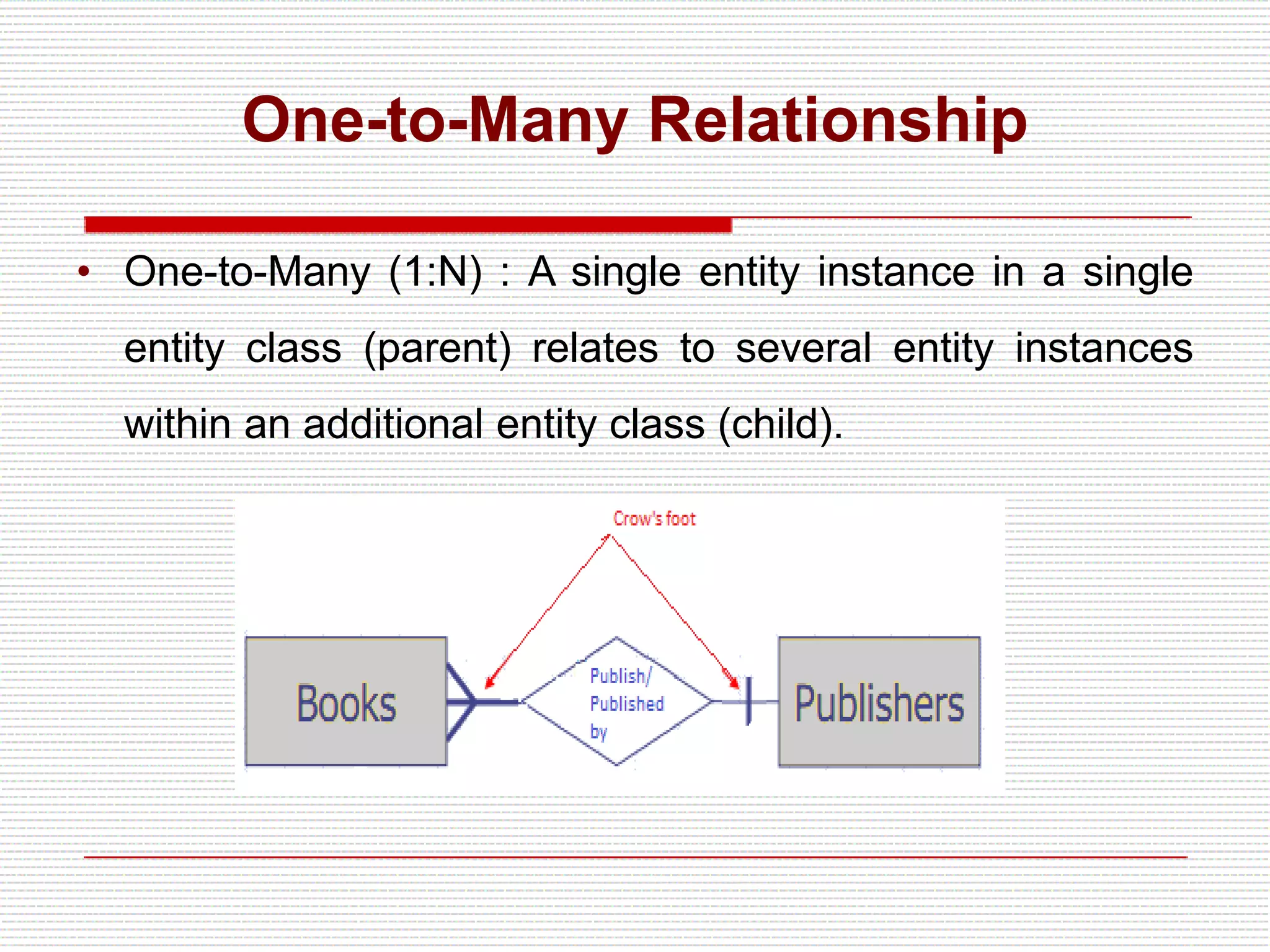
One-to-Many Relationship
• One-to-Many (1:N) : A single entity instance in a single
entity class (parent) relates to several entity instances
within an additional entity class (child).
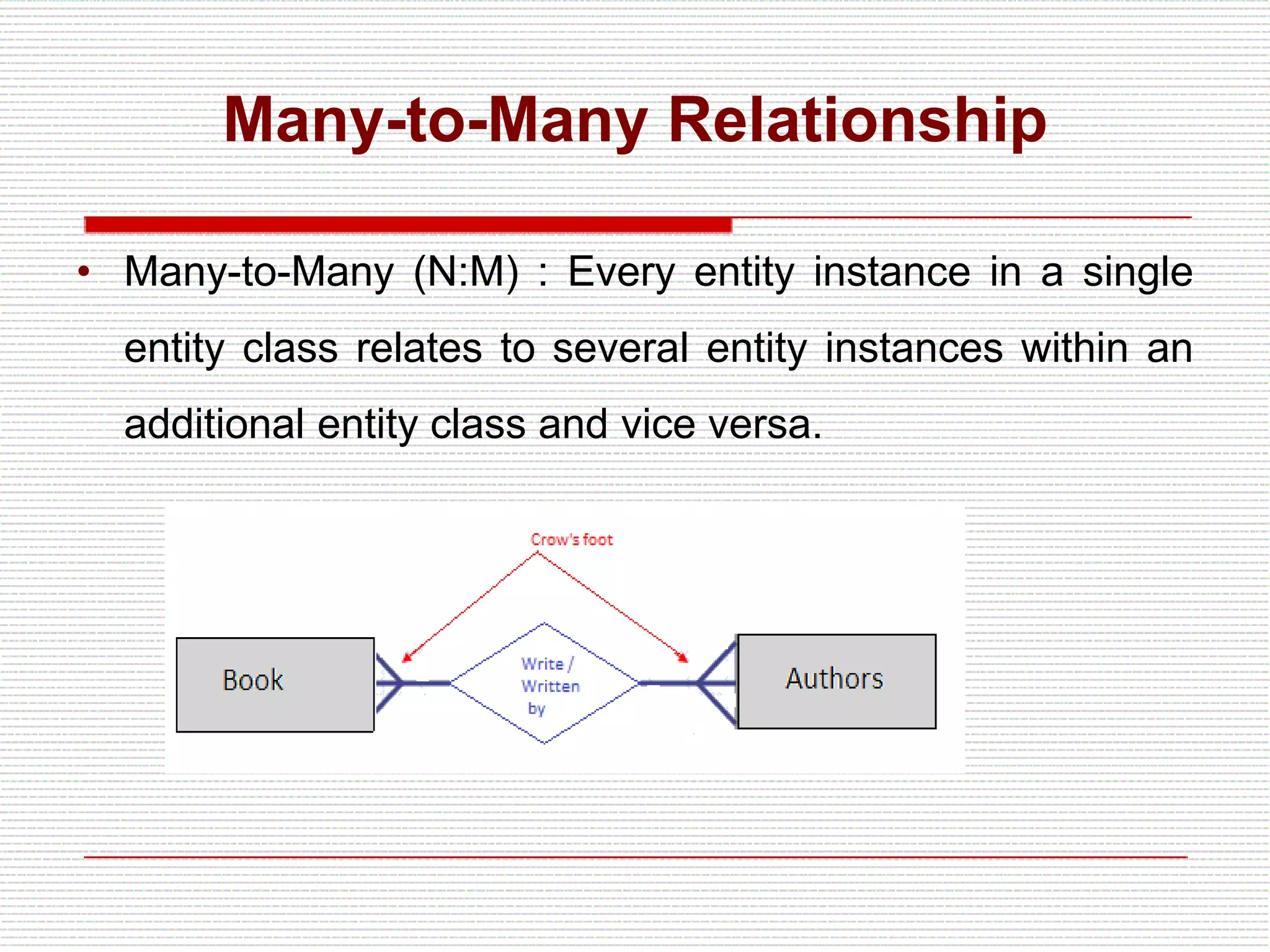
Many-to-Many Relationship
• Many-to-Many (N:M) : Every entity instance in a single
entity class relates to several entity instances within an
additional entity class and vice versa.
Naming and Defining Relationships
• Relationship name is a verb phrase.
• Avoid vague names
• Guidelines with regard to determining associations
– Definition explains what action is being taken as well
as the reason why it is necessary
– Provide good examples in order to clarify the action
– Optional participation should be described
– Clarify causes of any kind of explicit maximum
cardinality
Naming and Defining Relationships
• Guidelines with regard to determining relationships
– Clarify any kind of restrictions on participation within
the relationship
– Clarify extent of the history that is kept within the
relationship
– Clarify whether an entity instance involved with the
relationship instance can transfer participation to
another relationship instance
Contact us
Thank You
Email: support@myassignmenthelp.net
http://www.myassignmenthelp.net/uml-assignment-help.php

Entity relationship-diagrams

  • 1.
  • 2.
    Introduction to Entity-Relationship Modeling •Notation makes use of three primary constructs – Data entities – Relationships – Attributes • Entity-Relationship (E-R) Diagram – The detailed, logical representation of the entities, associations and also data elements with an organization or business.
  • 3.
  • 4.
    Key Terms • Entity –The person, place, object, event or even concept within the user environment regarding that the organization wishes in order to maintain data. – Symbolized with a rectangle within E-R diagrams. • Entity Type – A collection of entities that share typical properties or even characteristics.
  • 5.
  • 6.
    Attribute • Attribute :A named property or even characteristic of an entity that's associated with interest for an organization.
  • 7.
    Other Attribute Types •Composite attribute – An attribute that may be further divided into much more attributes • For example: Name, Address, and so on. • Multi-Value Attribute – An attribute which permit several values • For example: skills, phone numbers, and so on.
  • 8.
    Cont.. • Derived attribute –Attributes that may be calculated (derived) through additional attributes • For example: age, total, interest, due date, etc • Unlike the relational model, these types of attribute tend to be permitted within conceptual models.
  • 9.
    Relationship • Relationship explainshow entities tend to be associated. • Relationship features – Cardinality • Entity instance’s participation count – Degree of relationship • How many entities are involved in a relationship?
  • 10.
    One-to-One Relationship • One-to-One(1:1) A governor governs (only) one state; a state has (only) one governor.
  • 11.
    One-to-Many Relationship • One-to-Many(1:N) : A single entity instance in a single entity class (parent) relates to several entity instances within an additional entity class (child).
  • 12.
    Many-to-Many Relationship • Many-to-Many(N:M) : Every entity instance in a single entity class relates to several entity instances within an additional entity class and vice versa.
  • 13.
    Naming and DefiningRelationships • Relationship name is a verb phrase. • Avoid vague names • Guidelines with regard to determining associations – Definition explains what action is being taken as well as the reason why it is necessary – Provide good examples in order to clarify the action – Optional participation should be described – Clarify causes of any kind of explicit maximum cardinality
  • 14.
    Naming and DefiningRelationships • Guidelines with regard to determining relationships – Clarify any kind of restrictions on participation within the relationship – Clarify extent of the history that is kept within the relationship – Clarify whether an entity instance involved with the relationship instance can transfer participation to another relationship instance
  • 15.
    Contact us Thank You Email:support@myassignmenthelp.net http://www.myassignmenthelp.net/uml-assignment-help.php