Prog. Fundamentals I:Introduction to C++ / Slide 1
Programming Assignment Help
By myassignmenthelp
Prog. Fundamentals I:Introduction to C++ / Slide 2
Programming Languages
Machine Language
Assembly Language
High level Language
Prog. Fundamentals I:Introduction to C++ / Slide 3
Machine Language
In the earliest days of computers, the only
programming languages accessible have been
machine languages.
The fundamental language with the computer’s
processor, also known as Low Level Language.
All programs are converted into machine just before
they could be executed.
Contains combination regarding 0’s and also 1’s in
which symbolize high and also low electrical voltage.
Prog. Fundamentals I:Introduction to C++ / Slide 4
Assembly Language
The next evolution in programming came with the
idea of replacing binary code with regard to
instruction as well as addresses along with
symbols or even mnemonics. Simply because they
used symbols, these languages were first known
as symbolic languages
A low level language that is similar to machine
language.
Uses symbolic operation code in order to signify
the actual machine operation code.
Prog. Fundamentals I:Introduction to C++ / Slide 5
High Level Language
Assembly languages enhanced programming efficiency,
they still required programmers to concentrate on the
hardware they were using. Working with symbolic
languages had been additionally really tedious, because
each machine instruction needed to be separately coded.
The actual need to enhance programmer efficiency and to
change the focus from the computer to the problem being
solved led to the development associated with high-level
languages.
Computer languages that are better to understand..
Uses English like statements.
Examples are C ++, Visual Basic, Pascal, Fortran and …....
Prog. Fundamentals I:Introduction to C++ / Slide 6
Programming Language Concepts
What is a programming language?
The reason why exist a lot of programming
languages?
What are the kinds of programming languages?
Can the entire world will need new language?
Prog. Fundamentals I:Introduction to C++ / Slide 7
What is Programming Language?
A programming language is a set of rules that
provides with informing some type of computer
exactly what operations to perform. A
programming language is a set associated with
rules with regard to communicating an algorithm.
It provides a linguistic framework with regard to
explaining computations.
Prog. Fundamentals I:Introduction to C++ / Slide 8
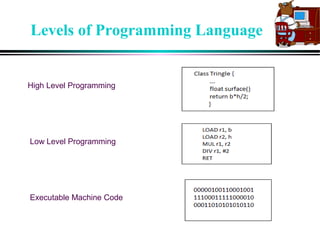
Levels of Programming Language
High Level Programming
Low Level Programming
Executable Machine Code
Prog. Fundamentals I:Introduction to C++ / Slide 9
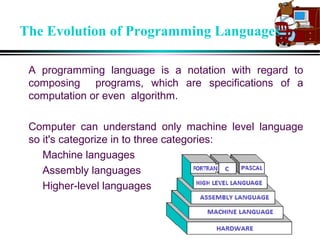
The Evolution of Programming Languages
A programming language is a notation with regard to
composing programs, which are specifications of a
computation or even algorithm.
Computer can understand only machine level language
so it's categorize in to three categories:
Machine languages
Assembly languages
Higher-level languages
Prog. Fundamentals I:Introduction to C++ / Slide 10
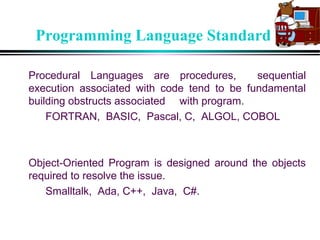
Programming Language Standard
Procedural Languages are procedures, sequential
execution associated with code tend to be fundamental
building obstructs associated with program.
FORTRAN, BASIC, Pascal, C, ALGOL, COBOL
Object-Oriented Program is designed around the objects
required to resolve the issue.
Smalltalk, Ada, C++, Java, C#.
Prog. Fundamentals I:Introduction to C++ / Slide 11
Cont….
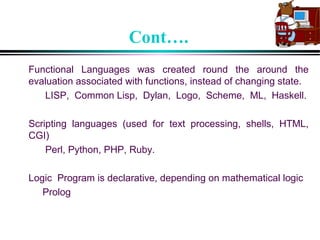
Functional Languages was created round the around the
evaluation associated with functions, instead of changing state.
LISP, Common Lisp, Dylan, Logo, Scheme, ML, Haskell.
Scripting languages (used for text processing, shells, HTML,
CGI)
Perl, Python, PHP, Ruby.
Logic Program is declarative, depending on mathematical logic
Prolog
Prog. Fundamentals I:Introduction to C++ / Slide 12
What does programming look like?
Here are some examples of an instruction to print the
word “HI”
Logo PR [HI]
JavaScript alert(“HI”);
FORTRAN PRINT “HI”
BASIC PRINT “HI”
COBOL DISPLAY ‘HI’.
C++ printf(“HI”);
Pascal WRITELN(‘HI’);
Assembly XPRNT MESSAGE1
Language MESSAGE1 DC ‘HI’
Prog. Fundamentals I:Introduction to C++ / Slide 13
TO Get help in your programing
assignments visit
http://www.myassignmenthelp.net/programming-assignment-help.php

Programming assignment help

  • 1.
    Prog. Fundamentals I:Introductionto C++ / Slide 1 Programming Assignment Help By myassignmenthelp
  • 2.
    Prog. Fundamentals I:Introductionto C++ / Slide 2 Programming Languages Machine Language Assembly Language High level Language
  • 3.
    Prog. Fundamentals I:Introductionto C++ / Slide 3 Machine Language In the earliest days of computers, the only programming languages accessible have been machine languages. The fundamental language with the computer’s processor, also known as Low Level Language. All programs are converted into machine just before they could be executed. Contains combination regarding 0’s and also 1’s in which symbolize high and also low electrical voltage.
  • 4.
    Prog. Fundamentals I:Introductionto C++ / Slide 4 Assembly Language The next evolution in programming came with the idea of replacing binary code with regard to instruction as well as addresses along with symbols or even mnemonics. Simply because they used symbols, these languages were first known as symbolic languages A low level language that is similar to machine language. Uses symbolic operation code in order to signify the actual machine operation code.
  • 5.
    Prog. Fundamentals I:Introductionto C++ / Slide 5 High Level Language Assembly languages enhanced programming efficiency, they still required programmers to concentrate on the hardware they were using. Working with symbolic languages had been additionally really tedious, because each machine instruction needed to be separately coded. The actual need to enhance programmer efficiency and to change the focus from the computer to the problem being solved led to the development associated with high-level languages. Computer languages that are better to understand.. Uses English like statements. Examples are C ++, Visual Basic, Pascal, Fortran and …....
  • 6.
    Prog. Fundamentals I:Introductionto C++ / Slide 6 Programming Language Concepts What is a programming language? The reason why exist a lot of programming languages? What are the kinds of programming languages? Can the entire world will need new language?
  • 7.
    Prog. Fundamentals I:Introductionto C++ / Slide 7 What is Programming Language? A programming language is a set of rules that provides with informing some type of computer exactly what operations to perform. A programming language is a set associated with rules with regard to communicating an algorithm. It provides a linguistic framework with regard to explaining computations.
  • 8.
    Prog. Fundamentals I:Introductionto C++ / Slide 8 Levels of Programming Language High Level Programming Low Level Programming Executable Machine Code
  • 9.
    Prog. Fundamentals I:Introductionto C++ / Slide 9 The Evolution of Programming Languages A programming language is a notation with regard to composing programs, which are specifications of a computation or even algorithm. Computer can understand only machine level language so it's categorize in to three categories: Machine languages Assembly languages Higher-level languages
  • 10.
    Prog. Fundamentals I:Introductionto C++ / Slide 10 Programming Language Standard Procedural Languages are procedures, sequential execution associated with code tend to be fundamental building obstructs associated with program. FORTRAN, BASIC, Pascal, C, ALGOL, COBOL Object-Oriented Program is designed around the objects required to resolve the issue. Smalltalk, Ada, C++, Java, C#.
  • 11.
    Prog. Fundamentals I:Introductionto C++ / Slide 11 Cont…. Functional Languages was created round the around the evaluation associated with functions, instead of changing state. LISP, Common Lisp, Dylan, Logo, Scheme, ML, Haskell. Scripting languages (used for text processing, shells, HTML, CGI) Perl, Python, PHP, Ruby. Logic Program is declarative, depending on mathematical logic Prolog
  • 12.
    Prog. Fundamentals I:Introductionto C++ / Slide 12 What does programming look like? Here are some examples of an instruction to print the word “HI” Logo PR [HI] JavaScript alert(“HI”); FORTRAN PRINT “HI” BASIC PRINT “HI” COBOL DISPLAY ‘HI’. C++ printf(“HI”); Pascal WRITELN(‘HI’); Assembly XPRNT MESSAGE1 Language MESSAGE1 DC ‘HI’
  • 13.
    Prog. Fundamentals I:Introductionto C++ / Slide 13 TO Get help in your programing assignments visit http://www.myassignmenthelp.net/programming-assignment-help.php