Enterprise Security Architecture
Business-driven security
April 2012
Page 2
Agenda
► Facilities and safety information
► Introduction
► Overview of the problem
► Introducing security architecture
► The SABSA approach
► A worked example
► Security architecture components
► Facilitated discussion
26 April 2012 ISACA Seminar– Enterprise Security Architecture
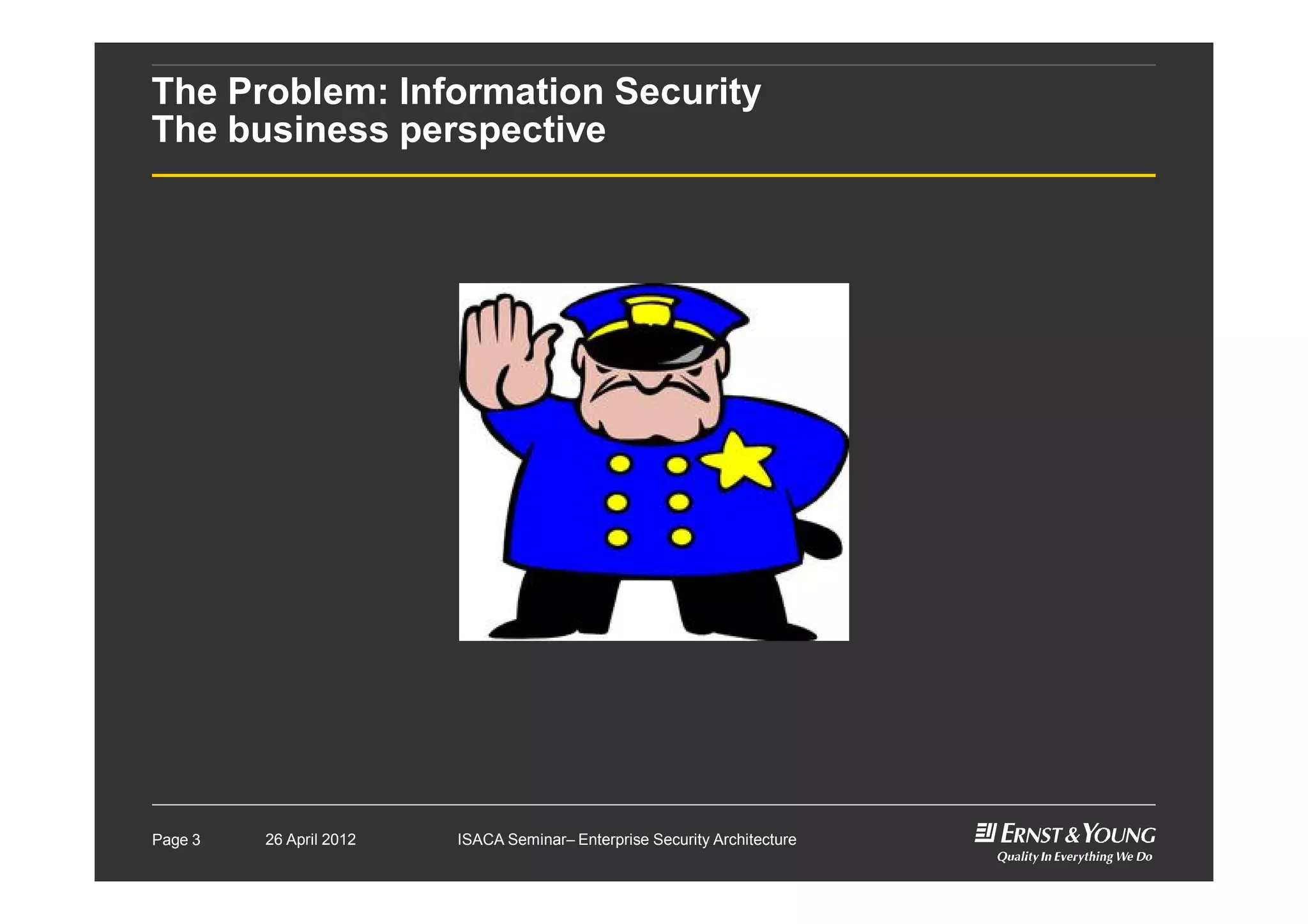
The Problem: Information Security
The business perspective
Page 3 26 April 2012 ISACA Seminar– Enterprise Security Architecture
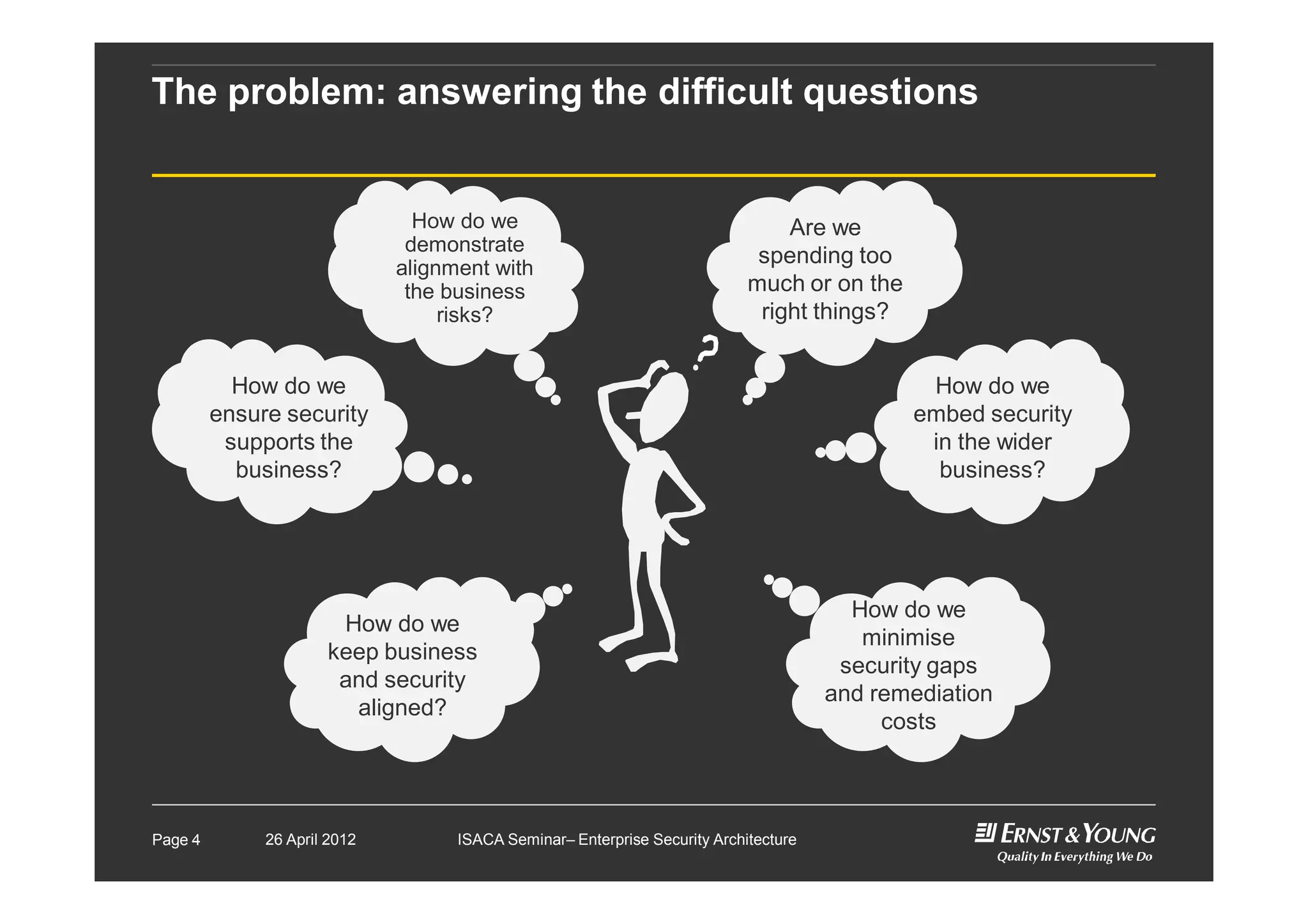
The problem: answering the difficult questions
How do we
ensure security
supports the
business?
How do we
demonstrate
alignment with
the business
risks?
Are we
spending too
much or on the
right things?
How do we
keep business
and security
aligned?
How do we
minimise
security gaps
and remediation
costs
How do we
embed security
in the wider
business?
Page 4 26 April 2012 ISACA Seminar– Enterprise Security Architecture
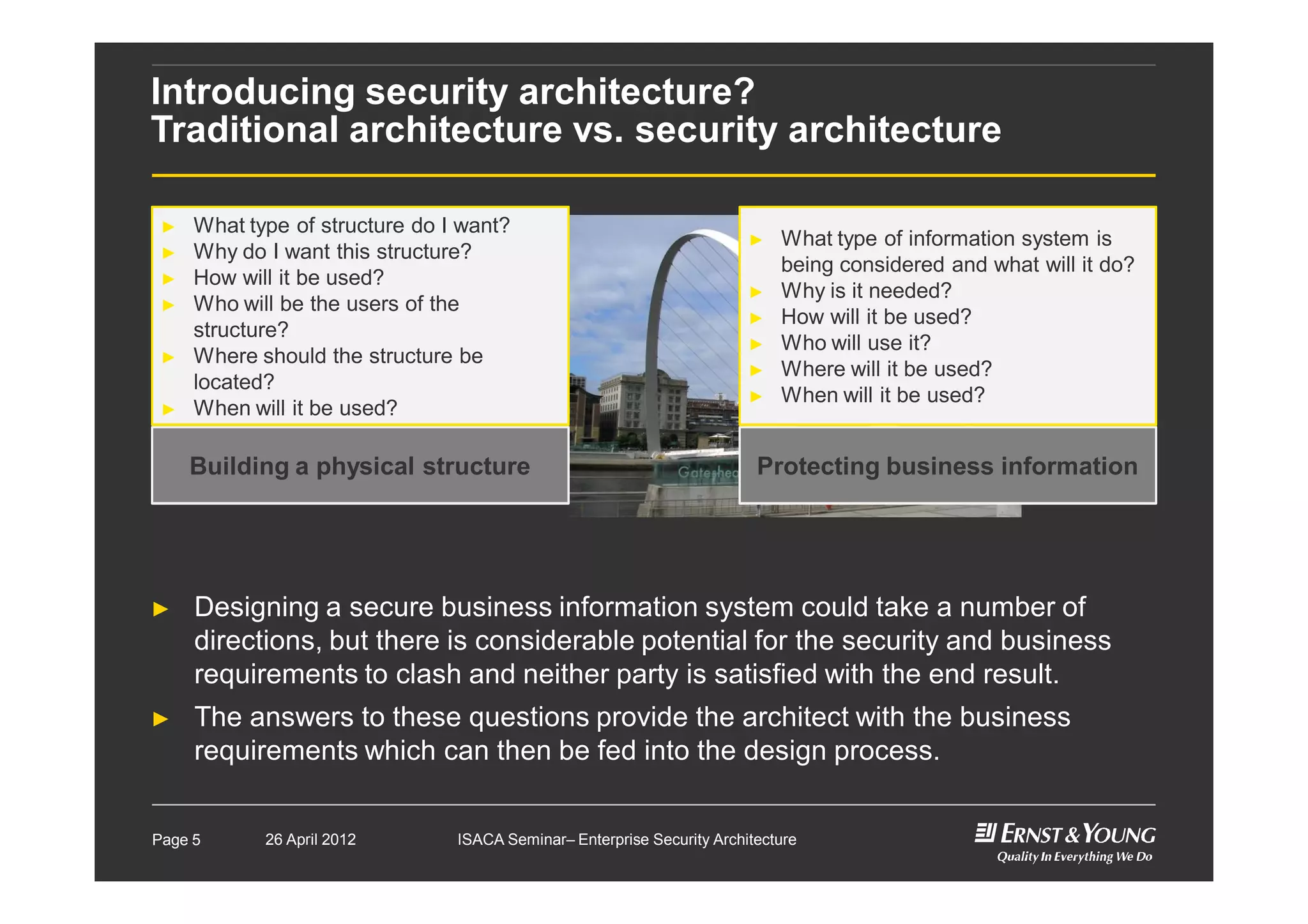
Introducing security architecture?
Traditional architecture vs. security architecture
► Designing a secure business information system could take a number of
directions, but there is considerable potential for the security and business
requirements to clash and neither party is satisfied with the end result.
► The answers to these questions provide the architect with the business
requirements which can then be fed into the design process.
► What type of structure do I want?
► Why do I want this structure?
► How will it be used?
► Who will be the users of the
structure?
► Where should the structure be
located?
► When will it be used?
Building a physical structure
► What type of information system is
being considered and what will it do?
► Why is it needed?
► How will it be used?
► Who will use it?
► Where will it be used?
► When will it be used?
Protecting business information
Page 5 26 April 2012 ISACA Seminar– Enterprise Security Architecture
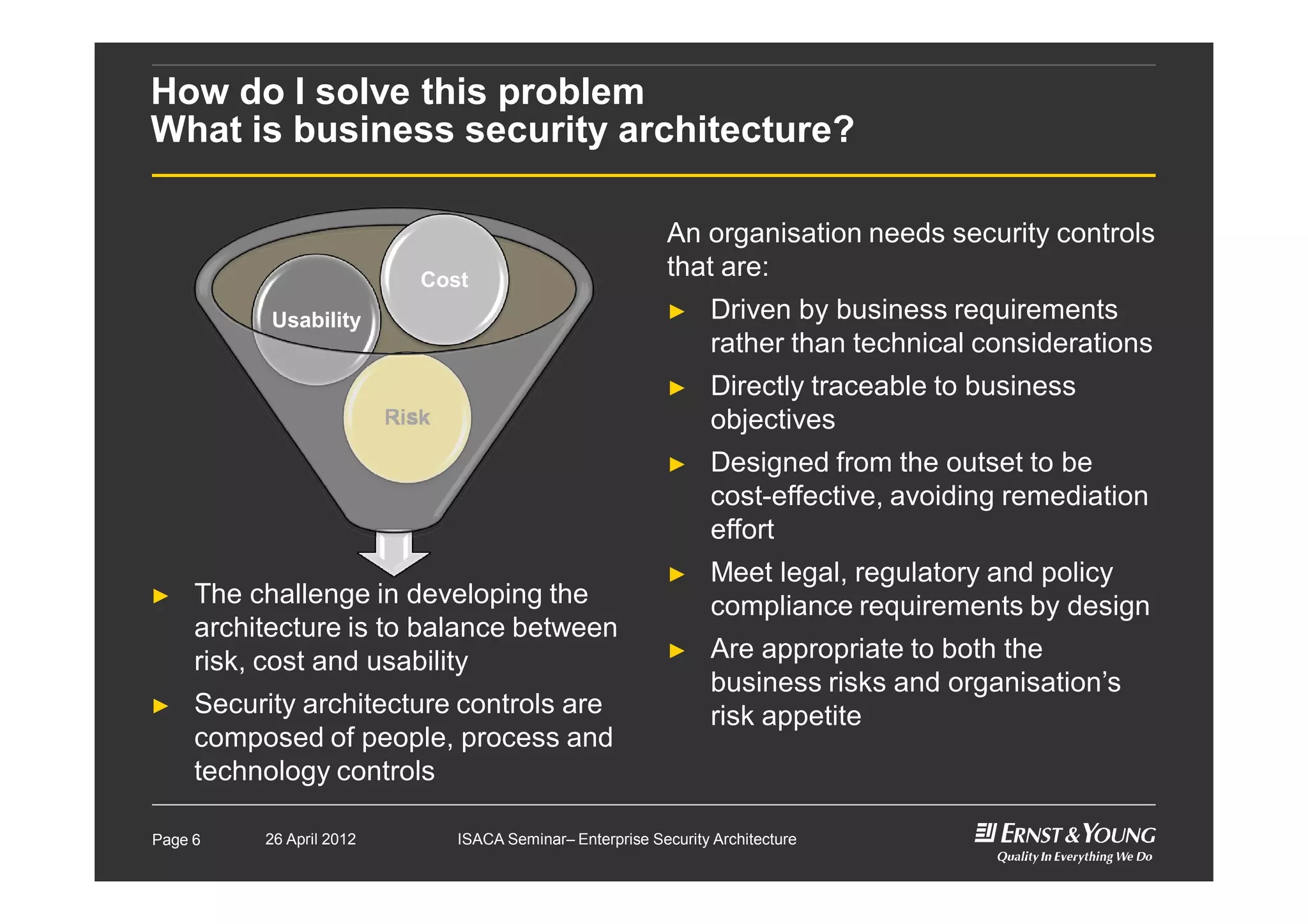
How do I solve this problem
What is business security architecture?
► The challenge in developing the
architecture is to balance between
risk, cost and usability
► Security architecture controls are
composed of people, process and
technology controls
An organisation needs security controls
that are:
► Driven by business requirements
rather than technical considerations
► Directly traceable to business
objectives
► Designed from the outset to be
cost-effective, avoiding remediation
effort
► Meet legal, regulatory and policy
compliance requirements by design
► Are appropriate to both the
business risks and organisation’s
risk appetite
Risk
Usability
Cost
Page 6 26 April 2012 ISACA Seminar– Enterprise Security Architecture
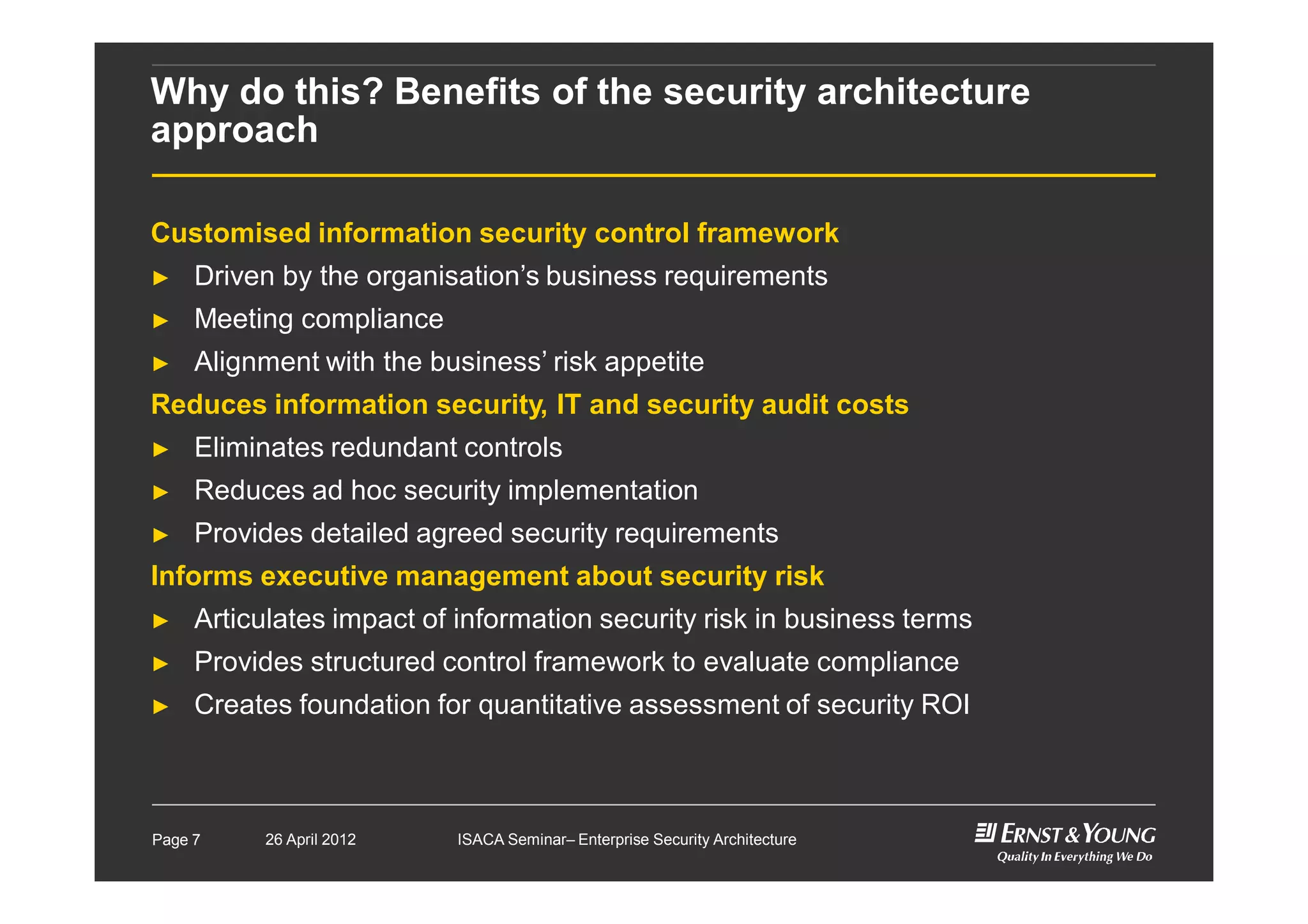
Why do this? Benefits of the security architecture
approach
Customised information security control framework
► Driven by the organisation’s business requirements
► Meeting compliance
► Alignment with the business’ risk appetite
Reduces information security, IT and security audit costs
► Eliminates redundant controls
► Reduces ad hoc security implementation
► Provides detailed agreed security requirements
Informs executive management about security risk
► Articulates impact of information security risk in business terms
► Provides structured control framework to evaluate compliance
► Creates foundation for quantitative assessment of security ROI
Page 7 26 April 2012 ISACA Seminar– Enterprise Security Architecture
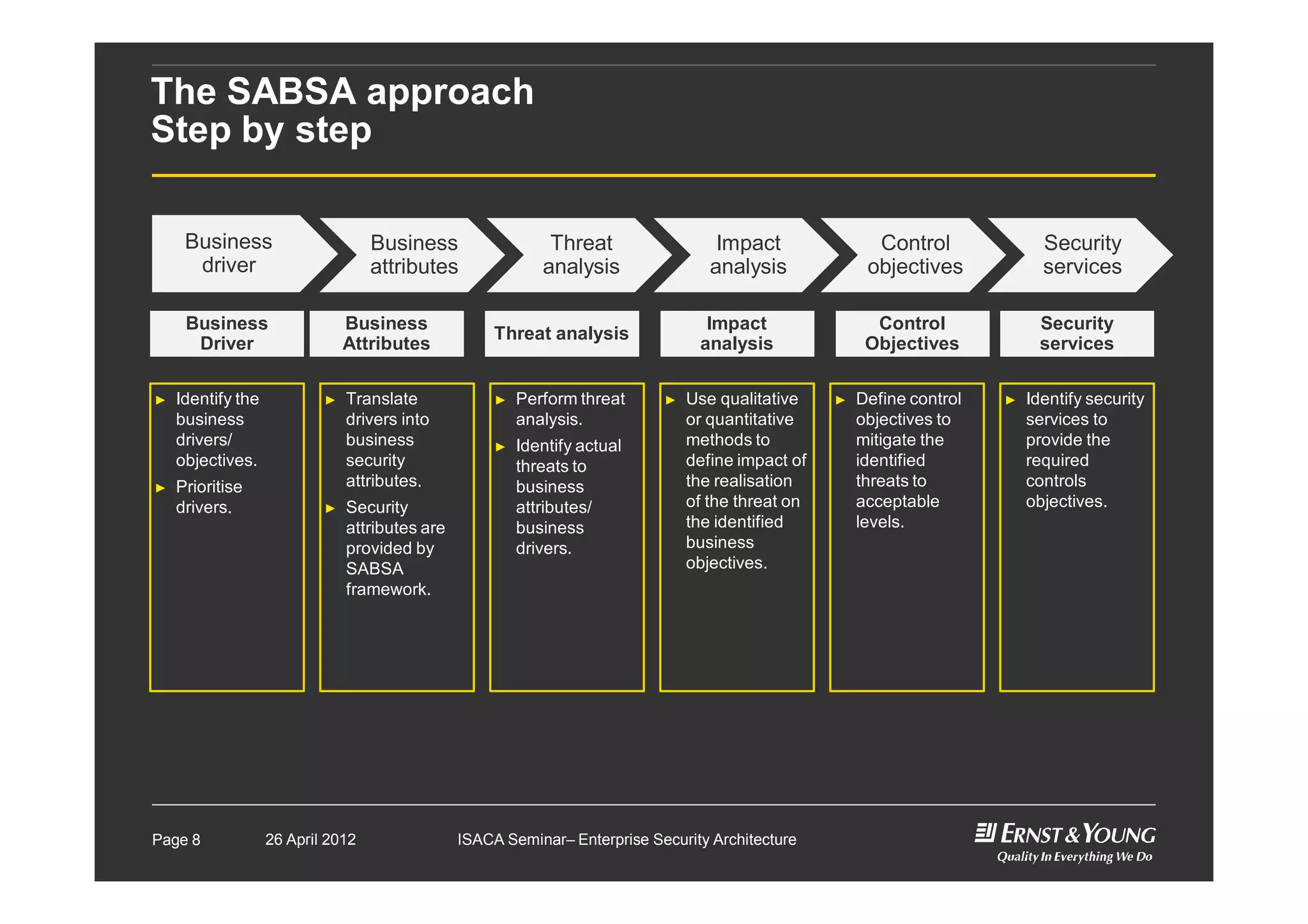
The SABSA approach
Step by step
Business
attributes
Threat
analysis
Impact
analysis
Control
objectives
Security
services
Business
Driver
► Identify the
business
drivers/
objectives.
► Prioritise
drivers.
Business
Attributes
► Translate
drivers into
business
security
attributes.
► Security
attributes are
provided by
SABSA
framework.
Threat analysis
► Perform threat
analysis.
► Identify actual
threats to
business
attributes/
business
drivers.
Impact
analysis
► Use qualitative
or quantitative
methods to
define impact of
the realisation
of the threat on
the identified
business
objectives.
Control
Objectives
► Define control
objectives to
mitigate the
identified
threats to
acceptable
levels.
Security
services
► Identify security
services to
provide the
required
controls
objectives.
Business
driver
Page 8 26 April 2012 ISACA Seminar– Enterprise Security Architecture
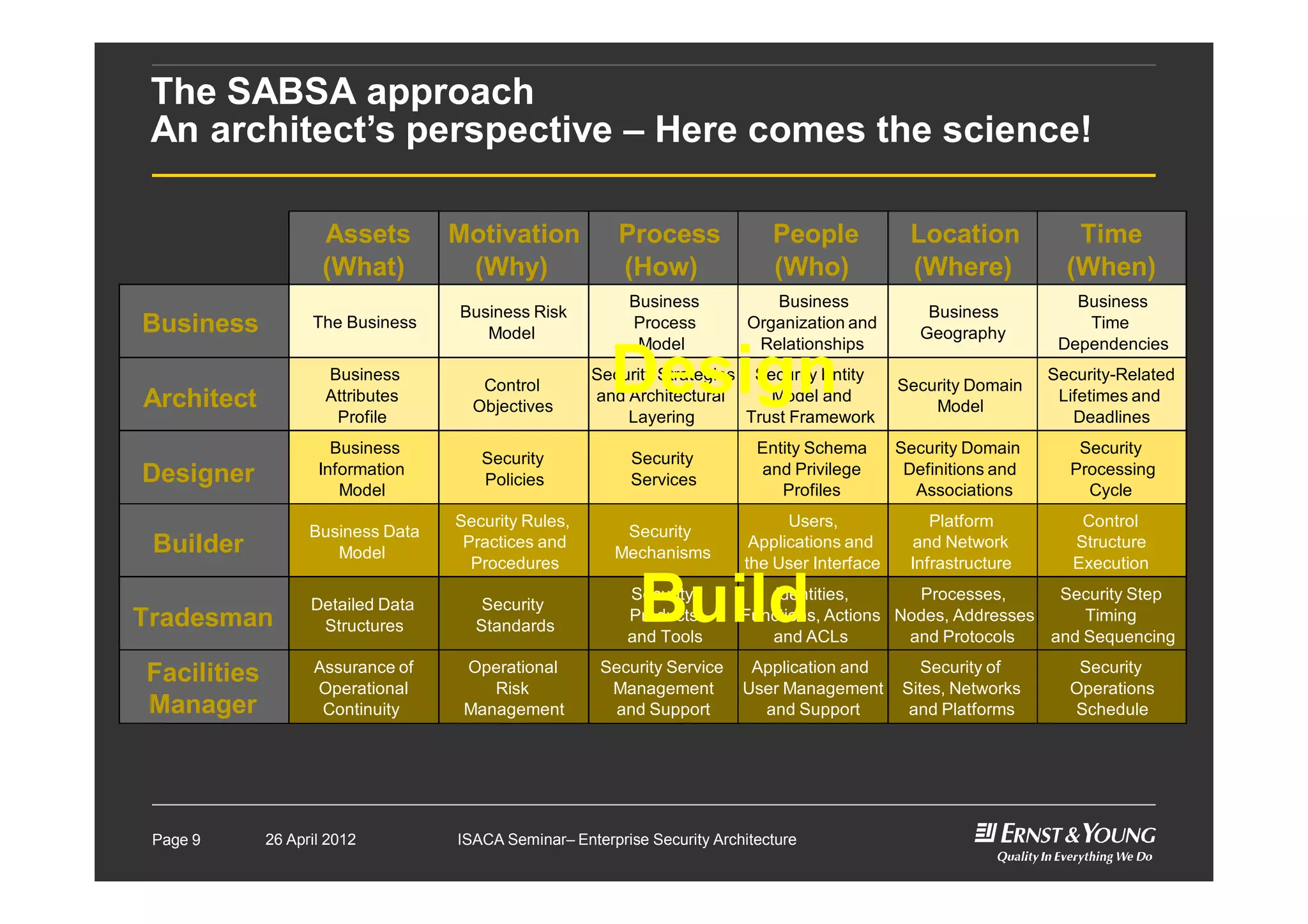
The SABSA approach
An architect’s perspective – Here comes the science!
Assets
(What)
Process
(How)
Location
(Where)
People
(Who)
Time
(When)
Motivation
(Why)
Contextual The Business
Business
Process
Model
Business
Geography
Business
Organization and
Relationships
Business
Time
Dependencies
Business Risk
Model
Conceptual
Business
Attributes
Profile
Security Strategies
and Architectural
Layering
Security Domain
Model
Security Entity
Model and
Trust Framework
Security-Related
Lifetimes and
Deadlines
Control
Objectives
Logical
Security
Services
Security Domain
Definitions and
Associations
Entity Schema
and Privilege
Profiles
Security
Processing
Cycle
Business
Information
Model
Security
Policies
Physical
Platform
and Network
Infrastructure
Users,
Applications and
the User Interface
Control
Structure
Execution
Business Data
Model
Security
Mechanisms
Security Rules,
Practices and
Procedures
Component
Processes,
Nodes, Addresses
and Protocols
Identities,
Functions, Actions
and ACLs
Security Step
Timing
and Sequencing
Detailed Data
Structures
Security
Products
and Tools
Security
Standards
Operational
Assurance of
Operational
Continuity
Security Service
Management
and Support
Security of
Sites, Networks
and Platforms
Application and
User Management
and Support
Security
Operations
Schedule
Operational
Risk
Management
Design
Build
Business
Architect
Designer
Builder
Tradesman
Facilities
Manager
26 April 2012 ISACA Seminar– Enterprise Security ArchitecturePage 9
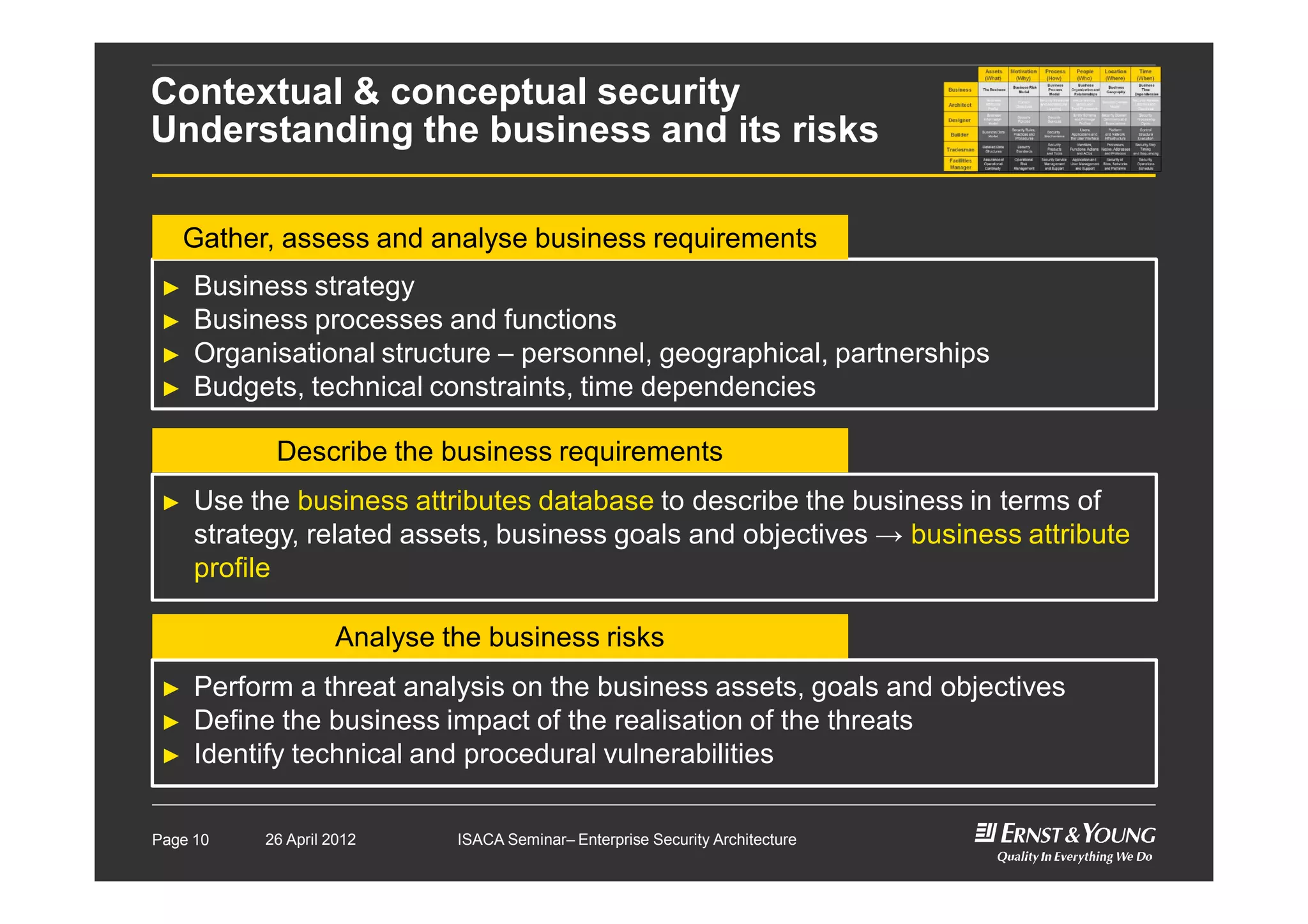
Contextual & conceptual security
Understanding the business and its risks
► Business strategy
► Business processes and functions
► Organisational structure – personnel, geographical, partnerships
► Budgets, technical constraints, time dependencies
► Use the business attributes database to describe the business in terms of
strategy, related assets, business goals and objectives → business attribute
profile
► Perform a threat analysis on the business assets, goals and objectives
► Define the business impact of the realisation of the threats
► Identify technical and procedural vulnerabilities
Gather, assess and analyse business requirements
Describe the business requirements
Analyse the business risks
Page 10 26 April 2012 ISACA Seminar– Enterprise Security Architecture
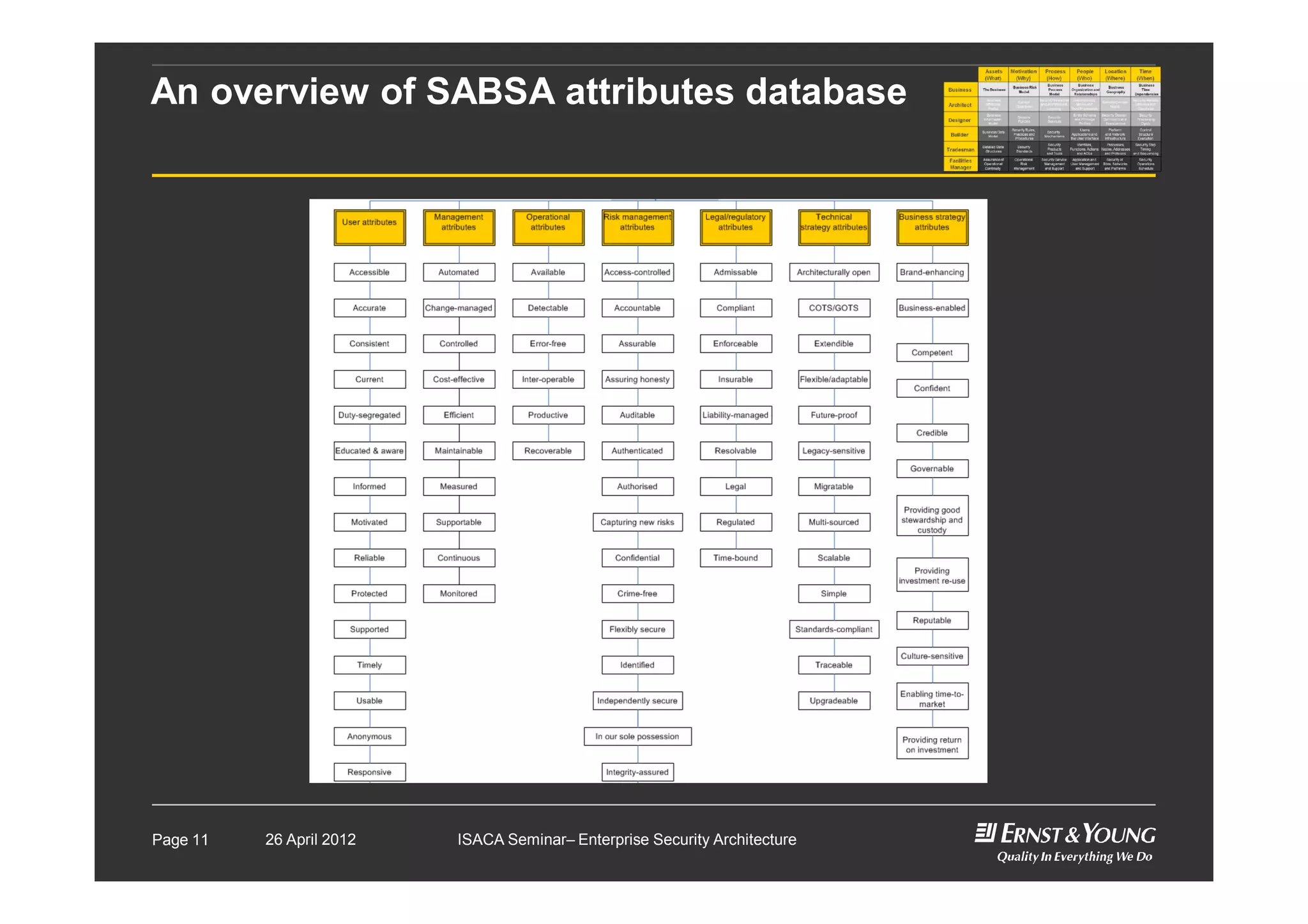
An overview of SABSA attributes database
Page 11 26 April 2012 ISACA Seminar– Enterprise Security Architecture
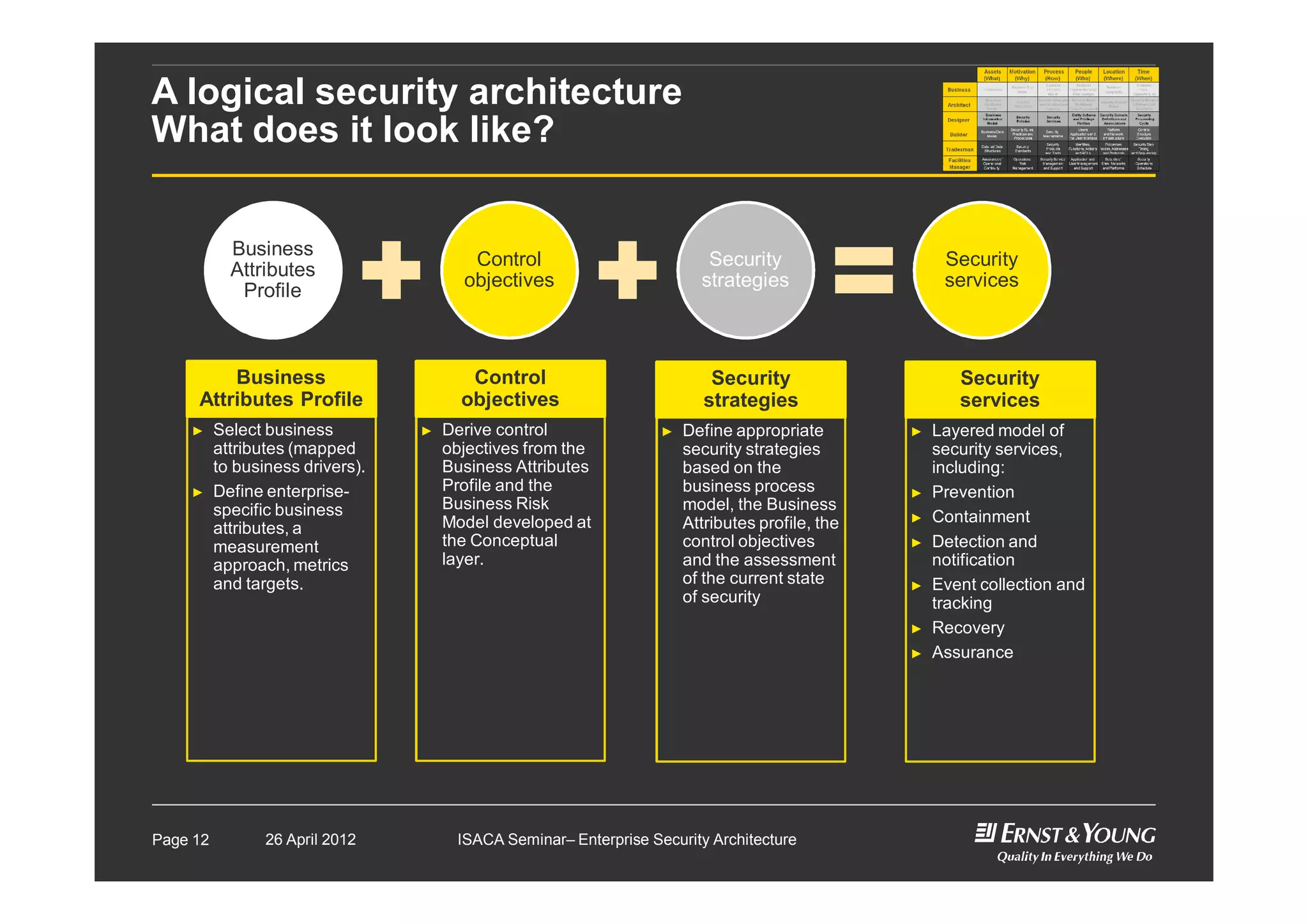
A logical security architecture
What does it look like?
Business
Attributes
Profile
Control
objectives
Security
strategies
Security
services
Business
Attributes Profile
► Select business
attributes (mapped
to business drivers).
► Define enterprise-
specific business
attributes, a
measurement
approach, metrics
and targets.
Control
objectives
► Derive control
objectives from the
Business Attributes
Profile and the
Business Risk
Model developed at
the Conceptual
layer.
Security
strategies
► Define appropriate
security strategies
based on the
business process
model, the Business
Attributes profile, the
control objectives
and the assessment
of the current state
of security
Security
services
► Layered model of
security services,
including:
► Prevention
► Containment
► Detection and
notification
► Event collection and
tracking
► Recovery
► Assurance
Page 12 26 April 2012 ISACA Seminar– Enterprise Security Architecture
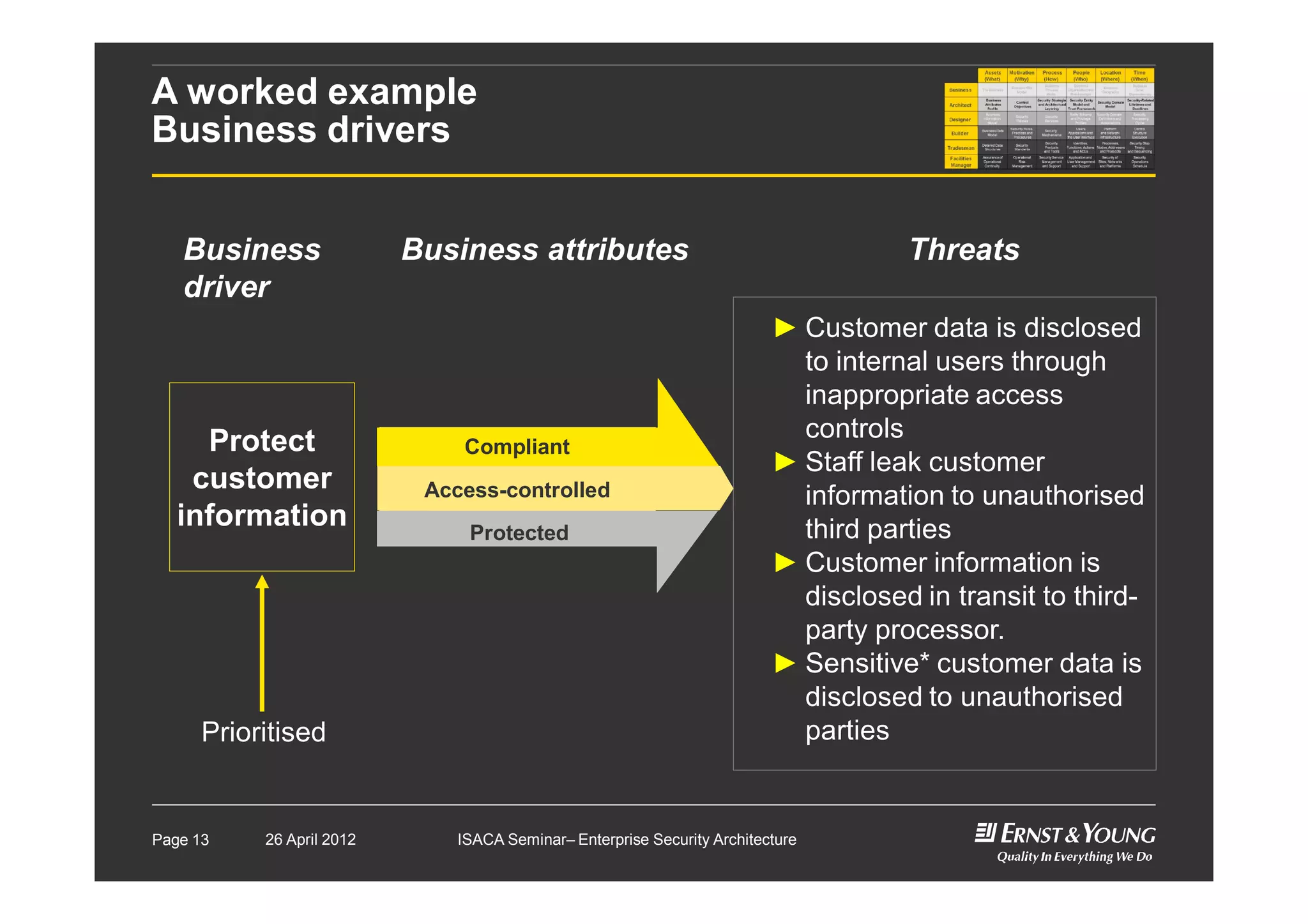
A worked example
Business drivers
► Customer data is disclosed
to internal users through
inappropriate access
controls
► Staff leak customer
information to unauthorised
third parties
► Customer information is
disclosed in transit to third-
party processor.
► Sensitive* customer data is
disclosed to unauthorised
parties
Compliant
Access-controlled
Protected
Protect
customer
information
Business
driver
Business attributes Threats
Prioritised
Page 13 26 April 2012 ISACA Seminar– Enterprise Security Architecture
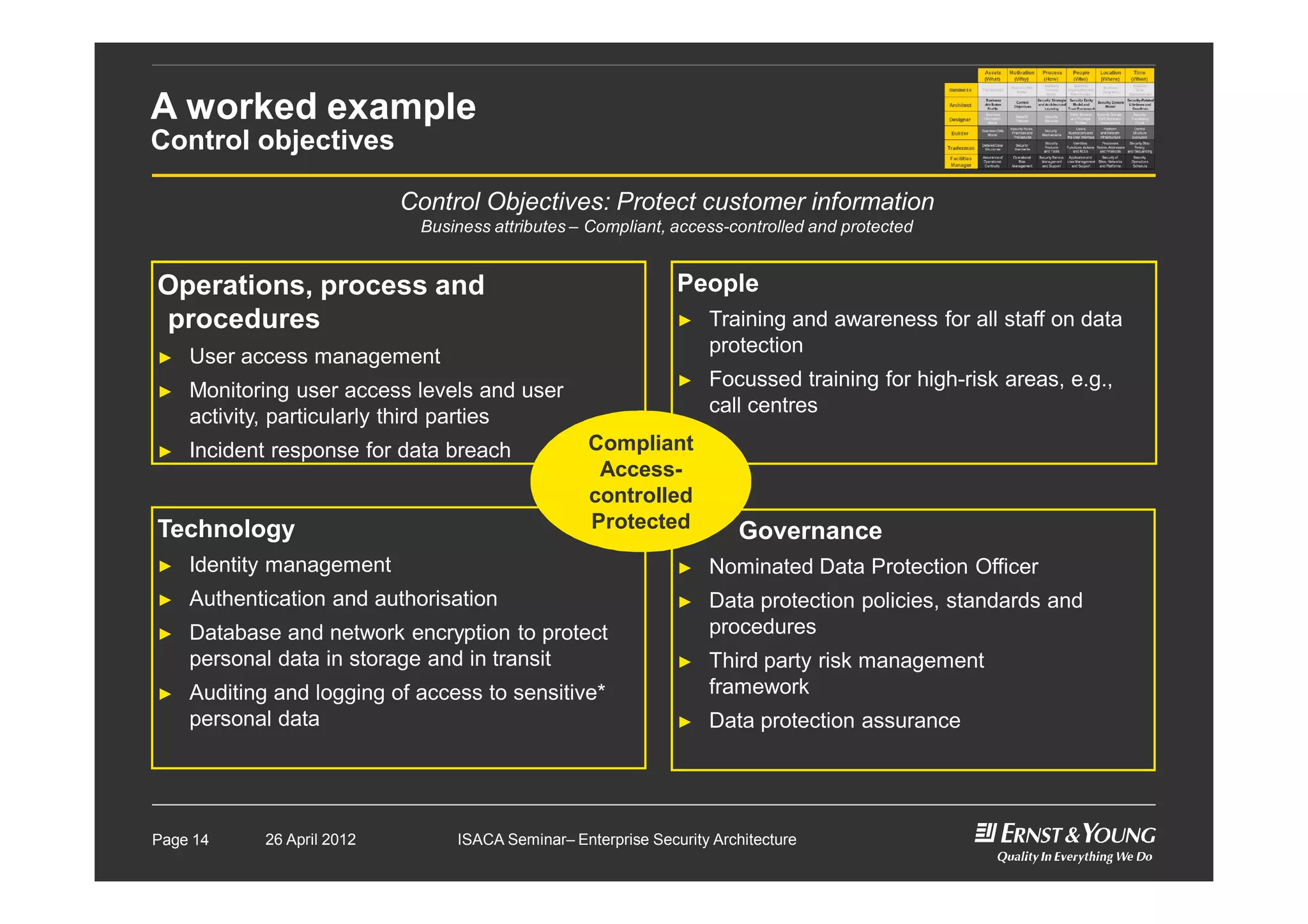
A worked example
Control objectives
Operations, process and
procedures
► User access management
► Monitoring user access levels and user
activity, particularly third parties
► Incident response for data breach
Technology
► Identity management
► Authentication and authorisation
► Database and network encryption to protect
personal data in storage and in transit
► Auditing and logging of access to sensitive*
personal data
People
► Training and awareness for all staff on data
protection
► Focussed training for high-risk areas, e.g.,
call centres
Governance
► Nominated Data Protection Officer
► Data protection policies, standards and
procedures
► Third party risk management
framework
► Data protection assurance
Compliant
Access-
controlled
Protected
Control Objectives: Protect customer information
Business attributes – Compliant, access-controlled and protected
Page 14 26 April 2012 ISACA Seminar– Enterprise Security Architecture
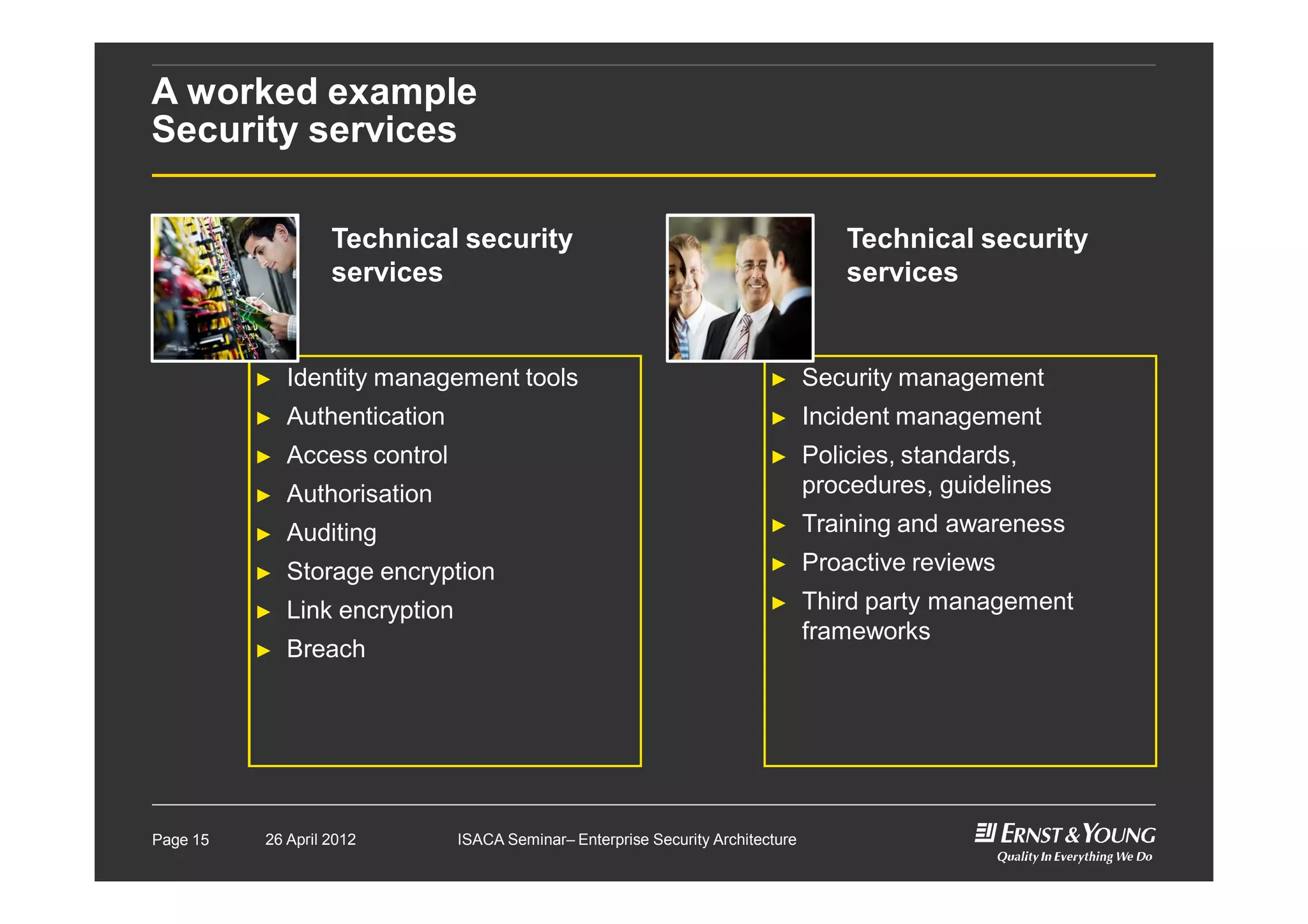
A worked example
Security services
► Identity management tools
► Authentication
► Access control
► Authorisation
► Auditing
► Storage encryption
► Link encryption
► Breach
► Security management
► Incident management
► Policies, standards,
procedures, guidelines
► Training and awareness
► Proactive reviews
► Third party management
frameworks
Technical security
services
Technical security
services
Page 15 26 April 2012 ISACA Seminar– Enterprise Security Architecture
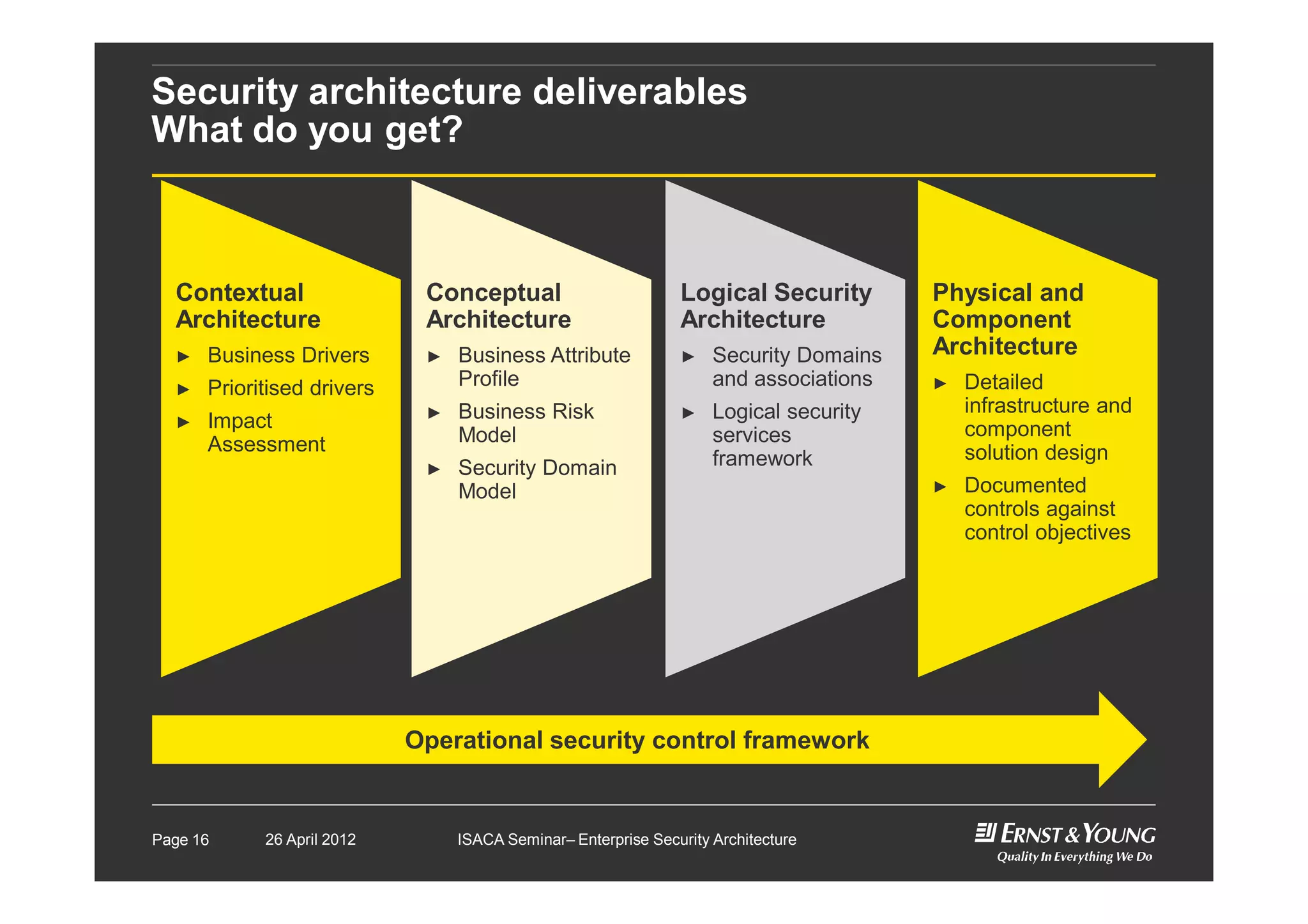
Security architecture deliverables
What do you get?
Contextual
Architecture
► Business Drivers
► Prioritised drivers
► Impact
Assessment
Conceptual
Architecture
► Business Attribute
Profile
► Business Risk
Model
► Security Domain
Model
Logical Security
Architecture
► Security Domains
and associations
► Logical security
services
framework
Physical and
Component
Architecture
► Detailed
infrastructure and
component
solution design
► Documented
controls against
control objectives
Operational security control framework
Page 16 26 April 2012 ISACA Seminar– Enterprise Security Architecture
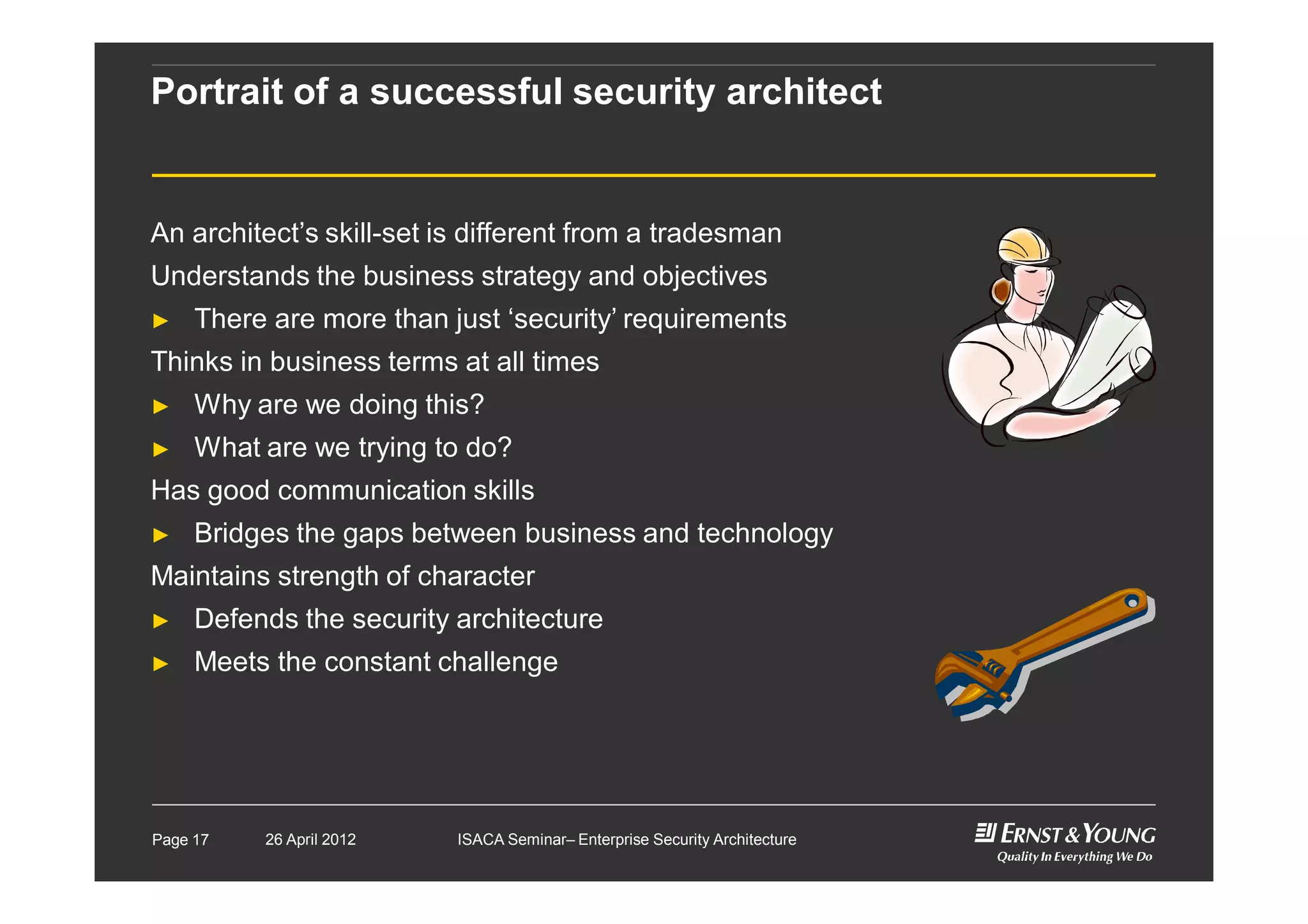
Portrait of a successful security architect
An architect’s skill-set is different from a tradesman
Understands the business strategy and objectives
► There are more than just ‘security’ requirements
Thinks in business terms at all times
► Why are we doing this?
► What are we trying to do?
Has good communication skills
► Bridges the gaps between business and technology
Maintains strength of character
► Defends the security architecture
► Meets the constant challenge
Page 17 26 April 2012 ISACA Seminar– Enterprise Security Architecture
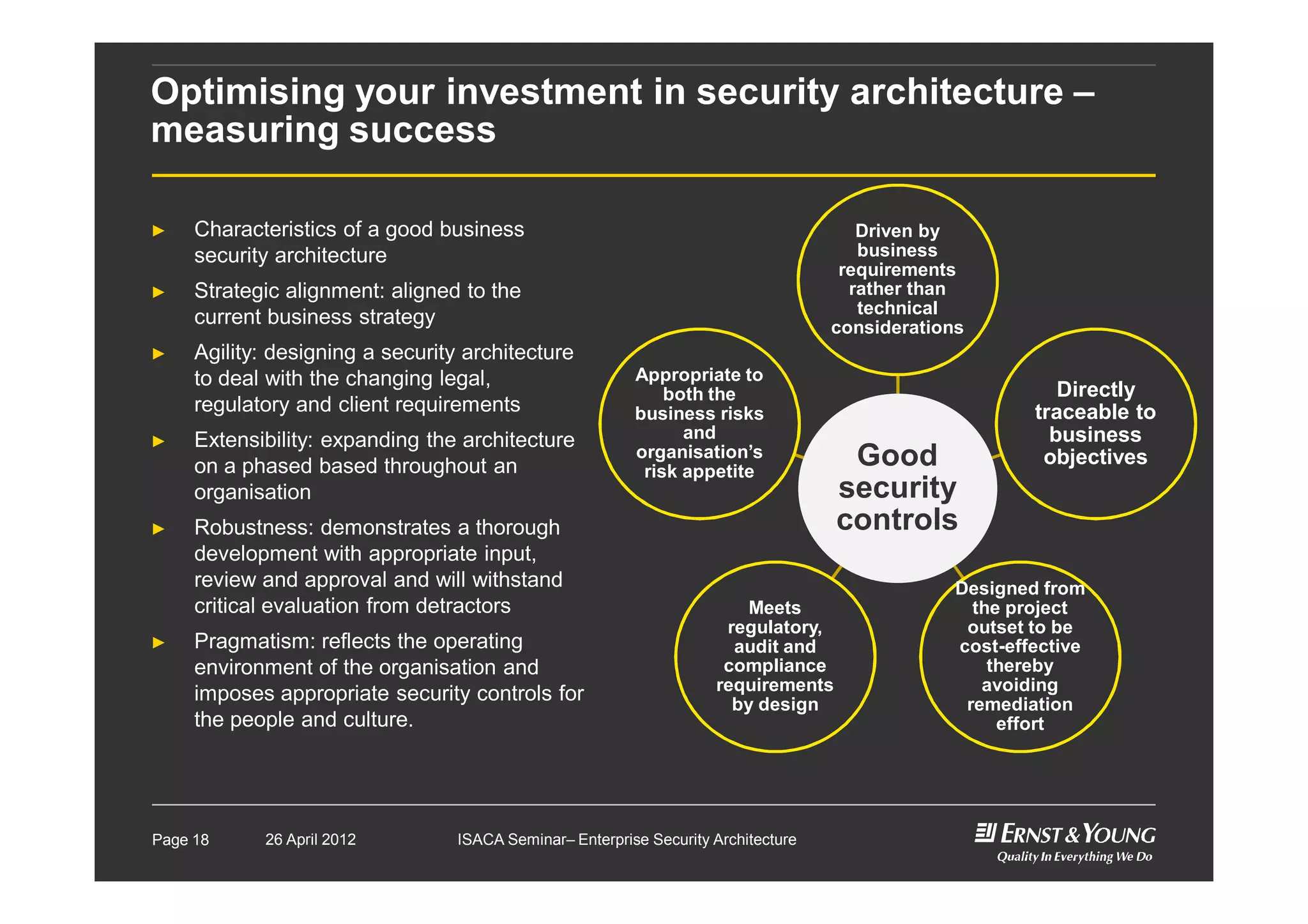
Optimising your investment in security architecture –
measuring success
► Characteristics of a good business
security architecture
► Strategic alignment: aligned to the
current business strategy
► Agility: designing a security architecture
to deal with the changing legal,
regulatory and client requirements
► Extensibility: expanding the architecture
on a phased based throughout an
organisation
► Robustness: demonstrates a thorough
development with appropriate input,
review and approval and will withstand
critical evaluation from detractors
► Pragmatism: reflects the operating
environment of the organisation and
imposes appropriate security controls for
the people and culture.
Page 18
Good
security
controls
Driven by
business
requirements
rather than
technical
considerations
Directly
traceable to
business
objectives
Designed from
the project
outset to be
cost-effective
thereby
avoiding
remediation
effort
Meets
regulatory,
audit and
compliance
requirements
by design
Appropriate to
both the
business risks
and
organisation’s
risk appetite
26 April 2012 ISACA Seminar– Enterprise Security Architecture
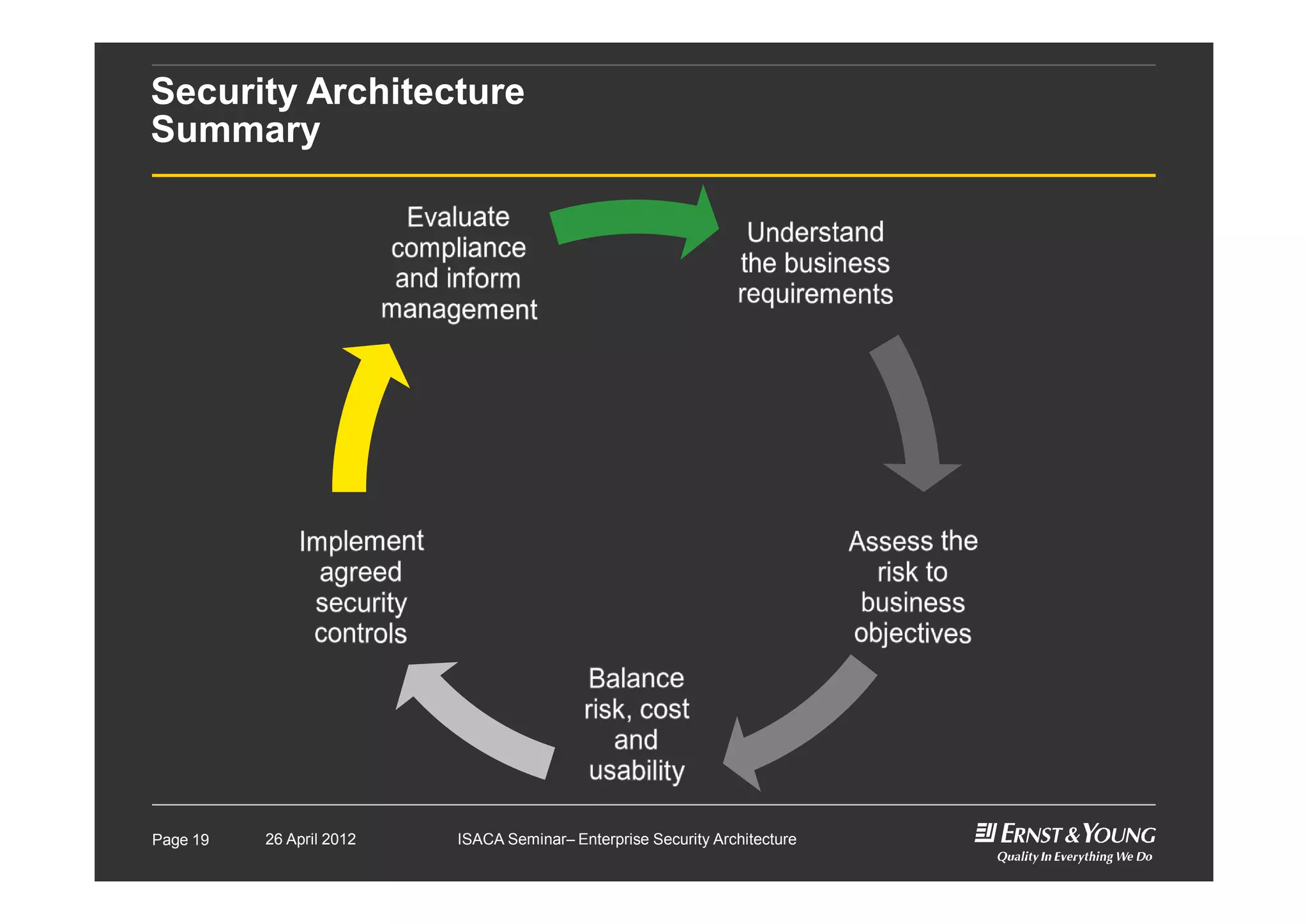
Security Architecture
Summary
Page 19 26 April 2012 ISACA Seminar– Enterprise Security Architecture
EY Contacts
Security architecture experience
Hugh Callaghan
Director
Direct Tel: +353 (0)1 221 2411
Direct Fax: +353 (0)1 475 0557
Mobile: +353 (0)87 983 8511
E-mail: hugh.callaghan@ie.ey.com
Patricia O’Gara
Senior Manager
Direct Tel: +353 (0)1 221 2008
Direct Fax: +353 (0)1 475 0557
Mobile: +353 (0)87 235 6023
E-mail: patricia.ogara@ie.ey.com
Vasilijs Mihailovs
Assistant
Direct Tel: +353 (0)1 221 2653
Direct Fax: +353 (0)1 475 0557
Mobile: +353 (0)86 176 6444
E-mail: vasilijs.mihailovs@ie.ey.com
Eoin O’Reilly
Senior Manager
Direct Tel: +353 (0)1 221 2698
Direct Fax: +353 (0)1 475 0557
Mobile: +353 (0)86 770 9820
E-mail: eoin.oreilly@ie.ey.com
26 April 2012 ISACA Seminar– Enterprise Security ArchitecturePage 20
Thank you

Enterprise%20 security%20architecture%20 %20business%20driven%20security

  • 1.
  • 2.
    Page 2 Agenda ► Facilitiesand safety information ► Introduction ► Overview of the problem ► Introducing security architecture ► The SABSA approach ► A worked example ► Security architecture components ► Facilitated discussion 26 April 2012 ISACA Seminar– Enterprise Security Architecture
  • 3.
    The Problem: InformationSecurity The business perspective Page 3 26 April 2012 ISACA Seminar– Enterprise Security Architecture
  • 4.
    The problem: answeringthe difficult questions How do we ensure security supports the business? How do we demonstrate alignment with the business risks? Are we spending too much or on the right things? How do we keep business and security aligned? How do we minimise security gaps and remediation costs How do we embed security in the wider business? Page 4 26 April 2012 ISACA Seminar– Enterprise Security Architecture
  • 5.
    Introducing security architecture? Traditionalarchitecture vs. security architecture ► Designing a secure business information system could take a number of directions, but there is considerable potential for the security and business requirements to clash and neither party is satisfied with the end result. ► The answers to these questions provide the architect with the business requirements which can then be fed into the design process. ► What type of structure do I want? ► Why do I want this structure? ► How will it be used? ► Who will be the users of the structure? ► Where should the structure be located? ► When will it be used? Building a physical structure ► What type of information system is being considered and what will it do? ► Why is it needed? ► How will it be used? ► Who will use it? ► Where will it be used? ► When will it be used? Protecting business information Page 5 26 April 2012 ISACA Seminar– Enterprise Security Architecture
  • 6.
    How do Isolve this problem What is business security architecture? ► The challenge in developing the architecture is to balance between risk, cost and usability ► Security architecture controls are composed of people, process and technology controls An organisation needs security controls that are: ► Driven by business requirements rather than technical considerations ► Directly traceable to business objectives ► Designed from the outset to be cost-effective, avoiding remediation effort ► Meet legal, regulatory and policy compliance requirements by design ► Are appropriate to both the business risks and organisation’s risk appetite Risk Usability Cost Page 6 26 April 2012 ISACA Seminar– Enterprise Security Architecture
  • 7.
    Why do this?Benefits of the security architecture approach Customised information security control framework ► Driven by the organisation’s business requirements ► Meeting compliance ► Alignment with the business’ risk appetite Reduces information security, IT and security audit costs ► Eliminates redundant controls ► Reduces ad hoc security implementation ► Provides detailed agreed security requirements Informs executive management about security risk ► Articulates impact of information security risk in business terms ► Provides structured control framework to evaluate compliance ► Creates foundation for quantitative assessment of security ROI Page 7 26 April 2012 ISACA Seminar– Enterprise Security Architecture
  • 8.
    The SABSA approach Stepby step Business attributes Threat analysis Impact analysis Control objectives Security services Business Driver ► Identify the business drivers/ objectives. ► Prioritise drivers. Business Attributes ► Translate drivers into business security attributes. ► Security attributes are provided by SABSA framework. Threat analysis ► Perform threat analysis. ► Identify actual threats to business attributes/ business drivers. Impact analysis ► Use qualitative or quantitative methods to define impact of the realisation of the threat on the identified business objectives. Control Objectives ► Define control objectives to mitigate the identified threats to acceptable levels. Security services ► Identify security services to provide the required controls objectives. Business driver Page 8 26 April 2012 ISACA Seminar– Enterprise Security Architecture
  • 9.
    The SABSA approach Anarchitect’s perspective – Here comes the science! Assets (What) Process (How) Location (Where) People (Who) Time (When) Motivation (Why) Contextual The Business Business Process Model Business Geography Business Organization and Relationships Business Time Dependencies Business Risk Model Conceptual Business Attributes Profile Security Strategies and Architectural Layering Security Domain Model Security Entity Model and Trust Framework Security-Related Lifetimes and Deadlines Control Objectives Logical Security Services Security Domain Definitions and Associations Entity Schema and Privilege Profiles Security Processing Cycle Business Information Model Security Policies Physical Platform and Network Infrastructure Users, Applications and the User Interface Control Structure Execution Business Data Model Security Mechanisms Security Rules, Practices and Procedures Component Processes, Nodes, Addresses and Protocols Identities, Functions, Actions and ACLs Security Step Timing and Sequencing Detailed Data Structures Security Products and Tools Security Standards Operational Assurance of Operational Continuity Security Service Management and Support Security of Sites, Networks and Platforms Application and User Management and Support Security Operations Schedule Operational Risk Management Design Build Business Architect Designer Builder Tradesman Facilities Manager 26 April 2012 ISACA Seminar– Enterprise Security ArchitecturePage 9
  • 10.
    Contextual & conceptualsecurity Understanding the business and its risks ► Business strategy ► Business processes and functions ► Organisational structure – personnel, geographical, partnerships ► Budgets, technical constraints, time dependencies ► Use the business attributes database to describe the business in terms of strategy, related assets, business goals and objectives → business attribute profile ► Perform a threat analysis on the business assets, goals and objectives ► Define the business impact of the realisation of the threats ► Identify technical and procedural vulnerabilities Gather, assess and analyse business requirements Describe the business requirements Analyse the business risks Page 10 26 April 2012 ISACA Seminar– Enterprise Security Architecture
  • 11.
    An overview ofSABSA attributes database Page 11 26 April 2012 ISACA Seminar– Enterprise Security Architecture
  • 12.
    A logical securityarchitecture What does it look like? Business Attributes Profile Control objectives Security strategies Security services Business Attributes Profile ► Select business attributes (mapped to business drivers). ► Define enterprise- specific business attributes, a measurement approach, metrics and targets. Control objectives ► Derive control objectives from the Business Attributes Profile and the Business Risk Model developed at the Conceptual layer. Security strategies ► Define appropriate security strategies based on the business process model, the Business Attributes profile, the control objectives and the assessment of the current state of security Security services ► Layered model of security services, including: ► Prevention ► Containment ► Detection and notification ► Event collection and tracking ► Recovery ► Assurance Page 12 26 April 2012 ISACA Seminar– Enterprise Security Architecture
  • 13.
    A worked example Businessdrivers ► Customer data is disclosed to internal users through inappropriate access controls ► Staff leak customer information to unauthorised third parties ► Customer information is disclosed in transit to third- party processor. ► Sensitive* customer data is disclosed to unauthorised parties Compliant Access-controlled Protected Protect customer information Business driver Business attributes Threats Prioritised Page 13 26 April 2012 ISACA Seminar– Enterprise Security Architecture
  • 14.
    A worked example Controlobjectives Operations, process and procedures ► User access management ► Monitoring user access levels and user activity, particularly third parties ► Incident response for data breach Technology ► Identity management ► Authentication and authorisation ► Database and network encryption to protect personal data in storage and in transit ► Auditing and logging of access to sensitive* personal data People ► Training and awareness for all staff on data protection ► Focussed training for high-risk areas, e.g., call centres Governance ► Nominated Data Protection Officer ► Data protection policies, standards and procedures ► Third party risk management framework ► Data protection assurance Compliant Access- controlled Protected Control Objectives: Protect customer information Business attributes – Compliant, access-controlled and protected Page 14 26 April 2012 ISACA Seminar– Enterprise Security Architecture
  • 15.
    A worked example Securityservices ► Identity management tools ► Authentication ► Access control ► Authorisation ► Auditing ► Storage encryption ► Link encryption ► Breach ► Security management ► Incident management ► Policies, standards, procedures, guidelines ► Training and awareness ► Proactive reviews ► Third party management frameworks Technical security services Technical security services Page 15 26 April 2012 ISACA Seminar– Enterprise Security Architecture
  • 16.
    Security architecture deliverables Whatdo you get? Contextual Architecture ► Business Drivers ► Prioritised drivers ► Impact Assessment Conceptual Architecture ► Business Attribute Profile ► Business Risk Model ► Security Domain Model Logical Security Architecture ► Security Domains and associations ► Logical security services framework Physical and Component Architecture ► Detailed infrastructure and component solution design ► Documented controls against control objectives Operational security control framework Page 16 26 April 2012 ISACA Seminar– Enterprise Security Architecture
  • 17.
    Portrait of asuccessful security architect An architect’s skill-set is different from a tradesman Understands the business strategy and objectives ► There are more than just ‘security’ requirements Thinks in business terms at all times ► Why are we doing this? ► What are we trying to do? Has good communication skills ► Bridges the gaps between business and technology Maintains strength of character ► Defends the security architecture ► Meets the constant challenge Page 17 26 April 2012 ISACA Seminar– Enterprise Security Architecture
  • 18.
    Optimising your investmentin security architecture – measuring success ► Characteristics of a good business security architecture ► Strategic alignment: aligned to the current business strategy ► Agility: designing a security architecture to deal with the changing legal, regulatory and client requirements ► Extensibility: expanding the architecture on a phased based throughout an organisation ► Robustness: demonstrates a thorough development with appropriate input, review and approval and will withstand critical evaluation from detractors ► Pragmatism: reflects the operating environment of the organisation and imposes appropriate security controls for the people and culture. Page 18 Good security controls Driven by business requirements rather than technical considerations Directly traceable to business objectives Designed from the project outset to be cost-effective thereby avoiding remediation effort Meets regulatory, audit and compliance requirements by design Appropriate to both the business risks and organisation’s risk appetite 26 April 2012 ISACA Seminar– Enterprise Security Architecture
  • 19.
    Security Architecture Summary Page 1926 April 2012 ISACA Seminar– Enterprise Security Architecture
  • 20.
    EY Contacts Security architectureexperience Hugh Callaghan Director Direct Tel: +353 (0)1 221 2411 Direct Fax: +353 (0)1 475 0557 Mobile: +353 (0)87 983 8511 E-mail: hugh.callaghan@ie.ey.com Patricia O’Gara Senior Manager Direct Tel: +353 (0)1 221 2008 Direct Fax: +353 (0)1 475 0557 Mobile: +353 (0)87 235 6023 E-mail: patricia.ogara@ie.ey.com Vasilijs Mihailovs Assistant Direct Tel: +353 (0)1 221 2653 Direct Fax: +353 (0)1 475 0557 Mobile: +353 (0)86 176 6444 E-mail: vasilijs.mihailovs@ie.ey.com Eoin O’Reilly Senior Manager Direct Tel: +353 (0)1 221 2698 Direct Fax: +353 (0)1 475 0557 Mobile: +353 (0)86 770 9820 E-mail: eoin.oreilly@ie.ey.com 26 April 2012 ISACA Seminar– Enterprise Security ArchitecturePage 20
  • 21.