Innovation in the Enterprise
Applying Innovation in Software Development
Amish Gandhi
Keynote Talk
Amish Gandhi
Founder and Principal at Perpetual: Product Innovation and Development for
Finance, Media and Telecom www.perpetualny.com
Innovation Background
• Working on innovating financial information services
• Working on wearable computing solutions for media
• Experience developing emerging technology based products in telecom
• Advanced Study Fellow in innovation at MIT
MS Computer Science from Univ. of Texas, Austin
BS Computer Science from Bombay University
Finance
Media
TelecomBackground
Contents
• Intro
– What is Innovation
– What it is not
• Business Innovation
– What it is
– Innovators Dilemma
• Innovation in Software Companies
– How it is different
– Innovation as a discipline
• 7 Steps for Software Innovation
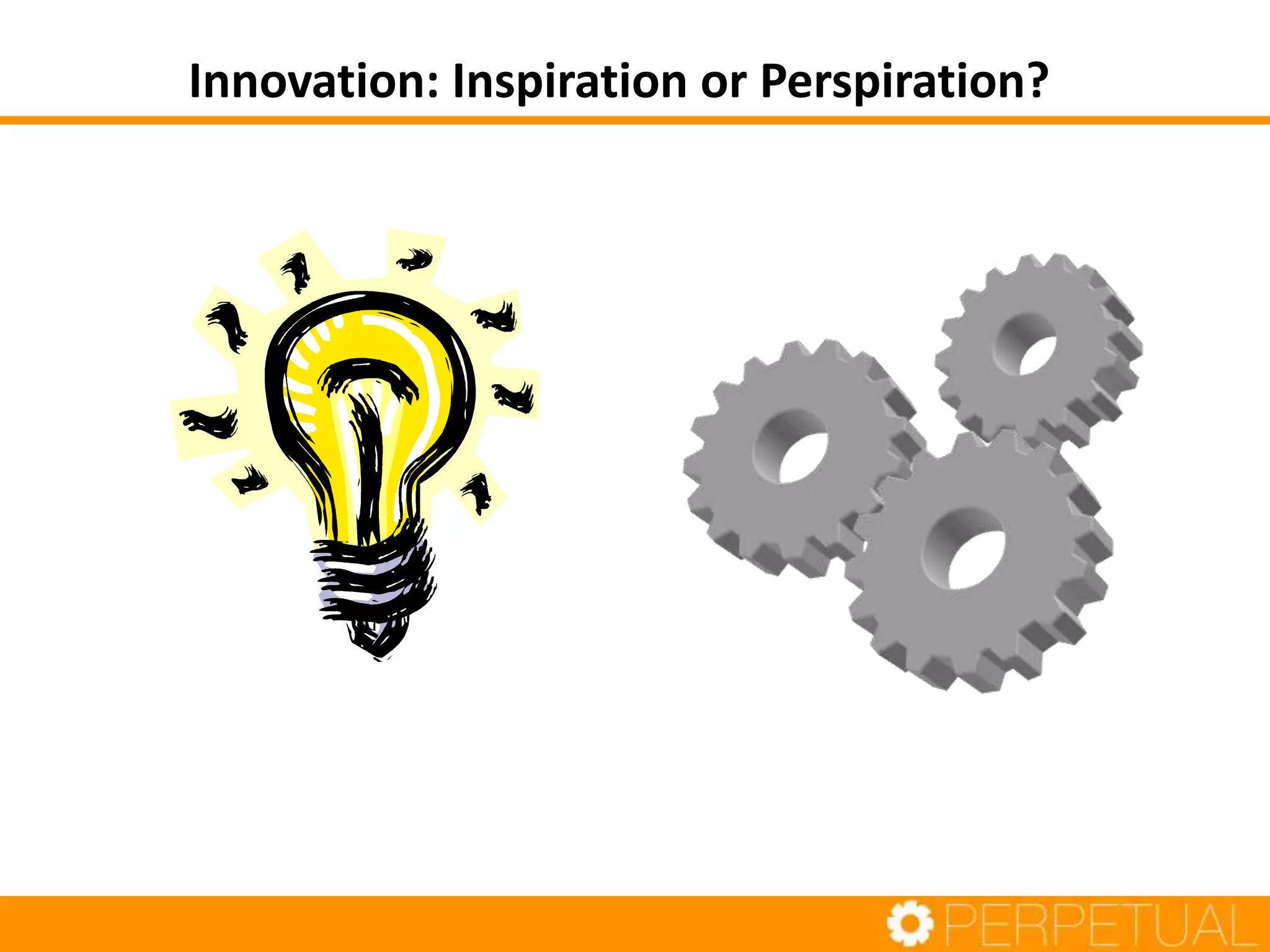
Innovation: Inspiration or Perspiration?
What is Innovation?
Innovation is a process that combines
• discovering an opportunity
• blueprinting an idea to seize that opportunity
• and implementing that idea to achieve results
No impact, no innovation
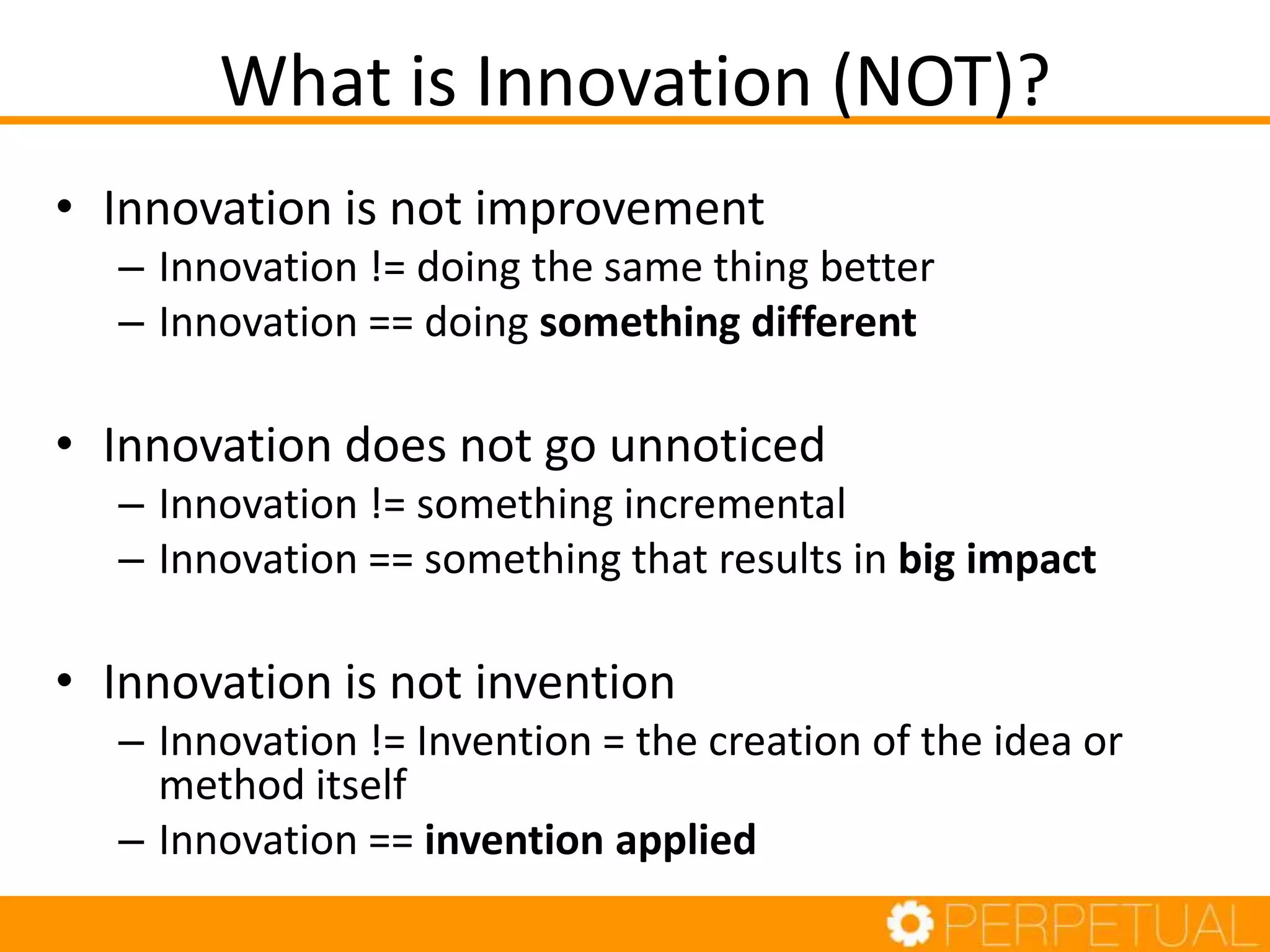
What is Innovation (NOT)?
• Innovation is not improvement
– Innovation != doing the same thing better
– Innovation == doing something different
• Innovation does not go unnoticed
– Innovation != something incremental
– Innovation == something that results in big impact
• Innovation is not invention
– Innovation != Invention = the creation of the idea or
method itself
– Innovation == invention applied
Business Innovation
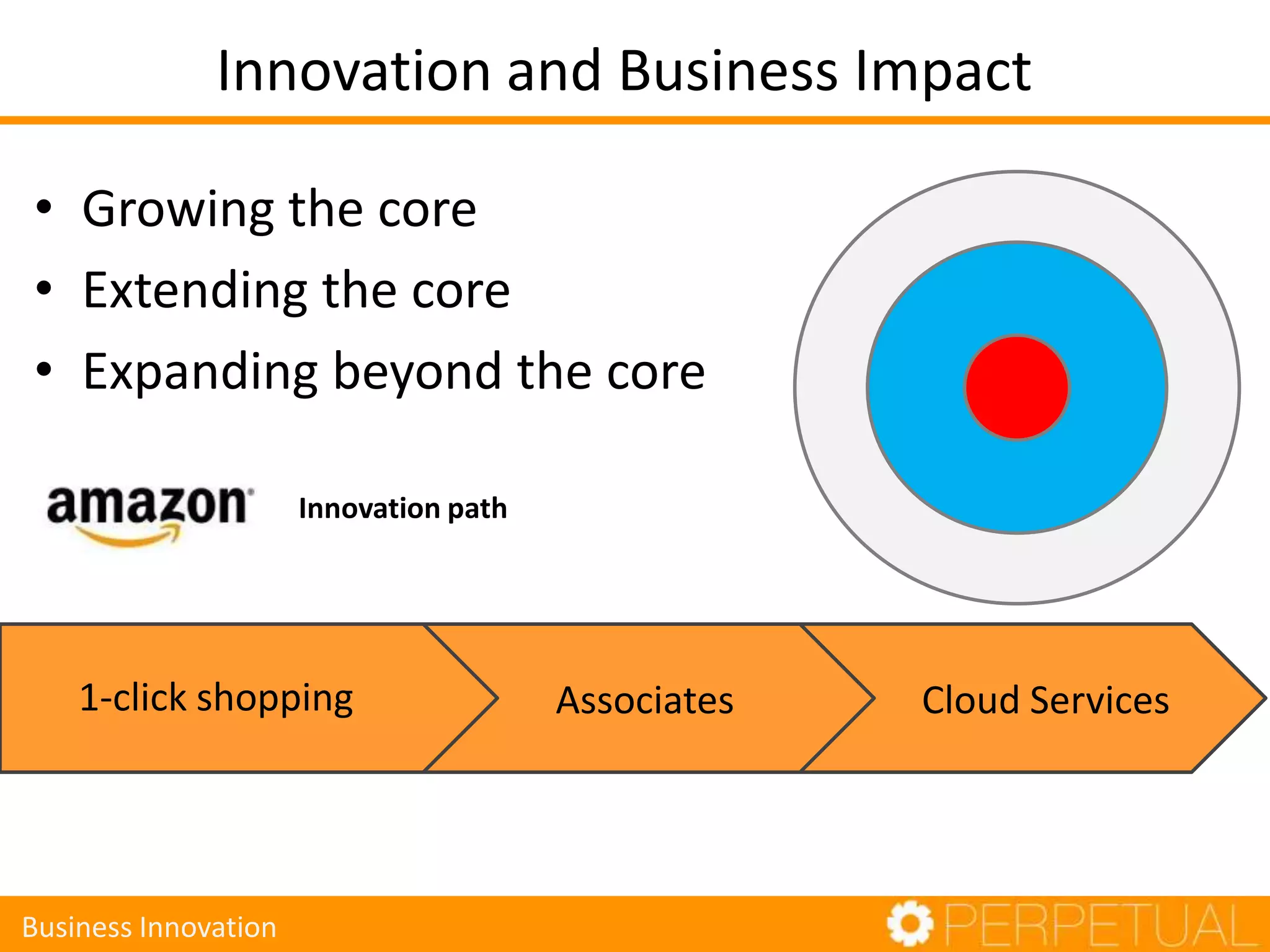
Innovation and Business Impact
• Growing the core
• Extending the core
• Expanding beyond the core
Innovation path
Business Innovation
1-click shopping Associates Cloud Services
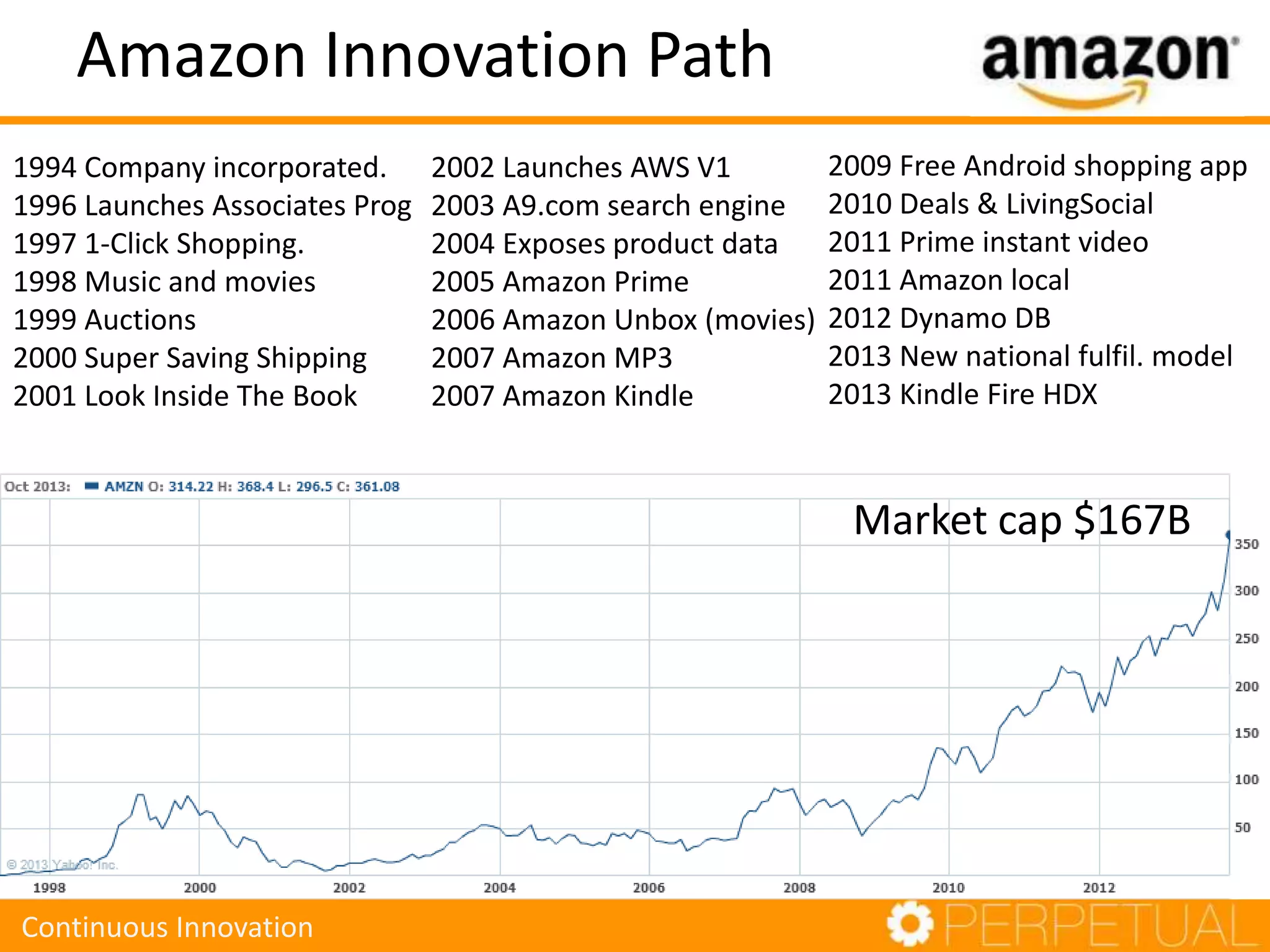
Amazon Innovation Path
Market cap $167B
Continuous Innovation
1994 Company incorporated.
1996 Launches Associates Prog
1997 1-Click Shopping.
1998 Music and movies
1999 Auctions
2000 Super Saving Shipping
2001 Look Inside The Book
2002 Launches AWS V1
2003 A9.com search engine
2004 Exposes product data
2005 Amazon Prime
2006 Amazon Unbox (movies)
2007 Amazon MP3
2007 Amazon Kindle
2009 Free Android shopping app
2010 Deals & LivingSocial
2011 Prime instant video
2011 Amazon local
2012 Dynamo DB
2013 New national fulfil. model
2013 Kindle Fire HDX
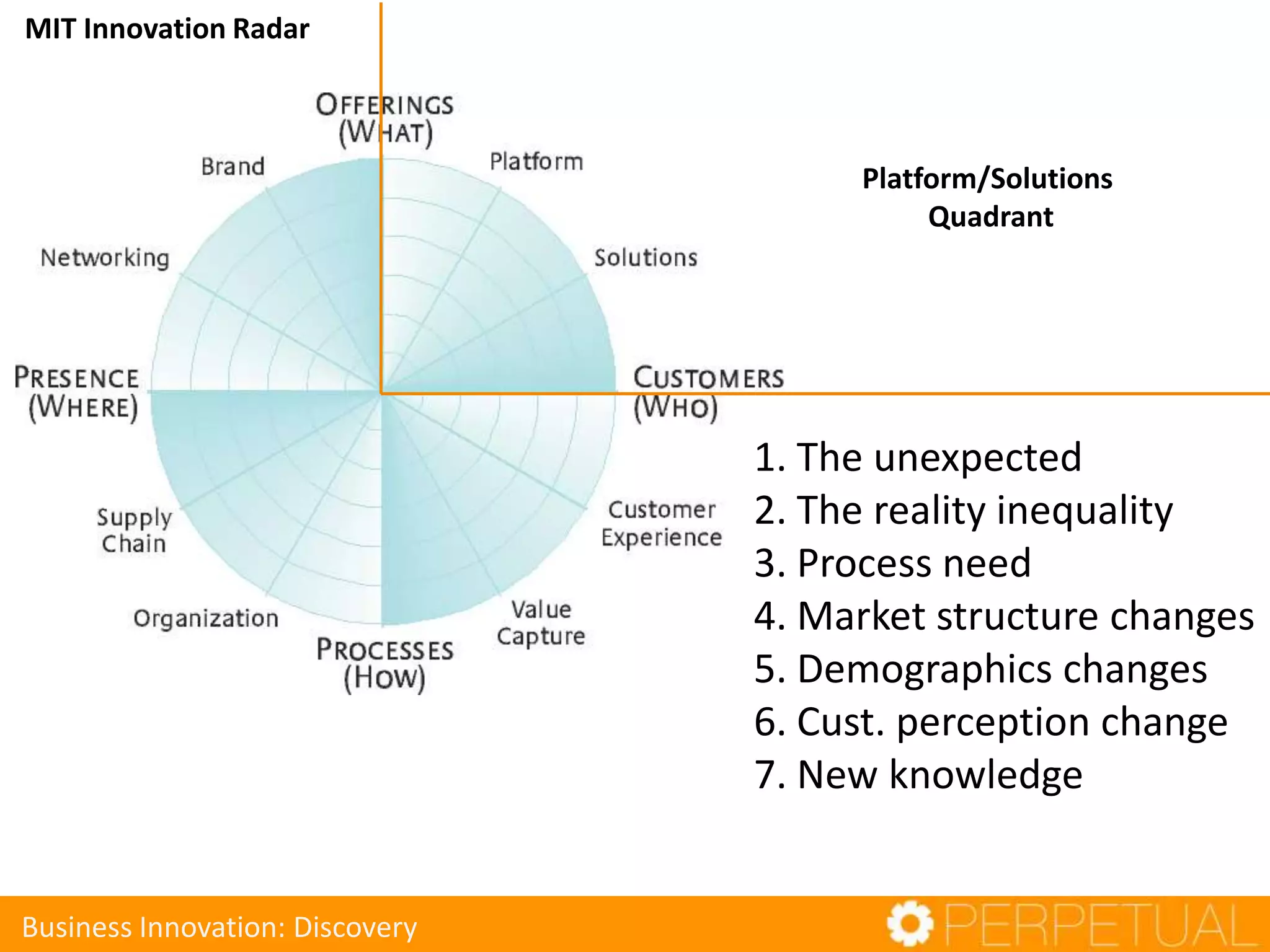
MIT Innovation Radar
Business Innovation: Discovery
Platform/Solutions
Quadrant
1. The unexpected
2. The reality inequality
3. Process need
4. Market structure changes
5. Demographics changes
6. Cust. perception change
7. New knowledge
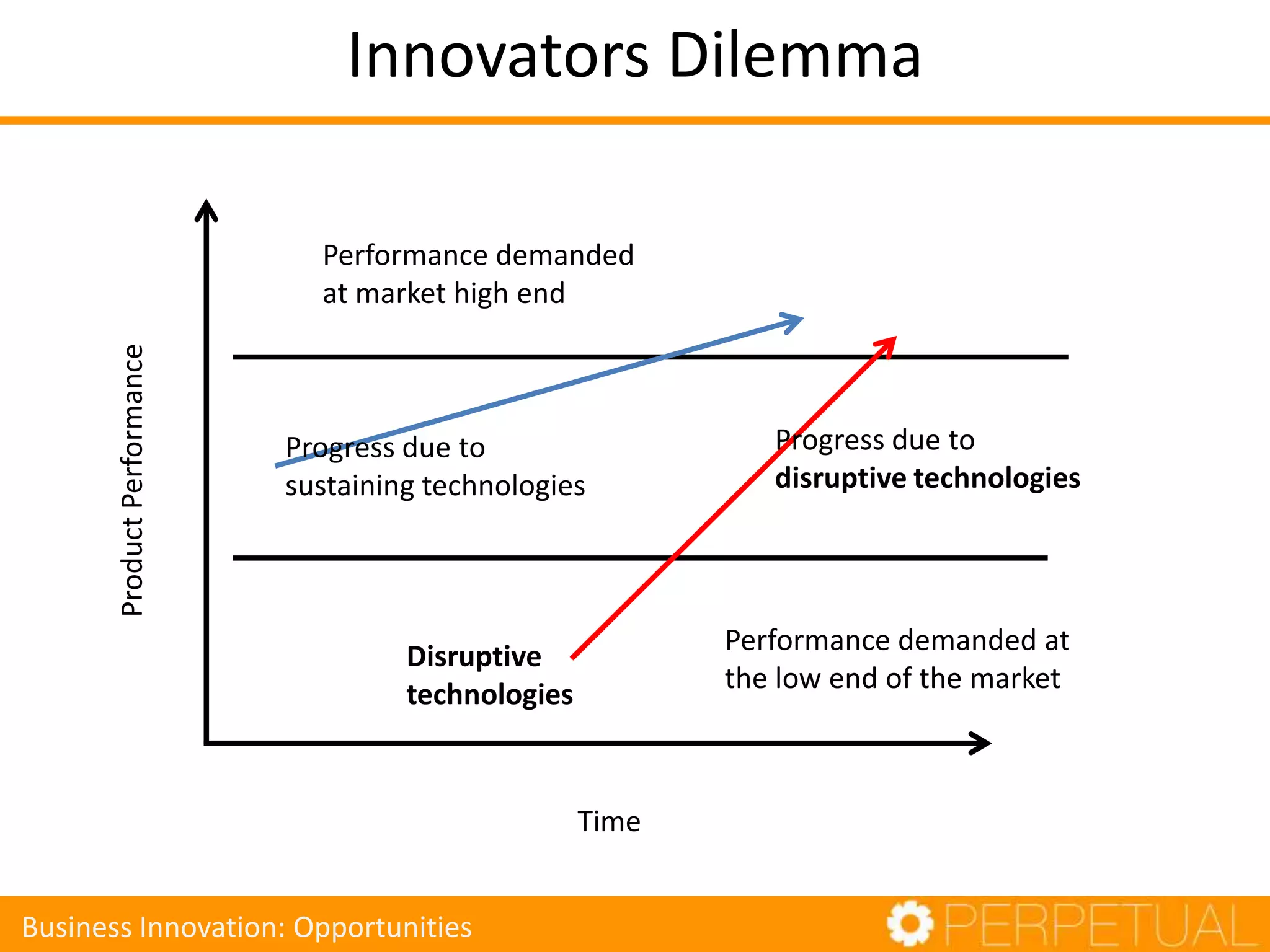
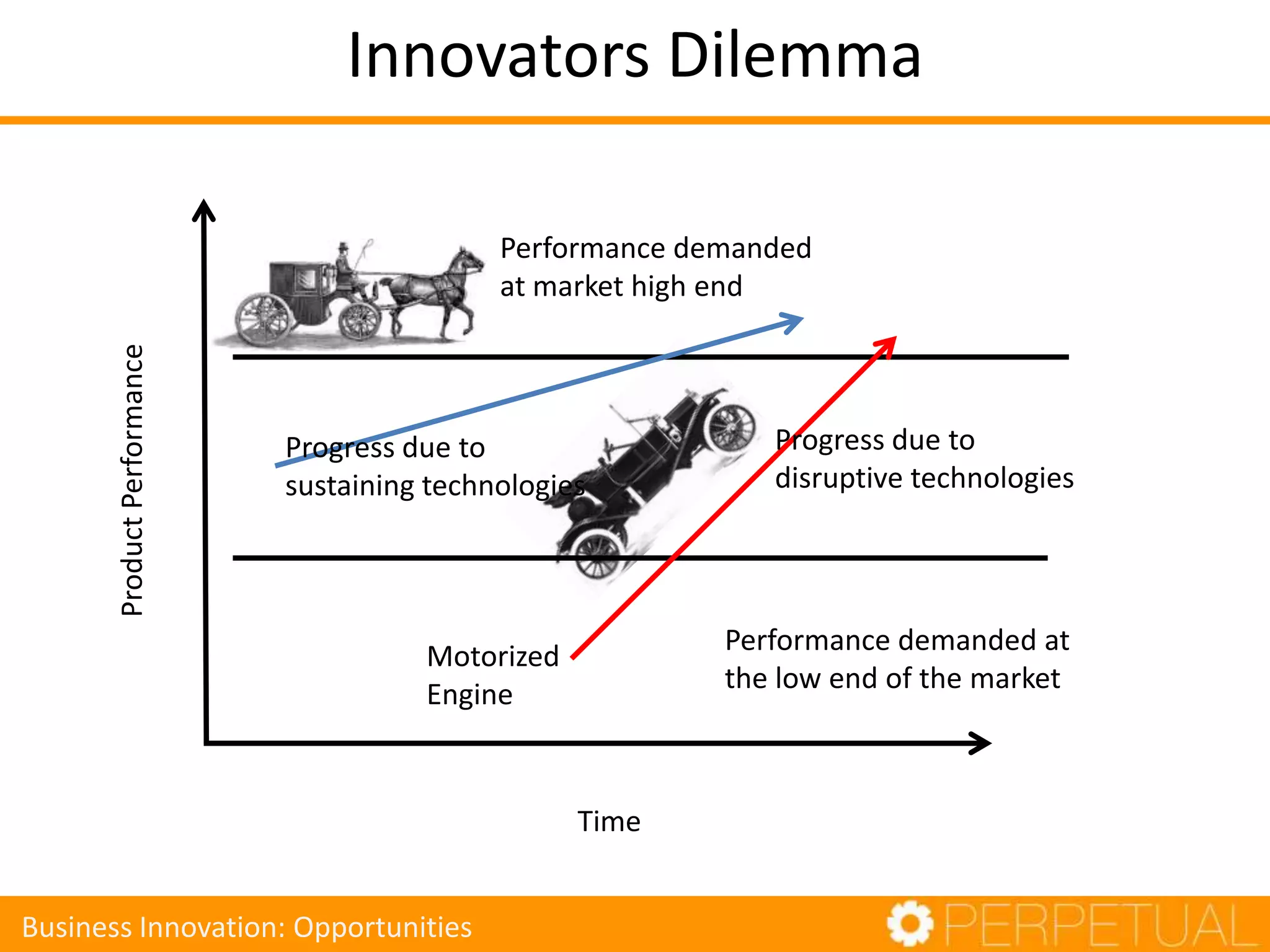
Performance demanded
at market high end
Progress due to
sustaining technologies
Progress due to
disruptive technologies
ProductPerformance
Time
Performance demanded at
the low end of the market
Innovators Dilemma
Business Innovation: Opportunities
Disruptive
technologies
Performance demanded
at market high end
Progress due to
sustaining technologies
Progress due to
disruptive technologies
ProductPerformance
Time
Performance demanded at
the low end of the market
Innovators Dilemma
Business Innovation: Opportunities
Motorized
Engine
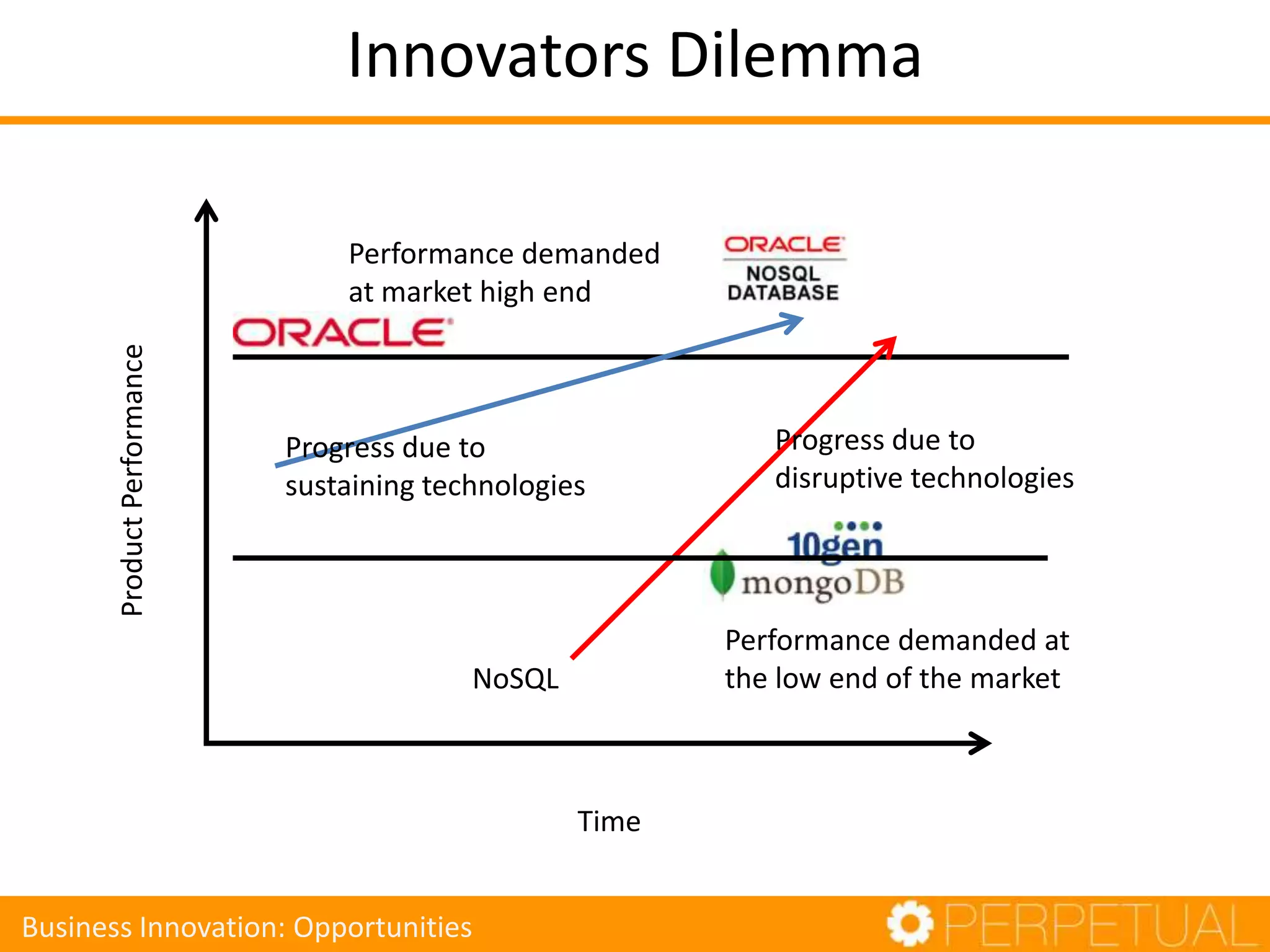
Performance demanded
at market high end
Progress due to
sustaining technologies
Progress due to
disruptive technologies
ProductPerformance
Time
Performance demanded at
the low end of the market
Innovators Dilemma
NoSQL
Business Innovation: Opportunities
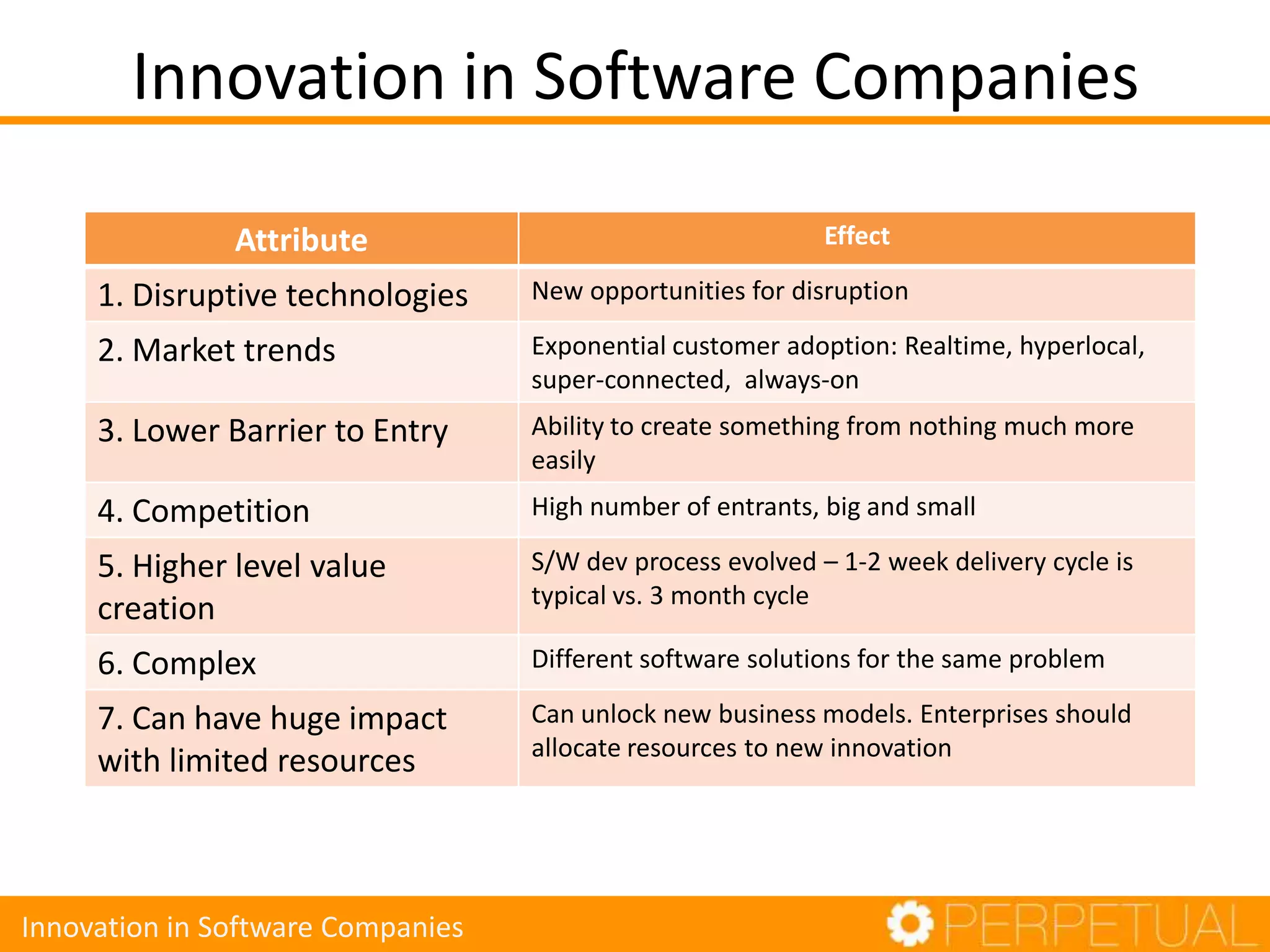
Innovation in Software Companies
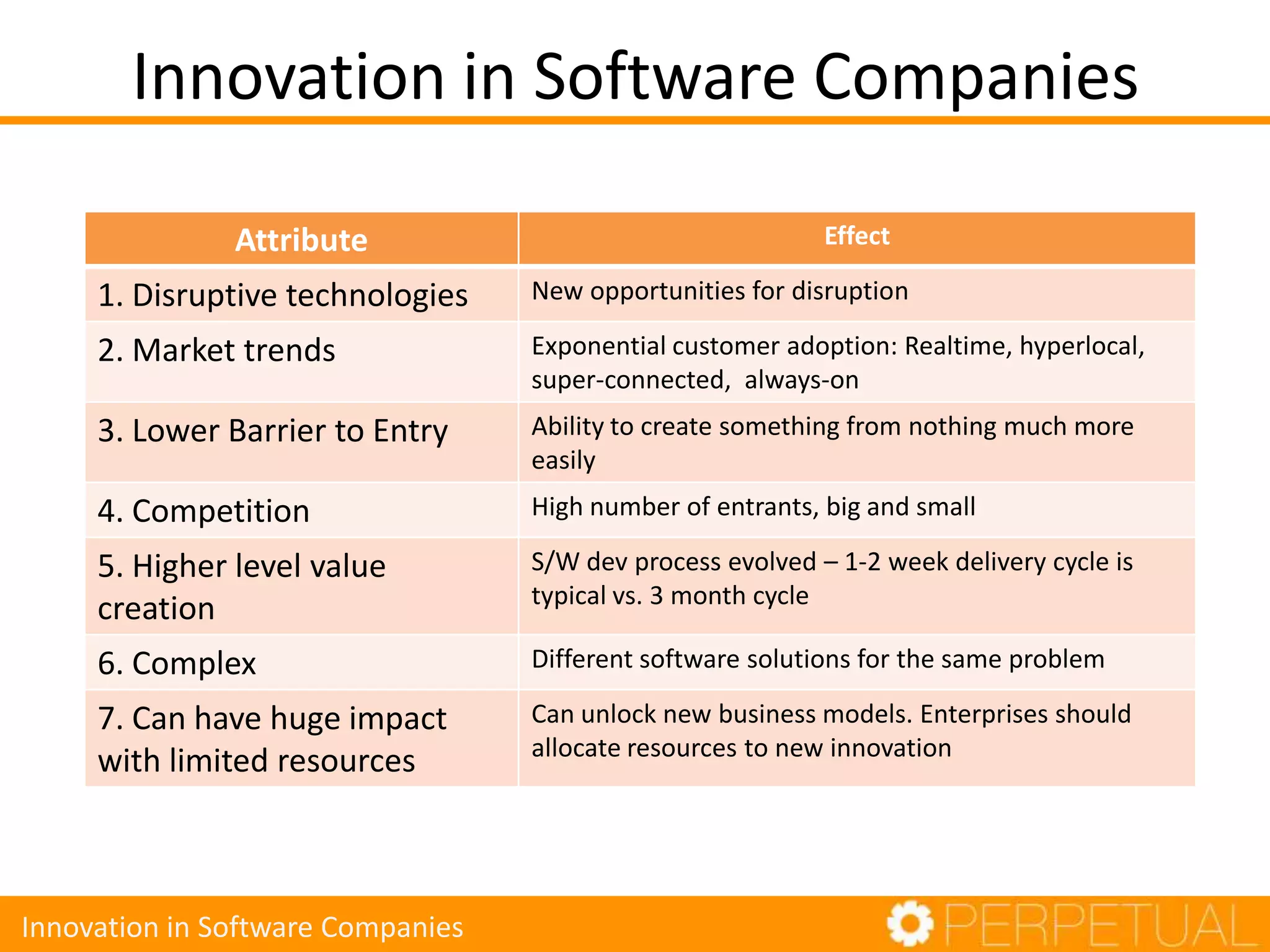
Attribute Effect
1. Disruptive technologies New opportunities for disruption
2. Market trends Exponential customer adoption: Realtime, hyperlocal,
super-connected, always-on
3. Lower Barrier to Entry Ability to create something from nothing much more
easily
4. Competition High number of entrants, big and small
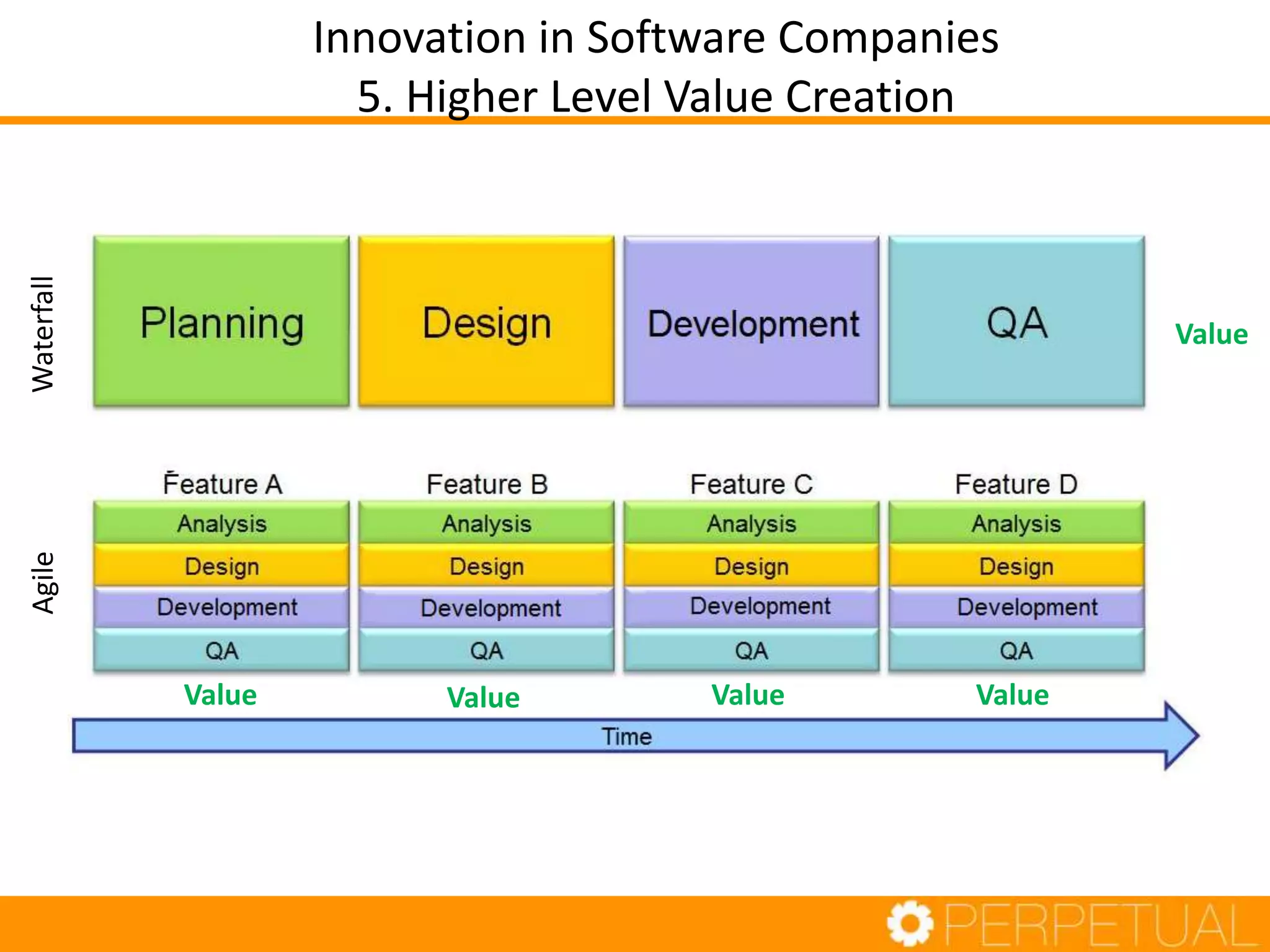
5. Higher level value
creation
S/W dev process evolved – 1-2 week delivery cycle is
typical vs. 3 month cycle
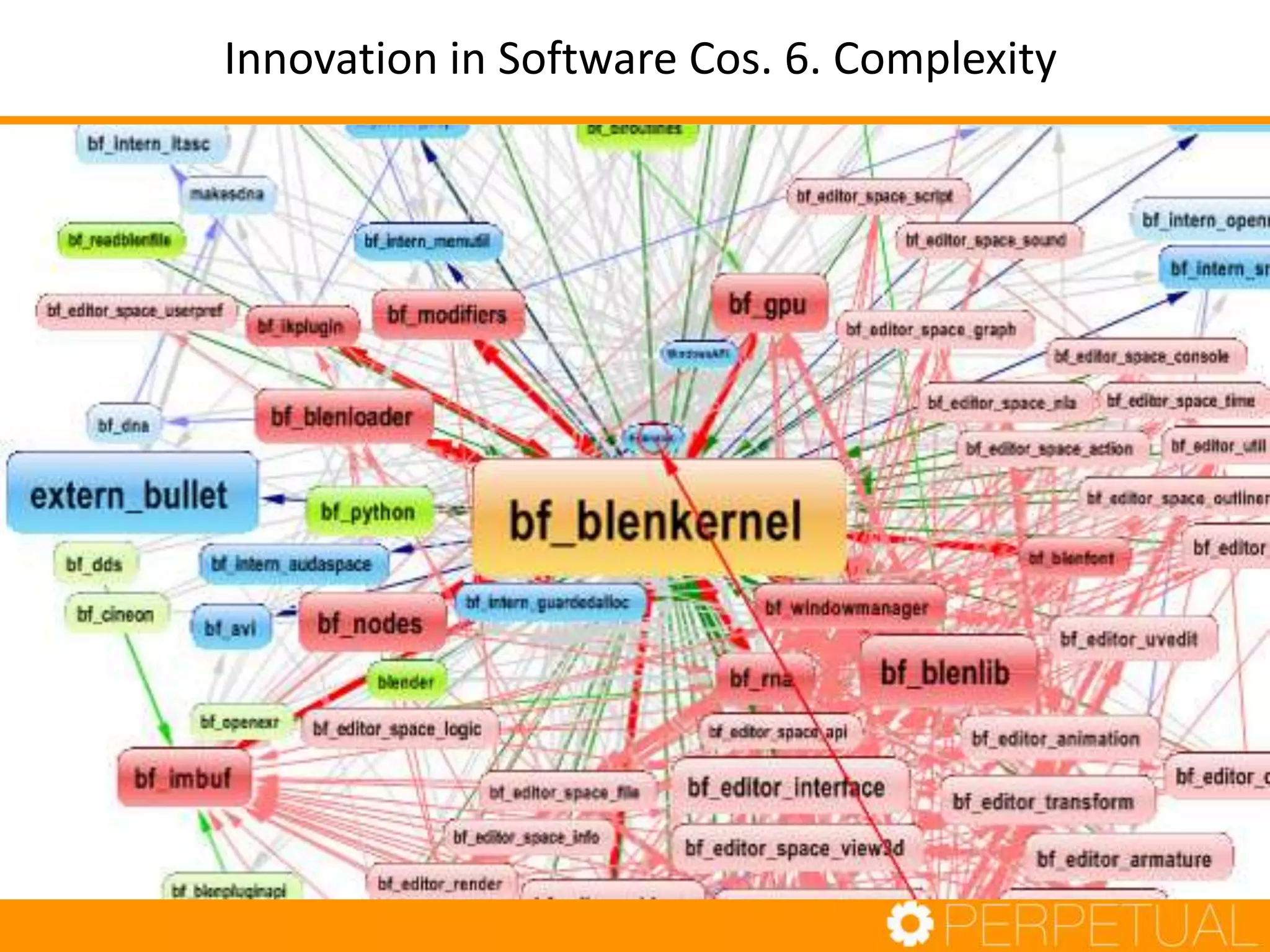
6. Complex Different software solutions for the same problem
7. Can have huge impact
with limited resources
Can unlock new business models. Enterprises should
allocate resources to new innovation
Innovation in Software Companies
Performance demanded
at market high end
Progress due to
sustaining technologies
Progress due to
disruptive technologies
ProductPerformance
Time
Performance demanded at
the low end of the market
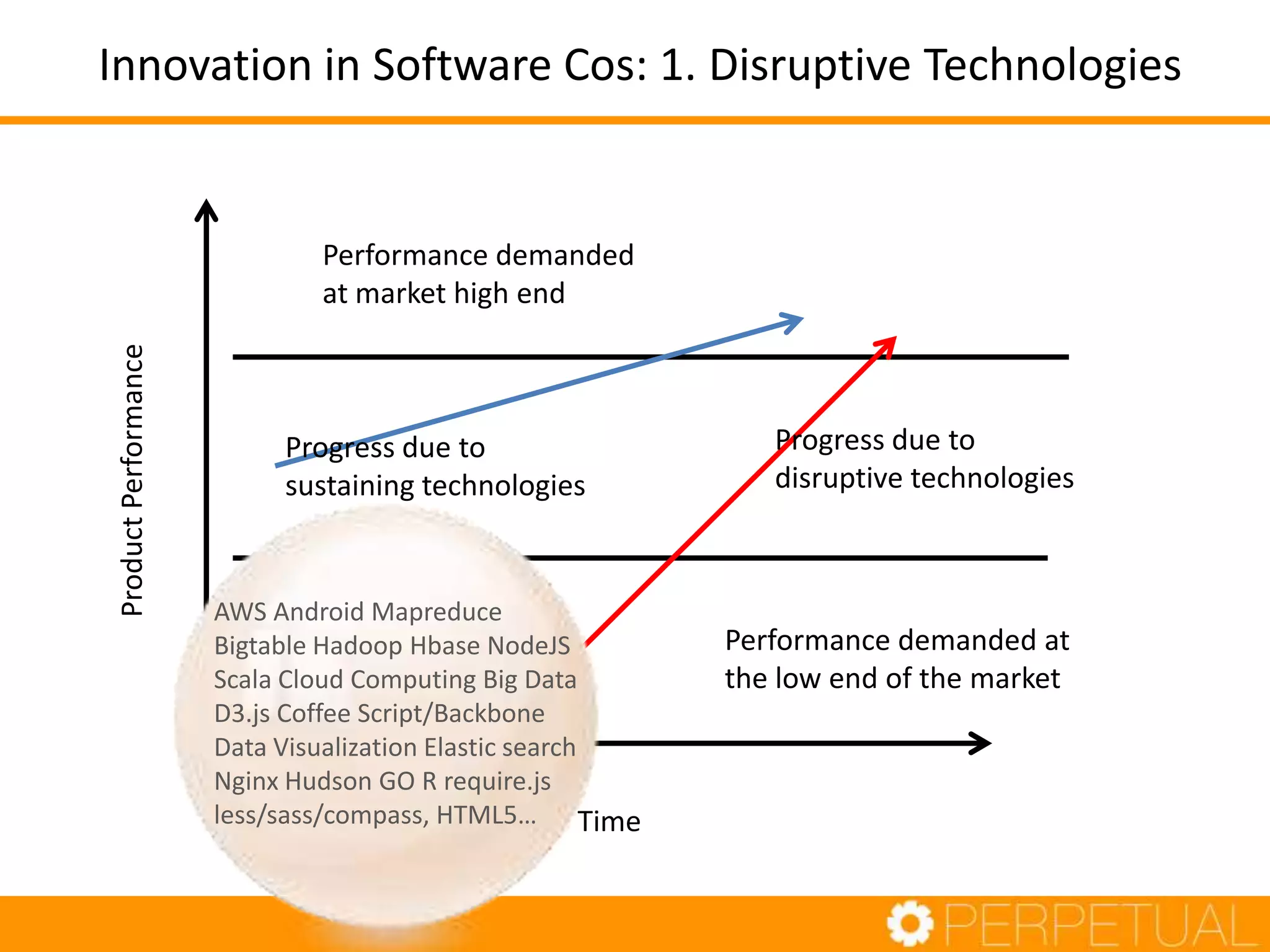
Innovation in Software Cos: 1. Disruptive Technologies
AWS Android Mapreduce
Bigtable Hadoop Hbase NodeJS
Scala Cloud Computing Big Data
D3.js Coffee Script/Backbone
Data Visualization Elastic search
Nginx Hudson GO R require.js
less/sass/compass, HTML5…
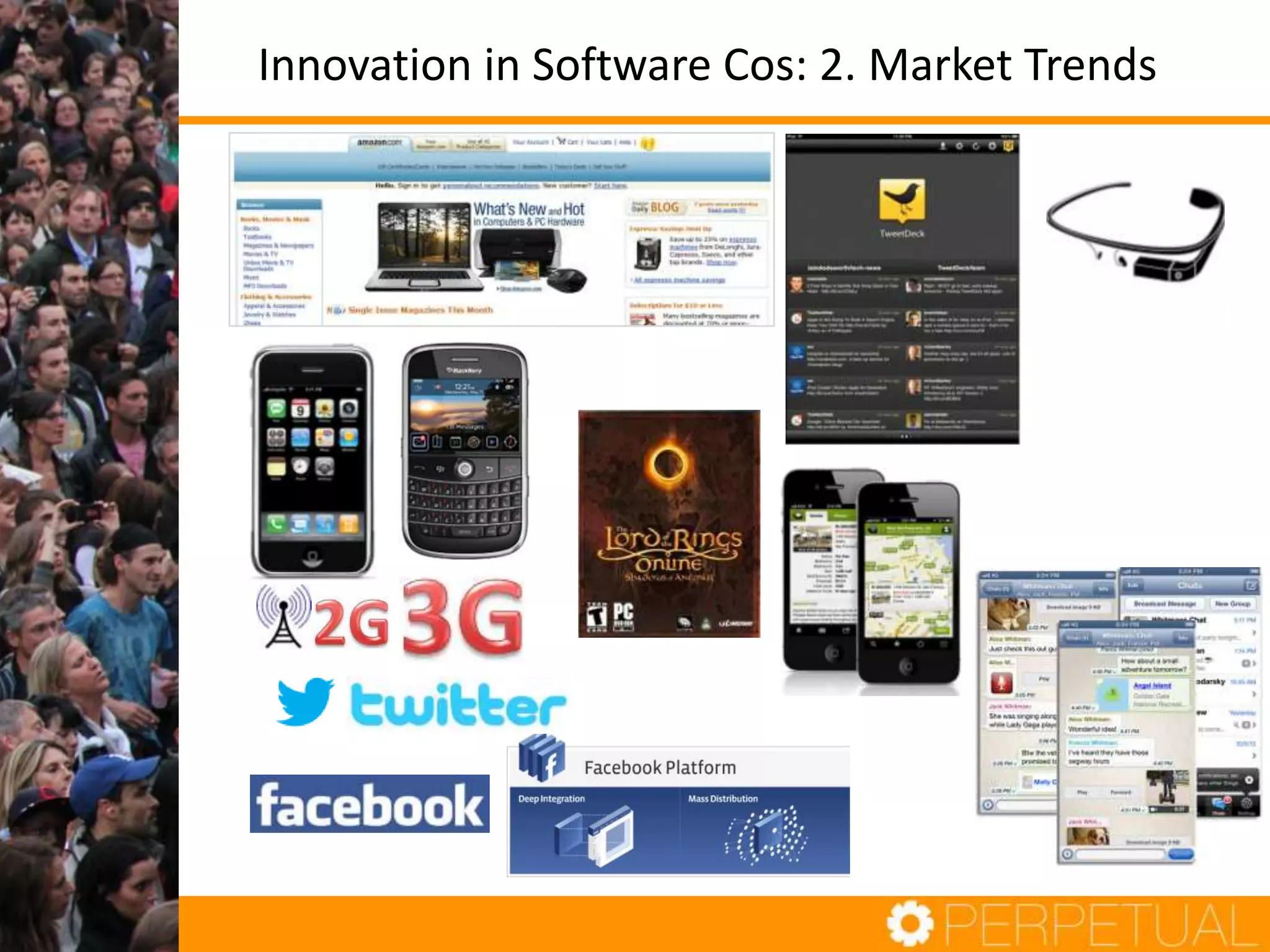
Innovation in Software Cos: 2. Market Trends
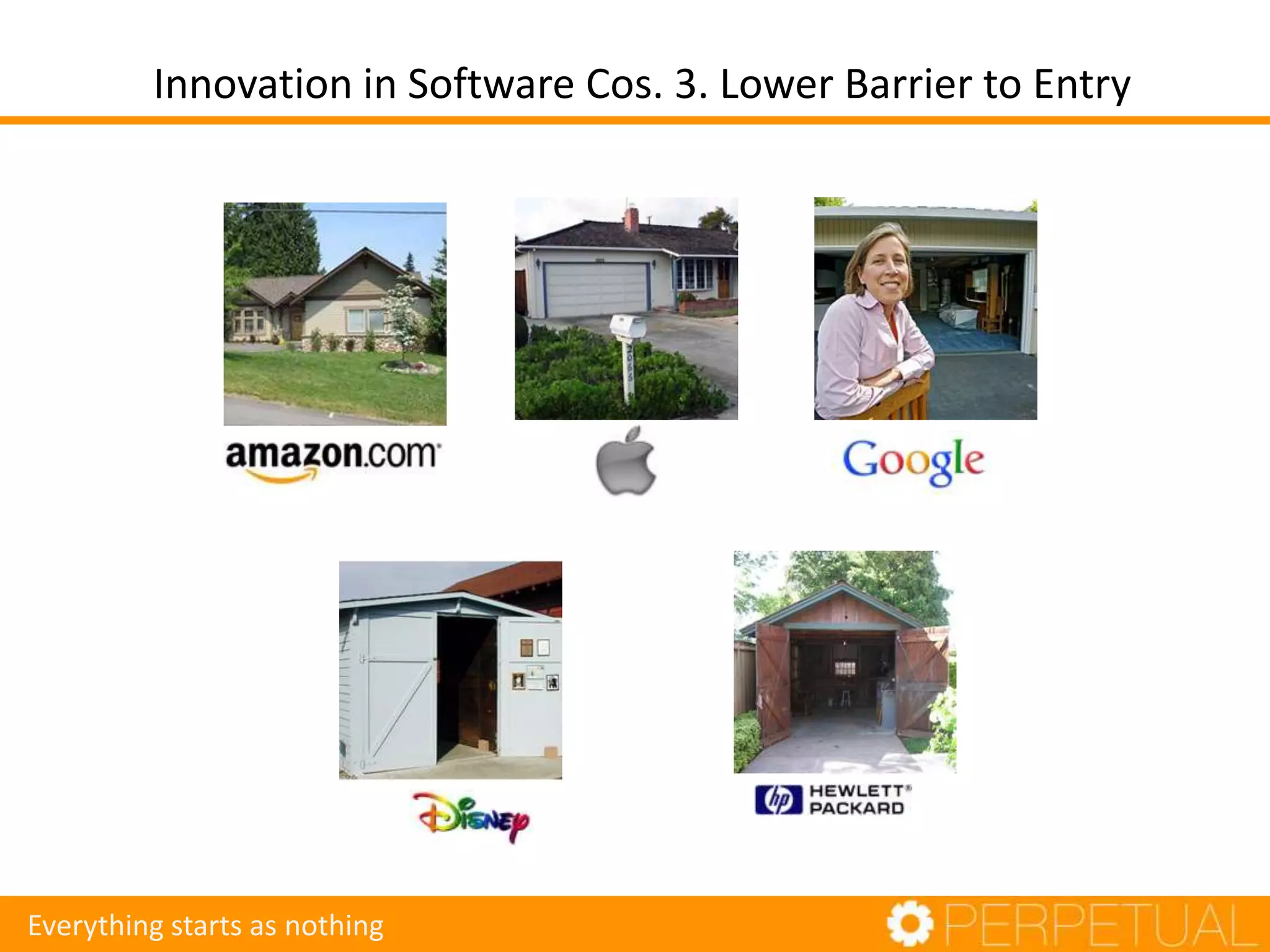
Innovation in Software Cos. 3. Lower Barrier to Entry
Everything starts as nothing
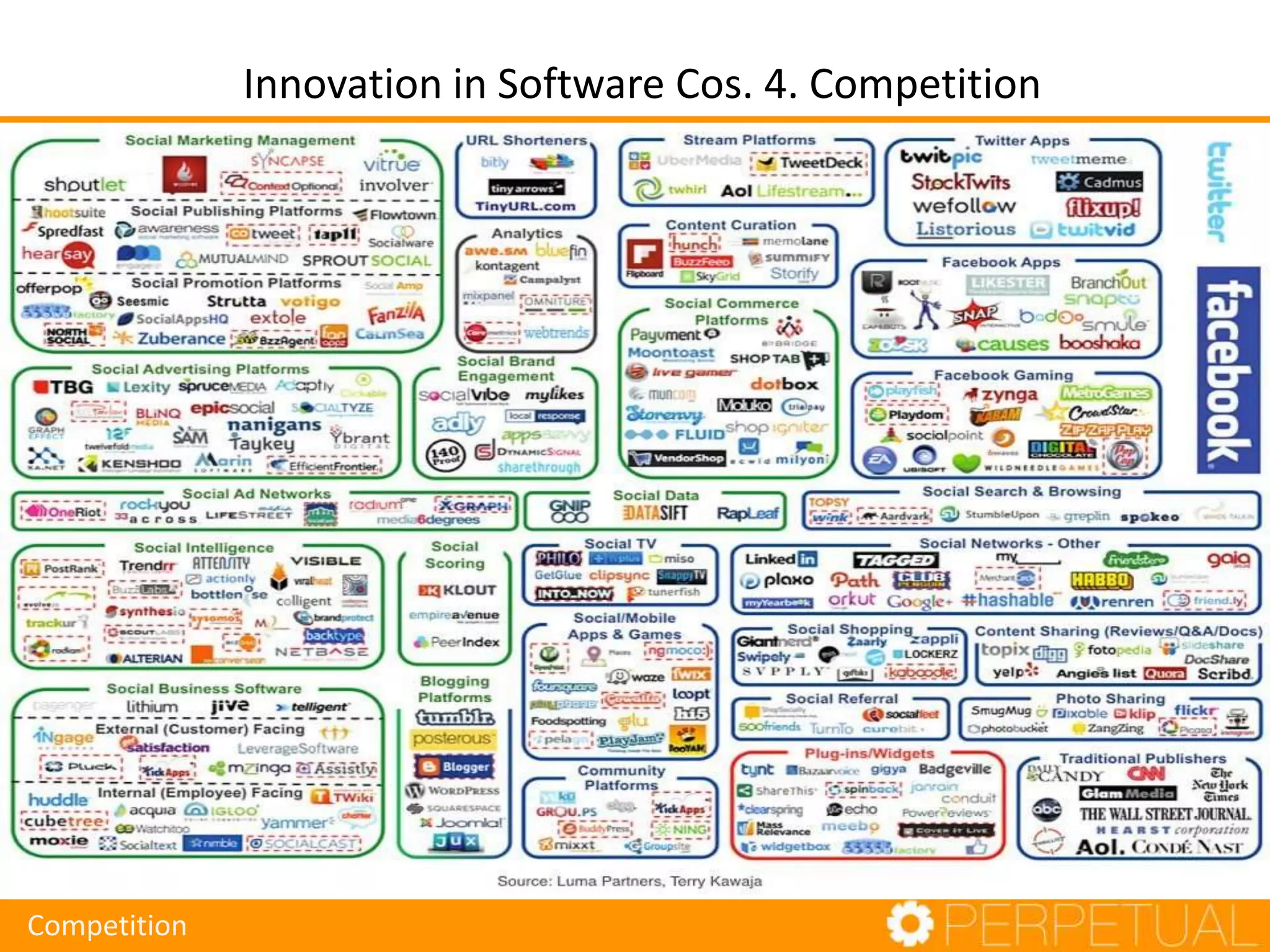
Innovation in Software Cos. 4. Competition
Competition
Innovation in Software Companies
5. Higher Level Value Creation
Value
Value Value Value Value
WaterfallAgile
Innovation in Software Cos. 6. Complexity
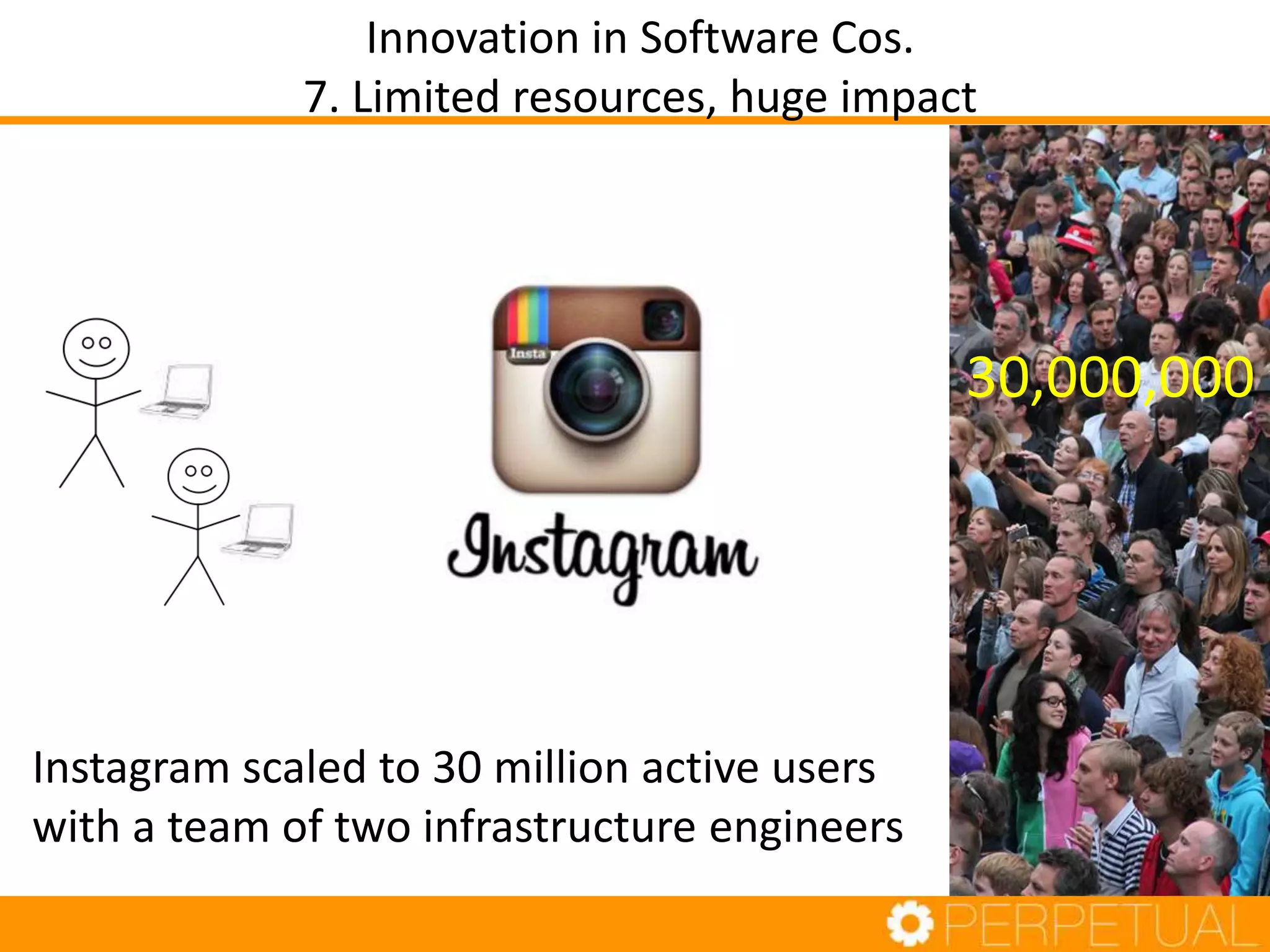
Instagram scaled to 30 million active users
with a team of two infrastructure engineers
Innovation in Software Cos.
7. Limited resources, huge impact
30,000,000
Innovation in Software Companies
Attribute Effect
1. Disruptive technologies New opportunities for disruption
2. Market trends Exponential customer adoption: Realtime, hyperlocal,
super-connected, always-on
3. Lower Barrier to Entry Ability to create something from nothing much more
easily
4. Competition High number of entrants, big and small
5. Higher level value
creation
S/W dev process evolved – 1-2 week delivery cycle is
typical vs. 3 month cycle
6. Complex Different software solutions for the same problem
7. Can have huge impact
with limited resources
Can unlock new business models. Enterprises should
allocate resources to new innovation
Innovation in Software Companies
Applying Innovation in a Software
Company
7 Steps
7 Steps
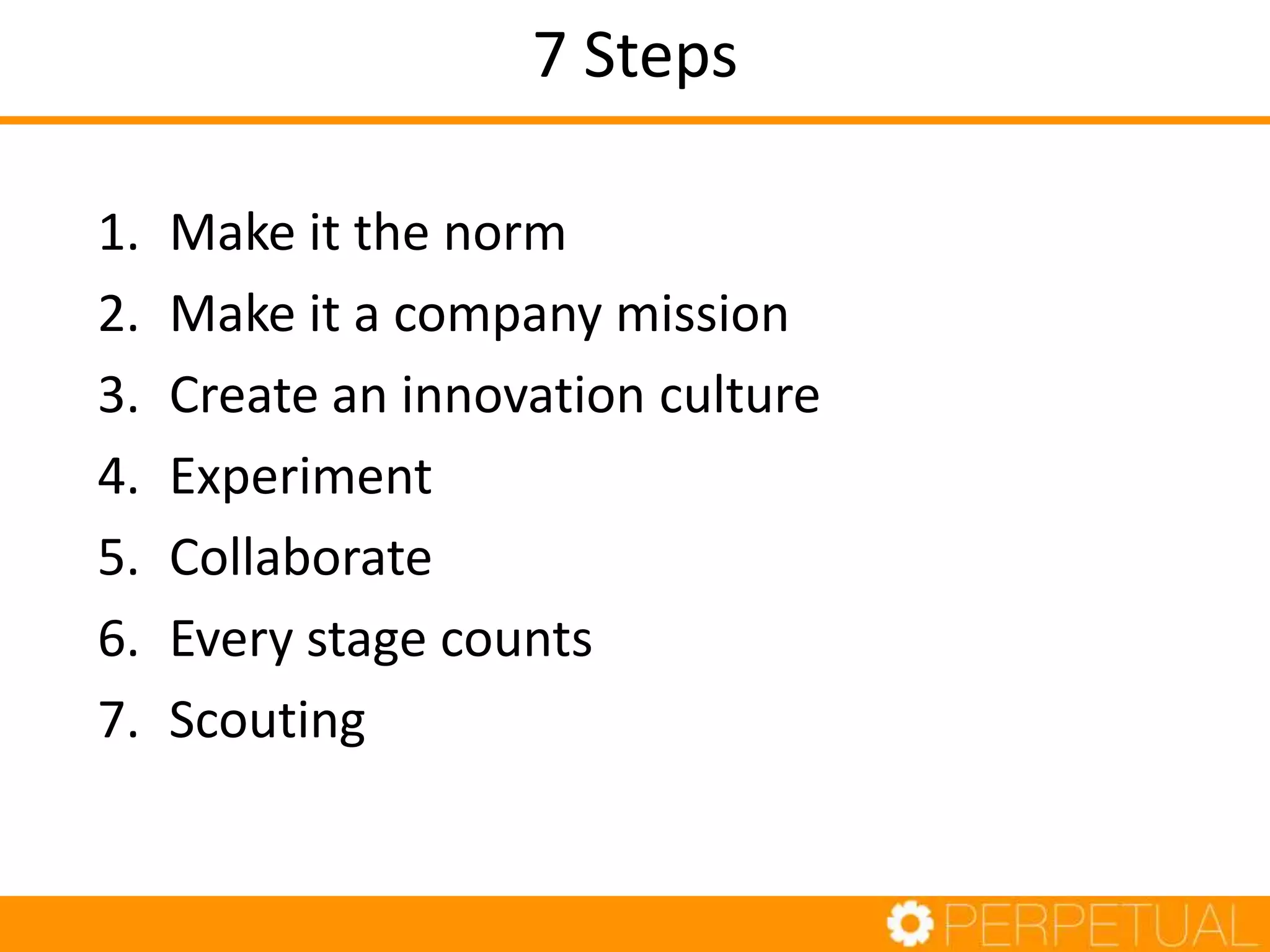
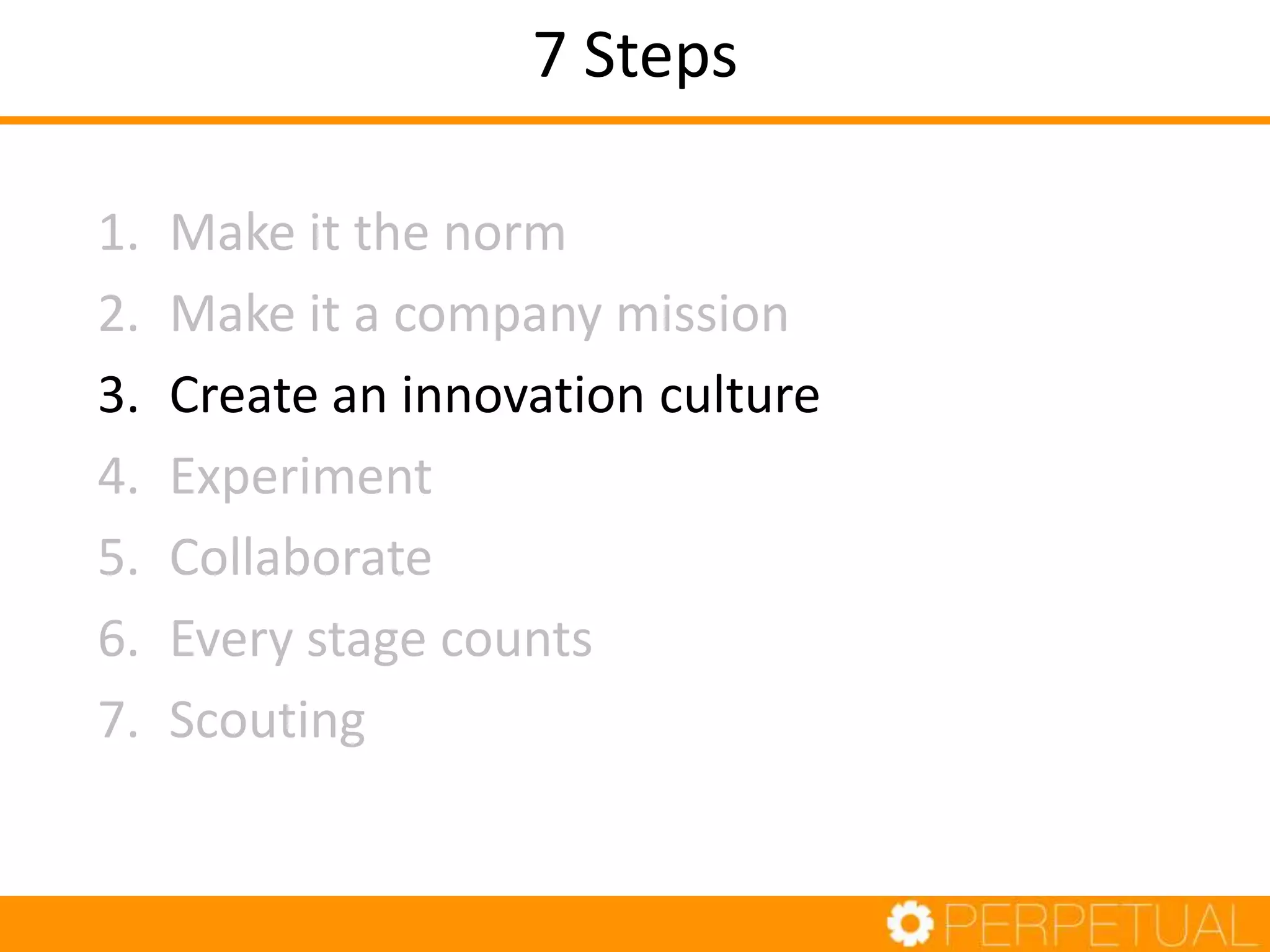
1. Make it the norm
2. Make it a company mission
3. Create an innovation culture
4. Experiment
5. Collaborate
6. Every stage counts
7. Scouting
7 Steps
1. Make it the norm
2. Make it a company mission
3. Create an innovation culture
4. Experiment
5. Collaborate
6. Every stage counts
7. Scouting
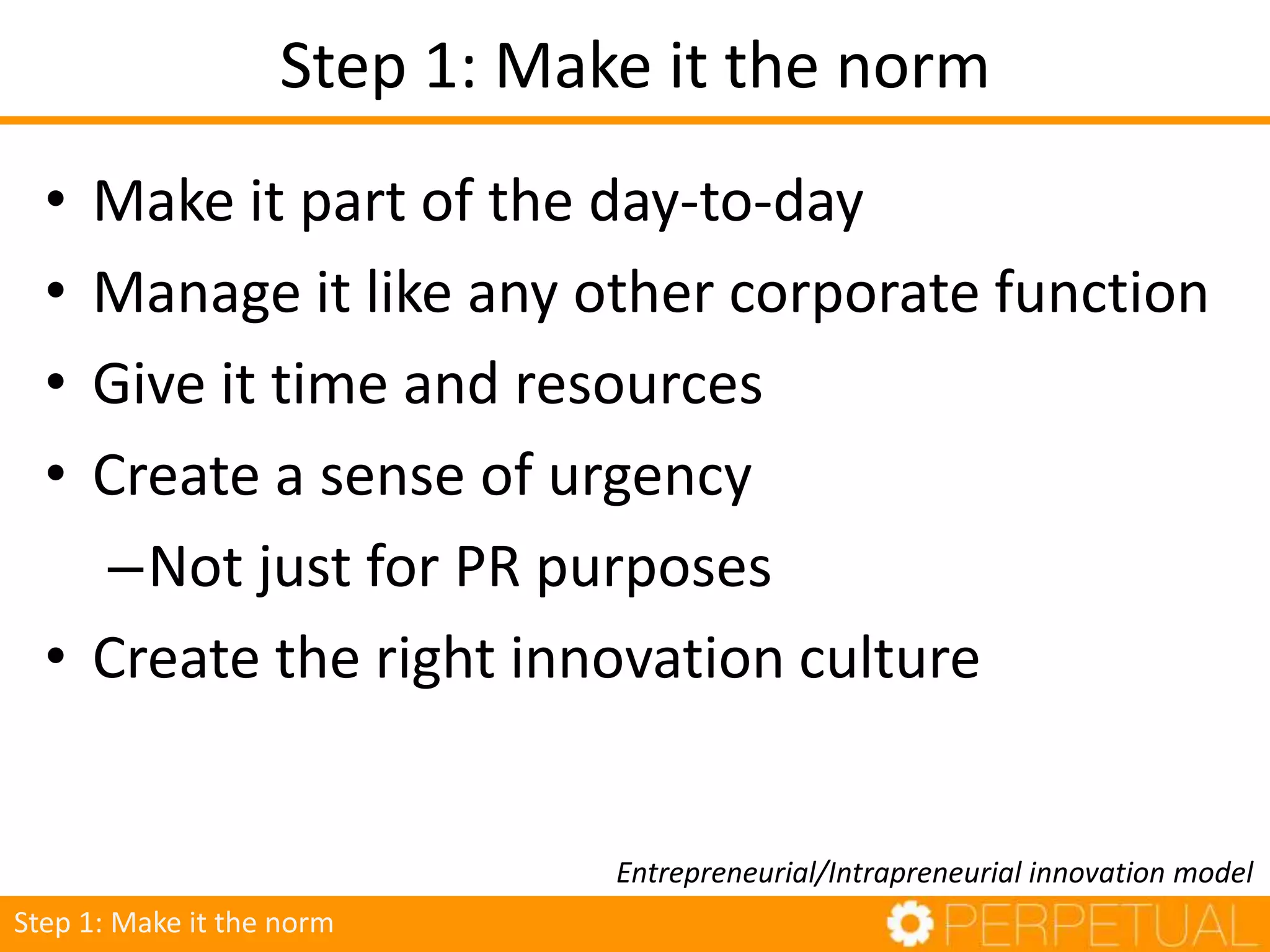
Step 1: Make it the norm
• Make it part of the day-to-day
• Manage it like any other corporate function
• Give it time and resources
• Create a sense of urgency
–Not just for PR purposes
• Create the right innovation culture
Entrepreneurial/Intrapreneurial innovation model
Step 1: Make it the norm
Step 1: Make it the norm. How?
Step 1: Make it the norm
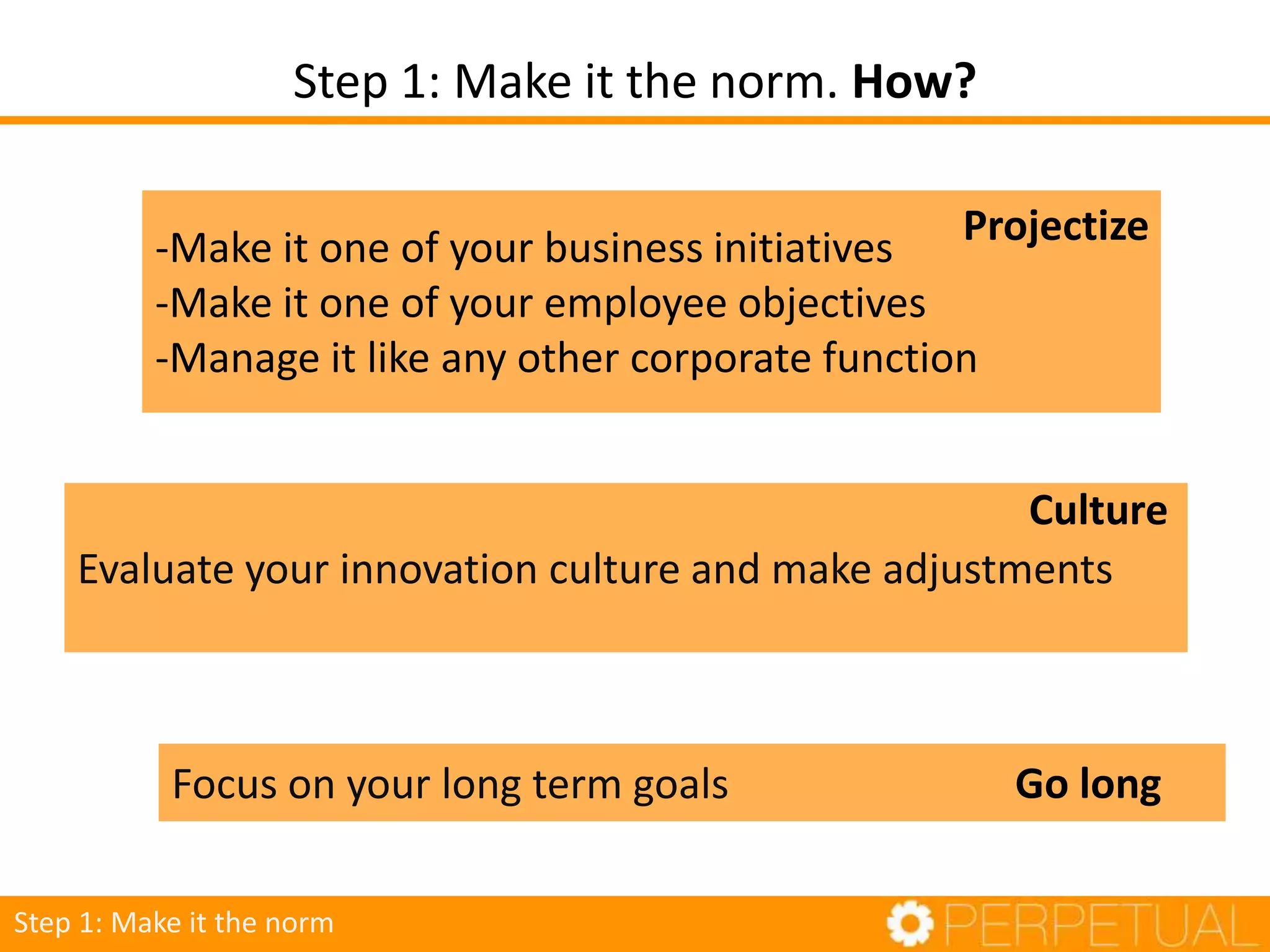
-Make it one of your business initiatives
-Make it one of your employee objectives
-Manage it like any other corporate function
Projectize
Focus on your long term goals Go long
Evaluate your innovation culture and make adjustments
Culture
Step 1: Make it the norm. How?
Step 1: Make it the norm
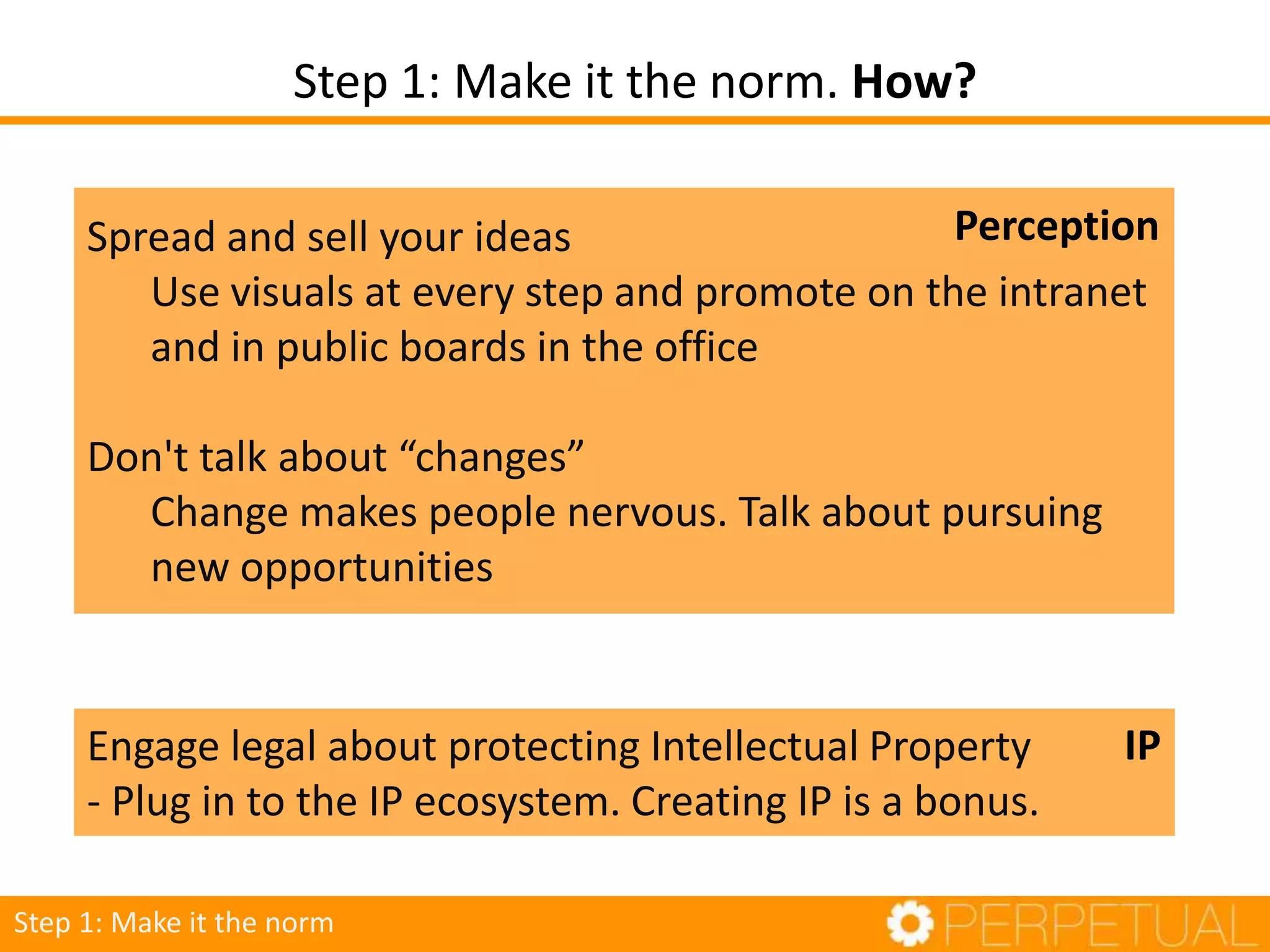
Engage legal about protecting Intellectual Property
- Plug in to the IP ecosystem. Creating IP is a bonus.
IP
Spread and sell your ideas
Use visuals at every step and promote on the intranet
and in public boards in the office
Don't talk about “changes”
Change makes people nervous. Talk about pursuing
new opportunities
Perception
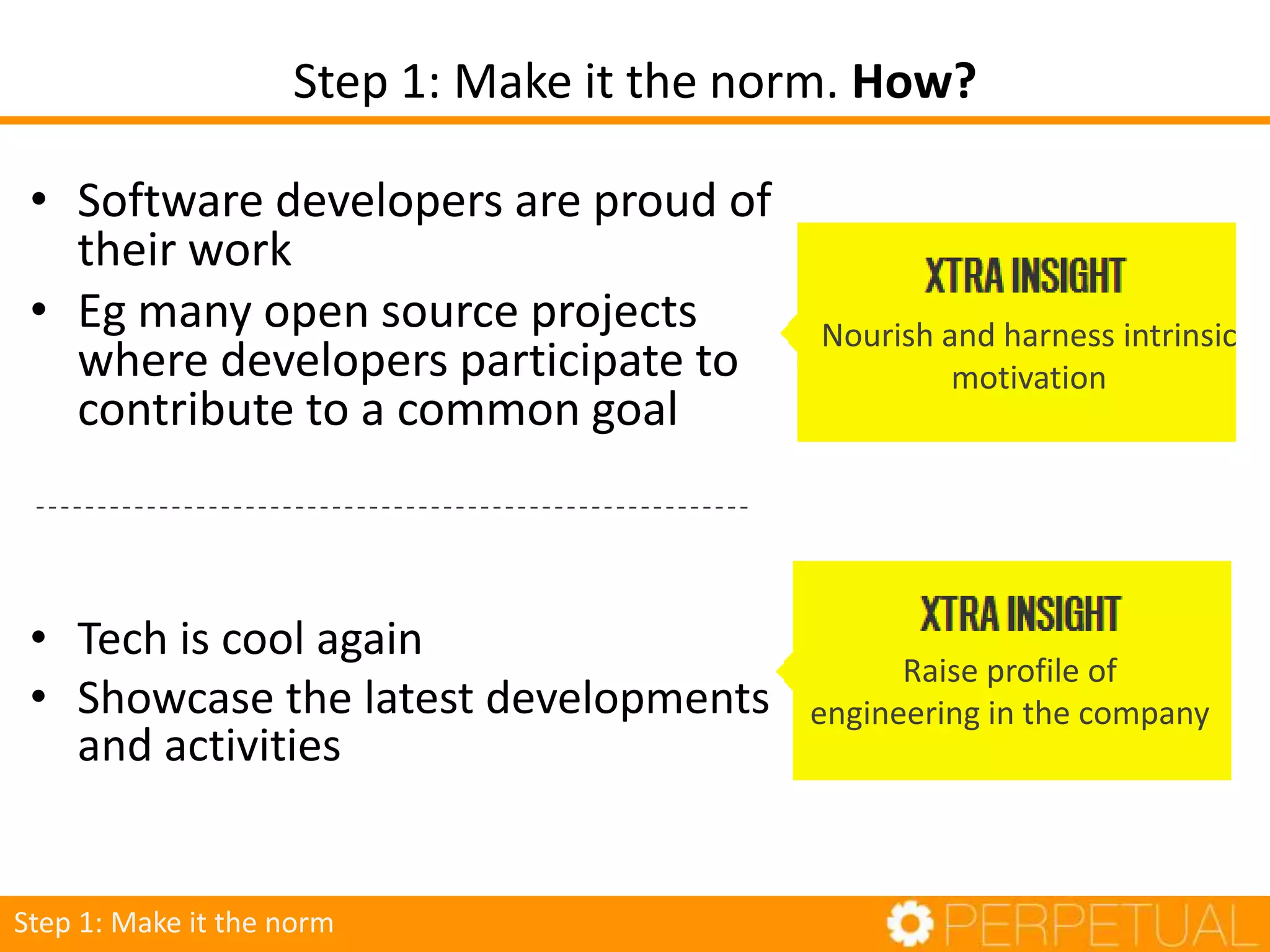
• Software developers are proud of
their work
• Eg many open source projects
where developers participate to
contribute to a common goal
• Tech is cool again
• Showcase the latest developments
and activities
Nourish and harness intrinsic
motivation
Raise profile of
engineering in the company
Step 1: Make it the norm
Step 1: Make it the norm. How?
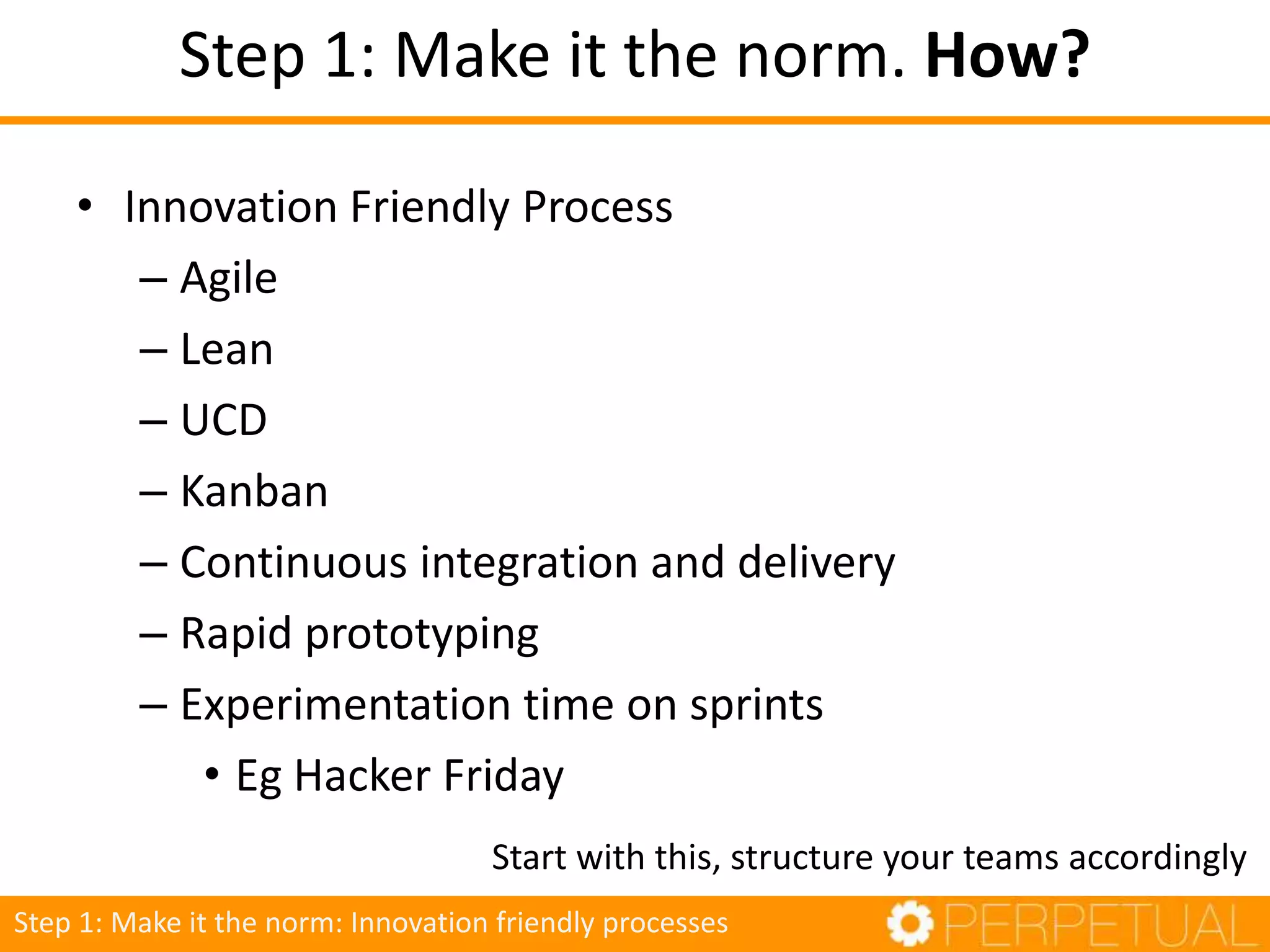
• Innovation Friendly Process
– Agile
– Lean
– UCD
– Kanban
– Continuous integration and delivery
– Rapid prototyping
– Experimentation time on sprints
• Eg Hacker Friday
Step 1: Make it the norm: Innovation friendly processes
Step 1: Make it the norm. How?
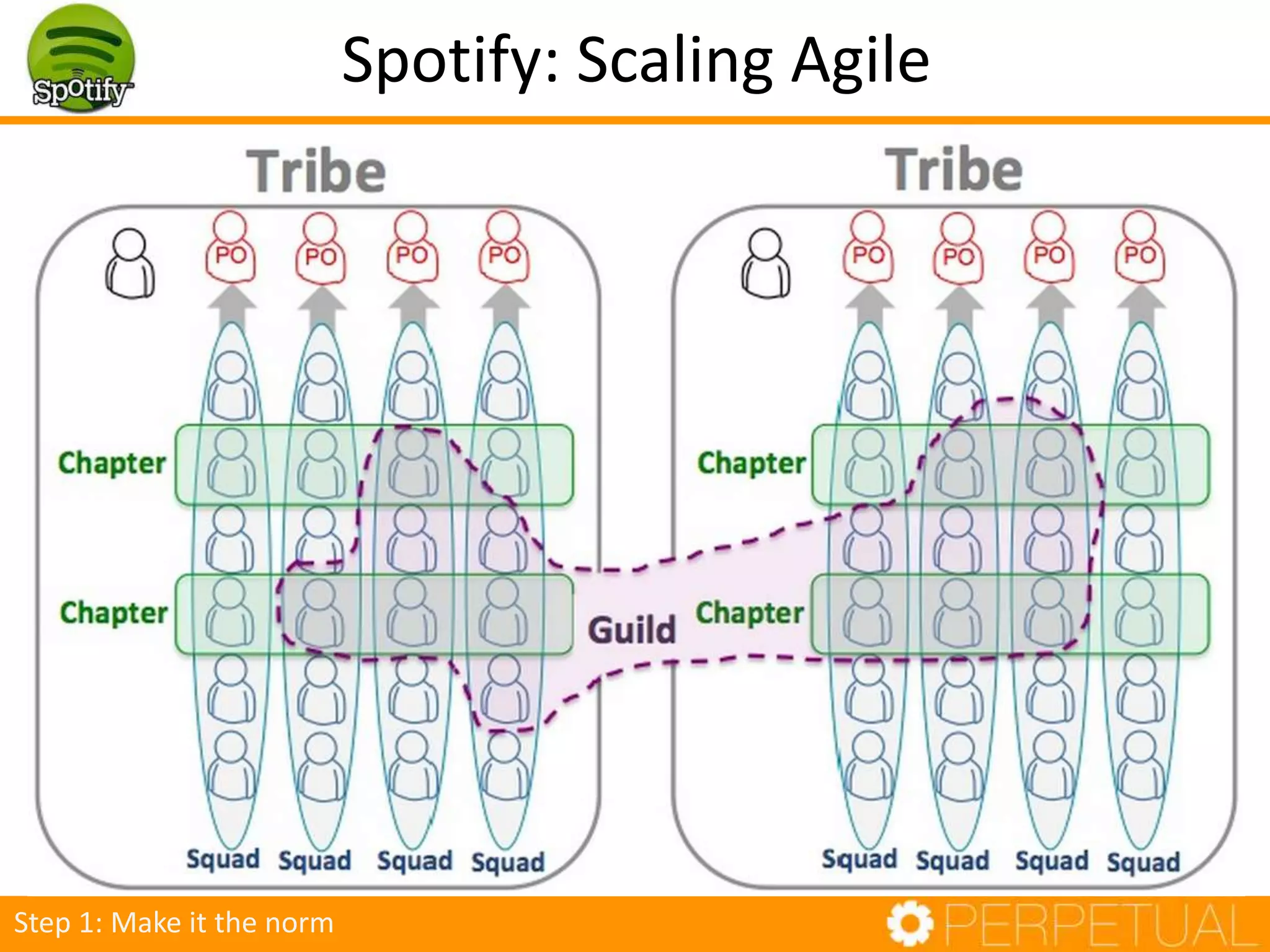
Start with this, structure your teams accordingly
Spotify: Scaling Agile
Step 1: Make it the norm
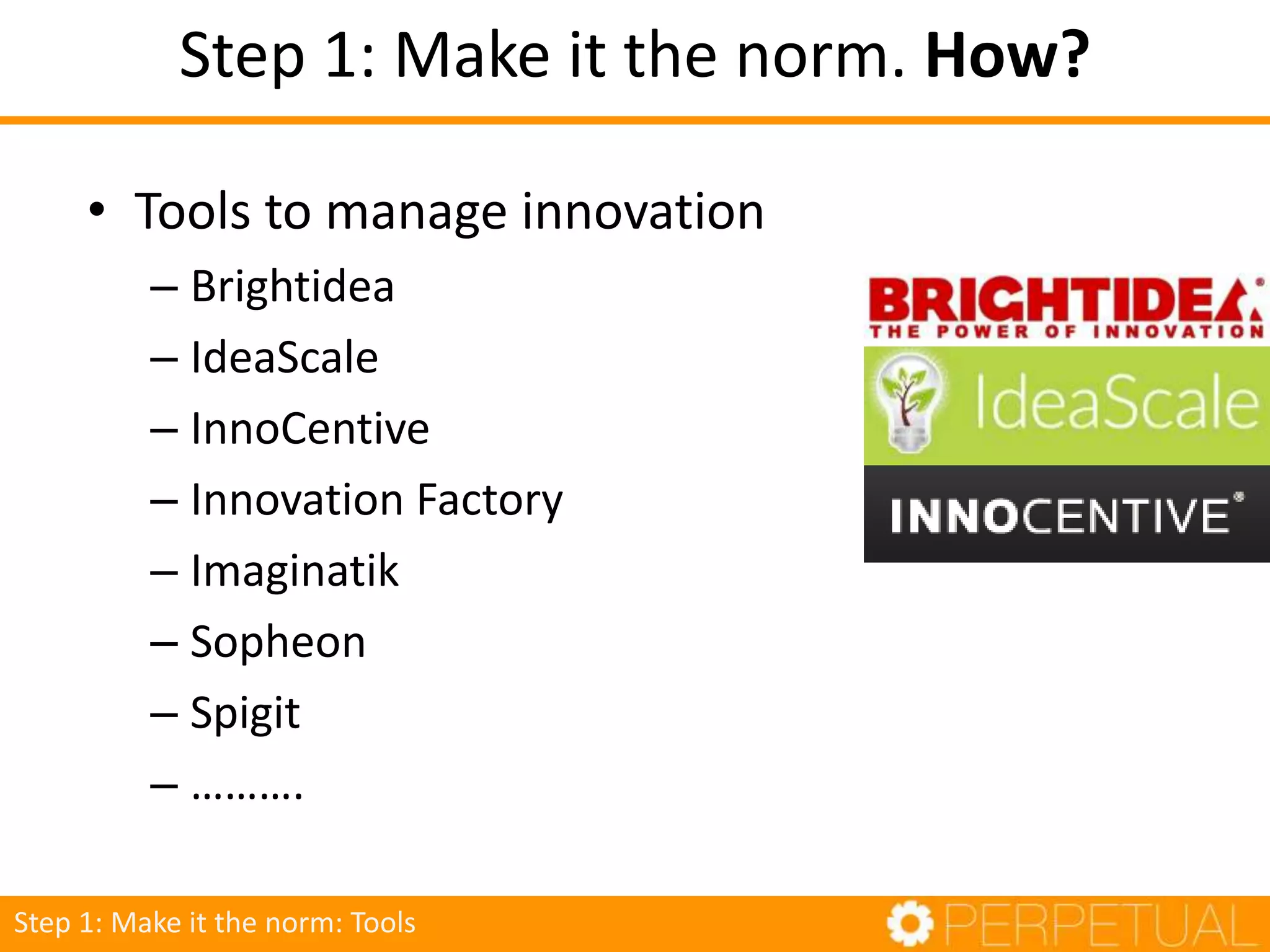
• Tools to manage innovation
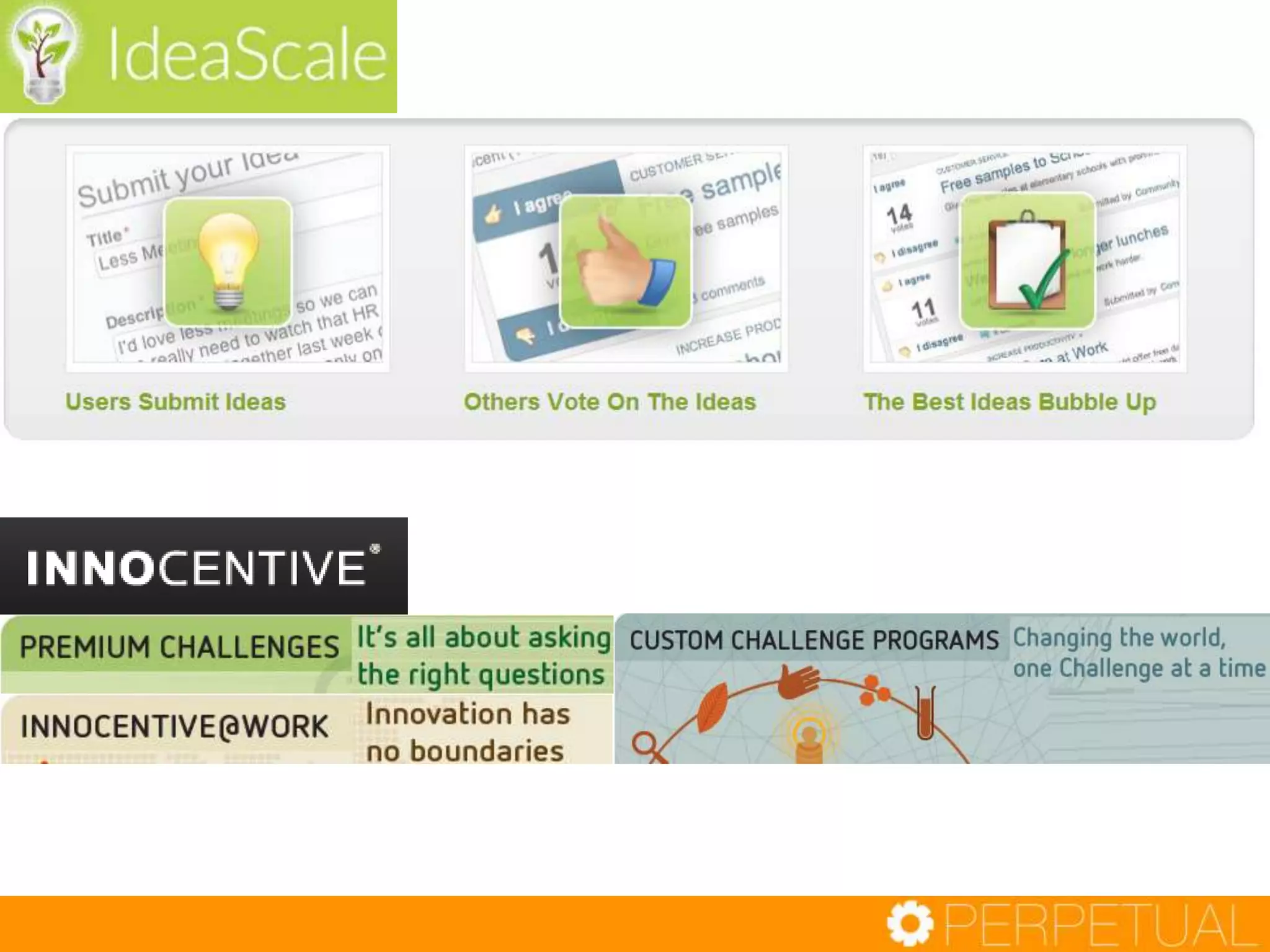
– Brightidea
– IdeaScale
– InnoCentive
– Innovation Factory
– Imaginatik
– Sopheon
– Spigit
– ……….
Step 1: Make it the norm: Tools
Step 1: Make it the norm. How?
7 Steps
1. Make it the norm
2. Make it a company mission
3. Create an innovation culture
4. Experiment
5. Collaborate
6. Every stage counts
7. Scouting
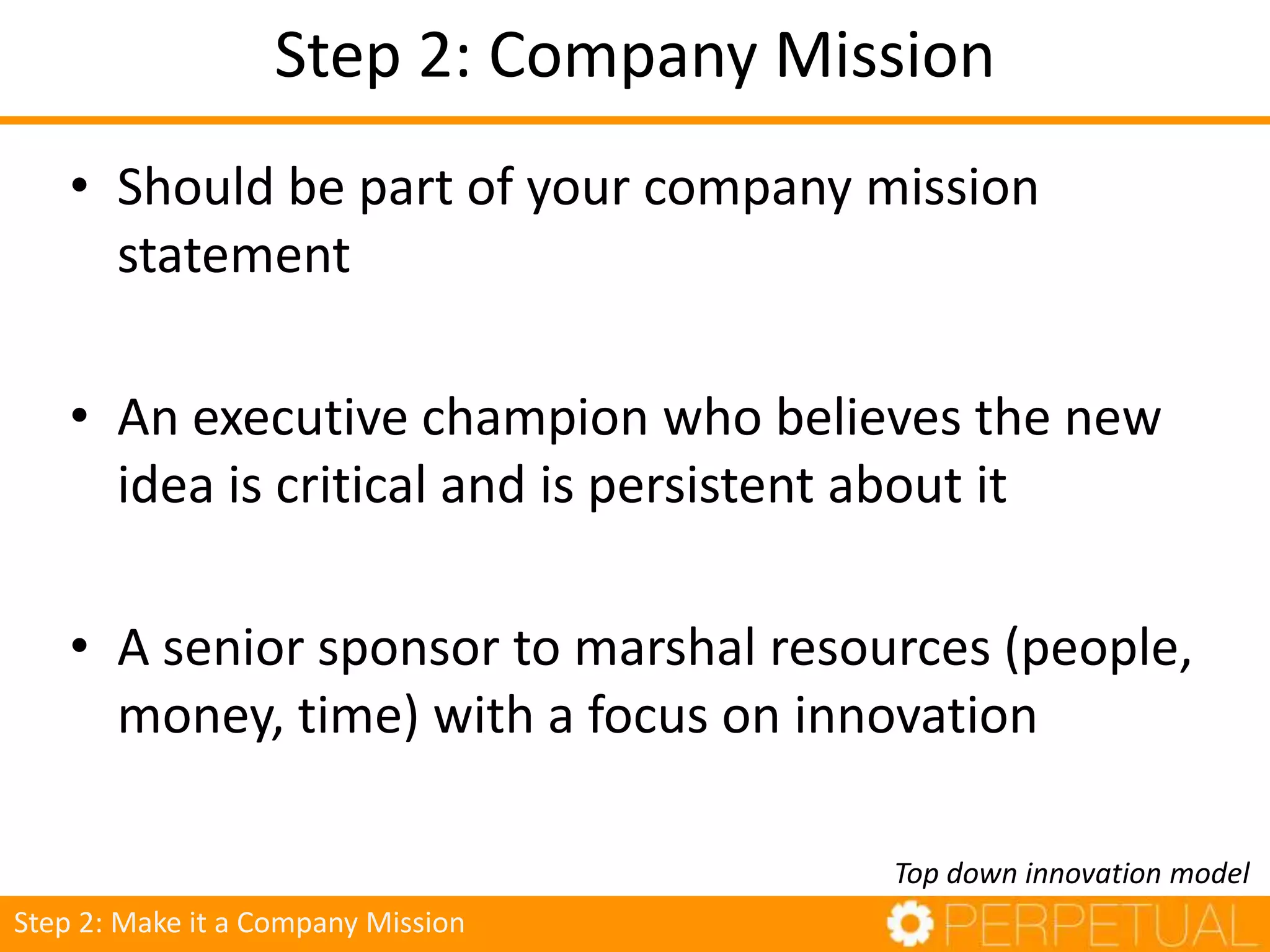
Step 2: Company Mission
• Should be part of your company mission
statement
• An executive champion who believes the new
idea is critical and is persistent about it
• A senior sponsor to marshal resources (people,
money, time) with a focus on innovation
Top down innovation model
Step 2: Make it a Company Mission
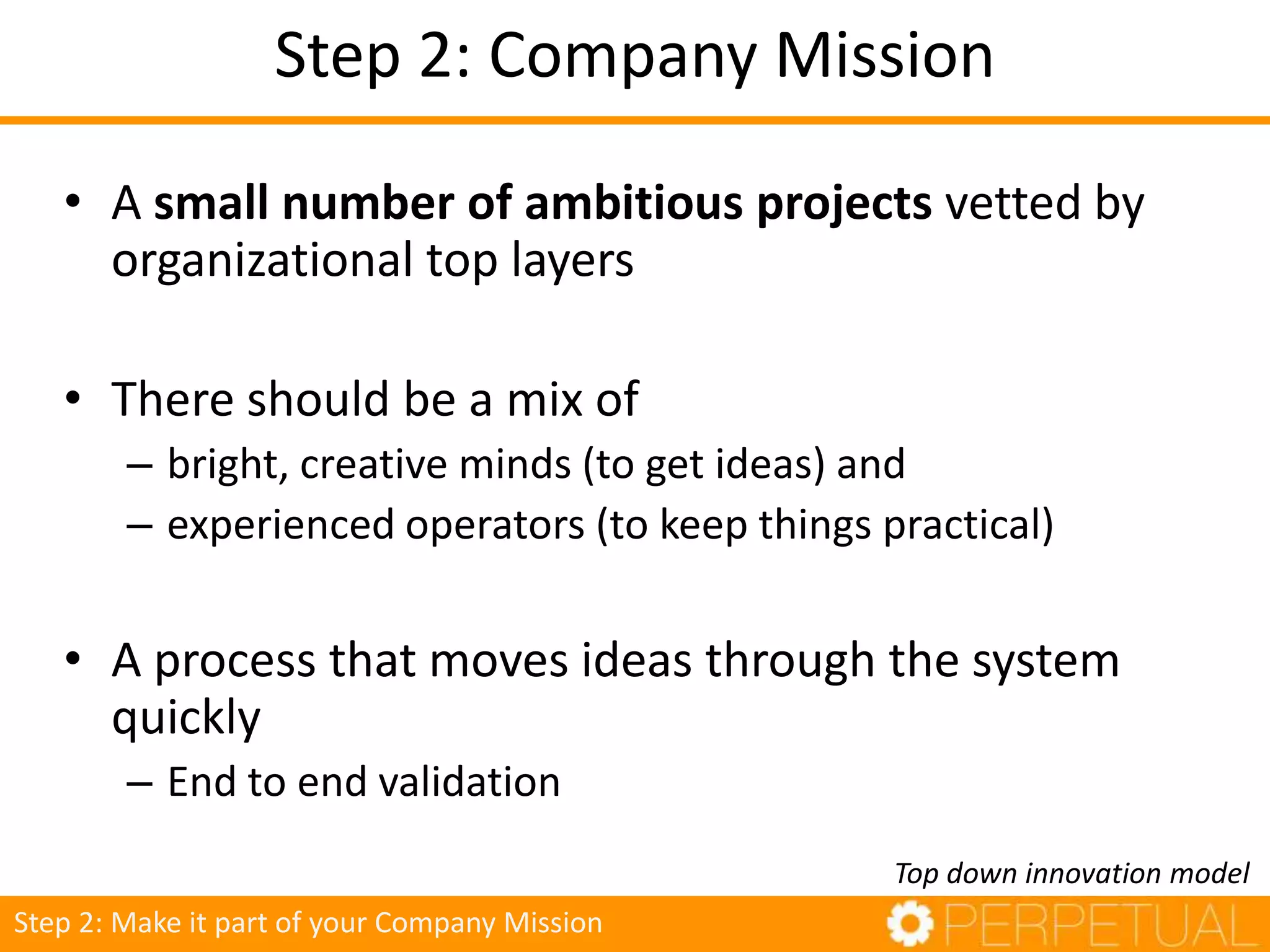
Step 2: Company Mission
• A small number of ambitious projects vetted by
organizational top layers
• There should be a mix of
– bright, creative minds (to get ideas) and
– experienced operators (to keep things practical)
• A process that moves ideas through the system
quickly
– End to end validation
Top down innovation model
Step 2: Make it part of your Company Mission
7 Steps
1. Make it the norm
2. Make it a company mission
3. Create an innovation culture
4. Experiment
5. Collaborate
6. Every stage counts
7. Scouting
Step 3: Create an Innovation Culture
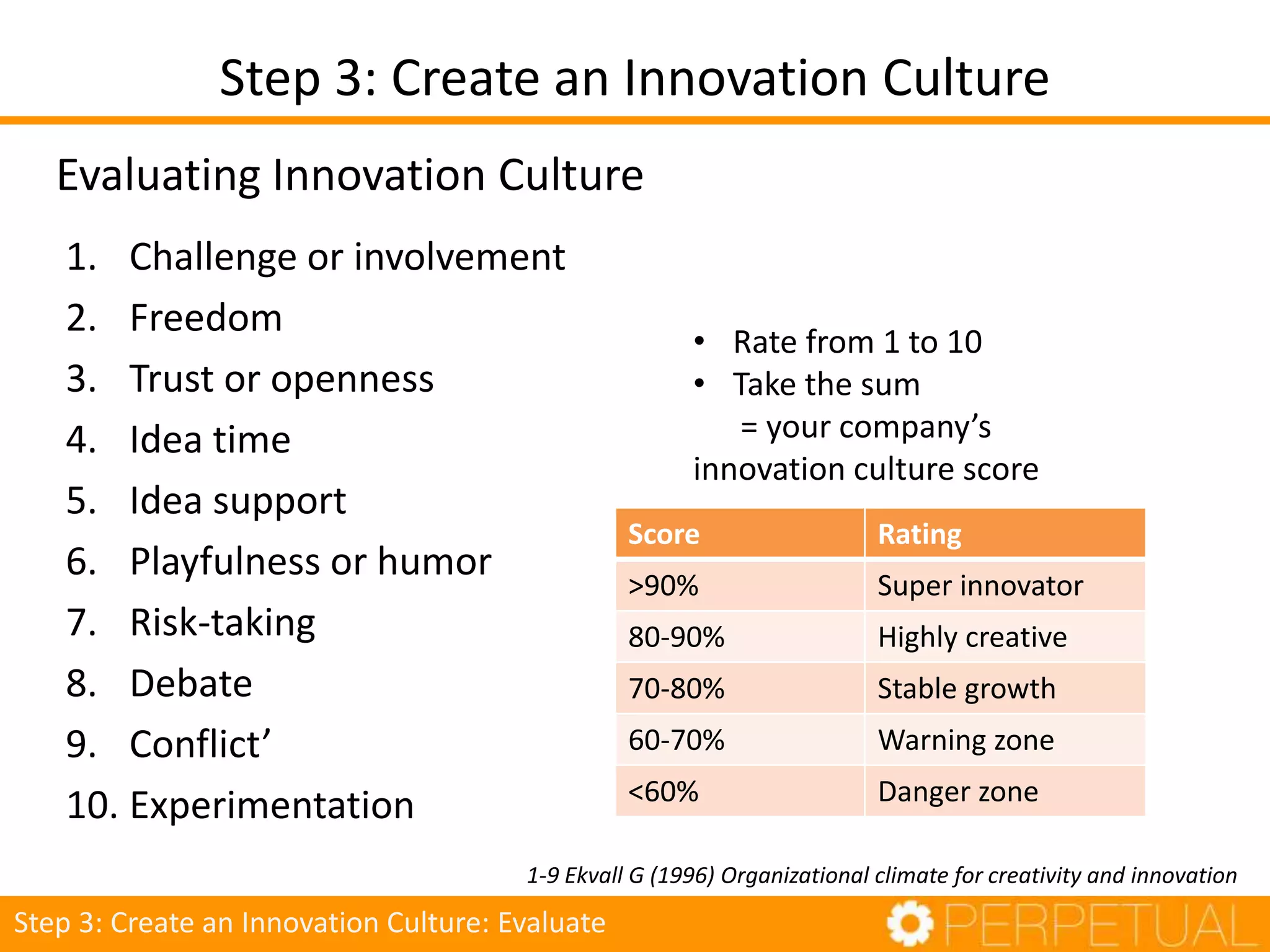
1. Challenge or involvement
2. Freedom
3. Trust or openness
4. Idea time
5. Idea support
6. Playfulness or humor
7. Risk-taking
8. Debate
9. Conflict’
10. Experimentation
1-9 Ekvall G (1996) Organizational climate for creativity and innovation
• Rate from 1 to 10
• Take the sum
= your company’s
innovation culture score
Score Rating
>90% Super innovator
80-90% Highly creative
70-80% Stable growth
60-70% Warning zone
<60% Danger zone
Step 3: Create an Innovation Culture: Evaluate
Evaluating Innovation Culture
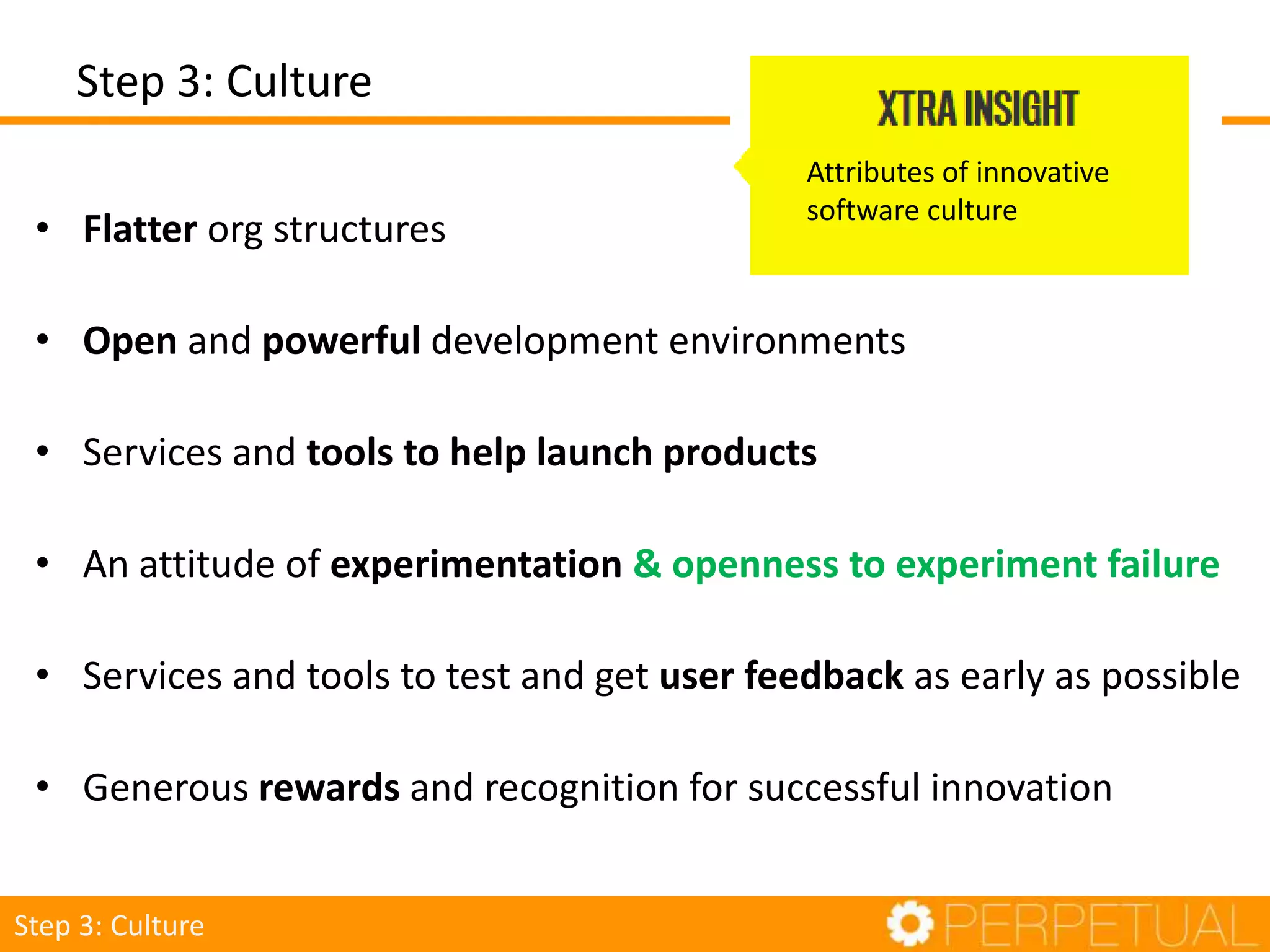
• Flatter org structures
• Open and powerful development environments
• Services and tools to help launch products
• An attitude of experimentation & openness to experiment failure
• Services and tools to test and get user feedback as early as possible
• Generous rewards and recognition for successful innovation
Attributes of innovative
software culture
Step 3: Culture
Step 3: Culture
Creativity Enhancing Techniques
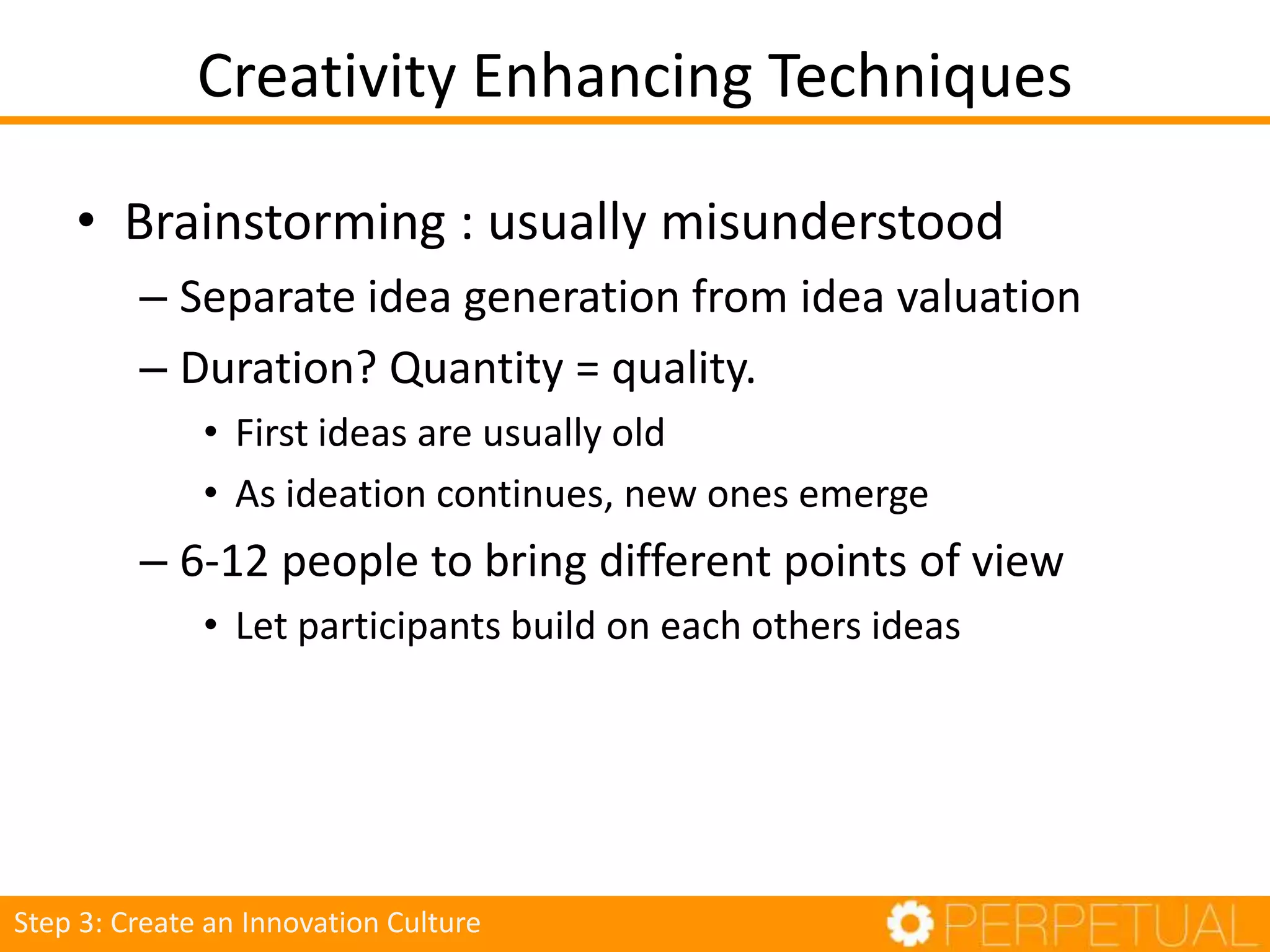
• Brainstorming : usually misunderstood
– Separate idea generation from idea valuation
– Duration? Quantity = quality.
• First ideas are usually old
• As ideation continues, new ones emerge
– 6-12 people to bring different points of view
• Let participants build on each others ideas
Step 3: Create an Innovation Culture
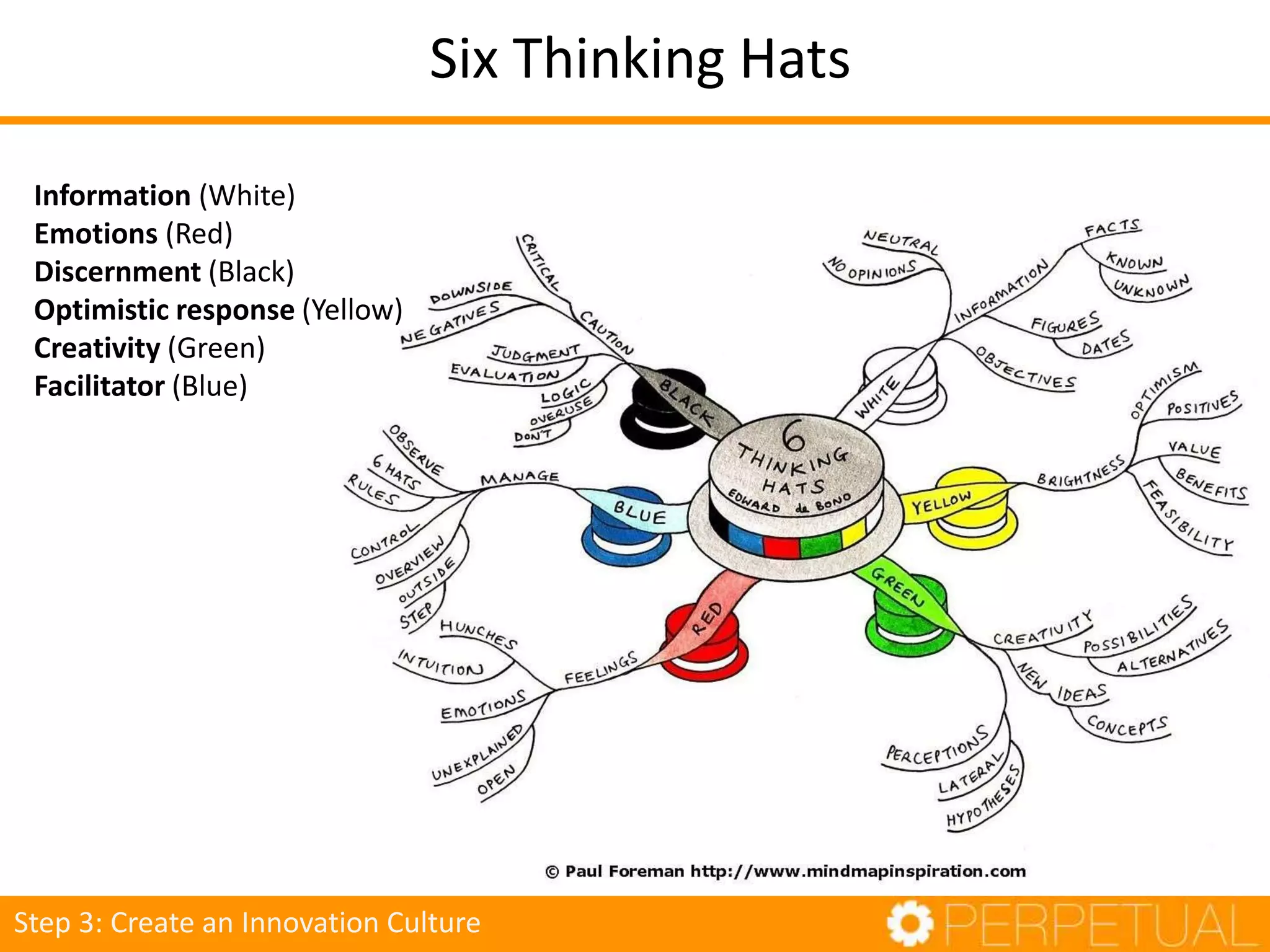
Six Thinking Hats
Information (White)
Emotions (Red)
Discernment (Black)
Optimistic response (Yellow)
Creativity (Green)
Facilitator (Blue)
Step 3: Create an Innovation Culture
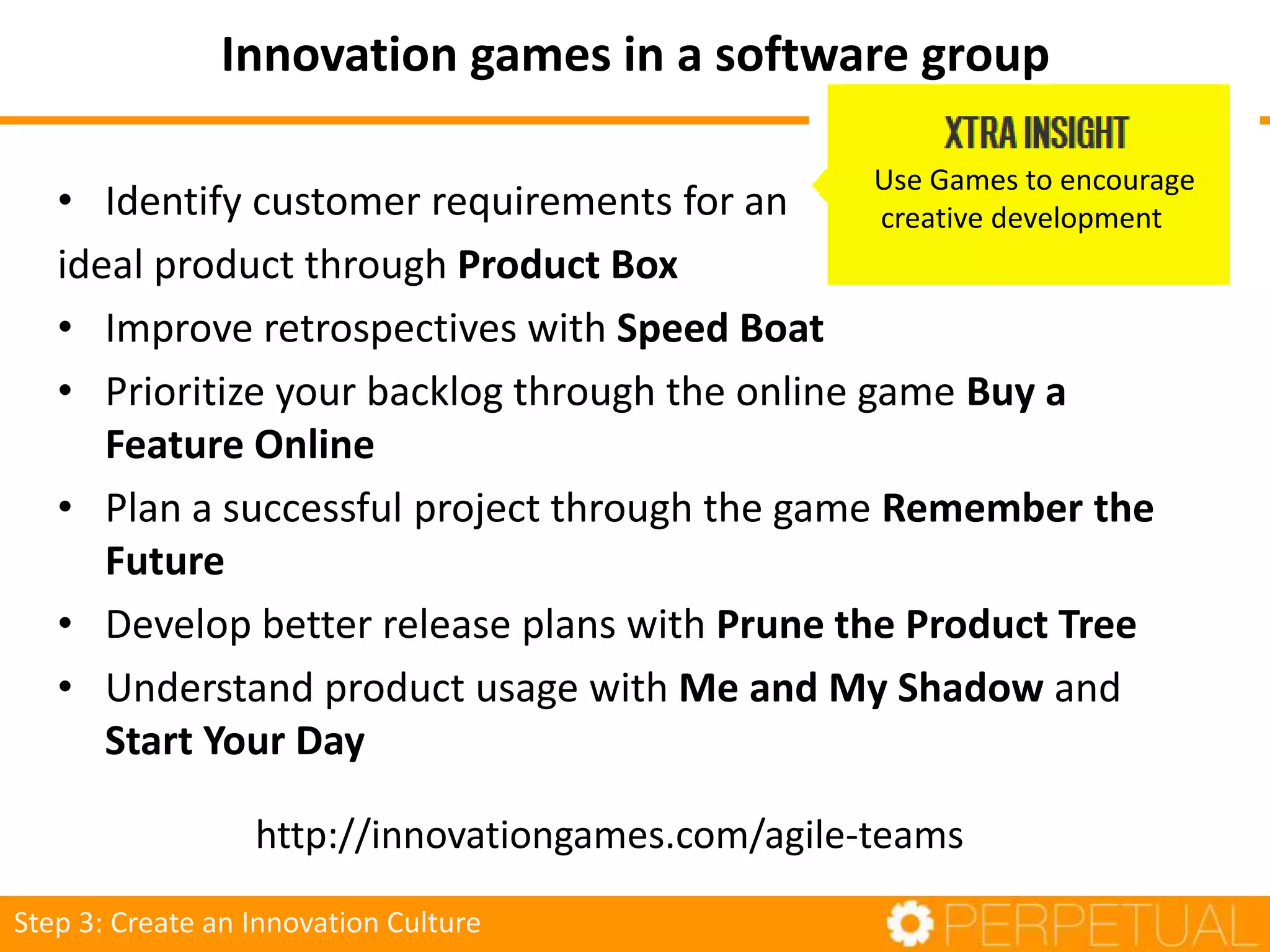
• Identify customer requirements for an
ideal product through Product Box
• Improve retrospectives with Speed Boat
• Prioritize your backlog through the online game Buy a
Feature Online
• Plan a successful project through the game Remember the
Future
• Develop better release plans with Prune the Product Tree
• Understand product usage with Me and My Shadow and
Start Your Day
http://innovationgames.com/agile-teams
Step 3: Create an Innovation Culture
Use Games to encourage
creative development
Innovation games in a software group
7 Steps
1. Make it the norm
2. Make it a company mission
3. Create an innovation culture
4. Experiment
5. Collaborate
6. Every stage counts
7. Scouting
Step 4: Experiment
• Run experiments instead of going on hunches
• Experiment lean and quick
– Validate your assumptions quickly
– Discard ideas, move one, fail fast
• Build early (a working prototype or code)
– Many advantages: users, stakeholders
• No penalty for failed experiments
• Focus on building real stuff vs. plans/designs
• Hack days
Step 4: Experiment
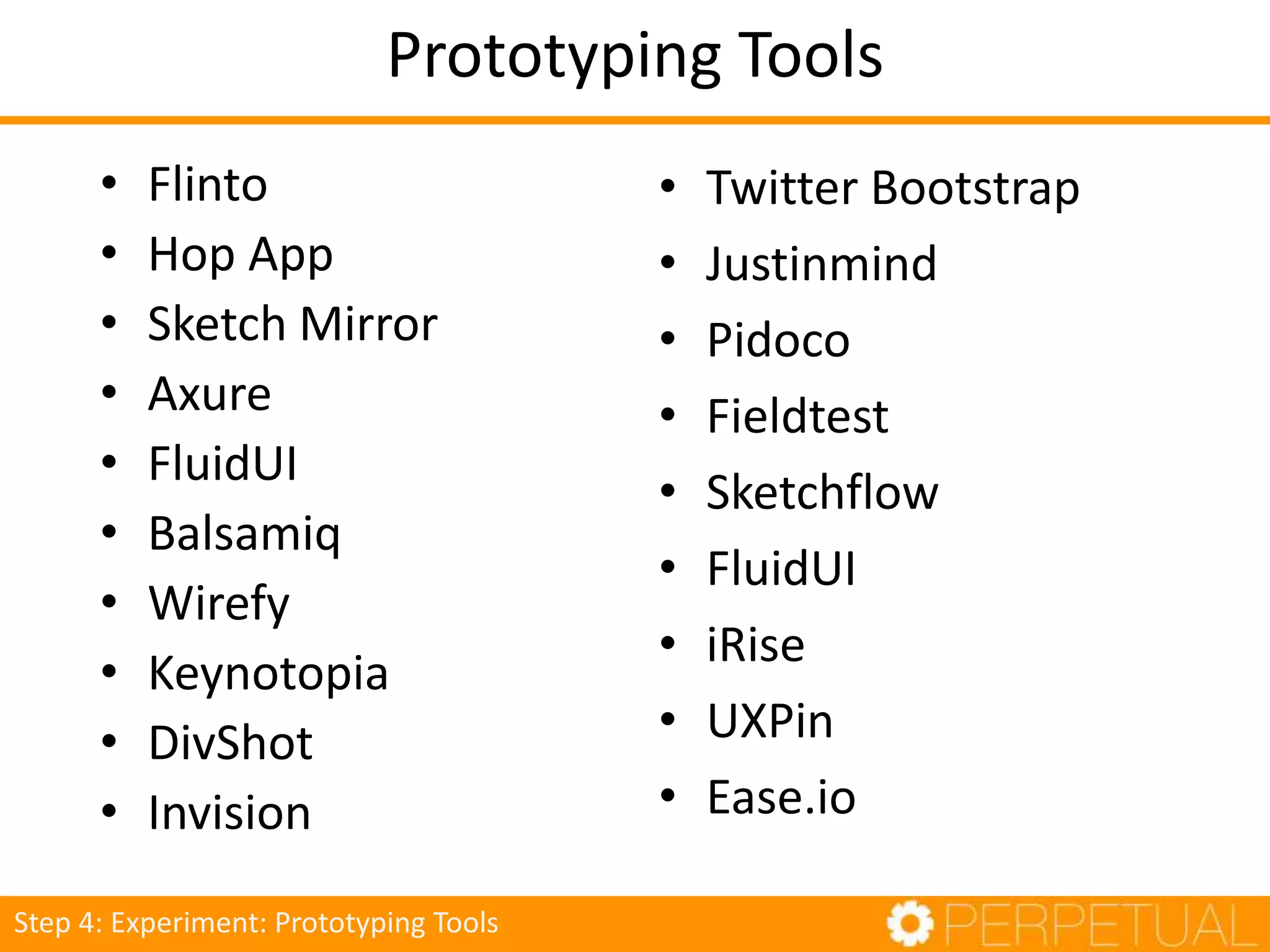
Prototyping Tools
• Flinto
• Hop App
• Sketch Mirror
• Axure
• FluidUI
• Balsamiq
• Wirefy
• Keynotopia
• DivShot
• Invision
Step 4: Experiment: Prototyping Tools
• Twitter Bootstrap
• Justinmind
• Pidoco
• Fieldtest
• Sketchflow
• FluidUI
• iRise
• UXPin
• Ease.io
7 Steps
1. Make it the norm
2. Make it a company mission
3. Create an innovation culture
4. Experiment
5. Collaborate
6. Every stage counts
7. Scouting
Internal Collaboration
• Plan joint working activities across business units
– Eg Editorial and Tech hackathon
– BizDev and Tech roadmap brainstorm
• Embed of teams/rotation
• Exchange programs within groups
• Common codebase (highly indexed/searchable)
• Cross-team skill breakdown and knowledge sharing
Step 5: Collaborate
Step 5: Collaborate: Internal
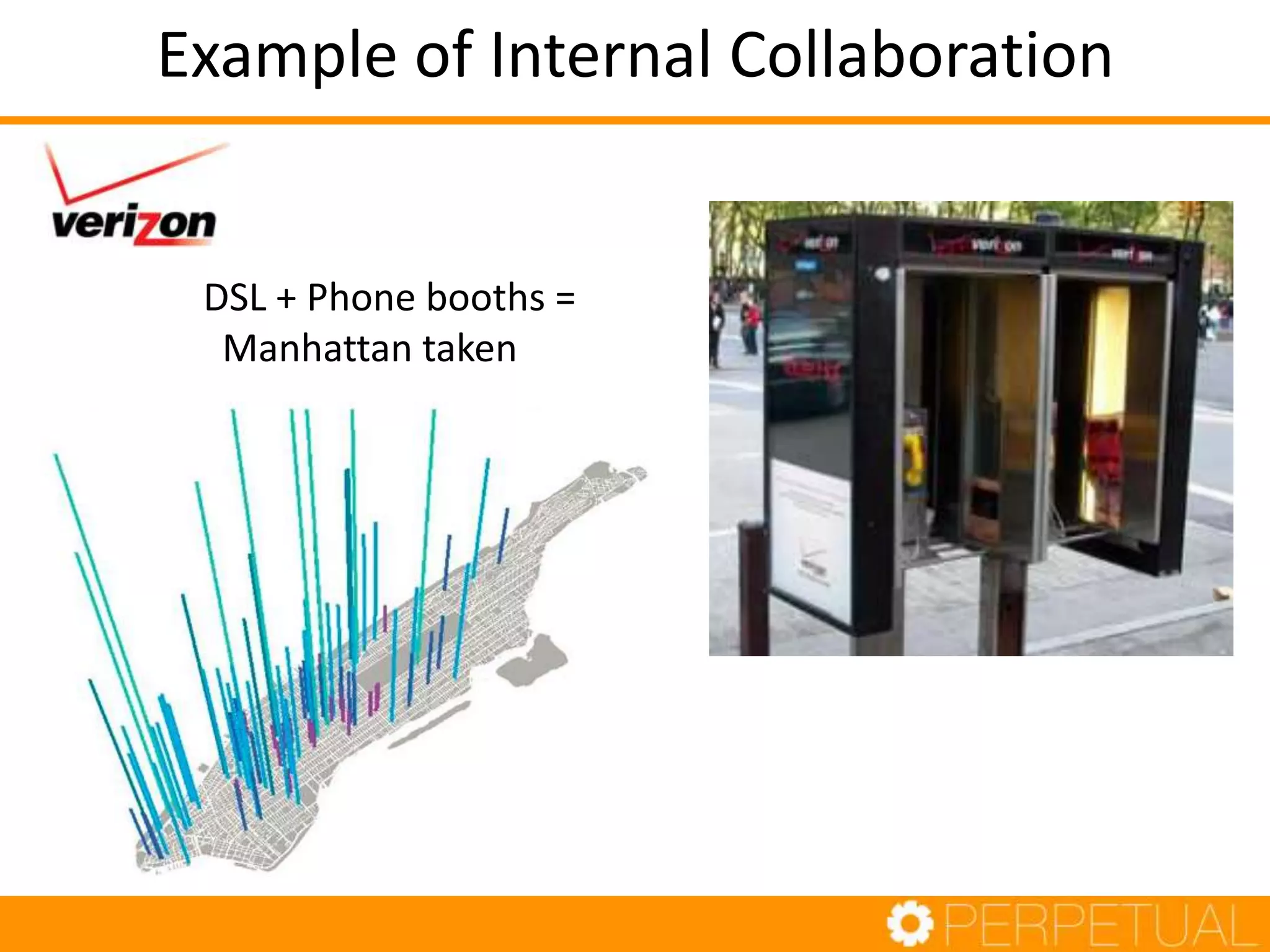
Example of Internal Collaboration
DSL + Phone booths =
Manhattan taken
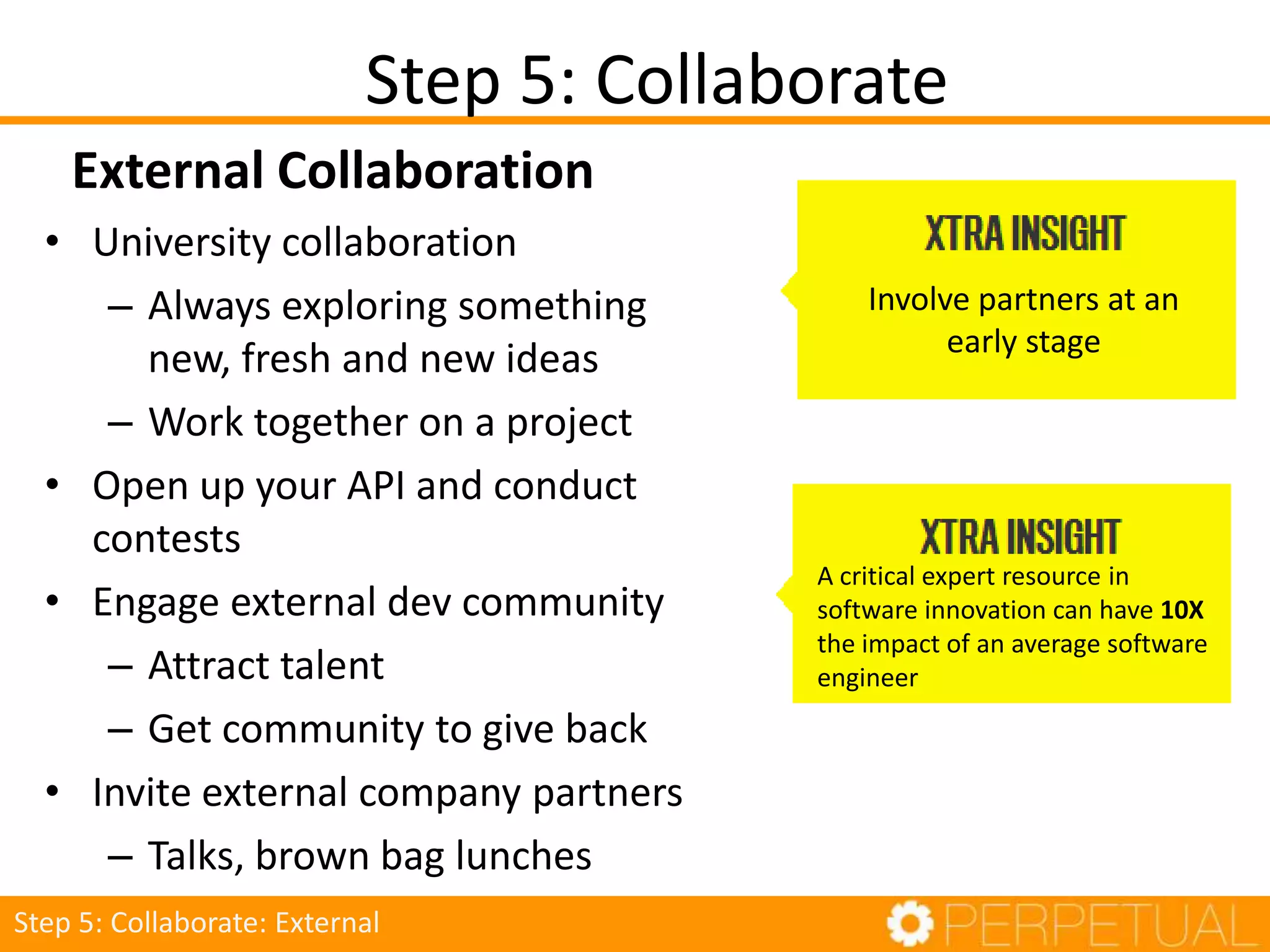
• University collaboration
– Always exploring something new,
fresh and new ideas
– Work together on a project
• Open up your API and conduct
contests
• Engage external dev community
– Attract talent
– Get community to give back
• Invite external company partners
– Talks, brown bag lunches
Step 5: Collaborate
Step 5: Collaborate: External
Involve partners at an
early stage
A critical expert resource in
software innovation can have 10X
the impact of an average software
engineer
External Collaboration
7 Steps
1. Make it the norm
2. Make it a company mission
3. Create an innovation culture
4. Experiment
5. Collaborate
6. Every stage counts
7. Scouting
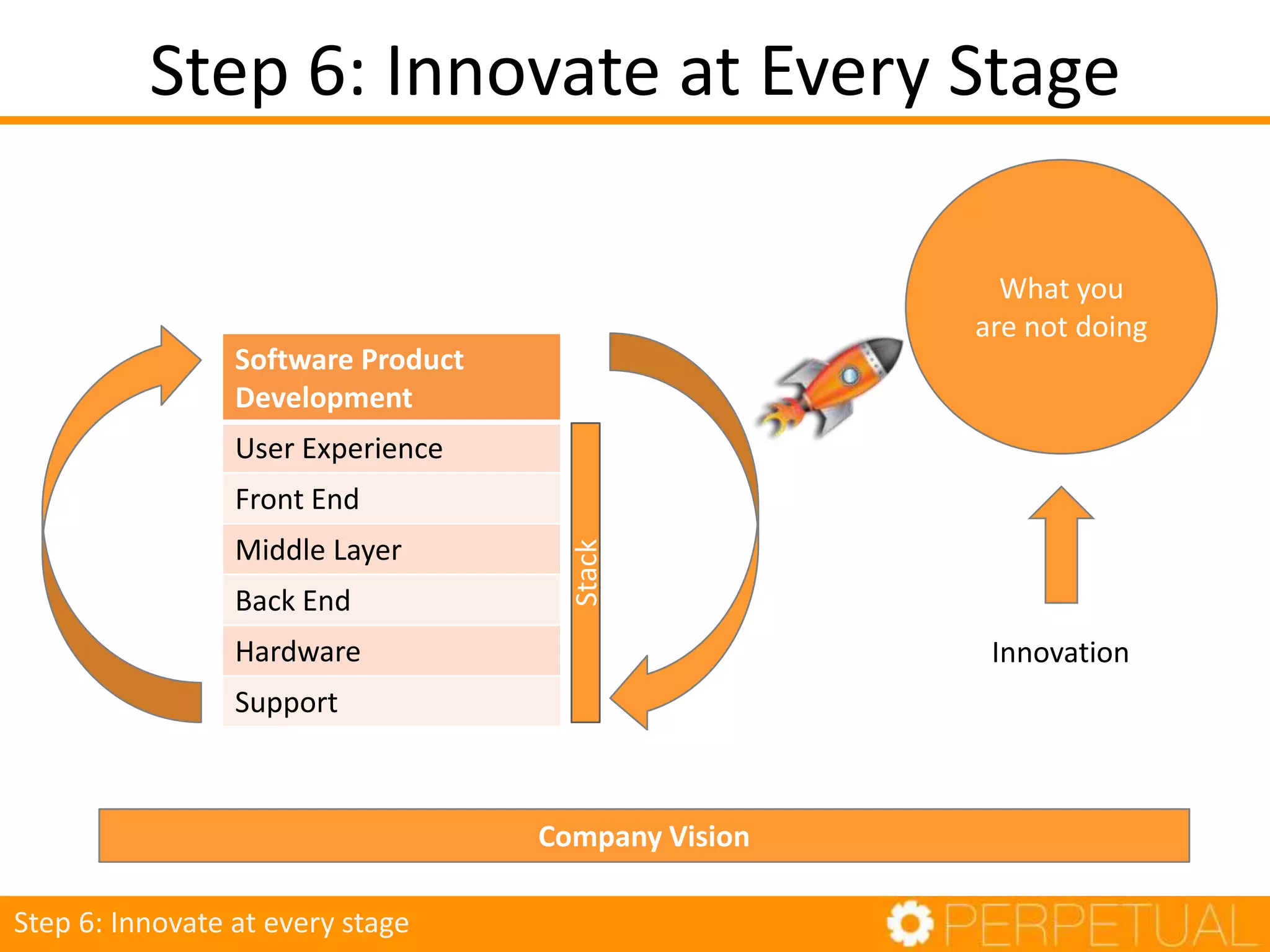
Step 6: Innovate at Every Stage
What you
are not doing
Innovation
Company Vision
Software Product
Development
User Experience
Front End
Middle Layer
Back End
Hardware
Support
Stack
Step 6: Innovate at every stage
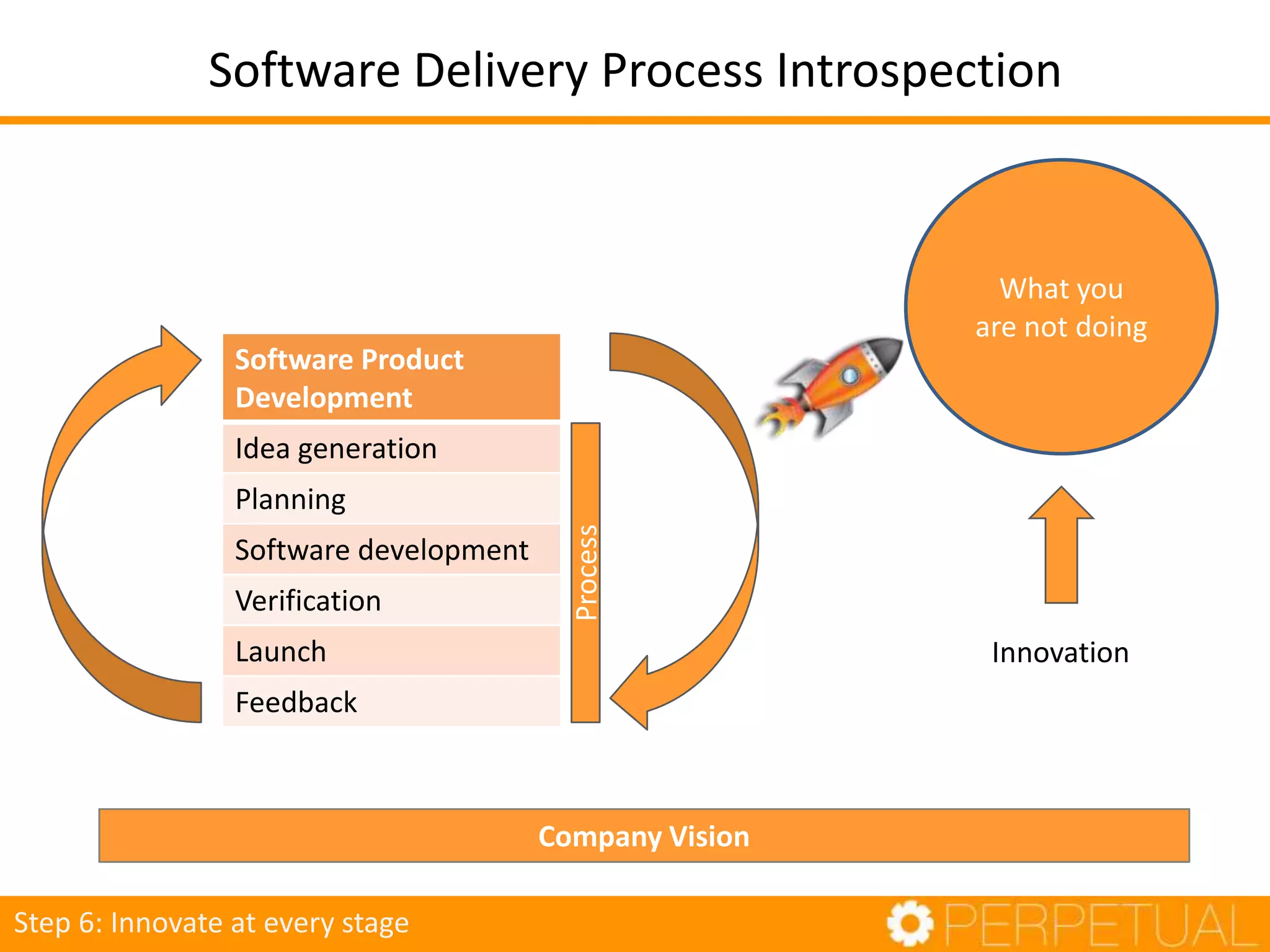
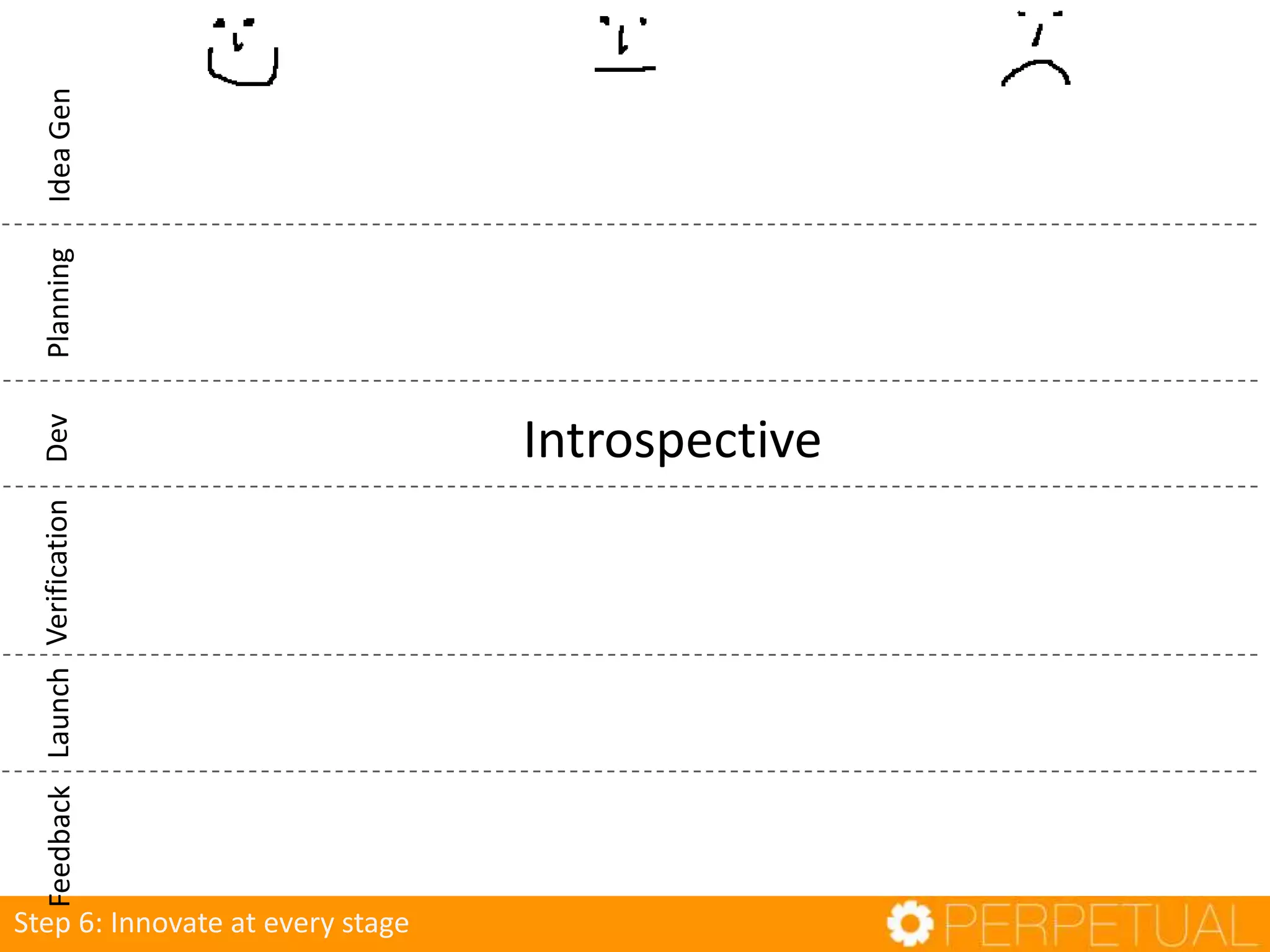
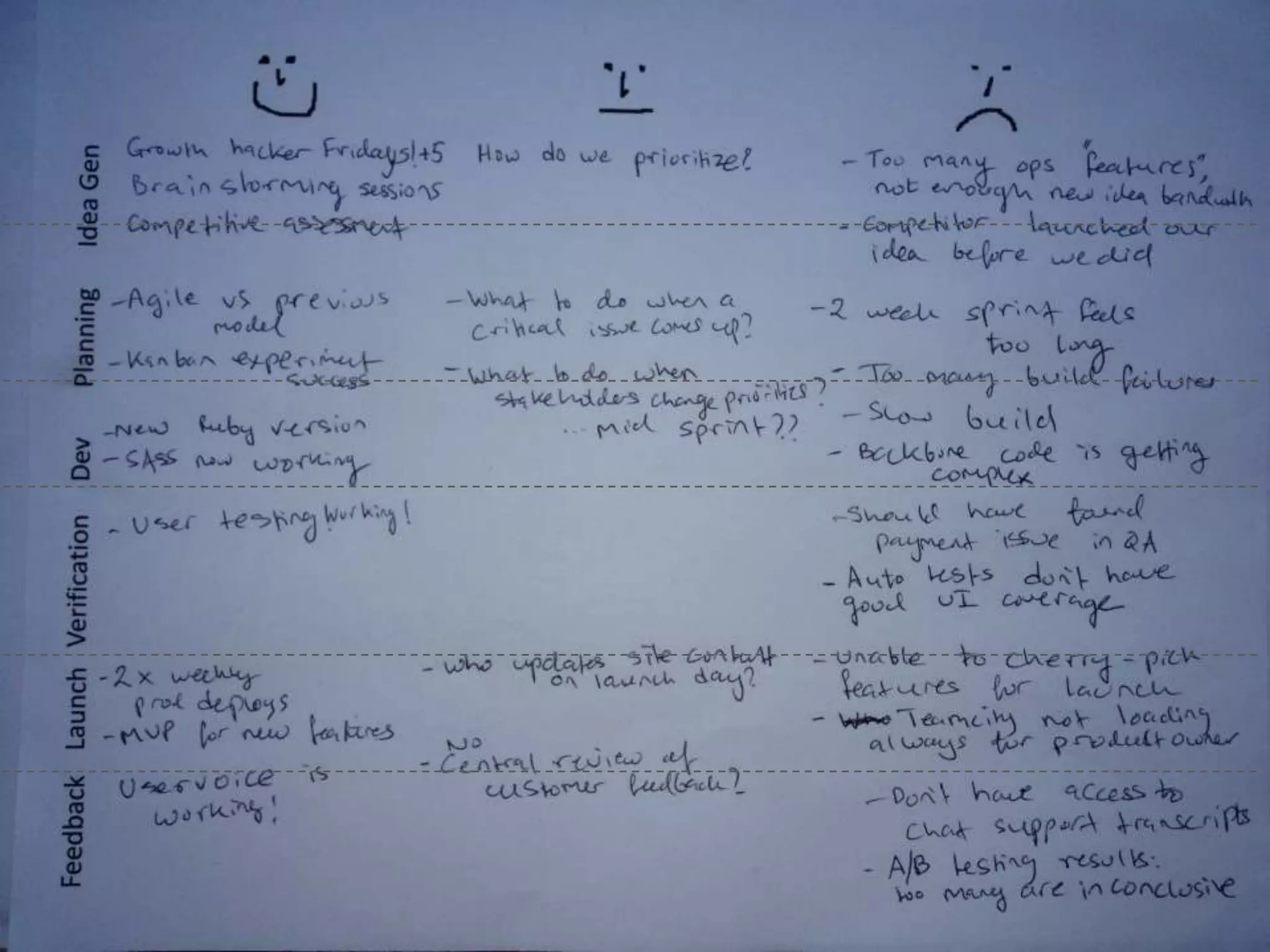
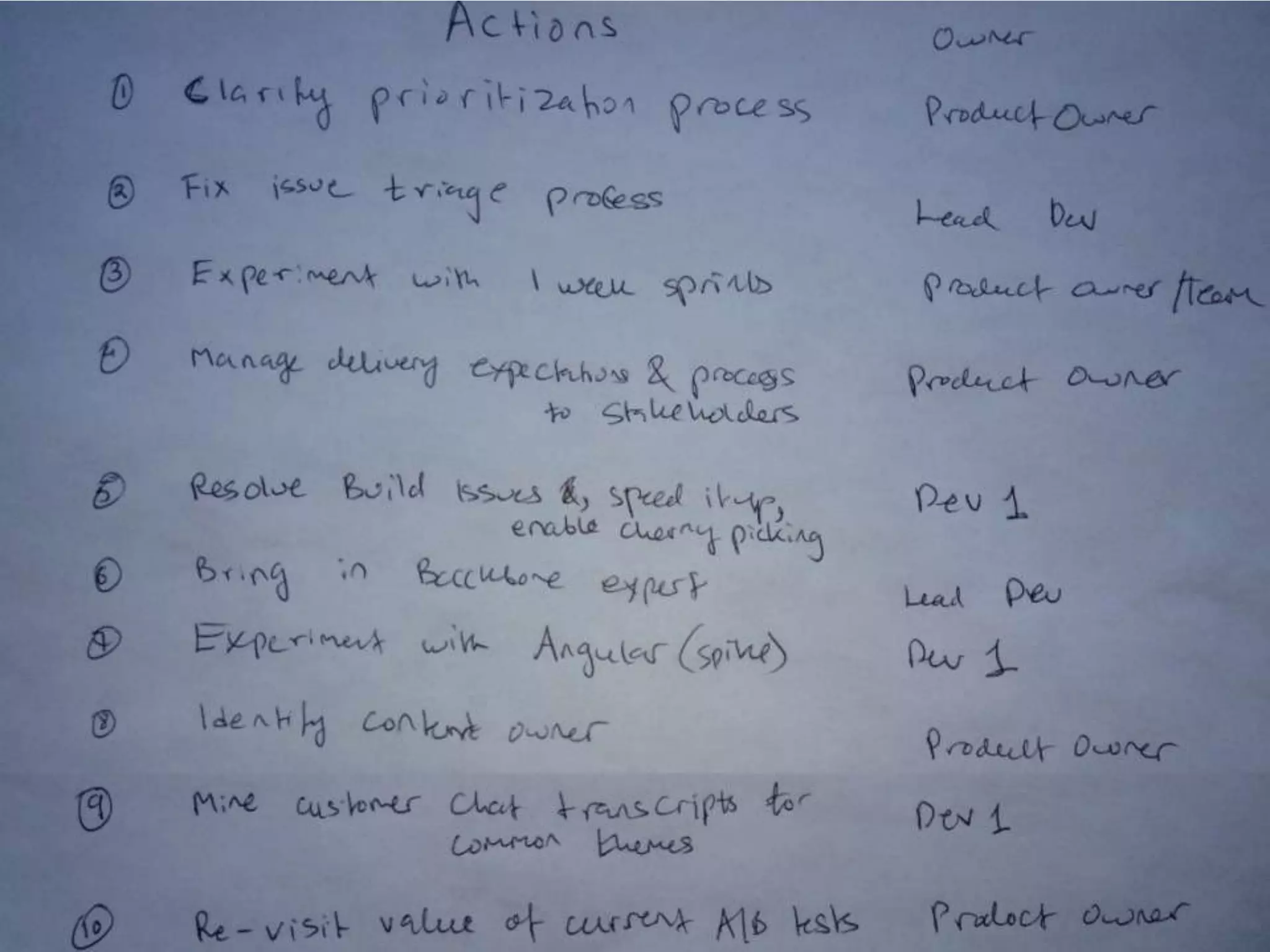
Software Delivery Process Introspection
What you
are not doing
Innovation
Software Product
Development
Idea generation
Planning
Software development
Verification
Launch
Feedback
Process
Step 6: Innovate at every stage
Company Vision
IdeaGenPlanningDevVerificationFeedbackLaunch
Introspective
Step 6: Innovate at every stage
7 Steps
1. Make it the norm
2. Make it a company mission
3. Create an innovation culture
4. Experiment
5. Collaborate
6. Every stage counts
7. Scouting
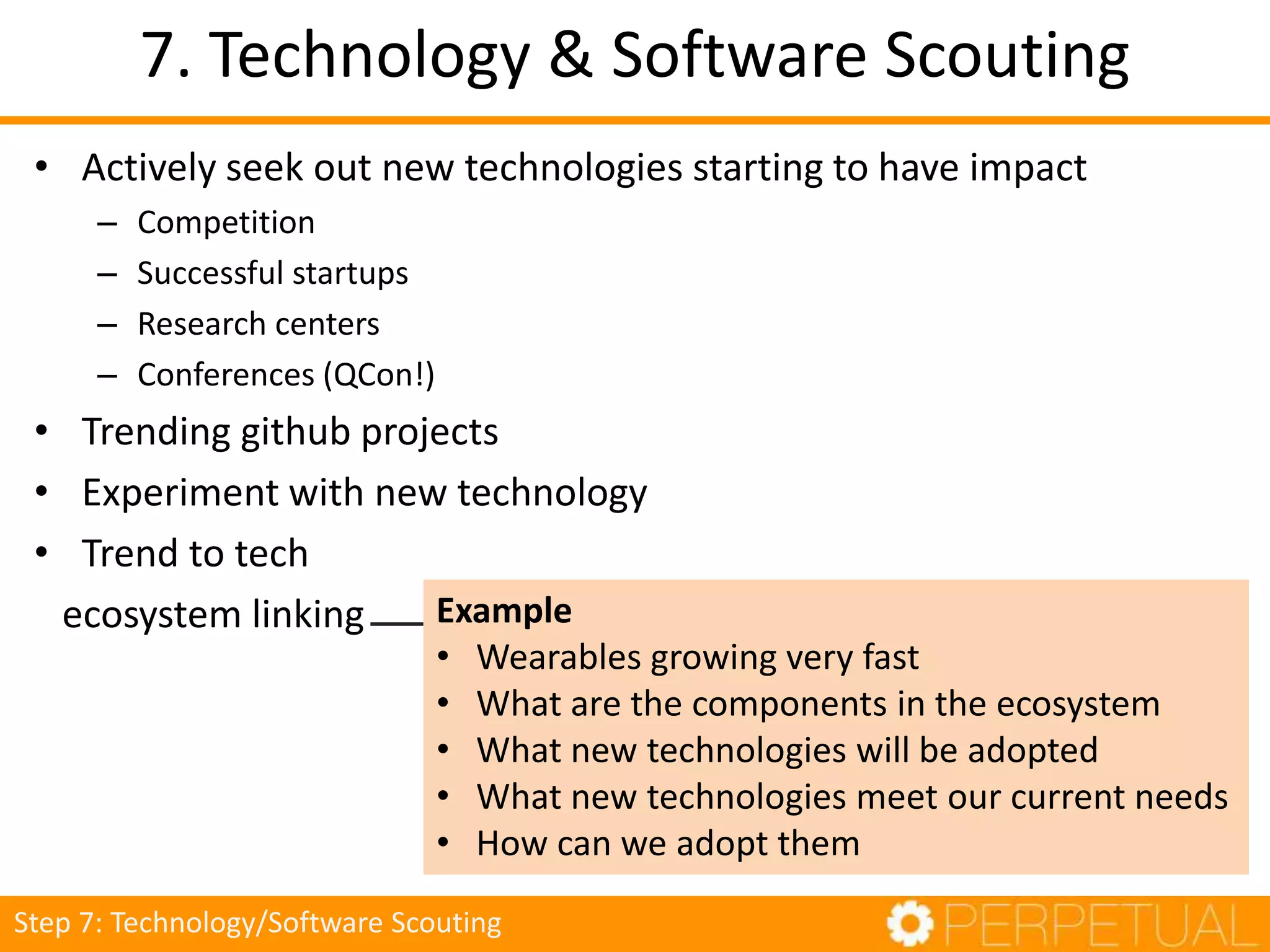
7. Technology & Software Scouting
• Actively seek out new technologies starting to have impact
– Competition
– Successful startups
– Research centers
– Conferences (QCon!)
• Trending github projects
• Experiment with new technology
• Trend to tech
ecosystem linking Example
• Wearables growing very fast
• What are the components in the ecosystem
• What new technologies will be adopted
• What new technologies meet our current needs
• How can we adopt them
Step 7: Technology/Software Scouting
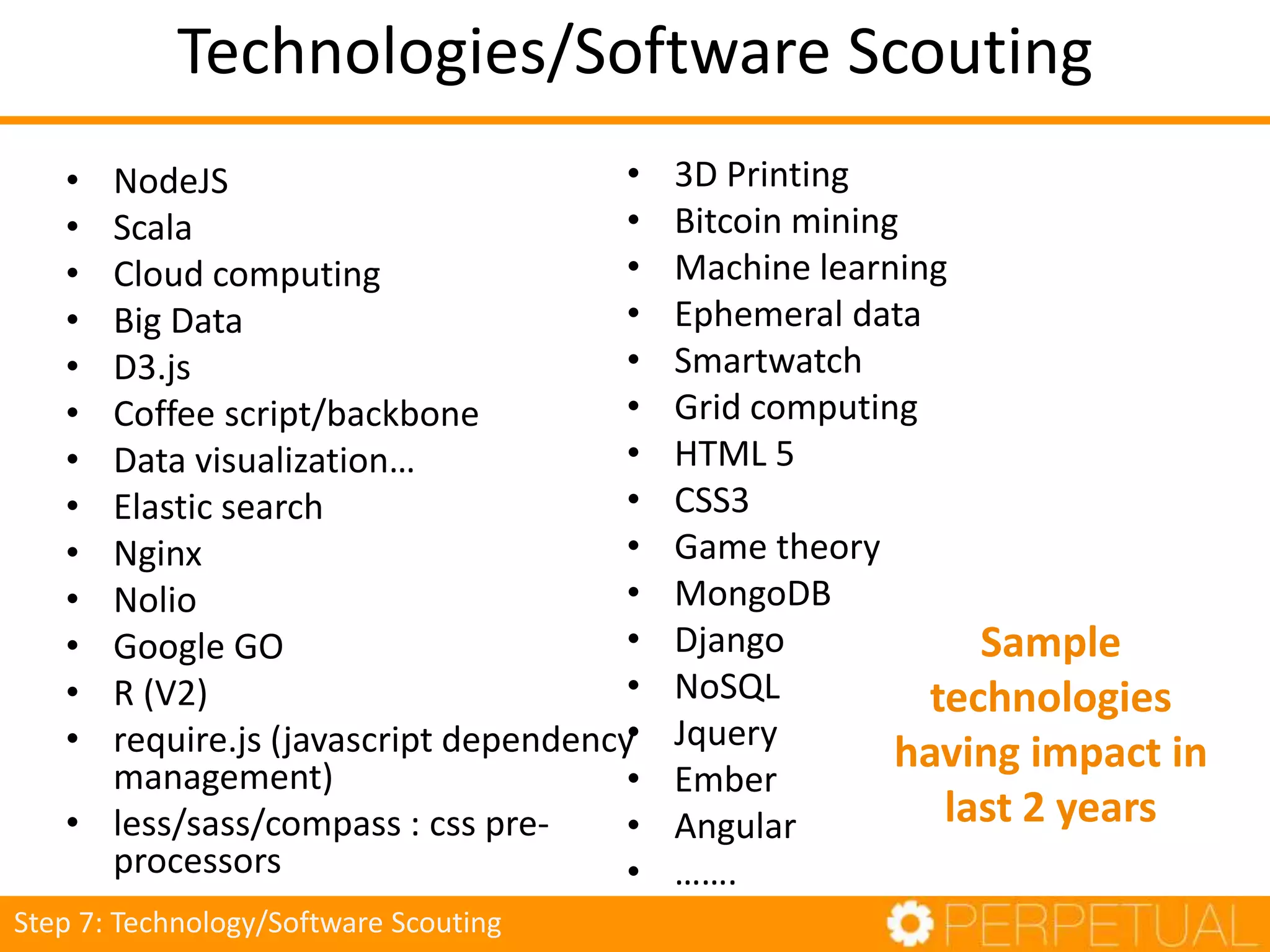
Technologies/Software Scouting
• NodeJS
• Scala
• Cloud computing
• Big Data
• D3.js
• Coffee script/backbone
• Data visualization…
• Elastic search
• Nginx
• Nolio
• Google GO
• R (V2)
• require.js (javascript dependency
management)
• less/sass/compass : css pre-
processors
Step 7: Technology/Software Scouting
• 3D Printing
• Bitcoin mining
• Machine learning
• Ephemeral data
• Smartwatch
• Grid computing
• HTML 5
• CSS3
• Game theory
• MongoDB
• Django
• NoSQL
• Jquery
• Ember
• Angular
• …….
Sample
technologies
having impact in
last 2 years
7 Steps
1. Make it the norm
2. Make it a company mission
3. Create an innovation culture
4. Experiment
5. Collaborate
6. Every stage counts
7. Scout
Ideas are no one’s monopoly

Applying Innovation in Software Development

  • 1.
    Innovation in theEnterprise Applying Innovation in Software Development Amish Gandhi Keynote Talk
  • 2.
    Amish Gandhi Founder andPrincipal at Perpetual: Product Innovation and Development for Finance, Media and Telecom www.perpetualny.com Innovation Background • Working on innovating financial information services • Working on wearable computing solutions for media • Experience developing emerging technology based products in telecom • Advanced Study Fellow in innovation at MIT MS Computer Science from Univ. of Texas, Austin BS Computer Science from Bombay University Finance Media TelecomBackground
  • 3.
    Contents • Intro – Whatis Innovation – What it is not • Business Innovation – What it is – Innovators Dilemma • Innovation in Software Companies – How it is different – Innovation as a discipline • 7 Steps for Software Innovation
  • 4.
  • 5.
    What is Innovation? Innovationis a process that combines • discovering an opportunity • blueprinting an idea to seize that opportunity • and implementing that idea to achieve results
  • 6.
    No impact, noinnovation
  • 7.
    What is Innovation(NOT)? • Innovation is not improvement – Innovation != doing the same thing better – Innovation == doing something different • Innovation does not go unnoticed – Innovation != something incremental – Innovation == something that results in big impact • Innovation is not invention – Innovation != Invention = the creation of the idea or method itself – Innovation == invention applied
  • 8.
  • 9.
    Innovation and BusinessImpact • Growing the core • Extending the core • Expanding beyond the core Innovation path Business Innovation 1-click shopping Associates Cloud Services
  • 10.
    Amazon Innovation Path Marketcap $167B Continuous Innovation 1994 Company incorporated. 1996 Launches Associates Prog 1997 1-Click Shopping. 1998 Music and movies 1999 Auctions 2000 Super Saving Shipping 2001 Look Inside The Book 2002 Launches AWS V1 2003 A9.com search engine 2004 Exposes product data 2005 Amazon Prime 2006 Amazon Unbox (movies) 2007 Amazon MP3 2007 Amazon Kindle 2009 Free Android shopping app 2010 Deals & LivingSocial 2011 Prime instant video 2011 Amazon local 2012 Dynamo DB 2013 New national fulfil. model 2013 Kindle Fire HDX
  • 11.
    MIT Innovation Radar BusinessInnovation: Discovery Platform/Solutions Quadrant 1. The unexpected 2. The reality inequality 3. Process need 4. Market structure changes 5. Demographics changes 6. Cust. perception change 7. New knowledge
  • 12.
    Performance demanded at markethigh end Progress due to sustaining technologies Progress due to disruptive technologies ProductPerformance Time Performance demanded at the low end of the market Innovators Dilemma Business Innovation: Opportunities Disruptive technologies
  • 13.
    Performance demanded at markethigh end Progress due to sustaining technologies Progress due to disruptive technologies ProductPerformance Time Performance demanded at the low end of the market Innovators Dilemma Business Innovation: Opportunities Motorized Engine
  • 14.
    Performance demanded at markethigh end Progress due to sustaining technologies Progress due to disruptive technologies ProductPerformance Time Performance demanded at the low end of the market Innovators Dilemma NoSQL Business Innovation: Opportunities
  • 15.
  • 16.
    Innovation in SoftwareCompanies Attribute Effect 1. Disruptive technologies New opportunities for disruption 2. Market trends Exponential customer adoption: Realtime, hyperlocal, super-connected, always-on 3. Lower Barrier to Entry Ability to create something from nothing much more easily 4. Competition High number of entrants, big and small 5. Higher level value creation S/W dev process evolved – 1-2 week delivery cycle is typical vs. 3 month cycle 6. Complex Different software solutions for the same problem 7. Can have huge impact with limited resources Can unlock new business models. Enterprises should allocate resources to new innovation Innovation in Software Companies
  • 17.
    Performance demanded at markethigh end Progress due to sustaining technologies Progress due to disruptive technologies ProductPerformance Time Performance demanded at the low end of the market Innovation in Software Cos: 1. Disruptive Technologies AWS Android Mapreduce Bigtable Hadoop Hbase NodeJS Scala Cloud Computing Big Data D3.js Coffee Script/Backbone Data Visualization Elastic search Nginx Hudson GO R require.js less/sass/compass, HTML5…
  • 18.
    Innovation in SoftwareCos: 2. Market Trends
  • 19.
    Innovation in SoftwareCos. 3. Lower Barrier to Entry Everything starts as nothing
  • 20.
    Innovation in SoftwareCos. 4. Competition Competition
  • 21.
    Innovation in SoftwareCompanies 5. Higher Level Value Creation Value Value Value Value Value WaterfallAgile
  • 22.
    Innovation in SoftwareCos. 6. Complexity
  • 23.
    Instagram scaled to30 million active users with a team of two infrastructure engineers Innovation in Software Cos. 7. Limited resources, huge impact 30,000,000
  • 24.
    Innovation in SoftwareCompanies Attribute Effect 1. Disruptive technologies New opportunities for disruption 2. Market trends Exponential customer adoption: Realtime, hyperlocal, super-connected, always-on 3. Lower Barrier to Entry Ability to create something from nothing much more easily 4. Competition High number of entrants, big and small 5. Higher level value creation S/W dev process evolved – 1-2 week delivery cycle is typical vs. 3 month cycle 6. Complex Different software solutions for the same problem 7. Can have huge impact with limited resources Can unlock new business models. Enterprises should allocate resources to new innovation Innovation in Software Companies
  • 25.
    Applying Innovation ina Software Company 7 Steps
  • 26.
    7 Steps 1. Makeit the norm 2. Make it a company mission 3. Create an innovation culture 4. Experiment 5. Collaborate 6. Every stage counts 7. Scouting
  • 27.
    7 Steps 1. Makeit the norm 2. Make it a company mission 3. Create an innovation culture 4. Experiment 5. Collaborate 6. Every stage counts 7. Scouting
  • 28.
    Step 1: Makeit the norm • Make it part of the day-to-day • Manage it like any other corporate function • Give it time and resources • Create a sense of urgency –Not just for PR purposes • Create the right innovation culture Entrepreneurial/Intrapreneurial innovation model Step 1: Make it the norm
  • 29.
    Step 1: Makeit the norm. How? Step 1: Make it the norm -Make it one of your business initiatives -Make it one of your employee objectives -Manage it like any other corporate function Projectize Focus on your long term goals Go long Evaluate your innovation culture and make adjustments Culture
  • 30.
    Step 1: Makeit the norm. How? Step 1: Make it the norm Engage legal about protecting Intellectual Property - Plug in to the IP ecosystem. Creating IP is a bonus. IP Spread and sell your ideas Use visuals at every step and promote on the intranet and in public boards in the office Don't talk about “changes” Change makes people nervous. Talk about pursuing new opportunities Perception
  • 31.
    • Software developersare proud of their work • Eg many open source projects where developers participate to contribute to a common goal • Tech is cool again • Showcase the latest developments and activities Nourish and harness intrinsic motivation Raise profile of engineering in the company Step 1: Make it the norm Step 1: Make it the norm. How?
  • 32.
    • Innovation FriendlyProcess – Agile – Lean – UCD – Kanban – Continuous integration and delivery – Rapid prototyping – Experimentation time on sprints • Eg Hacker Friday Step 1: Make it the norm: Innovation friendly processes Step 1: Make it the norm. How? Start with this, structure your teams accordingly
  • 33.
    Spotify: Scaling Agile Step1: Make it the norm
  • 34.
    Step 1: Makeit the norm
  • 35.
    • Tools tomanage innovation – Brightidea – IdeaScale – InnoCentive – Innovation Factory – Imaginatik – Sopheon – Spigit – ………. Step 1: Make it the norm: Tools Step 1: Make it the norm. How?
  • 37.
    7 Steps 1. Makeit the norm 2. Make it a company mission 3. Create an innovation culture 4. Experiment 5. Collaborate 6. Every stage counts 7. Scouting
  • 38.
    Step 2: CompanyMission • Should be part of your company mission statement • An executive champion who believes the new idea is critical and is persistent about it • A senior sponsor to marshal resources (people, money, time) with a focus on innovation Top down innovation model Step 2: Make it a Company Mission
  • 39.
    Step 2: CompanyMission • A small number of ambitious projects vetted by organizational top layers • There should be a mix of – bright, creative minds (to get ideas) and – experienced operators (to keep things practical) • A process that moves ideas through the system quickly – End to end validation Top down innovation model Step 2: Make it part of your Company Mission
  • 40.
    7 Steps 1. Makeit the norm 2. Make it a company mission 3. Create an innovation culture 4. Experiment 5. Collaborate 6. Every stage counts 7. Scouting
  • 41.
    Step 3: Createan Innovation Culture 1. Challenge or involvement 2. Freedom 3. Trust or openness 4. Idea time 5. Idea support 6. Playfulness or humor 7. Risk-taking 8. Debate 9. Conflict’ 10. Experimentation 1-9 Ekvall G (1996) Organizational climate for creativity and innovation • Rate from 1 to 10 • Take the sum = your company’s innovation culture score Score Rating >90% Super innovator 80-90% Highly creative 70-80% Stable growth 60-70% Warning zone <60% Danger zone Step 3: Create an Innovation Culture: Evaluate Evaluating Innovation Culture
  • 42.
    • Flatter orgstructures • Open and powerful development environments • Services and tools to help launch products • An attitude of experimentation & openness to experiment failure • Services and tools to test and get user feedback as early as possible • Generous rewards and recognition for successful innovation Attributes of innovative software culture Step 3: Culture Step 3: Culture
  • 43.
    Creativity Enhancing Techniques •Brainstorming : usually misunderstood – Separate idea generation from idea valuation – Duration? Quantity = quality. • First ideas are usually old • As ideation continues, new ones emerge – 6-12 people to bring different points of view • Let participants build on each others ideas Step 3: Create an Innovation Culture
  • 44.
    Six Thinking Hats Information(White) Emotions (Red) Discernment (Black) Optimistic response (Yellow) Creativity (Green) Facilitator (Blue) Step 3: Create an Innovation Culture
  • 45.
    • Identify customerrequirements for an ideal product through Product Box • Improve retrospectives with Speed Boat • Prioritize your backlog through the online game Buy a Feature Online • Plan a successful project through the game Remember the Future • Develop better release plans with Prune the Product Tree • Understand product usage with Me and My Shadow and Start Your Day http://innovationgames.com/agile-teams Step 3: Create an Innovation Culture Use Games to encourage creative development Innovation games in a software group
  • 46.
    7 Steps 1. Makeit the norm 2. Make it a company mission 3. Create an innovation culture 4. Experiment 5. Collaborate 6. Every stage counts 7. Scouting
  • 47.
    Step 4: Experiment •Run experiments instead of going on hunches • Experiment lean and quick – Validate your assumptions quickly – Discard ideas, move one, fail fast • Build early (a working prototype or code) – Many advantages: users, stakeholders • No penalty for failed experiments • Focus on building real stuff vs. plans/designs • Hack days Step 4: Experiment
  • 48.
    Prototyping Tools • Flinto •Hop App • Sketch Mirror • Axure • FluidUI • Balsamiq • Wirefy • Keynotopia • DivShot • Invision Step 4: Experiment: Prototyping Tools • Twitter Bootstrap • Justinmind • Pidoco • Fieldtest • Sketchflow • FluidUI • iRise • UXPin • Ease.io
  • 49.
    7 Steps 1. Makeit the norm 2. Make it a company mission 3. Create an innovation culture 4. Experiment 5. Collaborate 6. Every stage counts 7. Scouting
  • 50.
    Internal Collaboration • Planjoint working activities across business units – Eg Editorial and Tech hackathon – BizDev and Tech roadmap brainstorm • Embed of teams/rotation • Exchange programs within groups • Common codebase (highly indexed/searchable) • Cross-team skill breakdown and knowledge sharing Step 5: Collaborate Step 5: Collaborate: Internal
  • 51.
    Example of InternalCollaboration DSL + Phone booths = Manhattan taken
  • 52.
    • University collaboration –Always exploring something new, fresh and new ideas – Work together on a project • Open up your API and conduct contests • Engage external dev community – Attract talent – Get community to give back • Invite external company partners – Talks, brown bag lunches Step 5: Collaborate Step 5: Collaborate: External Involve partners at an early stage A critical expert resource in software innovation can have 10X the impact of an average software engineer External Collaboration
  • 53.
    7 Steps 1. Makeit the norm 2. Make it a company mission 3. Create an innovation culture 4. Experiment 5. Collaborate 6. Every stage counts 7. Scouting
  • 54.
    Step 6: Innovateat Every Stage What you are not doing Innovation Company Vision Software Product Development User Experience Front End Middle Layer Back End Hardware Support Stack Step 6: Innovate at every stage
  • 55.
    Software Delivery ProcessIntrospection What you are not doing Innovation Software Product Development Idea generation Planning Software development Verification Launch Feedback Process Step 6: Innovate at every stage Company Vision
  • 56.
  • 60.
    7 Steps 1. Makeit the norm 2. Make it a company mission 3. Create an innovation culture 4. Experiment 5. Collaborate 6. Every stage counts 7. Scouting
  • 61.
    7. Technology &Software Scouting • Actively seek out new technologies starting to have impact – Competition – Successful startups – Research centers – Conferences (QCon!) • Trending github projects • Experiment with new technology • Trend to tech ecosystem linking Example • Wearables growing very fast • What are the components in the ecosystem • What new technologies will be adopted • What new technologies meet our current needs • How can we adopt them Step 7: Technology/Software Scouting
  • 62.
    Technologies/Software Scouting • NodeJS •Scala • Cloud computing • Big Data • D3.js • Coffee script/backbone • Data visualization… • Elastic search • Nginx • Nolio • Google GO • R (V2) • require.js (javascript dependency management) • less/sass/compass : css pre- processors Step 7: Technology/Software Scouting • 3D Printing • Bitcoin mining • Machine learning • Ephemeral data • Smartwatch • Grid computing • HTML 5 • CSS3 • Game theory • MongoDB • Django • NoSQL • Jquery • Ember • Angular • ……. Sample technologies having impact in last 2 years
  • 63.
    7 Steps 1. Makeit the norm 2. Make it a company mission 3. Create an innovation culture 4. Experiment 5. Collaborate 6. Every stage counts 7. Scout
  • 64.
    Ideas are noone’s monopoly

Editor's Notes

  • #5 Innovation is real work and it can and should be managed like any other corporate function. But it’s not the same. It is the work of knowing and not of doing. The perception is still based on assumptions about eureka lightbulbs flashing over the head of an insprired genius Vs. well managed diligence of ordinary people [need a diagram for this] If it’s Inspiration, then just need to hire the right people and let them do what they have to do If it’s Perspiration, management must play a more vigorous role: Establish the right roles and processes, set clear goals and relevant measures, and review progress at every step. Innovation is real work and it can and should be managed like any other corporate function. But that doesn’t mean it’s the same as other business activities. Indeed, innovation is the work of knowing rather than doing.
  • #6 The Little Black Book of Innovation: How It Works, How to Do It Hardcover by Scott D. Anthony  It’s vague Sounds like a buzzword.. Loosely used .. But it’s what makes the biggest difference It is doing something different for upliftment
  • #8 Not just about high productivity and working towards deadlines (trend in software companies) Everyone should do it and it should be part of the culture Not just about creating new features
  • #13 What benefit. Not what product
  • #18 What benefit. Not what product
  • #19 What benefit. Not what product
  • #29  Stimulating innovation is so much more than brainstorming. Software companies that have a desire to grow will somehow have to leave their comfort zone of incremental innovation, and might have to look for more radical innovations. Innovation in software is about more than planning the next product release or service methodology update. We need to embrace perpetual agile business ecosystem incubation and adaptation to increase value creation. Peter Stuer, Spikes Intrapreneur The act of behaving like an entrepreneur while working within a large organization.
  • #30 Stimulating innovation is so much more than brainstorming. Software companies that have a desire to grow will somehow have to leave their comfort zone of incremental innovation, and might have to look for more radical innovations. Innovation in software is about more than planning the next product release or service methodology update. We need to embrace perpetual agile business ecosystem incubation and adaptation to increase value creation. Peter Stuer, Spikes Intrapreneur The act of behaving like an entrepreneur while working within a large organization.
  • #31 Stimulating innovation is so much more than brainstorming. Software companies that have a desire to grow will somehow have to leave their comfort zone of incremental innovation, and might have to look for more radical innovations. Innovation in software is about more than planning the next product release or service methodology update. We need to embrace perpetual agile business ecosystem incubation and adaptation to increase value creation. Peter Stuer, Spikes Intrapreneur The act of behaving like an entrepreneur while working within a large organization.
  • #32 Raise profile of engineering…. With the rise of cool techies being a geek is cool again Talent: creative technologists
  • #33 If a team can’t be fed with 2 pizzas it’s too big Pairing MVP Start at the top :ceos shud back it
  • #34 Each Squad is an independent lean startup Squads are grouped together into a Tribes eg Infrasctructure or Music Player tribes. These are incubators for startup like squads. Tribes: no more than 100 people
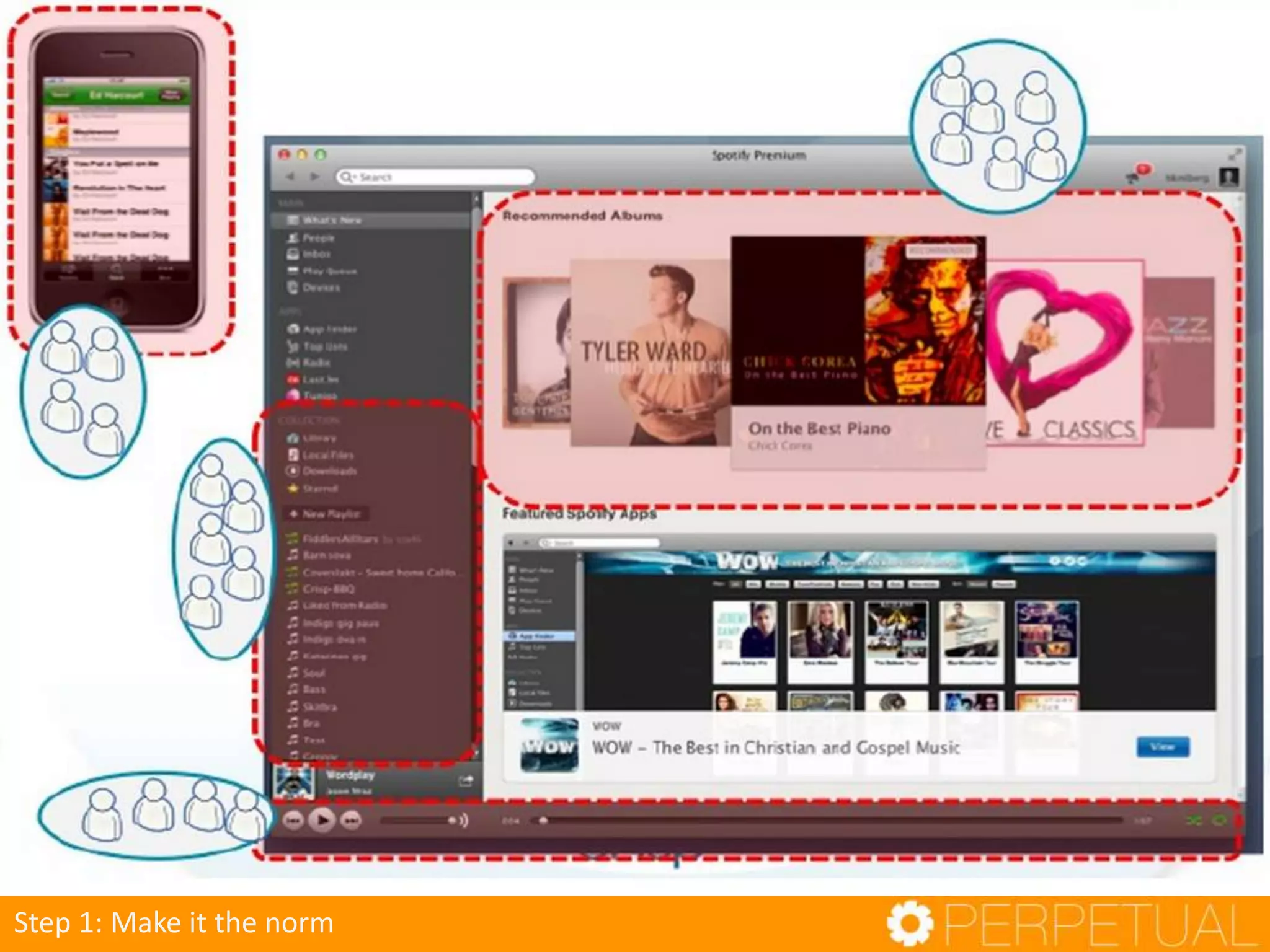
  • #35 Recommendations Library Mobile Player
  • #36 http://www.axure.com/ Product Management tool http://www.prodpad.com Prototype Quick Lean: education st Flinto…… http://hunchbuzz.com/buzz/40-idea-management-software-solutions/ innovationgames.com
  • #42 Challenge or involvement refers to the degree to which people are involved in daily operations, long-term goals and visions. High involvement indicates motivated and committed people. Freedom describes the independence and autonomy that people have in the organization with regard to their work. When trust or openness is high in the organization, people are more willing to share their ideas and to be frank and honest in their relationships with other people in the organization. Idea time is the time that people can use to elaborate on new ideas. Playfulness or humor is indicted in spontaneity and ease at the workplace, and these are conductive to innovation. Idea support refers to the way in which new ideas are treated and people react to each other’s ideas. Risk-taking describes the tolerance of uncertainty and ambiguity, for example, whether people can make decisions without being completely certainty and having all the necessary information. Debate refers to open disagreements between viewpoints and ideas. Debate contributes to sharing and combining different points of view and knowledge. Conflict refers to emotional tensions in the workplace. If conflict is high, people fight and plot against each other, which is naturally bad for creativity and productivity in general. Prioritizing Rationalizing Comparable Metrics Discovering best ideas
  • #44 Brainstorming doesn’t usually work. There is no replacement to taking a hard look at the following all at once:
  • #45 Information (White) - considering purely what information is available, what are the facts? Emotions (Red) - intuitive or instinctive gut reactions or statements of emotional feeling (but not any justification) Discernment (Black) - logic applied to identifying reasons to be cautious and conservative Optimistic response (Yellow) - logic applied to identifying benefits, seeking harmony Creativity (Green) - statements of provocation and investigation, seeing where a thought goes
  • #52 Elaborate ‘Can we come up with new value by a clever combination of available products, data sources, services or technologies?’ (10 W. Codenie et al. propositions)