1.
2.
3.
4.

5.
6.
7.

Innovation in action
Why should you innovate?
What can you innovate?
How can you innovate?
Innovation as a cycle
Start-up or organic?
Roadblocks – tips & tricks
Innovation is at the heart of the use of MIS.
Technology has evolved greatly and continues to
do so,
creating new markets, products and processes
at every turn of the road,
therefore changing the competitive landscape
and the bases for competition.
Mastering Information Systems therefore is key
to sustaining the thrust towards
innovation based competition
which is the key to company success nowadays.
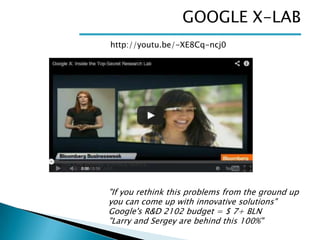
GOOGLE X-LAB
http://youtu.be/-XE8Cq-ncj0

"If you rethink this problems from the ground up
you can come up with innovative solutions"
Google's R&D 2102 budget = $ 7+ BLN
"Larry and Sergey are behind this 100%"
THE TRIZ METHOD


нрих

лович

ллер

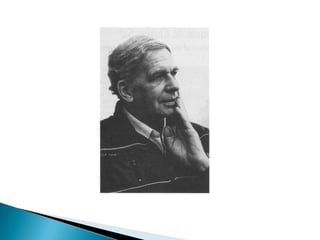
Genrikh Saulovich Altshuller (1926,1998)
The inventor of TRIZ
Biography







Working as a clerk in a Russian patent office
Studied 200,000 patents
Found out very few of them are real inventions, most are
just improvements
The same set of rules are applied over and over to
discover something new = the 40 Inventive Principles =
the TRIZ method
An inventive solution does not compromise following a
trade-off, but rather eliminates the contradiction
1.
2.
3.
4.

5.
6.
7.

Innovation in action
Why should you innovate?
What can you innovate?
How can you innovate?
Innovation as a cycle
Start-up or organic?
Roadblocks – tips & tricks
COMPANIES NEED TO INNOVATE
Ask a company executive about his agenda, how much time did he
spend last week on innovation, rather than on sustaining what's already
there?
1.
2.

3.

4.

5.

6.
7.

Competitors are exploiting technology to innovate, regardless
Technology is advancing, someone will exploit the opportunity
sooner or later
Product commoditization as an effect of innovation is pushing down
prices and eroding competitive advantages
Adjacent markets are producing substitutive products as an effect of
new capabilities
Innovation is needed for a new comer to enter or to gain a decent
positioning on a market
The business model all resolves around innovation (e.g. VC firms)
The company owns a technology which "per se" can be applied to
different market/products
1.
2.
3.
4.

5.
6.
7.

Innovation in action
Why should you innovate?
What can you innovate?
How can you innovate?
Innovation as a cycle
Start-up or organic?
Roadblocks – tips & tricks
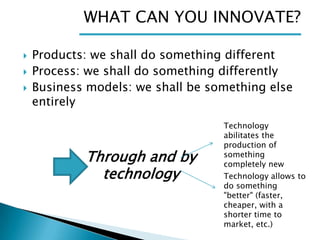
WHAT CAN YOU INNOVATE?




Products: we shall do something different
Process: we shall do something differently
Business models: we shall be something else
entirely

Through and by
technology

Technology
abilitates the
production of
something
completely new
Technology allows to
do something
"better" (faster,
cheaper, with a
shorter time to
market, etc.)
PRODUCT SIDE








A brand new product
Product features
Product positioning
Target market
Usage habits
PROCESS SIDE








New production machines
Process automation
New organization (e.g. functional vs. matrix)
Insourcing vs. outsourcing
Talents and competencies
BUSINESS MODEL







Revenue share between different businesses
Product portfolio
Company values/success criteria
Geographical spread
1.
2.
3.
4.

5.
6.
7.

Innovation in action
Why should you innovate?
What can you innovate?
How can you innovate?
Innovation as a cycle
Start-up or organic?
Roadblocks – tips & tricks
APPROACHES TO INNOVATION







TQM and Six Sigma
BPR
The blue ocean strategy
The lean startup
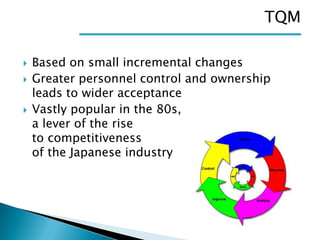
TQM





Based on small incremental changes
Greater personnel control and ownership
leads to wider acceptance
Vastly popular in the 80s,
a lever of the rise
to competitiveness
of the Japanese industry
SIX SIGMA









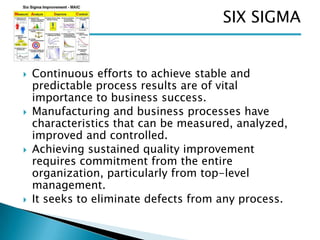
Continuous efforts to achieve stable and
predictable process results are of vital
importance to business success.
Manufacturing and business processes have
characteristics that can be measured, analyzed,
improved and controlled.
Achieving sustained quality improvement
requires commitment from the entire
organization, particularly from top-level
management.
It seeks to eliminate defects from any process.
BLUE OCEAN STRATEGY





A 2005 book from the INSEAD, heavily case based.
Red oceans are traditional markets where
companies compete on a traditional basis
(product, cost, differentiation etc.).
Inevitably this leads to commoditization
and cutthroat competition.
By contrast blue oceans is where the competitive
basis is redefined by invention that overcomes set
rules and traditional boundaries, creating new
space = "value innovation".
THE LEAN STRATEGY









A 2011 book by Eric Ries incorporating his
experience and thoughts in start-ups.
Specifically originated from high-tech companies.
An embodiment of Silicon Valley ethos and beliefs.
Minimum Viable Product
Continuous Deployment - based on "agile" way of
thinking and specific sw development techniques
Focus on analytics - pointedly A/B testing
Actionable metrics
Pivot
AGILE PROCESSES








Agile processes are processes that iterate
through a constant renewal cycle of design,
deliver, evaluate, redesign, and so on.
Ultimate goal for some are agile processes
that reconfigure themselves as they ‘learn.
For a process to be agile necessitates a high
degree of use of IT.
Processes that run entirely on the Internet
are candidates for becoming agile
processes
1.
2.
3.
4.

5.
6.
7.

Innovation in action
Why should you innovate?
What can you innovate?
How should you innovate?
Innovation as a cycle
Start-up or organic?
Roadblocks – tips & tricks
INNOVATION AS A CYCLE








The number of transistors on integrated circuits
double every two years (Moore’s law)
This s the basis of technology driven innovation
It’s embedded
And it means that it's always happening, rather
than in discontinuous waves.
Therefore "Innovation is a must"; apart from a few
top companies that determine the course of
innovation, all the other need to comply with what
is happening around them.
DRIVERS OF INNOVATION








Start-ups, VC push
The big 5s (e.g. big data)
Core hardware technology
New applications, new devices (e.g. Kinect)
Consumers invent new usage patterns (e.g.
texting)
Individuals creativity (e.g. BitTorrent)
LEARNING TO INNOVATE











So the problem is not innovating; it's rather learning to
innovate.
You need to create a "learning organization" by:
Hiring, recognizing, rewarding talent
Creating a "permission to fail" culture
Allowing time and resources for discovery (e.g 20% time rule
at Google)
Reducing hierarchical distance
Developing a well set up approach to innovation (project
management)
Creating shared metrics that define success
1.
2.
3.
4.

5.
6.
7.

Innovation in action
Why should you innovate?
What can you innovate?
How should you innovate?
Innovation as a cycle
Start-up or organic?
Roadblocks – tips & tricks
You cannot buy your way to innovation;
innovation is something you become, not
something you insert or attach.
Still, innovation through technology requires
the acquisition of a distinct set of systems and
competences that by definition were not there
before.
Therefore there are a number of paths you can
pursue.
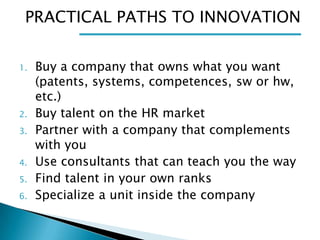
PRACTICAL PATHS TO INNOVATION
1.

2.
3.
4.

5.
6.

Buy a company that owns what you want
(patents, systems, competences, sw or hw,
etc.)
Buy talent on the HR market
Partner with a company that complements
with you
Use consultants that can teach you the way
Find talent in your own ranks
Specialize a unit inside the company
1.
2.
3.
4.

5.
6.
7.

Innovation in action
Why should you innovate?
What can you innovate?
How should you innovate?
Innovation as a cycle
Start-up or organic?
Roadblocks – tips & tricks
REAL LIFE HANDS ON ISSUES (1/2)










The first person that needs innovation is ... yourself - the
management team is old fashioned or at least not "à la page"
Most of the company people grew up in a pre-Internet
revolution world
The set of rules and standards in the company stifles
innovation (bureaucratic, hierarchical, centralized, etc.)
Some (a lot) of people have something (a lot) to lose from
innovation
Most of the company resources are devoted to maintaining
the core business who is under fire; innovation remains a
night job
REAL LIFE HANDS ON ISSUES (2/2)








It's hard to attract talent that will run to more
fashionable (innovative) companies
Metrics defining success are unclear; this allows
individuals to under perform
Innovation calls for a lot of bells and whistles that
in reality hinder and hide real matter-of-fact
efforts
Innovation was born in a period of strong economy;
negative cycles make it necessary to protect young
and still weak offsprings

Innovation through technology

  • 2.
    1. 2. 3. 4. 5. 6. 7. Innovation in action Whyshould you innovate? What can you innovate? How can you innovate? Innovation as a cycle Start-up or organic? Roadblocks – tips & tricks
  • 3.
    Innovation is atthe heart of the use of MIS. Technology has evolved greatly and continues to do so, creating new markets, products and processes at every turn of the road, therefore changing the competitive landscape and the bases for competition. Mastering Information Systems therefore is key to sustaining the thrust towards innovation based competition which is the key to company success nowadays.
  • 4.
    GOOGLE X-LAB http://youtu.be/-XE8Cq-ncj0 "If yourethink this problems from the ground up you can come up with innovative solutions" Google's R&D 2102 budget = $ 7+ BLN "Larry and Sergey are behind this 100%"
  • 6.
    THE TRIZ METHOD  нрих лович ллер GenrikhSaulovich Altshuller (1926,1998) The inventor of TRIZ Biography      Working as a clerk in a Russian patent office Studied 200,000 patents Found out very few of them are real inventions, most are just improvements The same set of rules are applied over and over to discover something new = the 40 Inventive Principles = the TRIZ method An inventive solution does not compromise following a trade-off, but rather eliminates the contradiction
  • 7.
    1. 2. 3. 4. 5. 6. 7. Innovation in action Whyshould you innovate? What can you innovate? How can you innovate? Innovation as a cycle Start-up or organic? Roadblocks – tips & tricks
  • 8.
    COMPANIES NEED TOINNOVATE Ask a company executive about his agenda, how much time did he spend last week on innovation, rather than on sustaining what's already there? 1. 2. 3. 4. 5. 6. 7. Competitors are exploiting technology to innovate, regardless Technology is advancing, someone will exploit the opportunity sooner or later Product commoditization as an effect of innovation is pushing down prices and eroding competitive advantages Adjacent markets are producing substitutive products as an effect of new capabilities Innovation is needed for a new comer to enter or to gain a decent positioning on a market The business model all resolves around innovation (e.g. VC firms) The company owns a technology which "per se" can be applied to different market/products
  • 9.
    1. 2. 3. 4. 5. 6. 7. Innovation in action Whyshould you innovate? What can you innovate? How can you innovate? Innovation as a cycle Start-up or organic? Roadblocks – tips & tricks
  • 10.
    WHAT CAN YOUINNOVATE?    Products: we shall do something different Process: we shall do something differently Business models: we shall be something else entirely Through and by technology Technology abilitates the production of something completely new Technology allows to do something "better" (faster, cheaper, with a shorter time to market, etc.)
  • 11.
    PRODUCT SIDE      A brandnew product Product features Product positioning Target market Usage habits
  • 12.
    PROCESS SIDE      New productionmachines Process automation New organization (e.g. functional vs. matrix) Insourcing vs. outsourcing Talents and competencies
  • 13.
    BUSINESS MODEL     Revenue sharebetween different businesses Product portfolio Company values/success criteria Geographical spread
  • 14.
    1. 2. 3. 4. 5. 6. 7. Innovation in action Whyshould you innovate? What can you innovate? How can you innovate? Innovation as a cycle Start-up or organic? Roadblocks – tips & tricks
  • 15.
    APPROACHES TO INNOVATION     TQMand Six Sigma BPR The blue ocean strategy The lean startup
  • 16.
    TQM    Based on smallincremental changes Greater personnel control and ownership leads to wider acceptance Vastly popular in the 80s, a lever of the rise to competitiveness of the Japanese industry
  • 17.
    SIX SIGMA     Continuous effortsto achieve stable and predictable process results are of vital importance to business success. Manufacturing and business processes have characteristics that can be measured, analyzed, improved and controlled. Achieving sustained quality improvement requires commitment from the entire organization, particularly from top-level management. It seeks to eliminate defects from any process.
  • 18.
    BLUE OCEAN STRATEGY    A2005 book from the INSEAD, heavily case based. Red oceans are traditional markets where companies compete on a traditional basis (product, cost, differentiation etc.). Inevitably this leads to commoditization and cutthroat competition. By contrast blue oceans is where the competitive basis is redefined by invention that overcomes set rules and traditional boundaries, creating new space = "value innovation".
  • 19.
    THE LEAN STRATEGY       A2011 book by Eric Ries incorporating his experience and thoughts in start-ups. Specifically originated from high-tech companies. An embodiment of Silicon Valley ethos and beliefs. Minimum Viable Product Continuous Deployment - based on "agile" way of thinking and specific sw development techniques Focus on analytics - pointedly A/B testing Actionable metrics Pivot
  • 20.
    AGILE PROCESSES     Agile processesare processes that iterate through a constant renewal cycle of design, deliver, evaluate, redesign, and so on. Ultimate goal for some are agile processes that reconfigure themselves as they ‘learn. For a process to be agile necessitates a high degree of use of IT. Processes that run entirely on the Internet are candidates for becoming agile processes
  • 21.
    1. 2. 3. 4. 5. 6. 7. Innovation in action Whyshould you innovate? What can you innovate? How should you innovate? Innovation as a cycle Start-up or organic? Roadblocks – tips & tricks
  • 22.
    INNOVATION AS ACYCLE      The number of transistors on integrated circuits double every two years (Moore’s law) This s the basis of technology driven innovation It’s embedded And it means that it's always happening, rather than in discontinuous waves. Therefore "Innovation is a must"; apart from a few top companies that determine the course of innovation, all the other need to comply with what is happening around them.
  • 23.
    DRIVERS OF INNOVATION       Start-ups,VC push The big 5s (e.g. big data) Core hardware technology New applications, new devices (e.g. Kinect) Consumers invent new usage patterns (e.g. texting) Individuals creativity (e.g. BitTorrent)
  • 24.
    LEARNING TO INNOVATE        Sothe problem is not innovating; it's rather learning to innovate. You need to create a "learning organization" by: Hiring, recognizing, rewarding talent Creating a "permission to fail" culture Allowing time and resources for discovery (e.g 20% time rule at Google) Reducing hierarchical distance Developing a well set up approach to innovation (project management) Creating shared metrics that define success
  • 25.
    1. 2. 3. 4. 5. 6. 7. Innovation in action Whyshould you innovate? What can you innovate? How should you innovate? Innovation as a cycle Start-up or organic? Roadblocks – tips & tricks
  • 26.
    You cannot buyyour way to innovation; innovation is something you become, not something you insert or attach. Still, innovation through technology requires the acquisition of a distinct set of systems and competences that by definition were not there before. Therefore there are a number of paths you can pursue.
  • 27.
    PRACTICAL PATHS TOINNOVATION 1. 2. 3. 4. 5. 6. Buy a company that owns what you want (patents, systems, competences, sw or hw, etc.) Buy talent on the HR market Partner with a company that complements with you Use consultants that can teach you the way Find talent in your own ranks Specialize a unit inside the company
  • 28.
    1. 2. 3. 4. 5. 6. 7. Innovation in action Whyshould you innovate? What can you innovate? How should you innovate? Innovation as a cycle Start-up or organic? Roadblocks – tips & tricks
  • 29.
    REAL LIFE HANDSON ISSUES (1/2)      The first person that needs innovation is ... yourself - the management team is old fashioned or at least not "à la page" Most of the company people grew up in a pre-Internet revolution world The set of rules and standards in the company stifles innovation (bureaucratic, hierarchical, centralized, etc.) Some (a lot) of people have something (a lot) to lose from innovation Most of the company resources are devoted to maintaining the core business who is under fire; innovation remains a night job
  • 30.
    REAL LIFE HANDSON ISSUES (2/2)     It's hard to attract talent that will run to more fashionable (innovative) companies Metrics defining success are unclear; this allows individuals to under perform Innovation calls for a lot of bells and whistles that in reality hinder and hide real matter-of-fact efforts Innovation was born in a period of strong economy; negative cycles make it necessary to protect young and still weak offsprings