Presentation on the
“Enron Scandal”
Presented by-
Anushka Gupta
B.Com(Hons.) 3rd Year
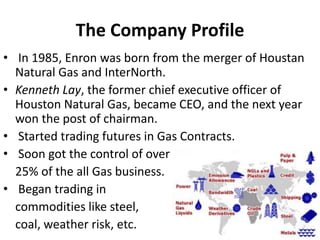
The Company Profile
• In 1985, Enron was born from the merger of Houstan
Natural Gas and InterNorth.
• Kenneth Lay, the former chief executive officer of
Houston Natural Gas, became CEO, and the next year
won the post of chairman.
• Started trading futures in Gas Contracts.
• Soon got the control of over
25% of the all Gas business.
• Began trading in
commodities like steel,
coal, weather risk, etc.
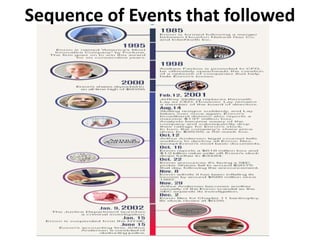
Sequence of Events that followed
Partners in Crime
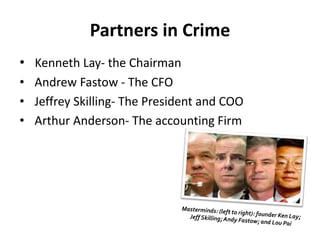
• Kenneth Lay- the Chairman
• Andrew Fastow - The CFO
• Jeffrey Skilling- The President and COO
• Arthur Anderson- The accounting Firm
Causes of the Enron Scandal
• Dubious Accounting Practices
• Enron’s misleading Accounts
• Mark to market accounting
• Special Purpose Entities
• Executive compensation
• Financial Audit
• Over-statement of Profits
• On an annualized basis between 1995 and 2000:
– Enron's assets grew 38%,
– revenues grew more than 60%, and
– earnings grew 12%.
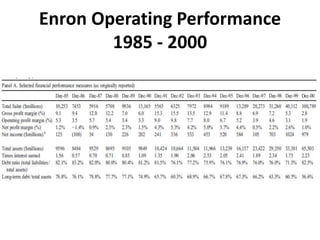
Enron Operating Performance
1985 - 2000
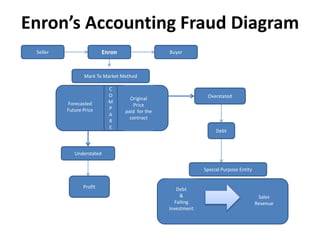
Enron’s Accounting Fraud Diagram
Enron
Profit
Understated
Forecasted
Future Price
C
O
M
P
A
R
E
Mark To Market Method
Seller Buyer
Overstated
Debt
Special Purpose Entity
Debt
&
Failing
Investment
Sales
Revenue
Original
Price
paid for the
contract
The Whistle Blower
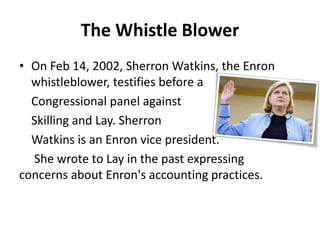
• On Feb 14, 2002, Sherron Watkins, the Enron
whistleblower, testifies before a
Congressional panel against
Skilling and Lay. Sherron
Watkins is an Enron vice president.
She wrote to Lay in the past expressing
concerns about Enron's accounting practices.
The Down Fall
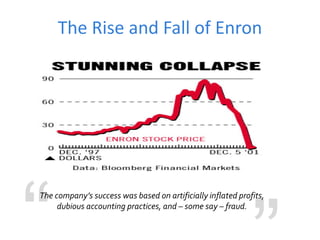
The Rise and Fall of Enron
The company’s success was based on artificially inflated profits,
dubious accounting practices, and – some say – fraud.
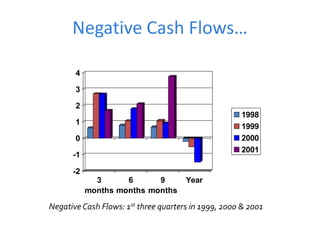
Negative Cash Flows…
-2
-1
0
1
2
3
4
3
months
6
months
9
months
Year
1998
1999
2000
2001
Negative Cash Flows: 1st three quarters in 1999, 2000 & 2001
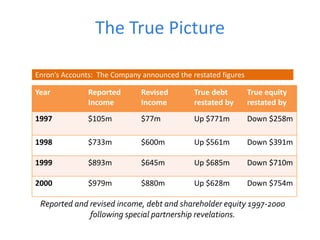
The True Picture
Year Reported
Income
Revised
Income
True debt
restated by
True equity
restated by
1997 $105m $77m Up $771m Down $258m
1998 $733m $600m Up $561m Down $391m
1999 $893m $645m Up $685m Down $710m
2000 $979m $880m Up $628m Down $754m
Reported and revised income, debt and shareholder equity 1997-2000
following special partnership revelations.
Enron’s Accounts: The Company announced the restated figures
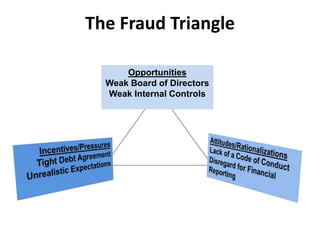
The Fraud Triangle
Opportunities
Weak Board of Directors
Weak Internal Controls
Role of Auditor
The Internal Audit Department
• Should have ensured the compliance of SA 240, SA 520.
• Should maintain a tight internal control system established by the
board members & directors
• Report directly to the CEO
• Direct consultation with the board director
• Submit a quarterly report to the board and the supervisory
committee .
Statutory Auditor
• Ensured compliance with SA 700 and SA 720.
• Independent from the company and the board
• Abides with accounting principles and rules
• Should hold neutral opinions
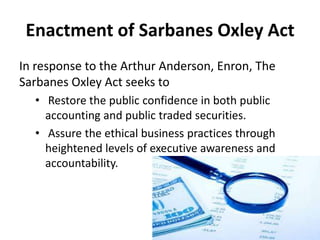
Enactment of Sarbanes Oxley Act
In response to the Arthur Anderson, Enron, The
Sarbanes Oxley Act seeks to
• Restore the public confidence in both public
accounting and public traded securities.
• Assure the ethical business practices through
heightened levels of executive awareness and
accountability.
What is SOX ?
• US Law,
• Enacted in July 2002,
• By a bill sponsored by Mr. Paul Sarbanes & co-
authored by Mr. Michael Oxley, under whose
name the act was enacted,
• Consists of 11 chapters and 69 articles,
• Also Known as “Public Company accounting
Reform and Investor Protection Act”.
How did SOX try to amend the
situation?
Sarbanes-Oxley provides for increased corporate
governance and corporate accountability.
Therefore, SOX is in place to be sure that fraud on
the scale of Enron never takes place again.
If a publicly-traded company is not in compliance
with the SOX law, the penalties are stiff. Multi-
million dollar fines can result and imprisonment of
the CEO or CFO. Penalties are based on the section
of SOX that the company is not in compliance with.
• In summary, the Sarbanes-Oxley Act of 2002 is
probably the best piece of legislation to protect
investors in modern times. It is a shame that it
took debacles like Enron and others to shake up
Congress into writing this legislation as many
innocent people, investors and employees,
literally lost their life savings. Perhaps SOX will
make sure that doesn't happen again.
What should have been done?
1. General Assembly
• Shareholders should be encouraged to attend GAs.
• Agenda items should be explained clearly
• GA Should be managed to allow shareholders to express their opinions.
• Voting on general assembly motions should be recorded accurately.
2. Board of Directors
• Should meet at least once every 3 months
• Non executive members may meet directors for consultation.
• Review internal regulations & procedures for their appropriateness &
efficiency
• An internal audit committee formed from a number of non-executive
members should be assigned to check internal controls & the company's
working practices.
• Responsible for risk management in accordance with the company's
activities, size, & market
• board should submit an annual report to shareholders including tasks
assigned by law.
3. The Audit Committee
• Comprises of a minimum of three non-executive members.
• One member should be a finance & accounting expert
• Assess the efficiency of the financial manager & other financial staff
• review the financial statements before being presented to the board and
give opinions and recommendations
• review the internal/external auditor’s plan and make suggestions.
• The committee should meet periodically, at least once every three
months, with a specified agenda
4. Disclosure of social policies
• At least once a year the company should disclose environmental, social,
safety & health policies to shareholders, customers and employees.
• The policies disclosed should be clear & unambiguous, including the
company's strategies for employee recruitment & training & social welfare
programs within or outside the company. Relationships
5.Avoiding conflict of interests
• Each company should have clear and recognized regulations for the
directors & staff regarding the prevention of conflict of interests
• Board members, directors and staff may not trade company stocks before
the disclosure of the company's financial statements
• Draw up rules of professional code of conduct
• Impose an internal system for supervising the implementation of the code
of conduct
6.Effective corporate governance
7.Disclosure and transparency
8. Audit Committee of the Board should have been more critical of the
auditors and their work.
Steps to take to enhance your internal controls:
• Establishment of an audit committee to provide financial reporting and
internal control expertise, along with oversight on such matters
• Establish a “Whistle-Blower” policy to provide the means and safeguards to
those who identify fraudulent practices
• Assess the risk associated with the processes that make-up your
organization (ie., sales/revenue, cash, accounts receivable, fixed assets,
accounts payable, payroll, etc.)
• For high risk areas and processes ask yourself, “What Could Go Wrong” and
address the answers to the question.
Conclusion
• The ENRON failure has not been the result of just
questionable activities by ENRON’s executive
management team. The cast of contributors to
the failure and bankruptcy are both inside and
outside the company. It’s the total system that
resulted in failure that needs to be further
understood and investigated.
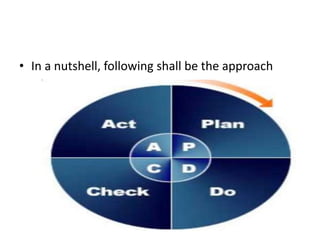
• In a nutshell, following shall be the approach
Thank You…

Enron scandal

  • 1.
    Presentation on the “EnronScandal” Presented by- Anushka Gupta B.Com(Hons.) 3rd Year
  • 2.
    The Company Profile •In 1985, Enron was born from the merger of Houstan Natural Gas and InterNorth. • Kenneth Lay, the former chief executive officer of Houston Natural Gas, became CEO, and the next year won the post of chairman. • Started trading futures in Gas Contracts. • Soon got the control of over 25% of the all Gas business. • Began trading in commodities like steel, coal, weather risk, etc.
  • 3.
    Sequence of Eventsthat followed
  • 4.
    Partners in Crime •Kenneth Lay- the Chairman • Andrew Fastow - The CFO • Jeffrey Skilling- The President and COO • Arthur Anderson- The accounting Firm
  • 5.
    Causes of theEnron Scandal • Dubious Accounting Practices • Enron’s misleading Accounts • Mark to market accounting • Special Purpose Entities • Executive compensation • Financial Audit • Over-statement of Profits
  • 6.
    • On anannualized basis between 1995 and 2000: – Enron's assets grew 38%, – revenues grew more than 60%, and – earnings grew 12%.
  • 7.
  • 8.
    Enron’s Accounting FraudDiagram Enron Profit Understated Forecasted Future Price C O M P A R E Mark To Market Method Seller Buyer Overstated Debt Special Purpose Entity Debt & Failing Investment Sales Revenue Original Price paid for the contract
  • 9.
    The Whistle Blower •On Feb 14, 2002, Sherron Watkins, the Enron whistleblower, testifies before a Congressional panel against Skilling and Lay. Sherron Watkins is an Enron vice president. She wrote to Lay in the past expressing concerns about Enron's accounting practices.
  • 10.
  • 11.
    The Rise andFall of Enron The company’s success was based on artificially inflated profits, dubious accounting practices, and – some say – fraud.
  • 12.
  • 13.
    The True Picture YearReported Income Revised Income True debt restated by True equity restated by 1997 $105m $77m Up $771m Down $258m 1998 $733m $600m Up $561m Down $391m 1999 $893m $645m Up $685m Down $710m 2000 $979m $880m Up $628m Down $754m Reported and revised income, debt and shareholder equity 1997-2000 following special partnership revelations. Enron’s Accounts: The Company announced the restated figures
  • 14.
    The Fraud Triangle Opportunities WeakBoard of Directors Weak Internal Controls
  • 15.
    Role of Auditor TheInternal Audit Department • Should have ensured the compliance of SA 240, SA 520. • Should maintain a tight internal control system established by the board members & directors • Report directly to the CEO • Direct consultation with the board director • Submit a quarterly report to the board and the supervisory committee . Statutory Auditor • Ensured compliance with SA 700 and SA 720. • Independent from the company and the board • Abides with accounting principles and rules • Should hold neutral opinions
  • 16.
    Enactment of SarbanesOxley Act In response to the Arthur Anderson, Enron, The Sarbanes Oxley Act seeks to • Restore the public confidence in both public accounting and public traded securities. • Assure the ethical business practices through heightened levels of executive awareness and accountability.
  • 17.
    What is SOX? • US Law, • Enacted in July 2002, • By a bill sponsored by Mr. Paul Sarbanes & co- authored by Mr. Michael Oxley, under whose name the act was enacted, • Consists of 11 chapters and 69 articles, • Also Known as “Public Company accounting Reform and Investor Protection Act”.
  • 18.
    How did SOXtry to amend the situation? Sarbanes-Oxley provides for increased corporate governance and corporate accountability. Therefore, SOX is in place to be sure that fraud on the scale of Enron never takes place again. If a publicly-traded company is not in compliance with the SOX law, the penalties are stiff. Multi- million dollar fines can result and imprisonment of the CEO or CFO. Penalties are based on the section of SOX that the company is not in compliance with.
  • 19.
    • In summary,the Sarbanes-Oxley Act of 2002 is probably the best piece of legislation to protect investors in modern times. It is a shame that it took debacles like Enron and others to shake up Congress into writing this legislation as many innocent people, investors and employees, literally lost their life savings. Perhaps SOX will make sure that doesn't happen again.
  • 20.
    What should havebeen done? 1. General Assembly • Shareholders should be encouraged to attend GAs. • Agenda items should be explained clearly • GA Should be managed to allow shareholders to express their opinions. • Voting on general assembly motions should be recorded accurately. 2. Board of Directors • Should meet at least once every 3 months • Non executive members may meet directors for consultation. • Review internal regulations & procedures for their appropriateness & efficiency • An internal audit committee formed from a number of non-executive members should be assigned to check internal controls & the company's working practices. • Responsible for risk management in accordance with the company's activities, size, & market • board should submit an annual report to shareholders including tasks assigned by law.
  • 21.
    3. The AuditCommittee • Comprises of a minimum of three non-executive members. • One member should be a finance & accounting expert • Assess the efficiency of the financial manager & other financial staff • review the financial statements before being presented to the board and give opinions and recommendations • review the internal/external auditor’s plan and make suggestions. • The committee should meet periodically, at least once every three months, with a specified agenda 4. Disclosure of social policies • At least once a year the company should disclose environmental, social, safety & health policies to shareholders, customers and employees. • The policies disclosed should be clear & unambiguous, including the company's strategies for employee recruitment & training & social welfare programs within or outside the company. Relationships
  • 22.
    5.Avoiding conflict ofinterests • Each company should have clear and recognized regulations for the directors & staff regarding the prevention of conflict of interests • Board members, directors and staff may not trade company stocks before the disclosure of the company's financial statements • Draw up rules of professional code of conduct • Impose an internal system for supervising the implementation of the code of conduct 6.Effective corporate governance 7.Disclosure and transparency 8. Audit Committee of the Board should have been more critical of the auditors and their work.
  • 23.
    Steps to taketo enhance your internal controls: • Establishment of an audit committee to provide financial reporting and internal control expertise, along with oversight on such matters • Establish a “Whistle-Blower” policy to provide the means and safeguards to those who identify fraudulent practices • Assess the risk associated with the processes that make-up your organization (ie., sales/revenue, cash, accounts receivable, fixed assets, accounts payable, payroll, etc.) • For high risk areas and processes ask yourself, “What Could Go Wrong” and address the answers to the question.
  • 24.
    Conclusion • The ENRONfailure has not been the result of just questionable activities by ENRON’s executive management team. The cast of contributors to the failure and bankruptcy are both inside and outside the company. It’s the total system that resulted in failure that needs to be further understood and investigated.
  • 25.
    • In anutshell, following shall be the approach
  • 26.

Editor's Notes

  • #12 The presentation can be made dramatic with One of the six of the group leading. He introduces the topic here.