Presented by:
Aditya Sharma
Himanshu Goyal
the Rise and Fall of Enron
The company’s success was based on artificially inflated profits,
dubious accounting practices, and – some say – fraud.
• Enron corp. is a company that reach the dramatic heights, only to face a dizzying
collapse.
• The story ends with the bankruptcy of one of America’s largest corporation.
• Affected the life of thousands of employees , shareholders and shook Wall Street
to core.
the Rise of Enron
•In 1985
• Enron was born from the merger of Houston
Natural Gas and Inter North.
•Kenneth Lay, became Enron’s CEO and
Chairman.
•Started trading futures in Gas Contracts.
•Soon got the control of over 25% of the all Gas
business.
•During 1985-1990
Traders gambling with company’s assets lost
$90 million in 5 days.
Arthur Anderson bluffed with the numbers and
miss reported company’s net worth.
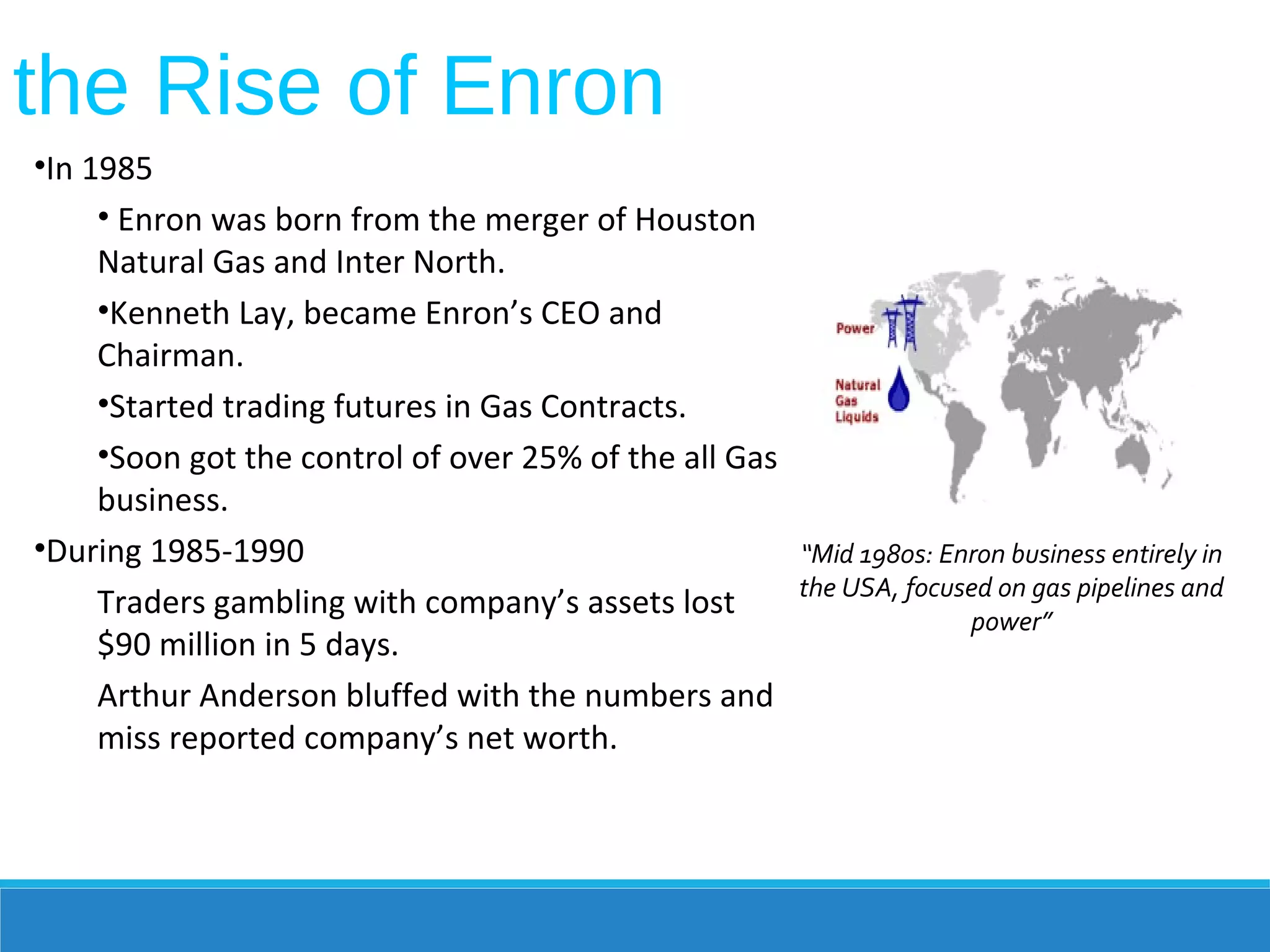
“Mid 1980s: Enron business entirely in
the USA, focused on gas pipelines and
power”
THE RISE OF ENRON
•DURING 1990-1999
1. Hired Jeffery Skilling , graduate from Harvard Business School.
2. Bought two ideas:-
• Trading natural gas as a value asset
• Changed accounting of Enron from Actual to Mark to Market
Accounting.
3. Did huge PR campaigning and media conference to project successful image
of Enron
4. Resulted in bolstering investor confidence so much that the price of the
Enron stock never went down whether it was making profit or not .
5. By the end of 90’s, trading was the primary focus.
6. Firm started shedding its assets as an asset light strategy.
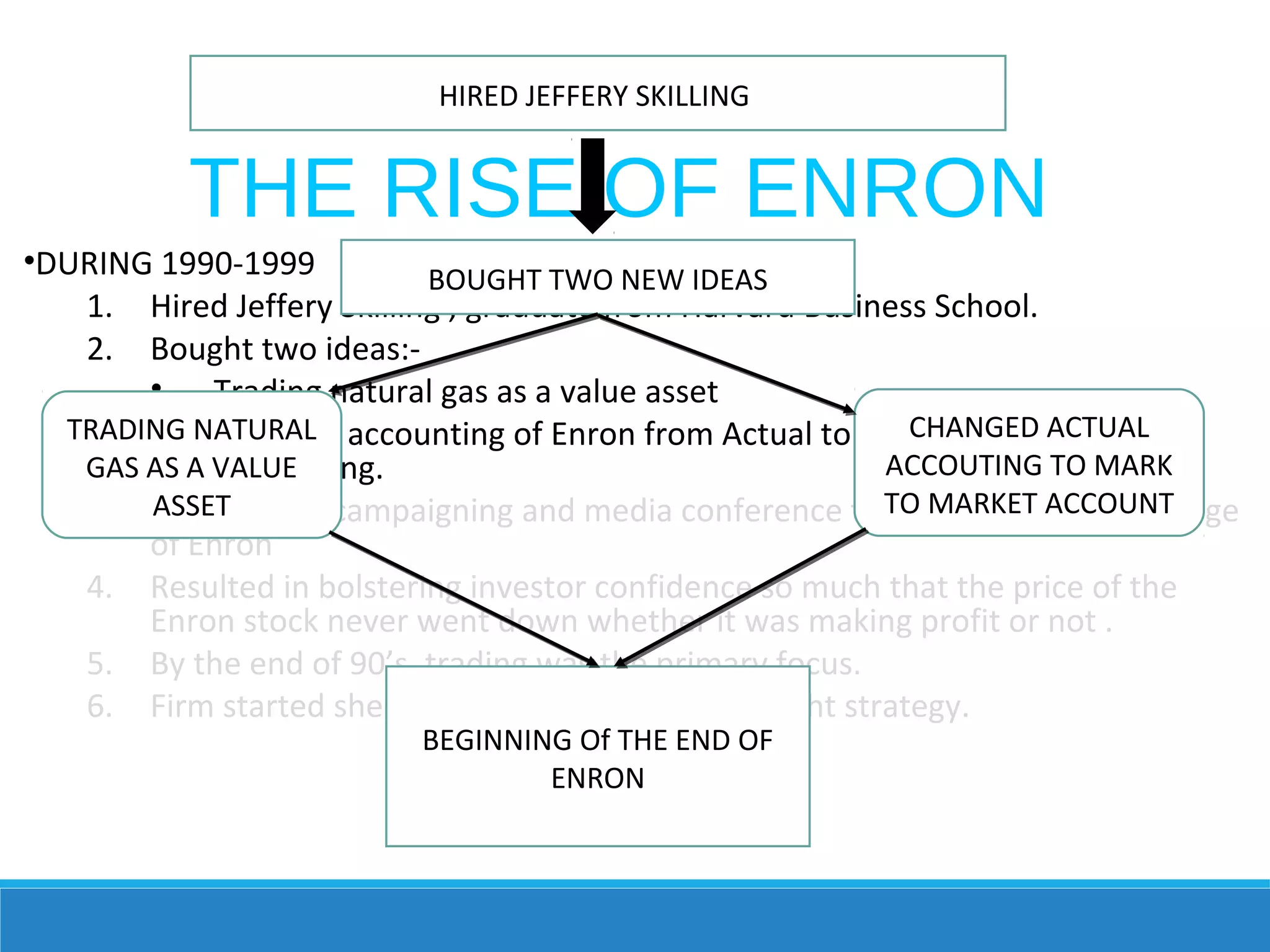
HIRED JEFFERY SKILLING
TRADING NATURAL
GAS AS A VALUE
ASSET
CHANGED ACTUAL
ACCOUTING TO MARK
TO MARKET ACCOUNT
BOUGHT TWO NEW IDEAS
BEGINNING Of THE END OF
ENRON
THE RISE OF ENRON
•DURING 1990-1999
1. Hired Jeffery Skilling , graduate from Harvard Business School.
2. Bought two ideas:-
• Trading natural gas as a value asset
• Changed accounting of Enron from Actual to Mark to Market
Accounting.
3. Did huge PR campaigning and media conference to project successful image
of Enron
4. Resulted in bolstering investor confidence so much that the price of the
Enron stock never went down whether it was making profit or not .
5. By the end of 90’s, trading was the primary focus.
6. Firm started shedding its assets as an asset light strategy.
THE RISE OF ENRON
•DURING 1990-1999
1. Hired Jeffery Skilling , graduate from Harvard Business School.
2. Bought two ideas:-
• Trading natural gas as a value asset
• Changed accounting of Enron from Actual to Mark to Market
Accounting.
3. Did huge PR campaigning and media conference to project successful image
of Enron
4. Resulted in bolstering investor confidence so much that the price of the
Enron stock never went down whether it was making profit or not .
5. By the end of 90’s, trading was the primary focus.
6. Firm started shedding its assets as an asset light strategy.
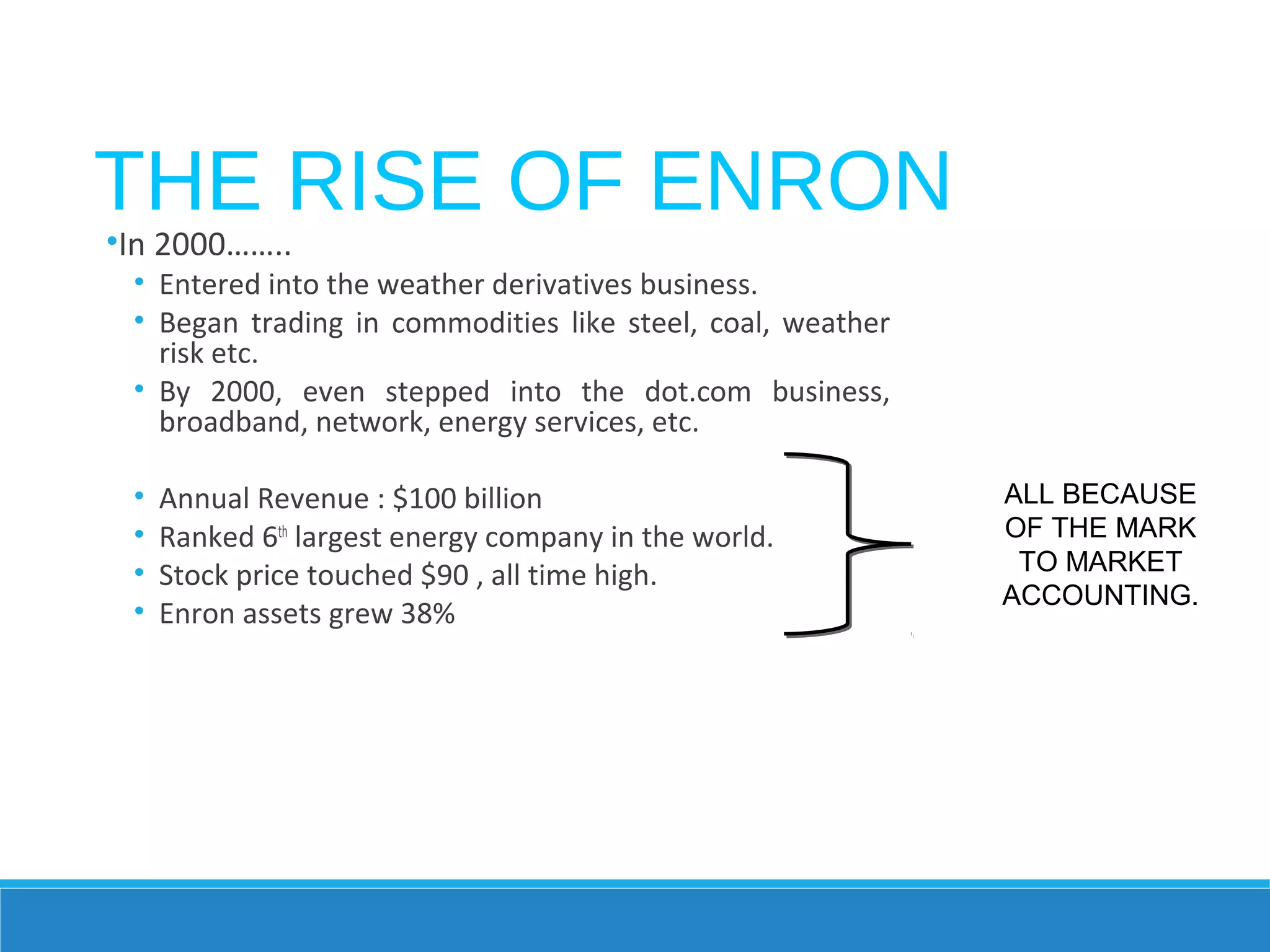
•In 2000……..
• Entered into the weather derivatives business.
• Began trading in commodities like steel, coal, weather
risk etc.
• By 2000, even stepped into the dot.com business,
broadband, network, energy services, etc.
• Annual Revenue : $100 billion
• Ranked 6th
largest energy company in the world.
• Stock price touched $90 , all time high.
• Enron assets grew 38%
THE RISE OF ENRON
ALL BECAUSE
OF THE MARK
TO MARKET
ACCOUNTING.
“2001: Enron trading in hundreds of commodities
Interests in: USA, South America, Europe, Asia and
Australia”
THE COLLAPSE OF WALL
STREET DARLING
By the fall of 2000, Enron started crumbling in its own weight.
INTRODUCED MARK TO
MARKET ACCOUNTING
CEO JEFFERY SKILLING
ENRON USED SPV’S TO HIDE
DEBTS
ENRON
Partnership
Special
Purpose
Entity
(SPE)
Account
In
Profit
3
4
2
1
5
1. Enron sets up partnership
using stock as funding
2. Partnership sets up SPE
3. ENRON transfer the its
stock to SPE for cash and
note.
4. SPV would subsequently
use the stock to protect the
asset on balance sheet.
5. Payment posted as profit,
even though it is Enron’s
own money
Andrew Fastow, a rising star who was promoted to CFO in 1998, introduced the
SPE’s to make the company appear in a better shape , despite the fact that all
its SPE’s were losing money.
INTRODUCED IN 1997, TO IMPROVE COMPANY’S BALANCE
SHEET
ARTHUR ANDERSON AND
ENRON
[RISKY BUSINESS]
Arthur Andersn LLP and David B. Ducan , who
oversaw Enron’s account were the major players in
the scandal.
Arthur Anderson was one the largest accounting
firm in the US during that time.
Ignoring Enron’s malpractices, it offered its stamp of
approval, which was enough for investors and
regulators alike for a while.
Which included approval for many subsidiaries like
raptor and condor.
Received $52 million in 2001, mainly for non audit
related consulting services.
tHE SHOCK FELT
AROUND US
 2001- ENRON was in a free fall
 Feb 14- Jeffry Skilling became CEOM
 May – Mr. Baxter, the Vice Chairman resigns.
 Aug 14 – Jeff Skilling resigned as CEO and Lay takes
over again.
• Enron’s broadband division also reported $137 million
loss .
• Analyst drop the company’s rating and stock price
fives to $39.95, a 52 week low.
 Oct 12- Arthur Anderson legal counsel tells auditors
to destroy all Enron file except basic doc.
 Oct 16- Enron announces $618 million loss and write
of $1.2 billion dollar. Stock further drop to $33.84.
Masterminds: (left to right):
founder Ken Lay; Jeff Skilling;
Andy Fastow; and Lou Pai
Stock heading South
•Oct 22 – Enron announces , its facing SEC [Security and
Exchange Commission] probe. Shares fall further to around
$20.75 that day.
•8th
Nov, 2001 – Told investors that they were restating
earnings for past 4 and ¾ years and admits its inflated its
income by around $586 million since 1997.
•By end of Nov, 2001 stock reached $0.3 falling from its peak
price $90 in just 8 months.
•2nd
Dec, 2001 – Filed Bankruptcy.
JEFF SKILLING QUITS AND AN INSIDER GETS
SUSPICIOUS
•Sherron Watkins, an Enron vice-president, had to
managed the list of assets when she got know about all the
malpractices by the Fastow and were approved by Arthur
Anderson.
•Fearing the predictable collapse she ordered Enron's
lawyers to conduct an investigation into the partnerships.
•Mr. Lay was also moving to reassure the markets. He was doing all
he could to "restore investor confidence" he told staff and
shareholders.
•But amid the selling, Mr. Lay himself joined the crowd as he
exercised options on 83,000 shares worth almost $2m.
Sherron Watkins
Kenneth Lay
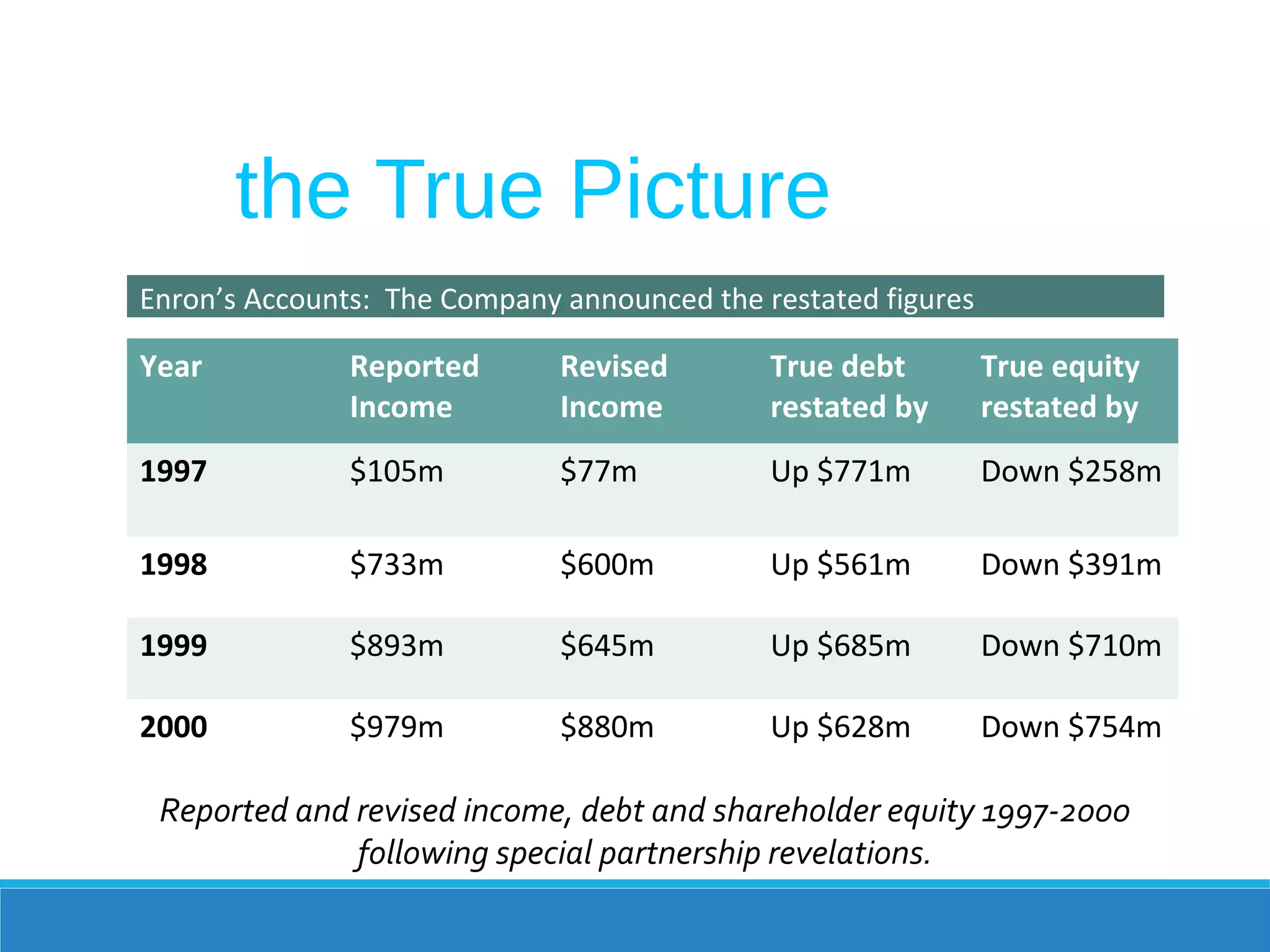
the True Picture
Year Reported
Income
Revised
Income
True debt
restated by
True equity
restated by
1997 $105m $77m Up $771m Down $258m
1998 $733m $600m Up $561m Down $391m
1999 $893m $645m Up $685m Down $710m
2000 $979m $880m Up $628m Down $754m
Reported and revised income, debt and shareholder equity 1997-2000
following special partnership revelations.
Enron’s Accounts: The Company announced the restated figures
CONSEQUENCES
20,000 Enron’s employees and 22,000 Arthur Anderson employees lost their job.
 Jeff Skilling former CEO and COO paid attorneys a $23 Million retainer to defend his
innocent plea. He was found guilty of fraud and insider trading; he is currently serving a
24 year prison sentence.
Ken Lay was convicted of 10 counts of fraud and 2 cases of conspiracy; he faced up to
165 years in prison but died of a heart attack before he could ever be processed.
CFO Andrew Fastow served just over 5 years in exchange for cooperation with
prosecutors and testimony against other Enron executives.
Investors, shareholders and employees lost some $74 billion dollars in the four years
leading up to its bankruptcy; for many it meant losing their old-age security.
The pension fund for the company's employees was obliterated.
The auditing firm Arthur Anderson lost its accreditation.
The rules for company financial reporting were drastically sharpened:
Sarbanes-Oxley Act (2002).
ENRON SCANDAL

ENRON SCANDAL

  • 1.
  • 2.
    the Rise andFall of Enron The company’s success was based on artificially inflated profits, dubious accounting practices, and – some say – fraud. • Enron corp. is a company that reach the dramatic heights, only to face a dizzying collapse. • The story ends with the bankruptcy of one of America’s largest corporation. • Affected the life of thousands of employees , shareholders and shook Wall Street to core.
  • 3.
    the Rise ofEnron •In 1985 • Enron was born from the merger of Houston Natural Gas and Inter North. •Kenneth Lay, became Enron’s CEO and Chairman. •Started trading futures in Gas Contracts. •Soon got the control of over 25% of the all Gas business. •During 1985-1990 Traders gambling with company’s assets lost $90 million in 5 days. Arthur Anderson bluffed with the numbers and miss reported company’s net worth. “Mid 1980s: Enron business entirely in the USA, focused on gas pipelines and power”
  • 4.
    THE RISE OFENRON •DURING 1990-1999 1. Hired Jeffery Skilling , graduate from Harvard Business School. 2. Bought two ideas:- • Trading natural gas as a value asset • Changed accounting of Enron from Actual to Mark to Market Accounting. 3. Did huge PR campaigning and media conference to project successful image of Enron 4. Resulted in bolstering investor confidence so much that the price of the Enron stock never went down whether it was making profit or not . 5. By the end of 90’s, trading was the primary focus. 6. Firm started shedding its assets as an asset light strategy. HIRED JEFFERY SKILLING TRADING NATURAL GAS AS A VALUE ASSET CHANGED ACTUAL ACCOUTING TO MARK TO MARKET ACCOUNT BOUGHT TWO NEW IDEAS BEGINNING Of THE END OF ENRON
  • 5.
    THE RISE OFENRON •DURING 1990-1999 1. Hired Jeffery Skilling , graduate from Harvard Business School. 2. Bought two ideas:- • Trading natural gas as a value asset • Changed accounting of Enron from Actual to Mark to Market Accounting. 3. Did huge PR campaigning and media conference to project successful image of Enron 4. Resulted in bolstering investor confidence so much that the price of the Enron stock never went down whether it was making profit or not . 5. By the end of 90’s, trading was the primary focus. 6. Firm started shedding its assets as an asset light strategy.
  • 6.
    THE RISE OFENRON •DURING 1990-1999 1. Hired Jeffery Skilling , graduate from Harvard Business School. 2. Bought two ideas:- • Trading natural gas as a value asset • Changed accounting of Enron from Actual to Mark to Market Accounting. 3. Did huge PR campaigning and media conference to project successful image of Enron 4. Resulted in bolstering investor confidence so much that the price of the Enron stock never went down whether it was making profit or not . 5. By the end of 90’s, trading was the primary focus. 6. Firm started shedding its assets as an asset light strategy.
  • 7.
    •In 2000…….. • Enteredinto the weather derivatives business. • Began trading in commodities like steel, coal, weather risk etc. • By 2000, even stepped into the dot.com business, broadband, network, energy services, etc. • Annual Revenue : $100 billion • Ranked 6th largest energy company in the world. • Stock price touched $90 , all time high. • Enron assets grew 38% THE RISE OF ENRON ALL BECAUSE OF THE MARK TO MARKET ACCOUNTING.
  • 8.
    “2001: Enron tradingin hundreds of commodities Interests in: USA, South America, Europe, Asia and Australia”
  • 9.
    THE COLLAPSE OFWALL STREET DARLING By the fall of 2000, Enron started crumbling in its own weight. INTRODUCED MARK TO MARKET ACCOUNTING CEO JEFFERY SKILLING
  • 10.
    ENRON USED SPV’STO HIDE DEBTS ENRON Partnership Special Purpose Entity (SPE) Account In Profit 3 4 2 1 5 1. Enron sets up partnership using stock as funding 2. Partnership sets up SPE 3. ENRON transfer the its stock to SPE for cash and note. 4. SPV would subsequently use the stock to protect the asset on balance sheet. 5. Payment posted as profit, even though it is Enron’s own money Andrew Fastow, a rising star who was promoted to CFO in 1998, introduced the SPE’s to make the company appear in a better shape , despite the fact that all its SPE’s were losing money. INTRODUCED IN 1997, TO IMPROVE COMPANY’S BALANCE SHEET
  • 11.
    ARTHUR ANDERSON AND ENRON [RISKYBUSINESS] Arthur Andersn LLP and David B. Ducan , who oversaw Enron’s account were the major players in the scandal. Arthur Anderson was one the largest accounting firm in the US during that time. Ignoring Enron’s malpractices, it offered its stamp of approval, which was enough for investors and regulators alike for a while. Which included approval for many subsidiaries like raptor and condor. Received $52 million in 2001, mainly for non audit related consulting services.
  • 12.
    tHE SHOCK FELT AROUNDUS  2001- ENRON was in a free fall  Feb 14- Jeffry Skilling became CEOM  May – Mr. Baxter, the Vice Chairman resigns.  Aug 14 – Jeff Skilling resigned as CEO and Lay takes over again. • Enron’s broadband division also reported $137 million loss . • Analyst drop the company’s rating and stock price fives to $39.95, a 52 week low.  Oct 12- Arthur Anderson legal counsel tells auditors to destroy all Enron file except basic doc.  Oct 16- Enron announces $618 million loss and write of $1.2 billion dollar. Stock further drop to $33.84. Masterminds: (left to right): founder Ken Lay; Jeff Skilling; Andy Fastow; and Lou Pai
  • 13.
    Stock heading South •Oct22 – Enron announces , its facing SEC [Security and Exchange Commission] probe. Shares fall further to around $20.75 that day. •8th Nov, 2001 – Told investors that they were restating earnings for past 4 and ¾ years and admits its inflated its income by around $586 million since 1997. •By end of Nov, 2001 stock reached $0.3 falling from its peak price $90 in just 8 months. •2nd Dec, 2001 – Filed Bankruptcy.
  • 14.
    JEFF SKILLING QUITSAND AN INSIDER GETS SUSPICIOUS •Sherron Watkins, an Enron vice-president, had to managed the list of assets when she got know about all the malpractices by the Fastow and were approved by Arthur Anderson. •Fearing the predictable collapse she ordered Enron's lawyers to conduct an investigation into the partnerships. •Mr. Lay was also moving to reassure the markets. He was doing all he could to "restore investor confidence" he told staff and shareholders. •But amid the selling, Mr. Lay himself joined the crowd as he exercised options on 83,000 shares worth almost $2m. Sherron Watkins Kenneth Lay
  • 15.
    the True Picture YearReported Income Revised Income True debt restated by True equity restated by 1997 $105m $77m Up $771m Down $258m 1998 $733m $600m Up $561m Down $391m 1999 $893m $645m Up $685m Down $710m 2000 $979m $880m Up $628m Down $754m Reported and revised income, debt and shareholder equity 1997-2000 following special partnership revelations. Enron’s Accounts: The Company announced the restated figures
  • 16.
    CONSEQUENCES 20,000 Enron’s employeesand 22,000 Arthur Anderson employees lost their job.  Jeff Skilling former CEO and COO paid attorneys a $23 Million retainer to defend his innocent plea. He was found guilty of fraud and insider trading; he is currently serving a 24 year prison sentence. Ken Lay was convicted of 10 counts of fraud and 2 cases of conspiracy; he faced up to 165 years in prison but died of a heart attack before he could ever be processed. CFO Andrew Fastow served just over 5 years in exchange for cooperation with prosecutors and testimony against other Enron executives. Investors, shareholders and employees lost some $74 billion dollars in the four years leading up to its bankruptcy; for many it meant losing their old-age security. The pension fund for the company's employees was obliterated. The auditing firm Arthur Anderson lost its accreditation. The rules for company financial reporting were drastically sharpened: Sarbanes-Oxley Act (2002).

Editor's Notes

  • #3 The presentation can be made dramatic with One of the six of the group leading. He introduces the topic here.