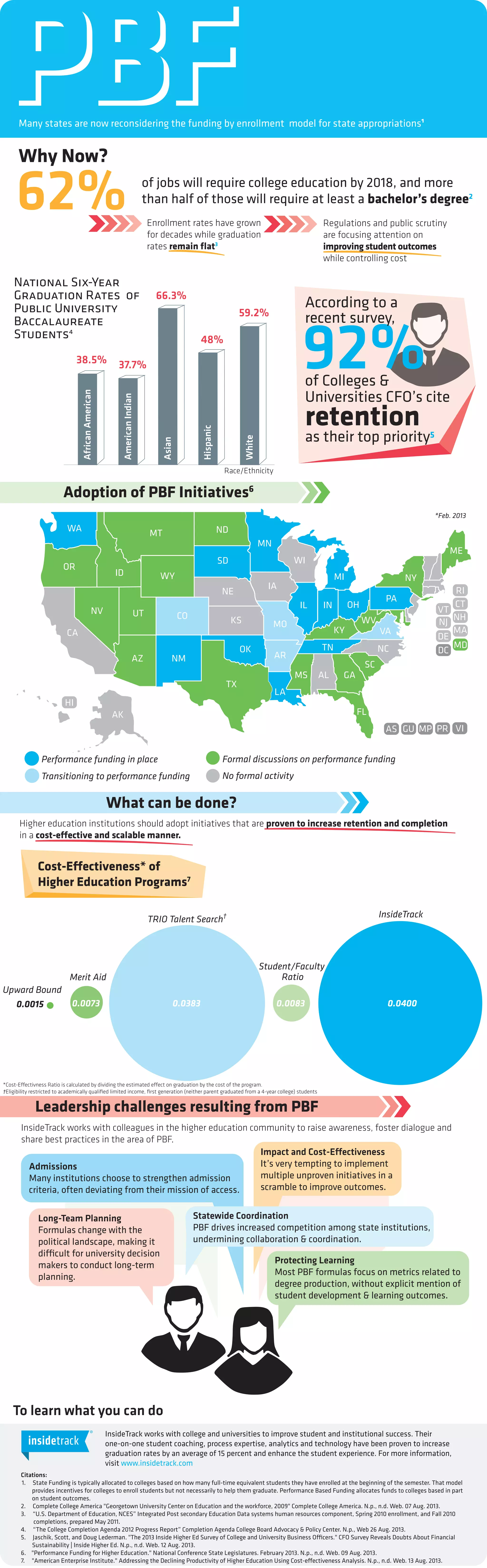
Many states are now reconsidering the funding by enrollment model for state appropriations 
62% of jobs will require college education by 2018, and more 
than half of those will require at least a bachelor’s degree2 
National Six-Year 
Graduation Rates of 
Public University 
Baccalaureate 
Students4 
WA MT 
CO 
What can be done? 
OR 
HI 
Regulations and public scrutiny 
are focusing attention on 
improving student outcomes 
while controlling cost 
According to a 
recent survey, 
SC 
VA 
*Feb. 2013 
Higher education institutions should adopt initiatives that are proven to increase retention and completion 
in a cost-eective and scalable manner. 
Student/Faculty 
Ratio 
Cost-Eectiveness* of 
Higher Education Programs7 
TRIO Talent Search† 
Merit Aid 
Upward Bound 
0.0015 0.0073 0.0383 0.0083 0.0400 
*Cost-Eectivness Ratio is calculated by dividing the estimated eect on graduation by the cost of the program. 
†Eligibility restricted to academically qualified limited income, first generation (neither parent graduated from a 4-year college) students 
Leadership challenges resulting from PBF 
InsideTrack works with colleagues in the higher education community to raise awareness, foster dialogue and 
share best practices in the area of PBF. 
Admissions 
Many institutions choose to strengthen admission 
criteria, often deviating from their mission of access. 
Long-Team Planning 
Formulas change with the 
political landscape, making it 
dicult for university decision 
makers to conduct long-term 
planning. 
To learn what you can do 
InsideTrack 
Impact and Cost-Eectiveness 
It’s very tempting to implement 
multiple unproven initiatives in a 
scramble to improve outcomes. 
Statewide Coordination 
PBF drives increased competition among state institutions, 
undermining collaboration  coordination. 
Protecting Learning 
Most PBF formulas focus on metrics related to 
degree production, without explicit mention of 
student development  learning outcomes. 
InsideTrack works with college and universities to improve student and institutional success. Their 
one-on-one student coaching, process expertise, analytics and technology have been proven to increase 
graduation rates by an average of 15 percent and enhance the student experience. For more information, 
visit www.insidetrack.com 
Citations: 
1. State Funding is typically allocated to colleges based on how many full-time equivalent students they have enrolled at the beginning of the semester. That model 
provides incentives for colleges to enroll students but not necessarily to help them graduate. Performance Based Funding allocates funds to colleges based in part 
on student outcomes. 
2. Complete College America Georgetown University Center on Education and the workforce, 2009 Complete College America. N.p., n.d. Web. 07 Aug. 2013. 
3. “U.S. Department of Education, NCES” Integrated Post secondary Education Data systems human resources component, Spring 2010 enrollment, and Fall 2010 
completions, prepared May 2011. 
4. “The College Completion Agenda 2012 Progress Report” Completion Agenda College Board Advocacy  Policy Center. N.p., Web 26 Aug. 2013. 
5. Jaschik, Scott, and Doug Lederman. The 2013 Inside Higher Ed Survey of College and University Business Ocers. CFO Survey Reveals Doubts About Financial 
Sustainability | Inside Higher Ed. N.p., n.d. Web. 12 Aug. 2013. 
6. Performance Funding for Higher Education. National Conference State Legislatures. February 2013. N.p., n.d. Web. 09 Aug. 2013. 
7. American Enterprise Institute. Addressing the Declining Productivity of Higher Education Using Cost-eectiveness Analysis. N.p., n.d. Web. 13 Aug. 2013. 
RI 
VT CT 
NJ NH 
MA 
DE 
DC 
Adoption of PBF Initiatives6 
Performance funding in place 
Transitioning to performance funding 
Formal discussions on performance funding 
No formal activity 
CA 
ID WY 
NV UT 
AZ NM 
ND 
SD 
NE 
KS 
OK 
TX 
MN 
WI 
IA 
MO 
AR 
LA 
IL IN 
MI 
KY 
OH 
TN 
MS AL GA 
FL 
NC 
WV 
PA 
NY 
ME 
AK 
MD 
AS GU MP PR VI 
Enrollment rates have grown 
for decades while graduation 
rates remain flat3 
92% of Colleges  
Universities CFO’s cite retention 
as their top priority 
Why Now? 
African American 
American Indian 
Asian 
Hispanic 
White 
37.7% 
66.3% 
48% 
59.2% 
38.5% 
Race/Ethnicity

Performance Based Funding – A new era in accountability?

  • 1.
    Many states arenow reconsidering the funding by enrollment model for state appropriations 62% of jobs will require college education by 2018, and more than half of those will require at least a bachelor’s degree2 National Six-Year Graduation Rates of Public University Baccalaureate Students4 WA MT CO What can be done? OR HI Regulations and public scrutiny are focusing attention on improving student outcomes while controlling cost According to a recent survey, SC VA *Feb. 2013 Higher education institutions should adopt initiatives that are proven to increase retention and completion in a cost-eective and scalable manner. Student/Faculty Ratio Cost-Eectiveness* of Higher Education Programs7 TRIO Talent Search† Merit Aid Upward Bound 0.0015 0.0073 0.0383 0.0083 0.0400 *Cost-Eectivness Ratio is calculated by dividing the estimated eect on graduation by the cost of the program. †Eligibility restricted to academically qualified limited income, first generation (neither parent graduated from a 4-year college) students Leadership challenges resulting from PBF InsideTrack works with colleagues in the higher education community to raise awareness, foster dialogue and share best practices in the area of PBF. Admissions Many institutions choose to strengthen admission criteria, often deviating from their mission of access. Long-Team Planning Formulas change with the political landscape, making it dicult for university decision makers to conduct long-term planning. To learn what you can do InsideTrack Impact and Cost-Eectiveness It’s very tempting to implement multiple unproven initiatives in a scramble to improve outcomes. Statewide Coordination PBF drives increased competition among state institutions, undermining collaboration coordination. Protecting Learning Most PBF formulas focus on metrics related to degree production, without explicit mention of student development learning outcomes. InsideTrack works with college and universities to improve student and institutional success. Their one-on-one student coaching, process expertise, analytics and technology have been proven to increase graduation rates by an average of 15 percent and enhance the student experience. For more information, visit www.insidetrack.com Citations: 1. State Funding is typically allocated to colleges based on how many full-time equivalent students they have enrolled at the beginning of the semester. That model provides incentives for colleges to enroll students but not necessarily to help them graduate. Performance Based Funding allocates funds to colleges based in part on student outcomes. 2. Complete College America Georgetown University Center on Education and the workforce, 2009 Complete College America. N.p., n.d. Web. 07 Aug. 2013. 3. “U.S. Department of Education, NCES” Integrated Post secondary Education Data systems human resources component, Spring 2010 enrollment, and Fall 2010 completions, prepared May 2011. 4. “The College Completion Agenda 2012 Progress Report” Completion Agenda College Board Advocacy Policy Center. N.p., Web 26 Aug. 2013. 5. Jaschik, Scott, and Doug Lederman. The 2013 Inside Higher Ed Survey of College and University Business Ocers. CFO Survey Reveals Doubts About Financial Sustainability | Inside Higher Ed. N.p., n.d. Web. 12 Aug. 2013. 6. Performance Funding for Higher Education. National Conference State Legislatures. February 2013. N.p., n.d. Web. 09 Aug. 2013. 7. American Enterprise Institute. Addressing the Declining Productivity of Higher Education Using Cost-eectiveness Analysis. N.p., n.d. Web. 13 Aug. 2013. RI VT CT NJ NH MA DE DC Adoption of PBF Initiatives6 Performance funding in place Transitioning to performance funding Formal discussions on performance funding No formal activity CA ID WY NV UT AZ NM ND SD NE KS OK TX MN WI IA MO AR LA IL IN MI KY OH TN MS AL GA FL NC WV PA NY ME AK MD AS GU MP PR VI Enrollment rates have grown for decades while graduation rates remain flat3 92% of Colleges Universities CFO’s cite retention as their top priority Why Now? African American American Indian Asian Hispanic White 37.7% 66.3% 48% 59.2% 38.5% Race/Ethnicity