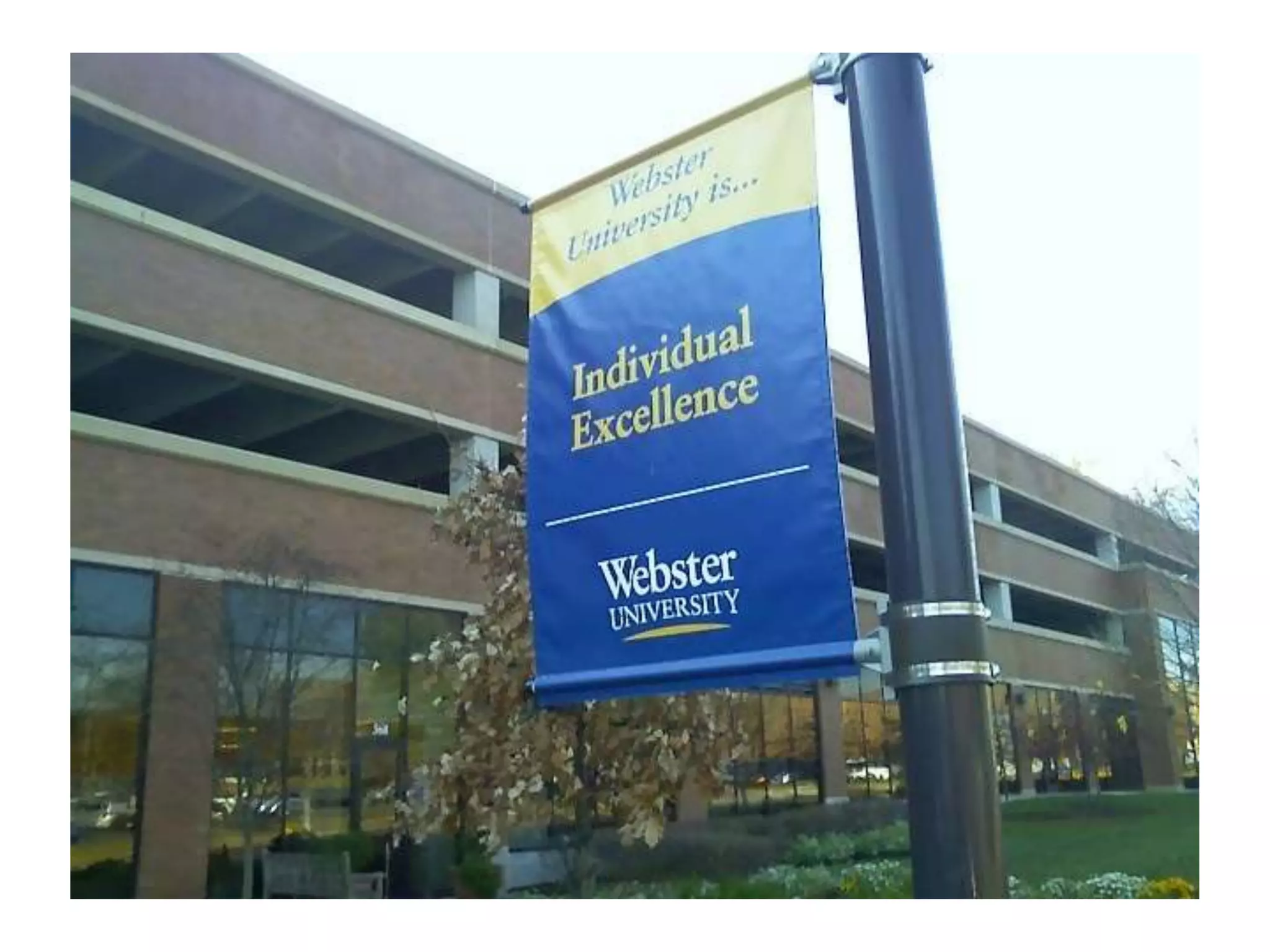
The Global Citizenship Program of general education
What makes a good life?Dave Pollard: How to Save the Worldhttp://blogs.salon.com/0002007/http://howtosavetheworld.ca/
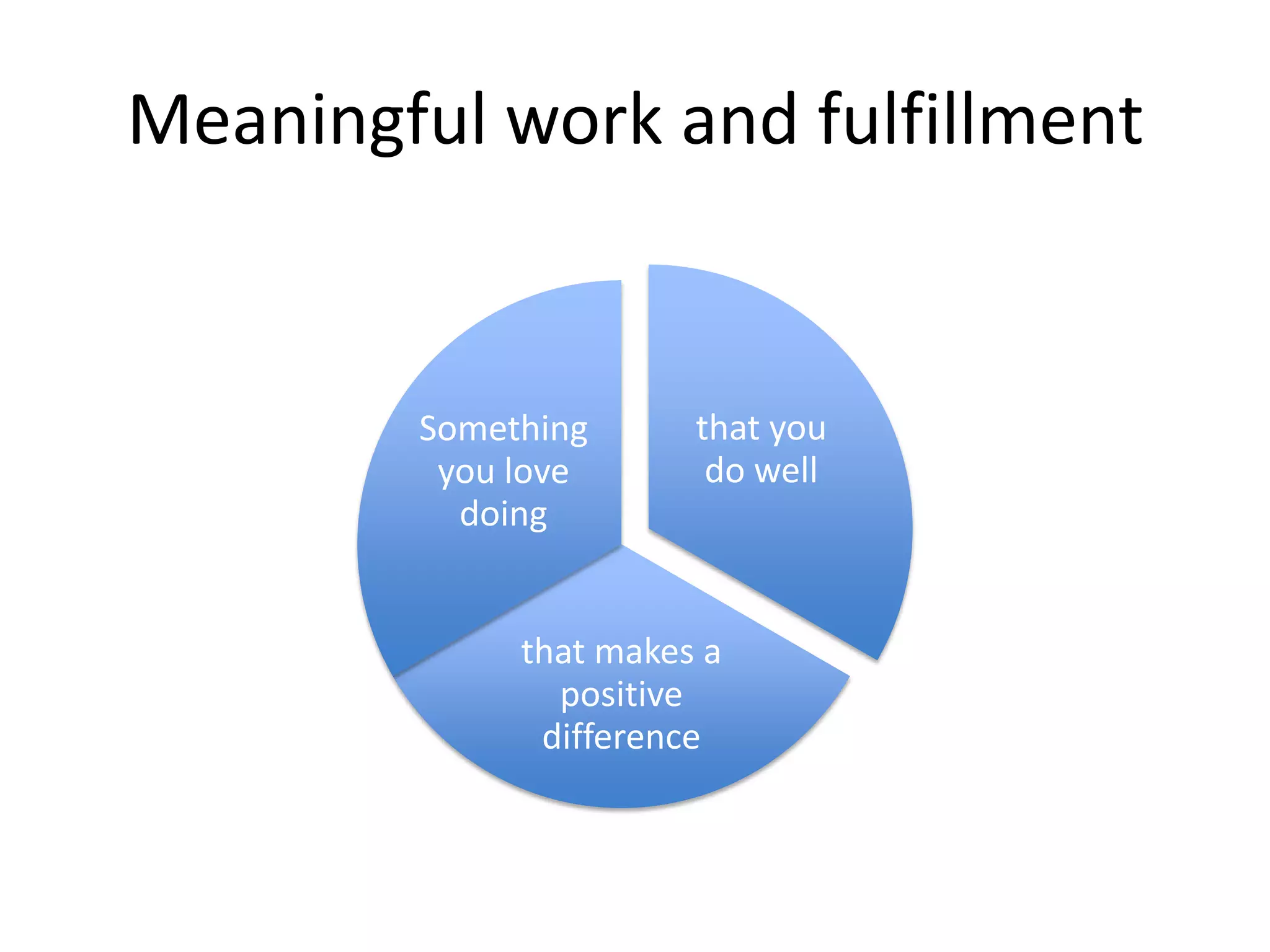
Meaningful work and fulfillment
General Education revision began in 2009
Three things converged:New University mission statementHLC Visit and Report: “Improve assessment practices.”Presidential search: Significant changes ahead.
(Old) Mission StatementMission & ValuesAlthough the Sisters of Loretto no longer oversee the day-to-day operation of Webster University, the general mission they established when they founded the university remains unchanged — to satisfy unmet educational needs.Webster today operates as an independent, comprehensive, non-demominational university with campus locations around the world. It offers undergraduate and graduate programs in a wide array of disciplines, including the liberal arts, fine and performing arts, teacher education, business and management.In striving to fulfill educational needs that may be underserved, Webster University:    * Creates a student-centered environment accessible to individuals of diverse ages, cultures and socioeconomic backgrounds.    * Sustains a personalized approach to education through small classes and close relationships among faculty and students.    * Develops educational programs that join theory and practice, and instill in students the spirit of systematic inquiry.    * Encourages creativity, scholarship and individual enterprise in its students and faculty.    * Promotes international perspectives in the curriculum and among students and faculty.    * Encourages in its students a critical perspective, a respect for diversity and an understanding of their own and others’ values.    * Fosters in its students a lifelong desire to learn and a commitment to contribute actively to their communities and the world.    * Educates diverse populations locally, regionally, nationally and internationally.    * Strengthens the communities it serves through support of civic, cultural, corporate and educational organizations.
2007-2008 Strategic PlanningMission StatementStrategic PlanPlanning Process and Institutional Planning Committee
2008: Self-study process for reaccreditation completedHigher Learning Commission VisitHigher Learning Commission -- 10-year reaccreditationGeneral Education – criterion met, assessment needs attention
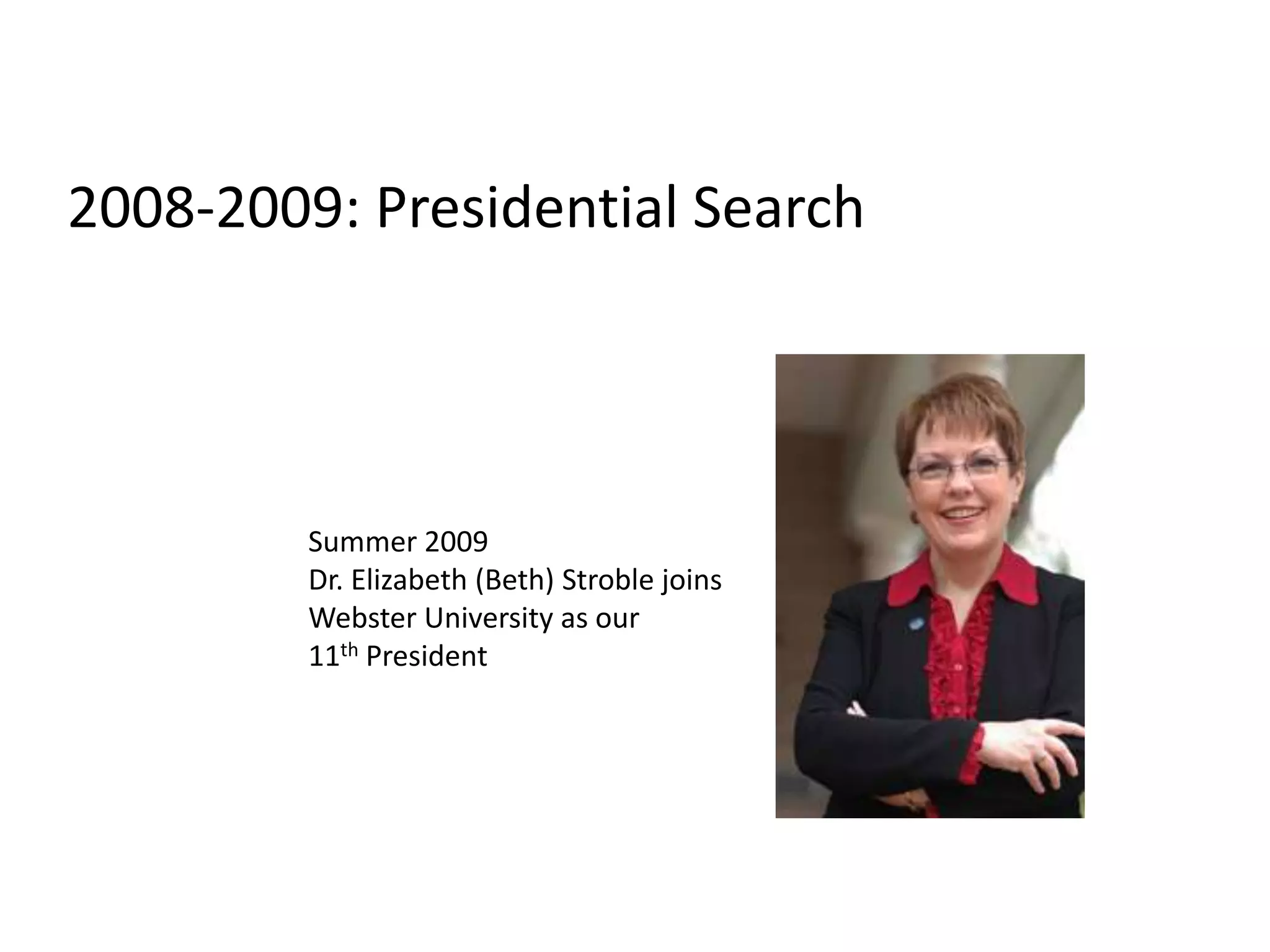
2008-2009: Presidential SearchSummer 2009Dr. Elizabeth (Beth) Stroble joins Webster University as our 11th President
February 2009:Webster submits proposal to the Association of American Colleges & Universities for a team to attend the summer Institute on General Education and Assessment
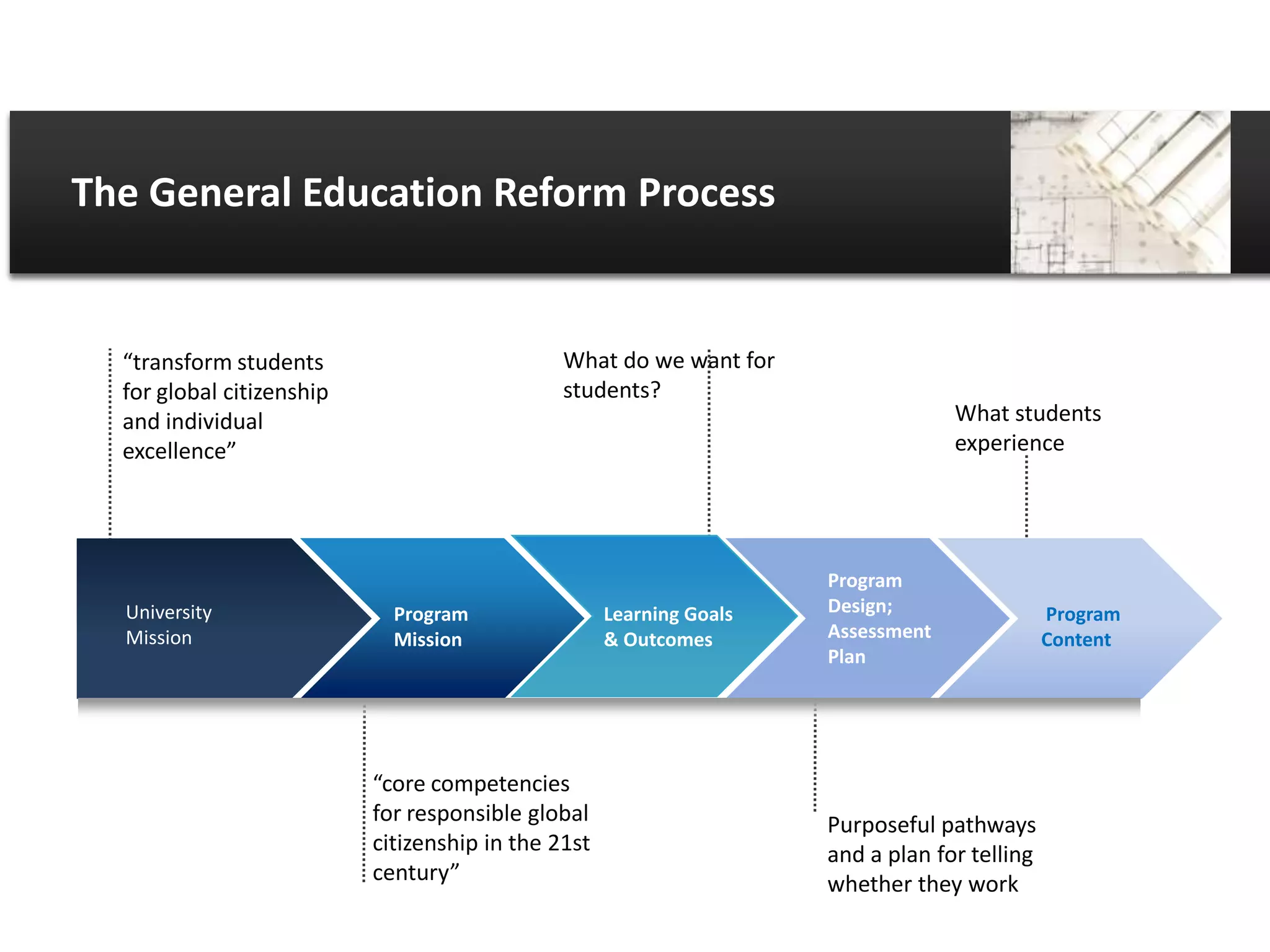
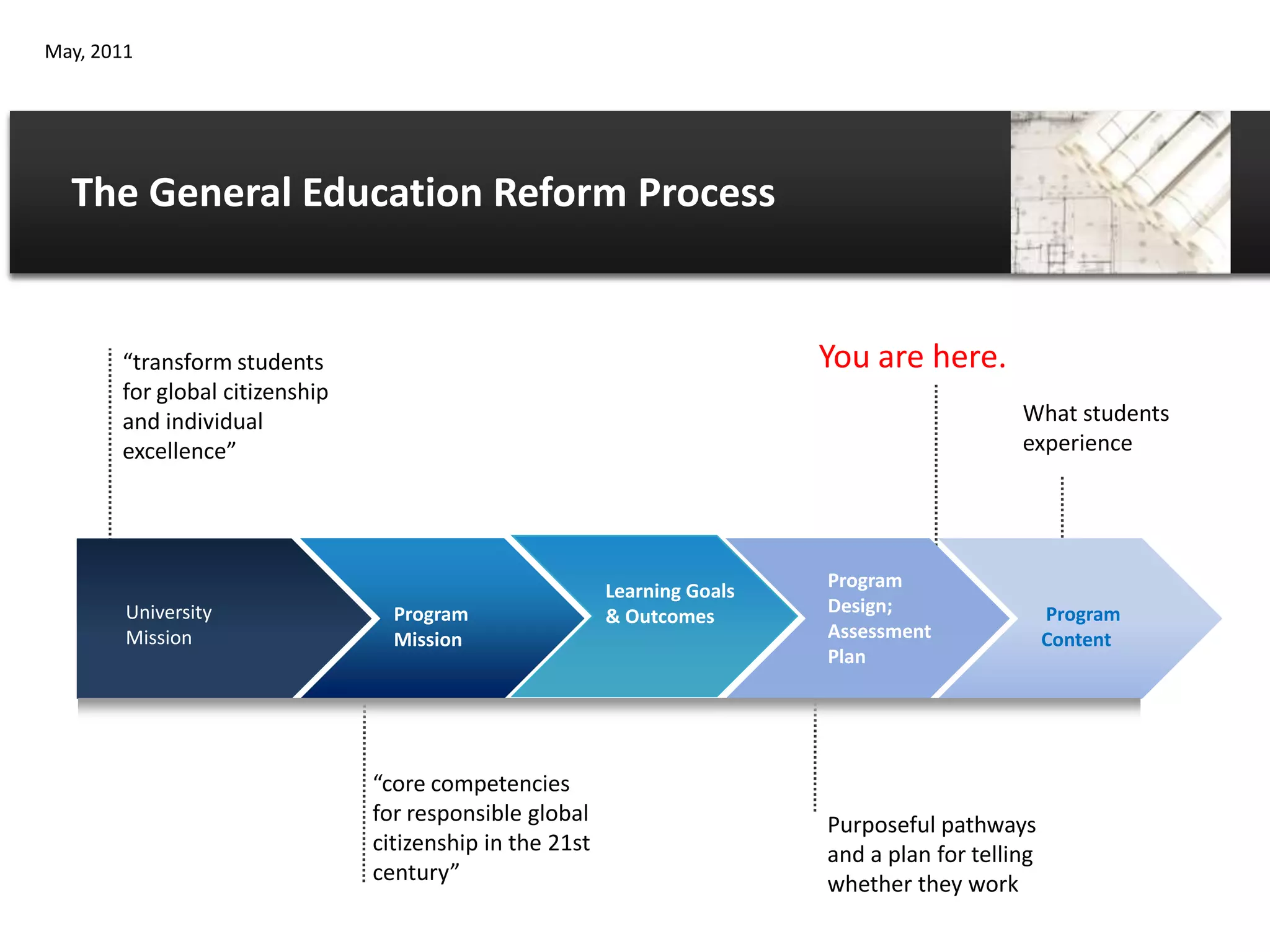
Arrow ProcessThe General Education Reform ProcessWhy use graphics from PowerPointing.com?What do we want for students?“transform students for global citizenship and individual excellence”What students experienceProgram Design; Assessment PlanUniversity MissionLearning Goals & Outcomes Program ContentProgram Mission“core competencies for responsible global citizenship in the 21st century”Purposeful pathways and a plan for telling whether they work
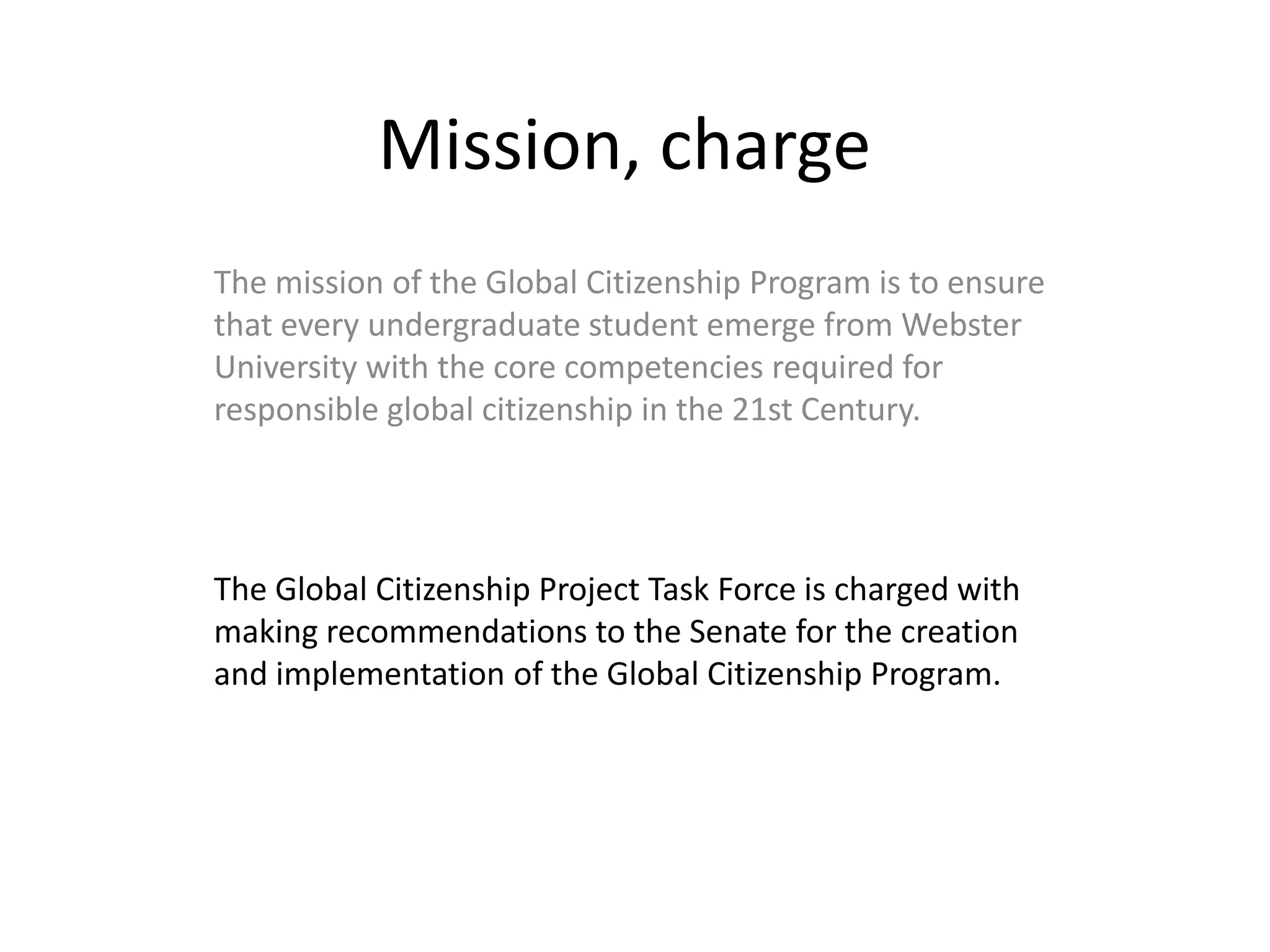
Mission, chargeThe mission of the Global Citizenship Program is to ensure that every undergraduate student emerge from Webster University with the core competencies required for responsible global citizenship in the 21st Century.The Global Citizenship Project Task Force is charged with making recommendations to the Senate for the creation and implementation of the Global Citizenship Program.
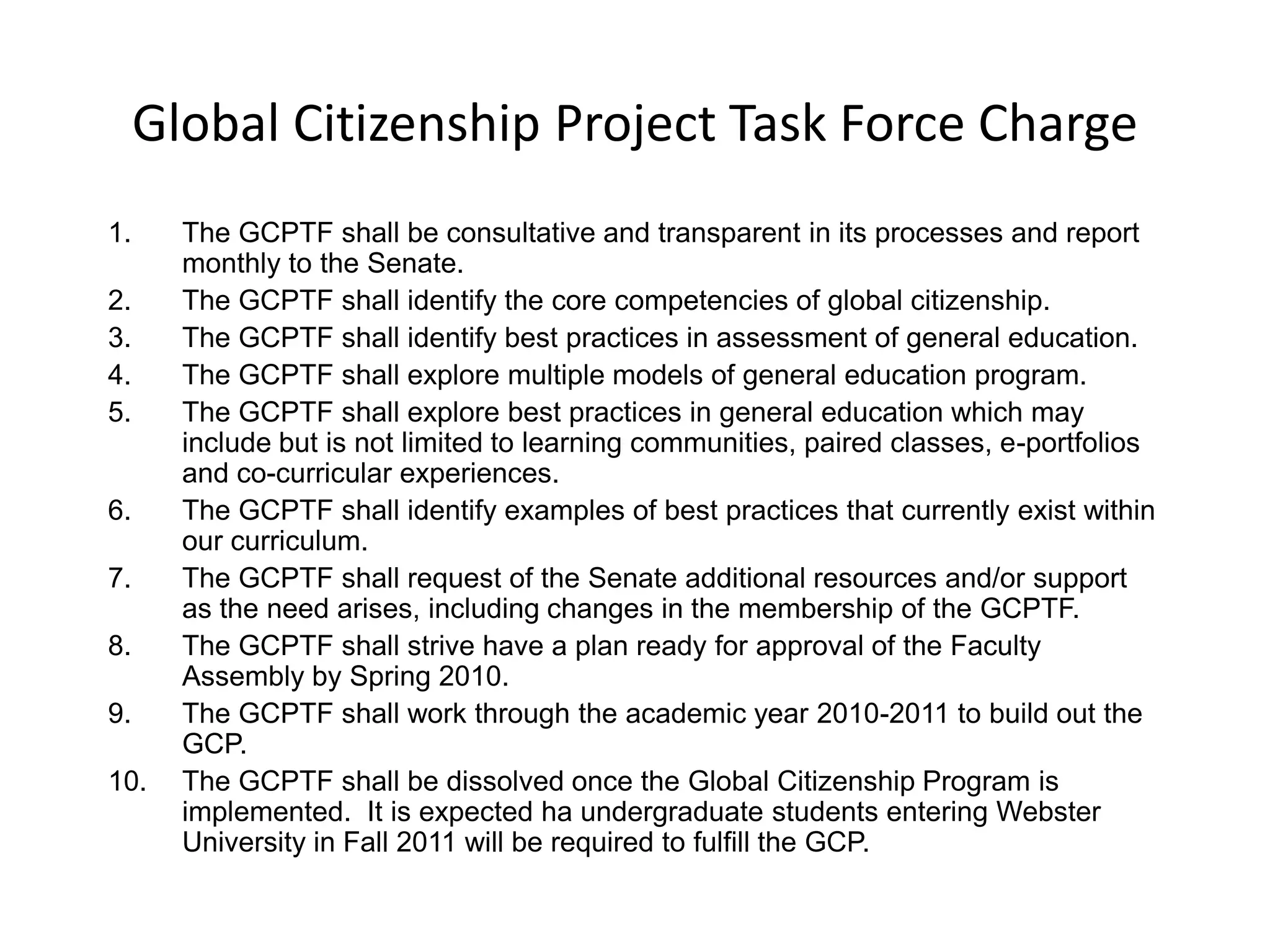
Global Citizenship Project Task Force ChargeThe GCPTF shall be consultative and transparent in its processes and report monthly to the Senate. The GCPTF shall identify the core competencies of global citizenship.The GCPTF shall identify best practices in assessment of general education.The GCPTF shall explore multiple models of general education program.The GCPTF shall explore best practices in general education which may include but is not limited to learning communities, paired classes, e-portfolios and co-curricular experiences.The GCPTF shall identify examples of best practices that currently exist within our curriculum.The GCPTF shall request of the Senate additional resources and/or support as the need arises, including changes in the membership of the GCPTF.The GCPTF shall strive have a plan ready for approval of the Faculty Assembly by Spring 2010.The GCPTF shall work through the academic year 2010-2011 to build out the GCP.The GCPTF shall be dissolved once the Global Citizenship Program is implemented.  It is expected ha undergraduate students entering Webster University in Fall 2011 will be required to fulfill the GCP.
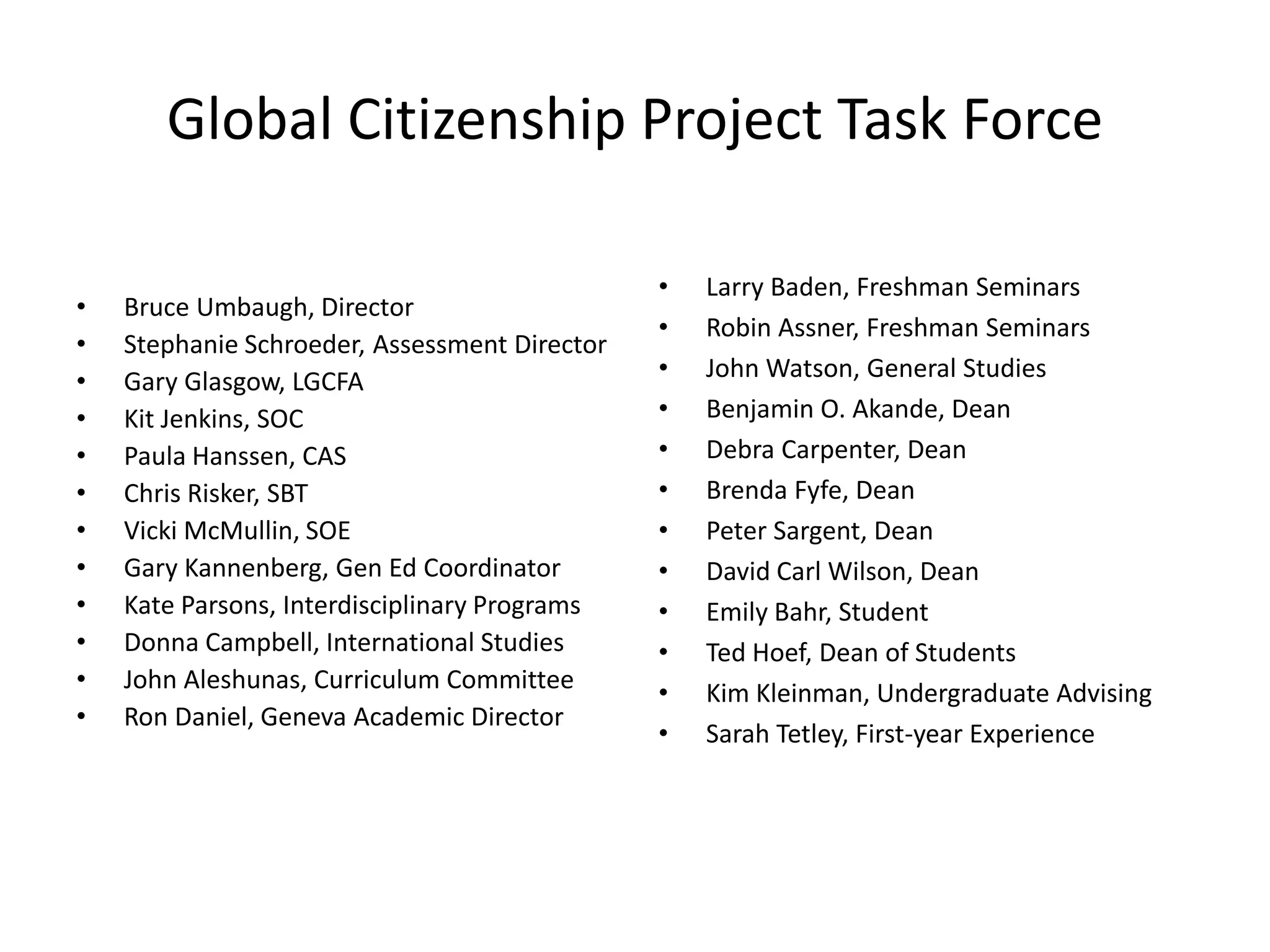
Global Citizenship Project Task ForceBruce Umbaugh, DirectorStephanie Schroeder, Assessment DirectorGary Glasgow, LGCFAKit Jenkins, SOCPaula Hanssen, CASChris Risker, SBTVicki McMullin, SOEGary Kannenberg, Gen Ed CoordinatorKate Parsons, Interdisciplinary ProgramsDonna Campbell, International StudiesJohn Aleshunas, Curriculum CommitteeRon Daniel, Geneva Academic DirectorLarry Baden, Freshman SeminarsRobin Assner, Freshman SeminarsJohn Watson, General StudiesBenjamin O. Akande, DeanDebra Carpenter, DeanBrenda Fyfe, DeanPeter Sargent, DeanDavid Carl Wilson, DeanEmily Bahr, StudentTed Hoef, Dean of StudentsKim Kleinman, Undergraduate AdvisingSarah Tetley, First-year Experience
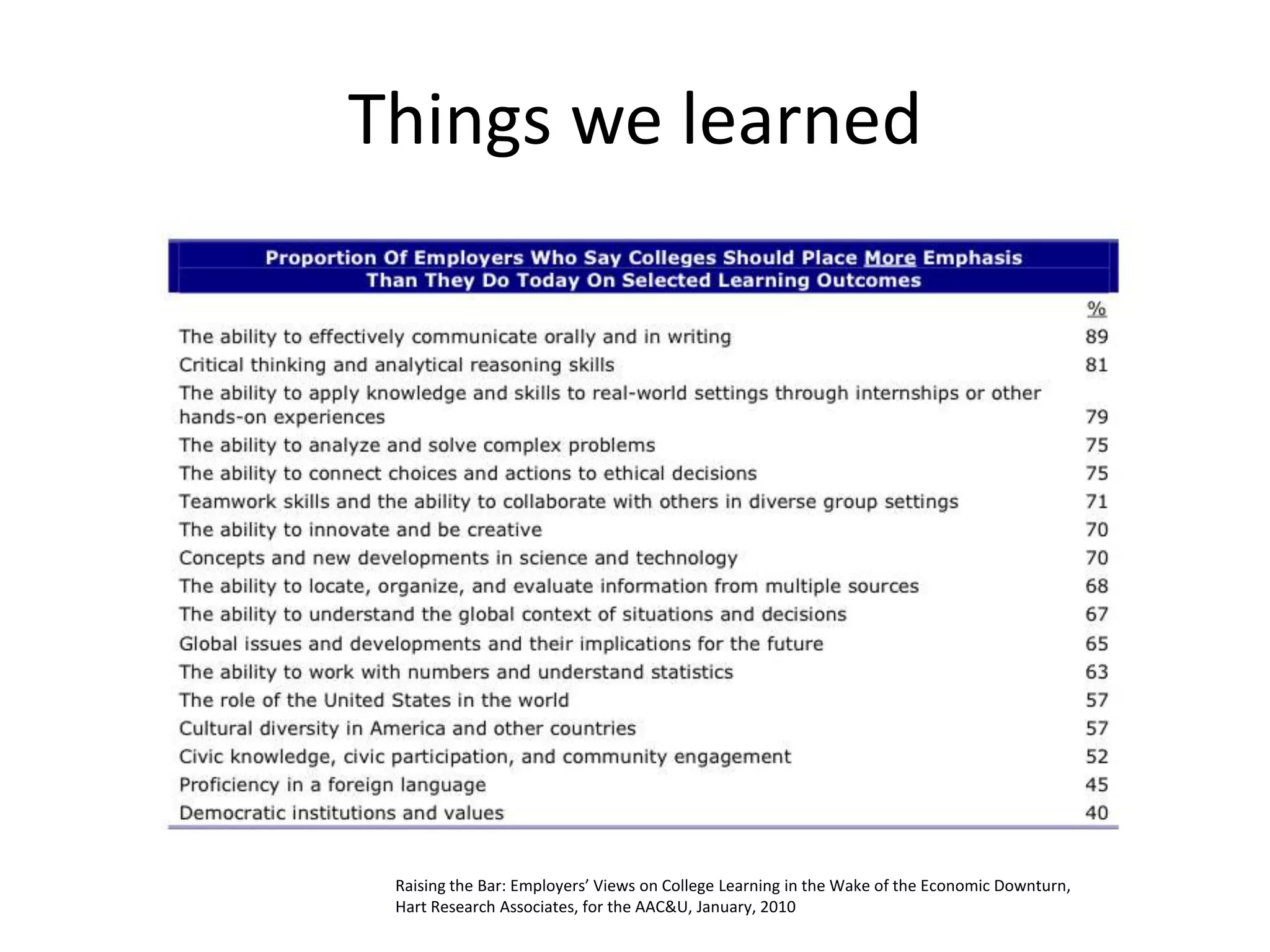
Things we learned
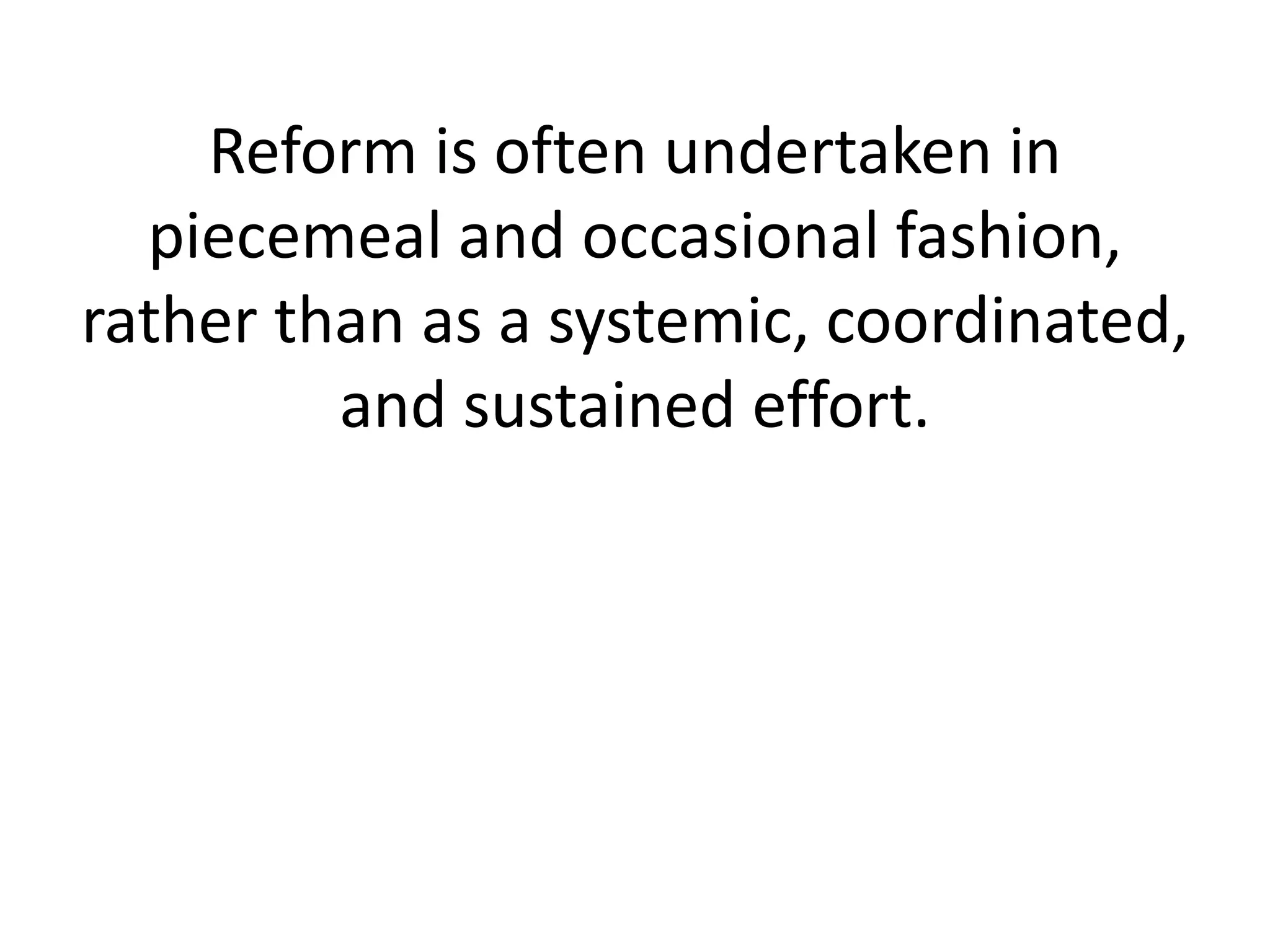
Reform is often undertaken in piecemeal and occasional fashion, rather than as a systemic, coordinated, and sustained effort.
Piecemeal reform efforts include:Freshman Seminar
MEDC/SOC Gen Ed
NEH Ethics Across the Curriculum
Title VI Language Across the Curriculum
Title III Teaching with Technology
Learning Communities: Pathways (undeclared), Biology, Communications, Fine Arts
Writing Across the Curriculum/Writing Intensive Courses
World Traveler
International Distinction
Webster Works Worldwide
Webster LEADS
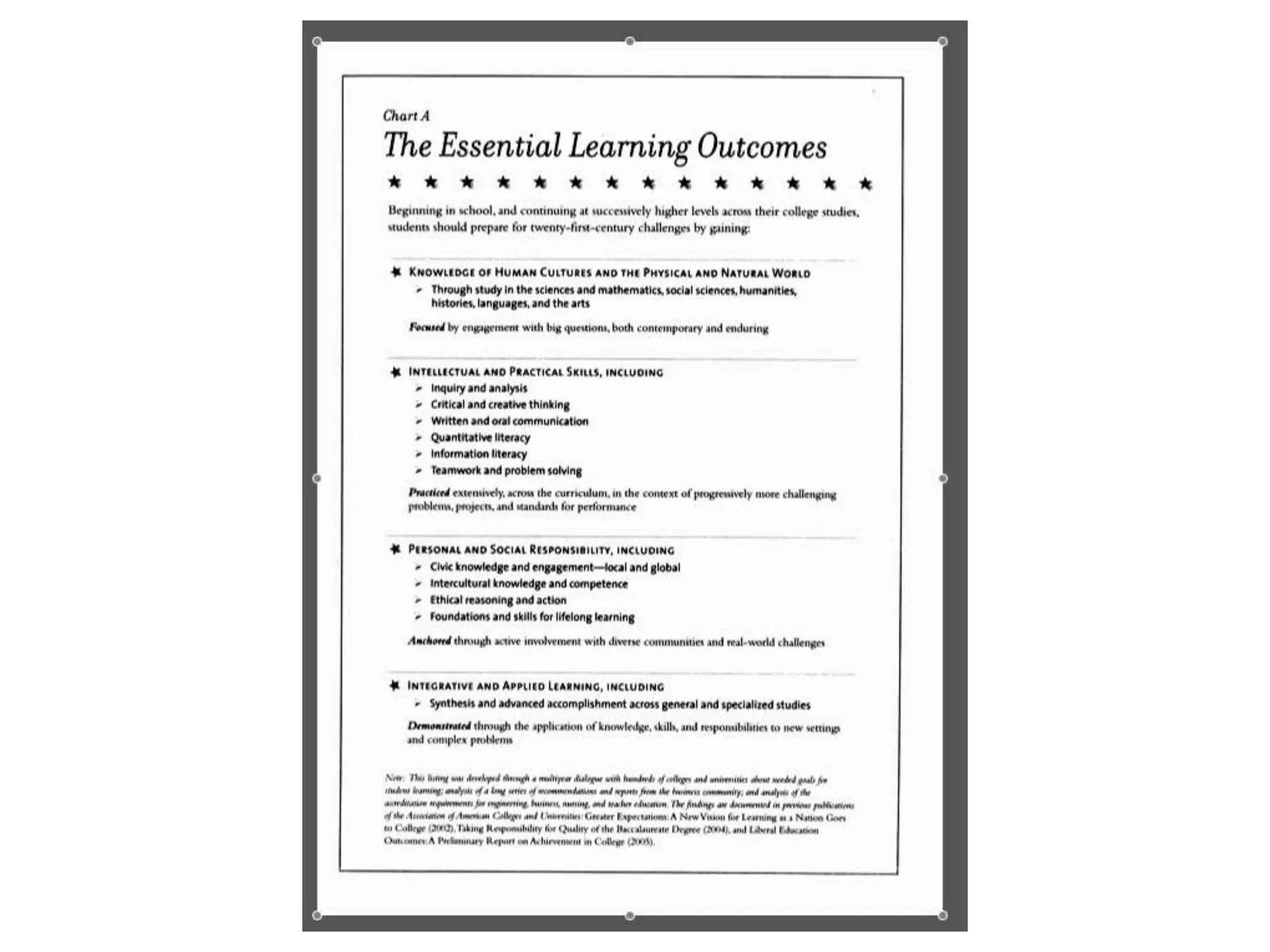
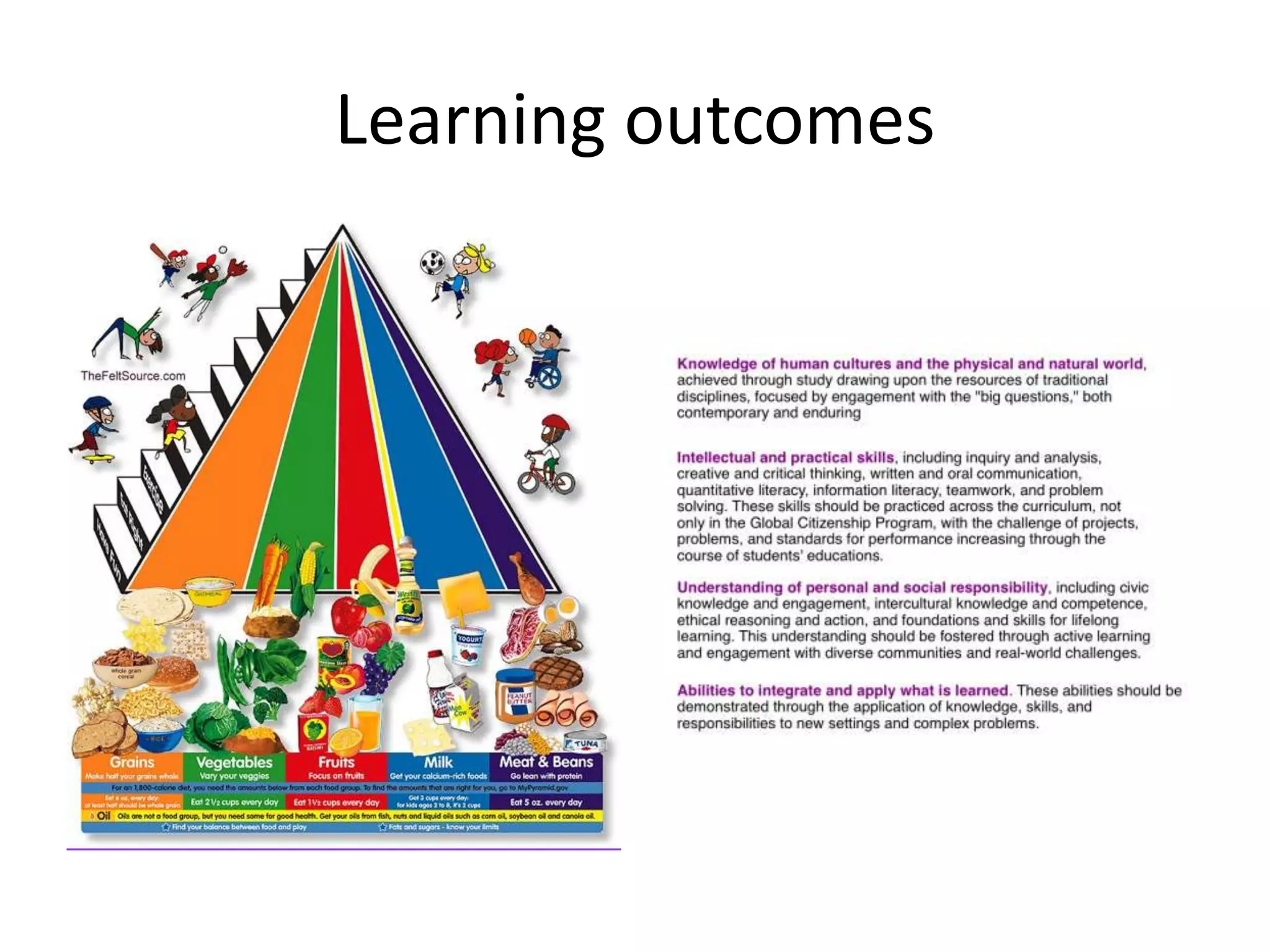
Learning outcomes
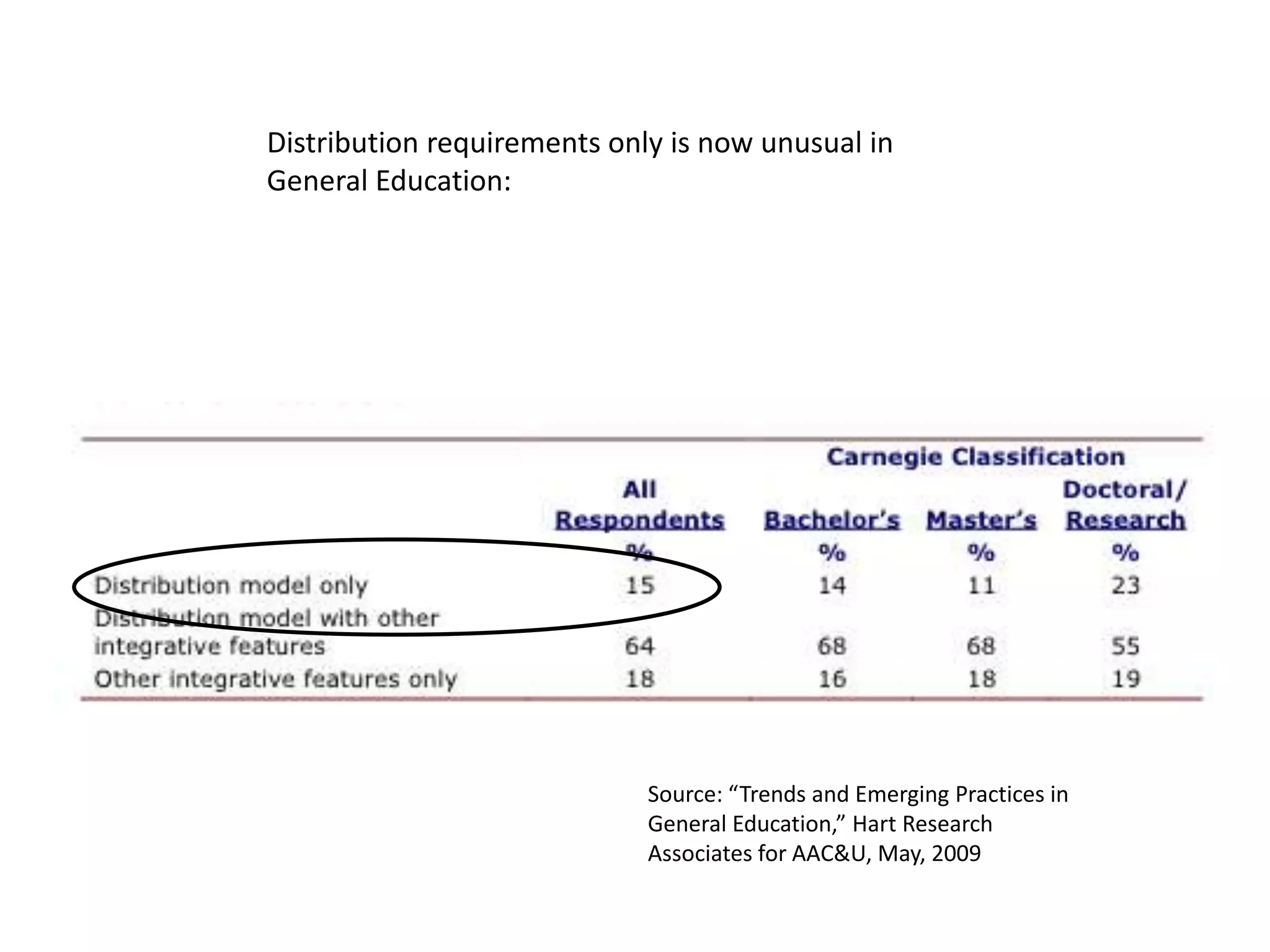
Distribution requirements only is now unusual in General Education:Source: “Trends and Emerging Practices in General Education,” Hart Research Associates for AAC&U, May, 2009
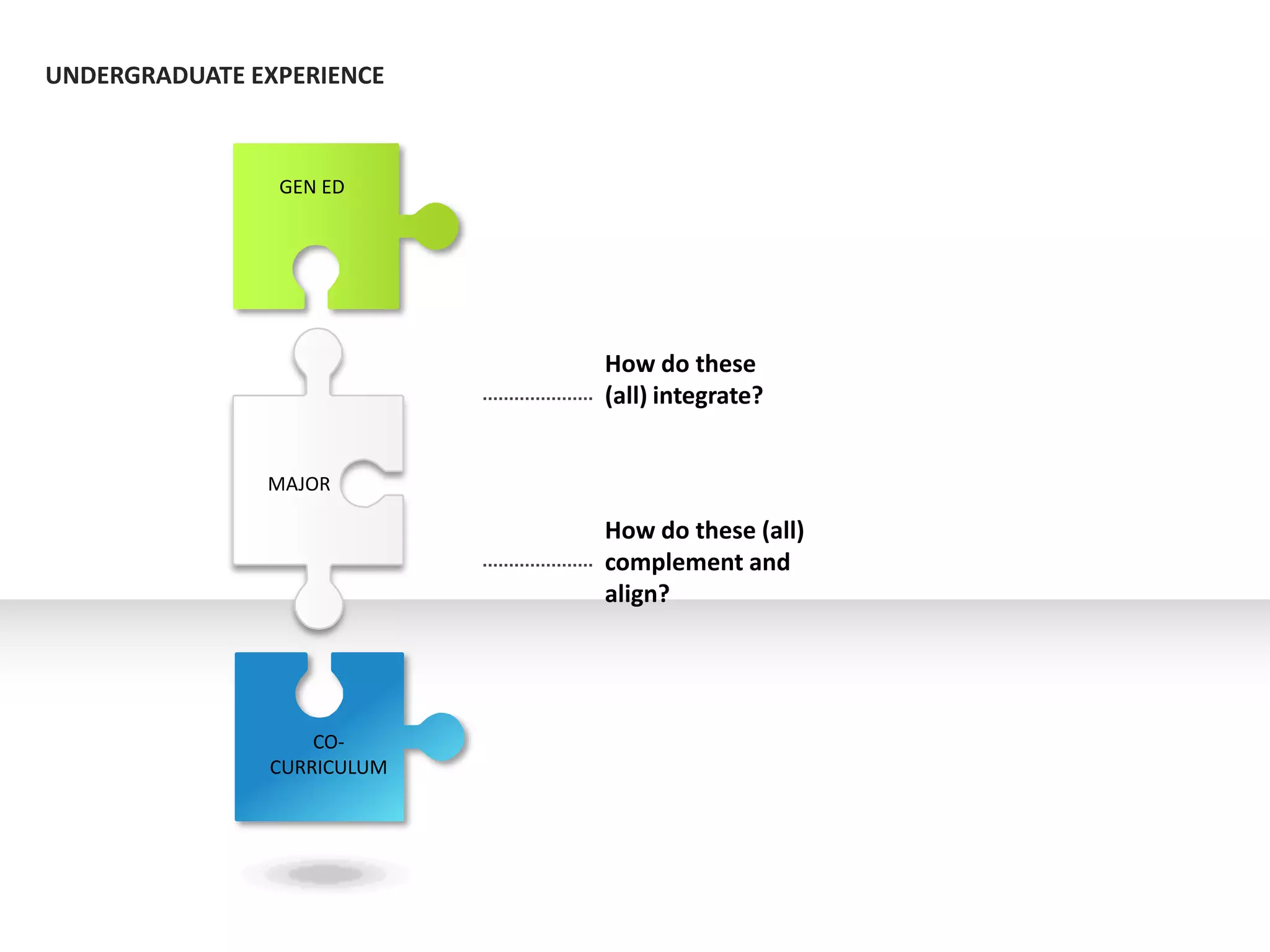
UNDERGRADUATE EXPERIENCEGEN EDHow do these (all) integrate?How do these (all) complement and align?MAJORCO-CURRICULUM
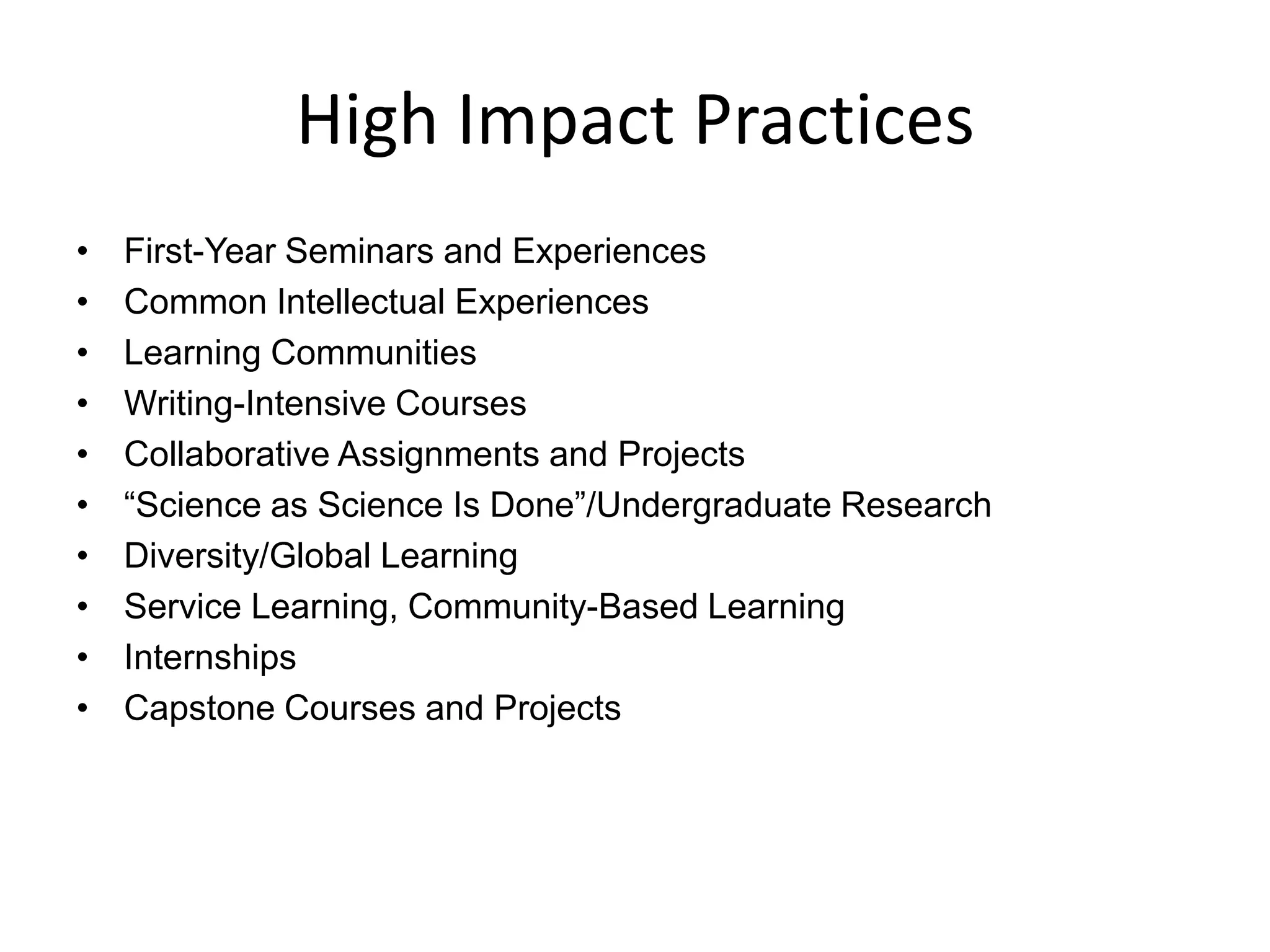
High Impact PracticesFirst-Year Seminars and ExperiencesCommon Intellectual ExperiencesLearning CommunitiesWriting-Intensive CoursesCollaborative Assignments and Projects“Science as Science Is Done”/Undergraduate ResearchDiversity/Global LearningService Learning, Community-Based LearningInternshipsCapstone Courses and Projects
High-impact practices are good for students:
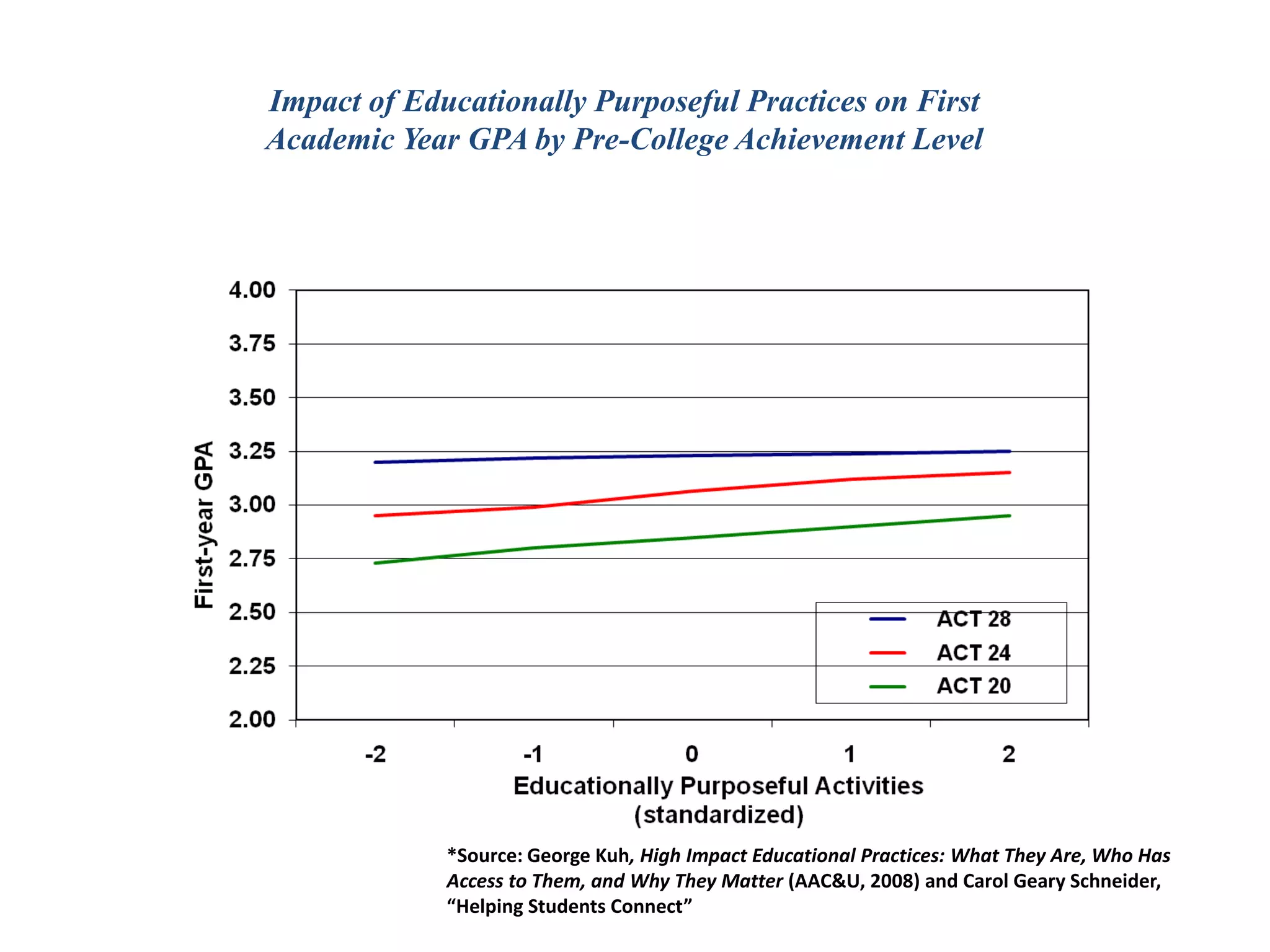
Impact of Educationally Purposeful Practices on First Academic Year GPA by Pre-College Achievement Level*Source: George Kuh, High Impact Educational Practices: What They Are, Who Has Access to Them, and Why They Matter (AAC&U, 2008) and Carol Geary Schneider, “Helping Students Connect”
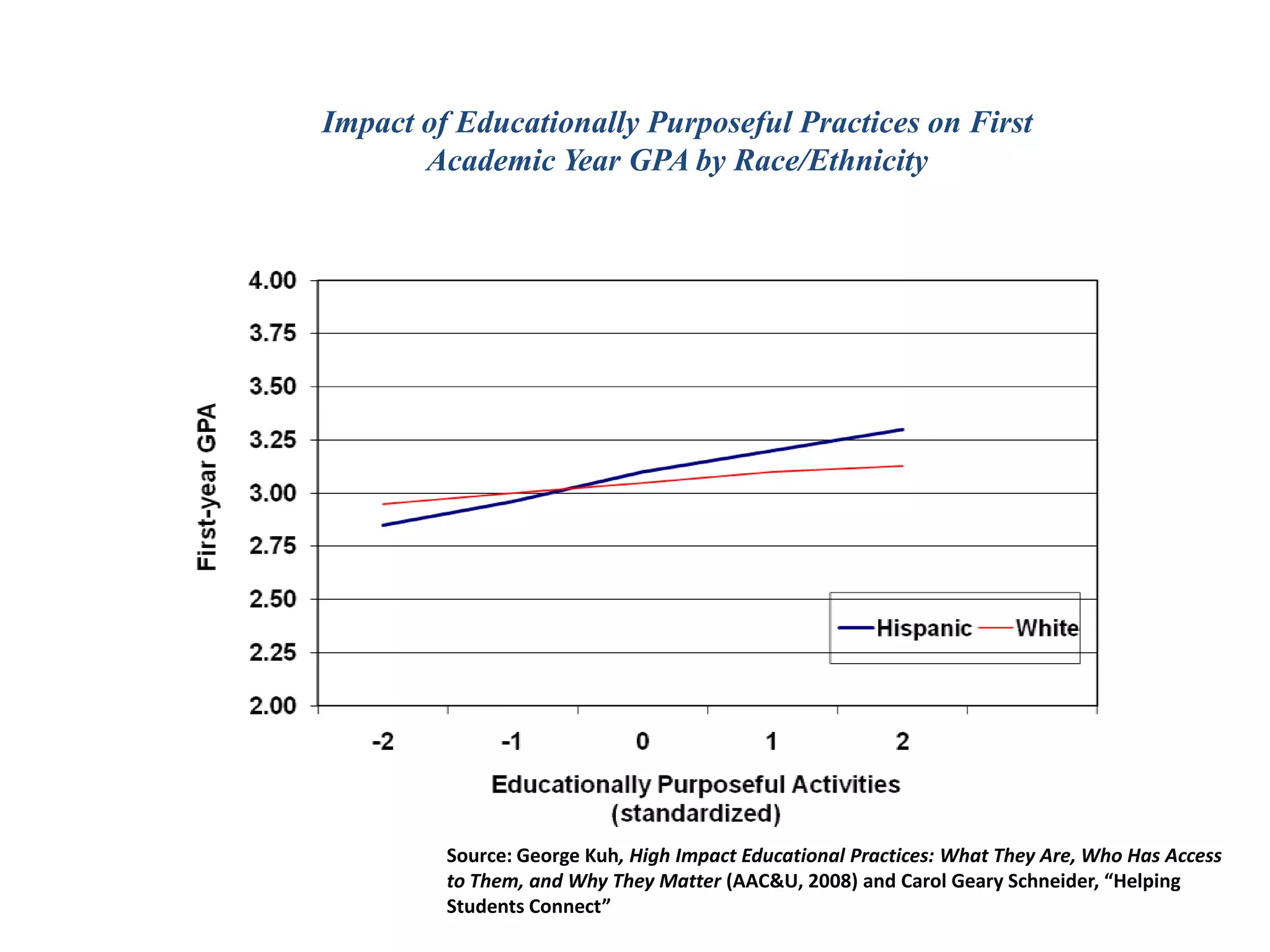
Impact of Educationally Purposeful Practices on First Academic Year GPA by Race/EthnicitySource: George Kuh, High Impact Educational Practices: What They Are, Who Has Access to Them, and Why They Matter (AAC&U, 2008) and Carol Geary Schneider, “Helping Students Connect”
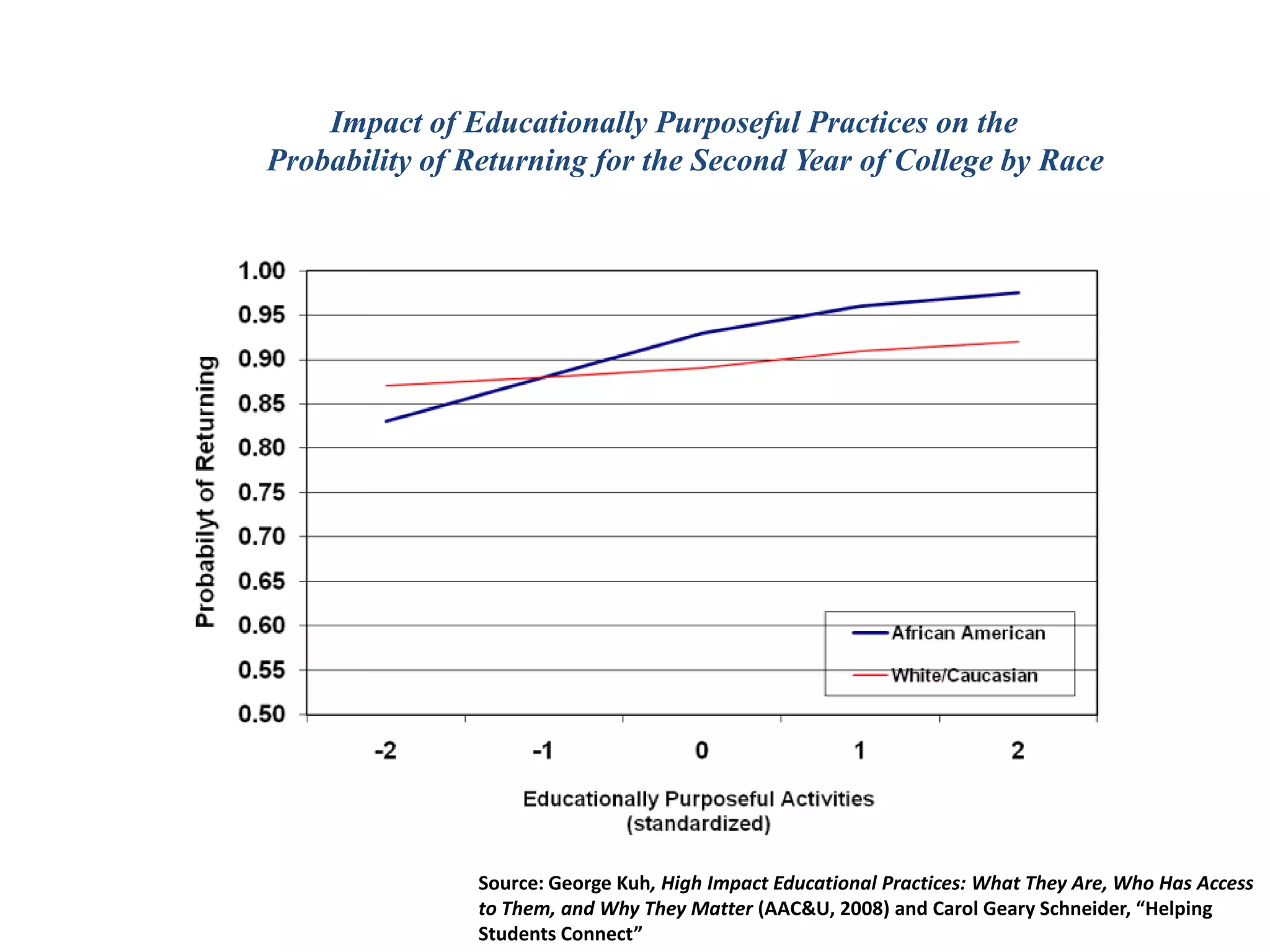
	Impact of Educationally Purposeful Practices on the Probability of Returning for the Second Year of College by RaceSource: George Kuh, High Impact Educational Practices: What They Are, Who Has Access to Them, and Why They Matter (AAC&U, 2008) and Carol Geary Schneider, “Helping Students Connect”
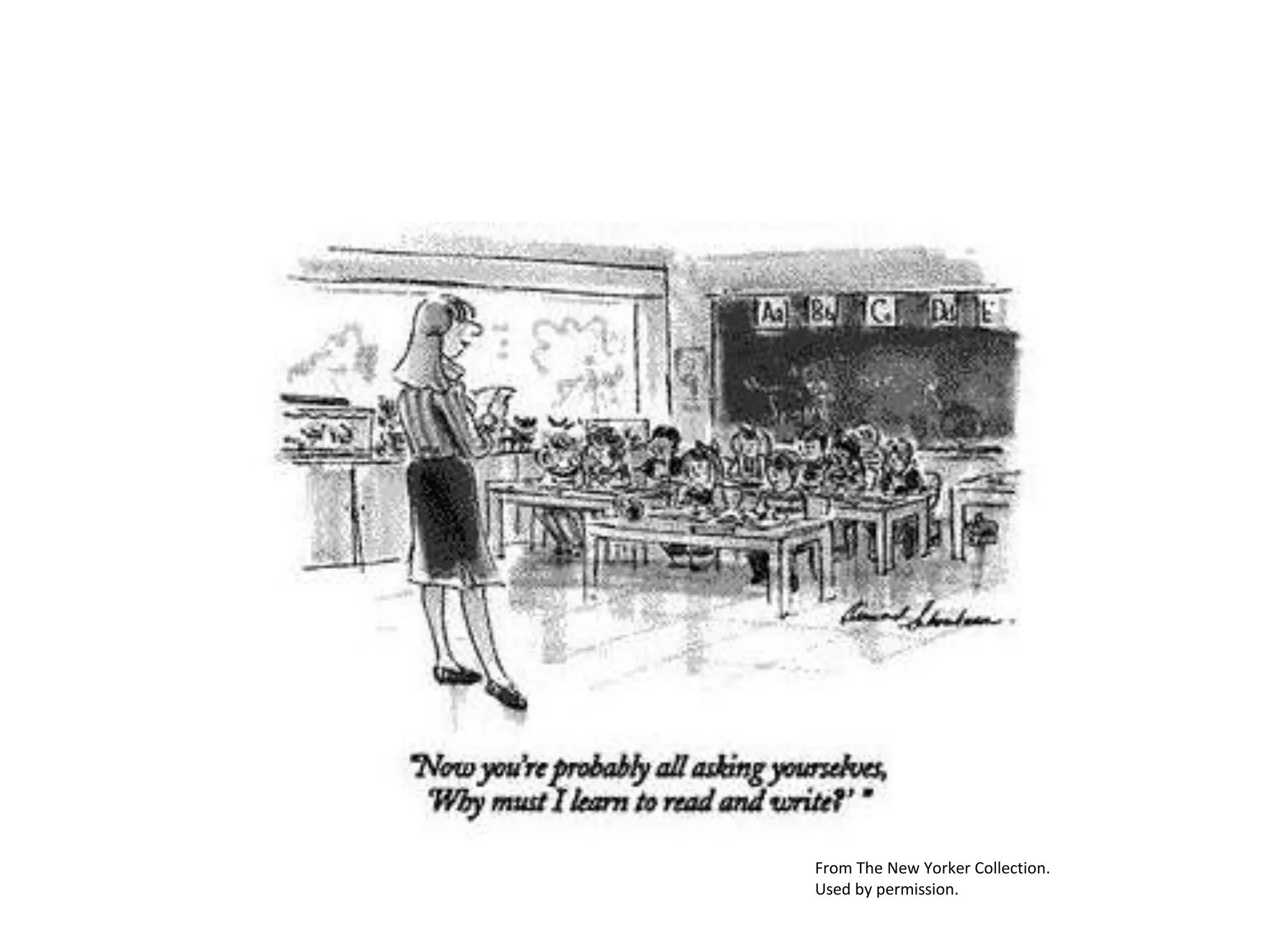
Students are often instrumental and extrinsically motivated about their education.
From The New Yorker Collection.Used by permission.
Question: Why must I learn ____ ?Answer: Global Citizenship Program  Competencies are the Gateway to Career Success and Earning Power
GCP Competencies are the Gateway to Career Success and Earning Power“Irrespective of college major or institutional selectivity, what matters to career success is students’ development of a broad set of cross-cutting capacities…”Anthony Carnevale, Georgetown UniversityCenter on Education and the Workforce
US Economy Defined by Greater Workplace Challenges and DynamismEvery year, more than 1/3 of the entire US labor force changes jobs.
Today's Students Will Have 10-14 Jobs by the Time They Are 38.
50% of Workers Have Been With Their Company Less Than 5 Years.
Every year, more than 30 million Americans are working in jobs that did not exist in the previous quarter.  Department of Labor – Bureau of Labor Statistics
Employers want to employ peoplewith the knowledge and skills that are in the GCP:
Things we learnedRaising the Bar: Employers’ Views on College Learning in the Wake of the Economic Downturn,Hart Research Associates, for the AAC&U, January, 2010
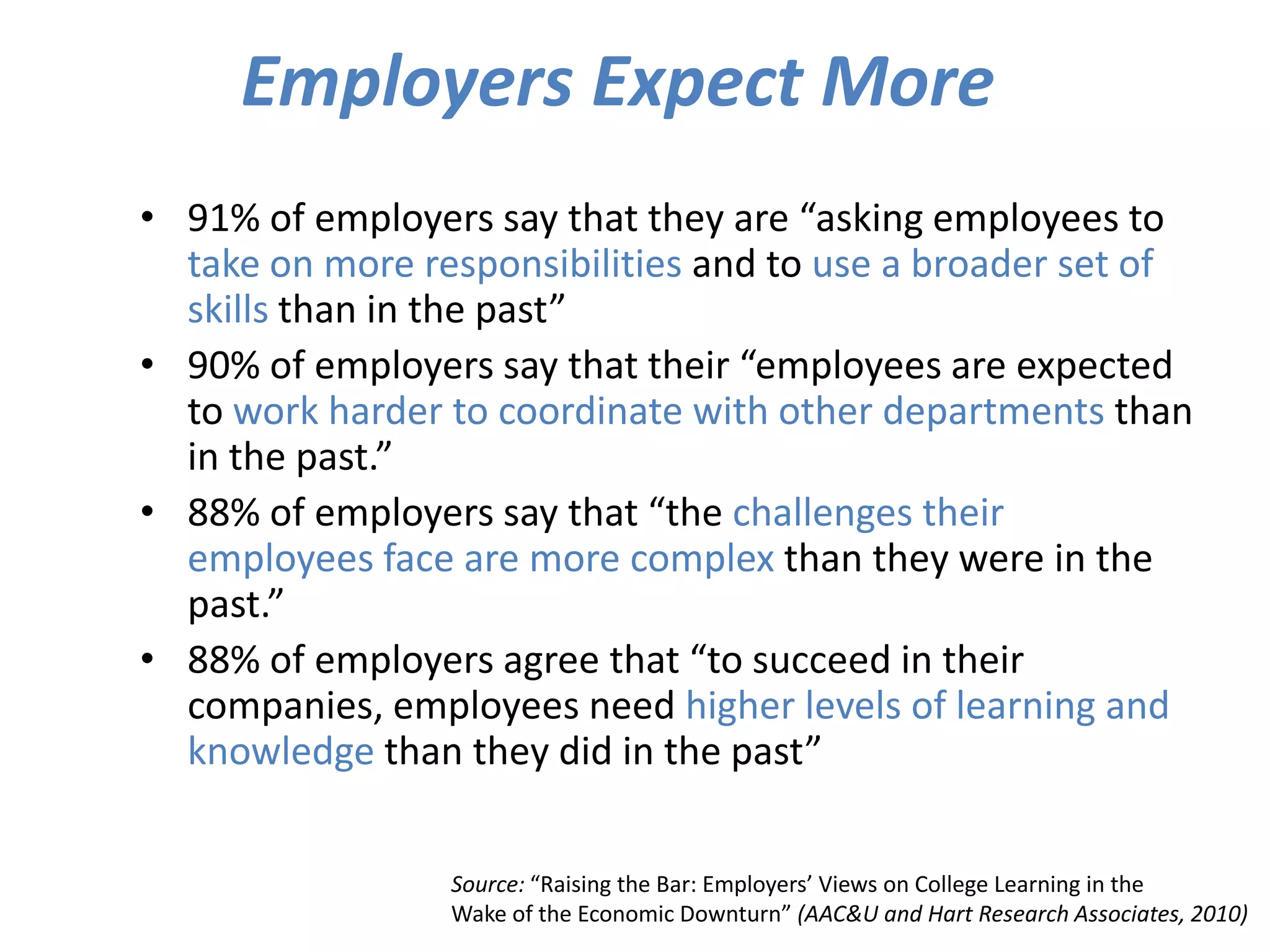
Employers Expect More91% of employers say that they are “asking employees to take on more responsibilities and to use a broader set of skills than in the past”90% of employers say that their “employees are expected to work harder to coordinate with other departments than in the past.”88% of employers say that “the challenges their employees face are more complex than they were in the past.”88% of employers agree that “to succeed in their companies, employees need higher levels of learning and knowledge than they did in the past”Source: “Raising the Bar: Employers’ Views on College Learning in the Wake of the Economic Downturn” (AAC&U and Hart Research Associates, 2010)
Global Citizenship Programskills pay better
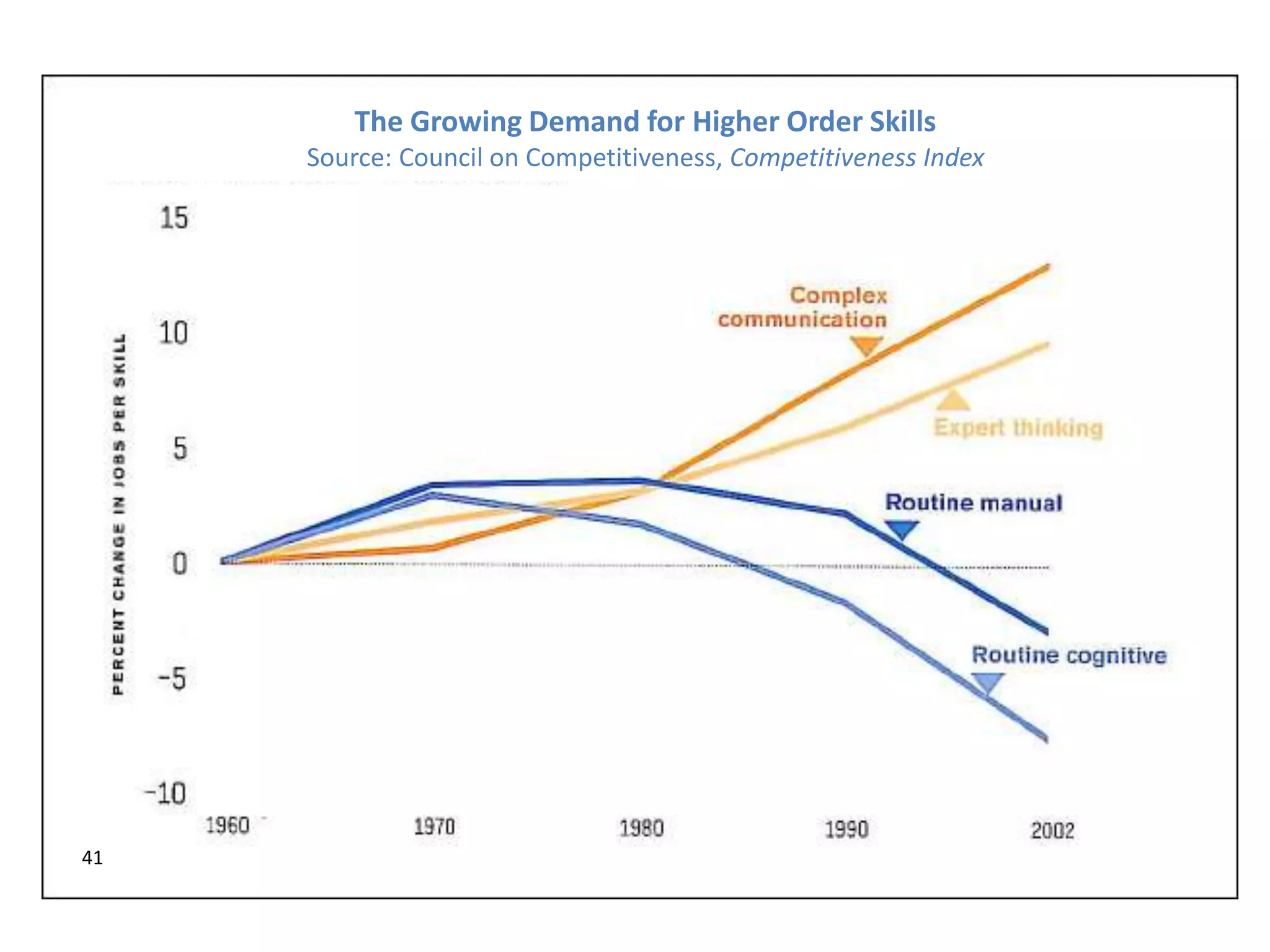
The Growing Demand for Higher Order SkillsSource: Council on Competitiveness, Competitiveness Index41
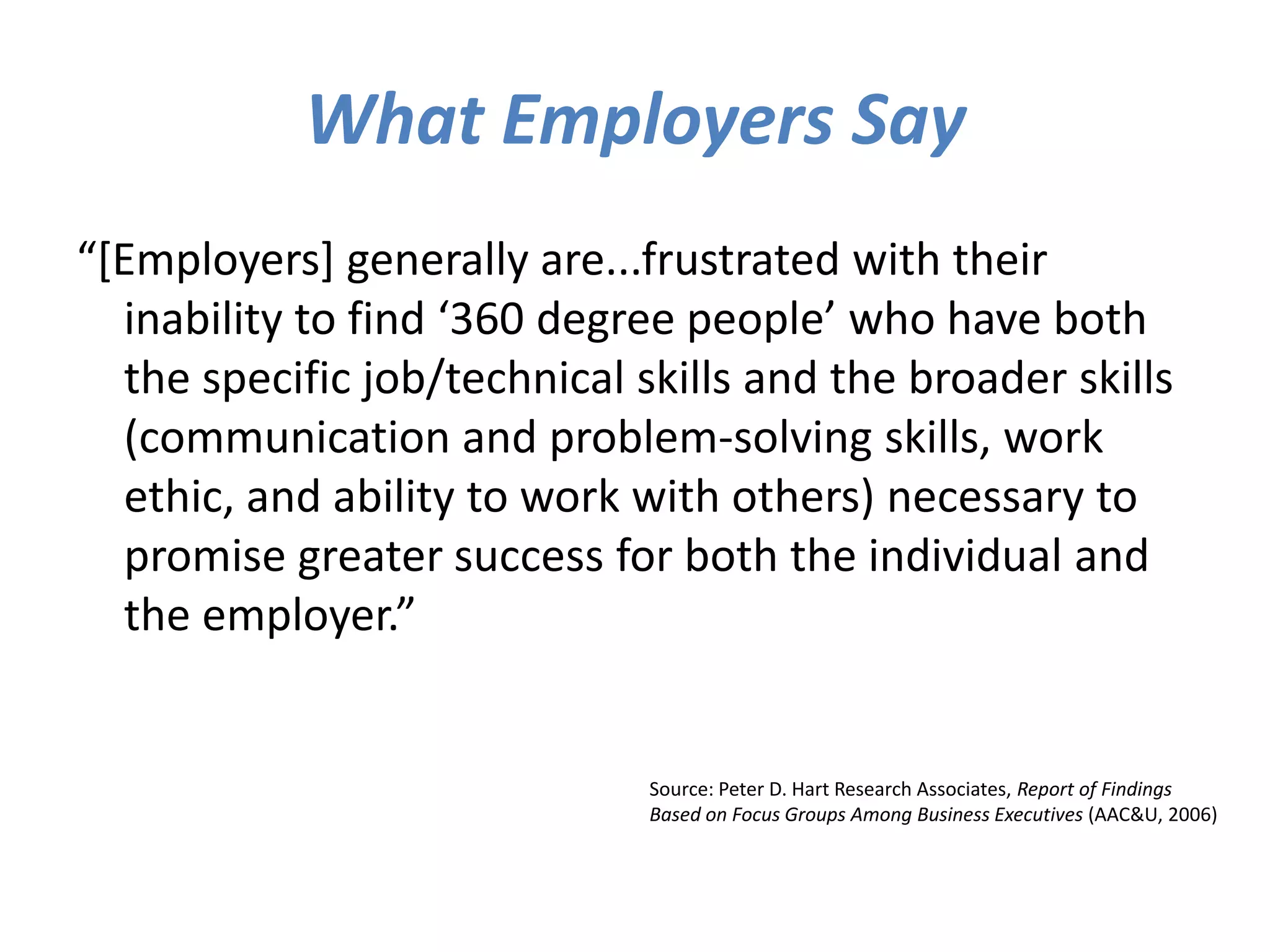
What Employers Say“[Employers] generally are...frustrated with their inability to find ‘360 degree people’ who have both the specific job/technical skills and the broader skills (communication and problem-solving skills, work ethic, and ability to work with others) necessary to promise greater success for both the individual and the employer.”Source: Peter D. Hart Research Associates, Report of Findings Based on Focus Groups Among Business Executives (AAC&U, 2006)
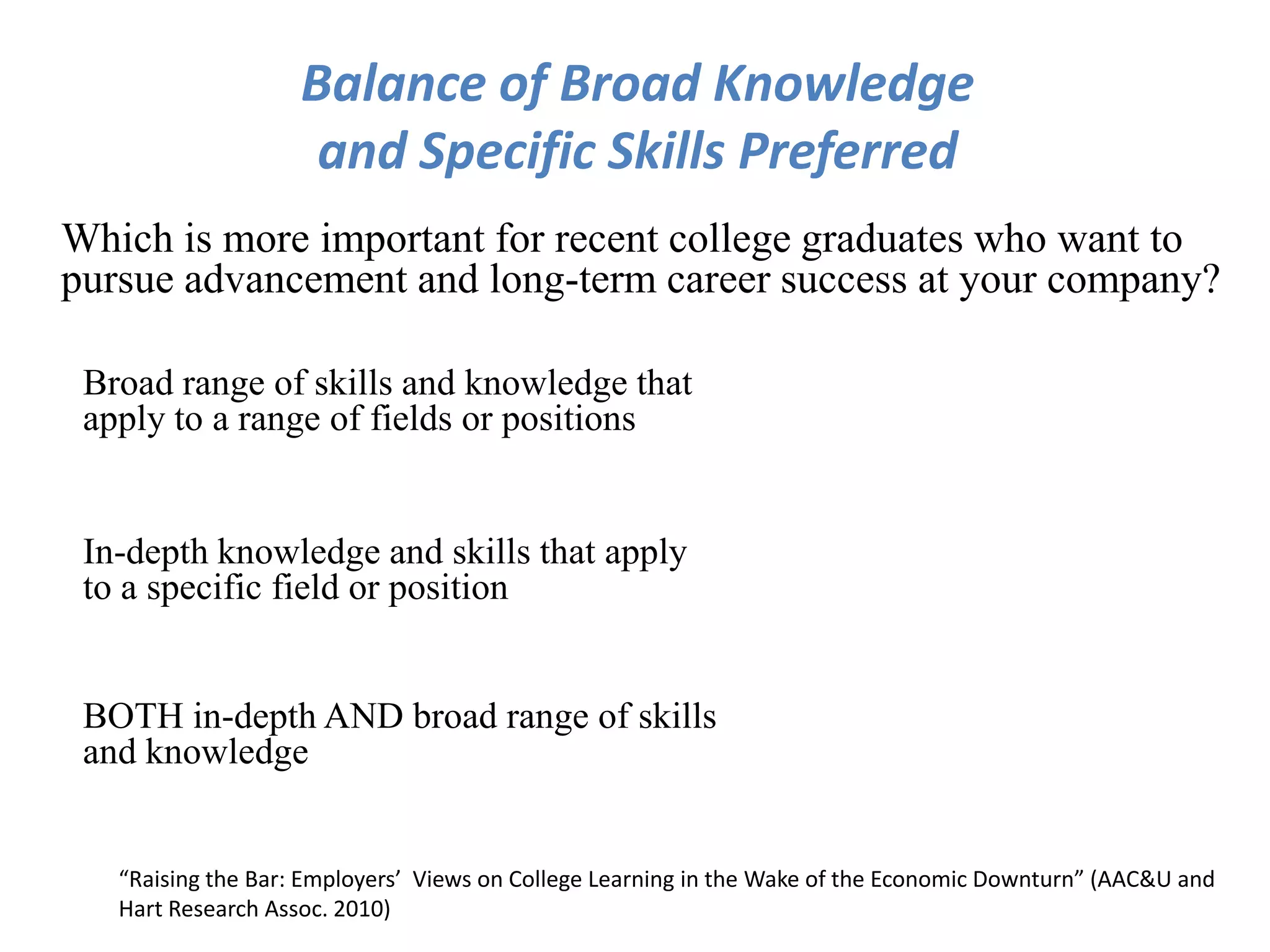
Balance of Broad Knowledgeand Specific Skills PreferredWhich is more important for recent college graduates who want to pursue advancement and long-term career success at your company? Broad range of skills and knowledge that apply to a range of fields or positionsIn-depth knowledge and skills that apply to a specific field or positionBOTH in-depth AND broad range of skills and knowledge“Raising the Bar: Employers’  Views on College Learning in the Wake of the Economic Downturn” (AAC&U and Hart Research Assoc. 2010)
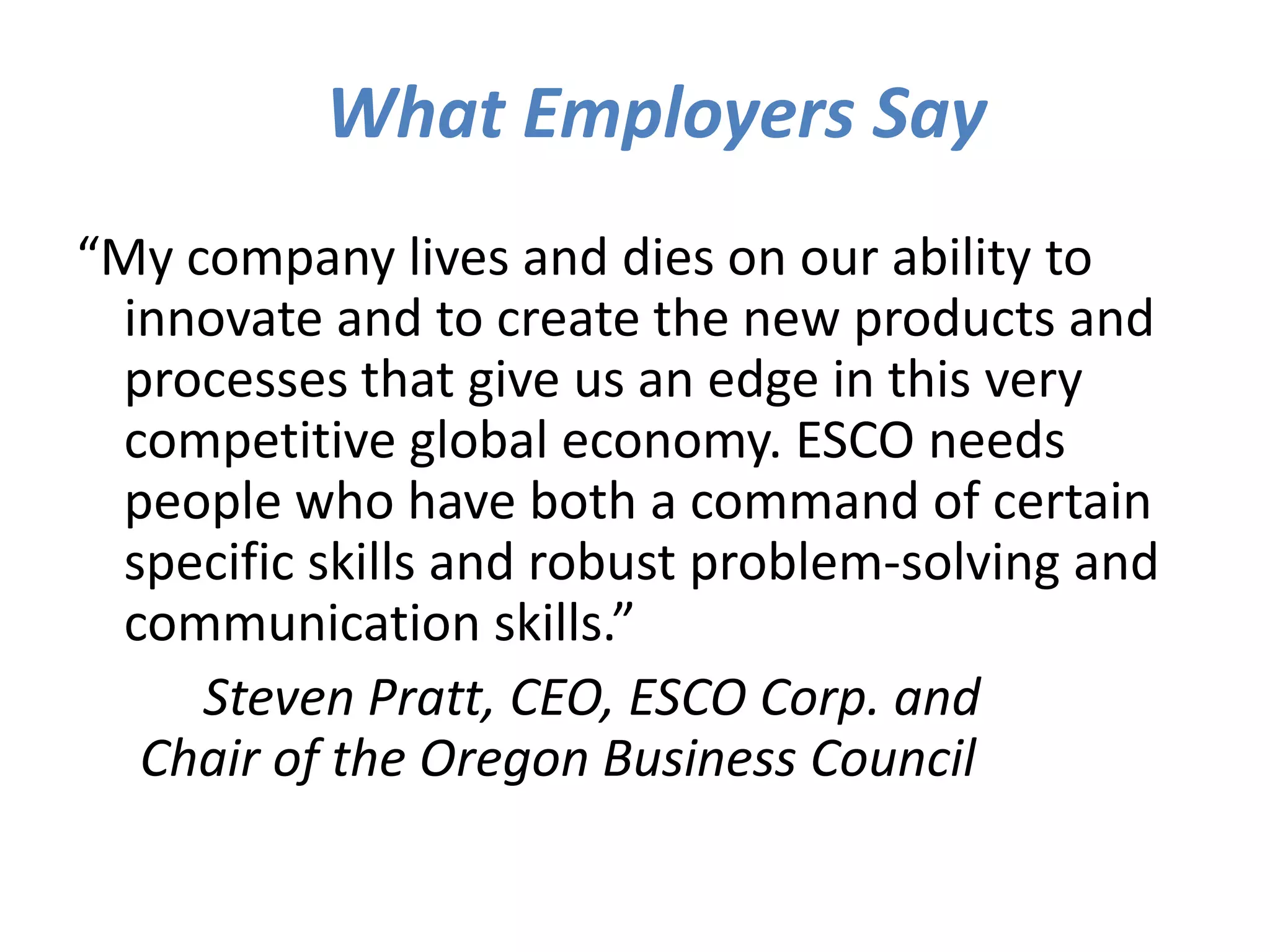
What Employers Say“My company lives and dies on our ability to innovate and to create the new products and processes that give us an edge in this very competitive global economy. ESCO needs people who have both a command of certain specific skills and robust problem-solving and communication skills.”			Steven Pratt, CEO, ESCO Corp. and 			Chair of the Oregon Business Council
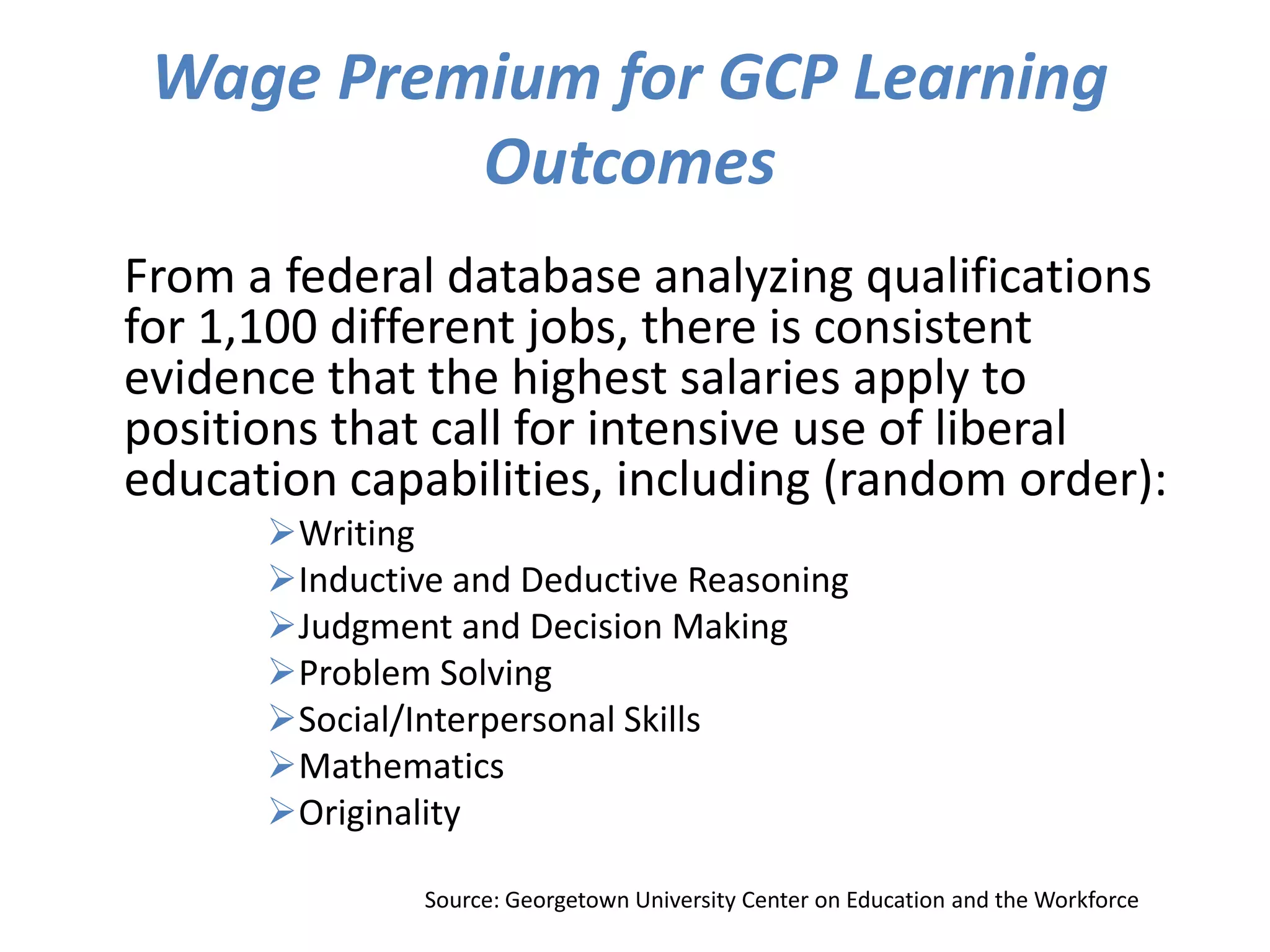
Wage Premium for GCP Learning Outcomes	From a federal database analyzing qualifications for 1,100 different jobs, there is consistent evidence that the highest salaries apply to positions that call for intensive use of liberal education capabilities, including (random order):Writing
Inductive and Deductive Reasoning
Judgment and Decision Making
Problem Solving
Social/Interpersonal Skills
Mathematics
OriginalitySource: Georgetown University Center on Education and the Workforce
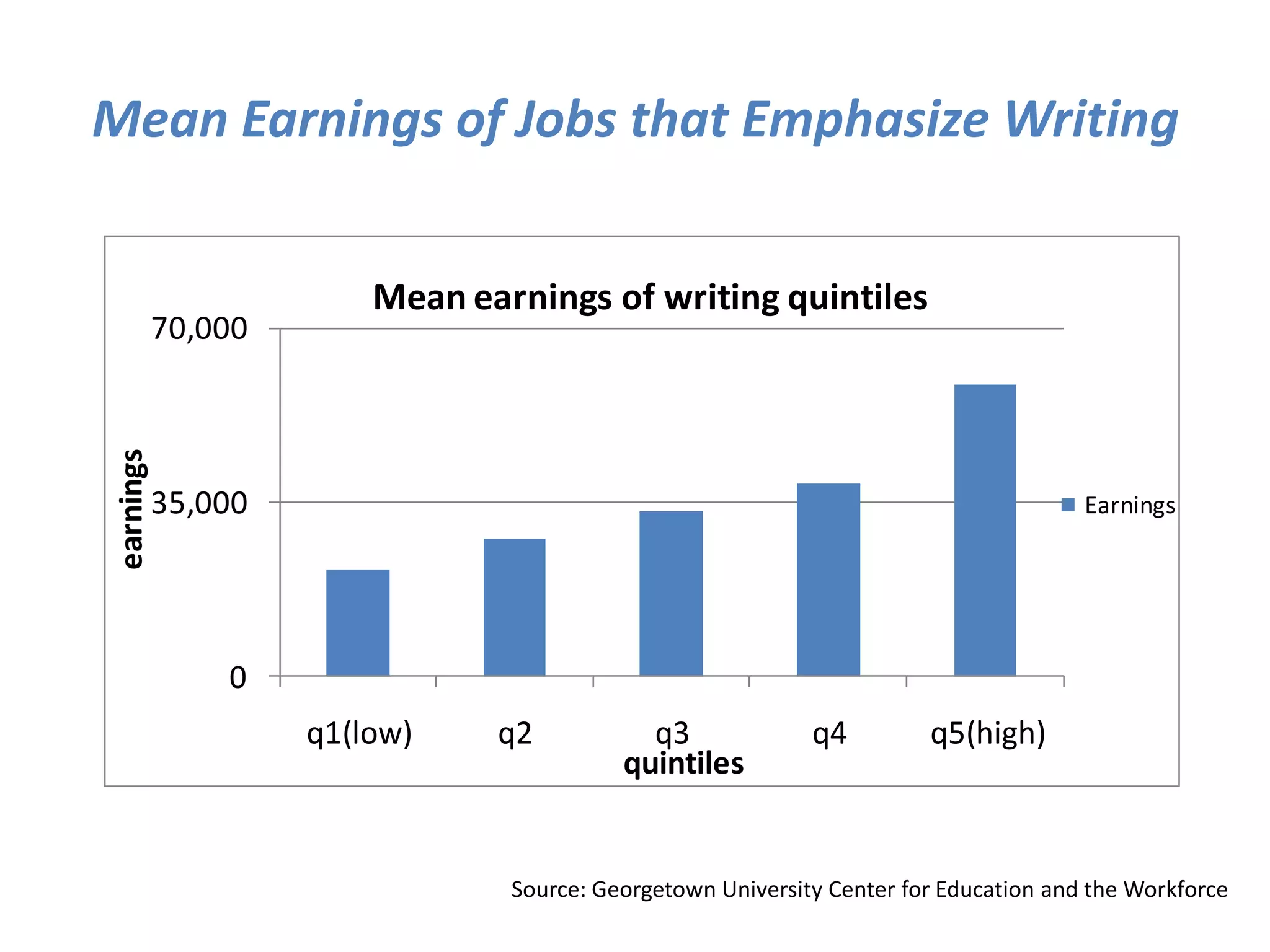
Mean Earnings of Jobs that Emphasize WritingSource: Georgetown University Center for Education and the Workforce
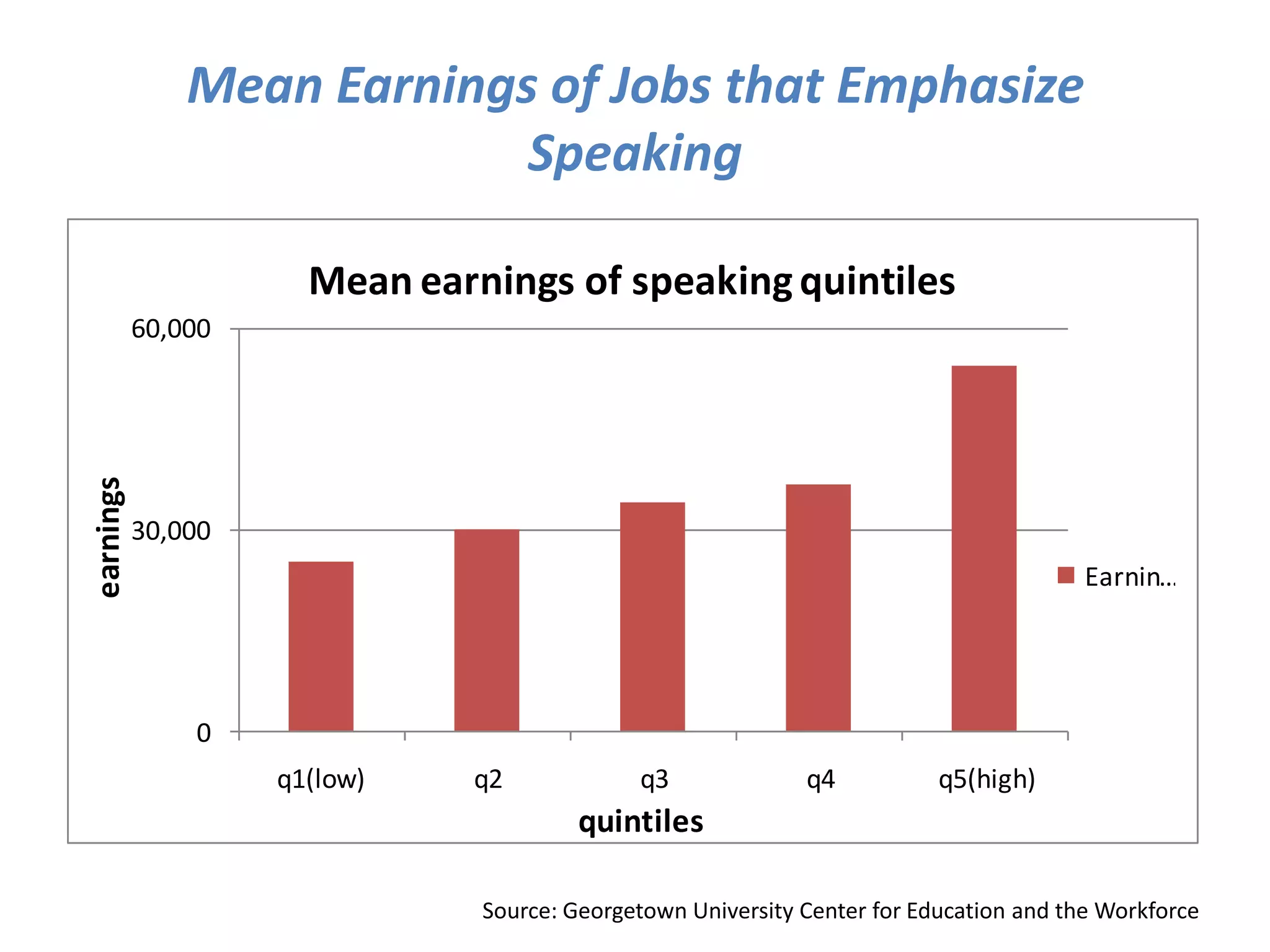
Mean Earnings of Jobs that Emphasize SpeakingSource: Georgetown University Center for Education and the Workforce
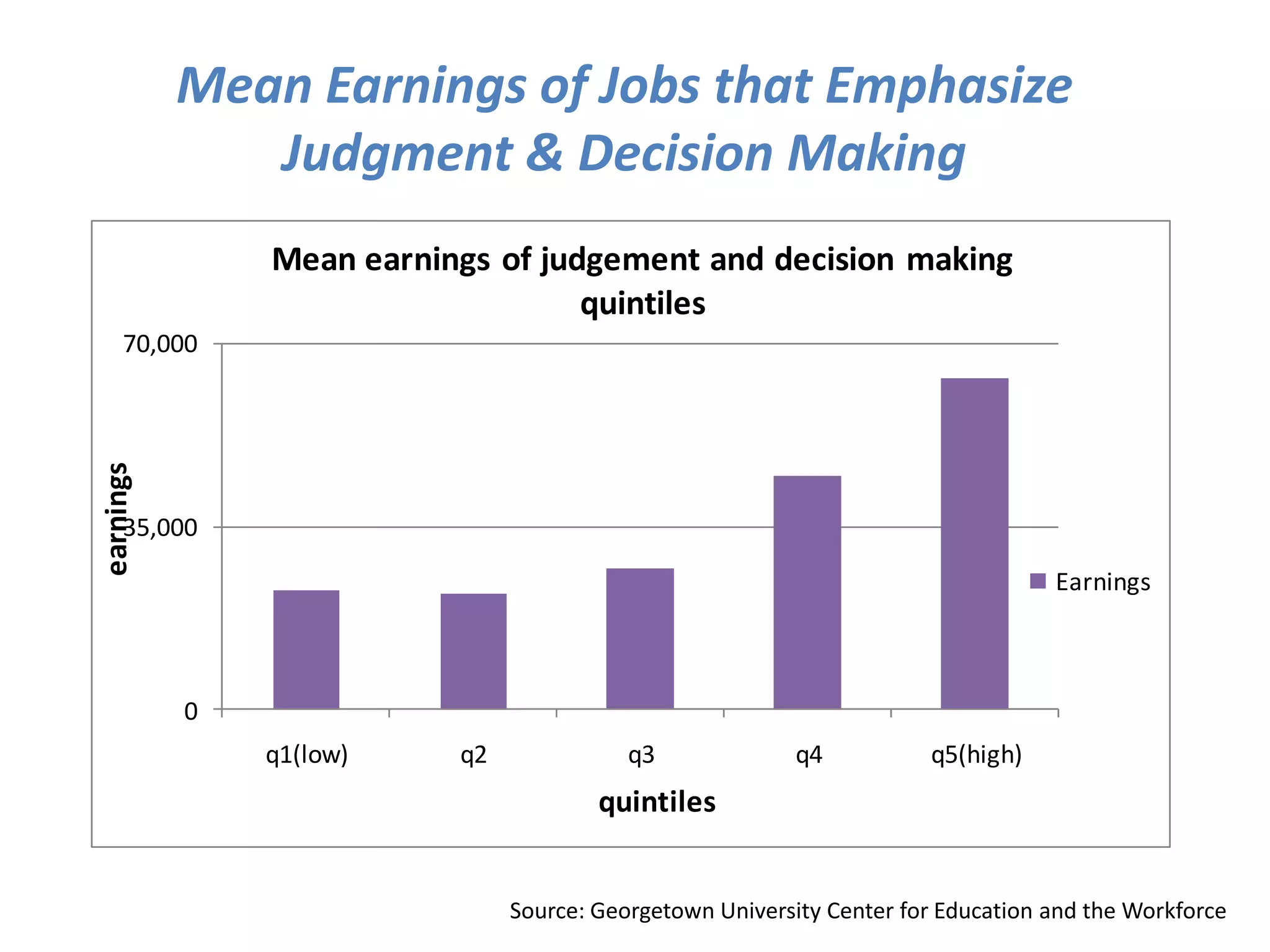
Mean Earnings of Jobs that EmphasizeJudgment & Decision MakingSource: Georgetown University Center for Education and the Workforce
Mean Earnings of Jobs that EmphasizeProblem SolvingSource: Georgetown University Center for Education and the Workforce

Presentation to Admissions staff on the Global Citizenship Program

  • 1.
    The Global CitizenshipProgram of general education
  • 3.
    What makes agood life?Dave Pollard: How to Save the Worldhttp://blogs.salon.com/0002007/http://howtosavetheworld.ca/
  • 4.
  • 5.
  • 6.
    Three things converged:NewUniversity mission statementHLC Visit and Report: “Improve assessment practices.”Presidential search: Significant changes ahead.
  • 7.
    (Old) Mission StatementMission& ValuesAlthough the Sisters of Loretto no longer oversee the day-to-day operation of Webster University, the general mission they established when they founded the university remains unchanged — to satisfy unmet educational needs.Webster today operates as an independent, comprehensive, non-demominational university with campus locations around the world. It offers undergraduate and graduate programs in a wide array of disciplines, including the liberal arts, fine and performing arts, teacher education, business and management.In striving to fulfill educational needs that may be underserved, Webster University: * Creates a student-centered environment accessible to individuals of diverse ages, cultures and socioeconomic backgrounds. * Sustains a personalized approach to education through small classes and close relationships among faculty and students. * Develops educational programs that join theory and practice, and instill in students the spirit of systematic inquiry. * Encourages creativity, scholarship and individual enterprise in its students and faculty. * Promotes international perspectives in the curriculum and among students and faculty. * Encourages in its students a critical perspective, a respect for diversity and an understanding of their own and others’ values. * Fosters in its students a lifelong desire to learn and a commitment to contribute actively to their communities and the world. * Educates diverse populations locally, regionally, nationally and internationally. * Strengthens the communities it serves through support of civic, cultural, corporate and educational organizations.
  • 8.
    2007-2008 Strategic PlanningMissionStatementStrategic PlanPlanning Process and Institutional Planning Committee
  • 11.
    2008: Self-study processfor reaccreditation completedHigher Learning Commission VisitHigher Learning Commission -- 10-year reaccreditationGeneral Education – criterion met, assessment needs attention
  • 12.
    2008-2009: Presidential SearchSummer2009Dr. Elizabeth (Beth) Stroble joins Webster University as our 11th President
  • 13.
    February 2009:Webster submitsproposal to the Association of American Colleges & Universities for a team to attend the summer Institute on General Education and Assessment
  • 15.
    Arrow ProcessThe GeneralEducation Reform ProcessWhy use graphics from PowerPointing.com?What do we want for students?“transform students for global citizenship and individual excellence”What students experienceProgram Design; Assessment PlanUniversity MissionLearning Goals & Outcomes Program ContentProgram Mission“core competencies for responsible global citizenship in the 21st century”Purposeful pathways and a plan for telling whether they work
  • 17.
    Mission, chargeThe missionof the Global Citizenship Program is to ensure that every undergraduate student emerge from Webster University with the core competencies required for responsible global citizenship in the 21st Century.The Global Citizenship Project Task Force is charged with making recommendations to the Senate for the creation and implementation of the Global Citizenship Program.
  • 18.
    Global Citizenship ProjectTask Force ChargeThe GCPTF shall be consultative and transparent in its processes and report monthly to the Senate. The GCPTF shall identify the core competencies of global citizenship.The GCPTF shall identify best practices in assessment of general education.The GCPTF shall explore multiple models of general education program.The GCPTF shall explore best practices in general education which may include but is not limited to learning communities, paired classes, e-portfolios and co-curricular experiences.The GCPTF shall identify examples of best practices that currently exist within our curriculum.The GCPTF shall request of the Senate additional resources and/or support as the need arises, including changes in the membership of the GCPTF.The GCPTF shall strive have a plan ready for approval of the Faculty Assembly by Spring 2010.The GCPTF shall work through the academic year 2010-2011 to build out the GCP.The GCPTF shall be dissolved once the Global Citizenship Program is implemented. It is expected ha undergraduate students entering Webster University in Fall 2011 will be required to fulfill the GCP.
  • 19.
    Global Citizenship ProjectTask ForceBruce Umbaugh, DirectorStephanie Schroeder, Assessment DirectorGary Glasgow, LGCFAKit Jenkins, SOCPaula Hanssen, CASChris Risker, SBTVicki McMullin, SOEGary Kannenberg, Gen Ed CoordinatorKate Parsons, Interdisciplinary ProgramsDonna Campbell, International StudiesJohn Aleshunas, Curriculum CommitteeRon Daniel, Geneva Academic DirectorLarry Baden, Freshman SeminarsRobin Assner, Freshman SeminarsJohn Watson, General StudiesBenjamin O. Akande, DeanDebra Carpenter, DeanBrenda Fyfe, DeanPeter Sargent, DeanDavid Carl Wilson, DeanEmily Bahr, StudentTed Hoef, Dean of StudentsKim Kleinman, Undergraduate AdvisingSarah Tetley, First-year Experience
  • 20.
  • 21.
    Reform is oftenundertaken in piecemeal and occasional fashion, rather than as a systemic, coordinated, and sustained effort.
  • 22.
    Piecemeal reform effortsinclude:Freshman Seminar
  • 23.
  • 24.
    NEH Ethics Acrossthe Curriculum
  • 25.
    Title VI LanguageAcross the Curriculum
  • 26.
    Title III Teachingwith Technology
  • 27.
    Learning Communities: Pathways(undeclared), Biology, Communications, Fine Arts
  • 28.
    Writing Across theCurriculum/Writing Intensive Courses
  • 29.
  • 30.
  • 31.
  • 32.
  • 33.
  • 34.
    Distribution requirements onlyis now unusual in General Education:Source: “Trends and Emerging Practices in General Education,” Hart Research Associates for AAC&U, May, 2009
  • 35.
    UNDERGRADUATE EXPERIENCEGEN EDHowdo these (all) integrate?How do these (all) complement and align?MAJORCO-CURRICULUM
  • 36.
    High Impact PracticesFirst-YearSeminars and ExperiencesCommon Intellectual ExperiencesLearning CommunitiesWriting-Intensive CoursesCollaborative Assignments and Projects“Science as Science Is Done”/Undergraduate ResearchDiversity/Global LearningService Learning, Community-Based LearningInternshipsCapstone Courses and Projects
  • 37.
    High-impact practices aregood for students:
  • 38.
    Impact of EducationallyPurposeful Practices on First Academic Year GPA by Pre-College Achievement Level*Source: George Kuh, High Impact Educational Practices: What They Are, Who Has Access to Them, and Why They Matter (AAC&U, 2008) and Carol Geary Schneider, “Helping Students Connect”
  • 39.
    Impact of EducationallyPurposeful Practices on First Academic Year GPA by Race/EthnicitySource: George Kuh, High Impact Educational Practices: What They Are, Who Has Access to Them, and Why They Matter (AAC&U, 2008) and Carol Geary Schneider, “Helping Students Connect”
  • 40.
    Impact of EducationallyPurposeful Practices on the Probability of Returning for the Second Year of College by RaceSource: George Kuh, High Impact Educational Practices: What They Are, Who Has Access to Them, and Why They Matter (AAC&U, 2008) and Carol Geary Schneider, “Helping Students Connect”
  • 41.
    Students are ofteninstrumental and extrinsically motivated about their education.
  • 42.
    From The NewYorker Collection.Used by permission.
  • 43.
    Question: Why mustI learn ____ ?Answer: Global Citizenship Program Competencies are the Gateway to Career Success and Earning Power
  • 44.
    GCP Competencies arethe Gateway to Career Success and Earning Power“Irrespective of college major or institutional selectivity, what matters to career success is students’ development of a broad set of cross-cutting capacities…”Anthony Carnevale, Georgetown UniversityCenter on Education and the Workforce
  • 45.
    US Economy Definedby Greater Workplace Challenges and DynamismEvery year, more than 1/3 of the entire US labor force changes jobs.
  • 46.
    Today's Students WillHave 10-14 Jobs by the Time They Are 38.
  • 47.
    50% of WorkersHave Been With Their Company Less Than 5 Years.
  • 48.
    Every year, morethan 30 million Americans are working in jobs that did not exist in the previous quarter. Department of Labor – Bureau of Labor Statistics
  • 49.
    Employers want toemploy peoplewith the knowledge and skills that are in the GCP:
  • 50.
    Things we learnedRaisingthe Bar: Employers’ Views on College Learning in the Wake of the Economic Downturn,Hart Research Associates, for the AAC&U, January, 2010
  • 51.
    Employers Expect More91%of employers say that they are “asking employees to take on more responsibilities and to use a broader set of skills than in the past”90% of employers say that their “employees are expected to work harder to coordinate with other departments than in the past.”88% of employers say that “the challenges their employees face are more complex than they were in the past.”88% of employers agree that “to succeed in their companies, employees need higher levels of learning and knowledge than they did in the past”Source: “Raising the Bar: Employers’ Views on College Learning in the Wake of the Economic Downturn” (AAC&U and Hart Research Associates, 2010)
  • 52.
  • 53.
    The Growing Demandfor Higher Order SkillsSource: Council on Competitiveness, Competitiveness Index41
  • 54.
    What Employers Say“[Employers]generally are...frustrated with their inability to find ‘360 degree people’ who have both the specific job/technical skills and the broader skills (communication and problem-solving skills, work ethic, and ability to work with others) necessary to promise greater success for both the individual and the employer.”Source: Peter D. Hart Research Associates, Report of Findings Based on Focus Groups Among Business Executives (AAC&U, 2006)
  • 55.
    Balance of BroadKnowledgeand Specific Skills PreferredWhich is more important for recent college graduates who want to pursue advancement and long-term career success at your company? Broad range of skills and knowledge that apply to a range of fields or positionsIn-depth knowledge and skills that apply to a specific field or positionBOTH in-depth AND broad range of skills and knowledge“Raising the Bar: Employers’  Views on College Learning in the Wake of the Economic Downturn” (AAC&U and Hart Research Assoc. 2010)
  • 56.
    What Employers Say“Mycompany lives and dies on our ability to innovate and to create the new products and processes that give us an edge in this very competitive global economy. ESCO needs people who have both a command of certain specific skills and robust problem-solving and communication skills.” Steven Pratt, CEO, ESCO Corp. and Chair of the Oregon Business Council
  • 57.
    Wage Premium forGCP Learning Outcomes From a federal database analyzing qualifications for 1,100 different jobs, there is consistent evidence that the highest salaries apply to positions that call for intensive use of liberal education capabilities, including (random order):Writing
  • 58.
  • 59.
  • 60.
  • 61.
  • 62.
  • 63.
    OriginalitySource: Georgetown UniversityCenter on Education and the Workforce
  • 64.
    Mean Earnings ofJobs that Emphasize WritingSource: Georgetown University Center for Education and the Workforce
  • 65.
    Mean Earnings ofJobs that Emphasize SpeakingSource: Georgetown University Center for Education and the Workforce
  • 66.
    Mean Earnings ofJobs that EmphasizeJudgment & Decision MakingSource: Georgetown University Center for Education and the Workforce
  • 67.
    Mean Earnings ofJobs that EmphasizeProblem SolvingSource: Georgetown University Center for Education and the Workforce
  • 68.
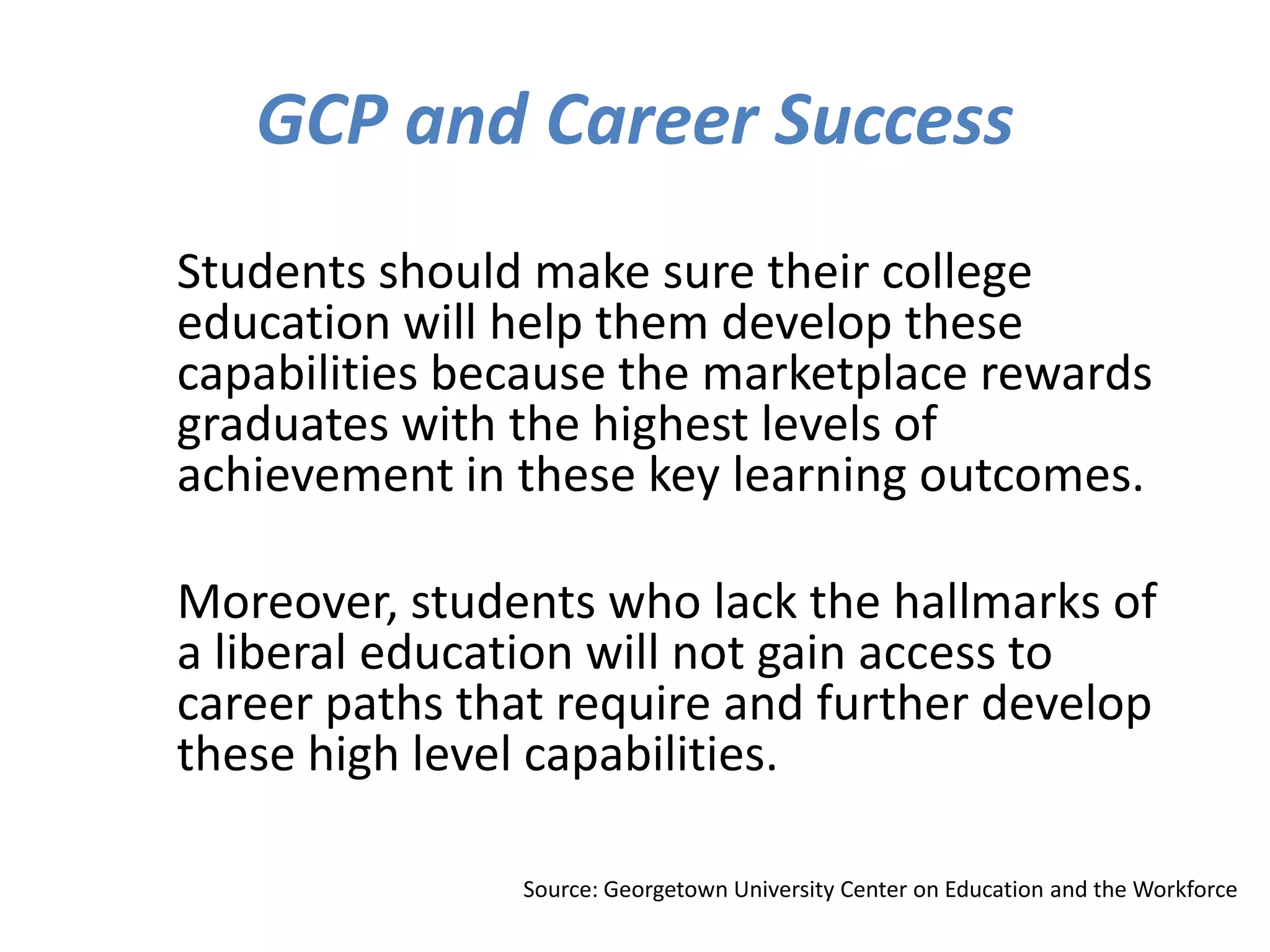
    GCP and CareerSuccess Students should make sure their college education will help them develop these capabilities because the marketplace rewards graduates with the highest levels of achievement in these key learning outcomes. Moreover, students who lack the hallmarks of a liberal education will not gain access to career paths that require and further develop these high level capabilities.Source: Georgetown University Center on Education and the Workforce
  • 69.
    But:Is there roomfor developing those skills, given the demands of the various majors?
  • 70.
  • 71.
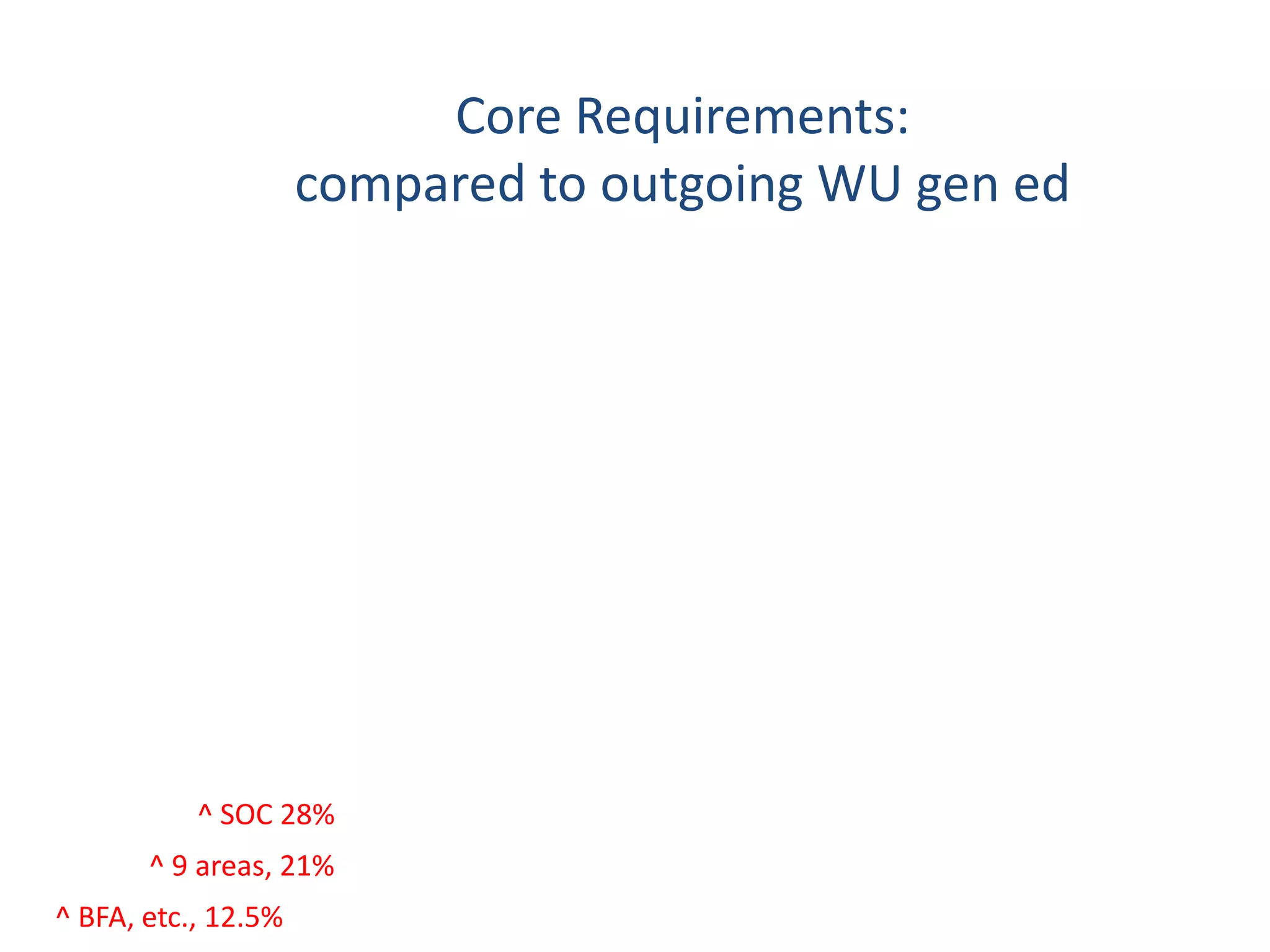
    Core Requirements:compared tooutgoing WU gen ed^ SOC 28%^ 9 areas, 21%^ BFA, etc., 12.5%
  • 72.
    Core Requirements:compared toGlobal Citizenship Program^ GCP, 23.5%
  • 73.
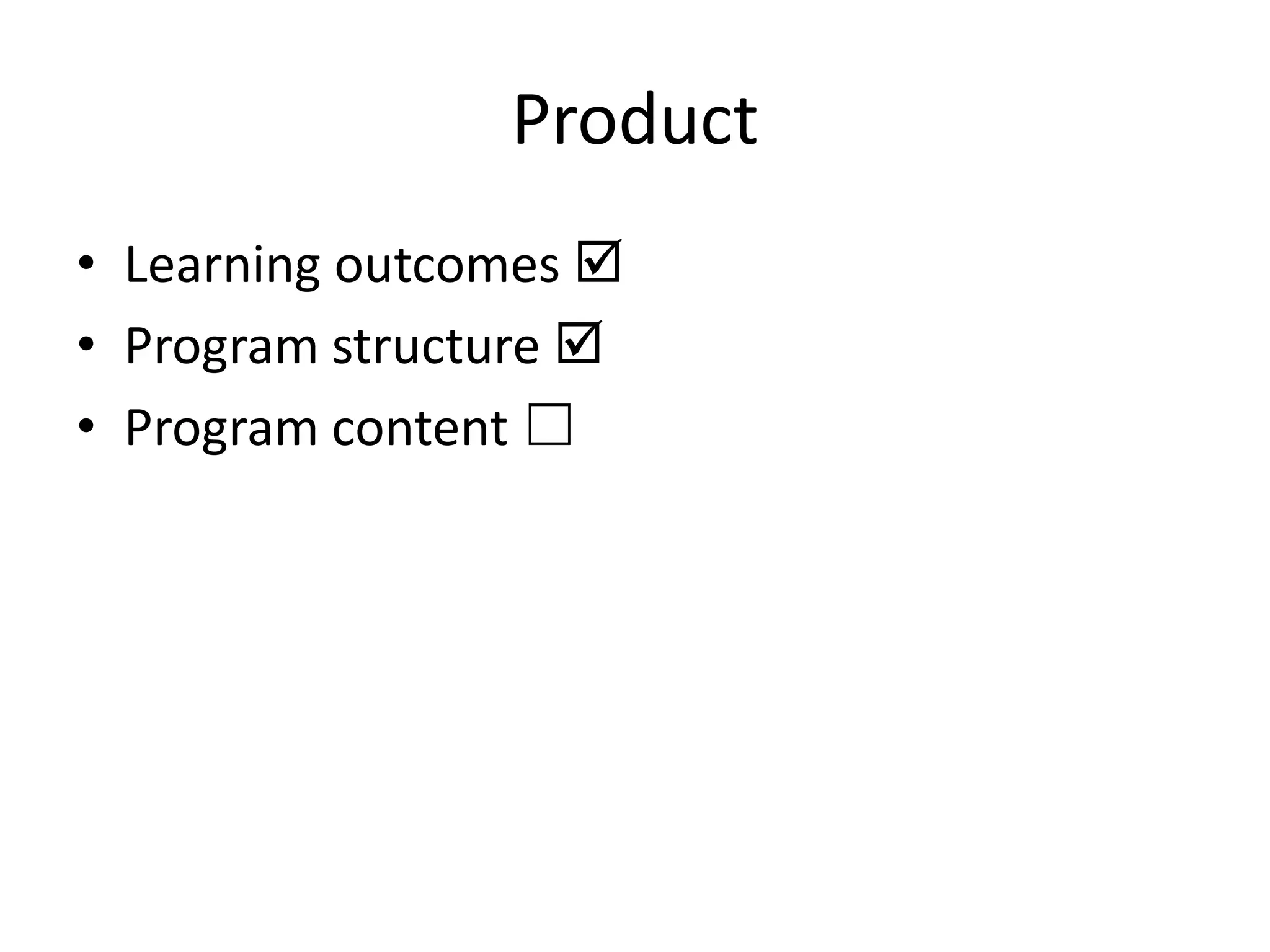
    ProductLearning outcomes Programstructure Program content ☐
  • 74.
    May, 2011Arrow ProcessTheGeneral Education Reform ProcessWhy use graphics from PowerPointing.com?You are here.“transform students for global citizenship and individual excellence”What students experienceProgram Design; Assessment PlanLearning Goals & OutcomesUniversity Mission Program ContentProgram Mission“core competencies for responsible global citizenship in the 21st century”Purposeful pathways and a plan for telling whether they work
  • 75.
    Understanding the GlobalCitizenship Program of general education
  • 76.
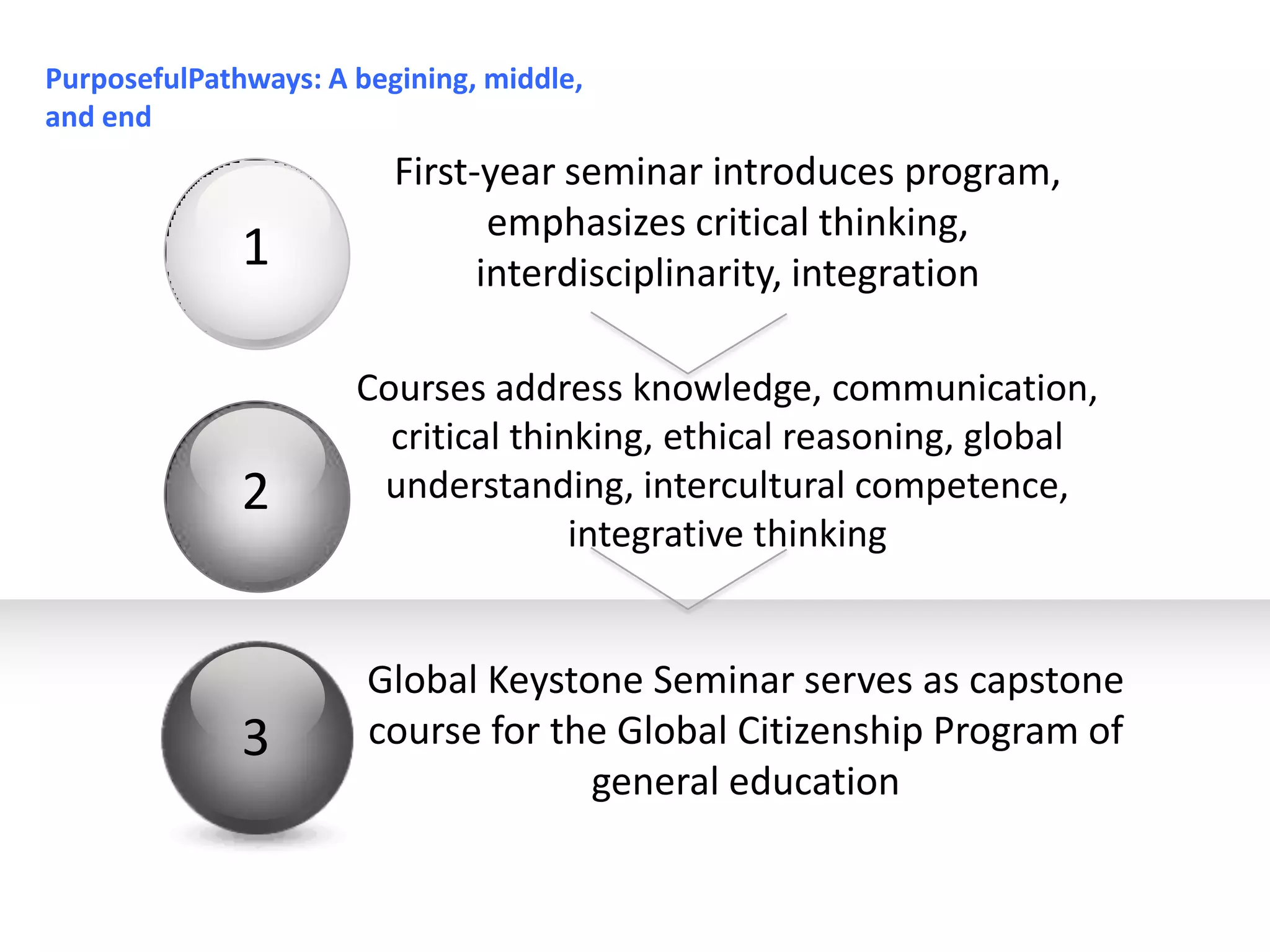
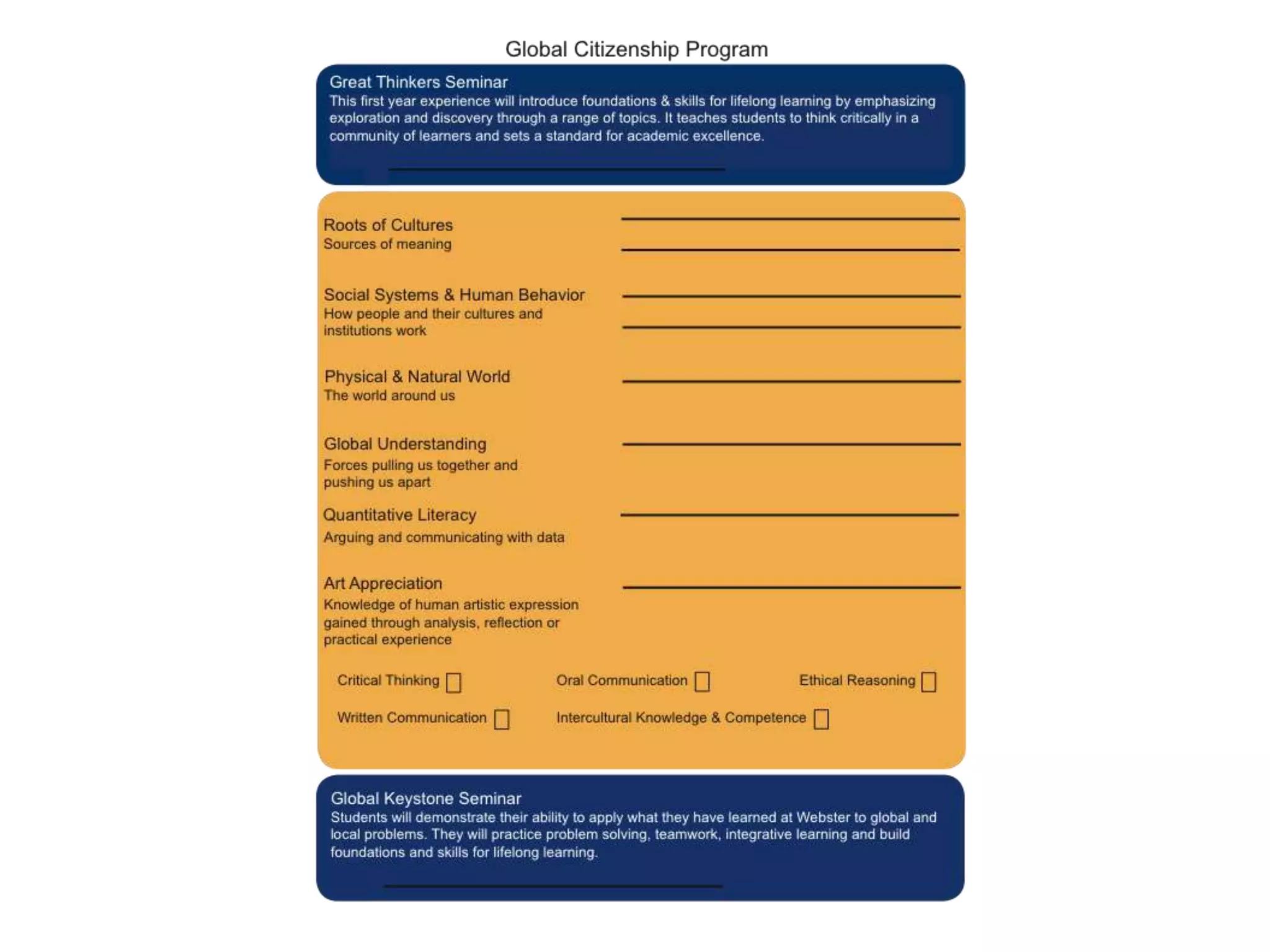
    PurposefulPathways: A begining,middle, and endFirst-year seminar introduces program, emphasizes critical thinking, interdisciplinarity, integration1Courses address knowledge, communication, critical thinking, ethical reasoning, global understanding, intercultural competence, integrative thinking2Global Keystone Seminar serves as capstone course for the Global Citizenship Program of general education3
  • 77.
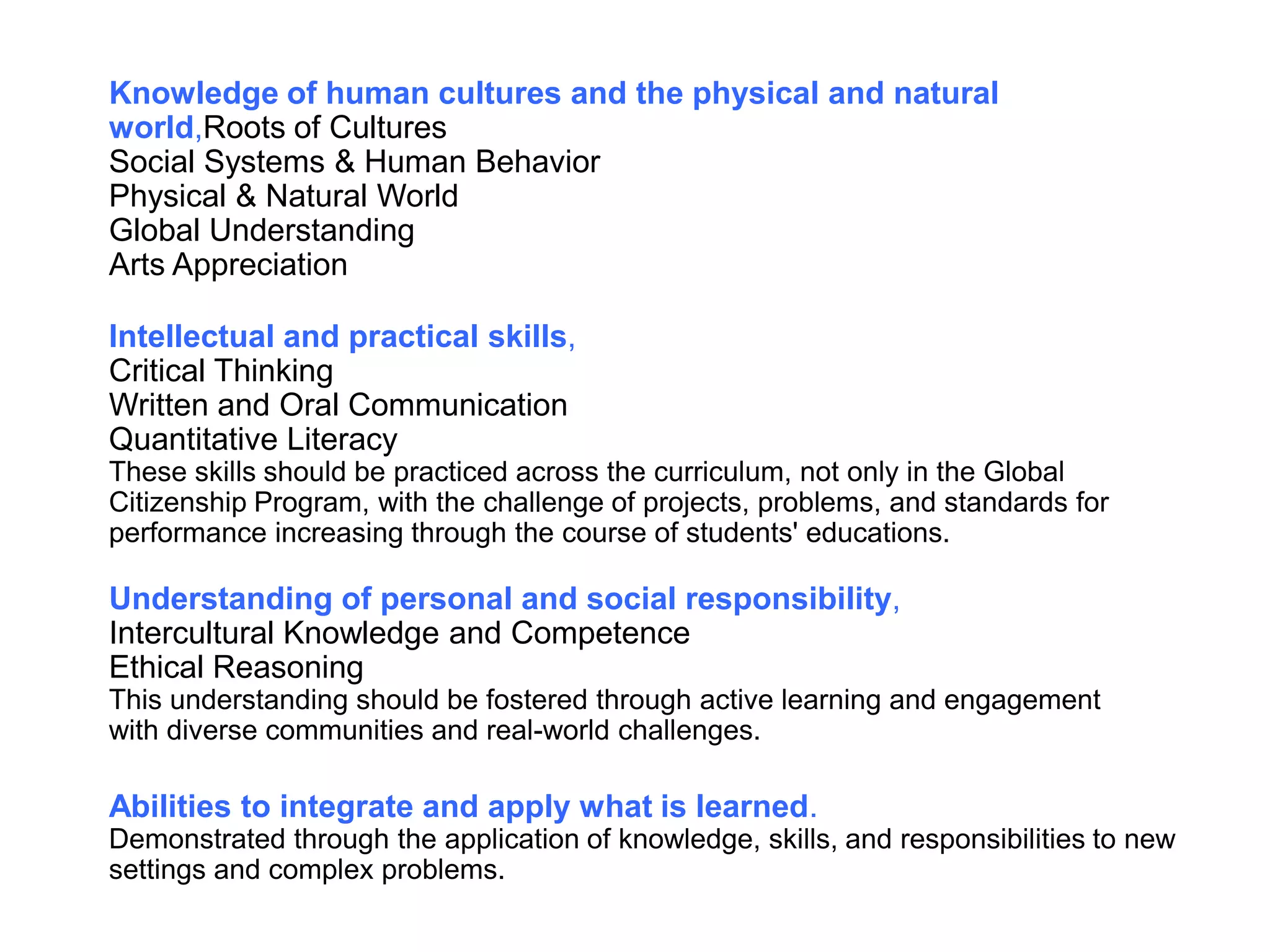
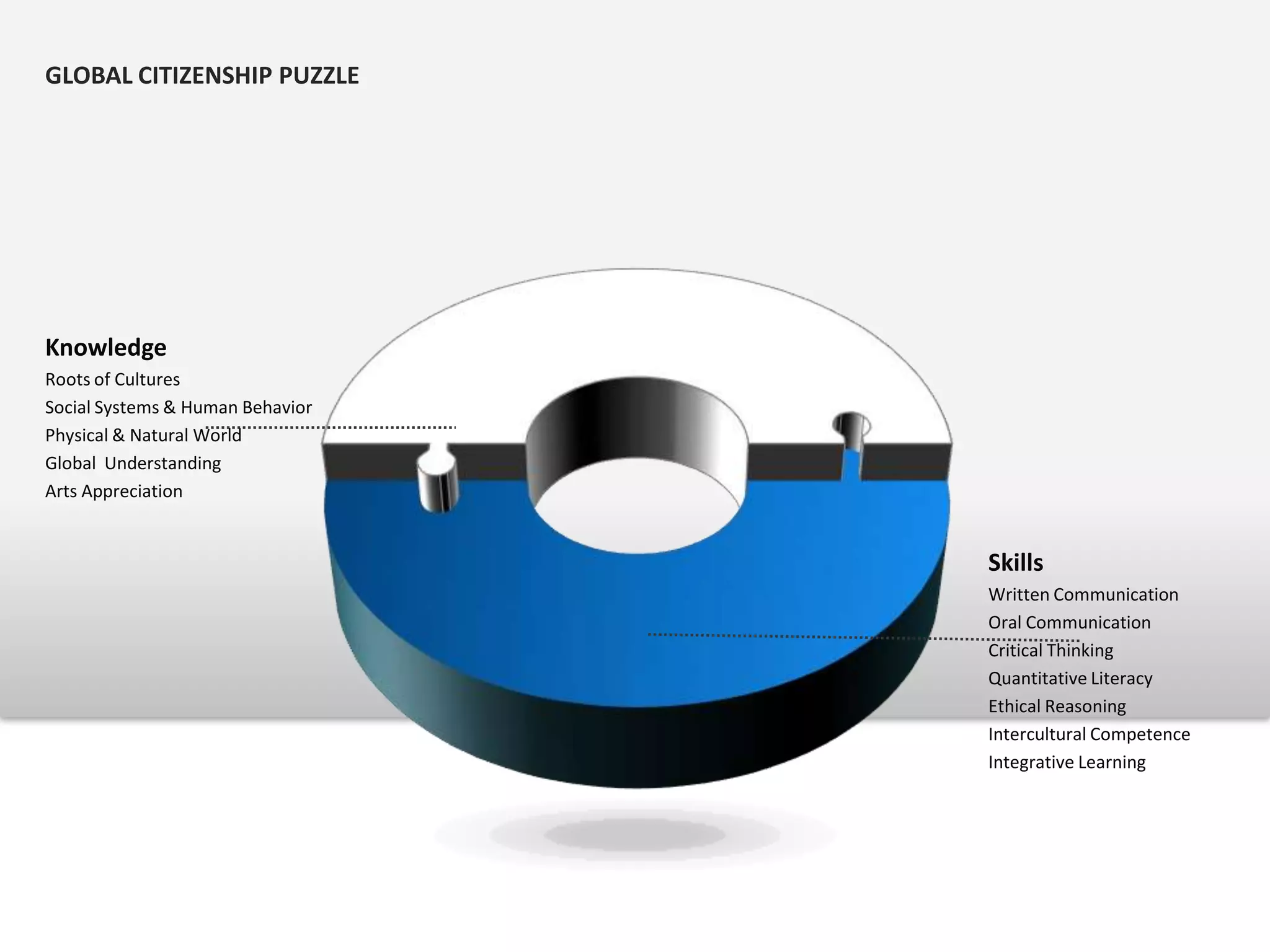
    Knowledge of humancultures and the physical and natural world,Roots of CulturesSocial Systems & Human BehaviorPhysical & Natural WorldGlobal UnderstandingArts AppreciationIntellectual and practical skills,Critical ThinkingWritten and Oral CommunicationQuantitative LiteracyThese skills should be practiced across the curriculum, not only in the Global Citizenship Program, with the challenge of projects, problems, and standards for performance increasing through the course of students' educations.Understanding of personal and social responsibility,Intercultural Knowledge and CompetenceEthical Reasoning This understanding should be fostered through active learning and engagement with diverse communities and real-world challenges.Abilities to integrate and apply what is learned.Demonstrated through the application of knowledge, skills, and responsibilities to new settings and complex problems.
  • 78.
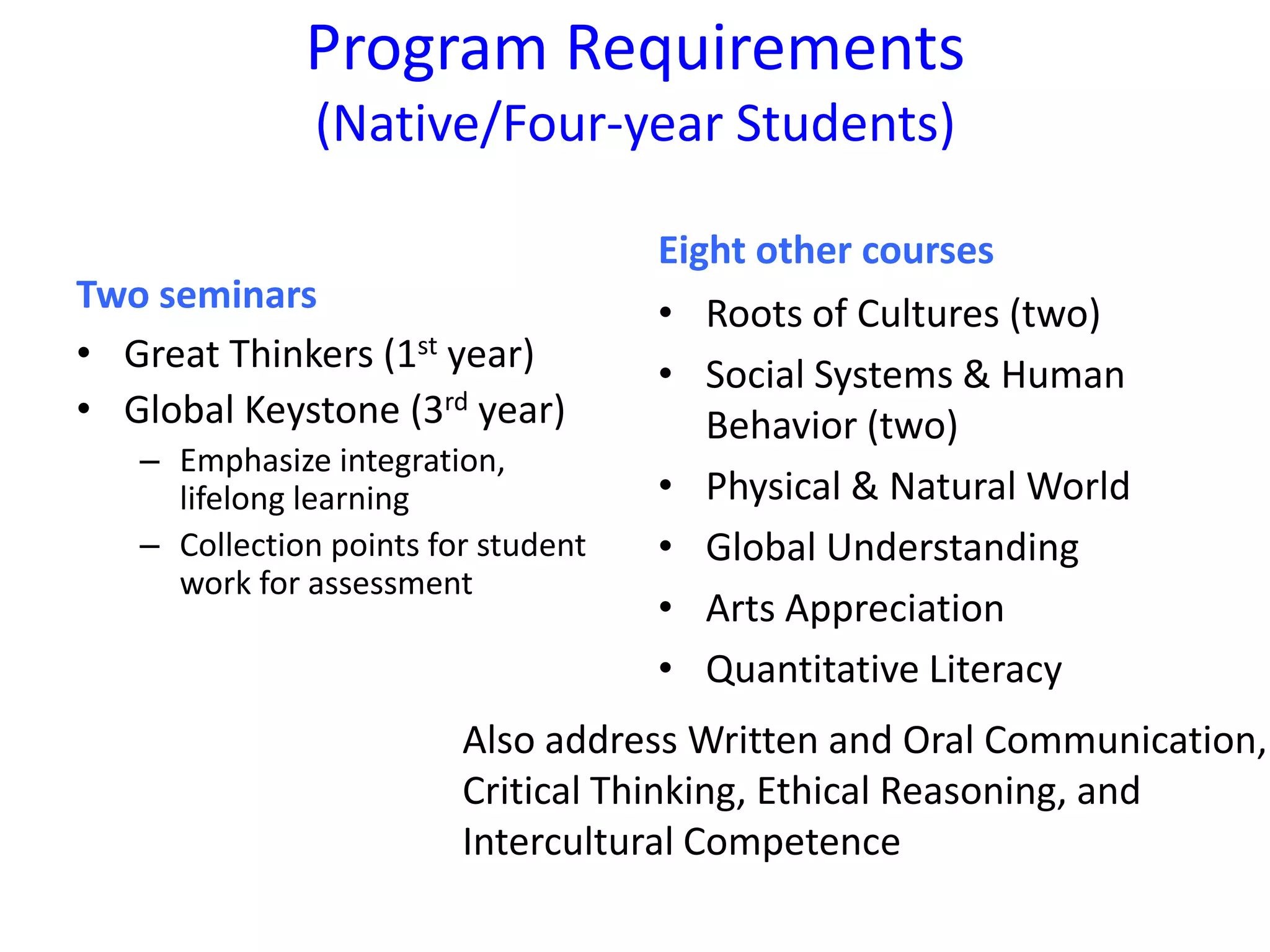
    Program Requirements (Native/Four-yearStudents)Eight other coursesTwo seminarsRoots of Cultures (two)Social Systems & Human Behavior (two)Physical & Natural WorldGlobal UnderstandingArts AppreciationQuantitative LiteracyGreat Thinkers (1st year) Global Keystone (3rd year)Emphasize integration, lifelong learningCollection points for student work for assessmentAlso address Written and Oral Communication, Critical Thinking, Ethical Reasoning, and Intercultural Competence
  • 79.
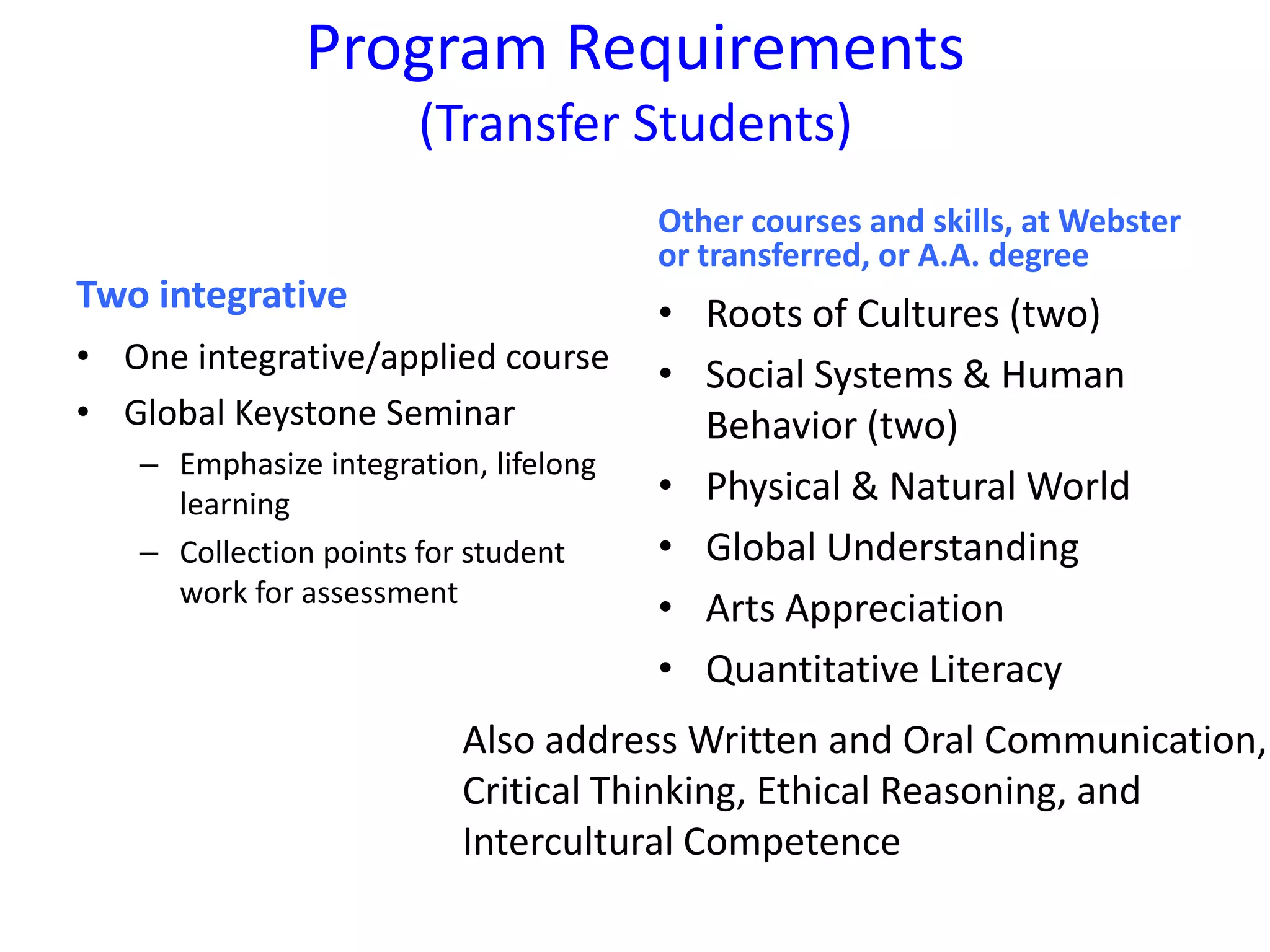
    Program Requirements (TransferStudents)Other courses and skills, at Webster or transferred, or A.A. degreeTwo integrativeRoots of Cultures (two)Social Systems & Human Behavior (two)Physical & Natural WorldGlobal UnderstandingArts AppreciationQuantitative LiteracyOne integrative/applied course Global Keystone SeminarEmphasize integration, lifelong learningCollection points for student work for assessmentAlso address Written and Oral Communication, Critical Thinking, Ethical Reasoning, and Intercultural Competence
  • 81.
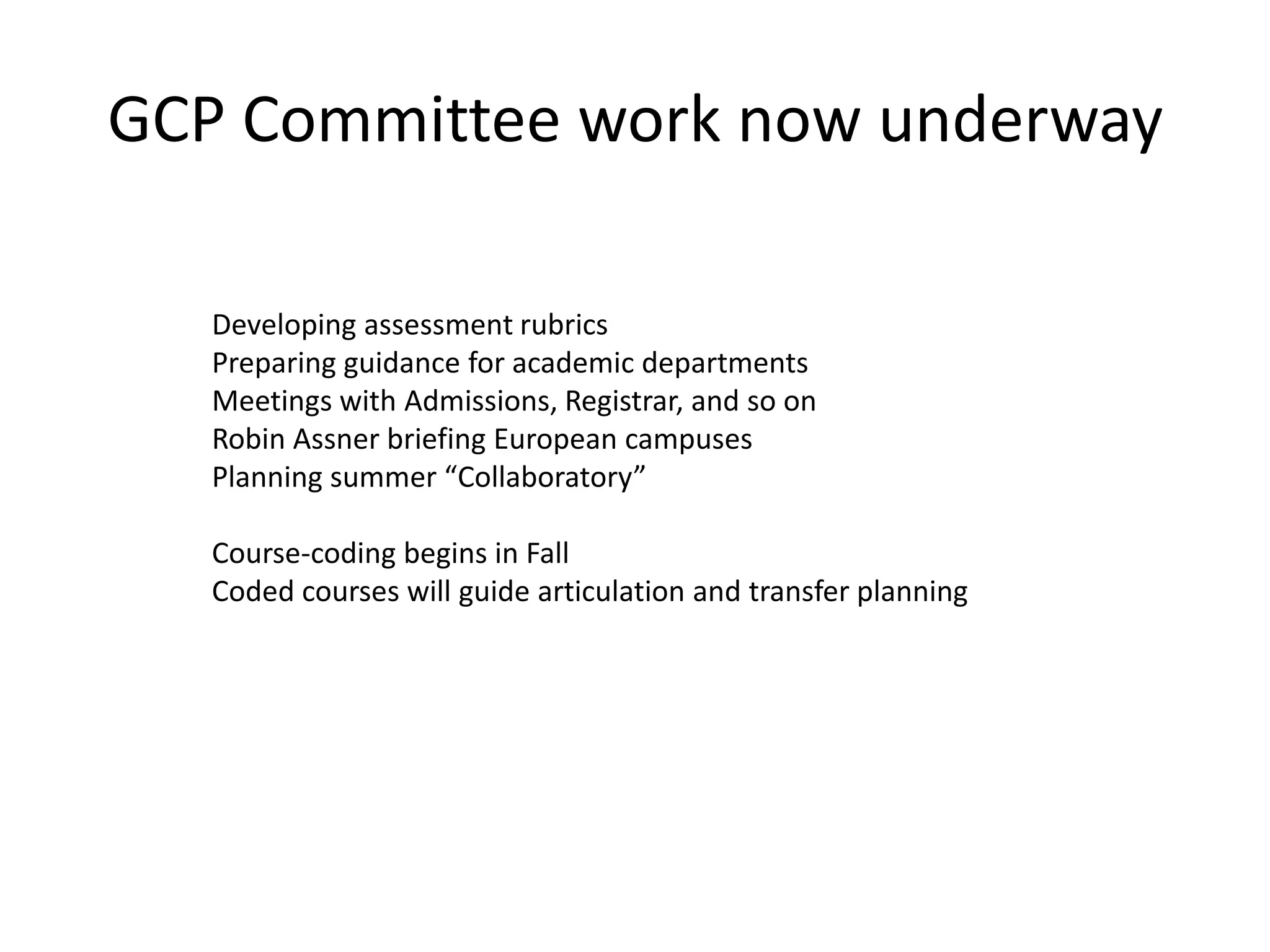
    GCP Committee worknow underwayDeveloping assessment rubricsPreparing guidance for academic departmentsMeetings with Admissions, Registrar, and so onRobin Assner briefing European campusesPlanning summer “Collaboratory”Course-coding begins in FallCoded courses will guide articulation and transfer planning
  • 82.
    The mission ofthe Global Citizenship Program to ensure that every undergraduate student emerge from Webster University with the core competencies required for responsible global citizenship in the 21st Century.
  • 83.
    GLOBAL CITIZENSHIP PUZZLEKnowledgeRootsof CulturesSocial Systems & Human BehaviorPhysical & Natural WorldGlobal UnderstandingArts AppreciationSkillsWritten CommunicationOral CommunicationCritical ThinkingQuantitative LiteracyEthical ReasoningIntercultural CompetenceIntegrative Learning
  • 84.
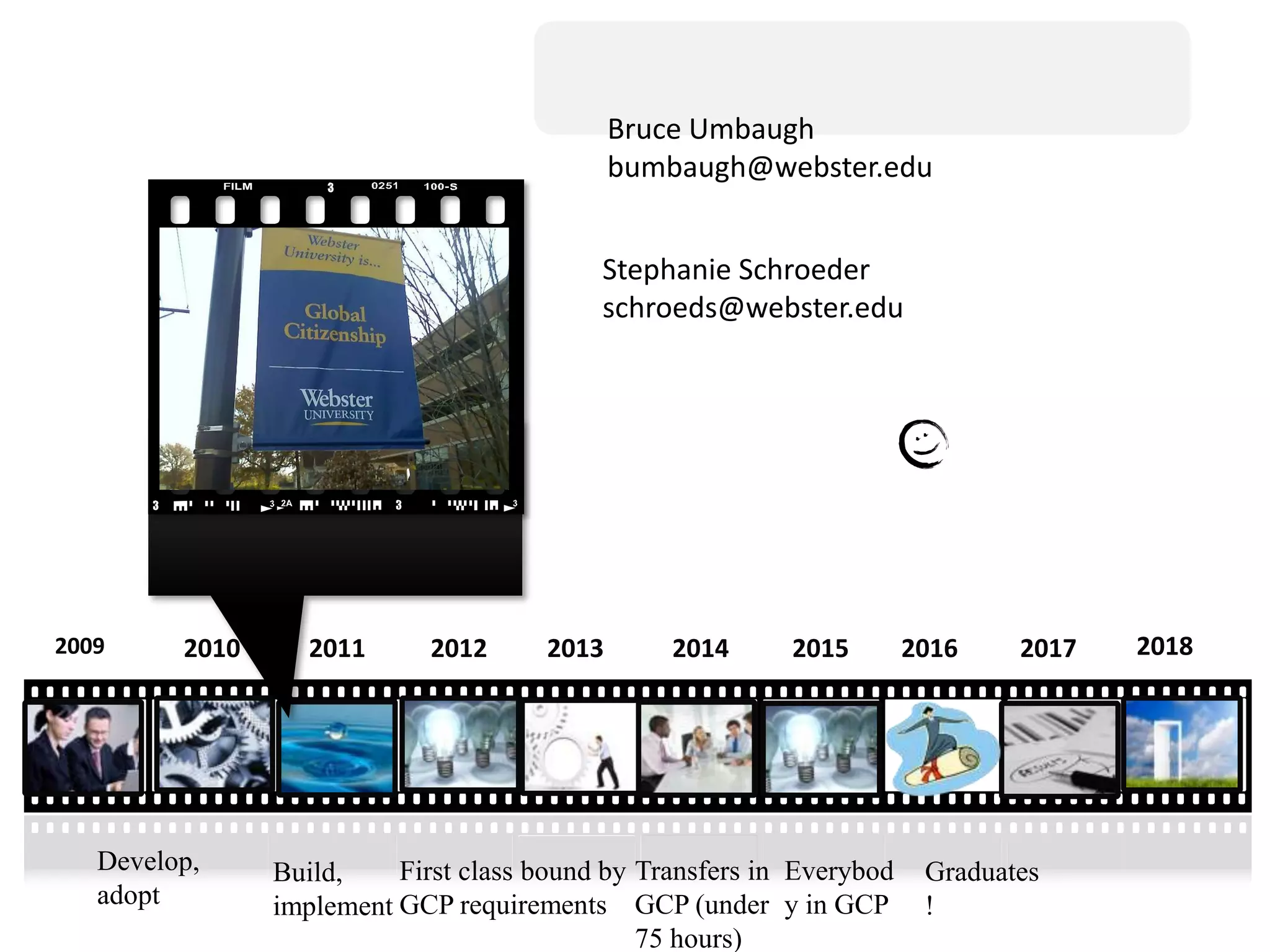
    Bruce Umbaughbumbaugh@webster.eduStephanie Schroederschroeds@webster.edu20112018201520142012201120102009201320162017Develop,adoptTransfers in GCP (under 75 hours)Everybody in GCPFirst class bound by GCP requirementsGraduates!Build, implement