
By- RANJANA
Co- author : Sandeep Kakran
NIT Kurukshetra
 Electrical power energy demand growth has led to an
amplified stress and increased danger of faults on the
transmission line.
 Power flow computed in the transmission lines is controlled
by the network characteristics such as:
 stability limit
 thermal limit
 voltage limit
 These limitations are removed by accumulation of new
transmission and generation capacity i.e. using Flexible
Alternating CurrentTransmission Systems (FACTS) devices
 There are many FACTS devices (power-
electronics-based) used to resolve the problems
associated with the efficient control of power
through the load flow distribution to improve
transmission capability, reactive compensated
power, providing the series and shunt
compensation and increase power quality.
 In conventional ideas of energy transmission,
the Unified Power Flow Controller (UPFC) is
utilized to control power quickly or specifically
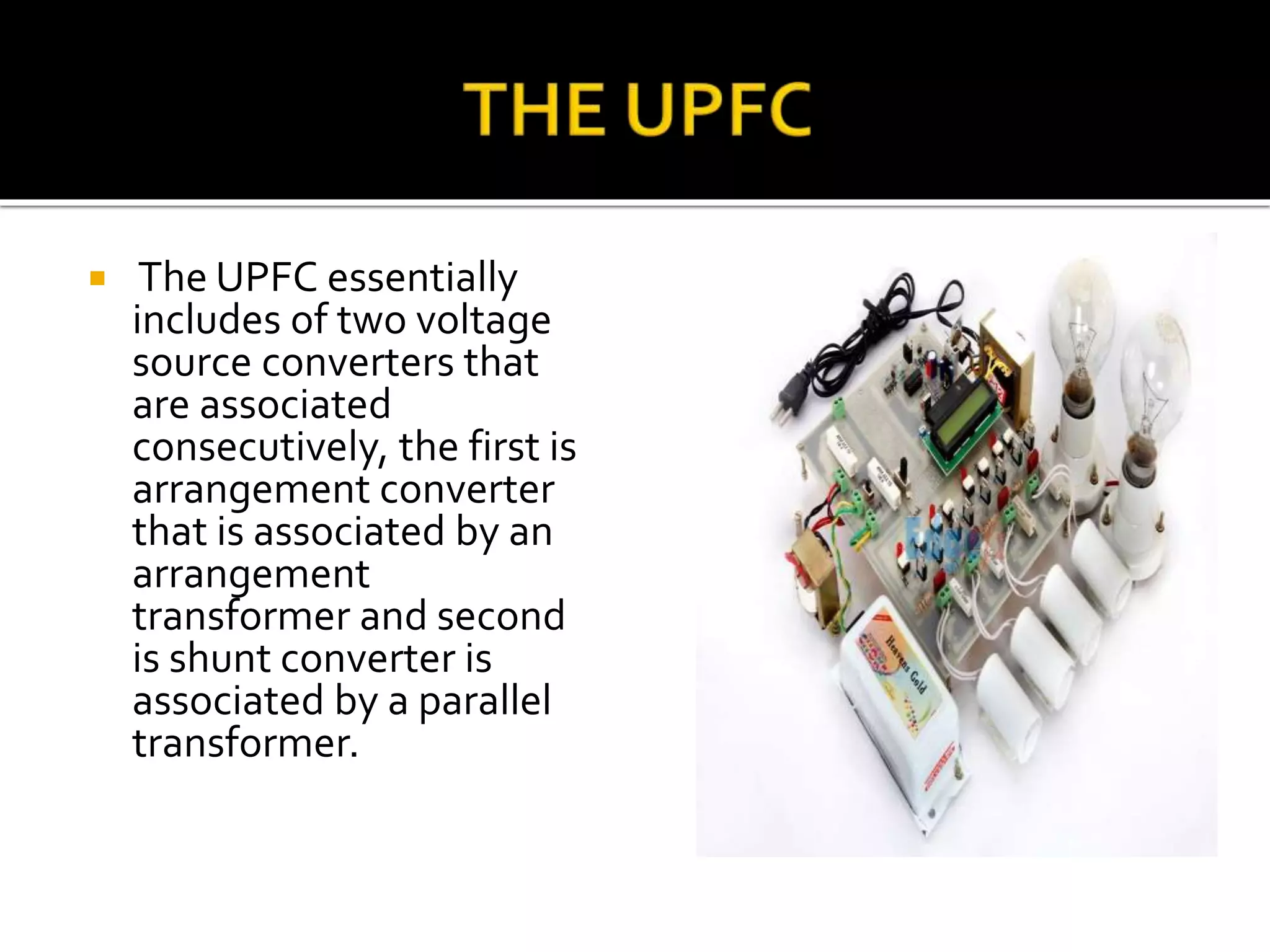
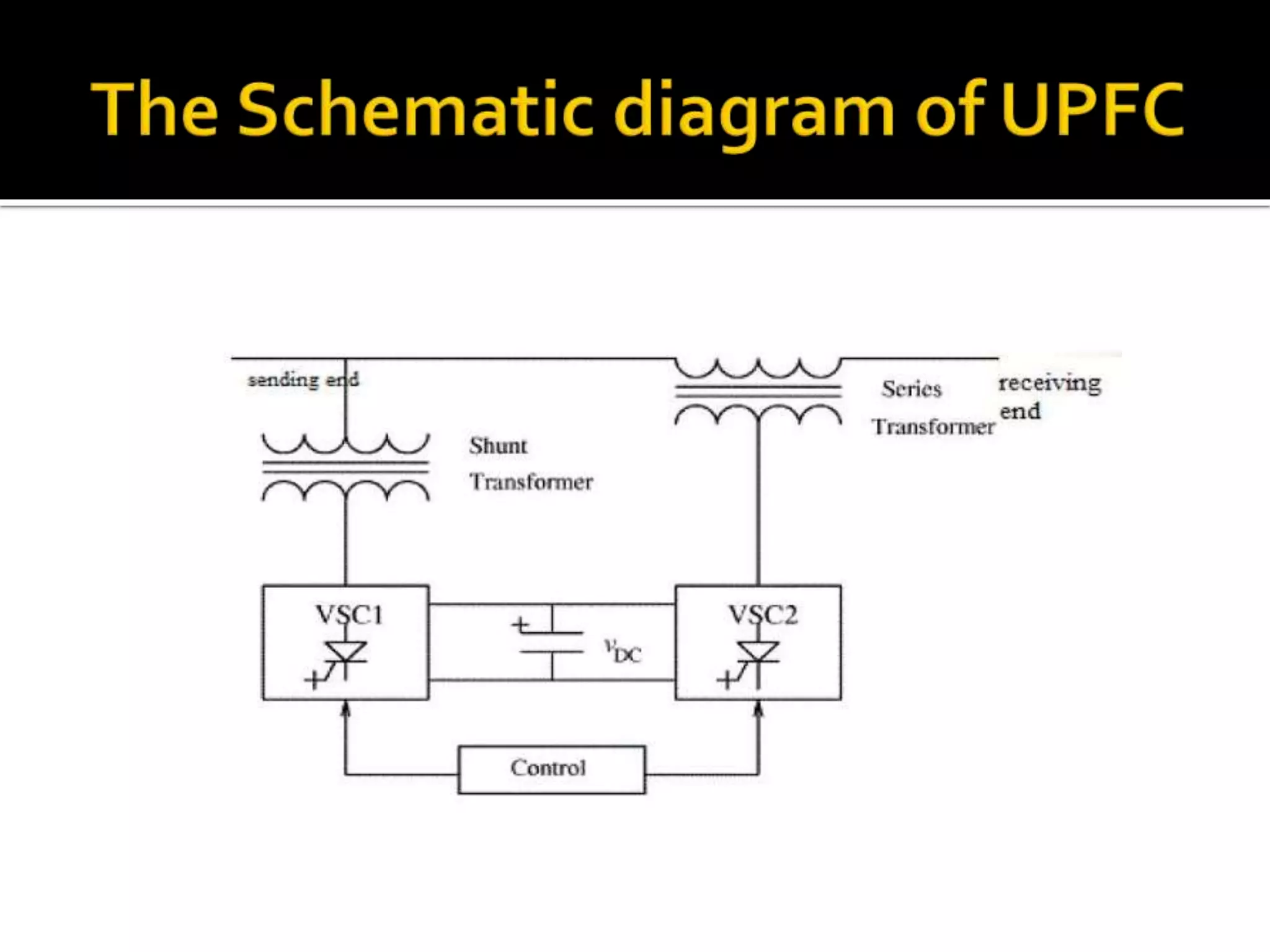
 The UPFC essentially
includes of two voltage
source converters that
are associated
consecutively, the first is
arrangement converter
that is associated by an
arrangement
transformer and second
is shunt converter is
associated by a parallel
transformer.
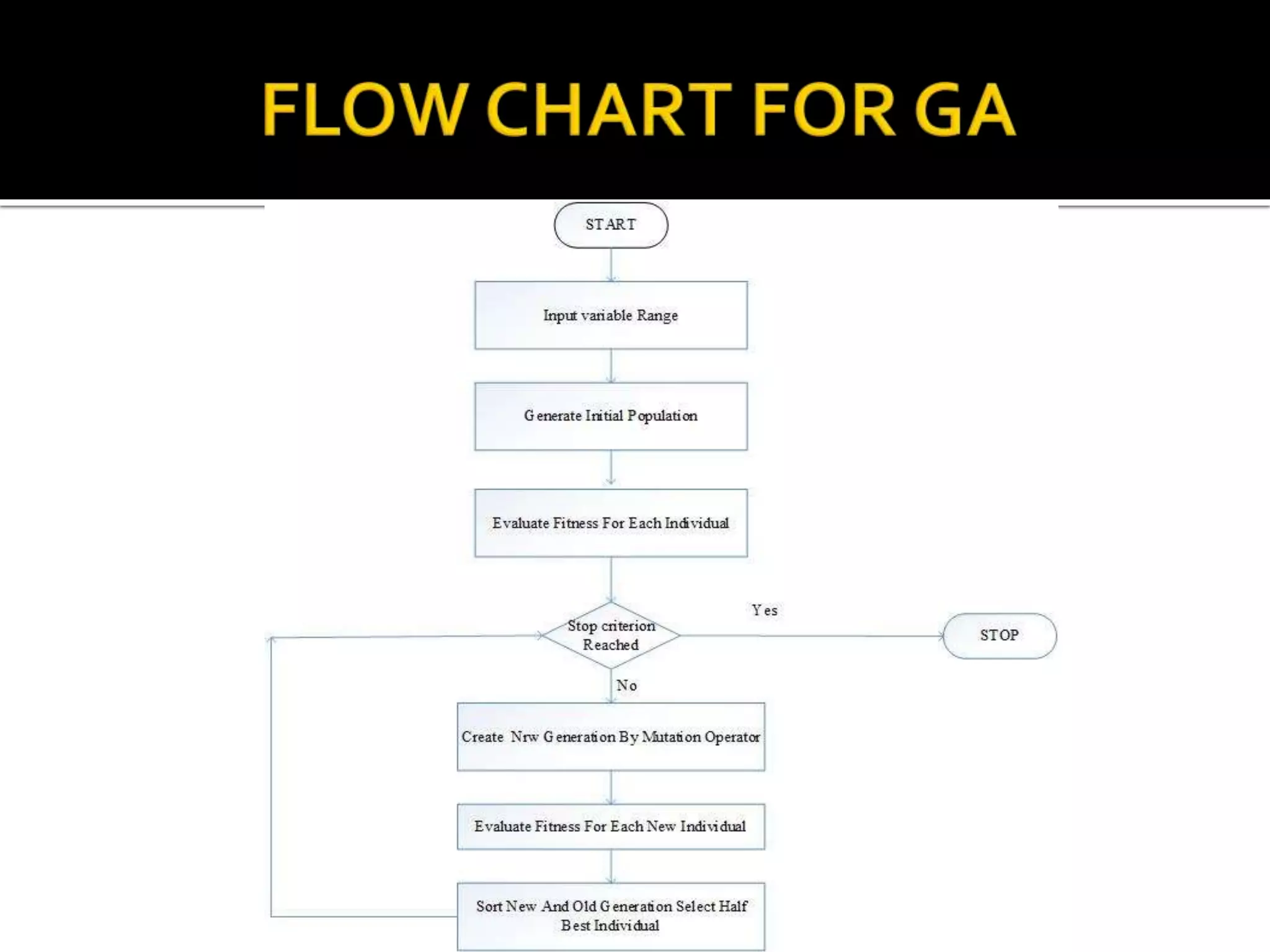
 Genetic algorithm (GA) is
mathematically stimulated by the
process of natural selection that fits
to the superior class of evolutionary
algorithm.
 Genetic algorithm is used to
generate high-quality solution
to optimization and search problem
depending on bio-inspired operators
such as mutation, crossover and
selection.
 This method uses principle of
ordinary evolution and the
population of genetic to explore the
results to reach at high class solution
that is near to global solution.
 PSO (particle swarm optimization)
technique is used to find the best of feasible
solution to an optimization problem.
 In PSO algorithm, all particles are started
randomly and evaluated to calculate the
fitness for giving conclusion of the personal
best (best value of each particle) and global
best (best value of particle in the swarm).
Then a loop starts to create an optimum
solution.
 In the started loop, first the particle velocity is
reorganized by the personal best and global
bests, and then position of every particle is
restructured by the present velocity.
 This exclusive feature of PSO overcomes the
rapid convergence difficulty and improves the
search capability.
 Also it is different from the other methods,
because the result value doesn’t depend on the
initial population.
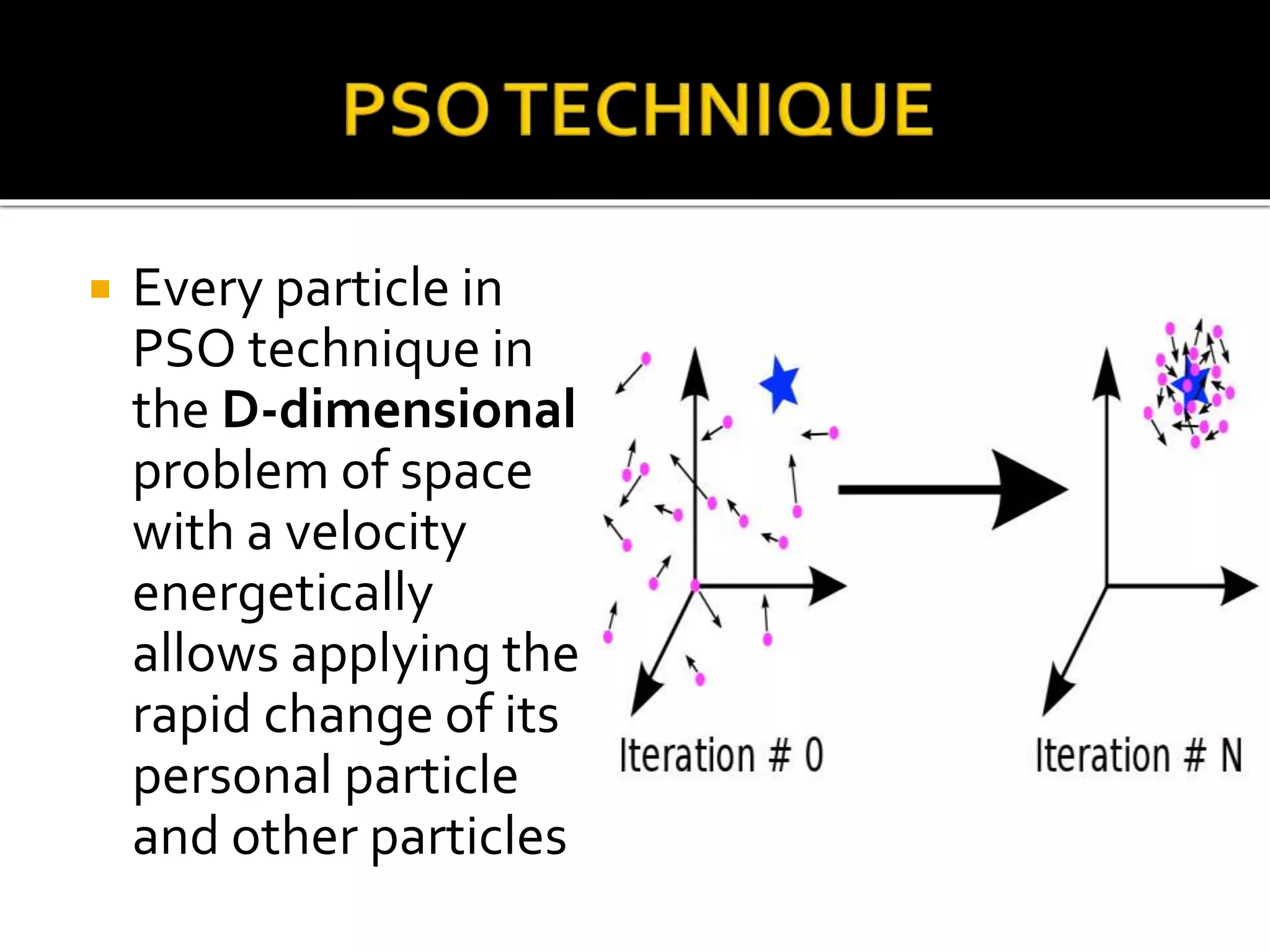
 Every particle in
PSO technique in
the D-dimensional
problem of space
with a velocity
energetically
allows applying the
rapid change of its
personal particle
and other particles
 The best prior position (that gives the value
of best) of the particle is calculated and
showed as that is called Pbest.
 Index of the particle which is best between
particles in the present population is denoted
by the letter g.The location of P and g is
symbolized as particle moves on extreme
velocity.
 Power data limits that the series converter is rated 100
MVA with maximum voltage injection 1.0pu.
 The shunt converter of UPFC is also rated 100MVA.
 The control constraints of the shunt converter are
voltage regulation mode and the series converter
which deliver power flow in a controlled manner.
 PSO and GA technique are used to find the best of
possible solution of optimization problem. Consider
the global optimal of an n-dimensional function when
a loop start toward finding an optimum solution
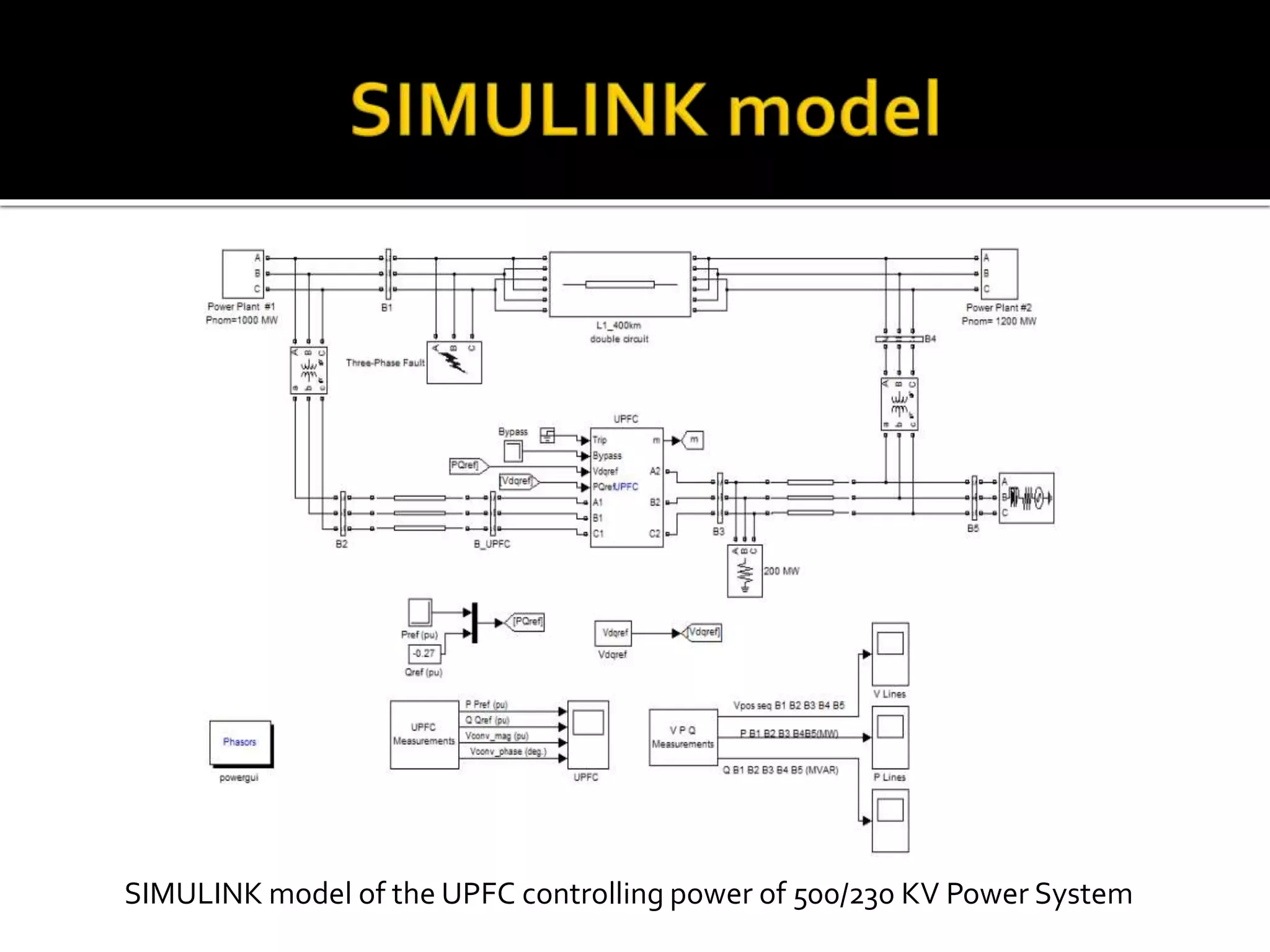
SIMULINK model of the UPFC controlling power of 500/230 KV Power System
 The UPFC consists of the two (VSI) voltage
source converter that are connected in back-to-
back manner, considered as the Shunt Converter
and the Series Converter as appeared in Figure
 are decided from the basic DC interface voltage
kept up by the DC storing capacitor.
 In normal operation of the stage edge of
arrangement voltage converter is chosen
autonomously of line current that lies in the
vicinity of 0 and 2π and its extent is changing in
range in the vicinity of zero and most extreme.
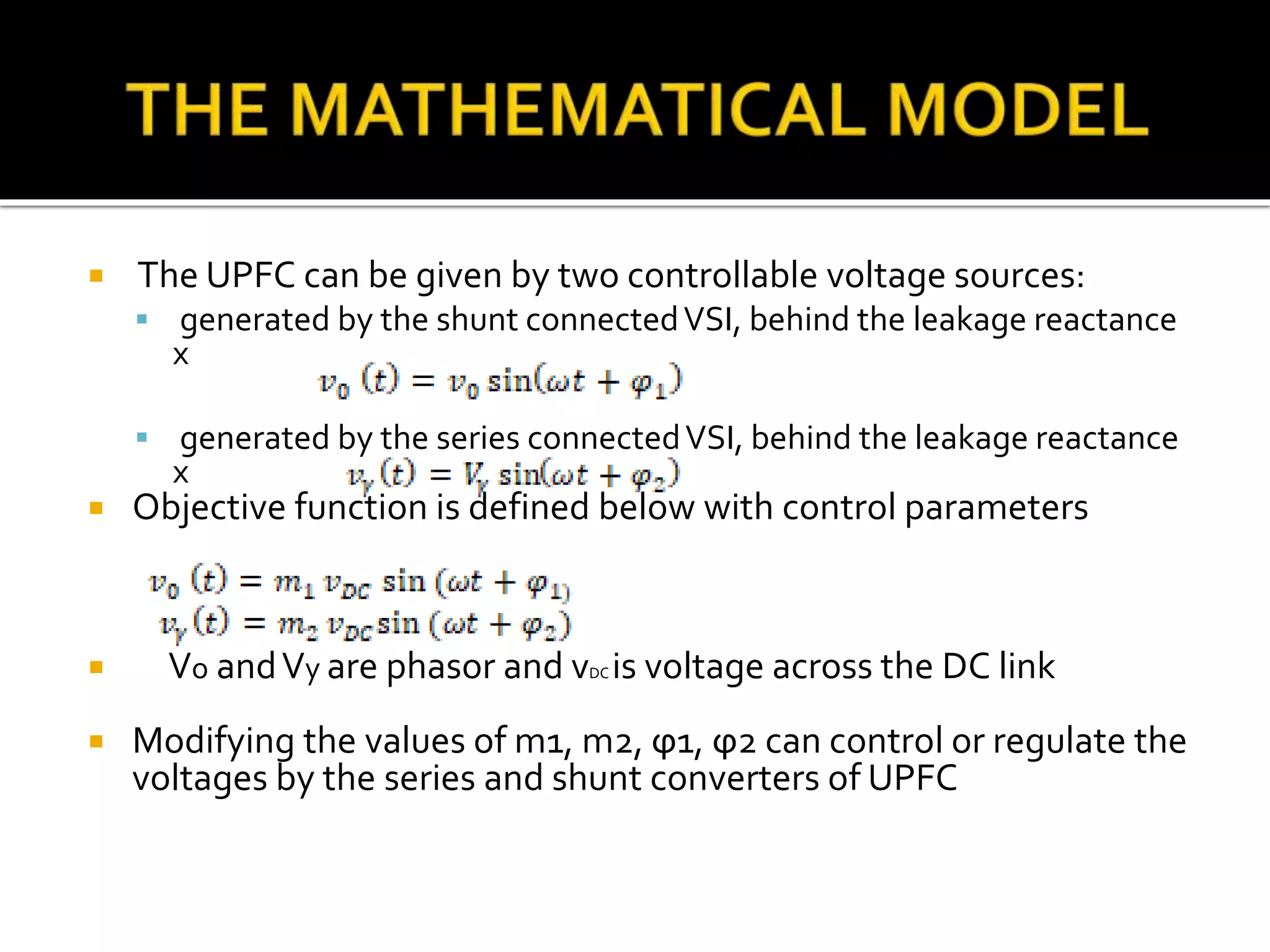
 The UPFC can be given by two controllable voltage sources:
 generated by the shunt connectedVSI, behind the leakage reactance
x
 generated by the series connectedVSI, behind the leakage reactance
x
 Objective function is defined below with control parameters
 Vo andVy are phasor and vDC is voltage across the DC link
 Modifying the values of m1, m2, ϕ1, ϕ2 can control or regulate the
voltages by the series and shunt converters of UPFC
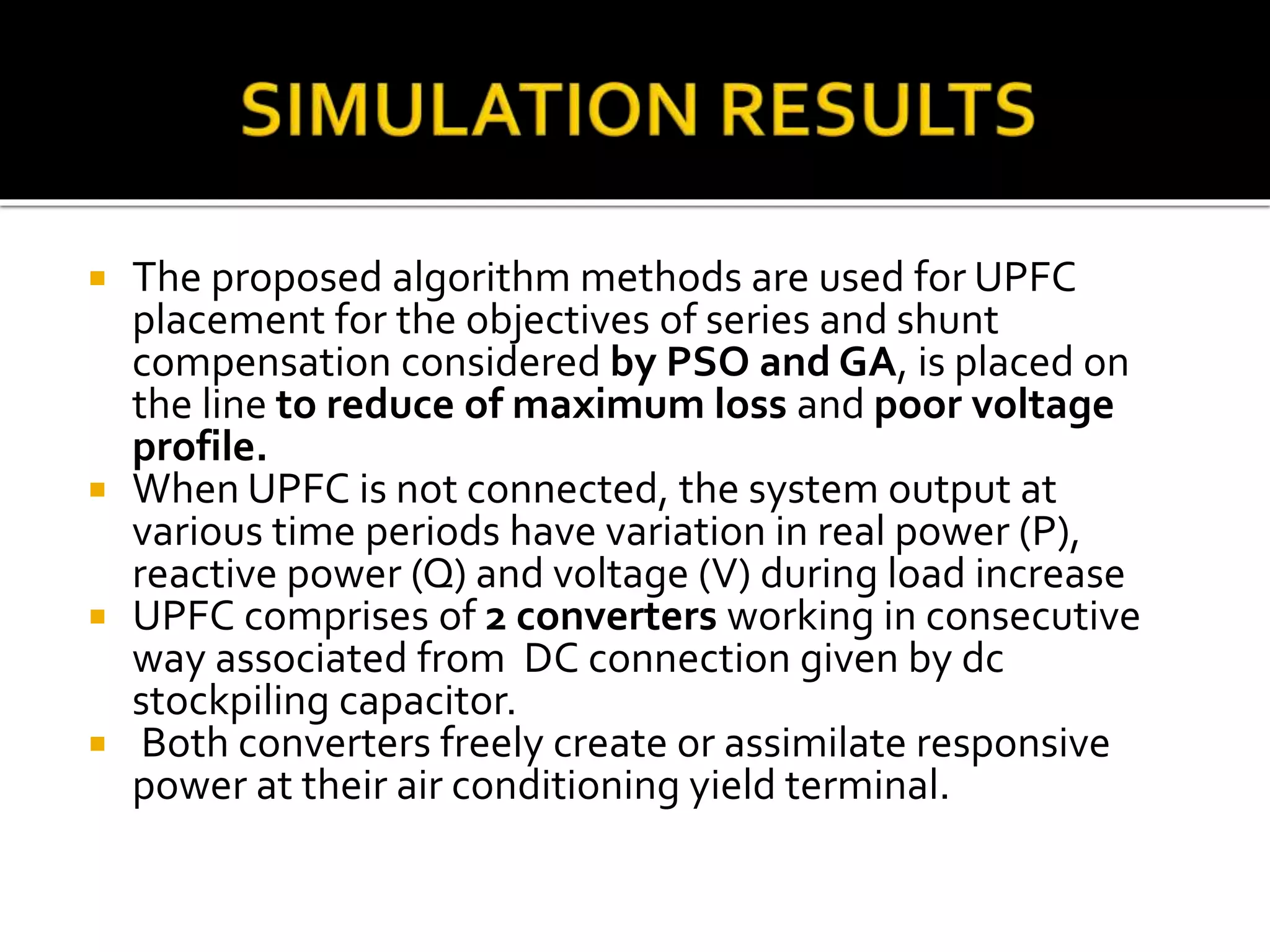
 The proposed algorithm methods are used for UPFC
placement for the objectives of series and shunt
compensation considered by PSO and GA, is placed on
the line to reduce of maximum loss and poor voltage
profile.
 When UPFC is not connected, the system output at
various time periods have variation in real power (P),
reactive power (Q) and voltage (V) during load increase
 UPFC comprises of 2 converters working in consecutive
way associated from DC connection given by dc
stockpiling capacitor.
 Both converters freely create or assimilate responsive
power at their air conditioning yield terminal.
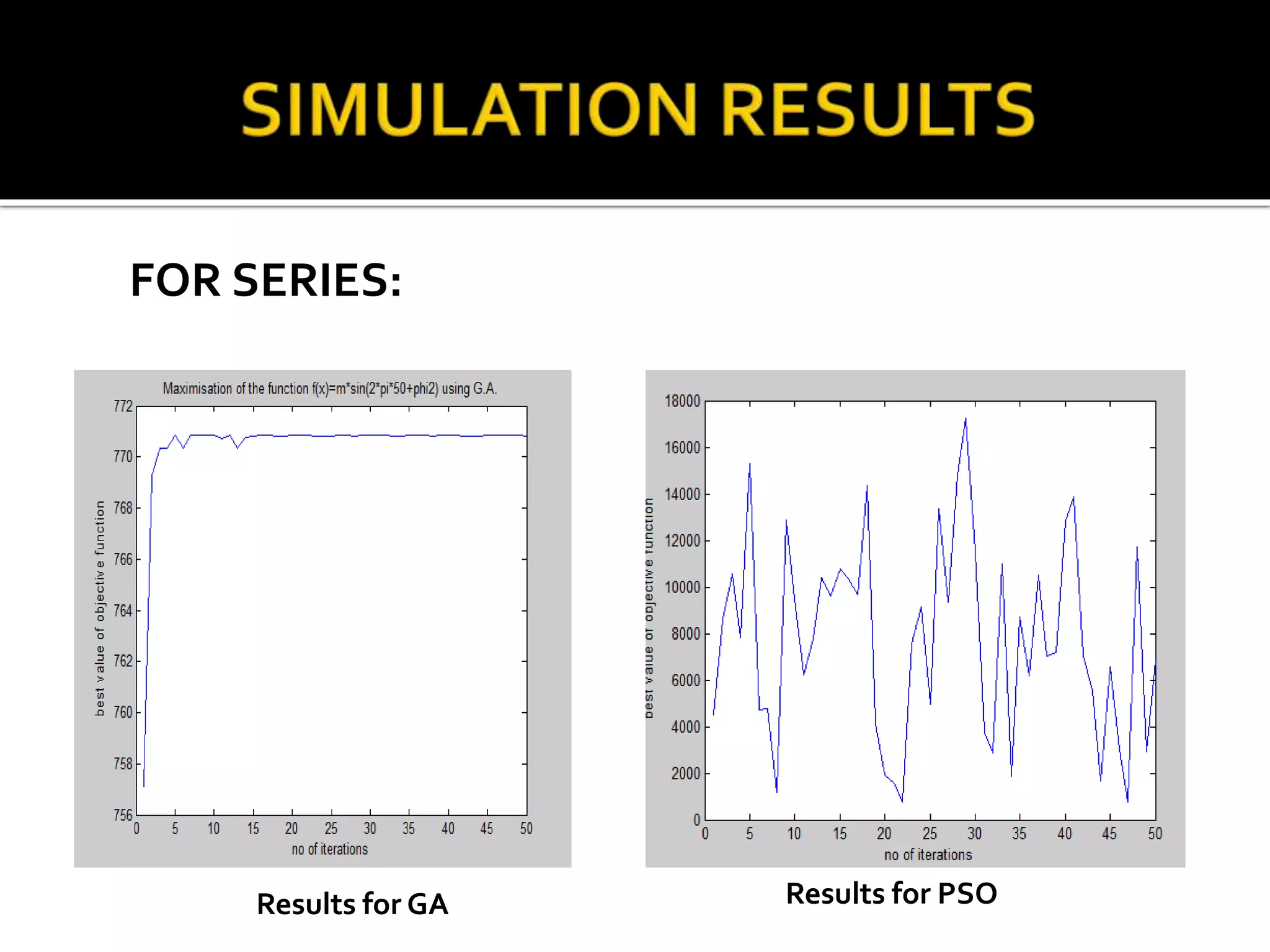
FOR SERIES:
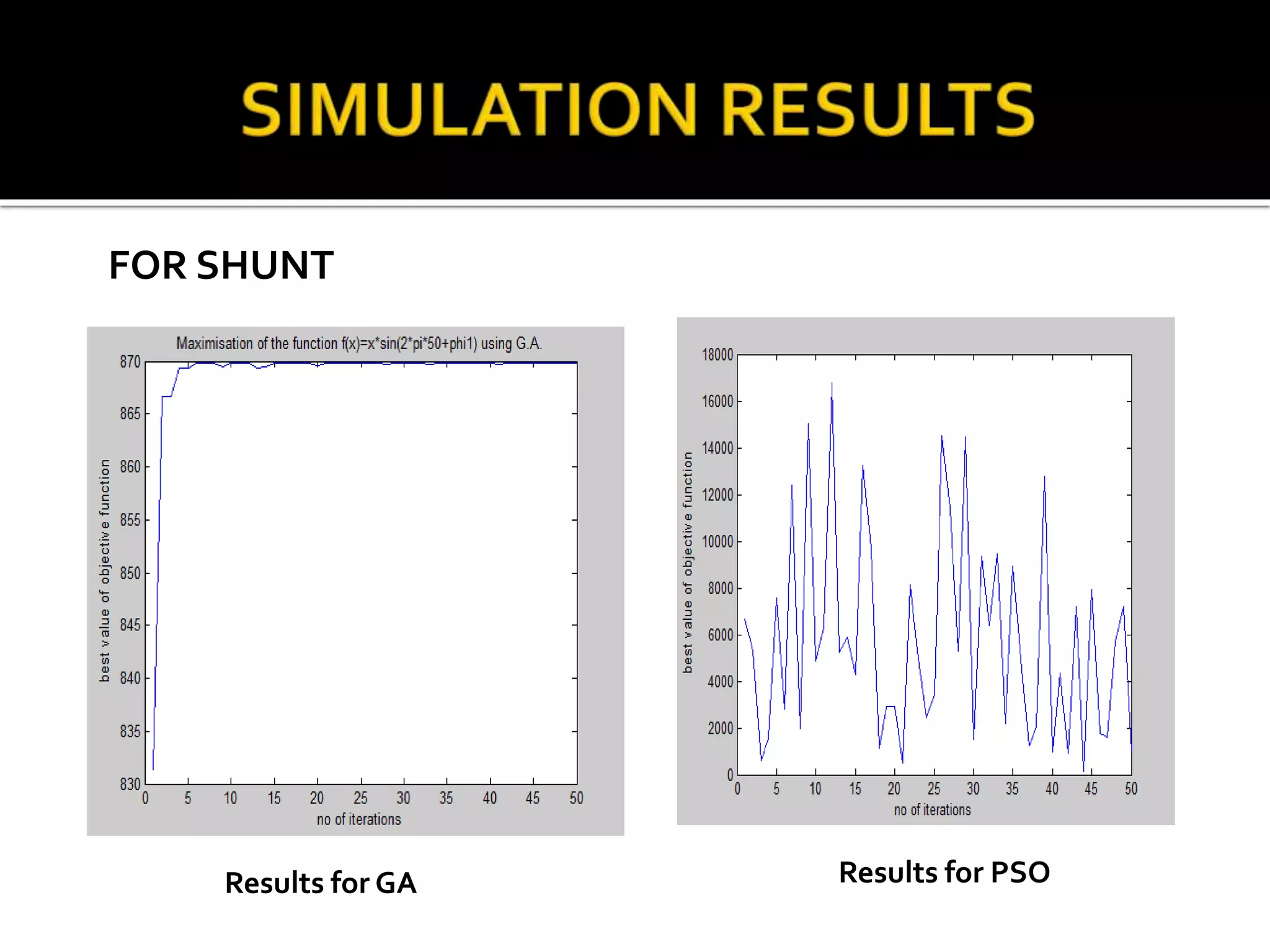
Results for GA Results for PSO
FOR SHUNT
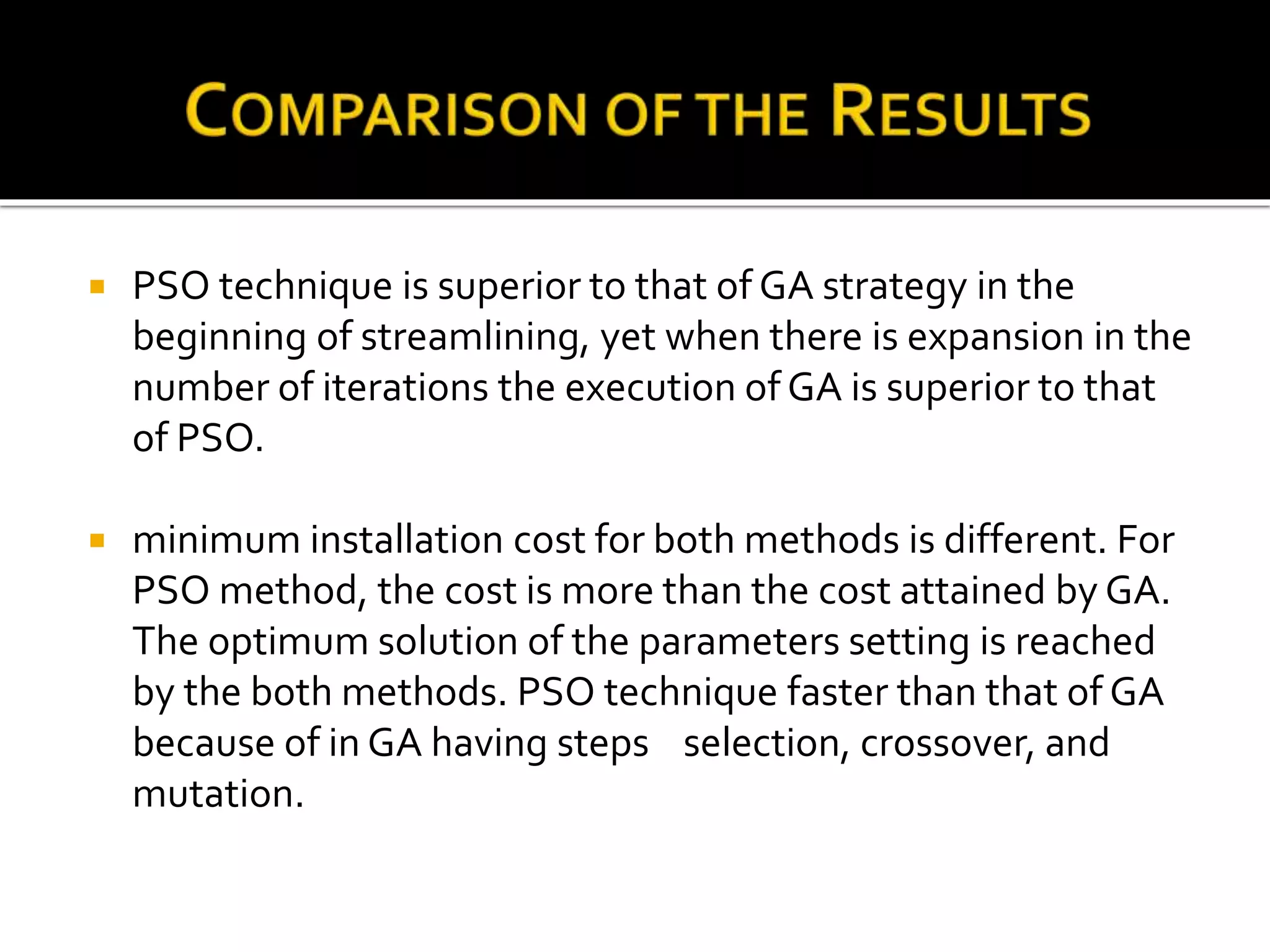
 PSO technique is superior to that of GA strategy in the
beginning of streamlining, yet when there is expansion in the
number of iterations the execution of GA is superior to that
of PSO.
 minimum installation cost for both methods is different. For
PSO method, the cost is more than the cost attained by GA.
The optimum solution of the parameters setting is reached
by the both methods. PSO technique faster than that of GA
because of in GA having steps selection, crossover, and
mutation.
 Particle Swarm Optimization (PSO) is practically search method
that based on the knowledge of the behavior of swarming in
biological populations. PSO is similar to Genetic Algorithm (GA)
because both methods are population based approaches and they
both are depends on the information of sharing between the
population members that increase their searching processes by
using combination actual and probabilistic rule.
 GA has fixed algorithm with various types and the uses. GA is very
helpful to when the inventor have not detailed domain because
GA possesses the ability to discover and rivet from their domain.
 PSO is applied to multi-objective problems in which fitness
evaluation take power into the account when moving the PSO
particle. The objective of this paper is to test hypothesis that
define the PSO and GA average yield the same effectiveness of
solution, PSO is the more efficient ( because of uses less number
of function evaluations) than the GA.
PSO and GA methods have been used to find the decrement in the
power loss and increment in voltage profile in the transmission
system.The following conclusions have identified:
 The outcomes demonstrate that power misfortune is lessened and the
voltage profile is kept up within indicated restrictions under various
load conditions.
 The results estimated from usage of the two strategies showed that
on both techniques the systems gives well values.This implies that the
system stability is improved with the proposed methods and reducing
the losses to a considerate level and high level efficiency can be
achieved.
 PSO gives quicker and better response than GA during comparison.
The real power losses and the voltage stability are found better with
the PSO algorithm than the GA.
 N.G.Hingorani , “Power Electronics In ElectricalUtilities: Role Of Power Electronics In Future Power System,”
Proceedings of the IEEE,Vol. 76 No. 4, April 1988, pp.481-48
 K. M. Soon and R. H. Lasseter, “A Newton-type current injection model of UPFC for studying low-frequency
oscillations,” IEEETrans. Power Del., vol. 19, no. 2, Apr. 2004.
 B. Fardanesh, “Optimal utilization, sizing, steady-state performance comparison of multiconverterVSC-based FACTS
controllers,” IEEETrans. Power Del., vol. 19, no. 3, Jul. 2004.
 M. Kowsalya, K. K. Ray, “Loss Optimization forVoltage Stability Enhancement IncoperatingUPFC Using PSO”,
Journal of Electrical Engineering ofTechnology Vol4.
 S. J. Cheng, “Optimal Location and Parameter Settings of UPFC for Increasing Power System Loadability Based PSO
Techniques”,Third International Conference on Natural Computation (ICNC 2007)
 L. Davis, “Handbook Of Genetic Algorithms,” Van Nostrand Reinhold, NewYork, 1991
 M. Saravanan, S. Mary Raja Slochanal”, Application Of PSOTechnique For Optimal Location Of FACTS Devices
Considering System Loadability And Cost Of Installation”,
 SapnaKatiyar,“A Comparative Study of Genetic Algorithm and the Particle Swarm Optimization”, Akgec
International Journal OfTechnology, Vol. 2, No. 2.
 SajanVarma, “FACTS Devices for Stability Enhancements”, 2015 IEEE.
 G. I. Rashed, “Optimal Location and Parameter Settings of FACTS for Increasing Power System LoadabilityBased on
GA and PSOTechniques”,Third International Conference on Natural Computation (ICNC 2007)
 RussellC. Eberhart andYuhuiShi,“Comparison between Genetic Algorithms and Particle Swarm Optimization” .
 AhadJahandidehshendi, “Optimal Design of UPFC Output Feed Back Controller for Power System Stability
Enhancement by Hybrid PSO and GSA”, Journal of Artificial Intelligence in Electrical Engineering, Vol. 2,No.
5,May2013.
 M. Saravanan, S. Mary Raja Slochanal, “Application Of PSOTechnique For Optimal Location Of FACTS Devices
Considering System Loadability And Cost Of Installation”, Department of Electrical and Electronics engineering,
Thiagarajar College of Engineering, Madurai, India.
 Arup RatanBhowmik ,“Optimal Location of UPFC Based on PSO Algorithm Considering Active Power Loss
Minimization”,978-1-4673-0766-6/122012 IEEE

Enhancement of Power System Static and Dynamic Stability Using UPFC by GA and PSO

  • 1.
    By- RANJANA Co- author: Sandeep Kakran NIT Kurukshetra
  • 2.
     Electrical powerenergy demand growth has led to an amplified stress and increased danger of faults on the transmission line.  Power flow computed in the transmission lines is controlled by the network characteristics such as:  stability limit  thermal limit  voltage limit  These limitations are removed by accumulation of new transmission and generation capacity i.e. using Flexible Alternating CurrentTransmission Systems (FACTS) devices
  • 3.
     There aremany FACTS devices (power- electronics-based) used to resolve the problems associated with the efficient control of power through the load flow distribution to improve transmission capability, reactive compensated power, providing the series and shunt compensation and increase power quality.  In conventional ideas of energy transmission, the Unified Power Flow Controller (UPFC) is utilized to control power quickly or specifically
  • 4.
     The UPFCessentially includes of two voltage source converters that are associated consecutively, the first is arrangement converter that is associated by an arrangement transformer and second is shunt converter is associated by a parallel transformer.
  • 5.
     Genetic algorithm(GA) is mathematically stimulated by the process of natural selection that fits to the superior class of evolutionary algorithm.  Genetic algorithm is used to generate high-quality solution to optimization and search problem depending on bio-inspired operators such as mutation, crossover and selection.  This method uses principle of ordinary evolution and the population of genetic to explore the results to reach at high class solution that is near to global solution.
  • 7.
     PSO (particleswarm optimization) technique is used to find the best of feasible solution to an optimization problem.  In PSO algorithm, all particles are started randomly and evaluated to calculate the fitness for giving conclusion of the personal best (best value of each particle) and global best (best value of particle in the swarm). Then a loop starts to create an optimum solution.
  • 8.
     In thestarted loop, first the particle velocity is reorganized by the personal best and global bests, and then position of every particle is restructured by the present velocity.  This exclusive feature of PSO overcomes the rapid convergence difficulty and improves the search capability.  Also it is different from the other methods, because the result value doesn’t depend on the initial population.
  • 9.
     Every particlein PSO technique in the D-dimensional problem of space with a velocity energetically allows applying the rapid change of its personal particle and other particles
  • 10.
     The bestprior position (that gives the value of best) of the particle is calculated and showed as that is called Pbest.  Index of the particle which is best between particles in the present population is denoted by the letter g.The location of P and g is symbolized as particle moves on extreme velocity.
  • 11.
     Power datalimits that the series converter is rated 100 MVA with maximum voltage injection 1.0pu.  The shunt converter of UPFC is also rated 100MVA.  The control constraints of the shunt converter are voltage regulation mode and the series converter which deliver power flow in a controlled manner.  PSO and GA technique are used to find the best of possible solution of optimization problem. Consider the global optimal of an n-dimensional function when a loop start toward finding an optimum solution
  • 12.
    SIMULINK model ofthe UPFC controlling power of 500/230 KV Power System
  • 13.
     The UPFCconsists of the two (VSI) voltage source converter that are connected in back-to- back manner, considered as the Shunt Converter and the Series Converter as appeared in Figure  are decided from the basic DC interface voltage kept up by the DC storing capacitor.  In normal operation of the stage edge of arrangement voltage converter is chosen autonomously of line current that lies in the vicinity of 0 and 2π and its extent is changing in range in the vicinity of zero and most extreme.
  • 15.
     The UPFCcan be given by two controllable voltage sources:  generated by the shunt connectedVSI, behind the leakage reactance x  generated by the series connectedVSI, behind the leakage reactance x  Objective function is defined below with control parameters  Vo andVy are phasor and vDC is voltage across the DC link  Modifying the values of m1, m2, ϕ1, ϕ2 can control or regulate the voltages by the series and shunt converters of UPFC
  • 16.
     The proposedalgorithm methods are used for UPFC placement for the objectives of series and shunt compensation considered by PSO and GA, is placed on the line to reduce of maximum loss and poor voltage profile.  When UPFC is not connected, the system output at various time periods have variation in real power (P), reactive power (Q) and voltage (V) during load increase  UPFC comprises of 2 converters working in consecutive way associated from DC connection given by dc stockpiling capacitor.  Both converters freely create or assimilate responsive power at their air conditioning yield terminal.
  • 17.
    FOR SERIES: Results forGA Results for PSO
  • 18.
    Results for GAResults for PSO FOR SHUNT
  • 19.
     PSO techniqueis superior to that of GA strategy in the beginning of streamlining, yet when there is expansion in the number of iterations the execution of GA is superior to that of PSO.  minimum installation cost for both methods is different. For PSO method, the cost is more than the cost attained by GA. The optimum solution of the parameters setting is reached by the both methods. PSO technique faster than that of GA because of in GA having steps selection, crossover, and mutation.
  • 20.
     Particle SwarmOptimization (PSO) is practically search method that based on the knowledge of the behavior of swarming in biological populations. PSO is similar to Genetic Algorithm (GA) because both methods are population based approaches and they both are depends on the information of sharing between the population members that increase their searching processes by using combination actual and probabilistic rule.  GA has fixed algorithm with various types and the uses. GA is very helpful to when the inventor have not detailed domain because GA possesses the ability to discover and rivet from their domain.  PSO is applied to multi-objective problems in which fitness evaluation take power into the account when moving the PSO particle. The objective of this paper is to test hypothesis that define the PSO and GA average yield the same effectiveness of solution, PSO is the more efficient ( because of uses less number of function evaluations) than the GA.
  • 21.
    PSO and GAmethods have been used to find the decrement in the power loss and increment in voltage profile in the transmission system.The following conclusions have identified:  The outcomes demonstrate that power misfortune is lessened and the voltage profile is kept up within indicated restrictions under various load conditions.  The results estimated from usage of the two strategies showed that on both techniques the systems gives well values.This implies that the system stability is improved with the proposed methods and reducing the losses to a considerate level and high level efficiency can be achieved.  PSO gives quicker and better response than GA during comparison. The real power losses and the voltage stability are found better with the PSO algorithm than the GA.
  • 22.
     N.G.Hingorani ,“Power Electronics In ElectricalUtilities: Role Of Power Electronics In Future Power System,” Proceedings of the IEEE,Vol. 76 No. 4, April 1988, pp.481-48  K. M. Soon and R. H. Lasseter, “A Newton-type current injection model of UPFC for studying low-frequency oscillations,” IEEETrans. Power Del., vol. 19, no. 2, Apr. 2004.  B. Fardanesh, “Optimal utilization, sizing, steady-state performance comparison of multiconverterVSC-based FACTS controllers,” IEEETrans. Power Del., vol. 19, no. 3, Jul. 2004.  M. Kowsalya, K. K. Ray, “Loss Optimization forVoltage Stability Enhancement IncoperatingUPFC Using PSO”, Journal of Electrical Engineering ofTechnology Vol4.  S. J. Cheng, “Optimal Location and Parameter Settings of UPFC for Increasing Power System Loadability Based PSO Techniques”,Third International Conference on Natural Computation (ICNC 2007)  L. Davis, “Handbook Of Genetic Algorithms,” Van Nostrand Reinhold, NewYork, 1991  M. Saravanan, S. Mary Raja Slochanal”, Application Of PSOTechnique For Optimal Location Of FACTS Devices Considering System Loadability And Cost Of Installation”,  SapnaKatiyar,“A Comparative Study of Genetic Algorithm and the Particle Swarm Optimization”, Akgec International Journal OfTechnology, Vol. 2, No. 2.  SajanVarma, “FACTS Devices for Stability Enhancements”, 2015 IEEE.  G. I. Rashed, “Optimal Location and Parameter Settings of FACTS for Increasing Power System LoadabilityBased on GA and PSOTechniques”,Third International Conference on Natural Computation (ICNC 2007)  RussellC. Eberhart andYuhuiShi,“Comparison between Genetic Algorithms and Particle Swarm Optimization” .  AhadJahandidehshendi, “Optimal Design of UPFC Output Feed Back Controller for Power System Stability Enhancement by Hybrid PSO and GSA”, Journal of Artificial Intelligence in Electrical Engineering, Vol. 2,No. 5,May2013.  M. Saravanan, S. Mary Raja Slochanal, “Application Of PSOTechnique For Optimal Location Of FACTS Devices Considering System Loadability And Cost Of Installation”, Department of Electrical and Electronics engineering, Thiagarajar College of Engineering, Madurai, India.  Arup RatanBhowmik ,“Optimal Location of UPFC Based on PSO Algorithm Considering Active Power Loss Minimization”,978-1-4673-0766-6/122012 IEEE