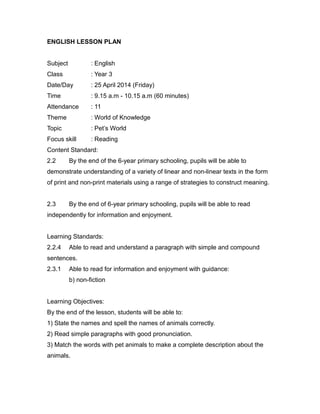


ENGLISH LESSON PLAN
Subject : English
Class : Year 3
Date/Day : 25 April 2014 (Friday)
Time : 9.15 a.m - 10.15 a.m (60 minutes)
Attendance : 11
Theme : World of Knowledge
Topic : Pet’s World
Focus skill : Reading
Content Standard:
2.2 By the end of the 6-year primary schooling, pupils will be able to
demonstrate understanding of a variety of linear and non-linear texts in the form
of print and non-print materials using a range of strategies to construct meaning.
2.3 By the end of 6-year primary schooling, pupils will be able to read
independently for information and enjoyment.
Learning Standards:
2.2.4 Able to read and understand a paragraph with simple and compound
sentences.
2.3.1 Able to read for information and enjoyment with guidance:
b) non-fiction
Learning Objectives:
By the end of the lesson, students will be able to:
1) State the names and spell the names of animals correctly.
2) Read simple paragraphs with good pronunciation.
3) Match the words with pet animals to make a complete description about the
animals.
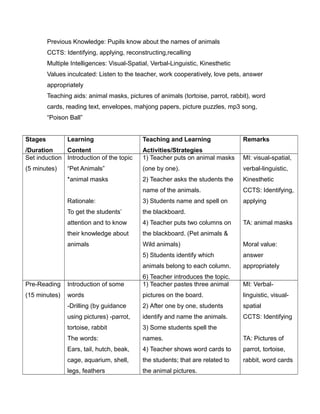
Previous Knowledge: Pupils know about the names of animals
CCTS: Identifying, applying, reconstructing,recalling
Multiple Intelligences: Visual-Spatial, Verbal-Linguistic, Kinesthetic
Values inculcated: Listen to the teacher, work cooperatively, love pets, answer
appropriately
Teaching aids: animal masks, pictures of animals (tortoise, parrot, rabbit), word
cards, reading text, envelopes, mahjong papers, picture puzzles, mp3 song,
“Poison Ball”
Stages
/Duration
Learning
Content
Teaching and Learning
Activities/Strategies
Remarks
Set induction
(5 minutes)
Introduction of the topic
“Pet Animals”
*animal masks
Rationale:
To get the students’
attention and to know
their knowledge about
animals
1) Teacher puts on animal masks
(one by one).
2) Teacher asks the students the
name of the animals.
3) Students name and spell on
the blackboard.
4) Teacher puts two columns on
the blackboard. (Pet animals &
Wild animals)
5) Students identify which
animals belong to each column.
6) Teacher introduces the topic.
MI: visual-spatial,
verbal-linguistic,
Kinesthetic
CCTS: Identifying,
applying
TA: animal masks
Moral value:
answer
appropriately
Pre-Reading
(15 minutes)
Introduction of some
words
-Drilling (by guidance
using pictures) -parrot,
tortoise, rabbit
The words:
Ears, tail, hutch, beak,
cage, aquarium, shell,
legs, feathers
1) Teacher pastes three animal
pictures on the board.
2) After one by one, students
identify and name the animals.
3) Some students spell the
names.
4) Teacher shows word cards to
the students; that are related to
the animal pictures.
MI: Verbal-
linguistic, visual-
spatial
CCTS: Identifying
TA: Pictures of
parrot, tortoise,
rabbit, word cards
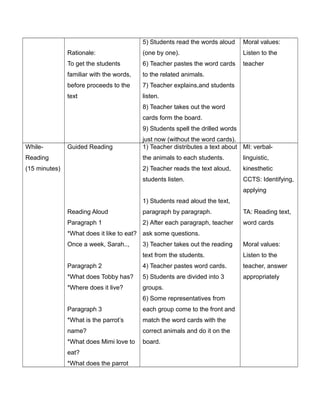
Rationale:
To get the students
familiar with the words,
before proceeds to the
text
5) Students read the words aloud
(one by one).
6) Teacher pastes the word cards
to the related animals.
7) Teacher explains,and students
listen.
8) Teacher takes out the word
cards form the board.
9) Students spell the drilled words
just now (without the word cards).
Moral values:
Listen to the
teacher
While-
Reading
(15 minutes)
Guided Reading
Reading Aloud
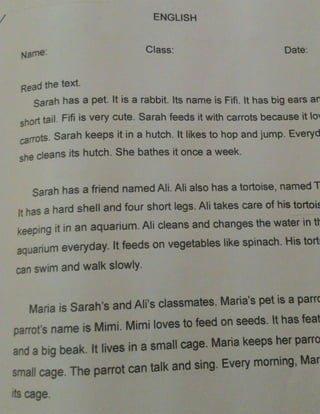
Paragraph 1
*What does it like to eat?
Once a week, Sarah..,
Paragraph 2
*What does Tobby has?
*Where does it live?
Paragraph 3
*What is the parrot’s
name?
*What does Mimi love to
eat?
*What does the parrot
1) Teacher distributes a text about
the animals to each students.
2) Teacher reads the text aloud,
students listen.
1) Students read aloud the text,
paragraph by paragraph.
2) After each paragraph, teacher
ask some questions.
3) Teacher takes out the reading
text from the students.
4) Teacher pastes word cards.
5) Students are divided into 3
groups.
6) Some representatives from
each group come to the front and
match the word cards with the
correct animals and do it on the
board.
MI: verbal-
linguistic,
kinesthetic
CCTS: Identifying,
applying
TA: Reading text,
word cards
Moral values:
Listen to the
teacher, answer
appropriately
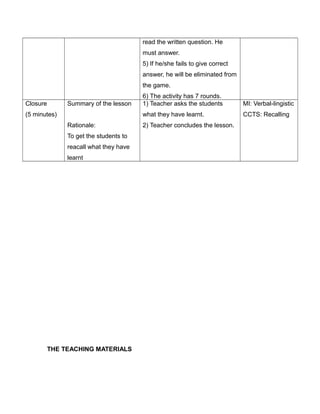
has?
Rationale: To enable
them understanding the
text
Post-reading
(20 minutes)
Application of what they
have learnt about the
animals
*Puzzles Solving
*Words Matching with
picture puzzles
Rationale:
To get the students to
apply what they have
learnt from the text
previously
Questions & Answers
(“Poison Ball” Game)
Rationale:
To get them to talk about
the animals by reading
the questions given
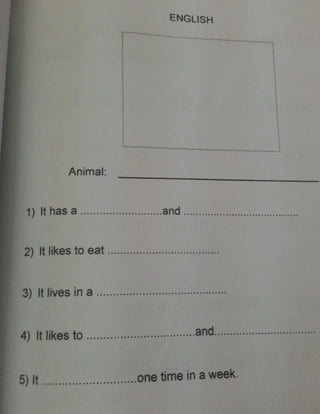
Activity 1
1) Students be in groups.
2) Teacher distributes an
envelope to each group, and
mahjong paper.
3) Students (in groups) need to
rearrange the picture puzzles of
animals, then write the names of
animals.
4) The students are given words
(in envelope) and they paste the
suitable/correct answer (words) in
the blank.
5) Teacher discusses the answers
with the students.
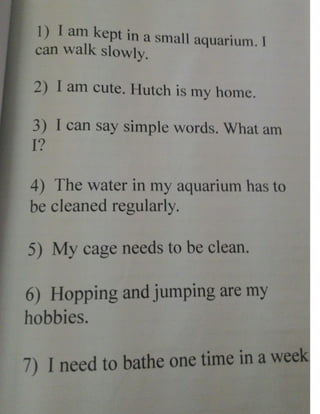
Activity 2
1) Students be in a circle.
2) Teacher gives instruction.
3) A song will be played. While
the song is being played, poison
ball will be passed around the
circle.
4) Once the song is paused, the
person with the poison ball has to
pick one paper in the box, and
MI: Linguistic
CCTS: Applying,
recosntructing
TA: Envelope,
mahjong paper,
picture puzzles,
mahjong paper
MV: Work
cooperatively
MI: Verbal-
linguistic,
kinesthetic
CCTS:
Synthesizing
TA: mp3 song,
“Poison Ball”
read the written question. He
must answer.
5) If he/she fails to give correct
answer, he will be eliminated from
the game.
6) The activity has 7 rounds.
Closure
(5 minutes)
Summary of the lesson
Rationale:
To get the students to
reacall what they have
learnt
1) Teacher asks the students
what they have learnt.
2) Teacher concludes the lesson.
MI: Verbal-lingistic
CCTS: Recalling
THE TEACHING MATERIALS
English lp year 3 reading

English lp year 3 reading

  • 1.
    ENGLISH LESSON PLAN Subject: English Class : Year 3 Date/Day : 25 April 2014 (Friday) Time : 9.15 a.m - 10.15 a.m (60 minutes) Attendance : 11 Theme : World of Knowledge Topic : Pet’s World Focus skill : Reading Content Standard: 2.2 By the end of the 6-year primary schooling, pupils will be able to demonstrate understanding of a variety of linear and non-linear texts in the form of print and non-print materials using a range of strategies to construct meaning. 2.3 By the end of 6-year primary schooling, pupils will be able to read independently for information and enjoyment. Learning Standards: 2.2.4 Able to read and understand a paragraph with simple and compound sentences. 2.3.1 Able to read for information and enjoyment with guidance: b) non-fiction Learning Objectives: By the end of the lesson, students will be able to: 1) State the names and spell the names of animals correctly. 2) Read simple paragraphs with good pronunciation. 3) Match the words with pet animals to make a complete description about the animals.
  • 2.
    Previous Knowledge: Pupilsknow about the names of animals CCTS: Identifying, applying, reconstructing,recalling Multiple Intelligences: Visual-Spatial, Verbal-Linguistic, Kinesthetic Values inculcated: Listen to the teacher, work cooperatively, love pets, answer appropriately Teaching aids: animal masks, pictures of animals (tortoise, parrot, rabbit), word cards, reading text, envelopes, mahjong papers, picture puzzles, mp3 song, “Poison Ball” Stages /Duration Learning Content Teaching and Learning Activities/Strategies Remarks Set induction (5 minutes) Introduction of the topic “Pet Animals” *animal masks Rationale: To get the students’ attention and to know their knowledge about animals 1) Teacher puts on animal masks (one by one). 2) Teacher asks the students the name of the animals. 3) Students name and spell on the blackboard. 4) Teacher puts two columns on the blackboard. (Pet animals & Wild animals) 5) Students identify which animals belong to each column. 6) Teacher introduces the topic. MI: visual-spatial, verbal-linguistic, Kinesthetic CCTS: Identifying, applying TA: animal masks Moral value: answer appropriately Pre-Reading (15 minutes) Introduction of some words -Drilling (by guidance using pictures) -parrot, tortoise, rabbit The words: Ears, tail, hutch, beak, cage, aquarium, shell, legs, feathers 1) Teacher pastes three animal pictures on the board. 2) After one by one, students identify and name the animals. 3) Some students spell the names. 4) Teacher shows word cards to the students; that are related to the animal pictures. MI: Verbal- linguistic, visual- spatial CCTS: Identifying TA: Pictures of parrot, tortoise, rabbit, word cards
  • 3.
    Rationale: To get thestudents familiar with the words, before proceeds to the text 5) Students read the words aloud (one by one). 6) Teacher pastes the word cards to the related animals. 7) Teacher explains,and students listen. 8) Teacher takes out the word cards form the board. 9) Students spell the drilled words just now (without the word cards). Moral values: Listen to the teacher While- Reading (15 minutes) Guided Reading Reading Aloud Paragraph 1 *What does it like to eat? Once a week, Sarah.., Paragraph 2 *What does Tobby has? *Where does it live? Paragraph 3 *What is the parrot’s name? *What does Mimi love to eat? *What does the parrot 1) Teacher distributes a text about the animals to each students. 2) Teacher reads the text aloud, students listen. 1) Students read aloud the text, paragraph by paragraph. 2) After each paragraph, teacher ask some questions. 3) Teacher takes out the reading text from the students. 4) Teacher pastes word cards. 5) Students are divided into 3 groups. 6) Some representatives from each group come to the front and match the word cards with the correct animals and do it on the board. MI: verbal- linguistic, kinesthetic CCTS: Identifying, applying TA: Reading text, word cards Moral values: Listen to the teacher, answer appropriately
  • 4.
    has? Rationale: To enable themunderstanding the text Post-reading (20 minutes) Application of what they have learnt about the animals *Puzzles Solving *Words Matching with picture puzzles Rationale: To get the students to apply what they have learnt from the text previously Questions & Answers (“Poison Ball” Game) Rationale: To get them to talk about the animals by reading the questions given Activity 1 1) Students be in groups. 2) Teacher distributes an envelope to each group, and mahjong paper. 3) Students (in groups) need to rearrange the picture puzzles of animals, then write the names of animals. 4) The students are given words (in envelope) and they paste the suitable/correct answer (words) in the blank. 5) Teacher discusses the answers with the students. Activity 2 1) Students be in a circle. 2) Teacher gives instruction. 3) A song will be played. While the song is being played, poison ball will be passed around the circle. 4) Once the song is paused, the person with the poison ball has to pick one paper in the box, and MI: Linguistic CCTS: Applying, recosntructing TA: Envelope, mahjong paper, picture puzzles, mahjong paper MV: Work cooperatively MI: Verbal- linguistic, kinesthetic CCTS: Synthesizing TA: mp3 song, “Poison Ball”
  • 5.
    read the writtenquestion. He must answer. 5) If he/she fails to give correct answer, he will be eliminated from the game. 6) The activity has 7 rounds. Closure (5 minutes) Summary of the lesson Rationale: To get the students to reacall what they have learnt 1) Teacher asks the students what they have learnt. 2) Teacher concludes the lesson. MI: Verbal-lingistic CCTS: Recalling THE TEACHING MATERIALS