I NSTITUTO DE FORMACIÓN DOCENTE CONTINUA
LENGUAS VIVAS BARILOCHE (A-052)
TALLER DE PRÁCTICA DOCENTE
Student: Gieser Leticia
Período de Práctica: Nivel Primario
Number of Students: 36
Institution: Colegio Cavagnaro
Adress: Calle 70 – N° 2753
Age: 11 years old
Level: Beginners
Lesson plan: a class
Date: August, 1st
Time: 40’ (11.10 a 11.50hs)
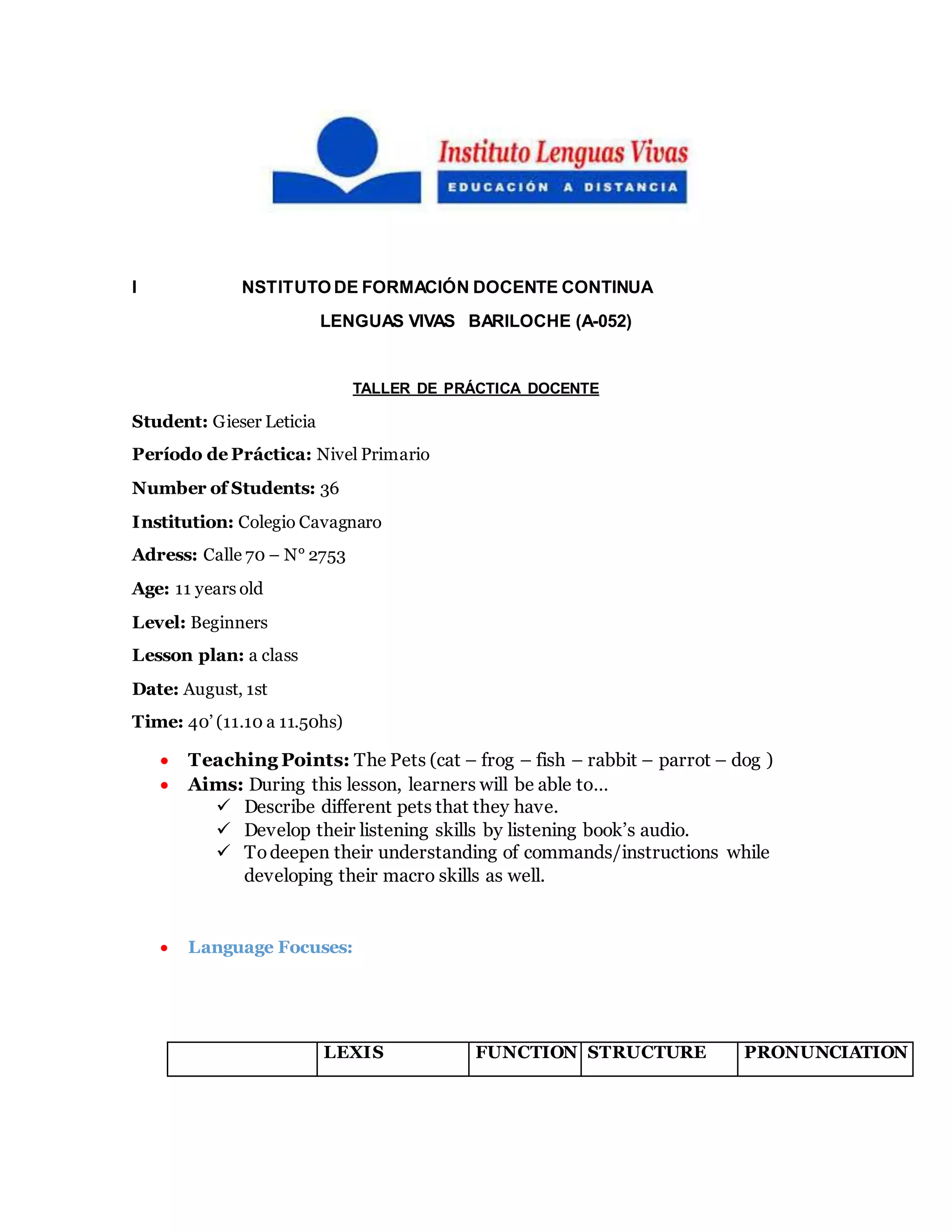
 Teaching Points: The Pets (cat – frog – fish – rabbit – parrot – dog )
 Aims: During this lesson, learners will be able to…
 Describe different pets that they have.
 Develop their listening skills by listening book’s audio.
 Todeepen their understanding of commands/instructions while
developing their macro skills as well.
 Language Focuses:
LEXIS FUNCTION STRUCTURE PRONUNCIATION
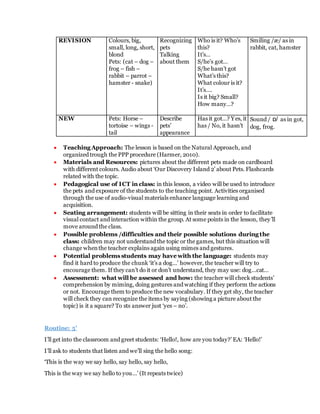
REVISION Colours, big,
small, long, short,
blond
Pets: (cat – dog –
frog – fish –
rabbit – parrot –
hamster - snake)
Recognizing
pets
Talking
about them
Who is it? Who’s
this?
It’s…
S/he’s got…
S/he hasn’t got
What’s this?
What colour is it?
It’s….
Is it big? Small?
How many…?
Smiling /æ/ as in
rabbit, cat, hamster
NEW Pets: Horse –
tortoise – wings -
tail
Describe
pets’
appearance
Has it got…? Yes, it
has / No, it hasn’t
Sound / ɒ/ as in got,
dog, frog.
 Teaching Approach: The lesson is based on the Natural Approach, and
organized trough the PPP procedure (Harmer, 2010).
 Materials and Resources: pictures about the different pets made on cardboard
with different colours. Audio about ‘Our Discovery Island 2’ about Pets. Flashcards
related with the topic.
 Pedagogical use of ICT in class: in this lesson, a video will be used to introduce
the pets and exposure of the students to the teaching point. Activities organised
through the use of audio-visual materials enhance language learning and
acquisition.
 Seating arrangement: students will be sitting in their seats in order to facilitate
visual contact and interaction within the group. At some points in the lesson, they’ll
move around the class.
 Possible problems /difficulties and their possible solutions during the
class: children may not understand the topic or the games, but this situation will
change whenthe teacher explains again using mimes and gestures.
 Potential problems students may have with the language: students may
find it hard to produce the chunk ‘it’s a dog…’ however, the teacher will try to
encourage them. If they can’t do it or don’t understand, they may use: dog…cat…
 Assessment: what will be assessed and how: the teacher will check students’
comprehension by miming, doing gestures and watching if they perform the actions
or not. Encourage them to produce the new vocabulary. If they get shy, the teacher
will check they can recognize the items by saying (showing a picture about the
topic) is it a square? To sts answer just ‘yes – no’.
Routine: 5’
I’ll get into the classroom and greet students: ‘Hello!, how are you today?’ EA: ‘Hello!’
I’ll ask to students that listen and we’ll sing the hello song:
‘This is the way we say hello, say hello, say hello,
This is the way we say hello to you…’ (It repeats twice)
Transition: well done kids! Now let’s pay attention to what I have here for you! Here the
teacher will stick the flashcards from the last class.
Warm – up 5’
The teacher will stick different flashcards on the board (from the last class) and she will
start to ask to students, what colour is it? How many legs…? And here the teacher will
introduce the question has it got…? And here she will use the flashcards to guide the
students they could realize it. And here she will encourage to students to participate and
say the different characteristics about pets.
Transition: ‘Great job kids!’ now, open your pupil’s book on page 71.
Presentation – 10’
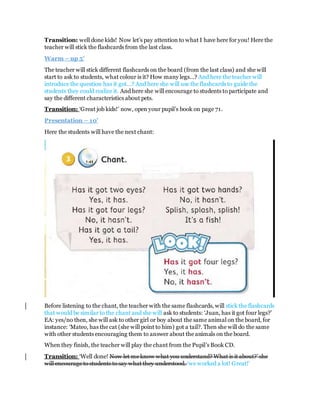
Here the students will have the next chant:
Before listening to the chant, the teacher with the same flashcards, will stick the flashcards
that would be similar to the chant and she will ask to students: ‘Juan, has it got four legs?’
EA: yes/no then, she will ask to other girl or boy about the same animal on the board, for
instance: ‘Mateo, has the cat (she will point to him) got a tail?. Then she will do the same
with other students encouraging them to answer about the animals on the board.
When they finish, the teacher will play the chant from the Pupil’s Book CD.
Transition: ‘Well done! Now let me know what you understand? What is it about?’ she
will encourage to students to say what they understood. ‘we worked a lot! Great!’
Development – 10’
Once they have finished to guessing the game, the teacher will ask to students to underline
the structures ‘Has it got…’ in the chant with colour green.
Activity 1 – 5’
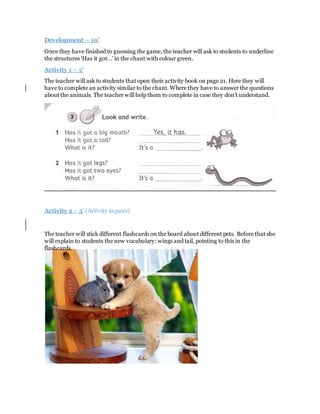
The teacher will ask to students that open their activity book on page 21. Here they will
have to complete an activity similar to the chant. Where they have to answer the questions
about the animals. The teacher will help them to complete in case they don’t understand.
Activity 2 – 5’ (Activity in pairs)
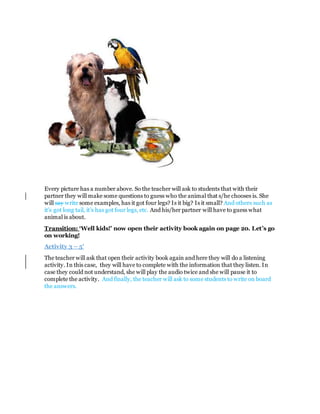
The teacher will stick different flashcards on the board about different pets. Before that she
will explain to students the new vocabulary: wings and tail, pointing to this in the
flashcards.
Every picture has a number above. So the teacher will ask to students that with their
partner they will make some questions to guess who the animal that s/he chooses is. She
will say write some examples, has it got four legs? Is it big? Is it small? And others such as
it’s got long tail, it’s has got four legs, etc. And his/her partner will have to guess what
animal is about.
Transition: ‘Well kids!’ now open their activity book again on page 20. Let’s go
on working!
Activity 3 – 5’
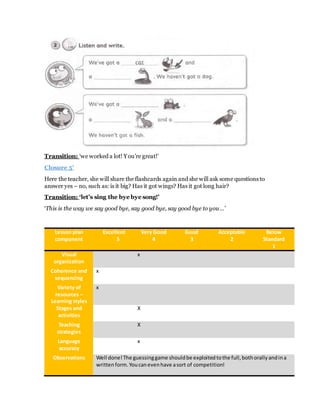
The teacher will ask that open their activity book again and here they will do a listening
activity. In this case, they will have to complete with the information that they listen. In
case they could not understand, she will play the audio twice and she will pause it to
complete the activity. And finally, the teacher will ask to some students to write on board
the answers.
Transition: ‘we worked a lot! You’re great!’
Closure 5’
Here the teacher, she will share the flashcards again and she will ask some questions to
answer yes – no, such as: is it big? Has it got wings? Has it got long hair?
Transition: ‘let’s sing the bye bye song!’
‘This is the way we say good bye, say good bye, say good bye to you…’
Lesson plan
component
Excellent
5
Very Good
4
Good
3
Acceptable
2
Below
Standard
1
Visual
organization
x
Coherence and
sequencing
x
Variety of
resources –
Learning styles
x
Stages and
activities
X
Teaching
strategies
X
Language
accuracy
x
Observations Well done!The guessinggame shouldbe exploitedtothe full,bothorallyandina
writtenform.Youcanevenhave asort of competition!
Have fun!
Aure

Gieser leticia lessonplan 2_ primary level - corrected

  • 1.
    I NSTITUTO DEFORMACIÓN DOCENTE CONTINUA LENGUAS VIVAS BARILOCHE (A-052) TALLER DE PRÁCTICA DOCENTE Student: Gieser Leticia Período de Práctica: Nivel Primario Number of Students: 36 Institution: Colegio Cavagnaro Adress: Calle 70 – N° 2753 Age: 11 years old Level: Beginners Lesson plan: a class Date: August, 1st Time: 40’ (11.10 a 11.50hs)  Teaching Points: The Pets (cat – frog – fish – rabbit – parrot – dog )  Aims: During this lesson, learners will be able to…  Describe different pets that they have.  Develop their listening skills by listening book’s audio.  Todeepen their understanding of commands/instructions while developing their macro skills as well.  Language Focuses: LEXIS FUNCTION STRUCTURE PRONUNCIATION
  • 2.
    REVISION Colours, big, small,long, short, blond Pets: (cat – dog – frog – fish – rabbit – parrot – hamster - snake) Recognizing pets Talking about them Who is it? Who’s this? It’s… S/he’s got… S/he hasn’t got What’s this? What colour is it? It’s…. Is it big? Small? How many…? Smiling /æ/ as in rabbit, cat, hamster NEW Pets: Horse – tortoise – wings - tail Describe pets’ appearance Has it got…? Yes, it has / No, it hasn’t Sound / ɒ/ as in got, dog, frog.  Teaching Approach: The lesson is based on the Natural Approach, and organized trough the PPP procedure (Harmer, 2010).  Materials and Resources: pictures about the different pets made on cardboard with different colours. Audio about ‘Our Discovery Island 2’ about Pets. Flashcards related with the topic.  Pedagogical use of ICT in class: in this lesson, a video will be used to introduce the pets and exposure of the students to the teaching point. Activities organised through the use of audio-visual materials enhance language learning and acquisition.  Seating arrangement: students will be sitting in their seats in order to facilitate visual contact and interaction within the group. At some points in the lesson, they’ll move around the class.  Possible problems /difficulties and their possible solutions during the class: children may not understand the topic or the games, but this situation will change whenthe teacher explains again using mimes and gestures.  Potential problems students may have with the language: students may find it hard to produce the chunk ‘it’s a dog…’ however, the teacher will try to encourage them. If they can’t do it or don’t understand, they may use: dog…cat…  Assessment: what will be assessed and how: the teacher will check students’ comprehension by miming, doing gestures and watching if they perform the actions or not. Encourage them to produce the new vocabulary. If they get shy, the teacher will check they can recognize the items by saying (showing a picture about the topic) is it a square? To sts answer just ‘yes – no’. Routine: 5’ I’ll get into the classroom and greet students: ‘Hello!, how are you today?’ EA: ‘Hello!’ I’ll ask to students that listen and we’ll sing the hello song: ‘This is the way we say hello, say hello, say hello, This is the way we say hello to you…’ (It repeats twice)
  • 3.
    Transition: well donekids! Now let’s pay attention to what I have here for you! Here the teacher will stick the flashcards from the last class. Warm – up 5’ The teacher will stick different flashcards on the board (from the last class) and she will start to ask to students, what colour is it? How many legs…? And here the teacher will introduce the question has it got…? And here she will use the flashcards to guide the students they could realize it. And here she will encourage to students to participate and say the different characteristics about pets. Transition: ‘Great job kids!’ now, open your pupil’s book on page 71. Presentation – 10’ Here the students will have the next chant: Before listening to the chant, the teacher with the same flashcards, will stick the flashcards that would be similar to the chant and she will ask to students: ‘Juan, has it got four legs?’ EA: yes/no then, she will ask to other girl or boy about the same animal on the board, for instance: ‘Mateo, has the cat (she will point to him) got a tail?. Then she will do the same with other students encouraging them to answer about the animals on the board. When they finish, the teacher will play the chant from the Pupil’s Book CD. Transition: ‘Well done! Now let me know what you understand? What is it about?’ she will encourage to students to say what they understood. ‘we worked a lot! Great!’
  • 4.
    Development – 10’ Oncethey have finished to guessing the game, the teacher will ask to students to underline the structures ‘Has it got…’ in the chant with colour green. Activity 1 – 5’ The teacher will ask to students that open their activity book on page 21. Here they will have to complete an activity similar to the chant. Where they have to answer the questions about the animals. The teacher will help them to complete in case they don’t understand. Activity 2 – 5’ (Activity in pairs) The teacher will stick different flashcards on the board about different pets. Before that she will explain to students the new vocabulary: wings and tail, pointing to this in the flashcards.
  • 5.
    Every picture hasa number above. So the teacher will ask to students that with their partner they will make some questions to guess who the animal that s/he chooses is. She will say write some examples, has it got four legs? Is it big? Is it small? And others such as it’s got long tail, it’s has got four legs, etc. And his/her partner will have to guess what animal is about. Transition: ‘Well kids!’ now open their activity book again on page 20. Let’s go on working! Activity 3 – 5’ The teacher will ask that open their activity book again and here they will do a listening activity. In this case, they will have to complete with the information that they listen. In case they could not understand, she will play the audio twice and she will pause it to complete the activity. And finally, the teacher will ask to some students to write on board the answers.
  • 6.
    Transition: ‘we workeda lot! You’re great!’ Closure 5’ Here the teacher, she will share the flashcards again and she will ask some questions to answer yes – no, such as: is it big? Has it got wings? Has it got long hair? Transition: ‘let’s sing the bye bye song!’ ‘This is the way we say good bye, say good bye, say good bye to you…’ Lesson plan component Excellent 5 Very Good 4 Good 3 Acceptable 2 Below Standard 1 Visual organization x Coherence and sequencing x Variety of resources – Learning styles x Stages and activities X Teaching strategies X Language accuracy x Observations Well done!The guessinggame shouldbe exploitedtothe full,bothorallyandina writtenform.Youcanevenhave asort of competition!
  • 7.