Lesson plan – Kindergarten
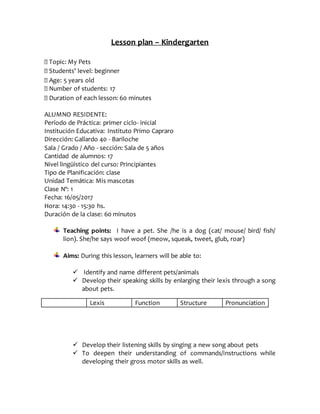
Topic: My Pets
Students’ level: beginner
Age: 5 years old
Number of students: 17
Duration of each lesson: 60 minutes
ALUMNO RESIDENTE:
Período de Práctica: primer ciclo- inicial
Institución Educativa: Instituto Primo Capraro
Dirección: Gallardo 40 - Bariloche
Sala / Grado / Año - sección: Sala de 5 años
Cantidad de alumnos: 17
Nivel lingüístico del curso: Principiantes
Tipo de Planificación: clase
Unidad Temática: Mis mascotas
Clase Nº: 1
Fecha: 16/05/2017
Hora: 14:30 - 15:30 hs.
Duración de la clase: 60 minutos
Teaching points: I have a pet. She /he is a dog (cat/ mouse/ bird/ fish/
lion). She/he says woof woof (meow, squeak, tweet, glub, roar)
Aims: During this lesson, learners will be able to:
 Identify and name different pets/animals
 Develop their speaking skills by enlarging their lexis through a song
about pets.
 Develop their listening skills by singing a new song about pets
 To deepen their understanding of commands/instructions while
developing their gross motor skills as well.
Lexis Function Structure Pronunciation
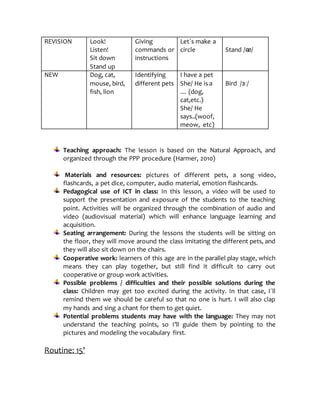
Teaching approach: The lesson is based on the Natural Approach, and
organized through the PPP procedure (Harmer, 2010)
Materials and resources: pictures of different pets, a song video,
flashcards, a pet dice, computer, audio material, emotion flashcards.
Pedagogical use of ICT in class: In this lesson, a video will be used to
support the presentation and exposure of the students to the teaching
point. Activities will be organized through the combination of audio and
video (audiovisual material) which will enhance language learning and
acquisition.
Seating arrangement: During the lessons the students will be sitting on
the floor, they will move around the class imitating the different pets, and
they will also sit down on the chairs.
Cooperative work: learners of this age are in the parallel play stage, which
means they can play together, but still find it difficult to carry out
cooperative or group work activities.
Possible problems / difficulties and their possible solutions during the
class: Children may get too excited during the activity. In that case, I´ll
remind them we should be careful so that no one is hurt. I will also clap
my hands and sing a chant for them to get quiet.
Potential problems students may have with the language: They may not
understand the teaching points, so I’ll guide them by pointing to the
pictures and modeling the vocabulary first.
Routine: 15’
REVISION Look!
Listen!
Sit down
Stand up
Giving
commands or
instructions
Let`s make a
circle Stand /ᴂ/
NEW Dog, cat,
mouse, bird,
fish, lion
Identifying
different pets
I have a pet
She/ He is a
… (dog,
cat,etc.)
She/ He
says..(woof,
meow, etc)
Bird /ɜː/
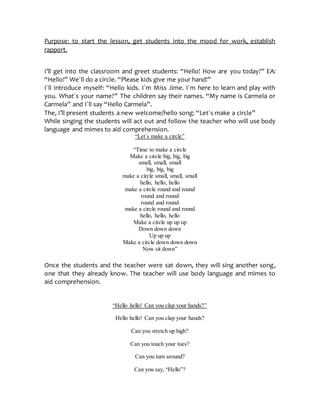
Purpose: to start the lesson, get students into the mood for work, establish
rapport.
I’ll get into the classroom and greet students: “Hello! How are you today?” EA:
“Hello!” We´ll do a circle. “Please kids give me your hand!”
I´ll introduce myself: “Hello kids. I´m Miss Jime. I´m here to learn and play with
you. What´s your name?” The children say their names. “My name is Carmela or
Carmela” and I´ll say “Hello Carmela”.
The, I’ll present students a new welcome/hello song: “Let´s make a circle”
While singing the students will act out and follow the teacher who will use body
language and mimes to aid comprehension.
“Let´s make a circle”
“Time to make a circle
Make a circle big, big, big
small, small, small
big, big, big
make a circle small, small, small
hello, hello, hello
make a circle round and round
round and round
round and round
make a circle round and round
hello, hello, hello
Make a circle up up up
Down down down
Up up up
Make a circle down down down
Now sit down”
Once the students and the teacher were sat down, they will sing another song,
one that they already know. The teacher will use body language and mimes to
aid comprehension.
“Hello hello! Can you clap your hands?”
Hello hello! Can you clap your hands?
Can you stretch up high?
Can you touch your toes?
Can you turn around?
Can you say, “Hello”?
Hello, hello
Can you stamp your feet?
Hello, hello
Can you stamp your feet?
Can you stretch up high?
Can you touch your toes?
Can you turn around?
Can you say, “Hello”?
Hello, hello
Can you clap your hands?
Hello, hello
Can you stamp your feet?”
After the song, we sit down on the floor and I ask them: “How are you today? Are you happy?”
Showing a big smile on the face and also showing a happy face flashcard. I´ll listen their
answers and then I´ll show them other flashcards and I´ll ask them: “Are you sleepy? Are you
angry?”
Warm-up 5’:
Purpose: to introduce the topic and the teaching points
Now the T shows different photographs with her pets: “Look at this photograph. This is my
pet”
I have a pet.She is a DOG and she says WOOF, WOOF, WOOF, WOOF. Hername is Fiona.
I have a pet. He is a DOG and he says WOOF, WOOF, WOOF, WOOF. His name is George.
Look! I have a pet. She is a CAT and she says MEOW,MEOW,MEOW,MEOW.Her name is Tita.
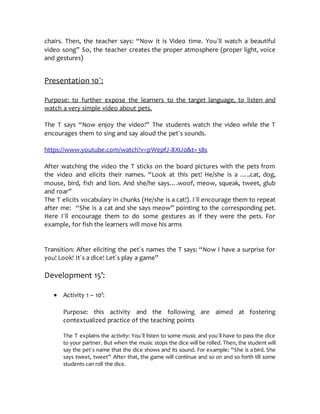
Transition: The teacher arranges the classroom seating as a horseshoe on the
chairs. “Please, kids bring the chairs and sit down here” The children sit on the
chairs. Then, the teacher says: “Now it is Video time. You´ll watch a beautiful
video song” So, the teacher creates the proper atmosphere (proper light, voice
and gestures)
Presentation 10´:
Purpose: to further expose the learners to the target language, to listen and
watch a very simple video about pets.
The T says “Now enjoy the video!” The students watch the video while the T
encourages them to sing and say aloud the pet´s sounds.
https://www.youtube.com/watch?v=pWepfJ-8XU0&t=38s
After watching the video the T sticks on the board pictures with the pets from
the video and elicits their names. “Look at this pet! He/she is a …..cat, dog,
mouse, bird, fish and lion. And she/he says….woof, meow, squeak, tweet, glub
and roar”
The T elicits vocabulary in chunks (He/she is a cat!). I´ll encourage them to repeat
after me: “She is a cat and she says meow” pointing to the corresponding pet.
Here I´ll encourage them to do some gestures as if they were the pets. For
example, for fish the learners will move his arms
Transition: After eliciting the pet´s names the T says: “Now I have a surprise for
you! Look! It´s a dice! Let´s play a game”
Development 15’:
 Activity 1 – 10’:
Purpose: this activity and the following are aimed at fostering
contextualized practice of the teaching points
The T explains the activity: You´ll listen to some music and you´ll have to pass the dice
to your partner. But when the music stops the dice will be rolled. Then, the student will
say the pet´s name that the dice shows and its sound. For example: “She is a bird. She
says tweet, tweet” After that, the game will continue and so on and so forth till some
students can roll the dice.
 Activity 2 – 5’:
Now the T sticks pet´s pictures around the classroom, then she gathers
the students in the center of classroom and says: I have a pet. He is a
MOUSE. Here I´ll encourage them to go towards the correct picture and
then I say: and he says…. In order the students complete the
sound…”squeak squeak”
Closure 15’:
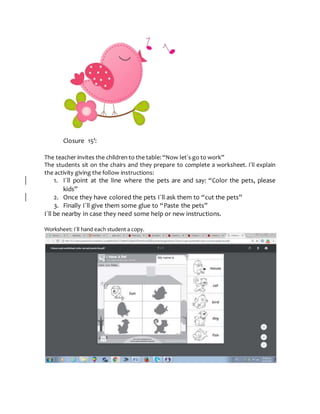
The teacher invites the children to the table: “Now let´s go to work”
The students sit on the chairs and they prepare to complete a worksheet. I´ll explain
the activity giving the follow instructions:
1. I´ll point at the line where the pets are and say: “Color the pets, please
kids”
2. Once they have colored the pets I´ll ask them to “cut the pets”
3. Finally I´ll give them some glue to “Paste the pets”
I´ll be nearby in case they need some help or new instructions.
Worksheet: I´ll hand each student a copy.
Once the students finish the activity I´ll say: “Oh, no! Look at the time” (pointing
the clock on the wall/ the watch on her wrist) It´s time to say good bye. We sit
on the floor and then I´ll say: “Let´s sing the goodbye song”
Bye, bye, Goodbye
Bye, bye, Goodbye
Bye, bye, bye, bye, Goodbye
I can clap my hands
I can stamp my feet
I can clap my hands
I can stamp my feet
Bye, bye, Goodbye
Bye, bye, bye, bye, Goodbye
Bye, bye, Goodbye
Bye, bye, bye, bye, Goodbye
You can watch and listen to the song at:
https://www.youtube.com/watch?v=PraN5ZoSjiY
 To be completed by my tutors:
Lesson plan
component
Excellent
5
Very Good
4
Good
3
Acceptable
2
Below
Standard
1
Visual
organization
X
Coherence and
sequencing
X
Variety of
resources –
Learning styles
X
Stages and
activities
X
Teaching
strategies
X
Language
accuracy
X
Observations Lovelylesson!Youhave createdaclearcontextand plannedacohesive andcoherent
class,includingdifferentandappealingresources.Well done!
Aure

Lesson Plan Kindergarten - Class 1

  • 1.
    Lesson plan –Kindergarten Topic: My Pets Students’ level: beginner Age: 5 years old Number of students: 17 Duration of each lesson: 60 minutes ALUMNO RESIDENTE: Período de Práctica: primer ciclo- inicial Institución Educativa: Instituto Primo Capraro Dirección: Gallardo 40 - Bariloche Sala / Grado / Año - sección: Sala de 5 años Cantidad de alumnos: 17 Nivel lingüístico del curso: Principiantes Tipo de Planificación: clase Unidad Temática: Mis mascotas Clase Nº: 1 Fecha: 16/05/2017 Hora: 14:30 - 15:30 hs. Duración de la clase: 60 minutos Teaching points: I have a pet. She /he is a dog (cat/ mouse/ bird/ fish/ lion). She/he says woof woof (meow, squeak, tweet, glub, roar) Aims: During this lesson, learners will be able to:  Identify and name different pets/animals  Develop their speaking skills by enlarging their lexis through a song about pets.  Develop their listening skills by singing a new song about pets  To deepen their understanding of commands/instructions while developing their gross motor skills as well. Lexis Function Structure Pronunciation
  • 2.
    Teaching approach: Thelesson is based on the Natural Approach, and organized through the PPP procedure (Harmer, 2010) Materials and resources: pictures of different pets, a song video, flashcards, a pet dice, computer, audio material, emotion flashcards. Pedagogical use of ICT in class: In this lesson, a video will be used to support the presentation and exposure of the students to the teaching point. Activities will be organized through the combination of audio and video (audiovisual material) which will enhance language learning and acquisition. Seating arrangement: During the lessons the students will be sitting on the floor, they will move around the class imitating the different pets, and they will also sit down on the chairs. Cooperative work: learners of this age are in the parallel play stage, which means they can play together, but still find it difficult to carry out cooperative or group work activities. Possible problems / difficulties and their possible solutions during the class: Children may get too excited during the activity. In that case, I´ll remind them we should be careful so that no one is hurt. I will also clap my hands and sing a chant for them to get quiet. Potential problems students may have with the language: They may not understand the teaching points, so I’ll guide them by pointing to the pictures and modeling the vocabulary first. Routine: 15’ REVISION Look! Listen! Sit down Stand up Giving commands or instructions Let`s make a circle Stand /ᴂ/ NEW Dog, cat, mouse, bird, fish, lion Identifying different pets I have a pet She/ He is a … (dog, cat,etc.) She/ He says..(woof, meow, etc) Bird /ɜː/
  • 3.
    Purpose: to startthe lesson, get students into the mood for work, establish rapport. I’ll get into the classroom and greet students: “Hello! How are you today?” EA: “Hello!” We´ll do a circle. “Please kids give me your hand!” I´ll introduce myself: “Hello kids. I´m Miss Jime. I´m here to learn and play with you. What´s your name?” The children say their names. “My name is Carmela or Carmela” and I´ll say “Hello Carmela”. The, I’ll present students a new welcome/hello song: “Let´s make a circle” While singing the students will act out and follow the teacher who will use body language and mimes to aid comprehension. “Let´s make a circle” “Time to make a circle Make a circle big, big, big small, small, small big, big, big make a circle small, small, small hello, hello, hello make a circle round and round round and round round and round make a circle round and round hello, hello, hello Make a circle up up up Down down down Up up up Make a circle down down down Now sit down” Once the students and the teacher were sat down, they will sing another song, one that they already know. The teacher will use body language and mimes to aid comprehension. “Hello hello! Can you clap your hands?” Hello hello! Can you clap your hands? Can you stretch up high? Can you touch your toes? Can you turn around? Can you say, “Hello”?
  • 4.
    Hello, hello Can youstamp your feet? Hello, hello Can you stamp your feet? Can you stretch up high? Can you touch your toes? Can you turn around? Can you say, “Hello”? Hello, hello Can you clap your hands? Hello, hello Can you stamp your feet?” After the song, we sit down on the floor and I ask them: “How are you today? Are you happy?” Showing a big smile on the face and also showing a happy face flashcard. I´ll listen their answers and then I´ll show them other flashcards and I´ll ask them: “Are you sleepy? Are you angry?” Warm-up 5’:
  • 5.
    Purpose: to introducethe topic and the teaching points Now the T shows different photographs with her pets: “Look at this photograph. This is my pet” I have a pet.She is a DOG and she says WOOF, WOOF, WOOF, WOOF. Hername is Fiona. I have a pet. He is a DOG and he says WOOF, WOOF, WOOF, WOOF. His name is George. Look! I have a pet. She is a CAT and she says MEOW,MEOW,MEOW,MEOW.Her name is Tita. Transition: The teacher arranges the classroom seating as a horseshoe on the chairs. “Please, kids bring the chairs and sit down here” The children sit on the
  • 6.
    chairs. Then, theteacher says: “Now it is Video time. You´ll watch a beautiful video song” So, the teacher creates the proper atmosphere (proper light, voice and gestures) Presentation 10´: Purpose: to further expose the learners to the target language, to listen and watch a very simple video about pets. The T says “Now enjoy the video!” The students watch the video while the T encourages them to sing and say aloud the pet´s sounds. https://www.youtube.com/watch?v=pWepfJ-8XU0&t=38s After watching the video the T sticks on the board pictures with the pets from the video and elicits their names. “Look at this pet! He/she is a …..cat, dog, mouse, bird, fish and lion. And she/he says….woof, meow, squeak, tweet, glub and roar” The T elicits vocabulary in chunks (He/she is a cat!). I´ll encourage them to repeat after me: “She is a cat and she says meow” pointing to the corresponding pet. Here I´ll encourage them to do some gestures as if they were the pets. For example, for fish the learners will move his arms Transition: After eliciting the pet´s names the T says: “Now I have a surprise for you! Look! It´s a dice! Let´s play a game” Development 15’:  Activity 1 – 10’: Purpose: this activity and the following are aimed at fostering contextualized practice of the teaching points The T explains the activity: You´ll listen to some music and you´ll have to pass the dice to your partner. But when the music stops the dice will be rolled. Then, the student will say the pet´s name that the dice shows and its sound. For example: “She is a bird. She says tweet, tweet” After that, the game will continue and so on and so forth till some students can roll the dice.
  • 7.
     Activity 2– 5’: Now the T sticks pet´s pictures around the classroom, then she gathers the students in the center of classroom and says: I have a pet. He is a MOUSE. Here I´ll encourage them to go towards the correct picture and then I say: and he says…. In order the students complete the sound…”squeak squeak”
  • 8.
    Closure 15’: The teacherinvites the children to the table: “Now let´s go to work” The students sit on the chairs and they prepare to complete a worksheet. I´ll explain the activity giving the follow instructions: 1. I´ll point at the line where the pets are and say: “Color the pets, please kids” 2. Once they have colored the pets I´ll ask them to “cut the pets” 3. Finally I´ll give them some glue to “Paste the pets” I´ll be nearby in case they need some help or new instructions. Worksheet: I´ll hand each student a copy.
  • 9.
    Once the studentsfinish the activity I´ll say: “Oh, no! Look at the time” (pointing the clock on the wall/ the watch on her wrist) It´s time to say good bye. We sit on the floor and then I´ll say: “Let´s sing the goodbye song” Bye, bye, Goodbye Bye, bye, Goodbye Bye, bye, bye, bye, Goodbye I can clap my hands I can stamp my feet I can clap my hands I can stamp my feet Bye, bye, Goodbye Bye, bye, bye, bye, Goodbye Bye, bye, Goodbye Bye, bye, bye, bye, Goodbye You can watch and listen to the song at: https://www.youtube.com/watch?v=PraN5ZoSjiY  To be completed by my tutors: Lesson plan component Excellent 5 Very Good 4 Good 3 Acceptable 2 Below Standard 1 Visual organization X Coherence and sequencing X Variety of resources – Learning styles X
  • 10.
    Stages and activities X Teaching strategies X Language accuracy X Observations Lovelylesson!Youhavecreatedaclearcontextand plannedacohesive andcoherent class,includingdifferentandappealingresources.Well done! Aure