AL-Bairaq
Science in Sports 5th Cycle
Baseball
Al-Shaymaa_Einstein
1-latifa Al-
Dosari
2-Aldana Al-
Mohammed
3- Nouf Al-
lbuainain
4-Alhanouf Al-Shammeri
Outline
• Introduction
• Activity 1: : Exploring Ball Design and
Materials
• Activity 2:Measuring the Rebound of
Sports Ball
• Activity 3:Investigating Energy Absorption
of Materials
• Activity 4: Comparing Rolling Friction on
Different Surfaces
• Product Idea: Making a Baseball
Introduction
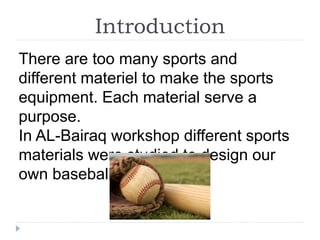
There are too many sports and
different materiel to make the sports
equipment. Each material serve a
purpose.
In AL-Bairaq workshop different sports
materials were studied to design our
own baseball
Activity 1: Exploring Ball design and
Materials
 Objective
To show that sports equipment are designed to
meet the requirements of a specific sport and that the
materials used in the equipment's construction
help it meet those requirements
 Procedure
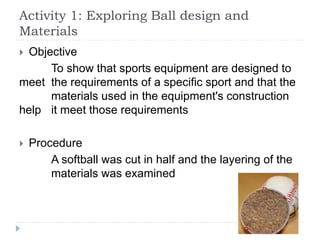
A softball was cut in half and the layering of the
materials was examined
Results
 Data
 Conclusion
We discovered that different materials are
needed to create a softball
Ball Materials made of Reason
Softball Cowhide Durability with
withstand frequent
hits
cork Centralized weight
Activity 2:Measuring the Rebound of Sports
Ball
 Objectives:
To understand that the materials in
a ball affects how high it bounces
 Procedure:
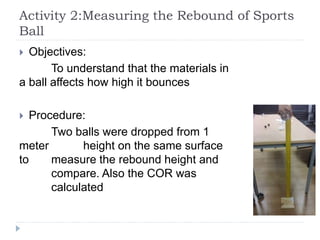
Two balls were dropped from 1
meter height on the same surface
to measure the rebound height and
compare. Also the COR was
calculated
Coefficient of Restitution COR
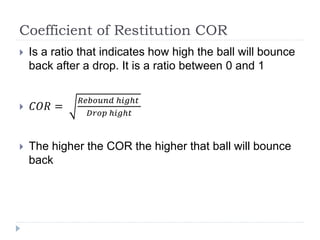
 Is a ratio that indicates how high the ball will bounce
back after a drop. It is a ratio between 0 and 1
 𝐶𝑂𝑅 =
𝑅𝑒𝑏𝑜𝑢𝑛𝑑 ℎ𝑖𝑔ℎ𝑡
𝐷𝑟𝑜𝑝 ℎ𝑖𝑔ℎ𝑡
 The higher the COR the higher that ball will bounce
back
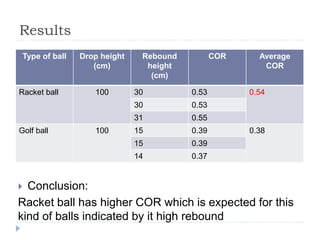
Results
 Conclusion‫الخل‬
 Conclusion:
Racket ball has higher COR which is expected for this
kind of balls indicated by it high rebound
Type of ball Drop height
(cm)
Rebound
height
(cm)
COR Average
COR
Racket ball 100 30 0.53 0.54
30 0.53
31 0.55
Golf ball 100 15 0.39 0.38
15 0.39
14 0.37
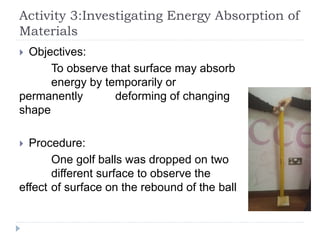
Activity 3:Investigating Energy Absorption of
Materials
 Objectives:
To observe that surface may absorb
energy by temporarily or
permanently deforming of changing
shape
 Procedure:
One golf balls was dropped on two
different surface to observe the
effect of surface on the rebound of the ball
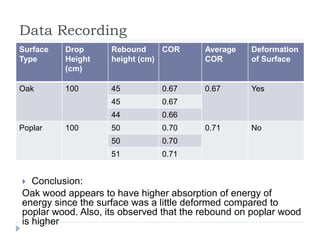
Data Recording
Deformation
of Surface
Average
COR
CORRebound
height (cm)
Drop
Height
(cm)
Surface
Type
Yes0.670.6745100Oak
0.6745
0.6644
No0.710.7050100Poplar
0.7050
0.7151
 Conclusion:
Oak wood appears to have higher absorption of energy of
energy since the surface was a little deformed compared to
poplar wood. Also, its observed that the rebound on poplar wood
is higher
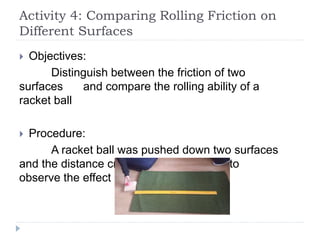
Activity 4: Comparing Rolling Friction on
Different Surfaces
 Objectives:
Distinguish between the friction of two
surfaces and compare the rolling ability of a
racket ball
 Procedure:
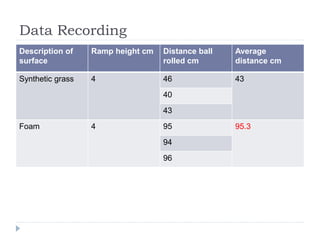
A racket ball was pushed down two surfaces
and the distance crossed was measured to
observe the effect of friction
Data Recording
Average
distance cm
Distance ball
rolled cm
Ramp height cmDescription of
surface
43464Synthetic grass
40
43
95.3954Foam
94
96
Conclusion
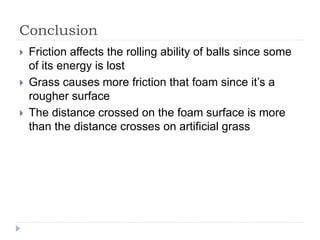
 Friction affects the rolling ability of balls since some
of its energy is lost
 Grass causes more friction that foam since it’s a
rougher surface
 The distance crossed on the foam surface is more
than the distance crosses on artificial grass
Product Idea:
Making a Baseball
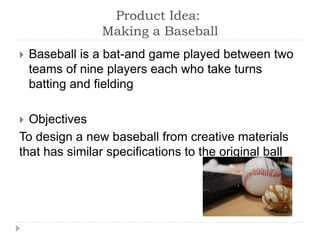
 Baseball is a bat-and game played between two
teams of nine players each who take turns
batting and fielding
 Objectives
To design a new baseball from creative materials
that has similar specifications to the original ball
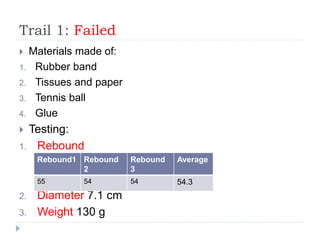
Trail 1: Failed
 Materials made of:
1. Rubber band
2. Tissues and paper
3. Tennis ball
4. Glue
 Testing:
1. Rebound
2. Diameter 7.1 cm
3. Weight 130 g
Rebound1 Rebound
2
Rebound
3
Average
55 54 54 54.3
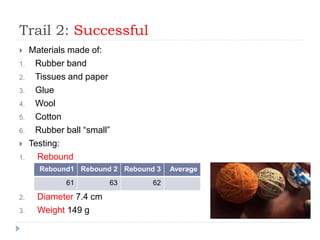
Trail 2: Successful
 Materials made of:
1. Rubber band
2. Tissues and paper
3. Glue
4. Wool
5. Cotton
6. Rubber ball “small”
 Testing:
1. Rebound
2. Diameter 7.4 cm
3. Weight 149 g
Rebound1 Rebound 2 Rebound 3 Average
61 63 62
Acknowledgment
I would like to thank my teammates who worked hard in
this project, Qatar University and Eng. Ruba. Also, I would
like to thank the sponsors UNESCO, Qatar National
Commission, Ras Gas and Shell.

Sports Materials , Baseball SIS5

  • 1.
    AL-Bairaq Science in Sports5th Cycle Baseball Al-Shaymaa_Einstein 1-latifa Al- Dosari 2-Aldana Al- Mohammed 3- Nouf Al- lbuainain 4-Alhanouf Al-Shammeri
  • 2.
    Outline • Introduction • Activity1: : Exploring Ball Design and Materials • Activity 2:Measuring the Rebound of Sports Ball • Activity 3:Investigating Energy Absorption of Materials • Activity 4: Comparing Rolling Friction on Different Surfaces • Product Idea: Making a Baseball
  • 3.
    Introduction There are toomany sports and different materiel to make the sports equipment. Each material serve a purpose. In AL-Bairaq workshop different sports materials were studied to design our own baseball
  • 4.
    Activity 1: ExploringBall design and Materials  Objective To show that sports equipment are designed to meet the requirements of a specific sport and that the materials used in the equipment's construction help it meet those requirements  Procedure A softball was cut in half and the layering of the materials was examined
  • 5.
    Results  Data  Conclusion Wediscovered that different materials are needed to create a softball Ball Materials made of Reason Softball Cowhide Durability with withstand frequent hits cork Centralized weight
  • 6.
    Activity 2:Measuring theRebound of Sports Ball  Objectives: To understand that the materials in a ball affects how high it bounces  Procedure: Two balls were dropped from 1 meter height on the same surface to measure the rebound height and compare. Also the COR was calculated
  • 7.
    Coefficient of RestitutionCOR  Is a ratio that indicates how high the ball will bounce back after a drop. It is a ratio between 0 and 1  𝐶𝑂𝑅 = 𝑅𝑒𝑏𝑜𝑢𝑛𝑑 ℎ𝑖𝑔ℎ𝑡 𝐷𝑟𝑜𝑝 ℎ𝑖𝑔ℎ𝑡  The higher the COR the higher that ball will bounce back
  • 8.
    Results  Conclusion‫الخل‬  Conclusion: Racketball has higher COR which is expected for this kind of balls indicated by it high rebound Type of ball Drop height (cm) Rebound height (cm) COR Average COR Racket ball 100 30 0.53 0.54 30 0.53 31 0.55 Golf ball 100 15 0.39 0.38 15 0.39 14 0.37
  • 9.
    Activity 3:Investigating EnergyAbsorption of Materials  Objectives: To observe that surface may absorb energy by temporarily or permanently deforming of changing shape  Procedure: One golf balls was dropped on two different surface to observe the effect of surface on the rebound of the ball
  • 10.
    Data Recording Deformation of Surface Average COR CORRebound height(cm) Drop Height (cm) Surface Type Yes0.670.6745100Oak 0.6745 0.6644 No0.710.7050100Poplar 0.7050 0.7151  Conclusion: Oak wood appears to have higher absorption of energy of energy since the surface was a little deformed compared to poplar wood. Also, its observed that the rebound on poplar wood is higher
  • 11.
    Activity 4: ComparingRolling Friction on Different Surfaces  Objectives: Distinguish between the friction of two surfaces and compare the rolling ability of a racket ball  Procedure: A racket ball was pushed down two surfaces and the distance crossed was measured to observe the effect of friction
  • 12.
    Data Recording Average distance cm Distanceball rolled cm Ramp height cmDescription of surface 43464Synthetic grass 40 43 95.3954Foam 94 96
  • 13.
    Conclusion  Friction affectsthe rolling ability of balls since some of its energy is lost  Grass causes more friction that foam since it’s a rougher surface  The distance crossed on the foam surface is more than the distance crosses on artificial grass
  • 14.
    Product Idea: Making aBaseball  Baseball is a bat-and game played between two teams of nine players each who take turns batting and fielding  Objectives To design a new baseball from creative materials that has similar specifications to the original ball
  • 15.
    Trail 1: Failed Materials made of: 1. Rubber band 2. Tissues and paper 3. Tennis ball 4. Glue  Testing: 1. Rebound 2. Diameter 7.1 cm 3. Weight 130 g Rebound1 Rebound 2 Rebound 3 Average 55 54 54 54.3
  • 16.
    Trail 2: Successful Materials made of: 1. Rubber band 2. Tissues and paper 3. Glue 4. Wool 5. Cotton 6. Rubber ball “small”  Testing: 1. Rebound 2. Diameter 7.4 cm 3. Weight 149 g Rebound1 Rebound 2 Rebound 3 Average 61 63 62
  • 17.
    Acknowledgment I would liketo thank my teammates who worked hard in this project, Qatar University and Eng. Ruba. Also, I would like to thank the sponsors UNESCO, Qatar National Commission, Ras Gas and Shell.