

Professional Ethics
oProfessional ethics is a set of standards that describe the professional
behavior that is expected in all fields of work. In this we will examine
the moral and ethical issues that professionals have to deal with in a
corporate environment.
oThese are principles that govern the behaviour of a person or group in
a business environment. It also provide rules on how a person should
act towards other people and institutions in such an environment.
oProfessional ethics encompass the personal and corporate standards
of behavior expected by professionals. The word professionalism
originally applied to vows of a religious order.
How professional ethics is related with engineers as
managers?
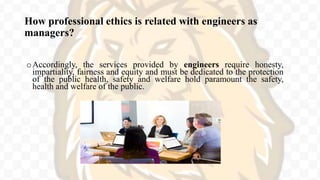
oAccordingly, the services provided by engineers require honesty,
impartiality, fairness and equity and must be dedicated to the protection
of the public health, safety and welfare hold paramount the safety,
health and welfare of the public.
Engineeering leadership
oOnly 26% of ceo’s in the top 1000 companies had their first degrees in
engineering (more in foreign countries)
oOnly 10% of university presidents are engineers
oFew engineers are in congress
oPresident jimmy carter was the only engineer, but he did not get
reelected
Importance of engineers as managers
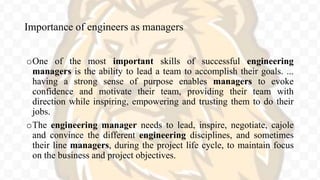
oOne of the most important skills of successful engineering
managers is the ability to lead a team to accomplish their goals. ...
having a strong sense of purpose enables managers to evoke
confidence and motivate their team, providing their team with
direction while inspiring, empowering and trusting them to do their
jobs.
oThe engineering manager needs to lead, inspire, negotiate, cajole
and convince the different engineering disciplines, and sometimes
their line managers, during the project life cycle, to maintain focus
on the business and project objectives.
Characteristics of engineers as managers
• Technical knowledge but most top engineering managers have a
background in engineering, complemented with a higher qualification
in engineering management.
• Project management.
• Communication.
• Decision making.
• Delegation.
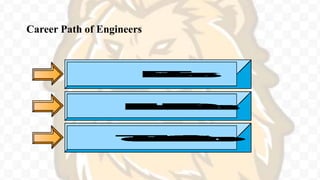
Career Path of Engineers
Mid-level Positions
oMid-level positions are equivalent in ranking, mid-point salary and
prestige
oTechnical ladder is capped at the corporate fellow level
oManagerial ladder, including project management positions, leads to
executive level positions (vice president)
Mid-level Technical
oLarger responsibility for programs of high technical contents but no
managerial duty
oAdd value by technical contributions, innovations, and technology
applications
oFellows are typically well-renowned both inside and outside of the
company for technical expertise demonstrated in patents, publications
and commercial success
Mid-level Managerial
oLarger responsibility of managing people, tasks, capabilities, functions and
programs
oDevote increasingly less time on technology work and more on managerial
work
oSuccess Factors
(1) established technical expertise
(2) proficient in all management functions
(3) problem solving and conflict resolution
(4) strategic planning abilities
Remarks on Mid-level Positions
oTechnical ladder positions are less quota-limited than the
corresponding positions in managerial ladder
oTransfer from positions in technical to managerial ladder is somewhat
more easier than the other way around
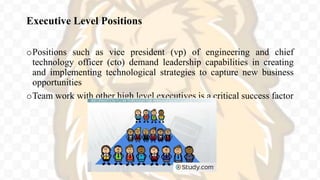
Executive Level Positions
oPositions such as vice president (vp) of engineering and chief
technology officer (cto) demand leadership capabilities in creating
and implementing technological strategies to capture new business
opportunities
oTeam work with other high level executives is a critical success factor
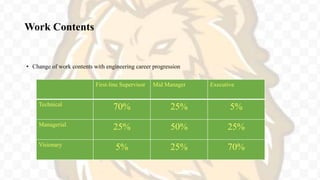
Work Contents
• Change of work contents with engineering career progression
First-line Supervisor Mid Manager Executive
Technical
70% 25% 5%
Managerial
25% 50% 25%
Visionary
5% 25% 70%
Goals for All Levels: Add Value
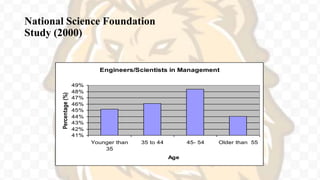
National Science Foundation
Study (2000)
Engineers/Scientists in Management
41%
42%
43%
44%
45%
46%
47%
48%
49%
Younger than
35
35 to 44 45- 54 Older than 55
Age
Percentage
(%)
How to Get Promoted
oCompetence in current assignments - master current duties and
responsibilities, gain respect of co-workers and get favorable
recommendation from the boss
oReadiness and desire to become manager - handle larger and more
challenging assignments (budget, people, impact)
oGood match with organizational needs
Failure Factors for Engineering Managers
• Lack of political savvy
• Uncomfortable with ambiguous situation
• Tense personality
• Lack of risk-taking willingness
• Tendency to clinch on technology
• Lack of human relations skills
• Deficiency in management skills and perception
• Not cognitive of manager’s roles and responsibility
• Narrow interest and preparation
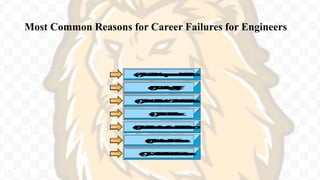
Most Common Reasons for Career Failures for Engineers
(A) Poor Interpersonal Skills
oThis is the single biggest reason for career failures every one needs to be
(1) showing respect and sensitivity in dealing with others
(2) minimizing conflicts and disagreements
(3) giving and taking criticisms well
(4) striving to build team support
(5) becoming emotionally stable
(6) behaving professionally
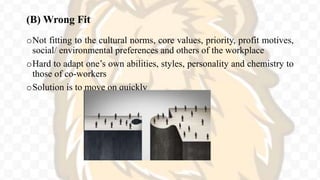
(B) Wrong Fit
oNot fitting to the cultural norms, core values, priority, profit motives,
social/ environmental preferences and others of the workplace
oHard to adapt one’s own abilities, styles, personality and chemistry to
those of co-workers
oSolution is to move on quickly
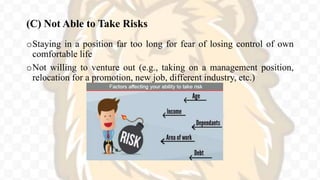
(C) Not Able to Take Risks
oStaying in a position far too long for fear of losing control of own
comfortable life
oNot willing to venture out (e.g., taking on a management position,
relocation for a promotion, new job, different industry, etc.)
(d) Self-destructive Behavior
oExamples include:
1)work in secret
2) resistance to change
3) being excessively aggressive
4) shown non-cooperative attitude
5) picking fights with people
6) becoming overly argumentative
7)being readily excitable about trivialities
8) showing a lack of perspectives in things.
oMust check own behavior often and modify
(e) Lack of Focus
oTry to be jack of all trades, but not good in any thing of value
oHaving no expertise to be known for is dangerous for one’s career
(examples: work well with different people - getting things done
effectively through teams; problem-solving – applying root cause
analysis techniques to complex problems)
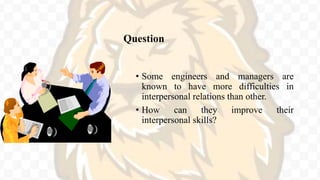
Question
• Some engineers and managers are
known to have more difficulties in
interpersonal relations than other.
• How can they improve their
interpersonal skills?
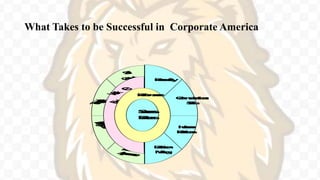
What Takes to be Successful in Corporate America
S
e
l
f
C
o
n
t
r
o
l
T
e
c
h
n
i
c
a
l
S
k
i
l
l
s
P
e
r
s
o
n
a
l
A
p
p
e
r
a
n
c
e
H
e
a
l
t
h
a
n
d
E
n
e
r
g
y
L
e
v
e
l
P
e
r
s
o
n
a
l
i
t
y
C
o
m
m
u
n
i
c
a
t
i
o
n
s
S
k
i
l
l
s
H
u
m
a
n
R
e
l
a
t
i
o
n
s
D
e
c
i
s
i
o
n
M
a
k
i
n
g
W
o
r
k
E
x
p
e
r
i
e
n
c
e
P
e
r
f
o
r
m
a
n
c
e
S
u
c
c
e
s
s
F
a
c
t
o
r
s
Success Factors
o(A) Performance - Make sure that each and everyone of assignment is
done well - “you are only as good as your last performance.”
o(B) Personality - How one acts and behaves is important. One should
project a mature, positive, reasonable and flexible personality.
o(c) Communication Skills - Ability to communicate is important for
promotability, particularly writing concerning readability,
correctness, appropriateness and thought.
o (D) HUMAN RELATIONS SKILLS - Interact with people to create and
maintain acceptable working relationships, avoid being labeled “not
working well with people”.
o(E) Make Tough Decisions - Take prudent risks and make the tough
plays.
o(F) Work Experience - Build up own work portfolio with diversified
experience and high impact assignments.
o(G) Self Control - Stay cool and be able to withstand pressure and
stress, having high tolerance to frustration.
o(H) Technical Skills/Ability - Capabilities need to be kept
marketable.
o(I) Health and Energy Level - Take care of own health and maintain
physical vitality.
o(J) Personal Appearance - To fit into the corporate image by
following the boss’s example.
Career Strategy for the 21st Century
oThink, speak, act and walk like an entrepreneur - entrepreneurial
mindset
oEmbrace change as an opportunity for growth, “eager to stay, yet
ready to leave”
oBe visionaries and detail-oriented
oKnow own strengths and weaknesses, be competitive, and set high
standards for self
oBuild alliances and stay connected
Summary and Conclusions
o“Rules of Thumb” from experience are worth knowing
oConstantly reading to reinforce one’s conviction in the values of
noted leadership profiles
oPracticing them until the preferred behavior becomes ones’ second
nature
Engineers as managers

Engineers as managers

  • 2.
    Professional Ethics oProfessional ethicsis a set of standards that describe the professional behavior that is expected in all fields of work. In this we will examine the moral and ethical issues that professionals have to deal with in a corporate environment. oThese are principles that govern the behaviour of a person or group in a business environment. It also provide rules on how a person should act towards other people and institutions in such an environment. oProfessional ethics encompass the personal and corporate standards of behavior expected by professionals. The word professionalism originally applied to vows of a religious order.
  • 3.
    How professional ethicsis related with engineers as managers? oAccordingly, the services provided by engineers require honesty, impartiality, fairness and equity and must be dedicated to the protection of the public health, safety and welfare hold paramount the safety, health and welfare of the public.
  • 4.
    Engineeering leadership oOnly 26%of ceo’s in the top 1000 companies had their first degrees in engineering (more in foreign countries) oOnly 10% of university presidents are engineers oFew engineers are in congress oPresident jimmy carter was the only engineer, but he did not get reelected
  • 5.
    Importance of engineersas managers oOne of the most important skills of successful engineering managers is the ability to lead a team to accomplish their goals. ... having a strong sense of purpose enables managers to evoke confidence and motivate their team, providing their team with direction while inspiring, empowering and trusting them to do their jobs. oThe engineering manager needs to lead, inspire, negotiate, cajole and convince the different engineering disciplines, and sometimes their line managers, during the project life cycle, to maintain focus on the business and project objectives.
  • 6.
    Characteristics of engineersas managers • Technical knowledge but most top engineering managers have a background in engineering, complemented with a higher qualification in engineering management. • Project management. • Communication. • Decision making. • Delegation.
  • 7.
    Career Path ofEngineers
  • 8.
    Mid-level Positions oMid-level positionsare equivalent in ranking, mid-point salary and prestige oTechnical ladder is capped at the corporate fellow level oManagerial ladder, including project management positions, leads to executive level positions (vice president)
  • 9.
    Mid-level Technical oLarger responsibilityfor programs of high technical contents but no managerial duty oAdd value by technical contributions, innovations, and technology applications oFellows are typically well-renowned both inside and outside of the company for technical expertise demonstrated in patents, publications and commercial success
  • 10.
    Mid-level Managerial oLarger responsibilityof managing people, tasks, capabilities, functions and programs oDevote increasingly less time on technology work and more on managerial work oSuccess Factors (1) established technical expertise (2) proficient in all management functions (3) problem solving and conflict resolution (4) strategic planning abilities
  • 11.
    Remarks on Mid-levelPositions oTechnical ladder positions are less quota-limited than the corresponding positions in managerial ladder oTransfer from positions in technical to managerial ladder is somewhat more easier than the other way around
  • 12.
    Executive Level Positions oPositionssuch as vice president (vp) of engineering and chief technology officer (cto) demand leadership capabilities in creating and implementing technological strategies to capture new business opportunities oTeam work with other high level executives is a critical success factor
  • 13.
    Work Contents • Changeof work contents with engineering career progression First-line Supervisor Mid Manager Executive Technical 70% 25% 5% Managerial 25% 50% 25% Visionary 5% 25% 70%
  • 14.
    Goals for AllLevels: Add Value
  • 15.
    National Science Foundation Study(2000) Engineers/Scientists in Management 41% 42% 43% 44% 45% 46% 47% 48% 49% Younger than 35 35 to 44 45- 54 Older than 55 Age Percentage (%)
  • 16.
    How to GetPromoted oCompetence in current assignments - master current duties and responsibilities, gain respect of co-workers and get favorable recommendation from the boss oReadiness and desire to become manager - handle larger and more challenging assignments (budget, people, impact) oGood match with organizational needs
  • 17.
    Failure Factors forEngineering Managers • Lack of political savvy • Uncomfortable with ambiguous situation • Tense personality • Lack of risk-taking willingness • Tendency to clinch on technology • Lack of human relations skills • Deficiency in management skills and perception • Not cognitive of manager’s roles and responsibility • Narrow interest and preparation
  • 18.
    Most Common Reasonsfor Career Failures for Engineers
  • 19.
    (A) Poor InterpersonalSkills oThis is the single biggest reason for career failures every one needs to be (1) showing respect and sensitivity in dealing with others (2) minimizing conflicts and disagreements (3) giving and taking criticisms well (4) striving to build team support (5) becoming emotionally stable (6) behaving professionally
  • 20.
    (B) Wrong Fit oNotfitting to the cultural norms, core values, priority, profit motives, social/ environmental preferences and others of the workplace oHard to adapt one’s own abilities, styles, personality and chemistry to those of co-workers oSolution is to move on quickly
  • 21.
    (C) Not Ableto Take Risks oStaying in a position far too long for fear of losing control of own comfortable life oNot willing to venture out (e.g., taking on a management position, relocation for a promotion, new job, different industry, etc.)
  • 22.
    (d) Self-destructive Behavior oExamplesinclude: 1)work in secret 2) resistance to change 3) being excessively aggressive 4) shown non-cooperative attitude 5) picking fights with people 6) becoming overly argumentative 7)being readily excitable about trivialities 8) showing a lack of perspectives in things. oMust check own behavior often and modify
  • 23.
    (e) Lack ofFocus oTry to be jack of all trades, but not good in any thing of value oHaving no expertise to be known for is dangerous for one’s career (examples: work well with different people - getting things done effectively through teams; problem-solving – applying root cause analysis techniques to complex problems)
  • 24.
    Question • Some engineersand managers are known to have more difficulties in interpersonal relations than other. • How can they improve their interpersonal skills?
  • 25.
    What Takes tobe Successful in Corporate America S e l f C o n t r o l T e c h n i c a l S k i l l s P e r s o n a l A p p e r a n c e H e a l t h a n d E n e r g y L e v e l P e r s o n a l i t y C o m m u n i c a t i o n s S k i l l s H u m a n R e l a t i o n s D e c i s i o n M a k i n g W o r k E x p e r i e n c e P e r f o r m a n c e S u c c e s s F a c t o r s
  • 26.
    Success Factors o(A) Performance- Make sure that each and everyone of assignment is done well - “you are only as good as your last performance.” o(B) Personality - How one acts and behaves is important. One should project a mature, positive, reasonable and flexible personality. o(c) Communication Skills - Ability to communicate is important for promotability, particularly writing concerning readability, correctness, appropriateness and thought. o (D) HUMAN RELATIONS SKILLS - Interact with people to create and maintain acceptable working relationships, avoid being labeled “not working well with people”.
  • 27.
    o(E) Make ToughDecisions - Take prudent risks and make the tough plays. o(F) Work Experience - Build up own work portfolio with diversified experience and high impact assignments. o(G) Self Control - Stay cool and be able to withstand pressure and stress, having high tolerance to frustration. o(H) Technical Skills/Ability - Capabilities need to be kept marketable. o(I) Health and Energy Level - Take care of own health and maintain physical vitality. o(J) Personal Appearance - To fit into the corporate image by following the boss’s example.
  • 28.
    Career Strategy forthe 21st Century oThink, speak, act and walk like an entrepreneur - entrepreneurial mindset oEmbrace change as an opportunity for growth, “eager to stay, yet ready to leave” oBe visionaries and detail-oriented oKnow own strengths and weaknesses, be competitive, and set high standards for self oBuild alliances and stay connected
  • 29.
    Summary and Conclusions o“Rulesof Thumb” from experience are worth knowing oConstantly reading to reinforce one’s conviction in the values of noted leadership profiles oPracticing them until the preferred behavior becomes ones’ second nature