UNIT-4
ENGINEER’S RESPONSIBILITY FOR
SAFETY and Risk
Safety
• One of the main duties of an engineer is to
ensure the safety of the people who will be
affected by the products that he designs.
• The code of ethics of the professional
engineering societies make it clear that safety
is of paramount importance to the engineer.
• The engineering codes of ethics show that
engineers have a responsibility to society to
produce products that are safe.
“A thing is safe (to a certain degree) with
respect to a given person or group at a given
time if, were they fully aware of its risks and
expressing their most settled values, they would
judge those risks to be acceptable (to that
certain degree.
Ex 1 : We judge fluoride in water can kill lots of
people -> Overestimating risk.
Ex2: We hire a taxi, without thinking about its
safety -> Not estimating risk
• A thing is NOT SAFE if it exposes us to
unacceptable danger or hazard
RISK
• Risk in technology could include dangers of
– bodily harm,
– economic loss,
– environmental degradation. – a
situation involving exposure to danger
Types of Risk
• Acceptable Risk
• Voluntary risk and Control
• JOB RELATED RISKS
Acceptable Risk
– refers to the level of human and property injury or
loss from an industrial process that is considered
to be tolerable by an individual, household, group,
organization, community, region, state, or nation
in view of the social, political, and economic cost-
benefit analysis.
• Example: For instance, the risk of flooding can be
accepted once every 500 years but it is not
unacceptable in every ten years.
Voluntary risk
• A person is said to take ‘VOLUNTARY RISK’
• - when he is subjected to risk by either his
own actions or action taken by others
• -volunteers to take that risk without any
apprehension.
• Ex: over rough ground for amusement
Risk Assessment
• Absolute safety is never possible to attain and
safety can be improved in an engineering
product only with an increase in cost.
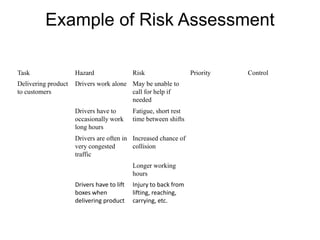
Example of Risk Assessment
Task Hazard Risk Priority Control
Delivering product
to customers
Drivers work alone May be unable to
call for help if
needed
Drivers have to
occasionally work
long hours
Fatigue, short rest
time between shifts
Drivers are often in
very congested
traffic
Increased chance of
collision
Longer working
hours
Drivers have to lift
boxes when
delivering product
Injury to back from
lifting, reaching,
carrying, etc.
Risk Analysis
The study of risk analysis covers other
areas such as risk identification, risk
analysis, risk assessment, risk rating,
suggestions on risk control and risk
mitigation.
A step-wise risk analysis includes:
• Hazards identification
• Failure modes and frequencies evaluation from
established sources and best practices.
• Selection of credible scenarios and risks.
• Consequences-effect calculations with work out from
models.
• Individual and societal risks.
• Probability and frequency analysis.
• Established risk criteria of countries, bodies, standards.
• Comparison of risk against defined risk criteria.
• Identification of risk beyond the location boundary, if
any.
• Risk mitigation measures.
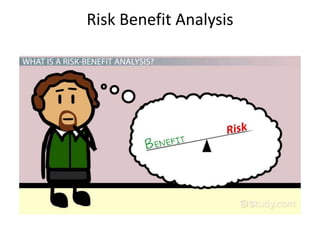
Risk Benefit Analysis
Risk–benefit analysis is analysis that
seeks to quantify the risk and benefits and
hence their ratio.
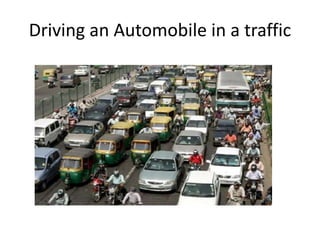
Driving an Automobile in a traffic
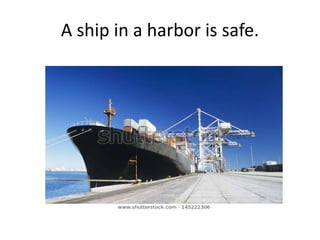
A ship in a harbor is safe.
For a Clinical Trial
A risk-benefit analysis for a clinical trial is
provisionally based on the preclinical phase of
the medicinal product. The sponsor-investigator
team needs to evaluate the toxicological tests
and results as well as submit the data to the
competent health authorities, with a projection
of all the possible risks for the proposed trial
subjects.
RISK BENEFIT ASSESSMENT-Example
• ACTIVITY How will young people BENEFIT from
this activity? Possible hazards Who is at risk?
PRECAUTIONS in place to reduce the risk of
injury Overall risk RATING: L/M/H
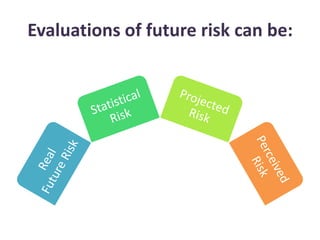
Evaluations of future risk can be:
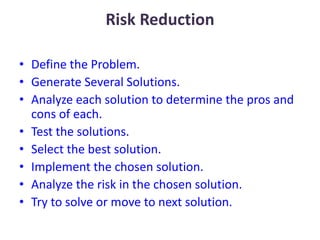
Risk Reduction
• Define the Problem.
• Generate Several Solutions.
• Analyze each solution to determine the pros and
cons of each.
• Test the solutions.
• Select the best solution.
• Implement the chosen solution.
• Analyze the risk in the chosen solution.
• Try to solve or move to next solution.
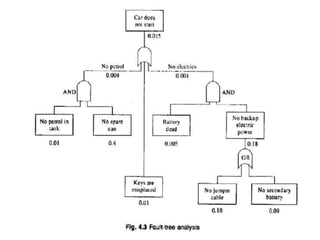
Example :
• An automobile car does not start. Develop
Fault tree analysis for this.
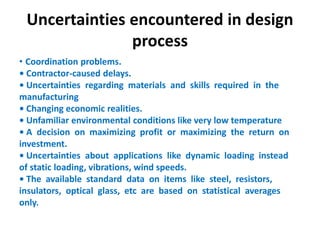
Uncertainties encountered in design
process
• Coordination problems.
• Contractor-caused delays.
• Uncertainties regarding materials and skills required in the
manufacturing
• Changing economic realities.
• Unfamiliar environmental conditions like very low temperature
• A decision on maximizing profit or maximizing the return on
investment.
• Uncertainties about applications like dynamic loading instead
of static loading, vibrations, wind speeds.
• The available standard data on items like steel, resistors,
insulators, optical glass, etc are based on statistical averages
only.
Environmental Ethics
• Environmental ethics is the study of
(a) moral issues concerning the environment,
(b) moral perspectives, beliefs, or attitudes
concerning those issues.
The American Society of Civil Engineers (ASCE) code of ethics
• “engineers shall hold paramount the safety,
health, and welfare of the public and shall
strive to comply with the principles of
sustainable development in the performance
of professional duties”
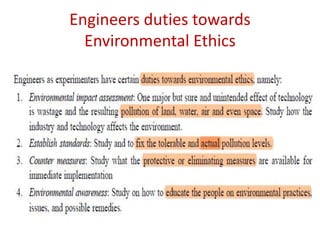
Engineers duties towards
Environmental Ethics
Environment Disasters
1. Plastic Waste Disposal
2. e-Waste Disposal
3. Industrial Waste Disposal
4. Depletion of Ozone Layer
5. Global Warming
6. Acid Rain
Human-centered Environmental Ethics
• This approach assumes that only human
beings have inherent moral worth duly to be
taken care of.
• Other living being and ecosystems are only
instrumental in nature.
Human-centered Environmental Ethics
• Utilitarianism aims to maximize good
consequences for human beings. Most of the
goods are engineered products made out of
natural resources.
• Rights ethicists favor the basic rights to live and
right to liberty, to realise the right to a live in a
supportive environment.
• Further, virtue ethics stresses importance of
prudence, humility, appreciation of natural
beauty, and gratitude to the mother nature that
provides everything.
Environmental Ethics
• all the human beings, animals, and plants as
divine.
• The eco-balance is the need of the hour and
the engineers are the right experimenters to
achieve this.
Computer Ethics
• Computer ethics is defined as
(a) study and analysis of nature and social impact
of computer technology,
(b) formulation and justification of policies, for
ethical use of computers.
This subject has become
• relevant to the professionals such as designers of
computers, programmers, system analysts,
system managers, and operators.
Computer Ethics - Types of Issues
1. Computer as the Instrument of Unethical
Acts
2. Computer as the Object of Unethical Act
3. Problems Related to the Autonomous Nature
of Computer
Computers In Workplace
• Elimination of routine and manual
jobs
• Health and safety
• Computer failure
Computer Crime
• The ethical features involved in
computer crime are :
1. Physical Security
2. Logical Security
Privacy and Anonymity
1. Records of Evidence
2. Hacking
3. Legal Response
4. Anonymity

UNIT-4 Engineer responsibility.pptx

  • 1.
  • 2.
    Safety • One ofthe main duties of an engineer is to ensure the safety of the people who will be affected by the products that he designs. • The code of ethics of the professional engineering societies make it clear that safety is of paramount importance to the engineer. • The engineering codes of ethics show that engineers have a responsibility to society to produce products that are safe.
  • 3.
    “A thing issafe (to a certain degree) with respect to a given person or group at a given time if, were they fully aware of its risks and expressing their most settled values, they would judge those risks to be acceptable (to that certain degree.
  • 4.
    Ex 1 :We judge fluoride in water can kill lots of people -> Overestimating risk. Ex2: We hire a taxi, without thinking about its safety -> Not estimating risk • A thing is NOT SAFE if it exposes us to unacceptable danger or hazard
  • 5.
    RISK • Risk intechnology could include dangers of – bodily harm, – economic loss, – environmental degradation. – a situation involving exposure to danger
  • 6.
    Types of Risk •Acceptable Risk • Voluntary risk and Control • JOB RELATED RISKS
  • 7.
    Acceptable Risk – refersto the level of human and property injury or loss from an industrial process that is considered to be tolerable by an individual, household, group, organization, community, region, state, or nation in view of the social, political, and economic cost- benefit analysis. • Example: For instance, the risk of flooding can be accepted once every 500 years but it is not unacceptable in every ten years.
  • 8.
    Voluntary risk • Aperson is said to take ‘VOLUNTARY RISK’ • - when he is subjected to risk by either his own actions or action taken by others • -volunteers to take that risk without any apprehension. • Ex: over rough ground for amusement
  • 9.
    Risk Assessment • Absolutesafety is never possible to attain and safety can be improved in an engineering product only with an increase in cost.
  • 10.
    Example of RiskAssessment Task Hazard Risk Priority Control Delivering product to customers Drivers work alone May be unable to call for help if needed Drivers have to occasionally work long hours Fatigue, short rest time between shifts Drivers are often in very congested traffic Increased chance of collision Longer working hours Drivers have to lift boxes when delivering product Injury to back from lifting, reaching, carrying, etc.
  • 11.
    Risk Analysis The studyof risk analysis covers other areas such as risk identification, risk analysis, risk assessment, risk rating, suggestions on risk control and risk mitigation.
  • 12.
    A step-wise riskanalysis includes: • Hazards identification • Failure modes and frequencies evaluation from established sources and best practices. • Selection of credible scenarios and risks. • Consequences-effect calculations with work out from models. • Individual and societal risks. • Probability and frequency analysis. • Established risk criteria of countries, bodies, standards. • Comparison of risk against defined risk criteria. • Identification of risk beyond the location boundary, if any. • Risk mitigation measures.
  • 13.
  • 14.
    Risk–benefit analysis isanalysis that seeks to quantify the risk and benefits and hence their ratio.
  • 15.
  • 16.
    A ship ina harbor is safe.
  • 17.
    For a ClinicalTrial A risk-benefit analysis for a clinical trial is provisionally based on the preclinical phase of the medicinal product. The sponsor-investigator team needs to evaluate the toxicological tests and results as well as submit the data to the competent health authorities, with a projection of all the possible risks for the proposed trial subjects.
  • 18.
    RISK BENEFIT ASSESSMENT-Example •ACTIVITY How will young people BENEFIT from this activity? Possible hazards Who is at risk? PRECAUTIONS in place to reduce the risk of injury Overall risk RATING: L/M/H
  • 19.
  • 20.
    Risk Reduction • Definethe Problem. • Generate Several Solutions. • Analyze each solution to determine the pros and cons of each. • Test the solutions. • Select the best solution. • Implement the chosen solution. • Analyze the risk in the chosen solution. • Try to solve or move to next solution.
  • 21.
    Example : • Anautomobile car does not start. Develop Fault tree analysis for this.
  • 23.
    Uncertainties encountered indesign process • Coordination problems. • Contractor-caused delays. • Uncertainties regarding materials and skills required in the manufacturing • Changing economic realities. • Unfamiliar environmental conditions like very low temperature • A decision on maximizing profit or maximizing the return on investment. • Uncertainties about applications like dynamic loading instead of static loading, vibrations, wind speeds. • The available standard data on items like steel, resistors, insulators, optical glass, etc are based on statistical averages only.
  • 24.
    Environmental Ethics • Environmentalethics is the study of (a) moral issues concerning the environment, (b) moral perspectives, beliefs, or attitudes concerning those issues.
  • 25.
    The American Societyof Civil Engineers (ASCE) code of ethics • “engineers shall hold paramount the safety, health, and welfare of the public and shall strive to comply with the principles of sustainable development in the performance of professional duties”
  • 26.
  • 27.
    Environment Disasters 1. PlasticWaste Disposal 2. e-Waste Disposal 3. Industrial Waste Disposal 4. Depletion of Ozone Layer 5. Global Warming 6. Acid Rain
  • 28.
    Human-centered Environmental Ethics •This approach assumes that only human beings have inherent moral worth duly to be taken care of. • Other living being and ecosystems are only instrumental in nature.
  • 29.
    Human-centered Environmental Ethics •Utilitarianism aims to maximize good consequences for human beings. Most of the goods are engineered products made out of natural resources. • Rights ethicists favor the basic rights to live and right to liberty, to realise the right to a live in a supportive environment. • Further, virtue ethics stresses importance of prudence, humility, appreciation of natural beauty, and gratitude to the mother nature that provides everything.
  • 30.
    Environmental Ethics • allthe human beings, animals, and plants as divine. • The eco-balance is the need of the hour and the engineers are the right experimenters to achieve this.
  • 31.
    Computer Ethics • Computerethics is defined as (a) study and analysis of nature and social impact of computer technology, (b) formulation and justification of policies, for ethical use of computers. This subject has become • relevant to the professionals such as designers of computers, programmers, system analysts, system managers, and operators.
  • 32.
    Computer Ethics -Types of Issues 1. Computer as the Instrument of Unethical Acts 2. Computer as the Object of Unethical Act 3. Problems Related to the Autonomous Nature of Computer
  • 33.
    Computers In Workplace •Elimination of routine and manual jobs • Health and safety • Computer failure
  • 34.
    Computer Crime • Theethical features involved in computer crime are : 1. Physical Security 2. Logical Security
  • 35.
    Privacy and Anonymity 1.Records of Evidence 2. Hacking 3. Legal Response 4. Anonymity