Engineering Students
Thanikachalam Vedhathiri, B.E., M. Tech., Ph.D., M.S., FIE., FIGS.,
FFIUCEE.
FMR. Professor and HOD., Center for International Affairs,
National Institute of Technical Teachers Training and Research, Chennai
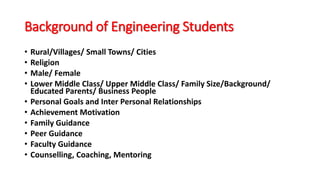
Background of Engineering Students
• Rural/Villages/ Small Towns/ Cities
• Religion
• Male/ Female
• Lower Middle Class/ Upper Middle Class/ Family Size/Background/
Educated Parents/ Business People
• Personal Goals and Inter Personal Relationships
• Achievement Motivation
• Family Guidance
• Peer Guidance
• Faculty Guidance
• Counselling, Coaching, Mentoring
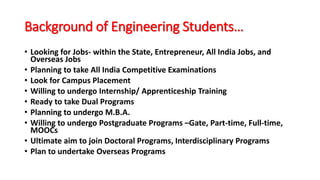
Background of Engineering Students…
• Looking for Jobs- within the State, Entrepreneur, All India Jobs, and
Overseas Jobs
• Planning to take All India Competitive Examinations
• Look for Campus Placement
• Willing to undergo Internship/ Apprenticeship Training
• Ready to take Dual Programs
• Planning to undergo M.B.A.
• Willing to undergo Postgraduate Programs –Gate, Part-time, Full-time,
MOOCs
• Ultimate aim to join Doctoral Programs, Interdisciplinary Programs
• Plan to undertake Overseas Programs
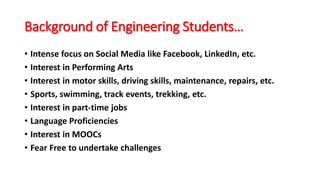
Background of Engineering Students…
• Intense focus on Social Media like Facebook, LinkedIn, etc.
• Interest in Performing Arts
• Interest in motor skills, driving skills, maintenance, repairs, etc.
• Sports, swimming, track events, trekking, etc.
• Interest in part-time jobs
• Language Proficiencies
• Interest in MOOCs
• Fear Free to undertake challenges
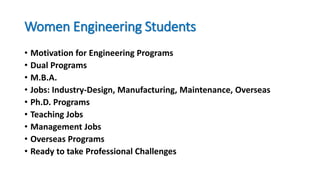
Women Engineering Students
• Motivation for Engineering Programs
• Dual Programs
• M.B.A.
• Jobs: Industry-Design, Manufacturing, Maintenance, Overseas
• Ph.D. Programs
• Teaching Jobs
• Management Jobs
• Overseas Programs
• Ready to take Professional Challenges
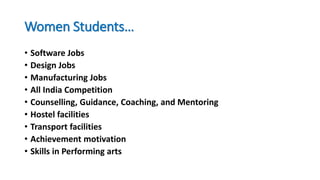
Women Students…
• Software Jobs
• Design Jobs
• Manufacturing Jobs
• All India Competition
• Counselling, Guidance, Coaching, and Mentoring
• Hostel facilities
• Transport facilities
• Achievement motivation
• Skills in Performing arts
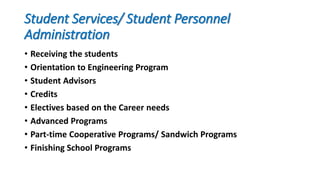
Student Services/ Student Personnel
Administration
• Receiving the students
• Orientation to Engineering Program
• Student Advisors
• Credits
• Electives based on the Career needs
• Advanced Programs
• Part-time Cooperative Programs/ Sandwich Programs
• Finishing School Programs
Scholarships, Bank Loans, Travel Concessions
• State Scholarships
• Central Scholarships
• Bank Loans
• Industry Sponsored Students
• Endowments
• Alumni Scholarships
• Management Scholarships
• Short-term Loans from the Institute
Leadership Development
• Professional Associations
• Industrial Visits
• On the job training
• Industry Sponsored Dissertations
• Career Guidance
• Portfolio Development
• Projects and Seminars
• Action Research
Leadership Development…
• Communication Abilities
• Written Reports, Project Reports
• Spoken
• Power Points, MMLP
• Story Board
• Video Scripts
• Research Papers
• Discussion
Professional Skills/ Abilities
• Problem Solving Abilities
• Critical Thinking Abilities
• Fearless Behavior
• Leadership
• Human Resource Management Skills
• Product Innovations
•3 a, k
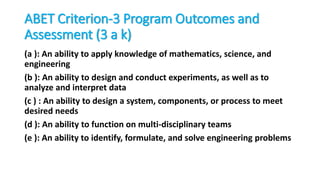
ABET Criterion-3 Program Outcomes and
Assessment (3 a k)
(a ): An ability to apply knowledge of mathematics, science, and
engineering
(b ): An ability to design and conduct experiments, as well as to
analyze and interpret data
(c ) : An ability to design a system, components, or process to meet
desired needs
(d ): An ability to function on multi-disciplinary teams
(e ): An ability to identify, formulate, and solve engineering problems
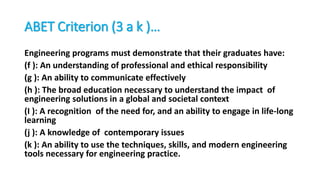
ABET Criterion (3 a k )…
Engineering programs must demonstrate that their graduates have:
(f ): An understanding of professional and ethical responsibility
(g ): An ability to communicate effectively
(h ): The broad education necessary to understand the impact of
engineering solutions in a global and societal context
(I ): A recognition of the need for, and an ability to engage in life-long
learning
(j ): A knowledge of contemporary issues
(k ): An ability to use the techniques, skills, and modern engineering
tools necessary for engineering practice.
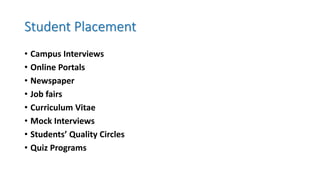
Student Placement
• Campus Interviews
• Online Portals
• Newspaper
• Job fairs
• Curriculum Vitae
• Mock Interviews
• Students’ Quality Circles
• Quiz Programs
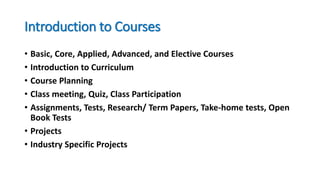
Introduction to Courses
• Basic, Core, Applied, Advanced, and Elective Courses
• Introduction to Curriculum
• Course Planning
• Class meeting, Quiz, Class Participation
• Assignments, Tests, Research/ Term Papers, Take-home tests, Open
Book Tests
• Projects
• Industry Specific Projects
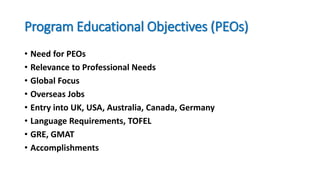
Program Educational Objectives (PEOs)
• Need for PEOs
• Relevance to Professional Needs
• Global Focus
• Overseas Jobs
• Entry into UK, USA, Australia, Canada, Germany
• Language Requirements, TOFEL
• GRE, GMAT
• Accomplishments
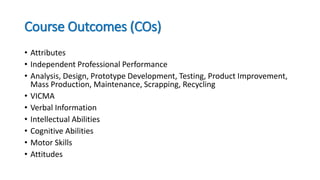
Course Outcomes (COs)
• Attributes
• Independent Professional Performance
• Analysis, Design, Prototype Development, Testing, Product Improvement,
Mass Production, Maintenance, Scrapping, Recycling
• VICMA
• Verbal Information
• Intellectual Abilities
• Cognitive Abilities
• Motor Skills
• Attitudes
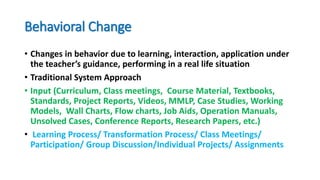
Behavioral Change
• Changes in behavior due to learning, interaction, application under
the teacher’s guidance, performing in a real life situation
• Traditional System Approach
• Input (Curriculum, Class meetings, Course Material, Textbooks,
Standards, Project Reports, Videos, MMLP, Case Studies, Working
Models, Wall Charts, Flow charts, Job Aids, Operation Manuals,
Unsolved Cases, Conference Reports, Research Papers, etc.)
• Learning Process/ Transformation Process/ Class Meetings/
Participation/ Group Discussion/Individual Projects/ Assignments
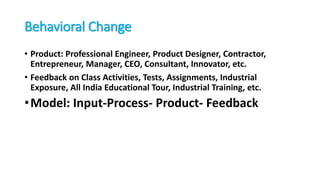
Behavioral Change
• Product: Professional Engineer, Product Designer, Contractor,
Entrepreneur, Manager, CEO, Consultant, Innovator, etc.
• Feedback on Class Activities, Tests, Assignments, Industrial
Exposure, All India Educational Tour, Industrial Training, etc.
•Model: Input-Process- Product- Feedback
Outcome-based Curriculum Development…
•Product: OUTCOME: Graduate who completed the program
• Skills and competencies desired by the employer
• Meeting the challenges
• Creating innovations
• Outstanding products
• Unicorn
• Fearless engineer, Product Developer
• Outstanding Engineer
Transformation Process
• Real life Skills in analysis, design, prototype development, testing,
improving, mass production, innovation
• Open book tests
• Take home tests
• Complex Problems
• Key Result Areas
• Team work
• Market Leader
Inputs
• Industry Specific Curriculum
• Global Focus
• Advances
• Selected Topics
• Focus on latest theories and industrial design
• Flipped Classes
• Student designed courses and Practicum
Feedback
• Feedback from the Employers
• Feedback from Alumni
• Feedback from the Experts
• Feedback from the Society
• Feedback from the global organizations
• Feedback from the Parliament
Product Driven Curriculum Design Process
•Feedback-Outcome-Process- Input
Instructional Objective
• Magar’s Approach: PCC
• Performance: The desired performance of the graduate in an
industrial situation, training undergone, skills, motivation, education,
etc.
• Conditions: Needed resources, tools, ergonomically designed
workplace, job aids, interpersonal relations, operation manuals,
workplace environment, feedback on the work, etc.
• Criteria: Acceptable quality, productivity, energy consumed, safety,
cost, aesthetics, utility, etc.
Andragogy
• Malcolm S. Knowles’ Theory of Andragogy is a learning
theory that is developed on the specific needs of adults.
• Engineering students are self-directed and expect to take
responsibility for decisions
• Graduate and postgraduate programs must accommodate
this basic aspects.
Self-Regulated Learning (SRL)
• Engineering students are self-directed, autonomous, and
independent.
• Self-regulated learning relates to the use of cognitive processes such
as critical thinking, taking action, metacognition, behaving and
engaging in purposeful academic activities.
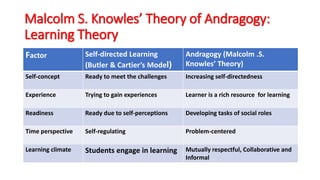
Malcolm S. Knowles’ Theory of Andragogy:
Learning Theory
Factor Self-directed Learning
(Butler & Cartier’s Model)
Andragogy (Malcolm .S.
Knowles’ Theory)
Self-concept Ready to meet the challenges Increasing self-directedness
Experience Trying to gain experiences Learner is a rich resource for learning
Readiness Ready due to self-perceptions Developing tasks of social roles
Time perspective Self-regulating Problem-centered
Learning climate Students engage in learning Mutually respectful, Collaborative and
Informal
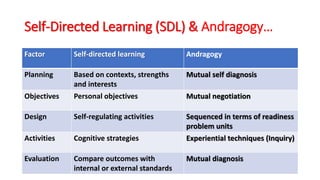
Self-Directed Learning (SDL) & Andragogy…
Factor Self-directed learning Andragogy
Planning Based on contexts, strengths
and interests
Mutual self diagnosis
Objectives Personal objectives Mutual negotiation
Design Self-regulating activities Sequenced in terms of readiness
problem units
Activities Cognitive strategies Experiential techniques (Inquiry)
Evaluation Compare outcomes with
internal or external standards
Mutual diagnosis
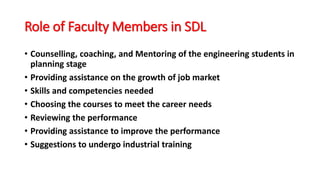
Role of Faculty Members in SDL
• Counselling, coaching, and Mentoring of the engineering students in
planning stage
• Providing assistance on the growth of job market
• Skills and competencies needed
• Choosing the courses to meet the career needs
• Reviewing the performance
• Providing assistance to improve the performance
• Suggestions to undergo industrial training
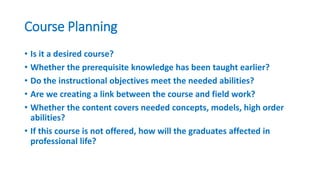
Course Planning
• Is it a desired course?
• Whether the prerequisite knowledge has been taught earlier?
• Do the instructional objectives meet the needed abilities?
• Are we creating a link between the course and field work?
• Whether the content covers needed concepts, models, high order
abilities?
• If this course is not offered, how will the graduates affected in
professional life?
Check on Course Planning
• Have you planned the course structure?
• Have you prepared the course materials?
• Have you planned the lecture schedules?
• Have you indicated the tests and assignments?
• Have you planned industrial visits?
• Have you provided research work?
• Have you included any external expert for a lecture?
• Have you included a seminar?
Thank you very much
Your Questions Please

Engineering students

  • 1.
    Engineering Students Thanikachalam Vedhathiri,B.E., M. Tech., Ph.D., M.S., FIE., FIGS., FFIUCEE. FMR. Professor and HOD., Center for International Affairs, National Institute of Technical Teachers Training and Research, Chennai
  • 2.
    Background of EngineeringStudents • Rural/Villages/ Small Towns/ Cities • Religion • Male/ Female • Lower Middle Class/ Upper Middle Class/ Family Size/Background/ Educated Parents/ Business People • Personal Goals and Inter Personal Relationships • Achievement Motivation • Family Guidance • Peer Guidance • Faculty Guidance • Counselling, Coaching, Mentoring
  • 3.
    Background of EngineeringStudents… • Looking for Jobs- within the State, Entrepreneur, All India Jobs, and Overseas Jobs • Planning to take All India Competitive Examinations • Look for Campus Placement • Willing to undergo Internship/ Apprenticeship Training • Ready to take Dual Programs • Planning to undergo M.B.A. • Willing to undergo Postgraduate Programs –Gate, Part-time, Full-time, MOOCs • Ultimate aim to join Doctoral Programs, Interdisciplinary Programs • Plan to undertake Overseas Programs
  • 4.
    Background of EngineeringStudents… • Intense focus on Social Media like Facebook, LinkedIn, etc. • Interest in Performing Arts • Interest in motor skills, driving skills, maintenance, repairs, etc. • Sports, swimming, track events, trekking, etc. • Interest in part-time jobs • Language Proficiencies • Interest in MOOCs • Fear Free to undertake challenges
  • 5.
    Women Engineering Students •Motivation for Engineering Programs • Dual Programs • M.B.A. • Jobs: Industry-Design, Manufacturing, Maintenance, Overseas • Ph.D. Programs • Teaching Jobs • Management Jobs • Overseas Programs • Ready to take Professional Challenges
  • 6.
    Women Students… • SoftwareJobs • Design Jobs • Manufacturing Jobs • All India Competition • Counselling, Guidance, Coaching, and Mentoring • Hostel facilities • Transport facilities • Achievement motivation • Skills in Performing arts
  • 7.
    Student Services/ StudentPersonnel Administration • Receiving the students • Orientation to Engineering Program • Student Advisors • Credits • Electives based on the Career needs • Advanced Programs • Part-time Cooperative Programs/ Sandwich Programs • Finishing School Programs
  • 8.
    Scholarships, Bank Loans,Travel Concessions • State Scholarships • Central Scholarships • Bank Loans • Industry Sponsored Students • Endowments • Alumni Scholarships • Management Scholarships • Short-term Loans from the Institute
  • 9.
    Leadership Development • ProfessionalAssociations • Industrial Visits • On the job training • Industry Sponsored Dissertations • Career Guidance • Portfolio Development • Projects and Seminars • Action Research
  • 10.
    Leadership Development… • CommunicationAbilities • Written Reports, Project Reports • Spoken • Power Points, MMLP • Story Board • Video Scripts • Research Papers • Discussion
  • 11.
    Professional Skills/ Abilities •Problem Solving Abilities • Critical Thinking Abilities • Fearless Behavior • Leadership • Human Resource Management Skills • Product Innovations •3 a, k
  • 12.
    ABET Criterion-3 ProgramOutcomes and Assessment (3 a k) (a ): An ability to apply knowledge of mathematics, science, and engineering (b ): An ability to design and conduct experiments, as well as to analyze and interpret data (c ) : An ability to design a system, components, or process to meet desired needs (d ): An ability to function on multi-disciplinary teams (e ): An ability to identify, formulate, and solve engineering problems
  • 13.
    ABET Criterion (3a k )… Engineering programs must demonstrate that their graduates have: (f ): An understanding of professional and ethical responsibility (g ): An ability to communicate effectively (h ): The broad education necessary to understand the impact of engineering solutions in a global and societal context (I ): A recognition of the need for, and an ability to engage in life-long learning (j ): A knowledge of contemporary issues (k ): An ability to use the techniques, skills, and modern engineering tools necessary for engineering practice.
  • 14.
    Student Placement • CampusInterviews • Online Portals • Newspaper • Job fairs • Curriculum Vitae • Mock Interviews • Students’ Quality Circles • Quiz Programs
  • 15.
    Introduction to Courses •Basic, Core, Applied, Advanced, and Elective Courses • Introduction to Curriculum • Course Planning • Class meeting, Quiz, Class Participation • Assignments, Tests, Research/ Term Papers, Take-home tests, Open Book Tests • Projects • Industry Specific Projects
  • 16.
    Program Educational Objectives(PEOs) • Need for PEOs • Relevance to Professional Needs • Global Focus • Overseas Jobs • Entry into UK, USA, Australia, Canada, Germany • Language Requirements, TOFEL • GRE, GMAT • Accomplishments
  • 17.
    Course Outcomes (COs) •Attributes • Independent Professional Performance • Analysis, Design, Prototype Development, Testing, Product Improvement, Mass Production, Maintenance, Scrapping, Recycling • VICMA • Verbal Information • Intellectual Abilities • Cognitive Abilities • Motor Skills • Attitudes
  • 18.
    Behavioral Change • Changesin behavior due to learning, interaction, application under the teacher’s guidance, performing in a real life situation • Traditional System Approach • Input (Curriculum, Class meetings, Course Material, Textbooks, Standards, Project Reports, Videos, MMLP, Case Studies, Working Models, Wall Charts, Flow charts, Job Aids, Operation Manuals, Unsolved Cases, Conference Reports, Research Papers, etc.) • Learning Process/ Transformation Process/ Class Meetings/ Participation/ Group Discussion/Individual Projects/ Assignments
  • 19.
    Behavioral Change • Product:Professional Engineer, Product Designer, Contractor, Entrepreneur, Manager, CEO, Consultant, Innovator, etc. • Feedback on Class Activities, Tests, Assignments, Industrial Exposure, All India Educational Tour, Industrial Training, etc. •Model: Input-Process- Product- Feedback
  • 20.
    Outcome-based Curriculum Development… •Product:OUTCOME: Graduate who completed the program • Skills and competencies desired by the employer • Meeting the challenges • Creating innovations • Outstanding products • Unicorn • Fearless engineer, Product Developer • Outstanding Engineer
  • 21.
    Transformation Process • Reallife Skills in analysis, design, prototype development, testing, improving, mass production, innovation • Open book tests • Take home tests • Complex Problems • Key Result Areas • Team work • Market Leader
  • 22.
    Inputs • Industry SpecificCurriculum • Global Focus • Advances • Selected Topics • Focus on latest theories and industrial design • Flipped Classes • Student designed courses and Practicum
  • 23.
    Feedback • Feedback fromthe Employers • Feedback from Alumni • Feedback from the Experts • Feedback from the Society • Feedback from the global organizations • Feedback from the Parliament
  • 24.
    Product Driven CurriculumDesign Process •Feedback-Outcome-Process- Input
  • 25.
    Instructional Objective • Magar’sApproach: PCC • Performance: The desired performance of the graduate in an industrial situation, training undergone, skills, motivation, education, etc. • Conditions: Needed resources, tools, ergonomically designed workplace, job aids, interpersonal relations, operation manuals, workplace environment, feedback on the work, etc. • Criteria: Acceptable quality, productivity, energy consumed, safety, cost, aesthetics, utility, etc.
  • 26.
    Andragogy • Malcolm S.Knowles’ Theory of Andragogy is a learning theory that is developed on the specific needs of adults. • Engineering students are self-directed and expect to take responsibility for decisions • Graduate and postgraduate programs must accommodate this basic aspects.
  • 27.
    Self-Regulated Learning (SRL) •Engineering students are self-directed, autonomous, and independent. • Self-regulated learning relates to the use of cognitive processes such as critical thinking, taking action, metacognition, behaving and engaging in purposeful academic activities.
  • 28.
    Malcolm S. Knowles’Theory of Andragogy: Learning Theory Factor Self-directed Learning (Butler & Cartier’s Model) Andragogy (Malcolm .S. Knowles’ Theory) Self-concept Ready to meet the challenges Increasing self-directedness Experience Trying to gain experiences Learner is a rich resource for learning Readiness Ready due to self-perceptions Developing tasks of social roles Time perspective Self-regulating Problem-centered Learning climate Students engage in learning Mutually respectful, Collaborative and Informal
  • 29.
    Self-Directed Learning (SDL)& Andragogy… Factor Self-directed learning Andragogy Planning Based on contexts, strengths and interests Mutual self diagnosis Objectives Personal objectives Mutual negotiation Design Self-regulating activities Sequenced in terms of readiness problem units Activities Cognitive strategies Experiential techniques (Inquiry) Evaluation Compare outcomes with internal or external standards Mutual diagnosis
  • 30.
    Role of FacultyMembers in SDL • Counselling, coaching, and Mentoring of the engineering students in planning stage • Providing assistance on the growth of job market • Skills and competencies needed • Choosing the courses to meet the career needs • Reviewing the performance • Providing assistance to improve the performance • Suggestions to undergo industrial training
  • 31.
    Course Planning • Isit a desired course? • Whether the prerequisite knowledge has been taught earlier? • Do the instructional objectives meet the needed abilities? • Are we creating a link between the course and field work? • Whether the content covers needed concepts, models, high order abilities? • If this course is not offered, how will the graduates affected in professional life?
  • 32.
    Check on CoursePlanning • Have you planned the course structure? • Have you prepared the course materials? • Have you planned the lecture schedules? • Have you indicated the tests and assignments? • Have you planned industrial visits? • Have you provided research work? • Have you included any external expert for a lecture? • Have you included a seminar?
  • 33.
    Thank you verymuch Your Questions Please