Pathways
to improve proficiency in engineer
personal, interpersonal,
professional skills
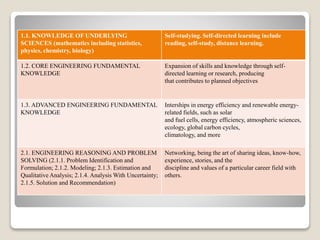
1.1. KNOWLEDGE OF UNDERLYING
SCIENCES (mathematics including statistics,
physics, chemistry, biology)
Self-studying. Self-directed learning include
reading, self-study, distance learning.
1.2. CORE ENGINEERING FUNDAMENTAL
KNOWLEDGE
Expansion of skills and knowledge through self-
directed learning or research, producing
that contributes to planned objectives
1.3. ADVANCED ENGINEERING FUNDAMENTAL
KNOWLEDGE
Interships in energy efficiency and renewable energy-
related fields, such as solar
and fuel cells, energy efficiency, atmospheric sciences,
ecology, global carbon cycles,
climatology, and more
2.1. ENGINEERING REASONING AND PROBLEM
SOLVING (2.1.1. Problem Identification and
Formulation; 2.1.2. Modeling; 2.1.3. Estimation and
Qualitative Analysis; 2.1.4. Analysis With Uncertainty;
2.1.5. Solution and Recommendation)
Networking, being the art of sharing ideas, know-how,
experience, stories, and the
discipline and values of a particular career field with
others.
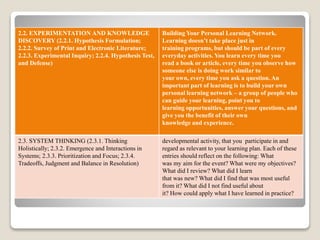
2.2. EXPERIMENTATION AND KNOWLEDGE
DISCOVERY (2.2.1. Hypothesis Formulation;
2.2.2. Survey of Print and Electronic Literature;
2.2.3. Experimental Inquiry; 2.2.4. Hypothesis Test,
and Defense)
Building Your Personal Learning Network.
Learning doesn’t take place just in
training programs, but should be part of every
everyday activities. You learn every time you
read a book or article, every time you observe how
someone else is doing work similar to
your own, every time you ask a question. An
important part of learning is to build your own
personal learning network – a group of people who
can guide your learning, point you to
learning opportunities, answer your questions, and
give you the benefit of their own
knowledge and experience.
2.3. SYSTEM THINKING (2.3.1. Thinking
Holistically; 2.3.2. Emergence and Interactions in
Systems; 2.3.3. Prioritization and Focus; 2.3.4.
Tradeoffs, Judgment and Balance in Resolution)
developmental activity, that you participate in and
regard as relevant to your learning plan. Each of these
entries should reflect on the following: What
was my aim for the event? What were my objectives?
What did I review? What did I learn
that was new? What did I find that was most useful
from it? What did I not find useful about
it? How could apply what I have learned in practice?
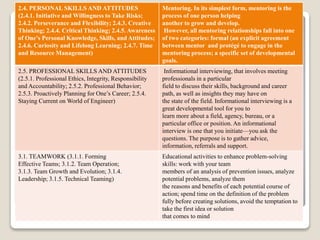
2.4. PERSONAL SKILLS AND ATTITUDES
(2.4.1. Initiative and Willingness to Take Risks;
2.4.2. Perseverance and Flexibility; 2.4.3. Creative
Thinking; 2.4.4. Critical Thinking; 2.4.5. Awareness
of One’s Personal Knowledge, Skills, and Attitudes;
2.4.6. Curiosity and Lifelong Learning; 2.4.7. Time
and Resource Management)
Mentoring. In its simplest form, mentoring is the
process of one person helping
another to grow and develop.
However, all mentoring relationships fall into one
of two categories: formal (an explicit agreement
between mentor and protégé to engage in the
mentoring process; a specific set of developmental
goals.
2.5. PROFESSIONAL SKILLS AND ATTITUDES
(2.5.1. Professional Ethics, Integrity, Responsibility
and Accountability; 2.5.2. Professional Behavior;
2.5.3. Proactively Planning for One’s Career; 2.5.4.
Staying Current on World of Engineer)
Informational interviewing, that involves meeting
professionals in a particular
field to discuss their skills, background and career
path, as well as insights they may have on
the state of the field. Informational interviewing is a
great developmental tool for you to
learn more about a field, agency, bureau, or a
particular office or position. An informational
interview is one that you initiate—you ask the
questions. The purpose is to gather advice,
information, referrals and support.
3.1. TEAMWORK (3.1.1. Forming
Effective Teams; 3.1.2. Team Operation;
3.1.3. Team Growth and Evolution; 3.1.4.
Leadership; 3.1.5. Technical Teaming)
Educational activities to enhance problem-solving
skills: work with your team
members of an analysis of prevention issues, analyze
potential problems, analyze them
the reasons and benefits of each potential course of
action; spend time on the definition of the problem
fully before creating solutions, avoid the temptation to
take the first idea or solution
that comes to mind
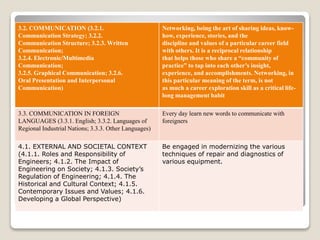
3.2. COMMUNICATION (3.2.1.
Communication Strategy; 3.2.2.
Communication Structure; 3.2.3. Written
Communication;
3.2.4. Electronic/Multimedia
Communication;
3.2.5. Graphical Communication; 3.2.6.
Oral Presentation and Interpersonal
Communication)
Networking, being the art of sharing ideas, know-
how, experience, stories, and the
discipline and values of a particular career field
with others. It is a reciprocal relationship
that helps those who share a “community of
practice” to tap into each other’s insight,
experience, and accomplishments. Networking, in
this particular meaning of the term, is not
as much a career exploration skill as a critical life-
long management habit
3.3. COMMUNICATION IN FOREIGN
LANGUAGES (3.3.1. English; 3.3.2. Languages of
Regional Industrial Nations; 3.3.3. Other Languages)
Every day learn new words to communicate with
foreigners
4.1. EXTERNAL AND SOCIETAL CONTEXT
(4.1.1. Roles and Responsibility of
Engineers; 4.1.2. The Impact of
Engineering on Society; 4.1.3. Society’s
Regulation of Engineering; 4.1.4. The
Historical and Cultural Context; 4.1.5.
Contemporary Issues and Values; 4.1.6.
Developing a Global Perspective)
Be engaged in modernizing the various
techniques of repair and diagnostics of
various equipment.
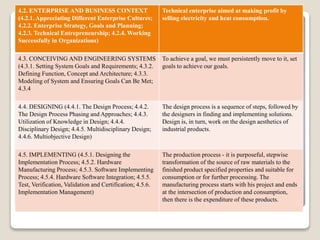
4.2. ENTERPRISE AND BUSINESS CONTEXT
(4.2.1. Appreciating Different Enterprise Cultures;
4.2.2. Enterprise Strategy, Goals and Planning;
4.2.3. Technical Entrepreneurship; 4.2.4. Working
Successfully in Organizations)
Technical enterprise aimed at making profit by
selling electricity and heat consumption.
4.3. CONCEIVING AND ENGINEERING SYSTEMS
(4.3.1. Setting System Goals and Requirements; 4.3.2.
Defining Function, Concept and Architecture; 4.3.3.
Modeling of System and Ensuring Goals Can Be Met;
4.3.4
To achieve a goal, we must persistently move to it, set
goals to achieve our goals.
4.4. DESIGNING (4.4.1. The Design Process; 4.4.2.
The Design Process Phasing and Approaches; 4.4.3.
Utilization of Knowledge in Design; 4.4.4.
Disciplinary Design; 4.4.5. Multidisciplinary Design;
4.4.6. Multiobjective Design)
The design process is a sequence of steps, followed by
the designers in finding and implementing solutions.
Design is, in turn, work on the design aesthetics of
industrial products.
4.5. IMPLEMENTING (4.5.1. Designing the
Implementation Process; 4.5.2. Hardware
Manufacturing Process; 4.5.3. Software Implementing
Process; 4.5.4. Hardware Software Integration; 4.5.5.
Test, Verification, Validation and Certification; 4.5.6.
Implementation Management)
The production process - it is purposeful, stepwise
transformation of the source of raw materials to the
finished product specified properties and suitable for
consumption or for further processing. The
manufacturing process starts with his project and ends
at the intersection of production and consumption,
then there is the expenditure of these products.
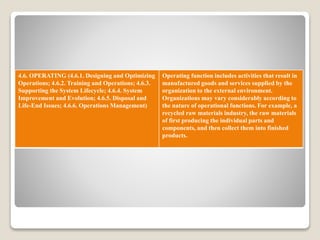
4.6. OPERATING (4.6.1. Designing and Optimizing
Operations; 4.6.2. Training and Operations; 4.6.3.
Supporting the System Lifecycle; 4.6.4. System
Improvement and Evolution; 4.6.5. Disposal and
Life-End Issues; 4.6.6. Operations Management)
Operating function includes activities that result in
manufactured goods and services supplied by the
organization to the external environment.
Organizations may vary considerably according to
the nature of operational functions. For example, a
recycled raw materials industry, the raw materials
of first producing the individual parts and
components, and then collect them into finished
products.
Сonclusion
• Practice developmental activities to advance lifelong
learning skills: spend one hour each day developing a
new knowledge or skill; shadow those who have the
expertise
 Find something you can learn from each person with
whom you study; approach every situation by asking
yourself “What can I learn?”

Pathways to improve proficiency

  • 1.
    Pathways to improve proficiencyin engineer personal, interpersonal, professional skills
  • 2.
    1.1. KNOWLEDGE OFUNDERLYING SCIENCES (mathematics including statistics, physics, chemistry, biology) Self-studying. Self-directed learning include reading, self-study, distance learning. 1.2. CORE ENGINEERING FUNDAMENTAL KNOWLEDGE Expansion of skills and knowledge through self- directed learning or research, producing that contributes to planned objectives 1.3. ADVANCED ENGINEERING FUNDAMENTAL KNOWLEDGE Interships in energy efficiency and renewable energy- related fields, such as solar and fuel cells, energy efficiency, atmospheric sciences, ecology, global carbon cycles, climatology, and more 2.1. ENGINEERING REASONING AND PROBLEM SOLVING (2.1.1. Problem Identification and Formulation; 2.1.2. Modeling; 2.1.3. Estimation and Qualitative Analysis; 2.1.4. Analysis With Uncertainty; 2.1.5. Solution and Recommendation) Networking, being the art of sharing ideas, know-how, experience, stories, and the discipline and values of a particular career field with others.
  • 3.
    2.2. EXPERIMENTATION ANDKNOWLEDGE DISCOVERY (2.2.1. Hypothesis Formulation; 2.2.2. Survey of Print and Electronic Literature; 2.2.3. Experimental Inquiry; 2.2.4. Hypothesis Test, and Defense) Building Your Personal Learning Network. Learning doesn’t take place just in training programs, but should be part of every everyday activities. You learn every time you read a book or article, every time you observe how someone else is doing work similar to your own, every time you ask a question. An important part of learning is to build your own personal learning network – a group of people who can guide your learning, point you to learning opportunities, answer your questions, and give you the benefit of their own knowledge and experience. 2.3. SYSTEM THINKING (2.3.1. Thinking Holistically; 2.3.2. Emergence and Interactions in Systems; 2.3.3. Prioritization and Focus; 2.3.4. Tradeoffs, Judgment and Balance in Resolution) developmental activity, that you participate in and regard as relevant to your learning plan. Each of these entries should reflect on the following: What was my aim for the event? What were my objectives? What did I review? What did I learn that was new? What did I find that was most useful from it? What did I not find useful about it? How could apply what I have learned in practice?
  • 4.
    2.4. PERSONAL SKILLSAND ATTITUDES (2.4.1. Initiative and Willingness to Take Risks; 2.4.2. Perseverance and Flexibility; 2.4.3. Creative Thinking; 2.4.4. Critical Thinking; 2.4.5. Awareness of One’s Personal Knowledge, Skills, and Attitudes; 2.4.6. Curiosity and Lifelong Learning; 2.4.7. Time and Resource Management) Mentoring. In its simplest form, mentoring is the process of one person helping another to grow and develop. However, all mentoring relationships fall into one of two categories: formal (an explicit agreement between mentor and protégé to engage in the mentoring process; a specific set of developmental goals. 2.5. PROFESSIONAL SKILLS AND ATTITUDES (2.5.1. Professional Ethics, Integrity, Responsibility and Accountability; 2.5.2. Professional Behavior; 2.5.3. Proactively Planning for One’s Career; 2.5.4. Staying Current on World of Engineer) Informational interviewing, that involves meeting professionals in a particular field to discuss their skills, background and career path, as well as insights they may have on the state of the field. Informational interviewing is a great developmental tool for you to learn more about a field, agency, bureau, or a particular office or position. An informational interview is one that you initiate—you ask the questions. The purpose is to gather advice, information, referrals and support. 3.1. TEAMWORK (3.1.1. Forming Effective Teams; 3.1.2. Team Operation; 3.1.3. Team Growth and Evolution; 3.1.4. Leadership; 3.1.5. Technical Teaming) Educational activities to enhance problem-solving skills: work with your team members of an analysis of prevention issues, analyze potential problems, analyze them the reasons and benefits of each potential course of action; spend time on the definition of the problem fully before creating solutions, avoid the temptation to take the first idea or solution that comes to mind
  • 5.
    3.2. COMMUNICATION (3.2.1. CommunicationStrategy; 3.2.2. Communication Structure; 3.2.3. Written Communication; 3.2.4. Electronic/Multimedia Communication; 3.2.5. Graphical Communication; 3.2.6. Oral Presentation and Interpersonal Communication) Networking, being the art of sharing ideas, know- how, experience, stories, and the discipline and values of a particular career field with others. It is a reciprocal relationship that helps those who share a “community of practice” to tap into each other’s insight, experience, and accomplishments. Networking, in this particular meaning of the term, is not as much a career exploration skill as a critical life- long management habit 3.3. COMMUNICATION IN FOREIGN LANGUAGES (3.3.1. English; 3.3.2. Languages of Regional Industrial Nations; 3.3.3. Other Languages) Every day learn new words to communicate with foreigners 4.1. EXTERNAL AND SOCIETAL CONTEXT (4.1.1. Roles and Responsibility of Engineers; 4.1.2. The Impact of Engineering on Society; 4.1.3. Society’s Regulation of Engineering; 4.1.4. The Historical and Cultural Context; 4.1.5. Contemporary Issues and Values; 4.1.6. Developing a Global Perspective) Be engaged in modernizing the various techniques of repair and diagnostics of various equipment.
  • 6.
    4.2. ENTERPRISE ANDBUSINESS CONTEXT (4.2.1. Appreciating Different Enterprise Cultures; 4.2.2. Enterprise Strategy, Goals and Planning; 4.2.3. Technical Entrepreneurship; 4.2.4. Working Successfully in Organizations) Technical enterprise aimed at making profit by selling electricity and heat consumption. 4.3. CONCEIVING AND ENGINEERING SYSTEMS (4.3.1. Setting System Goals and Requirements; 4.3.2. Defining Function, Concept and Architecture; 4.3.3. Modeling of System and Ensuring Goals Can Be Met; 4.3.4 To achieve a goal, we must persistently move to it, set goals to achieve our goals. 4.4. DESIGNING (4.4.1. The Design Process; 4.4.2. The Design Process Phasing and Approaches; 4.4.3. Utilization of Knowledge in Design; 4.4.4. Disciplinary Design; 4.4.5. Multidisciplinary Design; 4.4.6. Multiobjective Design) The design process is a sequence of steps, followed by the designers in finding and implementing solutions. Design is, in turn, work on the design aesthetics of industrial products. 4.5. IMPLEMENTING (4.5.1. Designing the Implementation Process; 4.5.2. Hardware Manufacturing Process; 4.5.3. Software Implementing Process; 4.5.4. Hardware Software Integration; 4.5.5. Test, Verification, Validation and Certification; 4.5.6. Implementation Management) The production process - it is purposeful, stepwise transformation of the source of raw materials to the finished product specified properties and suitable for consumption or for further processing. The manufacturing process starts with his project and ends at the intersection of production and consumption, then there is the expenditure of these products.
  • 7.
    4.6. OPERATING (4.6.1.Designing and Optimizing Operations; 4.6.2. Training and Operations; 4.6.3. Supporting the System Lifecycle; 4.6.4. System Improvement and Evolution; 4.6.5. Disposal and Life-End Issues; 4.6.6. Operations Management) Operating function includes activities that result in manufactured goods and services supplied by the organization to the external environment. Organizations may vary considerably according to the nature of operational functions. For example, a recycled raw materials industry, the raw materials of first producing the individual parts and components, and then collect them into finished products.
  • 8.
    Сonclusion • Practice developmentalactivities to advance lifelong learning skills: spend one hour each day developing a new knowledge or skill; shadow those who have the expertise  Find something you can learn from each person with whom you study; approach every situation by asking yourself “What can I learn?”