Effect of Self
Regulated Learning
Strategies on
Engineering Students
Thanikachalam.V., B.E., M.Tech., Ph.D., M.S.,FIE., FIGS., FFIUCEE
FMR FULBRIGHT SENIOR RESEARCHER, and Former Professor and HOD., CIA.,
NITTTR ,Chennai
Problem of the First Year Students
 Most of the first year students displayed maximum academic
achievement at the time of entry in to the engineering program but
their performance deuterated after joining.
 Even very high achievers failed in many basic and core courses.
 The problem is due to self-regulation which relates to the use of
processes such as thinking, taking action, behaving and engaging in
purposeful activities.
 The engineering students are self-directed, autonomous, and
independent.
 They tend to learn what they believe that what they need to know.
 These issues are to be investigated and solutions have to be
identified.
Objectives
 To identify the possible reasons for large percentage of failures of
engineering students in the basic and core courses though they
have achieved very well in their higher secondary education.
 To assess the students’ learning process, self-system, learning and
belief, perceived value of learning tasks and metacognitive system.
 To suggest guidelines to the faculties on students’ self-system,
counselling the students on the utilities of core and basic courses
in engineering and use the principles of andragogy in the
instructional design.
 To create an academic environment which will help the students
pursue the basic and core courses productively
Research Methodology
 Comparison of achievement between the standard group and experiment group.
 A set of six colleges have been selected and 30 faculty members have been
selected.
 They have been trained in Andragogy, cognitive system, metacognitive system,
self-system, students learning process, learned helplessness system, at risk
students, and perceived value of tasks.
 The faculty members have been trained to identify the learning difficulties of
their students and the performance of the students on the basic and the core
courses in the semester examinations.
 They have been guided to redesign the course outcomes and the instructional
methods.
 The needs of various courses, course objectives, their utility in engineering and
the outcome have been discussed.
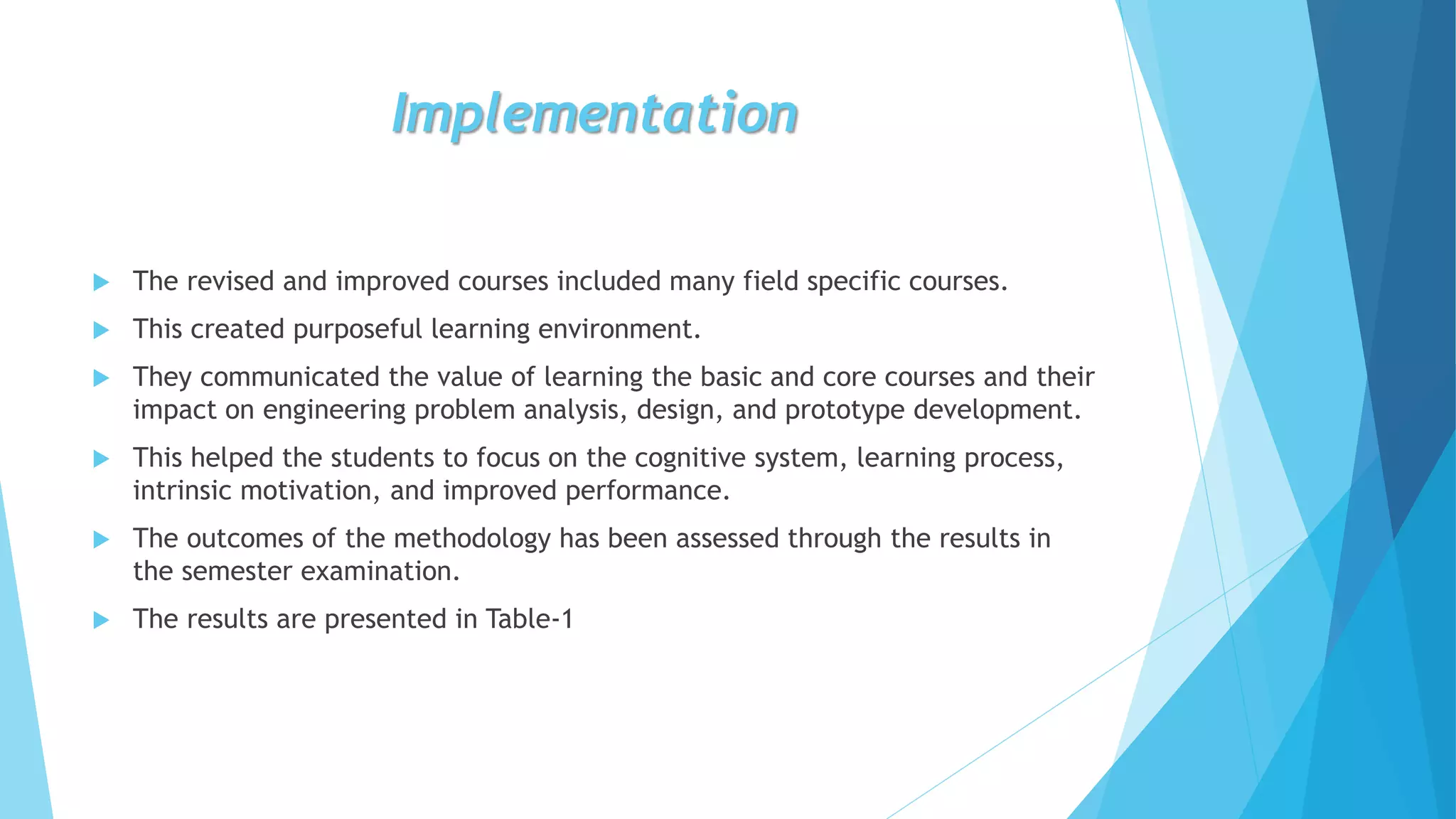
Implementation
 The revised and improved courses included many field specific courses.
 This created purposeful learning environment.
 They communicated the value of learning the basic and core courses and their
impact on engineering problem analysis, design, and prototype development.
 This helped the students to focus on the cognitive system, learning process,
intrinsic motivation, and improved performance.
 The outcomes of the methodology has been assessed through the results in
the semester examination.
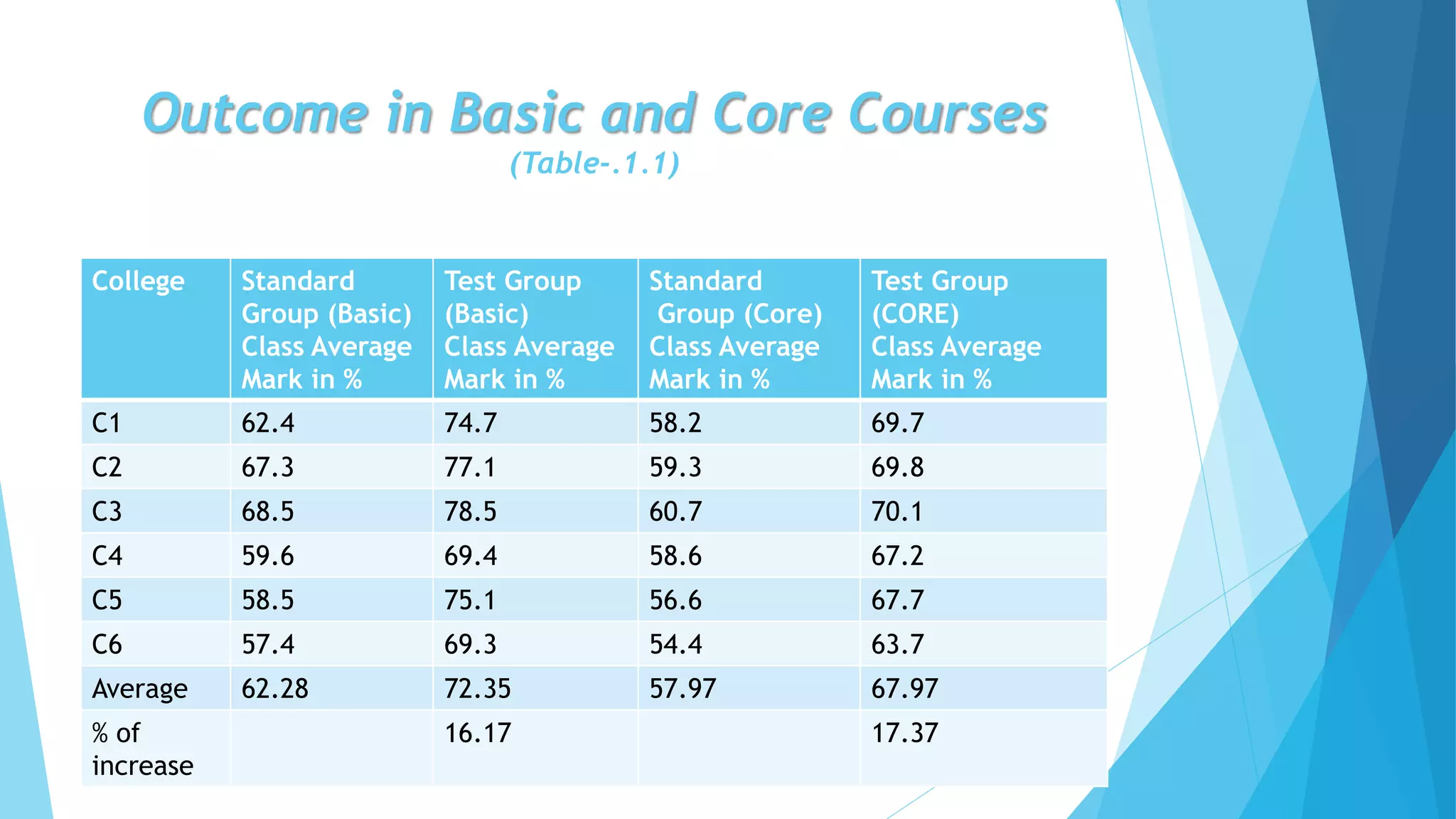
 The results are presented in Table-1
Outcome in Basic and Core Courses
(Table-.1.1)
College Standard
Group (Basic)
Class Average
Mark in %
Test Group
(Basic)
Class Average
Mark in %
Standard
Group (Core)
Class Average
Mark in %
Test Group
(CORE)
Class Average
Mark in %
C1 62.4 74.7 58.2 69.7
C2 67.3 77.1 59.3 69.8
C3 68.5 78.5 60.7 70.1
C4 59.6 69.4 58.6 67.2
C5 58.5 75.1 56.6 67.7
C6 57.4 69.3 54.4 63.7
Average 62.28 72.35 57.97 67.97
% of
increase
16.17 17.37
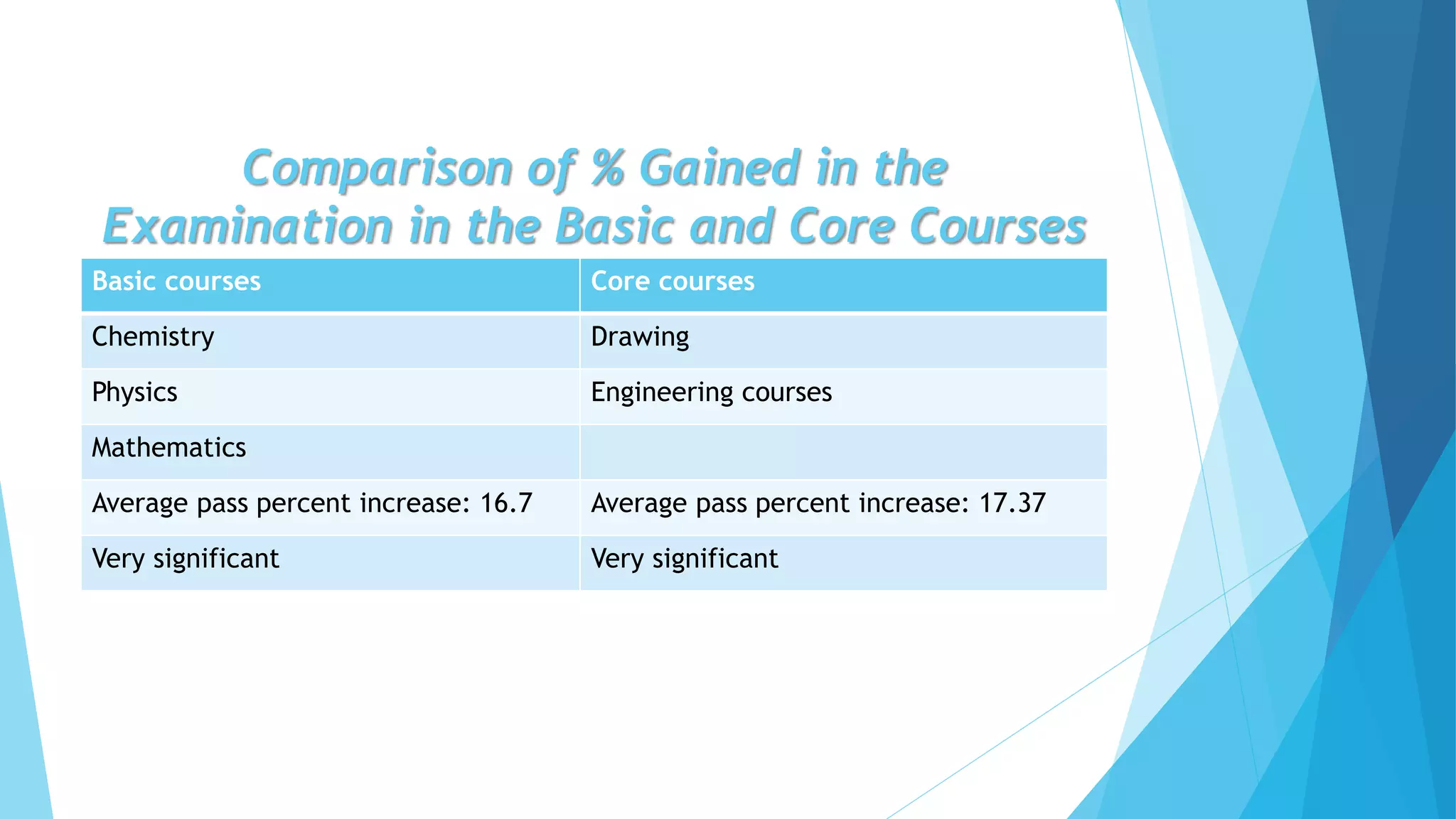
Comparison of % Gained in the
Examination in the Basic and Core Courses
Basic courses Core courses
Chemistry Drawing
Physics Engineering courses
Mathematics
Average pass percent increase: 16.7 Average pass percent increase: 17.37
Very significant Very significant
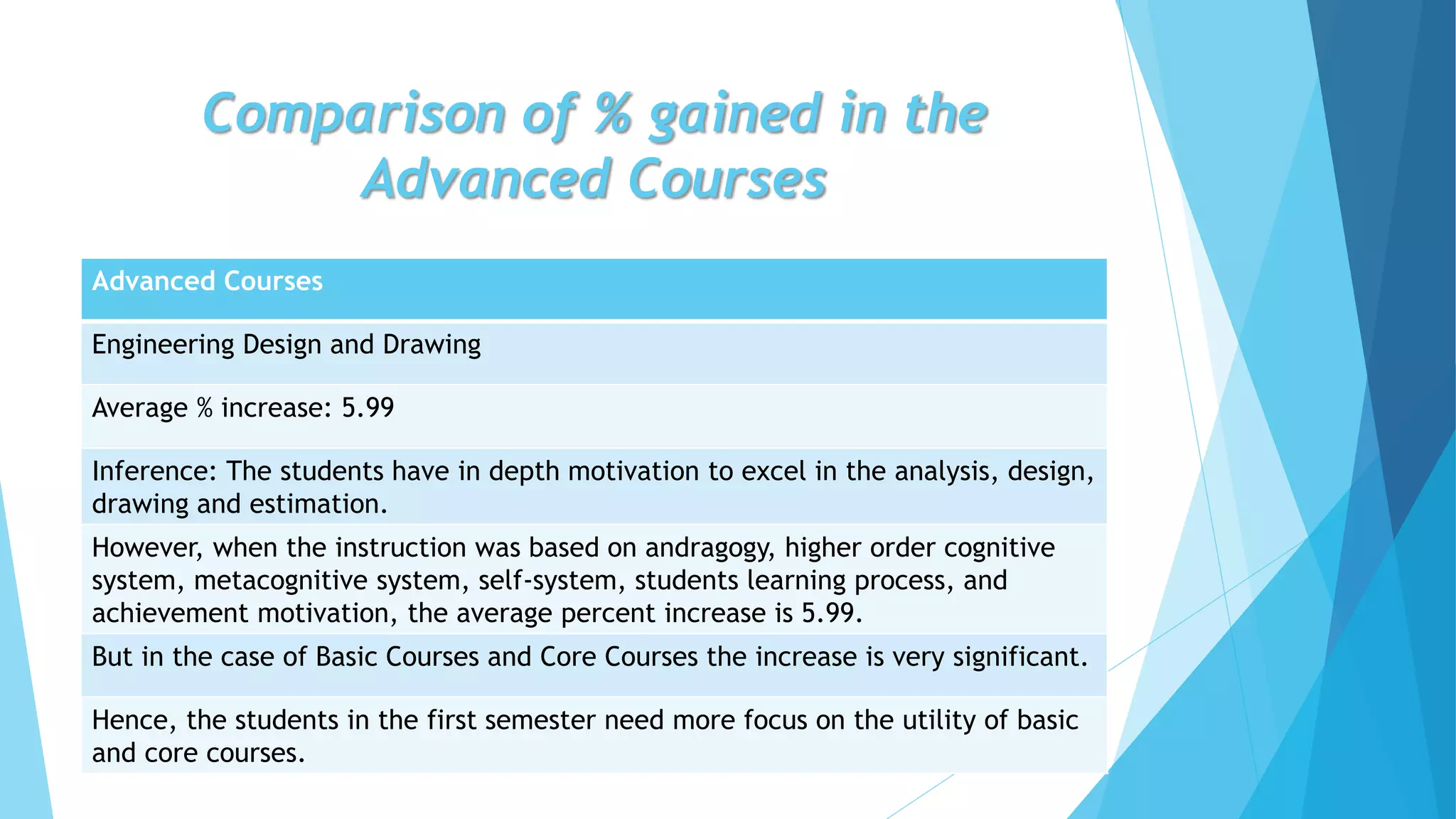
Comparison of % gained in the
Advanced Courses
Advanced Courses
Engineering Design and Drawing
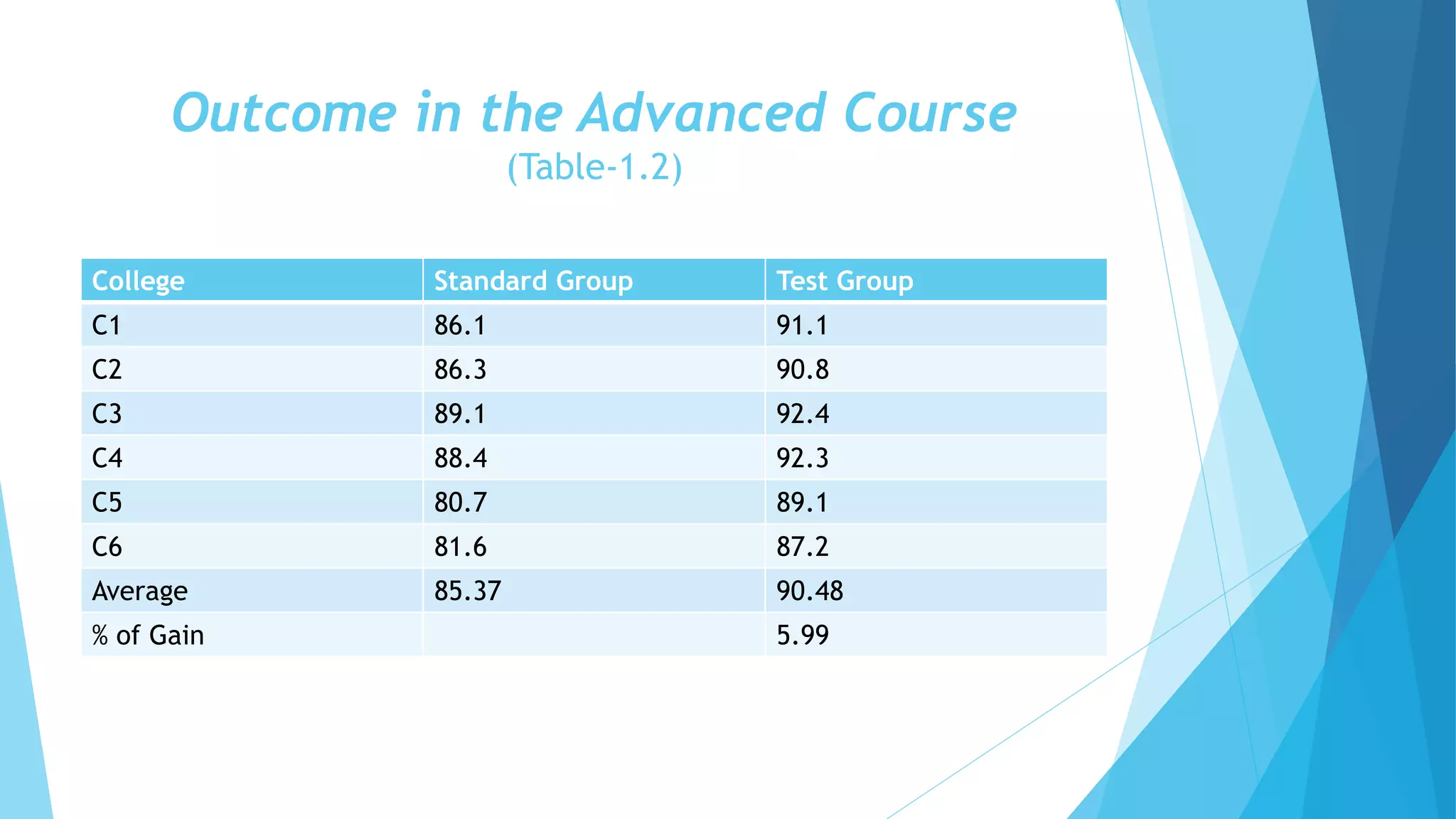
Average % increase: 5.99
Inference: The students have in depth motivation to excel in the analysis, design,
drawing and estimation.
However, when the instruction was based on andragogy, higher order cognitive
system, metacognitive system, self-system, students learning process, and
achievement motivation, the average percent increase is 5.99.
But in the case of Basic Courses and Core Courses the increase is very significant.
Hence, the students in the first semester need more focus on the utility of basic
and core courses.
Outcome in the Advanced Course
(Table-1.2)
College Standard Group Test Group
C1 86.1 91.1
C2 86.3 90.8
C3 89.1 92.4
C4 88.4 92.3
C5 80.7 89.1
C6 81.6 87.2
Average 85.37 90.48
% of Gain 5.99
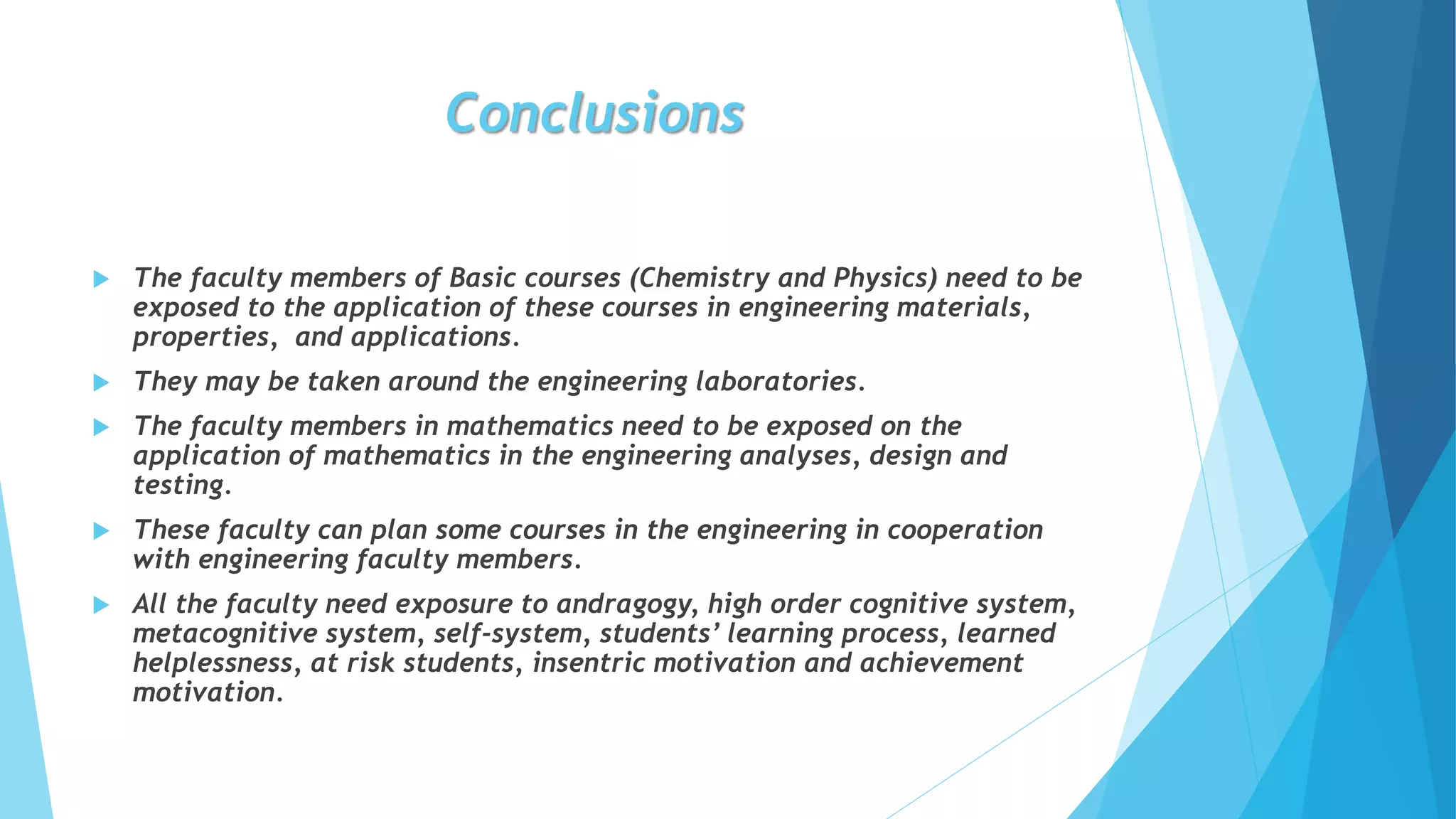
Conclusions
 The faculty members of Basic courses (Chemistry and Physics) need to be
exposed to the application of these courses in engineering materials,
properties, and applications.
 They may be taken around the engineering laboratories.
 The faculty members in mathematics need to be exposed on the
application of mathematics in the engineering analyses, design and
testing.
 These faculty can plan some courses in the engineering in cooperation
with engineering faculty members.
 All the faculty need exposure to andragogy, high order cognitive system,
metacognitive system, self-system, students’ learning process, learned
helplessness, at risk students, insentric motivation and achievement
motivation.

Effect of self regulated learning strategies on engineering

  • 1.
    Effect of Self RegulatedLearning Strategies on Engineering Students Thanikachalam.V., B.E., M.Tech., Ph.D., M.S.,FIE., FIGS., FFIUCEE FMR FULBRIGHT SENIOR RESEARCHER, and Former Professor and HOD., CIA., NITTTR ,Chennai
  • 2.
    Problem of theFirst Year Students  Most of the first year students displayed maximum academic achievement at the time of entry in to the engineering program but their performance deuterated after joining.  Even very high achievers failed in many basic and core courses.  The problem is due to self-regulation which relates to the use of processes such as thinking, taking action, behaving and engaging in purposeful activities.  The engineering students are self-directed, autonomous, and independent.  They tend to learn what they believe that what they need to know.  These issues are to be investigated and solutions have to be identified.
  • 3.
    Objectives  To identifythe possible reasons for large percentage of failures of engineering students in the basic and core courses though they have achieved very well in their higher secondary education.  To assess the students’ learning process, self-system, learning and belief, perceived value of learning tasks and metacognitive system.  To suggest guidelines to the faculties on students’ self-system, counselling the students on the utilities of core and basic courses in engineering and use the principles of andragogy in the instructional design.  To create an academic environment which will help the students pursue the basic and core courses productively
  • 4.
    Research Methodology  Comparisonof achievement between the standard group and experiment group.  A set of six colleges have been selected and 30 faculty members have been selected.  They have been trained in Andragogy, cognitive system, metacognitive system, self-system, students learning process, learned helplessness system, at risk students, and perceived value of tasks.  The faculty members have been trained to identify the learning difficulties of their students and the performance of the students on the basic and the core courses in the semester examinations.  They have been guided to redesign the course outcomes and the instructional methods.  The needs of various courses, course objectives, their utility in engineering and the outcome have been discussed.
  • 5.
    Implementation  The revisedand improved courses included many field specific courses.  This created purposeful learning environment.  They communicated the value of learning the basic and core courses and their impact on engineering problem analysis, design, and prototype development.  This helped the students to focus on the cognitive system, learning process, intrinsic motivation, and improved performance.  The outcomes of the methodology has been assessed through the results in the semester examination.  The results are presented in Table-1
  • 6.
    Outcome in Basicand Core Courses (Table-.1.1) College Standard Group (Basic) Class Average Mark in % Test Group (Basic) Class Average Mark in % Standard Group (Core) Class Average Mark in % Test Group (CORE) Class Average Mark in % C1 62.4 74.7 58.2 69.7 C2 67.3 77.1 59.3 69.8 C3 68.5 78.5 60.7 70.1 C4 59.6 69.4 58.6 67.2 C5 58.5 75.1 56.6 67.7 C6 57.4 69.3 54.4 63.7 Average 62.28 72.35 57.97 67.97 % of increase 16.17 17.37
  • 7.
    Comparison of %Gained in the Examination in the Basic and Core Courses Basic courses Core courses Chemistry Drawing Physics Engineering courses Mathematics Average pass percent increase: 16.7 Average pass percent increase: 17.37 Very significant Very significant
  • 8.
    Comparison of %gained in the Advanced Courses Advanced Courses Engineering Design and Drawing Average % increase: 5.99 Inference: The students have in depth motivation to excel in the analysis, design, drawing and estimation. However, when the instruction was based on andragogy, higher order cognitive system, metacognitive system, self-system, students learning process, and achievement motivation, the average percent increase is 5.99. But in the case of Basic Courses and Core Courses the increase is very significant. Hence, the students in the first semester need more focus on the utility of basic and core courses.
  • 9.
    Outcome in theAdvanced Course (Table-1.2) College Standard Group Test Group C1 86.1 91.1 C2 86.3 90.8 C3 89.1 92.4 C4 88.4 92.3 C5 80.7 89.1 C6 81.6 87.2 Average 85.37 90.48 % of Gain 5.99
  • 10.
    Conclusions  The facultymembers of Basic courses (Chemistry and Physics) need to be exposed to the application of these courses in engineering materials, properties, and applications.  They may be taken around the engineering laboratories.  The faculty members in mathematics need to be exposed on the application of mathematics in the engineering analyses, design and testing.  These faculty can plan some courses in the engineering in cooperation with engineering faculty members.  All the faculty need exposure to andragogy, high order cognitive system, metacognitive system, self-system, students’ learning process, learned helplessness, at risk students, insentric motivation and achievement motivation.