A Radical and Virtual Innovation
Center (RVIC) for Human
Resource Development
Thanikachalam Vedhathiri
vthani2025@gmail.com
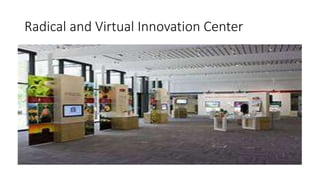
Radical and Virtual Innovation Center
Objectives
• Assess the need for a Radical and Virtual Innovation Center for
undertaking consultancy projects and programs under various
development national and international development agencies
• Identify the needs of the Radical and Virtual Innovation Center
• Identify the needs of Peace Engineering Education
• List the global human resource development programs completed
• State the outcomes of the projects and their impact
Needs for a Radical and Virtual Innovation Center
(RVIC) for Human Resource Development
• There is a need for a Radical and Virtual Human Resource
Development Center for planning country/ organization relevant, and
resource based training and development needs to synchronize with
the mission of development projects
• The RVIC should be capable of conducting training needs assessment
and analysis, developing needed transformation programs and ensure
the desired impact.
• Should prepare more competitive development programs which will
create leaders who can sustain the development under the fast
changing technology
Needs of RVIC
• An academic ecosystem with a team competent and innovative
faculty members and supported by an institution.
• Decentralized administration for dynamic planning
• An empowered project specific interdisciplinary team
• High performing and motivated team of faculty members
• Timely approval from the Board of Governors and the Government of
India
Preparation of Competitive Development
Programs
• Many developing countries have to eradicate the poverty through human
resource development for establishing institutions which will training the
youth, employees and executives.
• The developing countries have abundant natural resources which are to be
explored and processed for human consumption.
• Developing countries need the assistance of the well established human
resource development centers who have high reputation for their
development programs.
• Most of International Development Agencies provide funds for Capacity
Development, Quality Improvement and Efficiency Improvement based on
the Detailed Project Report.
Types of Human Resource Development
Programs
• Short-term courses for context specific knowledge development
needs.
• Medium-term programs to provide total exposure from needs
analysis, preparing organization relevant training courses, learning
materials development, resource generation, developing tools,
ergonomics, job aids, operation manuals, standards of performance,
continuous process improvement, and reviewing achievements and
updating the programs.
• Long-term programs for assisting the participants to undertake more
development activities for various organizations.
Needs of MSMEs
• To survive under the fast changing technology.
• To survive in the fierce competitive market.
• To continuously improve the skills of the employees.
• To improve the quality, life, and utility of the products.
• To reduce the cost of production.
• To introduce innovative products.
• To absorb the new technology.
Planning Flexible Human Resource
Development Programs
• Short-term courses to overcome the existing deficiencies in
knowledge, skills, and attitude.
• Utilizes the existing resources.
• Will attempt to improve the academic ecosystem.
• Planning is based on the goals, mission and vision.
• Courses are to be planned and conducted in the work place or as in-
house.
• Transfer of new skills are easy to work place.
Peripatetic Training Programs
• Planning a development program involving more than four or five global
resources institutions which are located in various countries.
• Training the participants in the resource institutes as per the schedule.
• Programs are usually planned by International Development Agencies.
• The program provides excellence of faculty and the resources.
• At the end, the participants gain the best of four or five resource institutes
guidance.
• The whole program should be planned to meet the development goals of
participants.
Lectures through Video Conferences
• Can be prepared to meet the challenging curriculum which can not be
done by a single faculty.
• The resource persons are selected based on their accomplishments.
• The coordinator plans the program based the achievement of more
than 10-20 best institutions.
• The program is very cost effective since the participants need not
travel from their institute.
• The global programs can be planned easily.
• Many International Research Universities utilize this methodology.
Lectures through Webinars
• Many international organizations and corporate training organizations
use this method.
• The participants are located in different states or countries.
• Webinar topics are planned based the outcomes which will provide a
learning opportunity to the participants.
• The presentations can be loaded in to YouTube for many others’ use
who could not attend the webinar.
• Many advanced courses with organization specific presentations can
be planned.
MOOCs
• Massive Open Online Courses (MOOCs).
• Many educational institutes offer MOOCs in thousands of areas.
• World Bank Institute offers many courses for global participants.
• Many degree and postgraduate programs can be undertaken through
MOOCs.
• Now Indian Universities and Institutes offer more courses through
MOOCs under SWAYAM.
Through free Websites
• The lectures and video programs can be uploaded to specific websites
like www. issuu.com which can be accessible by any learner.
• Articles can be downloaded easily.
• Some organization collect fees for downloading the material.
Through Research Gate
• Some of research materials could be uploaded in to Research Gate so
that the learners can get access to them through www.
Through Workshops
• Many conferences offer workshops to the learners where they can get
practical experiences.
• Many faculty develop workshop materials and conduct the needed
knowledge based courses.
• Workshops specifically offer well planned practical hands on
experiences.
Outcome of RVIC of NITTTR Chennai
• Presentation on the Impact of Globalization through video conference
for the senior students of Purdue University, Lafayette, Indiana, USA.
• International faculty development programs through Asian
Development Bank, UNESCO, UNDP and SIDA.
• Advanced certificate courses in Curriculum Design and Instructional
Materials Development, Human Resource Development,
Environmental Protection and Management, Development of
Technical Education for the countries in Asia, Africa, Europe, South
and Central America, and Oceania.
• Presentation of research papers through Webinars under IUCEE.
Outcome of RVIC…
• Uploading over 100 power points to www.issuu.com .
• Training programs for MSMEs through short-term courses.
• Faculty development under Quality Improvement Program.
• Diverse Global Faculty Development through SCAAP, ITEC, TCS
programs of Ministry of External Affairs, Ministry of Finance.
• Videos have been uploaded to You Tube.
• In-house faculty development courses are being offered.
• Programs under UNESCO’s APEID.
• Peripatetic Seminar for Asian educationalist under UNESCO’s APEID.
Summary
• The Engineering institutes should offer faculty and executive
development programs through various modes to sustain global
leadership.
• The journal articles should be available through WWW.
• Video conference facilities are to be fully used.
• The institutions are to plan global programs.
• Should come out of “2-4-6” mindset.
Thank You
•Your Questions Please.

A radical and virtual innovation center

  • 1.
    A Radical andVirtual Innovation Center (RVIC) for Human Resource Development Thanikachalam Vedhathiri vthani2025@gmail.com
  • 2.
    Radical and VirtualInnovation Center
  • 3.
    Objectives • Assess theneed for a Radical and Virtual Innovation Center for undertaking consultancy projects and programs under various development national and international development agencies • Identify the needs of the Radical and Virtual Innovation Center • Identify the needs of Peace Engineering Education • List the global human resource development programs completed • State the outcomes of the projects and their impact
  • 4.
    Needs for aRadical and Virtual Innovation Center (RVIC) for Human Resource Development • There is a need for a Radical and Virtual Human Resource Development Center for planning country/ organization relevant, and resource based training and development needs to synchronize with the mission of development projects • The RVIC should be capable of conducting training needs assessment and analysis, developing needed transformation programs and ensure the desired impact. • Should prepare more competitive development programs which will create leaders who can sustain the development under the fast changing technology
  • 5.
    Needs of RVIC •An academic ecosystem with a team competent and innovative faculty members and supported by an institution. • Decentralized administration for dynamic planning • An empowered project specific interdisciplinary team • High performing and motivated team of faculty members • Timely approval from the Board of Governors and the Government of India
  • 6.
    Preparation of CompetitiveDevelopment Programs • Many developing countries have to eradicate the poverty through human resource development for establishing institutions which will training the youth, employees and executives. • The developing countries have abundant natural resources which are to be explored and processed for human consumption. • Developing countries need the assistance of the well established human resource development centers who have high reputation for their development programs. • Most of International Development Agencies provide funds for Capacity Development, Quality Improvement and Efficiency Improvement based on the Detailed Project Report.
  • 7.
    Types of HumanResource Development Programs • Short-term courses for context specific knowledge development needs. • Medium-term programs to provide total exposure from needs analysis, preparing organization relevant training courses, learning materials development, resource generation, developing tools, ergonomics, job aids, operation manuals, standards of performance, continuous process improvement, and reviewing achievements and updating the programs. • Long-term programs for assisting the participants to undertake more development activities for various organizations.
  • 8.
    Needs of MSMEs •To survive under the fast changing technology. • To survive in the fierce competitive market. • To continuously improve the skills of the employees. • To improve the quality, life, and utility of the products. • To reduce the cost of production. • To introduce innovative products. • To absorb the new technology.
  • 9.
    Planning Flexible HumanResource Development Programs • Short-term courses to overcome the existing deficiencies in knowledge, skills, and attitude. • Utilizes the existing resources. • Will attempt to improve the academic ecosystem. • Planning is based on the goals, mission and vision. • Courses are to be planned and conducted in the work place or as in- house. • Transfer of new skills are easy to work place.
  • 10.
    Peripatetic Training Programs •Planning a development program involving more than four or five global resources institutions which are located in various countries. • Training the participants in the resource institutes as per the schedule. • Programs are usually planned by International Development Agencies. • The program provides excellence of faculty and the resources. • At the end, the participants gain the best of four or five resource institutes guidance. • The whole program should be planned to meet the development goals of participants.
  • 11.
    Lectures through VideoConferences • Can be prepared to meet the challenging curriculum which can not be done by a single faculty. • The resource persons are selected based on their accomplishments. • The coordinator plans the program based the achievement of more than 10-20 best institutions. • The program is very cost effective since the participants need not travel from their institute. • The global programs can be planned easily. • Many International Research Universities utilize this methodology.
  • 12.
    Lectures through Webinars •Many international organizations and corporate training organizations use this method. • The participants are located in different states or countries. • Webinar topics are planned based the outcomes which will provide a learning opportunity to the participants. • The presentations can be loaded in to YouTube for many others’ use who could not attend the webinar. • Many advanced courses with organization specific presentations can be planned.
  • 13.
    MOOCs • Massive OpenOnline Courses (MOOCs). • Many educational institutes offer MOOCs in thousands of areas. • World Bank Institute offers many courses for global participants. • Many degree and postgraduate programs can be undertaken through MOOCs. • Now Indian Universities and Institutes offer more courses through MOOCs under SWAYAM.
  • 14.
    Through free Websites •The lectures and video programs can be uploaded to specific websites like www. issuu.com which can be accessible by any learner. • Articles can be downloaded easily. • Some organization collect fees for downloading the material.
  • 15.
    Through Research Gate •Some of research materials could be uploaded in to Research Gate so that the learners can get access to them through www.
  • 16.
    Through Workshops • Manyconferences offer workshops to the learners where they can get practical experiences. • Many faculty develop workshop materials and conduct the needed knowledge based courses. • Workshops specifically offer well planned practical hands on experiences.
  • 17.
    Outcome of RVICof NITTTR Chennai • Presentation on the Impact of Globalization through video conference for the senior students of Purdue University, Lafayette, Indiana, USA. • International faculty development programs through Asian Development Bank, UNESCO, UNDP and SIDA. • Advanced certificate courses in Curriculum Design and Instructional Materials Development, Human Resource Development, Environmental Protection and Management, Development of Technical Education for the countries in Asia, Africa, Europe, South and Central America, and Oceania. • Presentation of research papers through Webinars under IUCEE.
  • 18.
    Outcome of RVIC… •Uploading over 100 power points to www.issuu.com . • Training programs for MSMEs through short-term courses. • Faculty development under Quality Improvement Program. • Diverse Global Faculty Development through SCAAP, ITEC, TCS programs of Ministry of External Affairs, Ministry of Finance. • Videos have been uploaded to You Tube. • In-house faculty development courses are being offered. • Programs under UNESCO’s APEID. • Peripatetic Seminar for Asian educationalist under UNESCO’s APEID.
  • 19.
    Summary • The Engineeringinstitutes should offer faculty and executive development programs through various modes to sustain global leadership. • The journal articles should be available through WWW. • Video conference facilities are to be fully used. • The institutions are to plan global programs. • Should come out of “2-4-6” mindset.
  • 20.