INSTITUTIONAL TRANSFORMATION AND
DEVELOPMENT IN THE ENGINEERING EDUCATION
TO MEET THE VOLATILITY, UNCERTAINTY, COMPLEXITY AND
AMBIGUITY
Thanikachalam Vedhathiri
(vthani2025@yahoo.in)
V U C A
VOLATILITY
The external environment is unstable.
Presents challenges that are infinite at great
speed.
Old products are wiped out
Formal degrees lose their value
Multidisciplinary programs are needed
New products invade the market
Their half life is also limited!
VOLATILITY
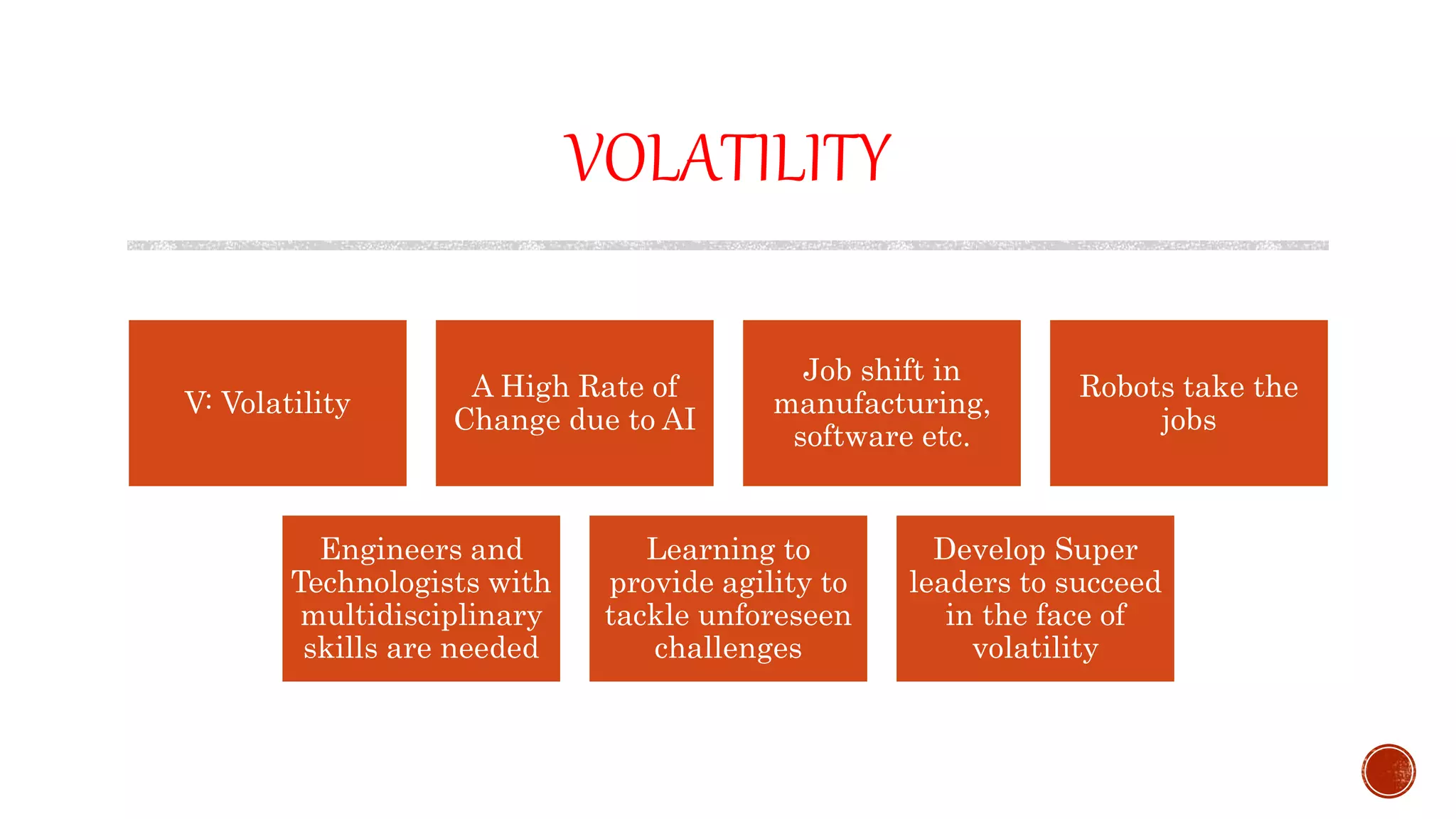
V: Volatility
A High Rate of
Change due to AI
Job shift in
manufacturing,
software etc.
Robots take the
jobs
Engineers and
Technologists with
multidisciplinary
skills are needed
Learning to
provide agility to
tackle unforeseen
challenges
Develop Super
leaders to succeed
in the face of
volatility
UNCERTAINTY
Unprecedented trends in the external
environment.
The long-term trajectories are more
difficult to predict.
Create a blueprint to meet the
uncertainty!
UNCERTAINTY
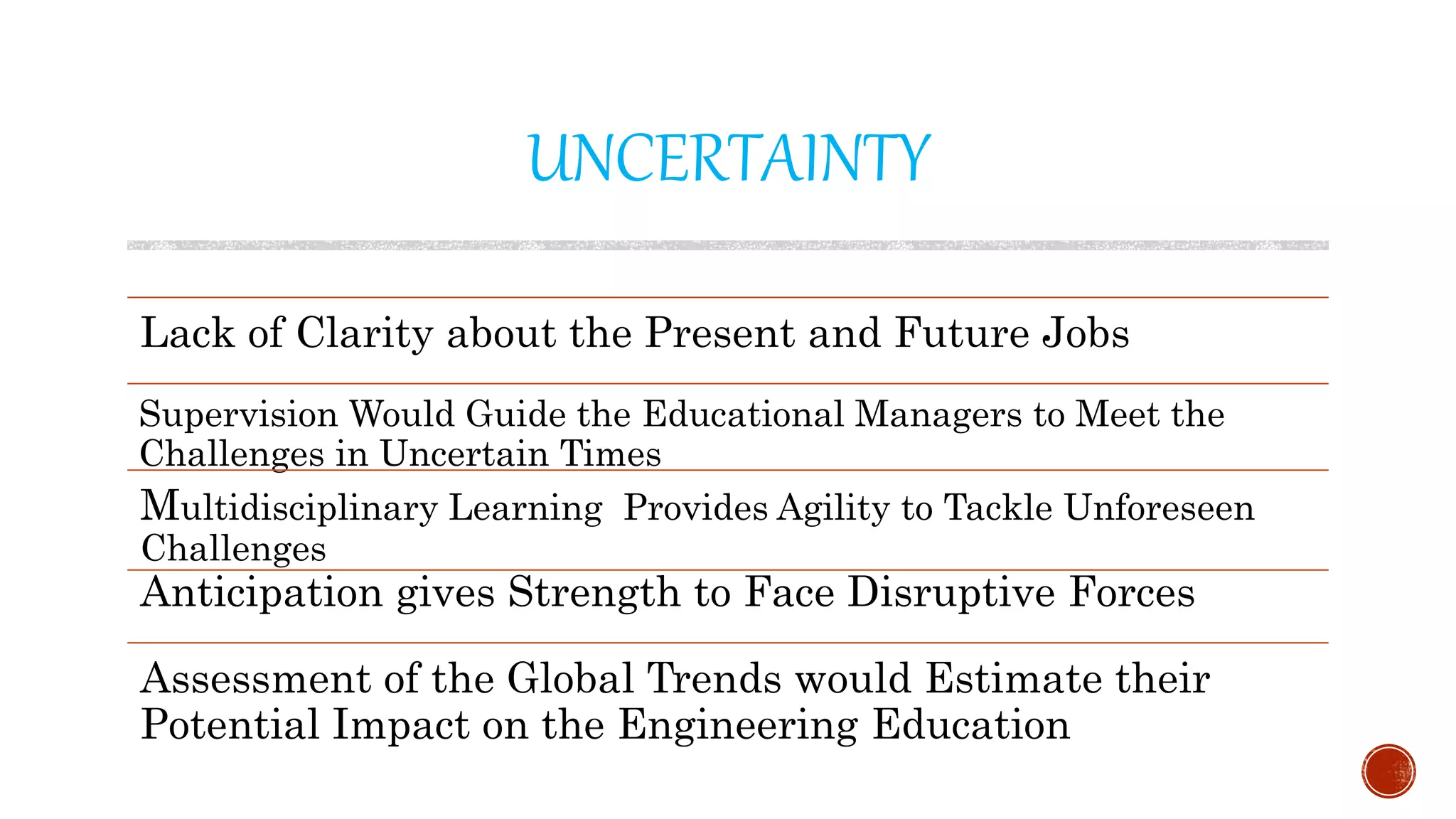
Lack of Clarity about the Present and Future Jobs
Supervision Would Guide the Educational Managers to Meet the
Challenges in Uncertain Times
Multidisciplinary Learning Provides Agility to Tackle Unforeseen
Challenges
Anticipation gives Strength to Face Disruptive Forces
Assessment of the Global Trends would Estimate their
Potential Impact on the Engineering Education
The external environment has many
interconnected parts that can be
overwhelming and confounding.
COMPLEXITY
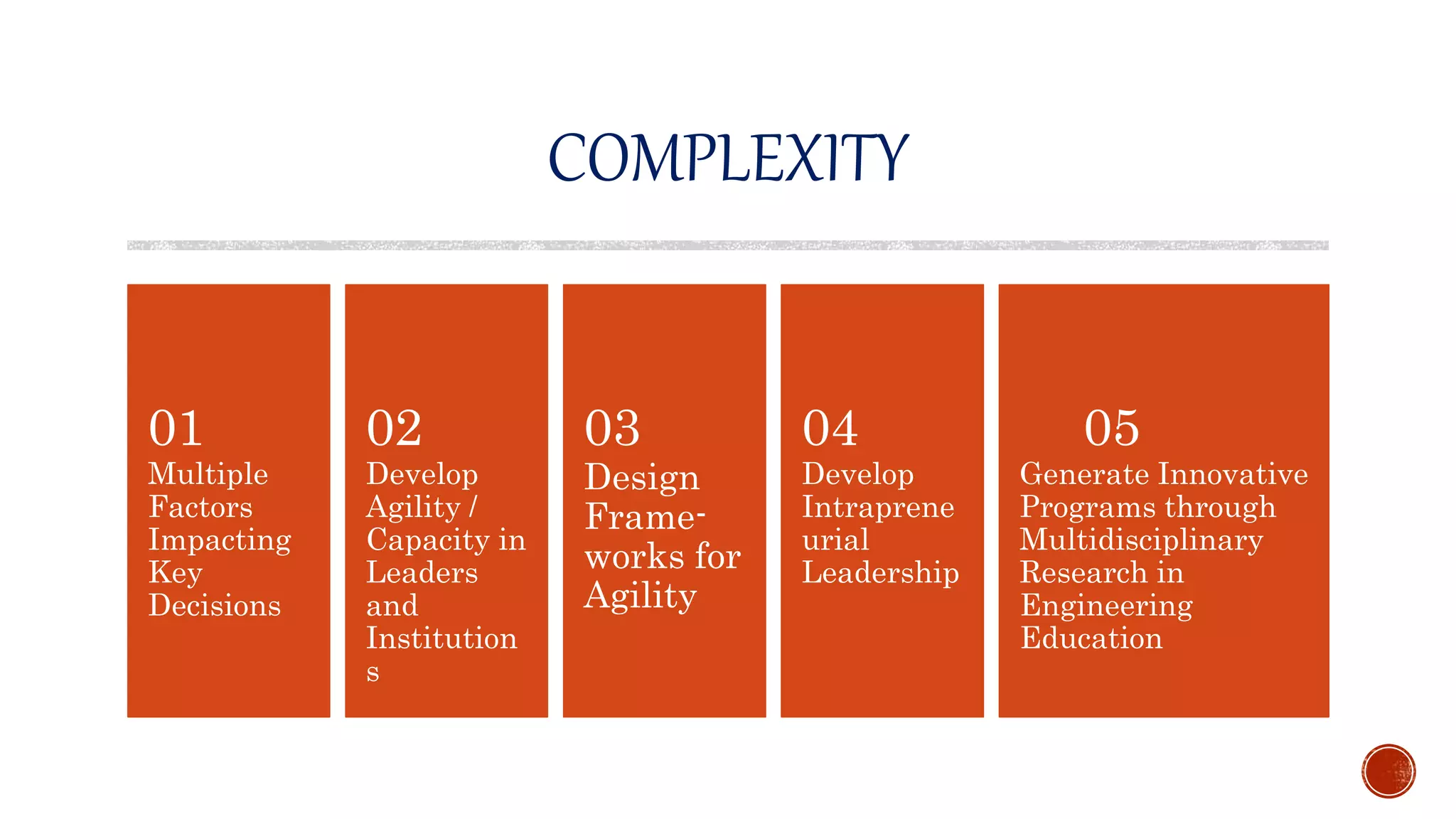
Multiple
Factors
Impacting
Key
Decisions
01
Develop
Agility /
Capacity in
Leaders
and
Institution
s
02
Design
Frame-
works for
Agility
03
Develop
Intraprene
urial
Leadership
04
Generate Innovative
Programs through
Multidisciplinary
Research in
Engineering
Education
05
AMBIGUITY
The external environment is hazy, with many
unknown unknowns, and cause- and-effect is
unclear.
Think of yellow light
Wait for green
Succeed
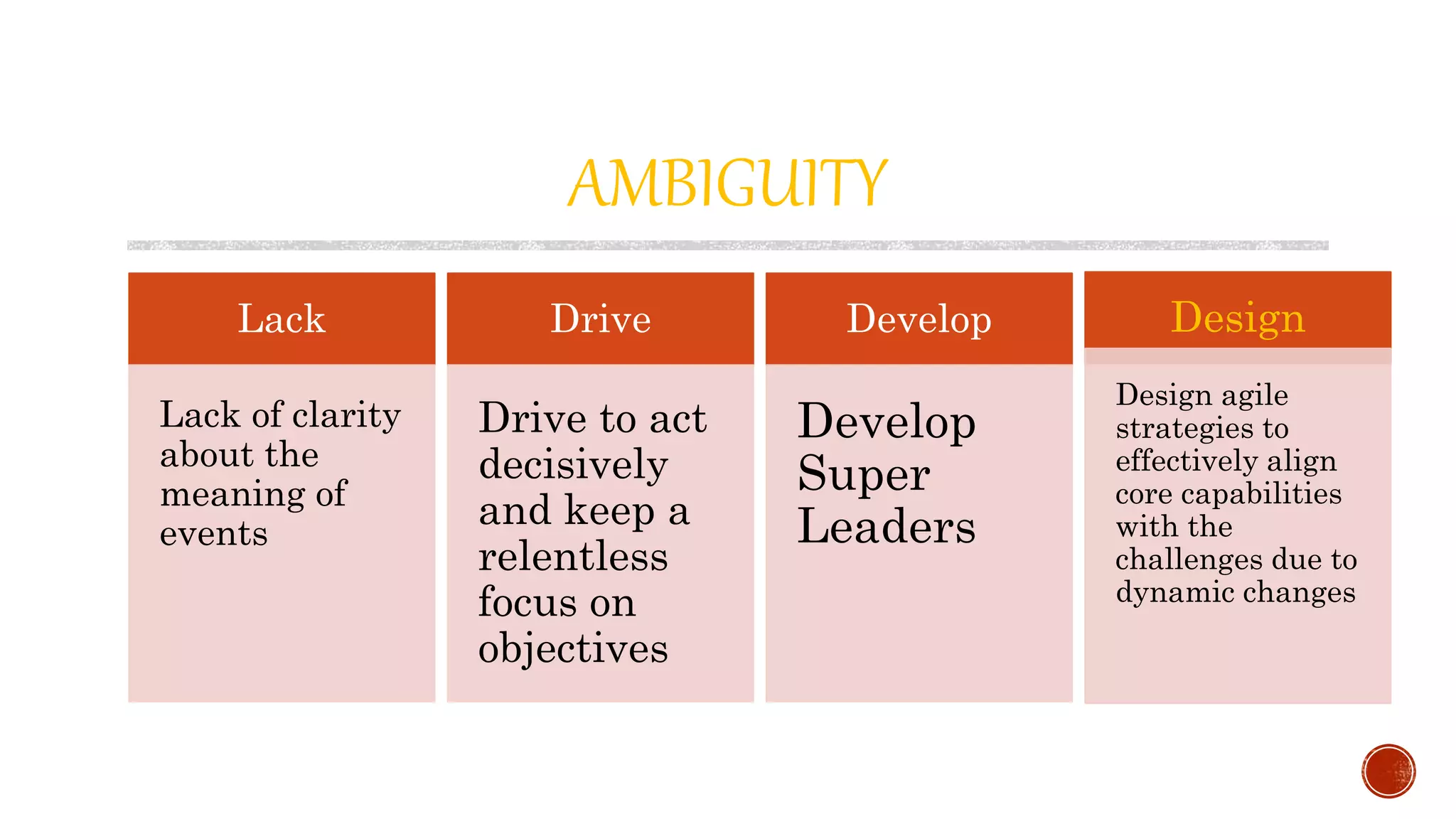
AMBIGUITY
Lack
Lack of clarity
about the
meaning of
events
Drive
Drive to act
decisively
and keep a
relentless
focus on
objectives
Develop
Develop
Super
Leaders
Design
Design agile
strategies to
effectively align
core capabilities
with the
challenges due to
dynamic changes
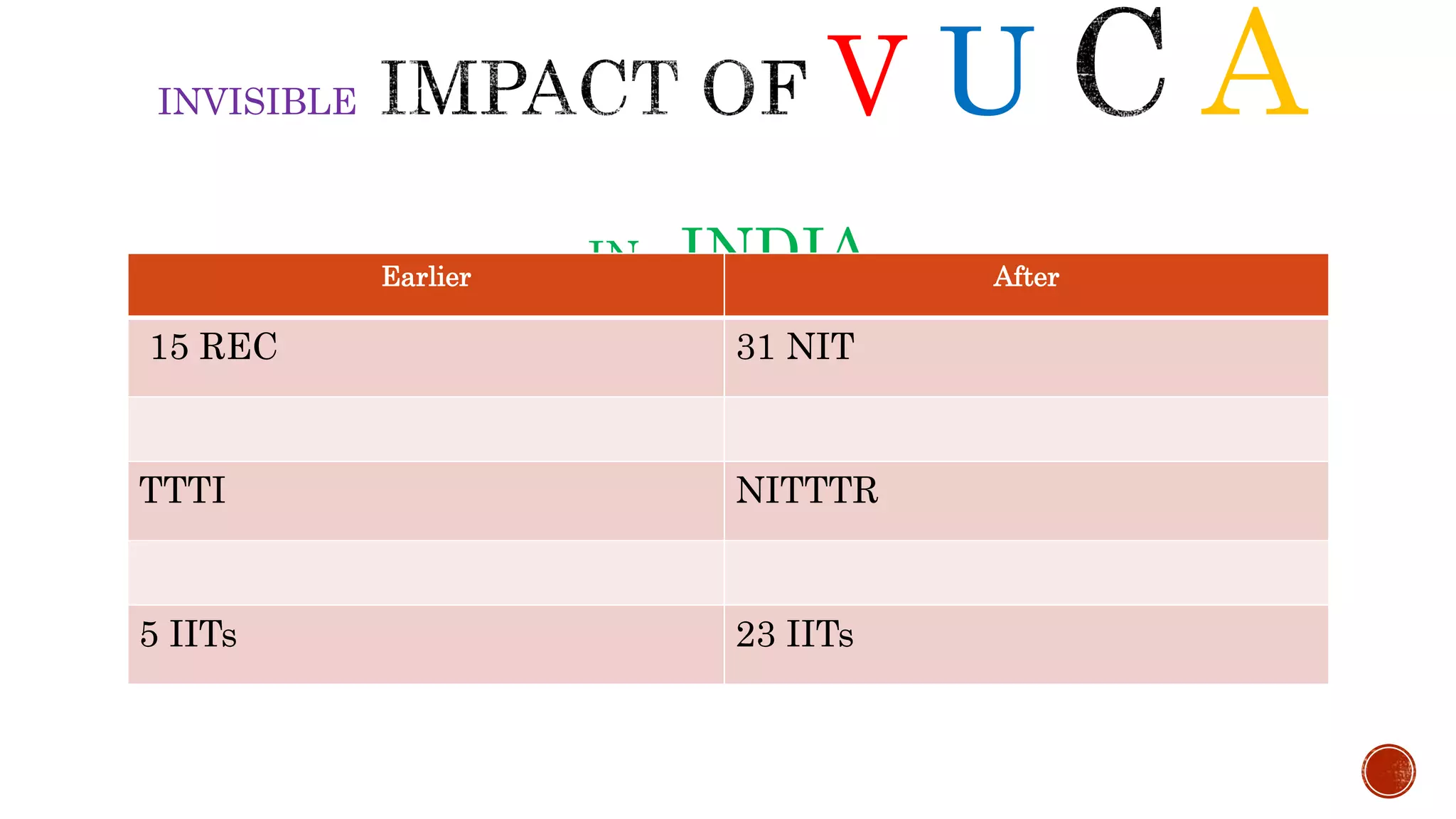
INVISIBLE V U A
IN INDIA
Earlier After
15 REC 31 NIT
TTTI NITTTR
5 IITs 23 IITs
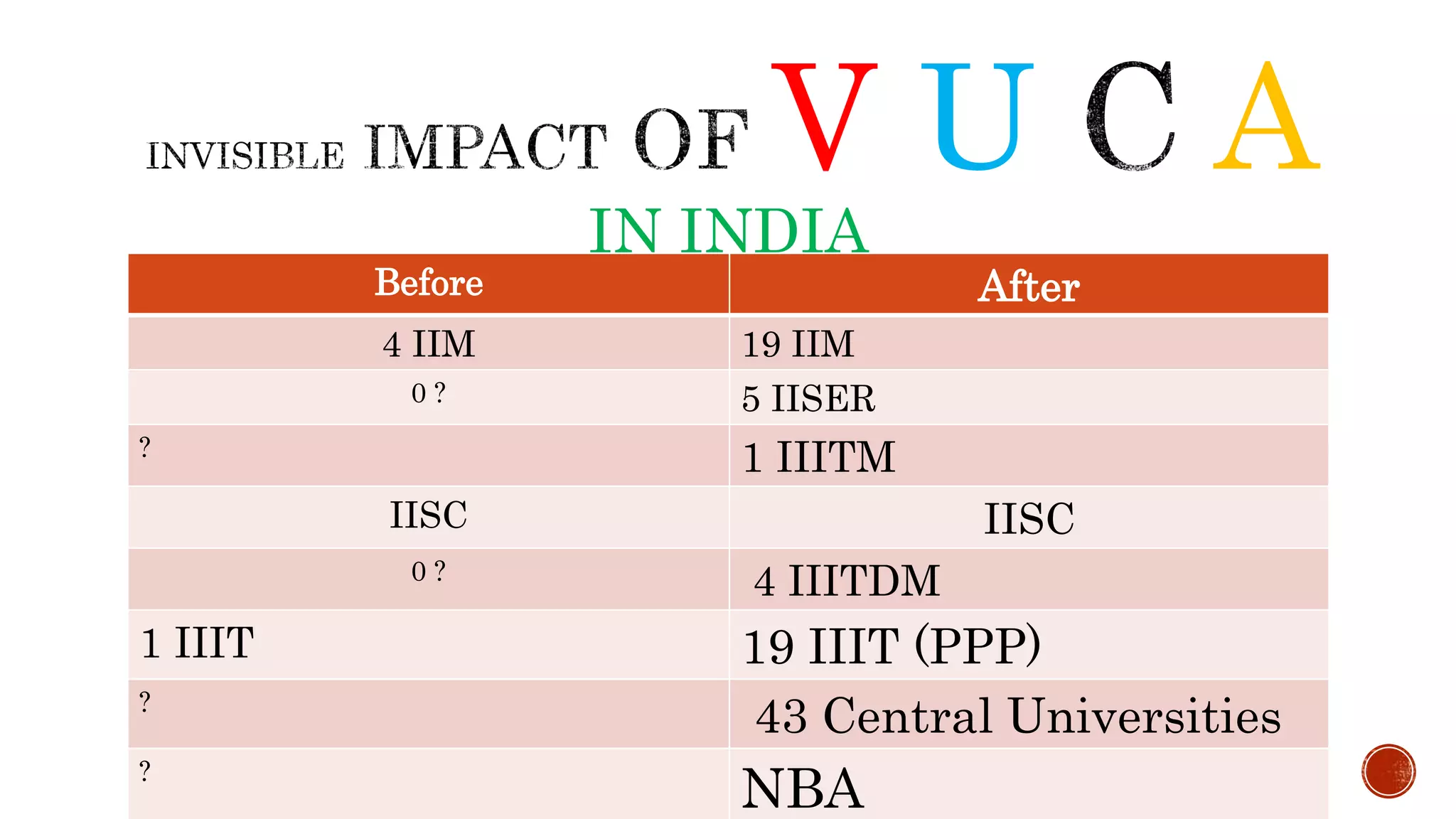
V U A
IN INDIA
Before After
4 IIM 19 IIM
0 ? 5 IISER
?
1 IIITM
IISC IISC
0 ?
4 IIITDM
1 IIIT 19 IIIT (PPP)
?
43 Central Universities
?
NBA
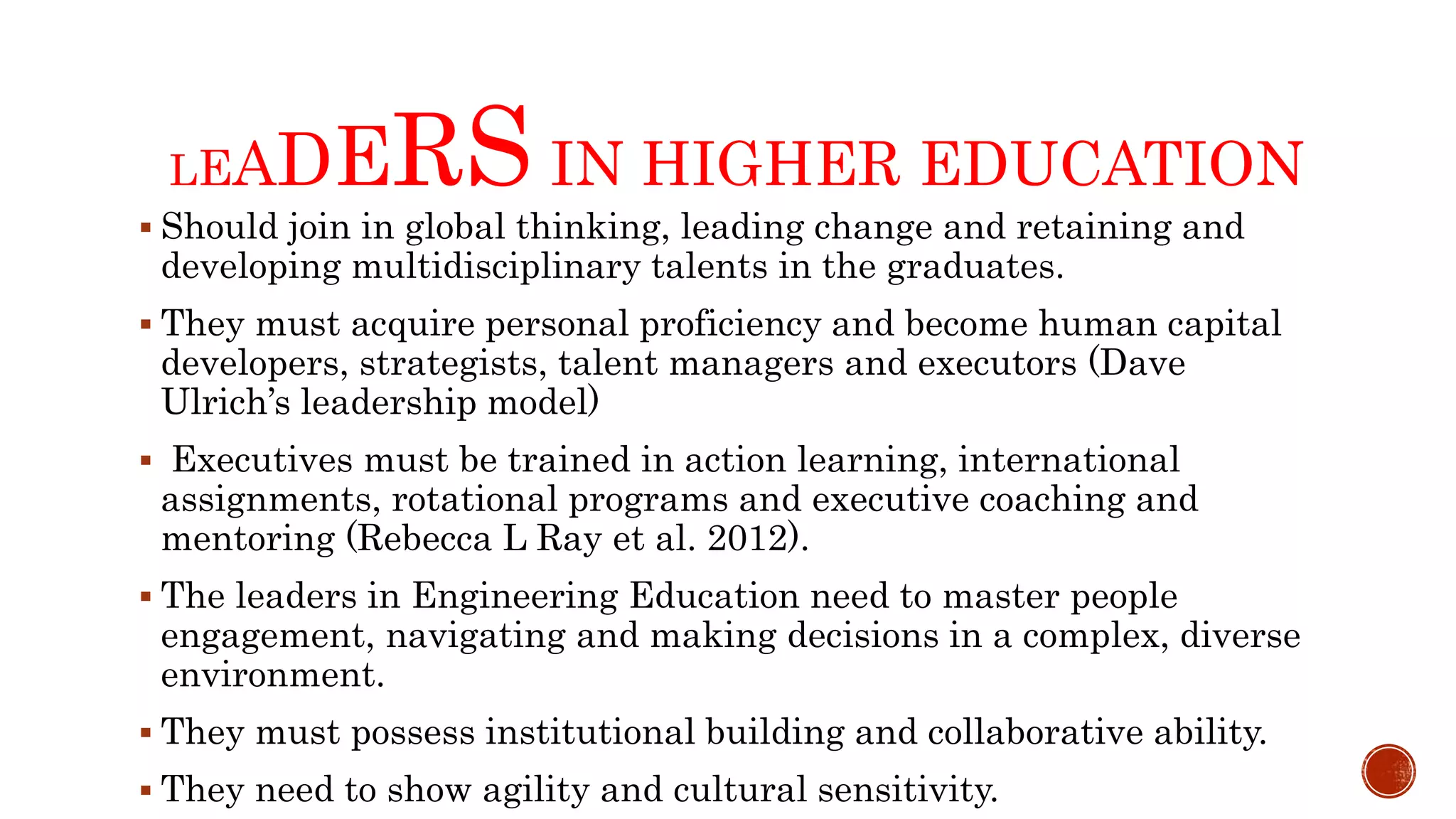
LEADERS IN HIGHER EDUCATION
 Should join in global thinking, leading change and retaining and
developing multidisciplinary talents in the graduates.
 They must acquire personal proficiency and become human capital
developers, strategists, talent managers and executors (Dave
Ulrich’s leadership model)
 Executives must be trained in action learning, international
assignments, rotational programs and executive coaching and
mentoring (Rebecca L Ray et al. 2012).
 The leaders in Engineering Education need to master people
engagement, navigating and making decisions in a complex, diverse
environment.
 They must possess institutional building and collaborative ability.
 They need to show agility and cultural sensitivity.
WHAT
 Higher education should be planned, structured with a formal
process to develop high potentials for the graduates.
 The leaders should have a clear articulation of the selection criteria,
clear road map of development opportunities and a tracking
mechanism to monitor the progress of the faculty.
 The senior faculty members of higher education institutes need
action learning, international assignments, rotational programs and
executive coaching and mentoring (Mitchell, Ray and Van Ark, 2012,
Michael Campbell and Roland Smith, 2012)
 Accelerated leadership development programs are to be carried out
transparently to retain top talent of the faculty.
CONTINUOUS TRANSFORMATION
V U A
Networking among educational management teams while
leveraging their diversity to rethink approaches to the
national and global market(Katherine Jones, Karen
O’Leonard, and Josh Bersin, 2012).
The global context is changing fast, becoming complex
and raising new risks around dealing with context and
raising opportunities that senior led skills around dealing
with context, and complexity ( Mathew Gitshan, 2009)
ROAD MAP
 Each high potential graduate has a career development “ road map”
 High potentials reflect on their career aspirations, the experiences
and education that have led to their current roles in the
organization, and the development they need to reach their goals
(Douglas A Ready, Linda A Hill and Jay A Conger, 2008)
 Competency models guide recruitment strategies as well as
development and training plans (Corporate Executive Board, 2008)
 Leaders who learn to combine the East and West as they shape the
future, make changes happen, develop talent, nurture future human
capital, and take care of themselves to become truly global leaders
(Shalini Shukia, 2012)
Considering the need for developing competent engineers
to face volatility, uncertainty, complexity and ambiguity,
the development strategies adopted in the engineering
education are to be critically reviewed and the gaps are
identified
Suggestions are proposed to develop interventions to
develop human capital to meet the challenges of volatility,
uncertainty, complexity, and ambiguity.
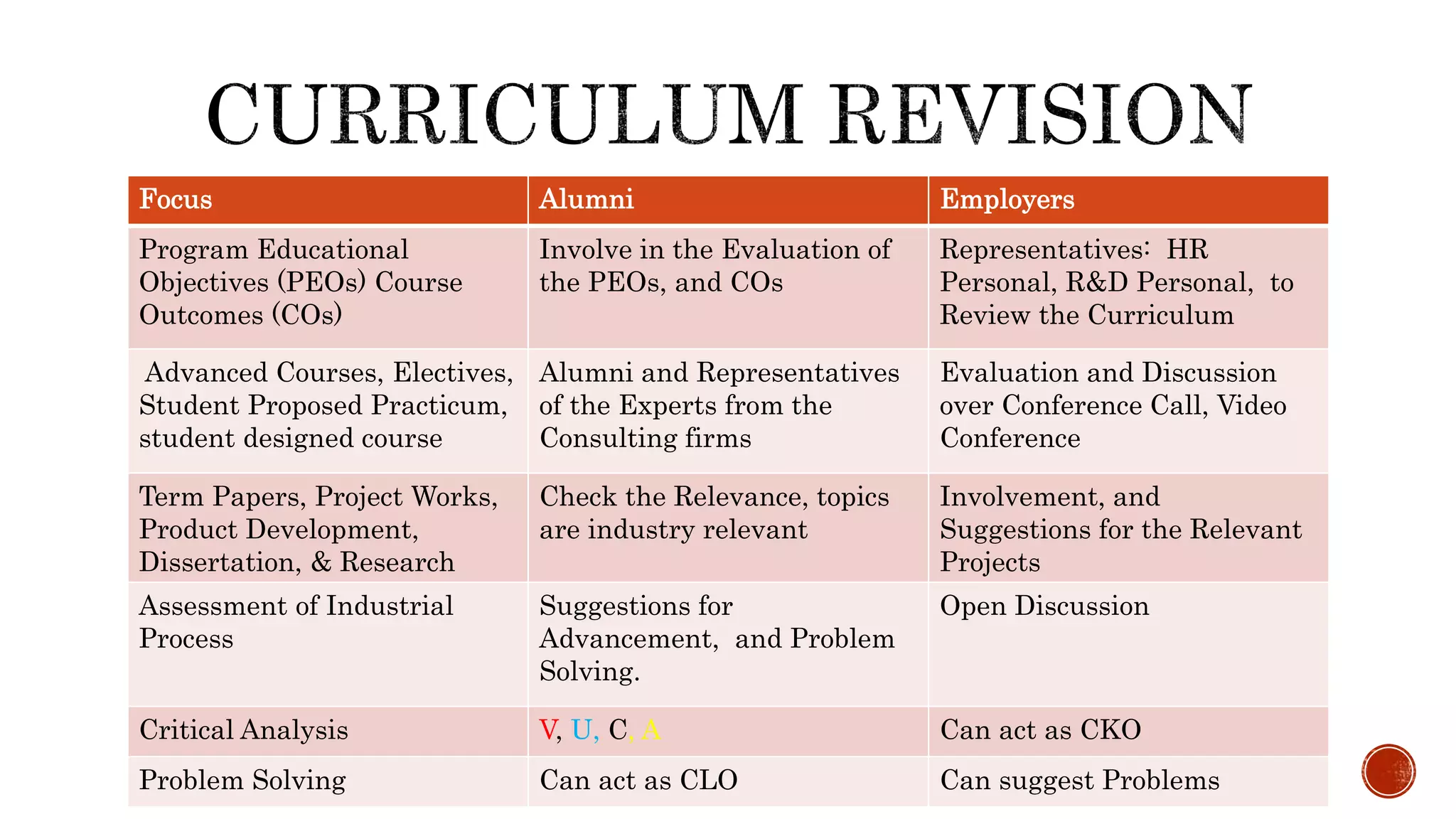
Focus Alumni Employers
Program Educational
Objectives (PEOs) Course
Outcomes (COs)
Involve in the Evaluation of
the PEOs, and COs
Representatives: HR
Personal, R&D Personal, to
Review the Curriculum
Advanced Courses, Electives,
Student Proposed Practicum,
student designed course
Alumni and Representatives
of the Experts from the
Consulting firms
Evaluation and Discussion
over Conference Call, Video
Conference
Term Papers, Project Works,
Product Development,
Dissertation, & Research
Check the Relevance, topics
are industry relevant
Involvement, and
Suggestions for the Relevant
Projects
Assessment of Industrial
Process
Suggestions for
Advancement, and Problem
Solving.
Open Discussion
Critical Analysis V, U, C, A Can act as CKO
Problem Solving Can act as CLO Can suggest Problems
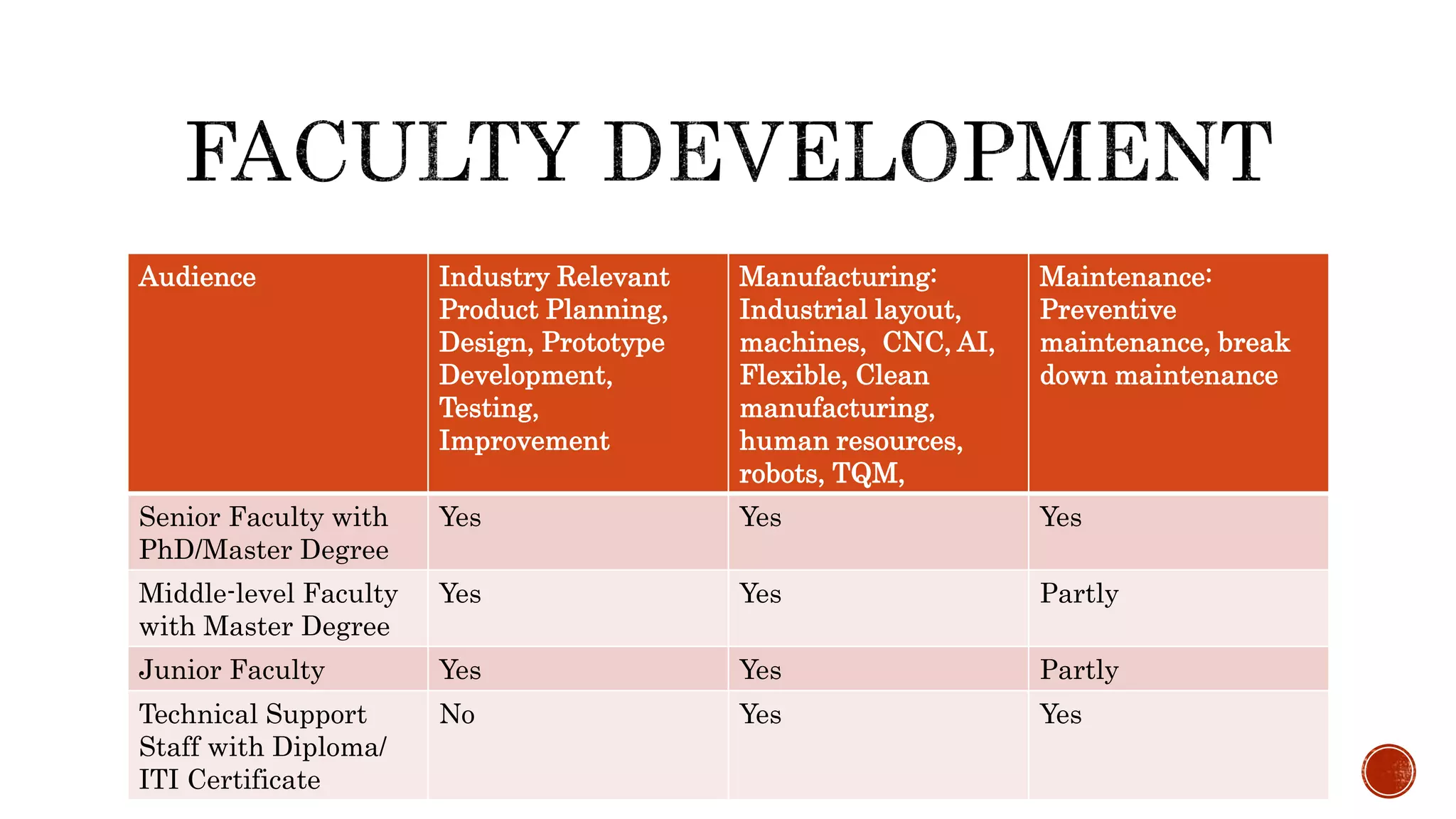
Audience Industry Relevant
Product Planning,
Design, Prototype
Development,
Testing,
Improvement
Manufacturing:
Industrial layout,
machines, CNC, AI,
Flexible, Clean
manufacturing,
human resources,
robots, TQM,
Maintenance:
Preventive
maintenance, break
down maintenance
Senior Faculty with
PhD/Master Degree
Yes Yes Yes
Middle-level Faculty
with Master Degree
Yes Yes Partly
Junior Faculty Yes Yes Partly
Technical Support
Staff with Diploma/
ITI Certificate
No Yes Yes
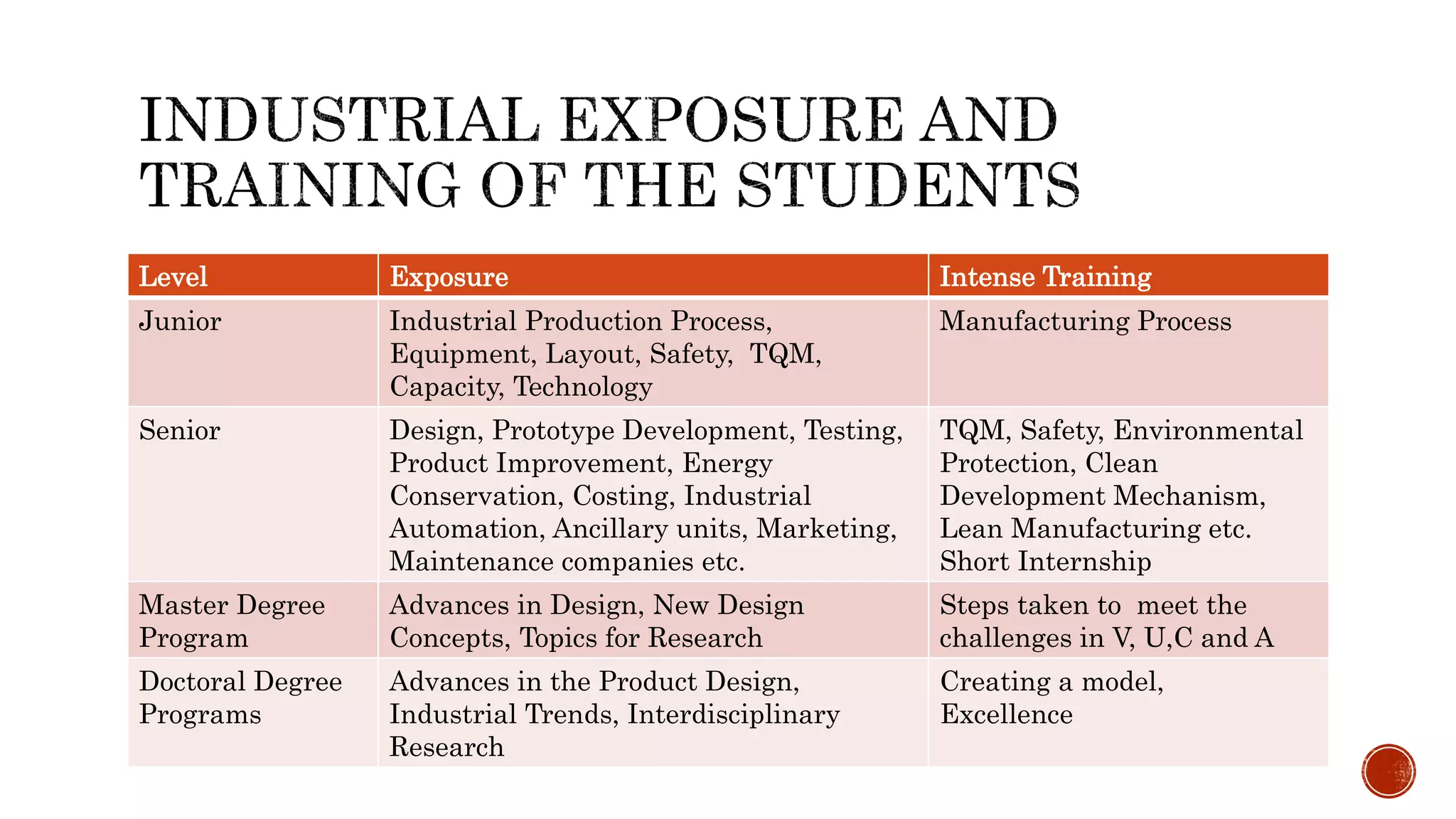
Level Exposure Intense Training
Junior Industrial Production Process,
Equipment, Layout, Safety, TQM,
Capacity, Technology
Manufacturing Process
Senior Design, Prototype Development, Testing,
Product Improvement, Energy
Conservation, Costing, Industrial
Automation, Ancillary units, Marketing,
Maintenance companies etc.
TQM, Safety, Environmental
Protection, Clean
Development Mechanism,
Lean Manufacturing etc.
Short Internship
Master Degree
Program
Advances in Design, New Design
Concepts, Topics for Research
Steps taken to meet the
challenges in V, U,C and A
Doctoral Degree
Programs
Advances in the Product Design,
Industrial Trends, Interdisciplinary
Research
Creating a model,
Excellence
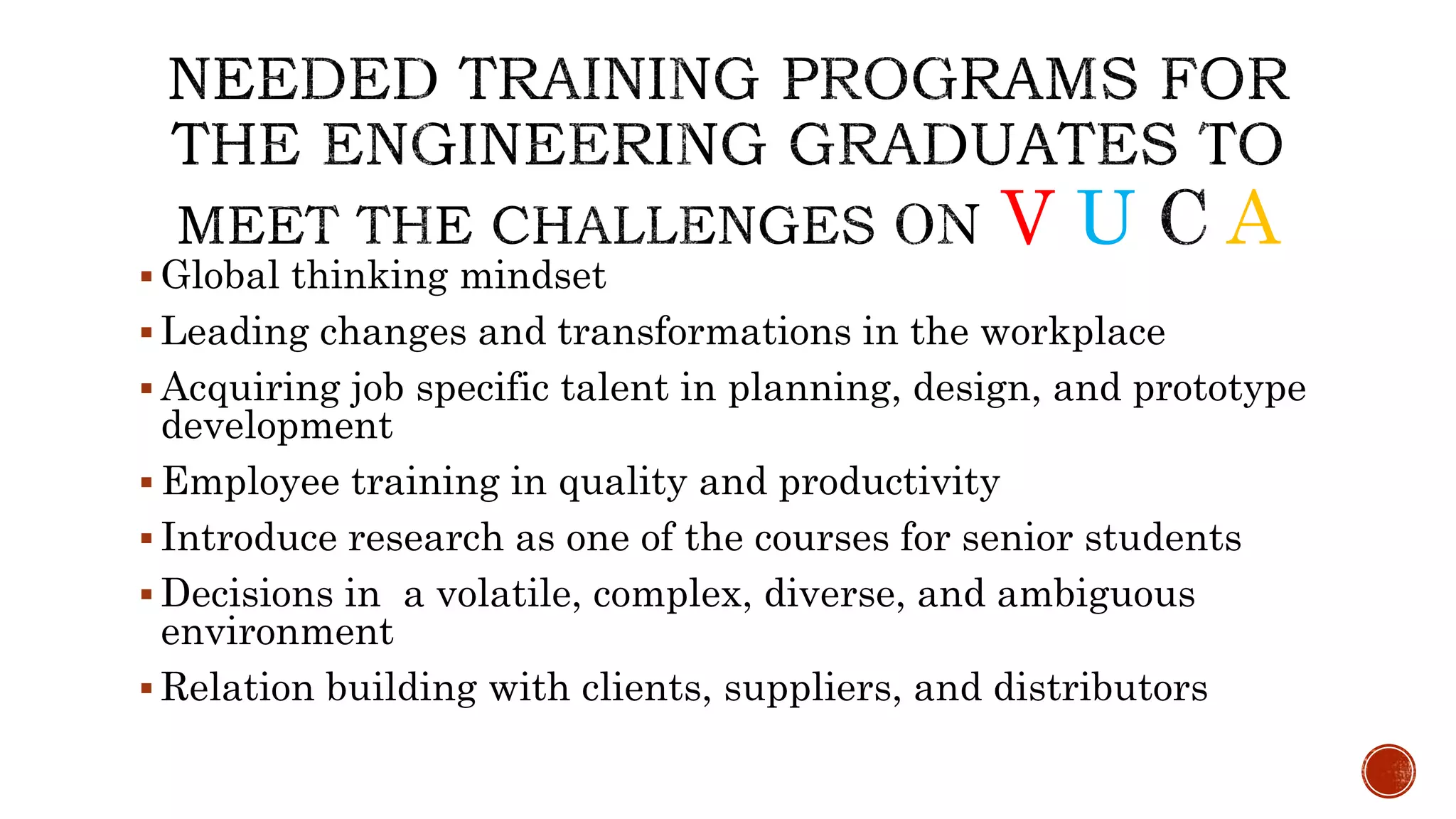
V U A
 Global thinking mindset
 Leading changes and transformations in the workplace
 Acquiring job specific talent in planning, design, and prototype
development
 Employee training in quality and productivity
 Introduce research as one of the courses for senior students
 Decisions in a volatile, complex, diverse, and ambiguous
environment
 Relation building with clients, suppliers, and distributors
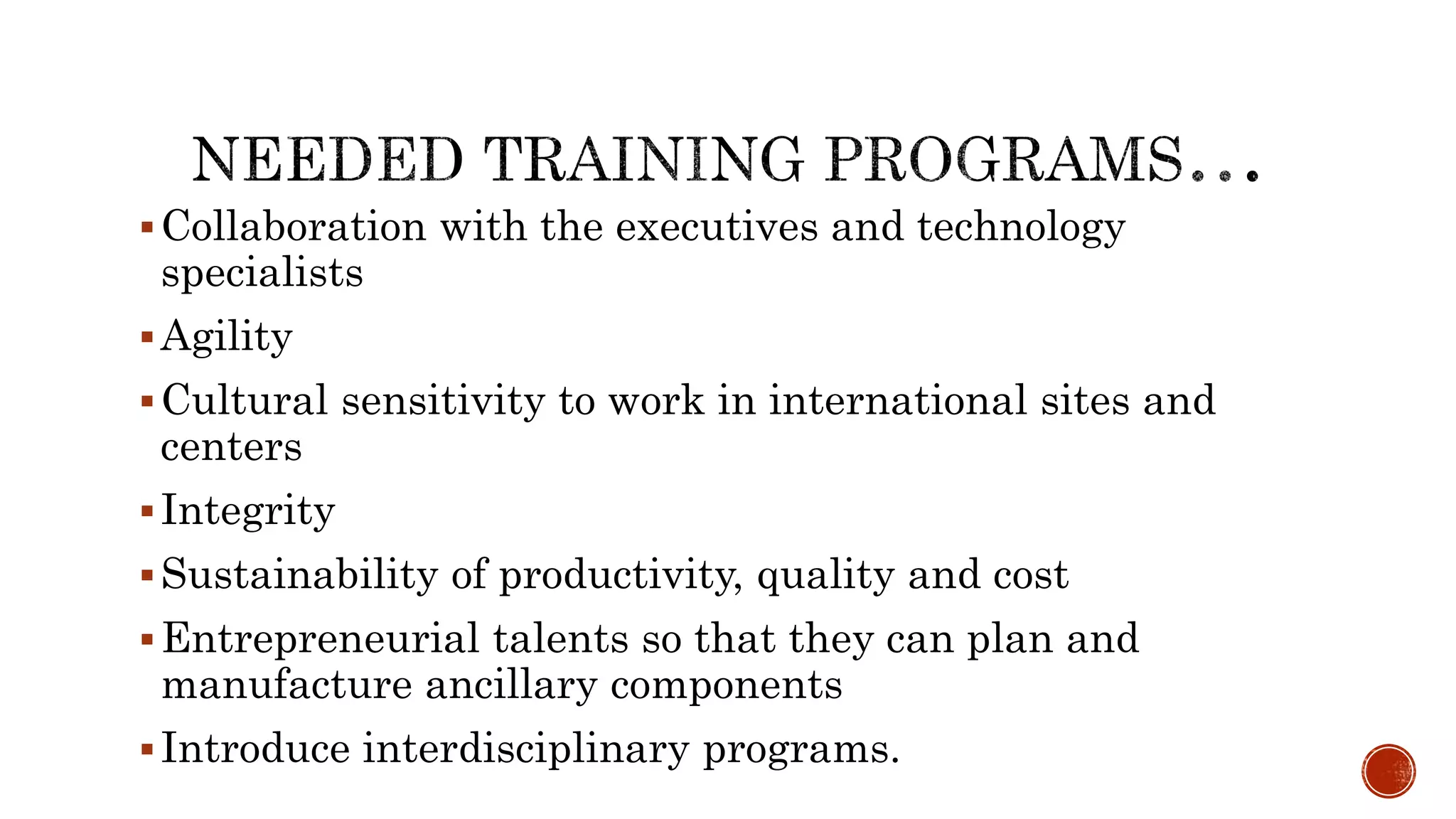
Collaboration with the executives and technology
specialists
Agility
Cultural sensitivity to work in international sites and
centers
Integrity
Sustainability of productivity, quality and cost
Entrepreneurial talents so that they can plan and
manufacture ancillary components
Introduce interdisciplinary programs.
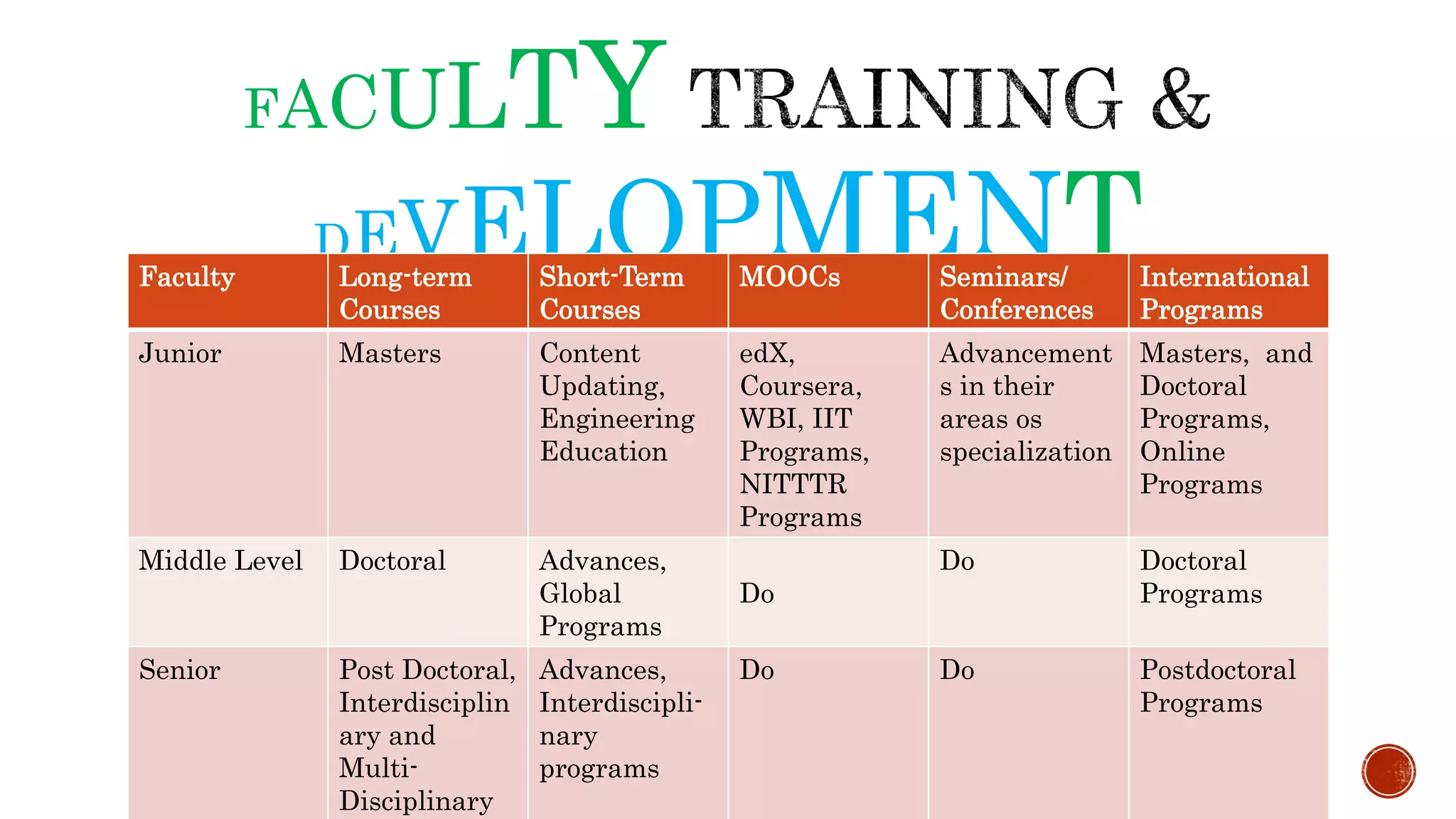
FACULTY
DEVELOPMENT
Faculty Long-term
Courses
Short-Term
Courses
MOOCs Seminars/
Conferences
International
Programs
Junior Masters Content
Updating,
Engineering
Education
edX,
Coursera,
WBI, IIT
Programs,
NITTTR
Programs
Advancement
s in their
areas os
specialization
Masters, and
Doctoral
Programs,
Online
Programs
Middle Level Doctoral Advances,
Global
Programs
Do
Do Doctoral
Programs
Senior Post Doctoral,
Interdisciplin
ary and
Multi-
Disciplinary
Advances,
Interdiscipli-
nary
programs
Do Do Postdoctoral
Programs
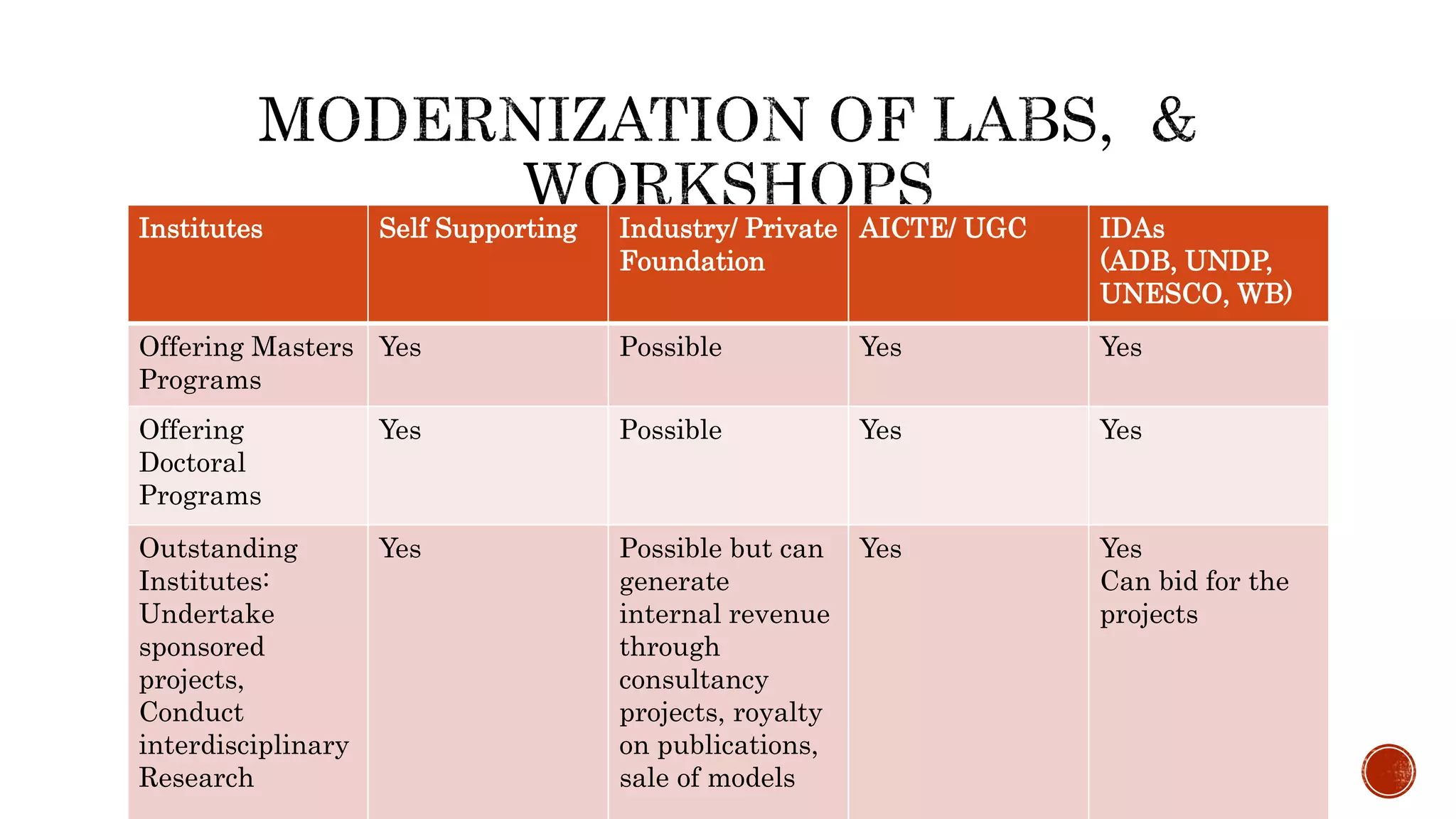
Institutes Self Supporting Industry/ Private
Foundation
AICTE/ UGC IDAs
(ADB, UNDP,
UNESCO, WB)
Offering Masters
Programs
Yes Possible Yes Yes
Offering
Doctoral
Programs
Yes Possible Yes Yes
Outstanding
Institutes:
Undertake
sponsored
projects,
Conduct
interdisciplinary
Research
Yes Possible but can
generate
internal revenue
through
consultancy
projects, royalty
on publications,
sale of models
Yes Yes
Can bid for the
projects
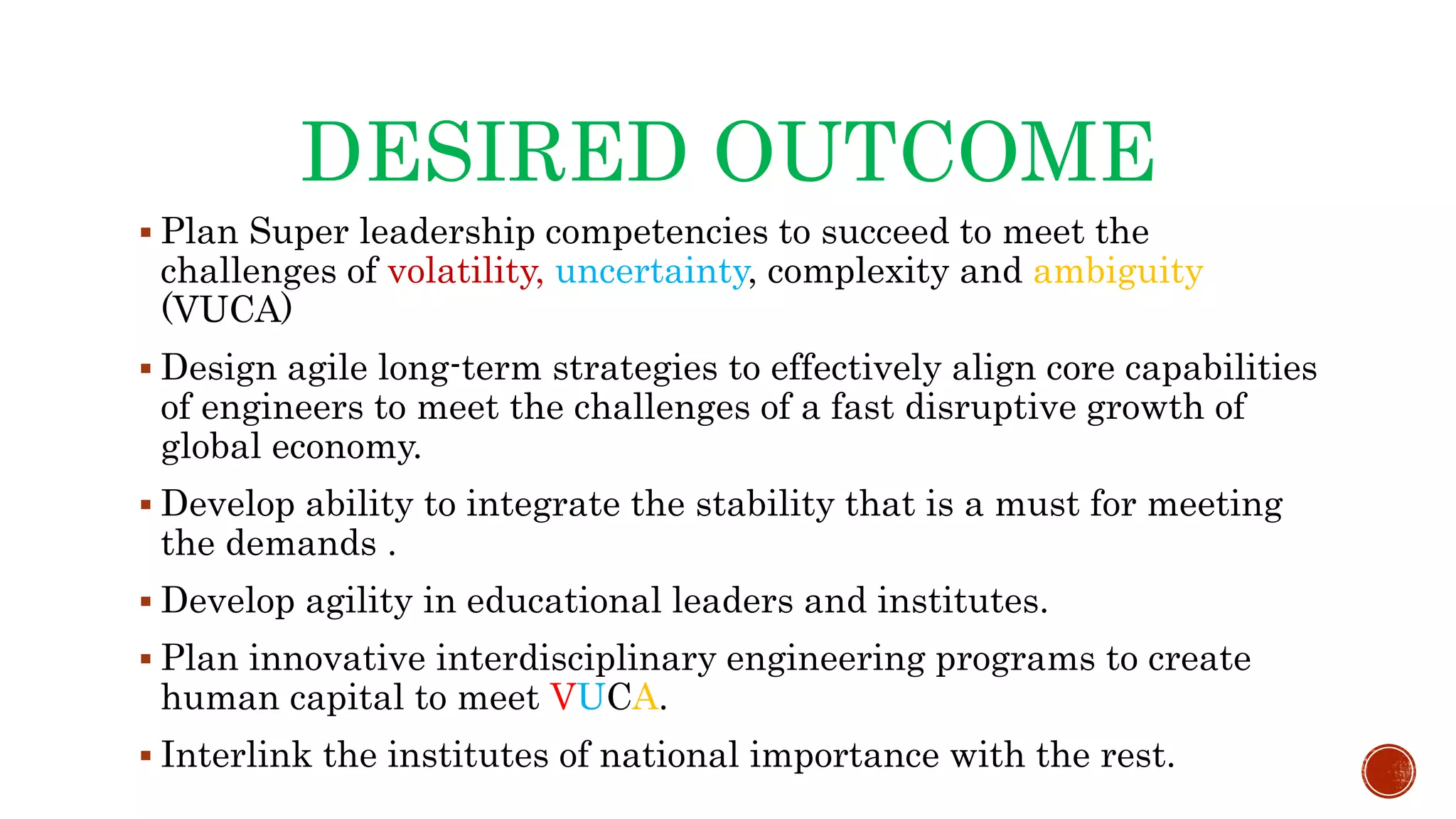
DESIRED OUTCOME
 Plan Super leadership competencies to succeed to meet the
challenges of volatility, uncertainty, complexity and ambiguity
(VUCA)
 Design agile long-term strategies to effectively align core capabilities
of engineers to meet the challenges of a fast disruptive growth of
global economy.
 Develop ability to integrate the stability that is a must for meeting
the demands .
 Develop agility in educational leaders and institutes.
 Plan innovative interdisciplinary engineering programs to create
human capital to meet VUCA.
 Interlink the institutes of national importance with the rest.
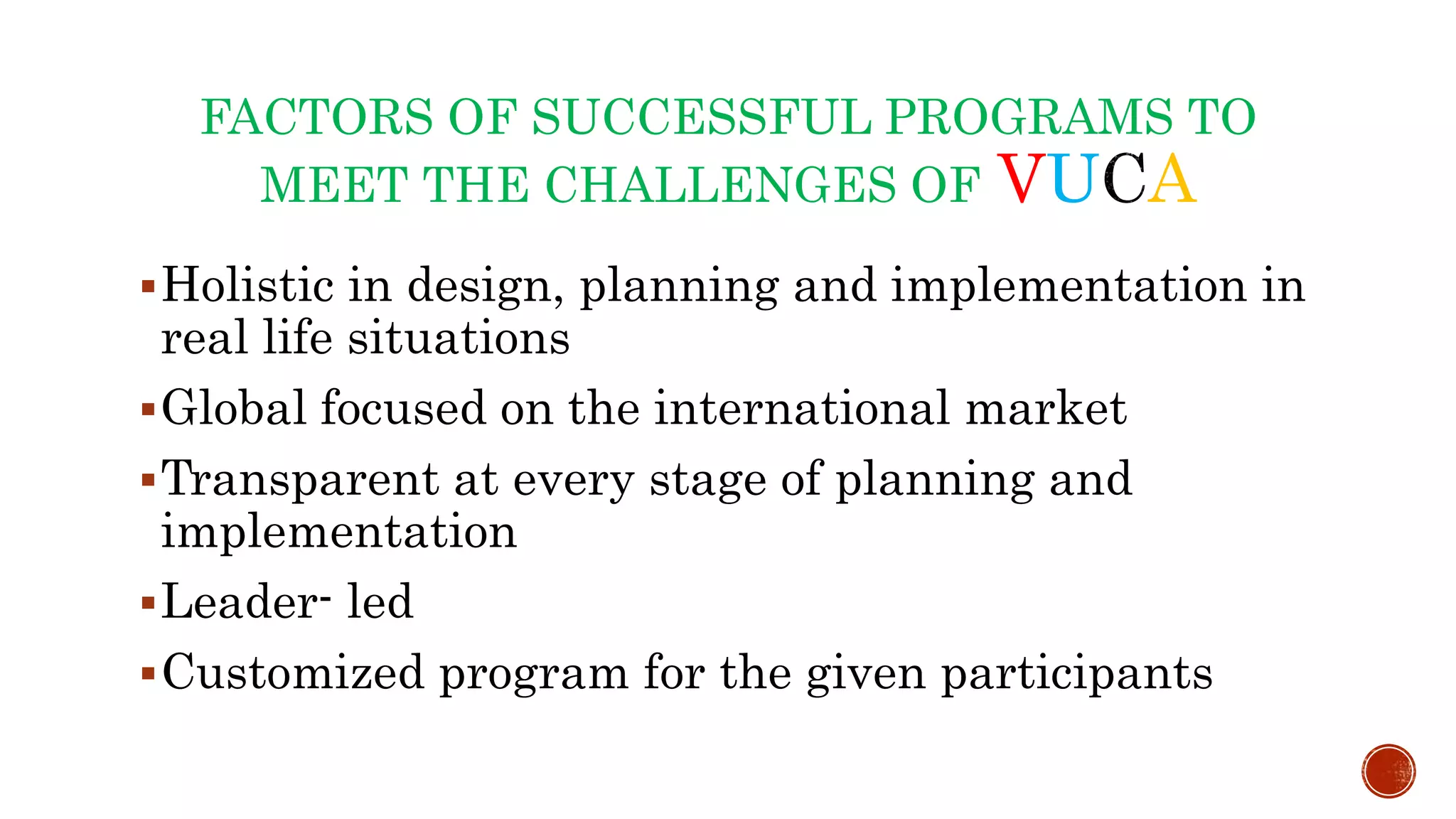
FACTORS OF SUCCESSFUL PROGRAMS TO
MEET THE CHALLENGES OF VU A
Holistic in design, planning and implementation in
real life situations
Global focused on the international market
Transparent at every stage of planning and
implementation
Leader- led
Customized program for the given participants
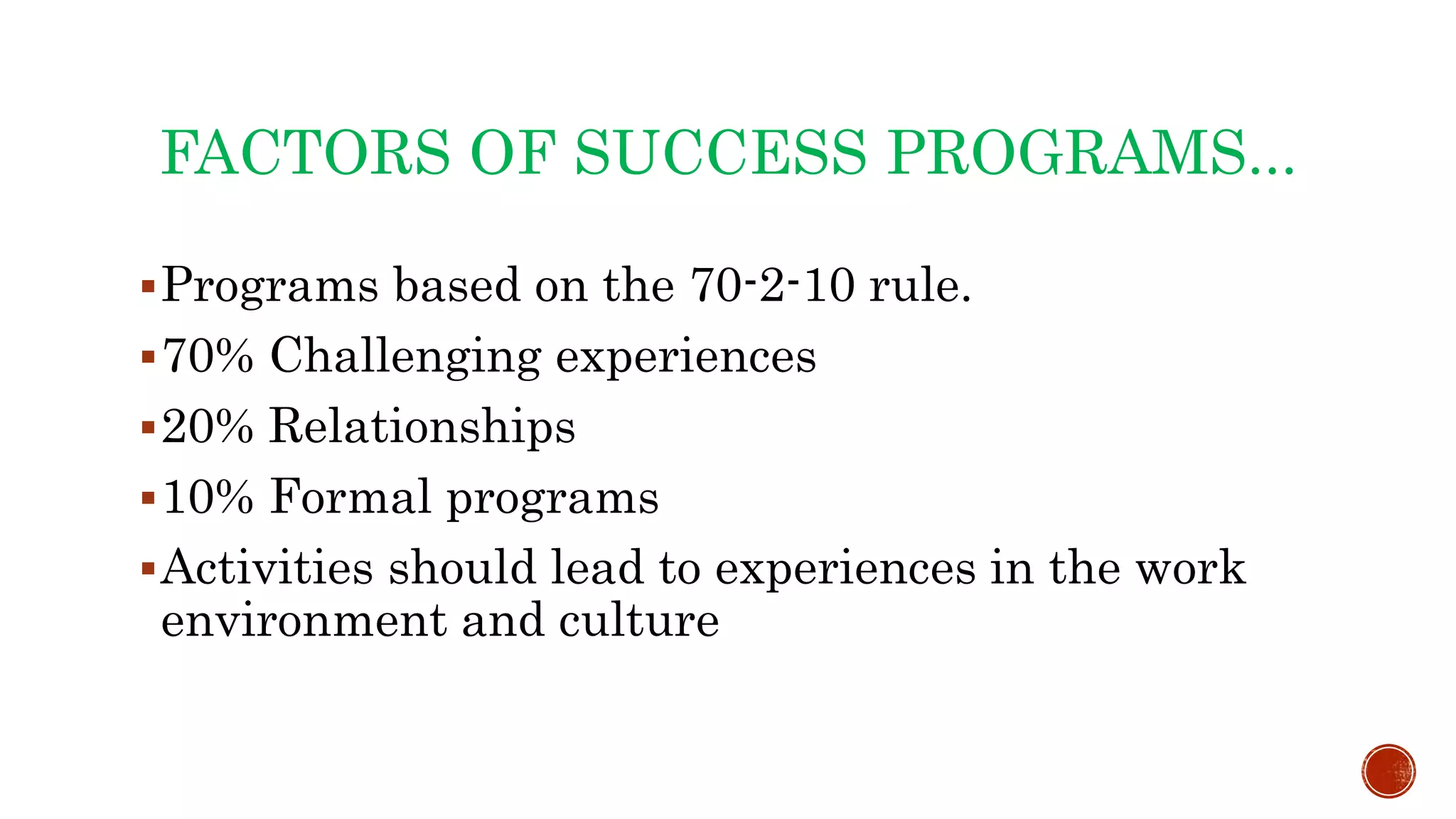
FACTORS OF SUCCESS PROGRAMS...
Programs based on the 70-2-10 rule.
70% Challenging experiences
20% Relationships
10% Formal programs
Activities should lead to experiences in the work
environment and culture
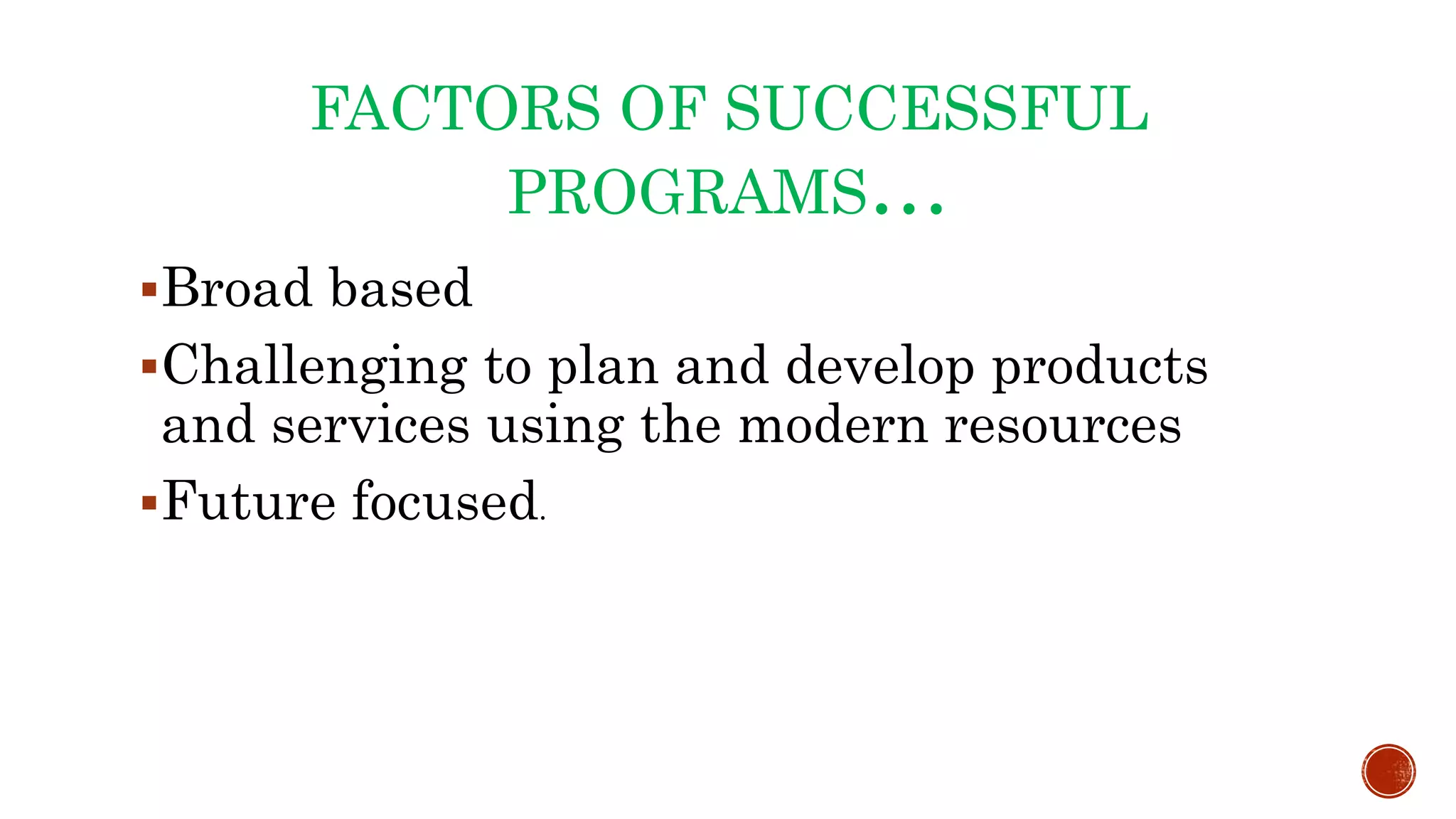
FACTORS OF SUCCESSFUL
PROGRAMS…
Broad based
Challenging to plan and develop products
and services using the modern resources
Future focused.
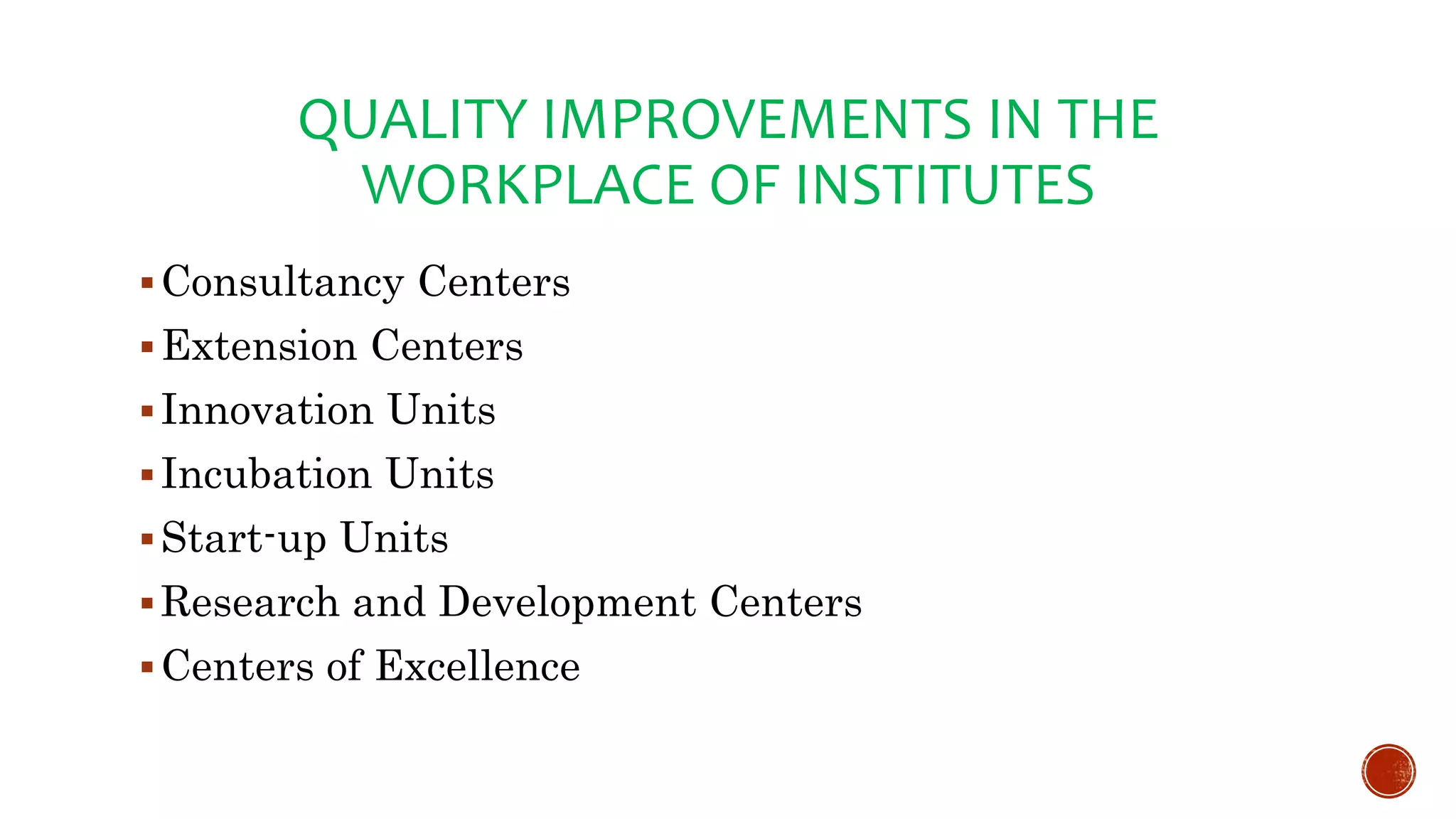
QUALITY IMPROVEMENTS IN THE
WORKPLACE OF INSTITUTES
Consultancy Centers
Extension Centers
Innovation Units
Incubation Units
Start-up Units
Research and Development Centers
Centers of Excellence
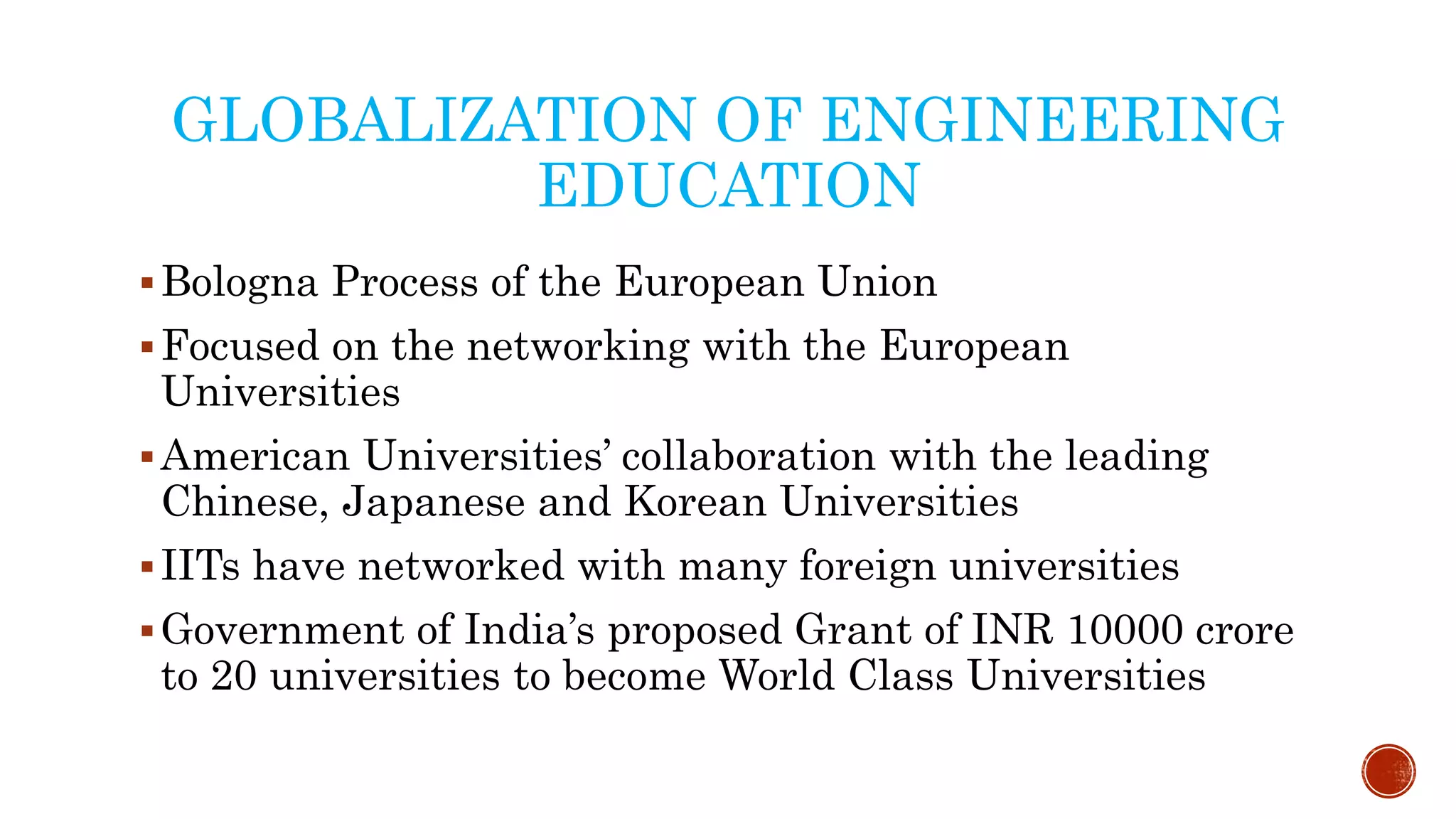
GLOBALIZATION OF ENGINEERING
EDUCATION
Bologna Process of the European Union
Focused on the networking with the European
Universities
American Universities’ collaboration with the leading
Chinese, Japanese and Korean Universities
IITs have networked with many foreign universities
Government of India’s proposed Grant of INR 10000 crore
to 20 universities to become World Class Universities
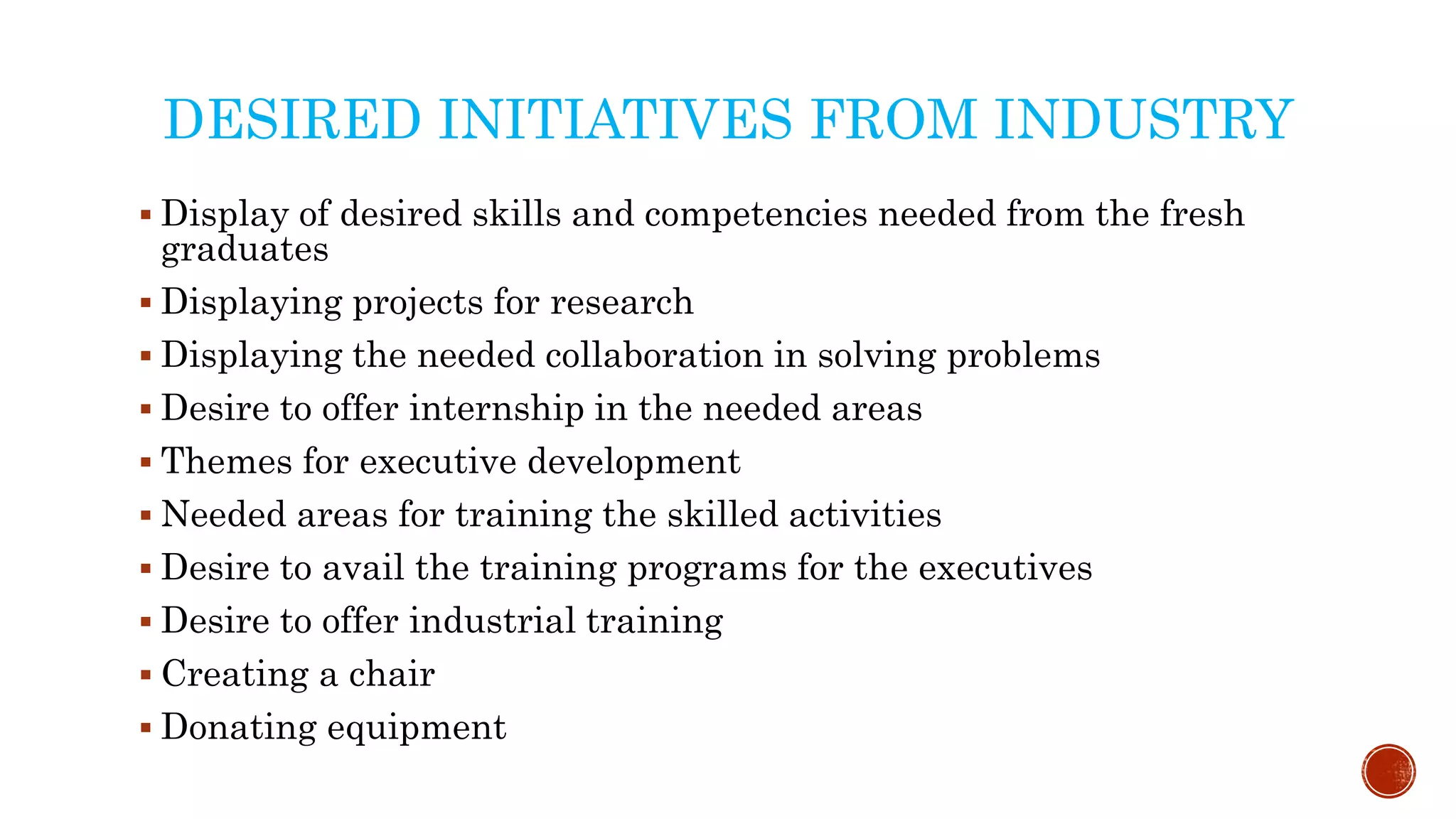
DESIRED INITIATIVES FROM INDUSTRY
 Display of desired skills and competencies needed from the fresh
graduates
 Displaying projects for research
 Displaying the needed collaboration in solving problems
 Desire to offer internship in the needed areas
 Themes for executive development
 Needed areas for training the skilled activities
 Desire to avail the training programs for the executives
 Desire to offer industrial training
 Creating a chair
 Donating equipment
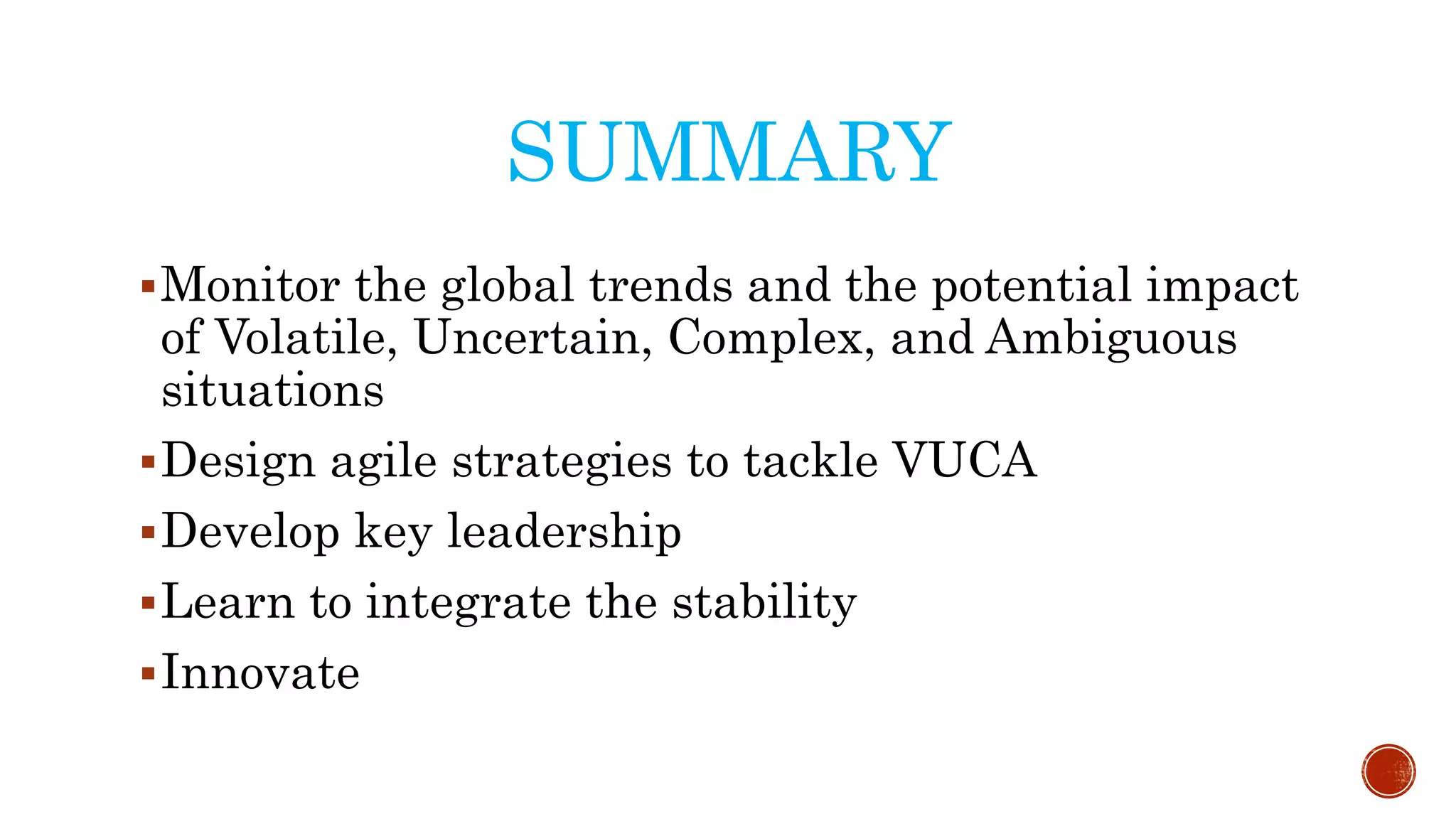
SUMMARY
Monitor the global trends and the potential impact
of Volatile, Uncertain, Complex, and Ambiguous
situations
Design agile strategies to tackle VUCA
Develop key leadership
Learn to integrate the stability
Innovate
THANK YOU
Your Questions Please
 (vthani2025@gmail.com)

Institutional transformation and development in the engineering education (1)

  • 1.
    INSTITUTIONAL TRANSFORMATION AND DEVELOPMENTIN THE ENGINEERING EDUCATION TO MEET THE VOLATILITY, UNCERTAINTY, COMPLEXITY AND AMBIGUITY Thanikachalam Vedhathiri (vthani2025@yahoo.in)
  • 2.
  • 3.
    VOLATILITY The external environmentis unstable. Presents challenges that are infinite at great speed. Old products are wiped out Formal degrees lose their value Multidisciplinary programs are needed New products invade the market Their half life is also limited!
  • 4.
    VOLATILITY V: Volatility A HighRate of Change due to AI Job shift in manufacturing, software etc. Robots take the jobs Engineers and Technologists with multidisciplinary skills are needed Learning to provide agility to tackle unforeseen challenges Develop Super leaders to succeed in the face of volatility
  • 5.
    UNCERTAINTY Unprecedented trends inthe external environment. The long-term trajectories are more difficult to predict. Create a blueprint to meet the uncertainty!
  • 6.
    UNCERTAINTY Lack of Clarityabout the Present and Future Jobs Supervision Would Guide the Educational Managers to Meet the Challenges in Uncertain Times Multidisciplinary Learning Provides Agility to Tackle Unforeseen Challenges Anticipation gives Strength to Face Disruptive Forces Assessment of the Global Trends would Estimate their Potential Impact on the Engineering Education
  • 7.
    The external environmenthas many interconnected parts that can be overwhelming and confounding.
  • 8.
    COMPLEXITY Multiple Factors Impacting Key Decisions 01 Develop Agility / Capacity in Leaders and Institution s 02 Design Frame- worksfor Agility 03 Develop Intraprene urial Leadership 04 Generate Innovative Programs through Multidisciplinary Research in Engineering Education 05
  • 9.
    AMBIGUITY The external environmentis hazy, with many unknown unknowns, and cause- and-effect is unclear. Think of yellow light Wait for green Succeed
  • 10.
    AMBIGUITY Lack Lack of clarity aboutthe meaning of events Drive Drive to act decisively and keep a relentless focus on objectives Develop Develop Super Leaders Design Design agile strategies to effectively align core capabilities with the challenges due to dynamic changes
  • 11.
    INVISIBLE V UA IN INDIA Earlier After 15 REC 31 NIT TTTI NITTTR 5 IITs 23 IITs
  • 12.
    V U A ININDIA Before After 4 IIM 19 IIM 0 ? 5 IISER ? 1 IIITM IISC IISC 0 ? 4 IIITDM 1 IIIT 19 IIIT (PPP) ? 43 Central Universities ? NBA
  • 13.
    LEADERS IN HIGHEREDUCATION  Should join in global thinking, leading change and retaining and developing multidisciplinary talents in the graduates.  They must acquire personal proficiency and become human capital developers, strategists, talent managers and executors (Dave Ulrich’s leadership model)  Executives must be trained in action learning, international assignments, rotational programs and executive coaching and mentoring (Rebecca L Ray et al. 2012).  The leaders in Engineering Education need to master people engagement, navigating and making decisions in a complex, diverse environment.  They must possess institutional building and collaborative ability.  They need to show agility and cultural sensitivity.
  • 14.
    WHAT  Higher educationshould be planned, structured with a formal process to develop high potentials for the graduates.  The leaders should have a clear articulation of the selection criteria, clear road map of development opportunities and a tracking mechanism to monitor the progress of the faculty.  The senior faculty members of higher education institutes need action learning, international assignments, rotational programs and executive coaching and mentoring (Mitchell, Ray and Van Ark, 2012, Michael Campbell and Roland Smith, 2012)  Accelerated leadership development programs are to be carried out transparently to retain top talent of the faculty.
  • 15.
    CONTINUOUS TRANSFORMATION V UA Networking among educational management teams while leveraging their diversity to rethink approaches to the national and global market(Katherine Jones, Karen O’Leonard, and Josh Bersin, 2012). The global context is changing fast, becoming complex and raising new risks around dealing with context and raising opportunities that senior led skills around dealing with context, and complexity ( Mathew Gitshan, 2009)
  • 16.
    ROAD MAP  Eachhigh potential graduate has a career development “ road map”  High potentials reflect on their career aspirations, the experiences and education that have led to their current roles in the organization, and the development they need to reach their goals (Douglas A Ready, Linda A Hill and Jay A Conger, 2008)  Competency models guide recruitment strategies as well as development and training plans (Corporate Executive Board, 2008)  Leaders who learn to combine the East and West as they shape the future, make changes happen, develop talent, nurture future human capital, and take care of themselves to become truly global leaders (Shalini Shukia, 2012)
  • 17.
    Considering the needfor developing competent engineers to face volatility, uncertainty, complexity and ambiguity, the development strategies adopted in the engineering education are to be critically reviewed and the gaps are identified Suggestions are proposed to develop interventions to develop human capital to meet the challenges of volatility, uncertainty, complexity, and ambiguity.
  • 18.
    Focus Alumni Employers ProgramEducational Objectives (PEOs) Course Outcomes (COs) Involve in the Evaluation of the PEOs, and COs Representatives: HR Personal, R&D Personal, to Review the Curriculum Advanced Courses, Electives, Student Proposed Practicum, student designed course Alumni and Representatives of the Experts from the Consulting firms Evaluation and Discussion over Conference Call, Video Conference Term Papers, Project Works, Product Development, Dissertation, & Research Check the Relevance, topics are industry relevant Involvement, and Suggestions for the Relevant Projects Assessment of Industrial Process Suggestions for Advancement, and Problem Solving. Open Discussion Critical Analysis V, U, C, A Can act as CKO Problem Solving Can act as CLO Can suggest Problems
  • 19.
    Audience Industry Relevant ProductPlanning, Design, Prototype Development, Testing, Improvement Manufacturing: Industrial layout, machines, CNC, AI, Flexible, Clean manufacturing, human resources, robots, TQM, Maintenance: Preventive maintenance, break down maintenance Senior Faculty with PhD/Master Degree Yes Yes Yes Middle-level Faculty with Master Degree Yes Yes Partly Junior Faculty Yes Yes Partly Technical Support Staff with Diploma/ ITI Certificate No Yes Yes
  • 20.
    Level Exposure IntenseTraining Junior Industrial Production Process, Equipment, Layout, Safety, TQM, Capacity, Technology Manufacturing Process Senior Design, Prototype Development, Testing, Product Improvement, Energy Conservation, Costing, Industrial Automation, Ancillary units, Marketing, Maintenance companies etc. TQM, Safety, Environmental Protection, Clean Development Mechanism, Lean Manufacturing etc. Short Internship Master Degree Program Advances in Design, New Design Concepts, Topics for Research Steps taken to meet the challenges in V, U,C and A Doctoral Degree Programs Advances in the Product Design, Industrial Trends, Interdisciplinary Research Creating a model, Excellence
  • 21.
    V U A Global thinking mindset  Leading changes and transformations in the workplace  Acquiring job specific talent in planning, design, and prototype development  Employee training in quality and productivity  Introduce research as one of the courses for senior students  Decisions in a volatile, complex, diverse, and ambiguous environment  Relation building with clients, suppliers, and distributors
  • 22.
    Collaboration with theexecutives and technology specialists Agility Cultural sensitivity to work in international sites and centers Integrity Sustainability of productivity, quality and cost Entrepreneurial talents so that they can plan and manufacture ancillary components Introduce interdisciplinary programs.
  • 23.
    FACULTY DEVELOPMENT Faculty Long-term Courses Short-Term Courses MOOCs Seminars/ Conferences International Programs JuniorMasters Content Updating, Engineering Education edX, Coursera, WBI, IIT Programs, NITTTR Programs Advancement s in their areas os specialization Masters, and Doctoral Programs, Online Programs Middle Level Doctoral Advances, Global Programs Do Do Doctoral Programs Senior Post Doctoral, Interdisciplin ary and Multi- Disciplinary Advances, Interdiscipli- nary programs Do Do Postdoctoral Programs
  • 24.
    Institutes Self SupportingIndustry/ Private Foundation AICTE/ UGC IDAs (ADB, UNDP, UNESCO, WB) Offering Masters Programs Yes Possible Yes Yes Offering Doctoral Programs Yes Possible Yes Yes Outstanding Institutes: Undertake sponsored projects, Conduct interdisciplinary Research Yes Possible but can generate internal revenue through consultancy projects, royalty on publications, sale of models Yes Yes Can bid for the projects
  • 25.
    DESIRED OUTCOME  PlanSuper leadership competencies to succeed to meet the challenges of volatility, uncertainty, complexity and ambiguity (VUCA)  Design agile long-term strategies to effectively align core capabilities of engineers to meet the challenges of a fast disruptive growth of global economy.  Develop ability to integrate the stability that is a must for meeting the demands .  Develop agility in educational leaders and institutes.  Plan innovative interdisciplinary engineering programs to create human capital to meet VUCA.  Interlink the institutes of national importance with the rest.
  • 26.
    FACTORS OF SUCCESSFULPROGRAMS TO MEET THE CHALLENGES OF VU A Holistic in design, planning and implementation in real life situations Global focused on the international market Transparent at every stage of planning and implementation Leader- led Customized program for the given participants
  • 27.
    FACTORS OF SUCCESSPROGRAMS... Programs based on the 70-2-10 rule. 70% Challenging experiences 20% Relationships 10% Formal programs Activities should lead to experiences in the work environment and culture
  • 28.
    FACTORS OF SUCCESSFUL PROGRAMS… Broadbased Challenging to plan and develop products and services using the modern resources Future focused.
  • 29.
    QUALITY IMPROVEMENTS INTHE WORKPLACE OF INSTITUTES Consultancy Centers Extension Centers Innovation Units Incubation Units Start-up Units Research and Development Centers Centers of Excellence
  • 30.
    GLOBALIZATION OF ENGINEERING EDUCATION BolognaProcess of the European Union Focused on the networking with the European Universities American Universities’ collaboration with the leading Chinese, Japanese and Korean Universities IITs have networked with many foreign universities Government of India’s proposed Grant of INR 10000 crore to 20 universities to become World Class Universities
  • 31.
    DESIRED INITIATIVES FROMINDUSTRY  Display of desired skills and competencies needed from the fresh graduates  Displaying projects for research  Displaying the needed collaboration in solving problems  Desire to offer internship in the needed areas  Themes for executive development  Needed areas for training the skilled activities  Desire to avail the training programs for the executives  Desire to offer industrial training  Creating a chair  Donating equipment
  • 32.
    SUMMARY Monitor the globaltrends and the potential impact of Volatile, Uncertain, Complex, and Ambiguous situations Design agile strategies to tackle VUCA Develop key leadership Learn to integrate the stability Innovate
  • 33.
    THANK YOU Your QuestionsPlease  (vthani2025@gmail.com)