APPLIED MECHANICS / ENGINEERING
MECHANICS
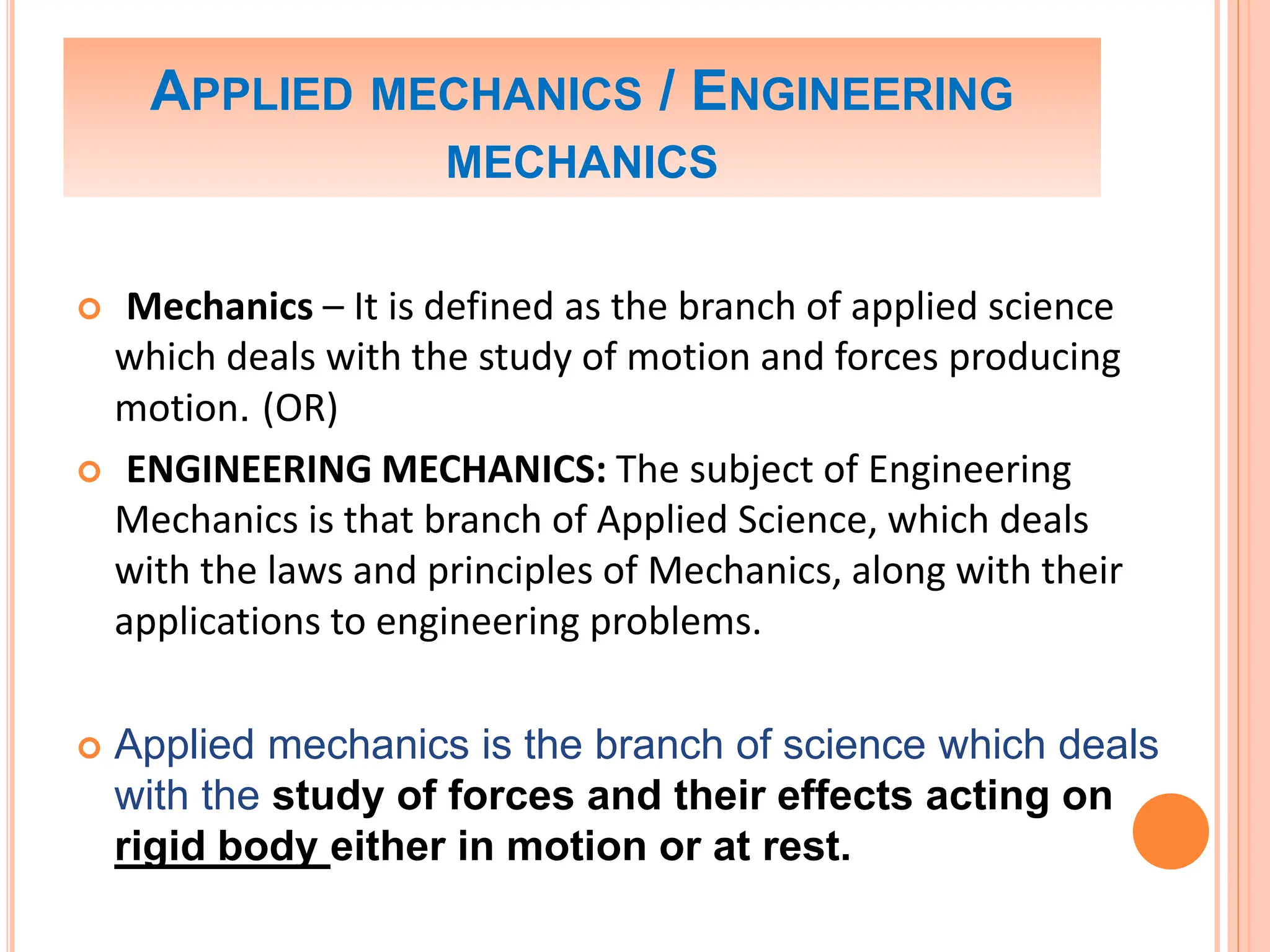
 Mechanics – It is defined as the branch of applied science
which deals with the study of motion and forces producing
motion. (OR)
 ENGINEERING MECHANICS: The subject of Engineering
Mechanics is that branch of Applied Science, which deals
with the laws and principles of Mechanics, along with their
applications to engineering problems.
 Applied mechanics is the branch of science which deals
with the study of forces and their effects acting on
rigid body either in motion or at rest.
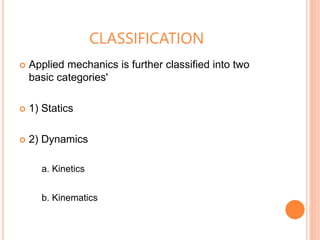
CLASSIFICATION
 Applied mechanics is further classified into two
basic categories'
 1) Statics
 2) Dynamics
a. Kinetics
b. Kinematics
DEFINITION
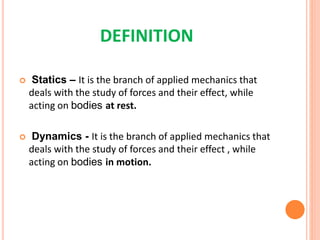
 Statics – It is the branch of applied mechanics that
deals with the study of forces and their effect, while
acting on bodies at rest.
 Dynamics - It is the branch of applied mechanics that
deals with the study of forces and their effect , while
acting on bodies in motion.
DEFINITION
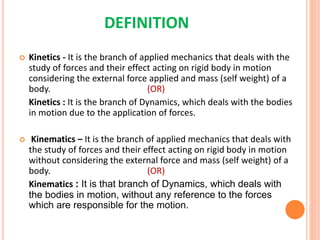
 Kinetics - It is the branch of applied mechanics that deals with the
study of forces and their effect acting on rigid body in motion
considering the external force applied and mass (self weight) of a
body. (OR)
Kinetics : It is the branch of Dynamics, which deals with the bodies
in motion due to the application of forces.
 Kinematics – It is the branch of applied mechanics that deals with
the study of forces and their effect acting on rigid body in motion
without considering the external force and mass (self weight) of a
body. (OR)
Kinematics : It is that branch of Dynamics, which deals with
the bodies in motion, without any reference to the forces
which are responsible for the motion.
TYPES OF BODY
 Body – An object having definite mass
occupying the definite space is called as body.
The body can be classified in following three
categories
a. Elastic body
b. Plastic body
c. Rigid body
 Elastic body – When the body regains its original
shape and size after the removal of external applied
force then the body is called as elastic body.
 Plastic body – When the body changes its shape
and size after the removal of external applied force
then the body is called as plastic body.
 Rigid body – The body which does not undergo
any change in shape and size after removal of
external applied force then the body is called as
rigid body. A rigid body (also known as a rigid
object) is a solid body in which deformation is zero
or so small it can be neglected.
 No body is perfectly rigid in nature but it is assumed
to be rigid in the study of applied mechanics.
[Important to note]
SCALAR AND VECTOR QUANTITIES
 Scalar quantity – It is a physical quantity having
only magnitude but no direction.
Examples – Time, mass, speed, area, power,
temperature, volume, work etc.
 Vector quantity – It is a physical quantity having
magnitude as well as direction.
Examples – Force, velocity, displacement,
acceleration etc.
MECHANICS AND FORCE SYSTEM
 FORCE: It is defined as an external agent which
produces or tends to produce, destroys or tends
to destroy motion. e.g., a horse applies force to
pull a cart and to set it in motion, But if the cart
is overloaded horse will try to put cart in motion
(tends to produce ).
 Force is also required to work on a bicycle pump.
In this case, the force is supplied by the muscular
power of our arms and shoulders.
EFFECTS OF A FORCE
 A force may produce the following effects in a
body, on which it acts:
1. It may change the motion of a body. i.e. if a
body is at rest, the force may set it in motion.
And if the body is already in motion, the force
may accelerate it.
2. It may retard the motion of a body.
3. It may retard the forces, already acting on a
body, thus bringing it to rest or in equilibrium.
4. It may give rise to the internal stresses in the
body, on which it acts.
CHARACTERISTIC OF A FORCE
 In order to determine the effects of a force, acting on a
body, we must know the following characteristics of a
force:
1. Magnitude of the force (i.e., 100 N, 50 N, 20 kN, 5 kN,
etc.)
2. The direction of the line, along which the force acts
(i.e., along OX, OY, at 30° North of East etc.). It is also
known as line of action of the force.
3. Nature of the force (i.e., whether the force is push or
pull). This is denoted by placing an arrow head on the
line of action of the force.
4. The point at which (or through which) the force acts
on the body
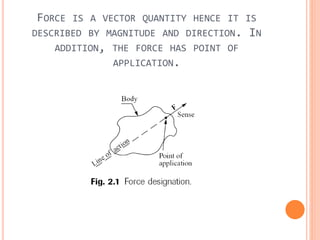
FORCE IS A VECTOR QUANTITY HENCE IT IS
DESCRIBED BY MAGNITUDE AND DIRECTION. IN
ADDITION, THE FORCE HAS POINT OF
APPLICATION.
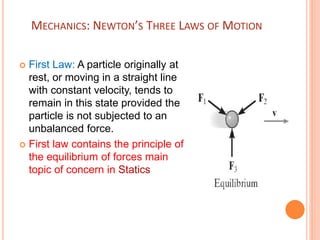
MECHANICS: NEWTON’S THREE LAWS OF MOTION
 First Law: A particle originally at
rest, or moving in a straight line
with constant velocity, tends to
remain in this state provided the
particle is not subjected to an
unbalanced force.
 First law contains the principle of
the equilibrium of forces main
topic of concern in Statics
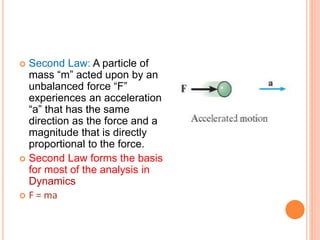
 Second Law: A particle of
mass “m” acted upon by an
unbalanced force “F”
experiences an acceleration
“a” that has the same
direction as the force and a
magnitude that is directly
proportional to the force.
 Second Law forms the basis
for most of the analysis in
Dynamics
 F = ma
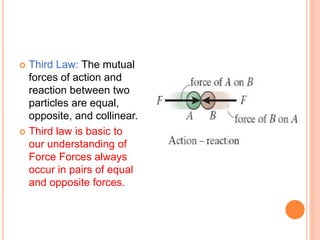
 Third Law: The mutual
forces of action and
reaction between two
particles are equal,
opposite, and collinear.
 Third law is basic to
our understanding of
Force Forces always
occur in pairs of equal
and opposite forces.
 ACTION AND REACTION FORCE: Forces always act in pairs
and always act in opposite directions. When you push on an
object, the object pushes back with an equal force. Think of a
pile of books on a table. The weight of the books exerts a
downward force on the table. This is the action force [ACTIVE
FORCE]. The table exerts an equal upward force on the books.
This is the reaction force [REACTIVE FORCE].
SYSTEM OF FORCES
 When two or more forces act on a body, they are called
to form a system of forces.
 We will consider two situations ,
I)when only two forces are acting.
II)when more than two forces are acting.
The system of forces may or may not be in equilibrium .
A] If the system is not in equilibrium then there is need
to find the resultant of the system.
B] If the system is in equilibrium ,then we will apply
conditions of equilibrium to find out the unknown
parameter.
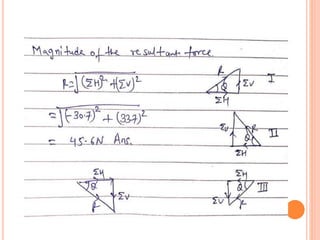
 COMPOSITION OF FORCES: The process of finding out
the resultant force, of a number of given forces, is called
composition of forces or compounding of forces.
 RESULTANT FORCE: If a number of forces, P, Q, R ... etc.
are acting simultaneously on a particle, then it is
possible to find out a single force which could replace
them i.e., which would produce the same effect as
produced by all the given forces. This single force is
called resultant force and the given forces R ...etc. are
called component forces
 METHODS FOR THE RESULTANT FORCE: Though there are
many methods for finding out the resultant force of a
number of given forces, yet the following are important from
the subject point of view :
1. Analytical method [using formula]
2. Graphical method[using vector diagram]
 ANALYTICAL METHOD FOR RESULTANT FORCE: The resultant
force, of a given system of forces, may be found out
analytically by the following methods :
1. Parallelogram law of forces[for 2force only]
2. Method of resolution [for more than 2force]
REOSLUTION
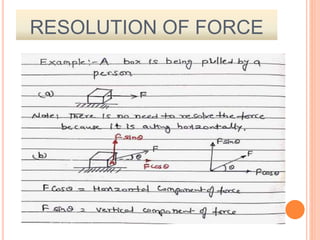
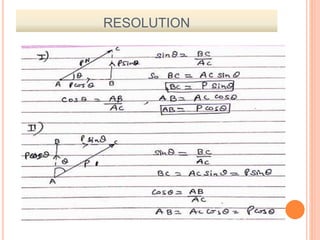
 REOSLUTION OF A FORCE: The process of splitting up the given
force into a number of components, without changing its effect
on the body is called resolution of a force. A force is, generally,
resolved along two mutually perpendicular directions. THE
COMPONENT ACTING ALONG X-AXIS IS CALLED Horizontal
component. In fact, the resolution of a force is the reverse
action of the addition of the component vectors.
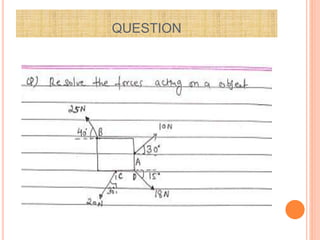
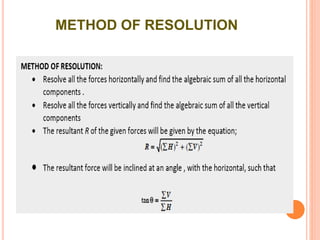
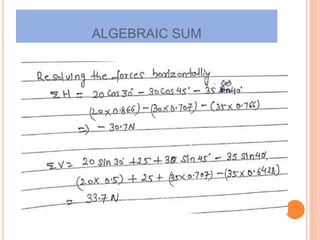
 PRINCIPLE OF RESOLUTION: It states, “The algebraic sum of the
resolved parts of a no. of forces, in a given direction, is equal to
the resolved part of their resultant in the same direction.”
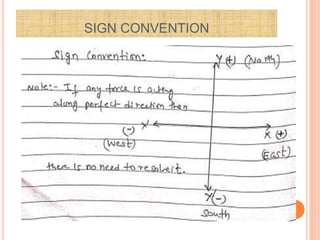
 Note: In general, the forces are resolved in the vertical and
horizontal directions.
RESOLUTION OF FORCE
SIGN CONVENTION
RESOLUTION
QUESTION
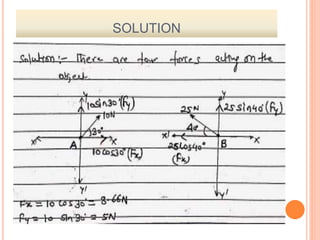
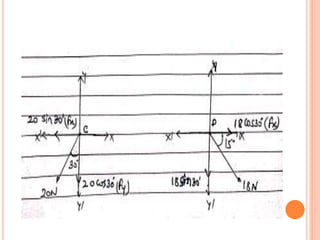
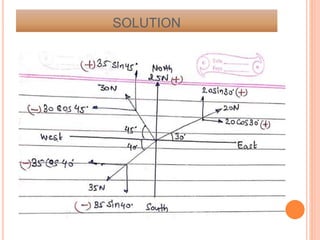
SOLUTION
METHOD OF RESOLUTION
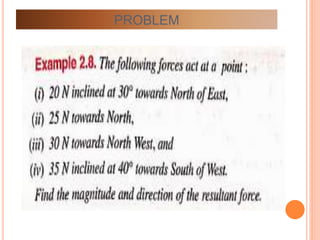
PROBLEM
SPACE DIAGRAM [POSITION DIAGRAM]
SOLUTION
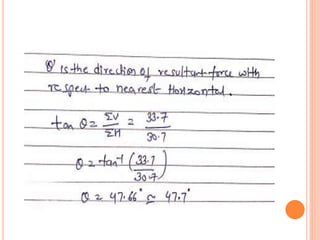
ALGEBRAIC SUM
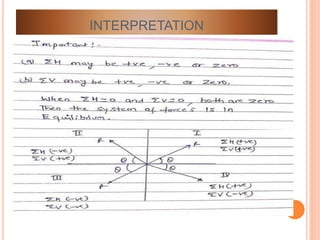
INTERPRETATION
 GRAPHICAL METHOD FOR RESULTANT FORCE: The
resultant force, of a given system of forces, may be
found out graphically by the following methods :
1. Triangle law of forces[for 2force only]
2. polygon law of forces[for [for more than 2force]
SYLLABUS
 Engineering Mechanics [BT-204]
 Unit IV: Forces and Equilibrium: Graphical and
Analytical Treatment of Concurrent and
nonconcurrent Co- planner forces, free Diagram,
Force Diagram and Bow’s notations,
 Application of Equilibrium Concepts: Analysis of
plane Trusses: Method of joints, Method of
Sections. Frictional force in equilibrium problems
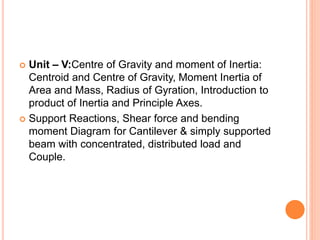
 Unit – V:Centre of Gravity and moment of Inertia:
Centroid and Centre of Gravity, Moment Inertia of
Area and Mass, Radius of Gyration, Introduction to
product of Inertia and Principle Axes.
 Support Reactions, Shear force and bending
moment Diagram for Cantilever & simply supported
beam with concentrated, distributed load and
Couple.
REFERENCE BOOKS:
 2.]Prasad I.B., Applied Mechanics, Khanna
Publication.
 10.] R.C. Hibbler – Engineering Mechanics: Statics
& Dynamics.
 11.] A. Boresi & Schmidt- Engineering Mechines-
statics dynamics, Thomson’ Books
 12.] R.K. Rajput, Engineering Mechanics S.Chand
& Co.
 R.S.Khurmi
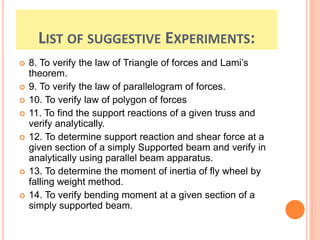
LIST OF SUGGESTIVE EXPERIMENTS:
 8. To verify the law of Triangle of forces and Lami’s
theorem.
 9. To verify the law of parallelogram of forces.
 10. To verify law of polygon of forces
 11. To find the support reactions of a given truss and
verify analytically.
 12. To determine support reaction and shear force at a
given section of a simply Supported beam and verify in
analytically using parallel beam apparatus.
 13. To determine the moment of inertia of fly wheel by
falling weight method.
 14. To verify bending moment at a given section of a
simply supported beam.
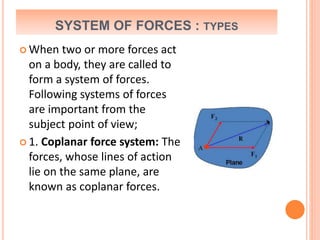
SYSTEM OF FORCES : TYPES
 When two or more forces act
on a body, they are called to
form a system of forces.
Following systems of forces
are important from the
subject point of view;
 1. Coplanar force system: The
forces, whose lines of action
lie on the same plane, are
known as coplanar forces.
SYSTEM OF FORCES:
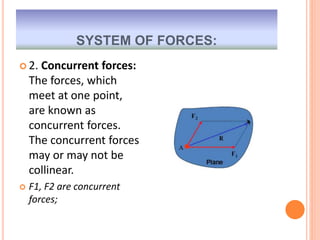
 2. Concurrent forces:
The forces, which
meet at one point,
are known as
concurrent forces.
The concurrent forces
may or may not be
collinear.
 F1, F2 are concurrent
forces;
 3. Collinear forces: The forces, whose lines of
action lie on the same line, are known as
collinear forces
 4. Coplanar concurrent forces: The forces,
which meet at one point and their lines of
action also lie on the same plane, are known as
coplanar concurrent forces.
 5. Coplanar non-concurrent forces: The forces, which do
not meet at one point, but their lines of action lie on the
same plane, are known as coplanar non-concurrent
forces.
 6. Non-coplanar concurrent forces: The forces, which
meet at one point, but their lines of action do not lie on
the same plane, are known as non-coplanar concurrent
forces.
 7. Non-coplanar non-concurrent forces: The forces,
which do not meet at one point and their lines of action
do not lie on the same plane, are called non-coplanar
non-concurrent forces.
GRAPHICAL METHOD FOR RESULTANT FORCE
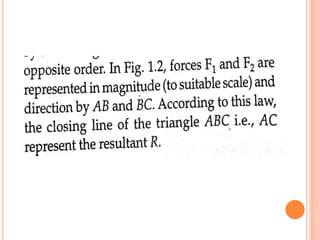
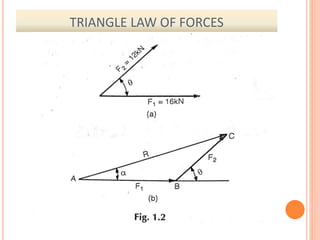
 TRIANGLE LAW OF FORCES: It states, “If two
forces acting simultaneously on a particle, be
represented in magnitude and direction by the
two sides of a triangle, taken in order ; their
resultant may be represented in magnitude and
direction by the third side of the triangle, taken
in opposite order.”
TRIANGLE LAW OF FORCES
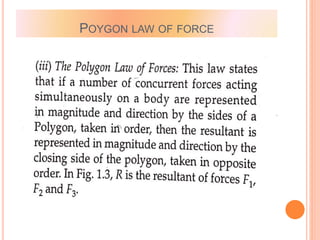
POYGON LAW OF FORCE
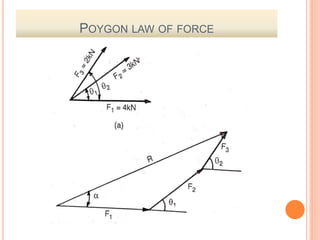
POYGON LAW OF FORCE
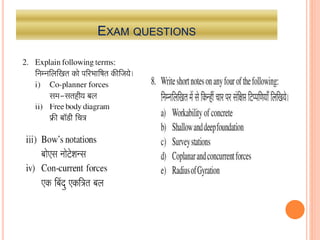
EXAM QUESTIONS
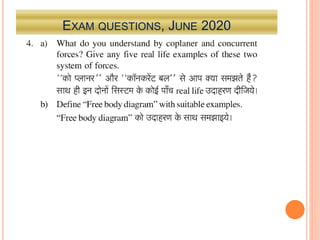
EXAM QUESTIONS, JUNE 2020
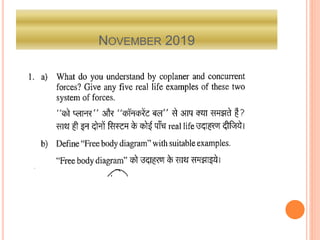
NOVEMBER 2019
JUNE 2020[ GRADING SYSTEM]
 2. a) State and prove Lami’s theorem?
 b) State and prove Varignon’s theorem?
 7. Define coplanar and concurrent forces. Also
define free body diagram.

FORCE-1.pptx

  • 1.
    APPLIED MECHANICS /ENGINEERING MECHANICS  Mechanics – It is defined as the branch of applied science which deals with the study of motion and forces producing motion. (OR)  ENGINEERING MECHANICS: The subject of Engineering Mechanics is that branch of Applied Science, which deals with the laws and principles of Mechanics, along with their applications to engineering problems.  Applied mechanics is the branch of science which deals with the study of forces and their effects acting on rigid body either in motion or at rest.
  • 2.
    CLASSIFICATION  Applied mechanicsis further classified into two basic categories'  1) Statics  2) Dynamics a. Kinetics b. Kinematics
  • 3.
    DEFINITION  Statics –It is the branch of applied mechanics that deals with the study of forces and their effect, while acting on bodies at rest.  Dynamics - It is the branch of applied mechanics that deals with the study of forces and their effect , while acting on bodies in motion.
  • 4.
    DEFINITION  Kinetics -It is the branch of applied mechanics that deals with the study of forces and their effect acting on rigid body in motion considering the external force applied and mass (self weight) of a body. (OR) Kinetics : It is the branch of Dynamics, which deals with the bodies in motion due to the application of forces.  Kinematics – It is the branch of applied mechanics that deals with the study of forces and their effect acting on rigid body in motion without considering the external force and mass (self weight) of a body. (OR) Kinematics : It is that branch of Dynamics, which deals with the bodies in motion, without any reference to the forces which are responsible for the motion.
  • 5.
    TYPES OF BODY Body – An object having definite mass occupying the definite space is called as body. The body can be classified in following three categories a. Elastic body b. Plastic body c. Rigid body
  • 6.
     Elastic body– When the body regains its original shape and size after the removal of external applied force then the body is called as elastic body.  Plastic body – When the body changes its shape and size after the removal of external applied force then the body is called as plastic body.
  • 7.
     Rigid body– The body which does not undergo any change in shape and size after removal of external applied force then the body is called as rigid body. A rigid body (also known as a rigid object) is a solid body in which deformation is zero or so small it can be neglected.  No body is perfectly rigid in nature but it is assumed to be rigid in the study of applied mechanics. [Important to note]
  • 8.
    SCALAR AND VECTORQUANTITIES  Scalar quantity – It is a physical quantity having only magnitude but no direction. Examples – Time, mass, speed, area, power, temperature, volume, work etc.  Vector quantity – It is a physical quantity having magnitude as well as direction. Examples – Force, velocity, displacement, acceleration etc.
  • 9.
    MECHANICS AND FORCESYSTEM  FORCE: It is defined as an external agent which produces or tends to produce, destroys or tends to destroy motion. e.g., a horse applies force to pull a cart and to set it in motion, But if the cart is overloaded horse will try to put cart in motion (tends to produce ).  Force is also required to work on a bicycle pump. In this case, the force is supplied by the muscular power of our arms and shoulders.
  • 10.
    EFFECTS OF AFORCE  A force may produce the following effects in a body, on which it acts: 1. It may change the motion of a body. i.e. if a body is at rest, the force may set it in motion. And if the body is already in motion, the force may accelerate it. 2. It may retard the motion of a body. 3. It may retard the forces, already acting on a body, thus bringing it to rest or in equilibrium. 4. It may give rise to the internal stresses in the body, on which it acts.
  • 11.
    CHARACTERISTIC OF AFORCE  In order to determine the effects of a force, acting on a body, we must know the following characteristics of a force: 1. Magnitude of the force (i.e., 100 N, 50 N, 20 kN, 5 kN, etc.) 2. The direction of the line, along which the force acts (i.e., along OX, OY, at 30° North of East etc.). It is also known as line of action of the force. 3. Nature of the force (i.e., whether the force is push or pull). This is denoted by placing an arrow head on the line of action of the force. 4. The point at which (or through which) the force acts on the body
  • 12.
    FORCE IS AVECTOR QUANTITY HENCE IT IS DESCRIBED BY MAGNITUDE AND DIRECTION. IN ADDITION, THE FORCE HAS POINT OF APPLICATION.
  • 13.
    MECHANICS: NEWTON’S THREELAWS OF MOTION  First Law: A particle originally at rest, or moving in a straight line with constant velocity, tends to remain in this state provided the particle is not subjected to an unbalanced force.  First law contains the principle of the equilibrium of forces main topic of concern in Statics
  • 14.
     Second Law:A particle of mass “m” acted upon by an unbalanced force “F” experiences an acceleration “a” that has the same direction as the force and a magnitude that is directly proportional to the force.  Second Law forms the basis for most of the analysis in Dynamics  F = ma
  • 15.
     Third Law:The mutual forces of action and reaction between two particles are equal, opposite, and collinear.  Third law is basic to our understanding of Force Forces always occur in pairs of equal and opposite forces.
  • 16.
     ACTION ANDREACTION FORCE: Forces always act in pairs and always act in opposite directions. When you push on an object, the object pushes back with an equal force. Think of a pile of books on a table. The weight of the books exerts a downward force on the table. This is the action force [ACTIVE FORCE]. The table exerts an equal upward force on the books. This is the reaction force [REACTIVE FORCE].
  • 17.
    SYSTEM OF FORCES When two or more forces act on a body, they are called to form a system of forces.  We will consider two situations , I)when only two forces are acting. II)when more than two forces are acting. The system of forces may or may not be in equilibrium . A] If the system is not in equilibrium then there is need to find the resultant of the system. B] If the system is in equilibrium ,then we will apply conditions of equilibrium to find out the unknown parameter.
  • 18.
     COMPOSITION OFFORCES: The process of finding out the resultant force, of a number of given forces, is called composition of forces or compounding of forces.  RESULTANT FORCE: If a number of forces, P, Q, R ... etc. are acting simultaneously on a particle, then it is possible to find out a single force which could replace them i.e., which would produce the same effect as produced by all the given forces. This single force is called resultant force and the given forces R ...etc. are called component forces
  • 19.
     METHODS FORTHE RESULTANT FORCE: Though there are many methods for finding out the resultant force of a number of given forces, yet the following are important from the subject point of view : 1. Analytical method [using formula] 2. Graphical method[using vector diagram]  ANALYTICAL METHOD FOR RESULTANT FORCE: The resultant force, of a given system of forces, may be found out analytically by the following methods : 1. Parallelogram law of forces[for 2force only] 2. Method of resolution [for more than 2force]
  • 20.
    REOSLUTION  REOSLUTION OFA FORCE: The process of splitting up the given force into a number of components, without changing its effect on the body is called resolution of a force. A force is, generally, resolved along two mutually perpendicular directions. THE COMPONENT ACTING ALONG X-AXIS IS CALLED Horizontal component. In fact, the resolution of a force is the reverse action of the addition of the component vectors.  PRINCIPLE OF RESOLUTION: It states, “The algebraic sum of the resolved parts of a no. of forces, in a given direction, is equal to the resolved part of their resultant in the same direction.”  Note: In general, the forces are resolved in the vertical and horizontal directions.
  • 21.
  • 22.
  • 23.
  • 24.
  • 25.
  • 27.
  • 28.
  • 29.
  • 30.
  • 31.
  • 33.
  • 35.
     GRAPHICAL METHODFOR RESULTANT FORCE: The resultant force, of a given system of forces, may be found out graphically by the following methods : 1. Triangle law of forces[for 2force only] 2. polygon law of forces[for [for more than 2force]
  • 36.
    SYLLABUS  Engineering Mechanics[BT-204]  Unit IV: Forces and Equilibrium: Graphical and Analytical Treatment of Concurrent and nonconcurrent Co- planner forces, free Diagram, Force Diagram and Bow’s notations,  Application of Equilibrium Concepts: Analysis of plane Trusses: Method of joints, Method of Sections. Frictional force in equilibrium problems
  • 37.
     Unit –V:Centre of Gravity and moment of Inertia: Centroid and Centre of Gravity, Moment Inertia of Area and Mass, Radius of Gyration, Introduction to product of Inertia and Principle Axes.  Support Reactions, Shear force and bending moment Diagram for Cantilever & simply supported beam with concentrated, distributed load and Couple.
  • 38.
    REFERENCE BOOKS:  2.]PrasadI.B., Applied Mechanics, Khanna Publication.  10.] R.C. Hibbler – Engineering Mechanics: Statics & Dynamics.  11.] A. Boresi & Schmidt- Engineering Mechines- statics dynamics, Thomson’ Books  12.] R.K. Rajput, Engineering Mechanics S.Chand & Co.  R.S.Khurmi
  • 39.
    LIST OF SUGGESTIVEEXPERIMENTS:  8. To verify the law of Triangle of forces and Lami’s theorem.  9. To verify the law of parallelogram of forces.  10. To verify law of polygon of forces  11. To find the support reactions of a given truss and verify analytically.  12. To determine support reaction and shear force at a given section of a simply Supported beam and verify in analytically using parallel beam apparatus.  13. To determine the moment of inertia of fly wheel by falling weight method.  14. To verify bending moment at a given section of a simply supported beam.
  • 40.
    SYSTEM OF FORCES: TYPES  When two or more forces act on a body, they are called to form a system of forces. Following systems of forces are important from the subject point of view;  1. Coplanar force system: The forces, whose lines of action lie on the same plane, are known as coplanar forces.
  • 41.
    SYSTEM OF FORCES: 2. Concurrent forces: The forces, which meet at one point, are known as concurrent forces. The concurrent forces may or may not be collinear.  F1, F2 are concurrent forces;
  • 42.
     3. Collinearforces: The forces, whose lines of action lie on the same line, are known as collinear forces  4. Coplanar concurrent forces: The forces, which meet at one point and their lines of action also lie on the same plane, are known as coplanar concurrent forces.
  • 43.
     5. Coplanarnon-concurrent forces: The forces, which do not meet at one point, but their lines of action lie on the same plane, are known as coplanar non-concurrent forces.  6. Non-coplanar concurrent forces: The forces, which meet at one point, but their lines of action do not lie on the same plane, are known as non-coplanar concurrent forces.  7. Non-coplanar non-concurrent forces: The forces, which do not meet at one point and their lines of action do not lie on the same plane, are called non-coplanar non-concurrent forces.
  • 44.
    GRAPHICAL METHOD FORRESULTANT FORCE  TRIANGLE LAW OF FORCES: It states, “If two forces acting simultaneously on a particle, be represented in magnitude and direction by the two sides of a triangle, taken in order ; their resultant may be represented in magnitude and direction by the third side of the triangle, taken in opposite order.”
  • 46.
  • 47.
  • 48.
  • 49.
  • 50.
  • 51.
  • 52.
    JUNE 2020[ GRADINGSYSTEM]  2. a) State and prove Lami’s theorem?  b) State and prove Varignon’s theorem?  7. Define coplanar and concurrent forces. Also define free body diagram.