UMAIR KHAN
Overview
• What is a game engine?
• Game engines:
– Commercial
– Open source
• Game engine architecture
– Physics, AI, Graphics, etc.
What is a game engine?
• A game engine is the core software
component of a computer or video
game other interactive application with
real-time graphics
• The term “game engine” was coined in the
mid-1990s due to the development of first
person shooters such as
Doom, Wolfenstein 3D...
Purpose of creating games:
Fun, creative
Raising the bar
Virtual worlds & immersion, rules
Real-time
Programming
Visual Art
Audio
Management, marketing
Game engine: main goals
• Provide for underlying technologies
– Graphics Rendering
– Physics engine
– Sound
– Scripting
– Animation
– Artificial Intelligence
– Networking
• Simplify development process
• Run on multiple platforms
Top 10 commercial engines
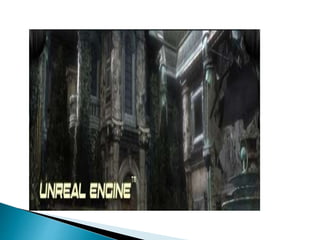
• Unreal Engine 3
• Gamebryo Lightspeed
• CryEngine 3
• Unity 3D
• BlitzTech
• Infernal Engine
• Vision Engine 7.5
• Bigworld Technology Suite
• Vicious Engine 2
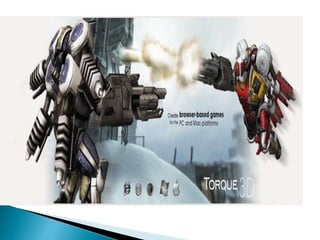
• Torque 3D
Open source engines
• OGRE
• Panda3D
• Crystal Space
• Irrlicht
Game middleware
• Components in game engines can be based
on middleware (Havok, SpeedTree, ...)
• Increasing popularity of MMOGs spawns
new middlewares:
– Gamebryo, HeroEngine, RealmCrafter,
MultiverseNetwork, ...
• Advantages in using a game engine:
– Less development time required
– Less testing and debugging
– Many features directly available
– Better focus on the game design
• Disadvantages in using a game engine:
– No control over the implementation
of feature
The game loop
• A game is a real-time interactive application
• Three tasks that run concurrently:
– Recompute the state of the world
– The player interacts with the world
– The resulting state must be presented to the
user (graphics, sound, etc.)
• Limitations of real-world technology
– 1-2 processors with limited memory
and speed
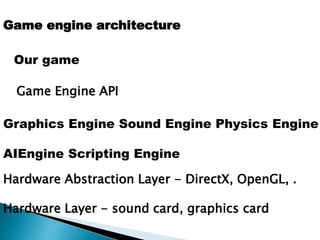
Game engine architecture
Our game
Game Engine API
Graphics Engine Sound Engine Physics Engine
AIEngine Scripting Engine
Hardware Abstraction Layer - DirectX, OpenGL, .
Hardware Layer - sound card, graphics card
Scripting engine
• Advantages:
– Easy control of many (or all) features in the
game engine
– Scripting language often provides full control
– Promotes data-driven design
• Disadvantages:
– Performance
– Development support tools
– Learning curve
• Common scripting languages:
– Python, Lua, GameMonkey, and AngelScript
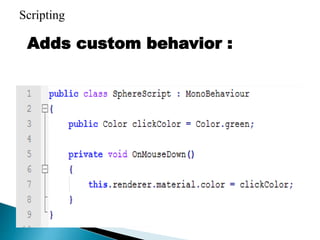
Adds custom behavior :
Scripting
Hardware layer
• Physical
– Graphics card
– Sound card
– Physics card
– Input devices (keyboard, mouse,
joysticks, game pads, steering
wheels, ...)
• Drivers
– Low level interface
Handles more complicated display aspects
– Mini map
– Multiple views
– Overlays
– Special effects ...
• Some of these engines are for sale or
available on the web
• Often remade or heavily tuned for each
game
– Too much time and money is spent on this
Sound engine
• Function of sound
– Effects to enhance reality
– Ambience
– Clues about what to do
– Clues about what is about to happen (but
be careful)
• Sound formats
– Wave (high quality, lots of memory, fast)
– MP3 (high quality, compressed, slower)
– Midi (lower quality, very low storage,
limited, adaptable)
– CD (Very high quality, fast, limited to
background music)
• Simultaneous sounds
– Mixers (hidden in the HAL)
– Buffer management
– Streaming sound
• Special features
– Positional 3D sound (possibly with Dolby
surround)
• Important for clues
– Adaptive music (DirectMusic)
• Some sound engines:
– Wwise
– FMOD
– Razer Maelstrom
Physics engine
• Handles the simulation of the world
– Collisions
– Terrain changes
– Waves in the sea
– Explosions
– Object destruction
• Limited or non-existent in simple games
• Some commercial/open source engines:
– ODE (Open Dynamics Engine)
– Havok
– Tokamak
– JigLib
• Physics hardware:
– Nvidia/Ageia PhysX
• Physics is more and more integrated into
the gameplay and game subsystems
– Physics-based animation
– Interaction with objects using physics
AI engine
• Behaviour& interaction (dialogue) scripts
– Especially in adventure games
• Flocking
• Obstacle avoidance
• Attack strategies
– Hiding
– Attacking player as a team of enemies
• Decision making
• Path planning
– Search algorithms
– Waypoint networks
• Crowd behaviours
• AI engines that are available:
– AI-Implant
– DirectIA
– SimBionic
– AISeek (dedicated AI card
Graphics engine
• Higher level interface, tuned to a particular
graphics and game type
– Sprite-based
– Isometric
– Full 3D
• Can deal with higher level modeling
concepts
– Sprites
– Solids
– Characters (articulated) ...
– Scene Manager
• Each scene is represented by a scene graph
• Contains everything that appears on the
screen
Summary:
• What is a game engine?
• Why to build up a game engine?
• Game engines:
– Commercial
– Open source
• Game engine components and middleware
• The game loop
• Game Engine Architecture
– Physics, AI, Graphics, etc

game development

  • 2.
  • 3.
    Overview • What isa game engine? • Game engines: – Commercial – Open source • Game engine architecture – Physics, AI, Graphics, etc.
  • 4.
    What is agame engine? • A game engine is the core software component of a computer or video game other interactive application with real-time graphics • The term “game engine” was coined in the mid-1990s due to the development of first person shooters such as Doom, Wolfenstein 3D...
  • 5.
    Purpose of creatinggames: Fun, creative Raising the bar Virtual worlds & immersion, rules Real-time Programming Visual Art Audio Management, marketing
  • 6.
    Game engine: maingoals • Provide for underlying technologies – Graphics Rendering – Physics engine – Sound – Scripting – Animation – Artificial Intelligence – Networking • Simplify development process • Run on multiple platforms
  • 7.
    Top 10 commercialengines • Unreal Engine 3 • Gamebryo Lightspeed • CryEngine 3 • Unity 3D • BlitzTech • Infernal Engine • Vision Engine 7.5 • Bigworld Technology Suite • Vicious Engine 2 • Torque 3D
  • 10.
    Open source engines •OGRE • Panda3D • Crystal Space • Irrlicht
  • 11.
    Game middleware • Componentsin game engines can be based on middleware (Havok, SpeedTree, ...) • Increasing popularity of MMOGs spawns new middlewares: – Gamebryo, HeroEngine, RealmCrafter, MultiverseNetwork, ... • Advantages in using a game engine: – Less development time required – Less testing and debugging – Many features directly available – Better focus on the game design • Disadvantages in using a game engine: – No control over the implementation of feature
  • 12.
    The game loop •A game is a real-time interactive application • Three tasks that run concurrently: – Recompute the state of the world – The player interacts with the world – The resulting state must be presented to the user (graphics, sound, etc.) • Limitations of real-world technology – 1-2 processors with limited memory and speed
  • 13.
    Game engine architecture Ourgame Game Engine API Graphics Engine Sound Engine Physics Engine AIEngine Scripting Engine Hardware Abstraction Layer - DirectX, OpenGL, . Hardware Layer - sound card, graphics card
  • 14.
    Scripting engine • Advantages: –Easy control of many (or all) features in the game engine – Scripting language often provides full control – Promotes data-driven design • Disadvantages: – Performance – Development support tools – Learning curve • Common scripting languages: – Python, Lua, GameMonkey, and AngelScript
  • 15.
  • 16.
    Hardware layer • Physical –Graphics card – Sound card – Physics card – Input devices (keyboard, mouse, joysticks, game pads, steering wheels, ...) • Drivers – Low level interface
  • 17.
    Handles more complicateddisplay aspects – Mini map – Multiple views – Overlays – Special effects ... • Some of these engines are for sale or available on the web • Often remade or heavily tuned for each game – Too much time and money is spent on this
  • 18.
    Sound engine • Functionof sound – Effects to enhance reality – Ambience – Clues about what to do – Clues about what is about to happen (but be careful) • Sound formats – Wave (high quality, lots of memory, fast) – MP3 (high quality, compressed, slower) – Midi (lower quality, very low storage, limited, adaptable) – CD (Very high quality, fast, limited to background music)
  • 19.
    • Simultaneous sounds –Mixers (hidden in the HAL) – Buffer management – Streaming sound • Special features – Positional 3D sound (possibly with Dolby surround) • Important for clues – Adaptive music (DirectMusic) • Some sound engines: – Wwise – FMOD – Razer Maelstrom
  • 20.
    Physics engine • Handlesthe simulation of the world – Collisions – Terrain changes – Waves in the sea – Explosions – Object destruction • Limited or non-existent in simple games • Some commercial/open source engines: – ODE (Open Dynamics Engine) – Havok – Tokamak – JigLib
  • 21.
    • Physics hardware: –Nvidia/Ageia PhysX • Physics is more and more integrated into the gameplay and game subsystems – Physics-based animation – Interaction with objects using physics
  • 22.
    AI engine • Behaviour&interaction (dialogue) scripts – Especially in adventure games • Flocking • Obstacle avoidance • Attack strategies – Hiding – Attacking player as a team of enemies • Decision making • Path planning – Search algorithms – Waypoint networks • Crowd behaviours
  • 23.
    • AI enginesthat are available: – AI-Implant – DirectIA – SimBionic – AISeek (dedicated AI card
  • 24.
    Graphics engine • Higherlevel interface, tuned to a particular graphics and game type – Sprite-based – Isometric – Full 3D • Can deal with higher level modeling concepts – Sprites – Solids – Characters (articulated) ... – Scene Manager • Each scene is represented by a scene graph • Contains everything that appears on the screen
  • 25.
    Summary: • What isa game engine? • Why to build up a game engine? • Game engines: – Commercial – Open source • Game engine components and middleware • The game loop • Game Engine Architecture – Physics, AI, Graphics, etc