

APPLICATION OF HAM RADIO
Bijendra Kumar Ray
&
Saurabh Yadav
(ECE&D 2nd Year)
Introduction
• What is HAM Radio ?
HAM Radio is a popular hobby and service that bring people, electronics and
communication together. People use ham radio to talk across town, around
the world or even into the space, all without internet or cell phone. HAM
Radio operator use amateur bands for communication, these band are Radio
Frequency allocated by the Federal Communication Commission (FCC) for
use by HAM Radio operator. Ham radio is two way wireless communication
device which is used by astronauts, doctors, students, kids, politicians, truck
drivers, movie stars, missionaries and even your average neighbor next door.
They are of all ages, sexes, income levels and nationalities. Whether through
Morse Code on an old brass telegraph key, voice communication on a hand-
held radio or computerized messages transmitted via satellite, all HAMs use
radio to reach out to the world.
Ham Radio Operators are the only NON-
GOVERNMENTAL people privileged to be allowed
to do private WORLDWIDE wireless communication
Long Distance Communication using Short Wave Frequencies in the
range of 1.8 to 30 MHz
• The origin of the word HAM came from the name of three
scientists: Heinrich Hertz + Major Armstrong + Guglielmo
Marconi
• “Home Amateur Mechanic” (Edited by Hugo Gernsback )-
A 1900 do-it-yourself magazine.
Origin of the word “HAM”
Ham Radio Licensing Exam
• Why we need a license?
• The Government tries to ensure that the person going to be a ham
radio hobbyist is technically competent.
• He/She does not interfere with other professional two-way wireless
communication services (aeronautical, maritime, police, military etc.)
• Prevent misuse of the wireless set.
• She/he maintains the standard international operating practices.
Applications of HAM Radio
1. Emergency communication during disaster
2. Ham Radios in Space
3. Digital application of HAM Radio
4. Automatic Packet Reporting System (APRS)
5. Packet Radio
6. Software-Defined Radio (SDR)
7. HAM Radio in Agriculture
8. Amateur Radio High Altitude Ballooning (ARHAB)-
9. D-STAR (Digital Smart Technologies for Amateur Radio)
10. Internet via Ham Radio
Emergency Communication During Disaster
• Why HAM Radio Communication is successful during emergency?
In times of crisis and natural disasters, amateur radio is often used as a
means of emergency communication when wireline, cell phones and
other conventional means of communications fail.
One of the advantages of ham radio is that a
message originated from an individual can be
virtually intercepted by any number of other ham
radio operators at different locations
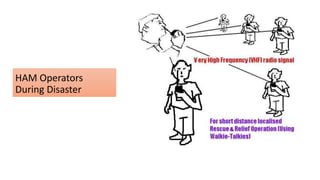
HAM Operators
During Disaster
Some Examples
• Amateur Radio Service kept New York City agencies in touch with
each other after their command center was destroyed during the
9/11 tragedy. Ham radio also came to the rescue during Hurricane
Katrina, where all other communications failed, and the devastating
flooding in Colorado in 2013.
• In the Nepal tragedy ham radio played an important role and spread
the message of earthquake across the country . Indian hams was
working on 14.210 MHz to contact hams in Nepal, where a massive
7.9 magnitude earthquake has claimed the lives of close to 2,000
people
Ham Radio in Space
• Amateur radio operators all over the world are able to speak directly
to astronauts/cosmonauts via their handheld, mobile, or home radio
stations.
• It is also possible to send digital data to the space station via laptop
computers
• If a common man wants to talk a man in space , then the only way to
make contact is Ham Radio .
• official channels are usually reserved for presidents and heads of
state.
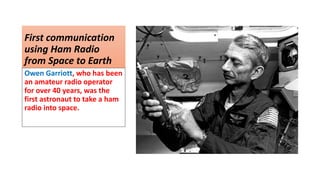
First communication
using Ham Radio
from Space to Earth
Owen Garriott, who has been
an amateur radio operator
for over 40 years, was the
first astronaut to take a ham
radio into space.
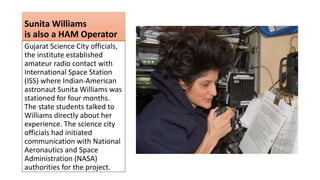
Sunita Williams
is also a HAM Operator
Gujarat Science City officials,
the institute established
amateur radio contact with
International Space Station
(ISS) where Indian-American
astronaut Sunita Williams was
stationed for four months.
The state students talked to
Williams directly about her
experience. The science city
officials had initiated
communication with National
Aeronautics and Space
Administration (NASA)
authorities for the project.
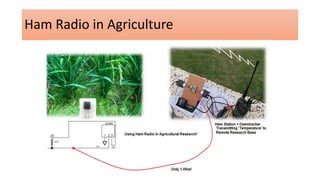
Ham Radio in Agriculture
Digital Applications of HAM
Radio
1. Automatic Packet Reporting System (APRS)
2. Packet Radio
3. Software-Defined Radio (SDR)
4. Amateur Radio High Altitude Ballooning (ARHAB)-
5. D-STAR (Digital Smart Technologies for Amateur Radio)
6. Internet via Ham Radio
7. Echo-Link
8. HAMShield
Automatic Packet Reporting System (APRS)
• APRS is an amateur radio based system for real time tactical digital
communications of information of immediate value in the local area.
APRS data is typically broadcast on a single shared frequency
(depending on country) to be repeated locally by area relay stations
and digipeaters for widespread local consumption. In addition, all
such data is typically ingested into the APRS Internet System (APRS-IS)
via an internet connected receiver (IGATE) and distributed globally for
ubiquitous and immediate access. Shared information contains global
coordinates, altitude, speed, heading, text messages, alerts,
announcements, and bulletins.
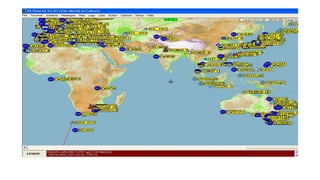
An Aircraft can be tracked
by Ham Radio using APRS
TEXT TRANSMISSION THROUGH HAM RADIO
• PSK31 is a new digital mode which utilizes the processing power of
computers and sound cards.
• Software on the computer converts inputted text to audio level wave
forms which can be fed into most standard SSB radios.
• The same software listens to the output of the radio and decodes the
audio signals back into text.
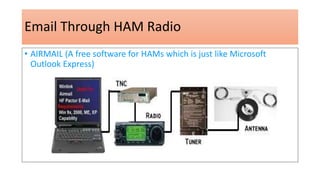
Email Through HAM Radio
• AIRMAIL (A free software for HAMs which is just like Microsoft
Outlook Express)
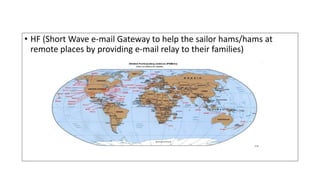
HF (Short Wave e-mail Gateway to help
the sailor hams/hams at remote places
by providing e-mail relay to their
families)
• HF (Short Wave e-mail Gateway to help the sailor hams/hams at
remote places by providing e-mail relay to their families)
Software-Defined Radio (SDR)
• SDR is a Radio Communication system where components that have
been typically implemented in hardware
(e.g. mixers, filters, amplifiers, modulators/demodulators, detectors,
etc.) are instead implemented by means of software on a personal
computer or embedded system.
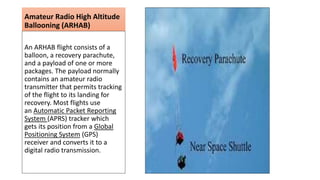
Amateur Radio High Altitude
Ballooning (ARHAB)
An ARHAB flight consists of a
balloon, a recovery parachute,
and a payload of one or more
packages. The payload normally
contains an amateur radio
transmitter that permits tracking
of the flight to its landing for
recovery. Most flights use
an Automatic Packet Reporting
System (APRS) tracker which
gets its position from a Global
Positioning System (GPS)
receiver and converts it to a
digital radio transmission.
Picture taken at
approx. 100,000 feet
above Oregon by
Justin Hamel and
Chris Tho
D-STAR (Digital Smart Technologies for
Amateur Radio)-
• D-STAR is a digital voice and data protocol specification for amateur
radio. The system uses frequency-division multiple
access and minimum-shift keying in its packet-based standard. There
are newer digital modes (Codec2 for example) that have been
adapted for use by amateurs, but D-STAR was the first that was
designed specifically for amateur radio.
• Several advantages of using digital voice modes are that it uses
less bandwidth than older analog voice modes such as amplitude
modulation, frequency modulation, and single sideband. The quality
of the data received is also better than an analog signal at the same
signal strength.
Internet via Ham Radio
• It is possible to build a repeater network that allows HAMs to access the
internet through a HAM Radio. In fact, during emergency situations HAM
Radios can be used quite successfully to send email, data, and documents
when all other forms of communication have gone down.
• Even before the internet, Ham radio operators were using an internet of
their own called Packet Radio. Packet Radio allows Hams to send files,
update bulletin board systems, send text messages and even control
remote systems and networks via their radios.
• Today, through worldwide radio messaging systems like D-Star and Winlink,
Ham Radio operators can send email with attachments, send emergency
relief communications and message relays, and even access the internet.
Echo-Link
• This software allows licensed Amateur Radio stations to communicate
with one another over the Internet, using streaming-audio
technology.
• The program allows worldwide connections to be made between
stations, or from computer to station, greatly enhancing Amateur
Radio's communications capabilities.
• There are more than 200,000 validated users worldwide — in 151 of
the world's 193 nations — with about 5,200 online at any given time.
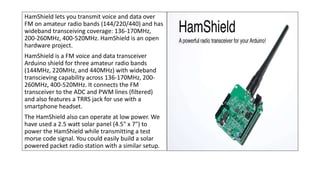
HamShield lets you transmit voice and data over
FM on amateur radio bands (144/220/440) and has
wideband transceiving coverage: 136-170MHz,
200-260MHz, 400-520MHz. HamShield is an open
hardware project.
HamShield is a FM voice and data transceiver
Arduino shield for three amateur radio bands
(144MHz, 220MHz, and 440MHz) with wideband
transcieving capability across 136-170MHz, 200-
260MHz, 400-520MHz. It connects the FM
transceiver to the ADC and PWM lines (filtered)
and also features a TRRS jack for use with a
smartphone headset.
The HamShield also can operate at low power. We
have used a 2.5 watt solar panel (4.5" x 7") to
power the HamShield while transmitting a test
morse code signal. You could easily build a solar
powered packet radio station with a similar setup.
Engineering Application of Ham Radio

Engineering Application of Ham Radio

  • 1.
    APPLICATION OF HAMRADIO Bijendra Kumar Ray & Saurabh Yadav (ECE&D 2nd Year)
  • 2.
    Introduction • What isHAM Radio ? HAM Radio is a popular hobby and service that bring people, electronics and communication together. People use ham radio to talk across town, around the world or even into the space, all without internet or cell phone. HAM Radio operator use amateur bands for communication, these band are Radio Frequency allocated by the Federal Communication Commission (FCC) for use by HAM Radio operator. Ham radio is two way wireless communication device which is used by astronauts, doctors, students, kids, politicians, truck drivers, movie stars, missionaries and even your average neighbor next door. They are of all ages, sexes, income levels and nationalities. Whether through Morse Code on an old brass telegraph key, voice communication on a hand- held radio or computerized messages transmitted via satellite, all HAMs use radio to reach out to the world.
  • 3.
    Ham Radio Operatorsare the only NON- GOVERNMENTAL people privileged to be allowed to do private WORLDWIDE wireless communication Long Distance Communication using Short Wave Frequencies in the range of 1.8 to 30 MHz
  • 4.
    • The originof the word HAM came from the name of three scientists: Heinrich Hertz + Major Armstrong + Guglielmo Marconi • “Home Amateur Mechanic” (Edited by Hugo Gernsback )- A 1900 do-it-yourself magazine. Origin of the word “HAM”
  • 5.
    Ham Radio LicensingExam • Why we need a license? • The Government tries to ensure that the person going to be a ham radio hobbyist is technically competent. • He/She does not interfere with other professional two-way wireless communication services (aeronautical, maritime, police, military etc.) • Prevent misuse of the wireless set. • She/he maintains the standard international operating practices.
  • 6.
    Applications of HAMRadio 1. Emergency communication during disaster 2. Ham Radios in Space 3. Digital application of HAM Radio 4. Automatic Packet Reporting System (APRS) 5. Packet Radio 6. Software-Defined Radio (SDR) 7. HAM Radio in Agriculture 8. Amateur Radio High Altitude Ballooning (ARHAB)- 9. D-STAR (Digital Smart Technologies for Amateur Radio) 10. Internet via Ham Radio
  • 7.
    Emergency Communication DuringDisaster • Why HAM Radio Communication is successful during emergency? In times of crisis and natural disasters, amateur radio is often used as a means of emergency communication when wireline, cell phones and other conventional means of communications fail. One of the advantages of ham radio is that a message originated from an individual can be virtually intercepted by any number of other ham radio operators at different locations
  • 8.
  • 9.
    Some Examples • AmateurRadio Service kept New York City agencies in touch with each other after their command center was destroyed during the 9/11 tragedy. Ham radio also came to the rescue during Hurricane Katrina, where all other communications failed, and the devastating flooding in Colorado in 2013. • In the Nepal tragedy ham radio played an important role and spread the message of earthquake across the country . Indian hams was working on 14.210 MHz to contact hams in Nepal, where a massive 7.9 magnitude earthquake has claimed the lives of close to 2,000 people
  • 10.
    Ham Radio inSpace • Amateur radio operators all over the world are able to speak directly to astronauts/cosmonauts via their handheld, mobile, or home radio stations. • It is also possible to send digital data to the space station via laptop computers • If a common man wants to talk a man in space , then the only way to make contact is Ham Radio . • official channels are usually reserved for presidents and heads of state.
  • 11.
    First communication using HamRadio from Space to Earth Owen Garriott, who has been an amateur radio operator for over 40 years, was the first astronaut to take a ham radio into space.
  • 12.
    Sunita Williams is alsoa HAM Operator Gujarat Science City officials, the institute established amateur radio contact with International Space Station (ISS) where Indian-American astronaut Sunita Williams was stationed for four months. The state students talked to Williams directly about her experience. The science city officials had initiated communication with National Aeronautics and Space Administration (NASA) authorities for the project.
  • 13.
    Ham Radio inAgriculture
  • 14.
    Digital Applications ofHAM Radio 1. Automatic Packet Reporting System (APRS) 2. Packet Radio 3. Software-Defined Radio (SDR) 4. Amateur Radio High Altitude Ballooning (ARHAB)- 5. D-STAR (Digital Smart Technologies for Amateur Radio) 6. Internet via Ham Radio 7. Echo-Link 8. HAMShield
  • 15.
    Automatic Packet ReportingSystem (APRS) • APRS is an amateur radio based system for real time tactical digital communications of information of immediate value in the local area. APRS data is typically broadcast on a single shared frequency (depending on country) to be repeated locally by area relay stations and digipeaters for widespread local consumption. In addition, all such data is typically ingested into the APRS Internet System (APRS-IS) via an internet connected receiver (IGATE) and distributed globally for ubiquitous and immediate access. Shared information contains global coordinates, altitude, speed, heading, text messages, alerts, announcements, and bulletins.
  • 17.
    An Aircraft canbe tracked by Ham Radio using APRS
  • 18.
    TEXT TRANSMISSION THROUGHHAM RADIO • PSK31 is a new digital mode which utilizes the processing power of computers and sound cards. • Software on the computer converts inputted text to audio level wave forms which can be fed into most standard SSB radios. • The same software listens to the output of the radio and decodes the audio signals back into text.
  • 19.
    Email Through HAMRadio • AIRMAIL (A free software for HAMs which is just like Microsoft Outlook Express)
  • 20.
    HF (Short Wavee-mail Gateway to help the sailor hams/hams at remote places by providing e-mail relay to their families) • HF (Short Wave e-mail Gateway to help the sailor hams/hams at remote places by providing e-mail relay to their families)
  • 21.
    Software-Defined Radio (SDR) •SDR is a Radio Communication system where components that have been typically implemented in hardware (e.g. mixers, filters, amplifiers, modulators/demodulators, detectors, etc.) are instead implemented by means of software on a personal computer or embedded system.
  • 22.
    Amateur Radio HighAltitude Ballooning (ARHAB) An ARHAB flight consists of a balloon, a recovery parachute, and a payload of one or more packages. The payload normally contains an amateur radio transmitter that permits tracking of the flight to its landing for recovery. Most flights use an Automatic Packet Reporting System (APRS) tracker which gets its position from a Global Positioning System (GPS) receiver and converts it to a digital radio transmission.
  • 23.
    Picture taken at approx.100,000 feet above Oregon by Justin Hamel and Chris Tho
  • 24.
    D-STAR (Digital SmartTechnologies for Amateur Radio)- • D-STAR is a digital voice and data protocol specification for amateur radio. The system uses frequency-division multiple access and minimum-shift keying in its packet-based standard. There are newer digital modes (Codec2 for example) that have been adapted for use by amateurs, but D-STAR was the first that was designed specifically for amateur radio. • Several advantages of using digital voice modes are that it uses less bandwidth than older analog voice modes such as amplitude modulation, frequency modulation, and single sideband. The quality of the data received is also better than an analog signal at the same signal strength.
  • 25.
    Internet via HamRadio • It is possible to build a repeater network that allows HAMs to access the internet through a HAM Radio. In fact, during emergency situations HAM Radios can be used quite successfully to send email, data, and documents when all other forms of communication have gone down. • Even before the internet, Ham radio operators were using an internet of their own called Packet Radio. Packet Radio allows Hams to send files, update bulletin board systems, send text messages and even control remote systems and networks via their radios. • Today, through worldwide radio messaging systems like D-Star and Winlink, Ham Radio operators can send email with attachments, send emergency relief communications and message relays, and even access the internet.
  • 26.
    Echo-Link • This softwareallows licensed Amateur Radio stations to communicate with one another over the Internet, using streaming-audio technology. • The program allows worldwide connections to be made between stations, or from computer to station, greatly enhancing Amateur Radio's communications capabilities. • There are more than 200,000 validated users worldwide — in 151 of the world's 193 nations — with about 5,200 online at any given time.
  • 27.
    HamShield lets youtransmit voice and data over FM on amateur radio bands (144/220/440) and has wideband transceiving coverage: 136-170MHz, 200-260MHz, 400-520MHz. HamShield is an open hardware project. HamShield is a FM voice and data transceiver Arduino shield for three amateur radio bands (144MHz, 220MHz, and 440MHz) with wideband transcieving capability across 136-170MHz, 200- 260MHz, 400-520MHz. It connects the FM transceiver to the ADC and PWM lines (filtered) and also features a TRRS jack for use with a smartphone headset. The HamShield also can operate at low power. We have used a 2.5 watt solar panel (4.5" x 7") to power the HamShield while transmitting a test morse code signal. You could easily build a solar powered packet radio station with a similar setup.