ENGAGING PARTICIPANTS
LINK PRIOR KNOWLEDGE
• Motivate participants by linking in prior
knowledge.
• Knowledge is activated and relevant in
new learning by linking prior knowledge
• Participants can organize and grasp the
new knowledge more easily.
FIND OUT PARTICIPANTS GOALS
• Find out what participant’s goals are.
• Goals are very helpful in developing the
course materials and delivering them.
• Personalize the participants learning. This
will also help build rapport between
instructor and participant.
• When designing or creating materials,
always have the participant’s goals in mind.
• When participants feel they are learning,
they will be more interested and engaged.
FIND OUT WHAT STIMULATES AND INTERESTS
YOUR PARTICIPANTS
• The biggest challenge for an instructor is when
he/she has to teach participants who do not like
the course. They always come up with excuses for
not participating in class.
• Ask participants what it is that they like doing in
their spare time or enjoy.
• Shape your class assignments or discussion topics
to fit them in as well. Like watching movies, ask
them to see a movie, and analyze characters,
critique, or summarize the theme. Depending on
the subject you are teaching, and what you’re
learning objectives are. This will help stimulate
their interest in wanting more.
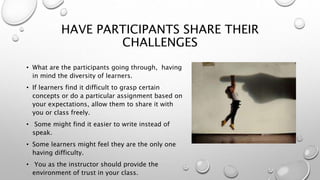
HAVE PARTICIPANTS SHARE THEIR
CHALLENGES
• What are the participants going through? Having
in mind the diversity of learners.
• If learners find it difficult to grasp certain
concepts or do a particular assignment based on
your expectations, allow them to share it with
you or class freely.
• Some might find it easier to write instead of
speak.
• Some learners might feel they are the only one
having difficulty.
• You as the instructor should provide the
environment of trust in your class.
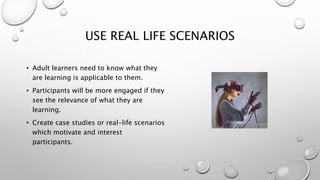
USE REAL LIFE SCENARIOS
• Adult learners need to know what they
are learning is applicable to them.
• Participants will be more engaged if they
see the relevance of what they are
learning.
• Create case studies or real-life scenarios
which motivate and interest
participants.

Engaging participants

  • 1.
  • 2.
    LINK PRIOR KNOWLEDGE •Motivate participants by linking in prior knowledge. • Knowledge is activated and relevant in new learning by linking prior knowledge • Participants can organize and grasp the new knowledge more easily.
  • 3.
    FIND OUT PARTICIPANTSGOALS • Find out what participant’s goals are. • Goals are very helpful in developing the course materials and delivering them. • Personalize the participants learning. This will also help build rapport between instructor and participant. • When designing or creating materials, always have the participant’s goals in mind. • When participants feel they are learning, they will be more interested and engaged.
  • 4.
    FIND OUT WHATSTIMULATES AND INTERESTS YOUR PARTICIPANTS • The biggest challenge for an instructor is when he/she has to teach participants who do not like the course. They always come up with excuses for not participating in class. • Ask participants what it is that they like doing in their spare time or enjoy. • Shape your class assignments or discussion topics to fit them in as well. Like watching movies, ask them to see a movie, and analyze characters, critique, or summarize the theme. Depending on the subject you are teaching, and what you’re learning objectives are. This will help stimulate their interest in wanting more.
  • 5.
    HAVE PARTICIPANTS SHARETHEIR CHALLENGES • What are the participants going through? Having in mind the diversity of learners. • If learners find it difficult to grasp certain concepts or do a particular assignment based on your expectations, allow them to share it with you or class freely. • Some might find it easier to write instead of speak. • Some learners might feel they are the only one having difficulty. • You as the instructor should provide the environment of trust in your class.
  • 6.
    USE REAL LIFESCENARIOS • Adult learners need to know what they are learning is applicable to them. • Participants will be more engaged if they see the relevance of what they are learning. • Create case studies or real-life scenarios which motivate and interest participants.