Prepared for:
Instructional Design Team


                            Prepared by:
                            Charlotte Penny & Stevie Geddes
So, how do you engage your
         learners?
Two of our favourite models that we use to
  engage our learners are:

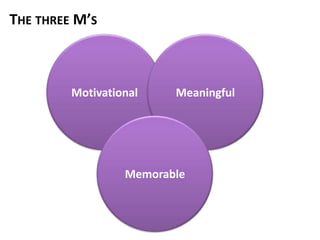
     THE THREE M’S
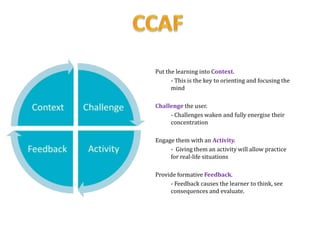
     CCAF
THE THREE M’S


         Motivational    Meaningful


                  Memorable
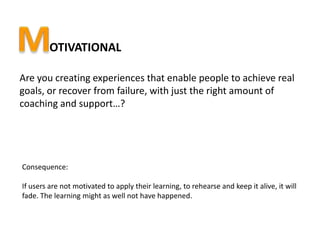
OTIVATIONAL

Are you creating experiences that enable people to achieve real
goals, or recover from failure, with just the right amount of
coaching and support…?


Consequence:

If users are not motivated to apply their learning, to rehearse and keep it alive, it will
fade. The learning might as well not have happened.
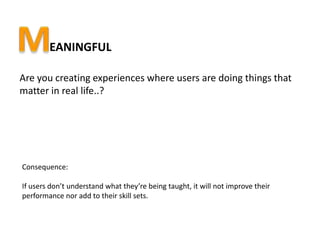
EANINGFUL

Are you creating experiences where users are doing things that
matter in real life..?


Consequence:

If users don’t understand what they’re being taught, it will not improve their
performance nor add to their skill sets.
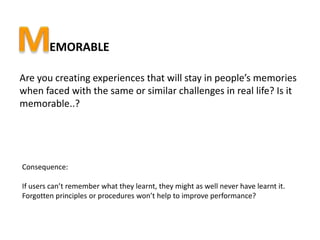
EMORABLE

Are you creating experiences that will stay in people’s memories
when faced with the same or similar challenges in real life? Is it
memorable..?


Consequence:

If users can’t remember what they learnt, they might as well never have learnt it.
Forgotten principles or procedures won’t help to improve performance?
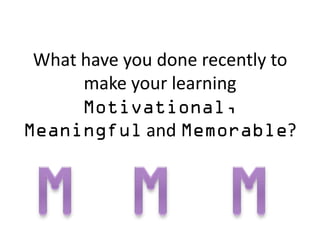
What have you done recently to
     make your learning

             and                 ?
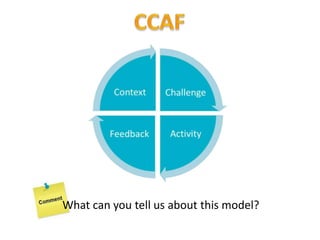
What can you tell us about this model?
Put the learning into Context.
      - This is the key to orienting and focusing the
      mind

Challenge the user.
     - Challenges waken and fully energise their
     concentration

Engage them with an Activity.
     - Giving them an activity will allow practice
     for real-life situations

Provide formative Feedback.
     - Feedback causes the learner to think, see
     consequences and evaluate.
[ ENGAGING THE USER]


                                                                          Put the learning into context…

Context is the foundation, the critical base. Information is useless unless the learner can think of some way to
associate it with other information around the topic. Associations reinforce memory, the more realistic, the
easier it is for learners to transfer their learning to real-life performance.
[ ENGAGING THE USER]


                                                                             Challenge the user…

Challenges take on relevance when they build on the context. They help learners to visualise situations and the
way they would respond. Challenges should work together with context, in order to make it clear to the learner
why they should care about the outcome.
[ ENGAGING THE USER]


                                                                      Engage them with an activity…

Activities need to have some resemblance to the physical performance, otherwise they’re not providing any
practice for the learner. Requiring the learner to do exactly what they would do when faced with the real situation
makes for good learning activities. They are not there to catch the learner out.

Engaging the user 1

  • 1.
    Prepared for: Instructional DesignTeam Prepared by: Charlotte Penny & Stevie Geddes
  • 2.
    So, how doyou engage your learners?
  • 3.
    Two of ourfavourite models that we use to engage our learners are: THE THREE M’S CCAF
  • 4.
    THE THREE M’S Motivational Meaningful Memorable
  • 5.
    OTIVATIONAL Are you creatingexperiences that enable people to achieve real goals, or recover from failure, with just the right amount of coaching and support…? Consequence: If users are not motivated to apply their learning, to rehearse and keep it alive, it will fade. The learning might as well not have happened.
  • 6.
    EANINGFUL Are you creatingexperiences where users are doing things that matter in real life..? Consequence: If users don’t understand what they’re being taught, it will not improve their performance nor add to their skill sets.
  • 7.
    EMORABLE Are you creatingexperiences that will stay in people’s memories when faced with the same or similar challenges in real life? Is it memorable..? Consequence: If users can’t remember what they learnt, they might as well never have learnt it. Forgotten principles or procedures won’t help to improve performance?
  • 8.
    What have youdone recently to make your learning and ?
  • 9.
    What can youtell us about this model?
  • 10.
    Put the learninginto Context. - This is the key to orienting and focusing the mind Challenge the user. - Challenges waken and fully energise their concentration Engage them with an Activity. - Giving them an activity will allow practice for real-life situations Provide formative Feedback. - Feedback causes the learner to think, see consequences and evaluate.
  • 11.
    [ ENGAGING THEUSER] Put the learning into context… Context is the foundation, the critical base. Information is useless unless the learner can think of some way to associate it with other information around the topic. Associations reinforce memory, the more realistic, the easier it is for learners to transfer their learning to real-life performance.
  • 12.
    [ ENGAGING THEUSER] Challenge the user… Challenges take on relevance when they build on the context. They help learners to visualise situations and the way they would respond. Challenges should work together with context, in order to make it clear to the learner why they should care about the outcome.
  • 13.
    [ ENGAGING THEUSER] Engage them with an activity… Activities need to have some resemblance to the physical performance, otherwise they’re not providing any practice for the learner. Requiring the learner to do exactly what they would do when faced with the real situation makes for good learning activities. They are not there to catch the learner out.