Engaging Consumers in                        !
Your ! Story
          Dr. Pamela Rutledge
 Director, Media Psychology Research Center
             November 12, 2012
              @pamelarutledge
Overview

     1     What’s Happening Out There?


     2     What’s in a Story

     3     How Do You Find It?

     4     What Do You Do With It?
1
What’s Happening
  Out There?!
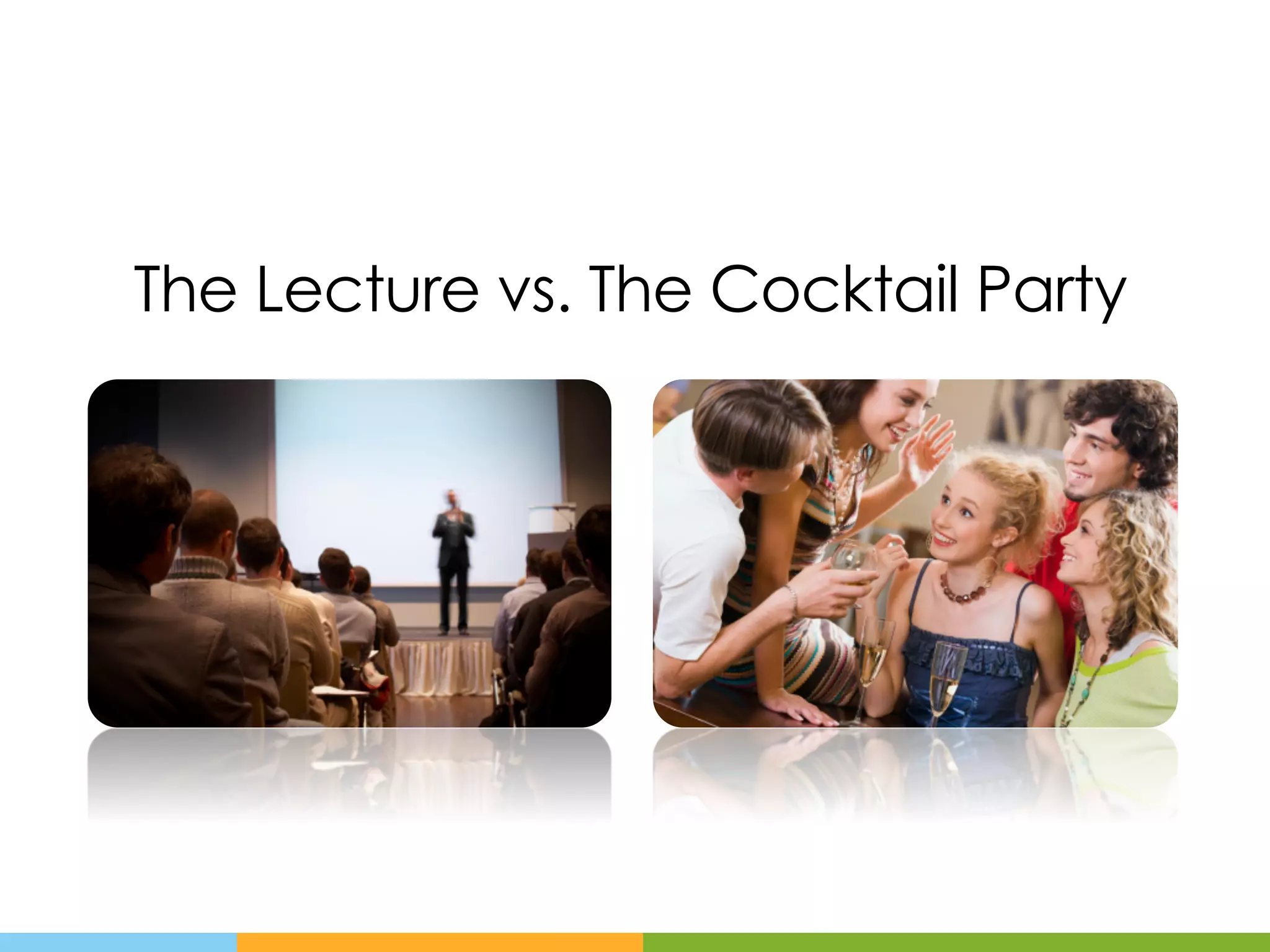
The Lecture vs. The Cocktail Party
Mobile
On-demand Information
Full-time connectivity
The New Normal

Consumers expect to participate, be heard,
collaborate, get information, and connect.

             Fast. All the time.
How Do You Compete?
2

Tell a story!
1
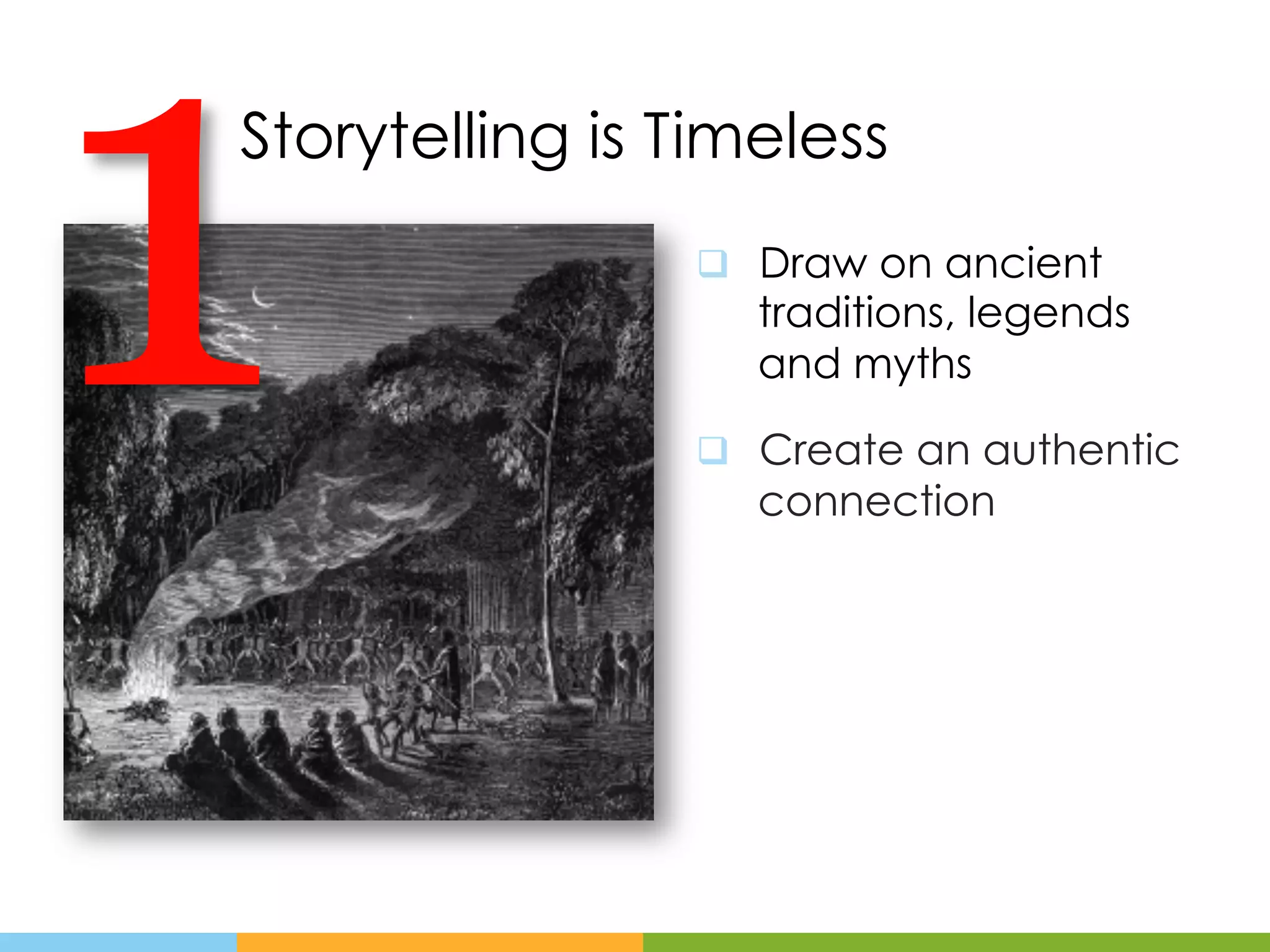
Storytelling is Timeless
                q  Draw on ancient
                   traditions, legends
                   and myths

                q  Create an authentic
                   connection
2
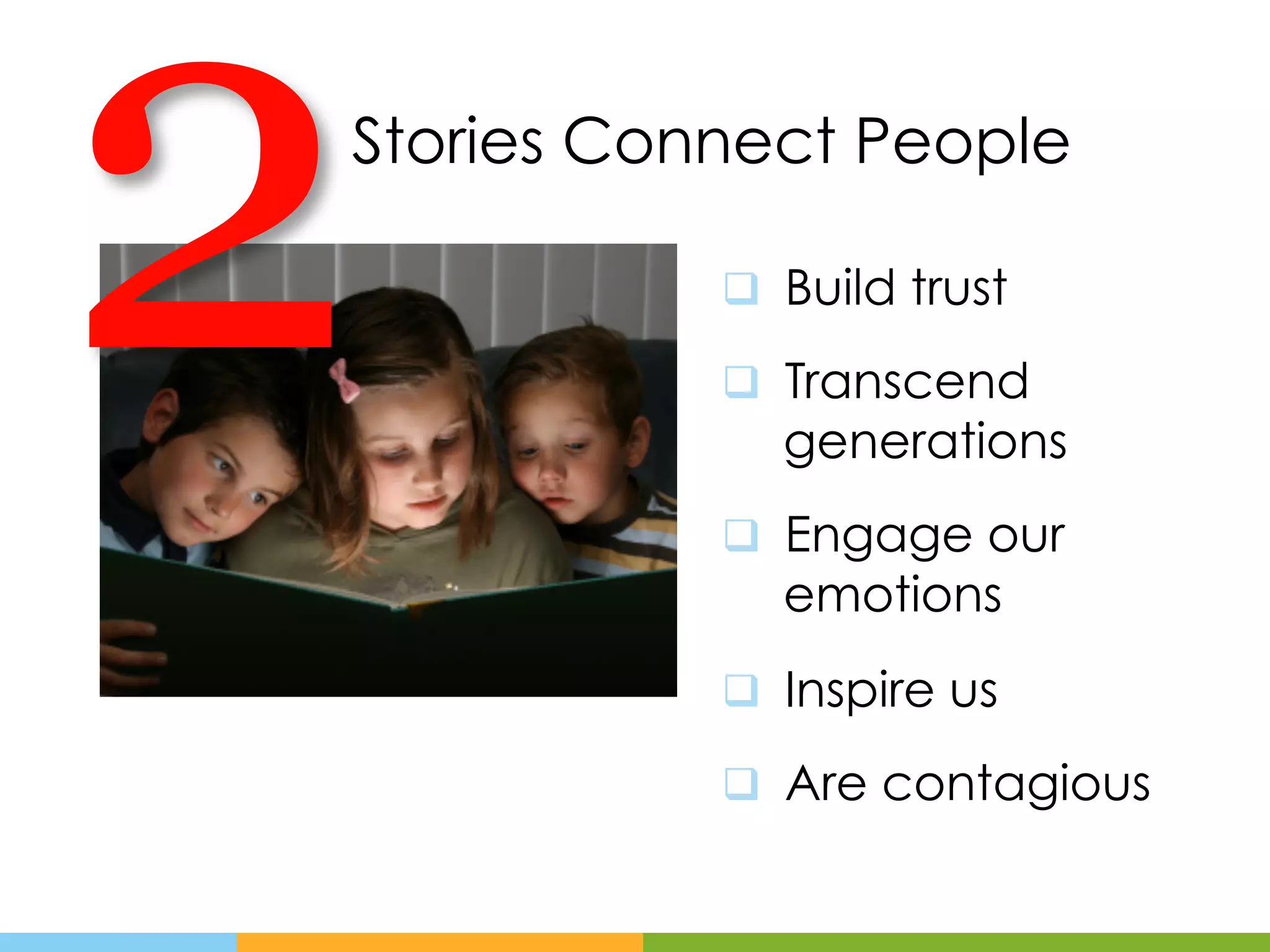
Stories Connect People

           q  Build trust

           q  Transcend
              generations
           q  Engage our
              emotions
           q  Inspire us

           q  Are contagious
3
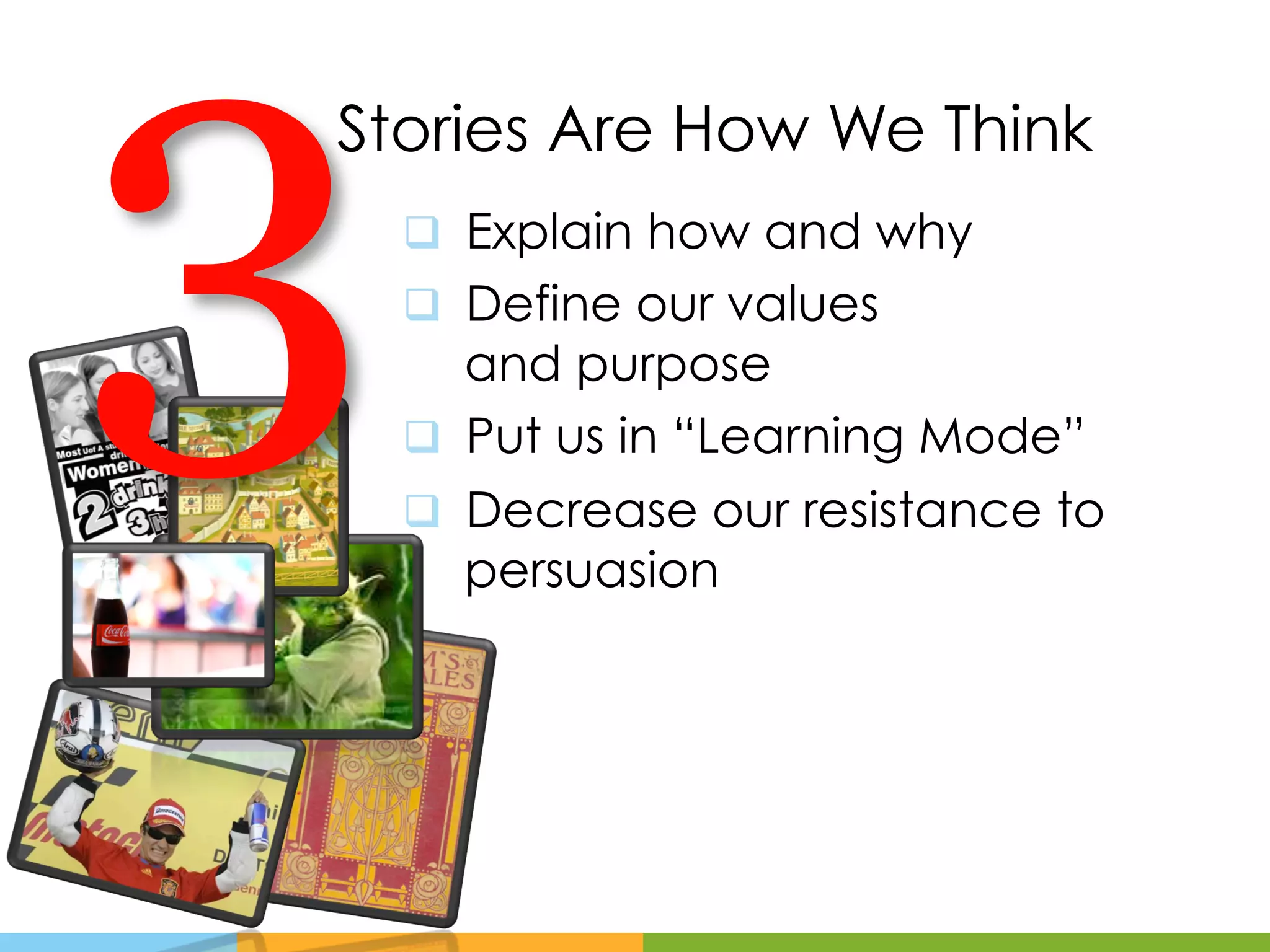
Stories Are How We Think
    q  Explain how and why
    q  Define our values
        and purpose
    q  Put us in “Learning Mode”
    q  Decrease our resistance to
        persuasion
4
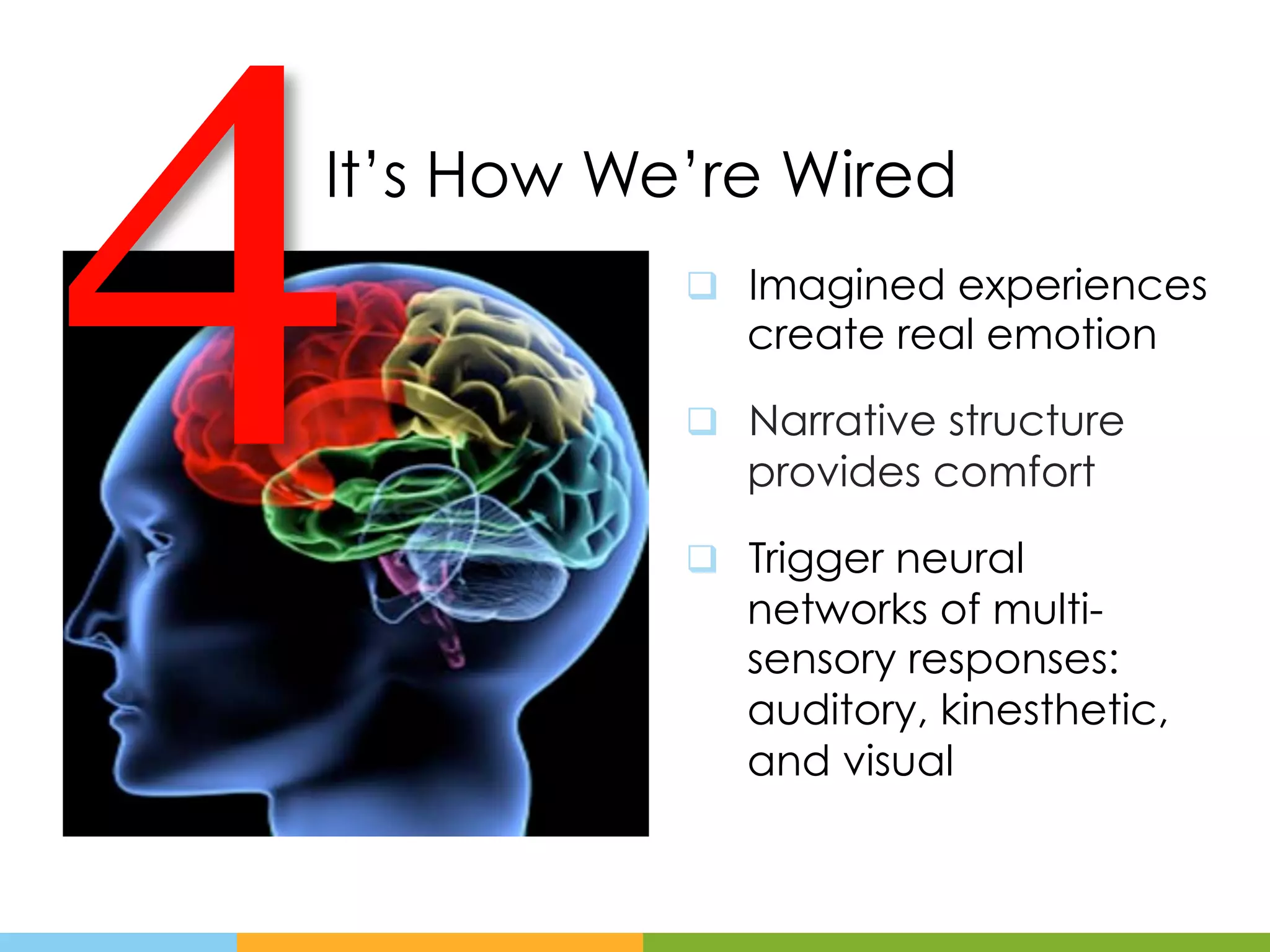
It’s How We’re Wired
           q  Imagined experiences
              create real emotion

           q  Narrative structure
              provides comfort

           q  Trigger neural
              networks of multi-
              sensory responses:
              auditory, kinesthetic,
              and visual
The shortest distance
 between people is
   through story!
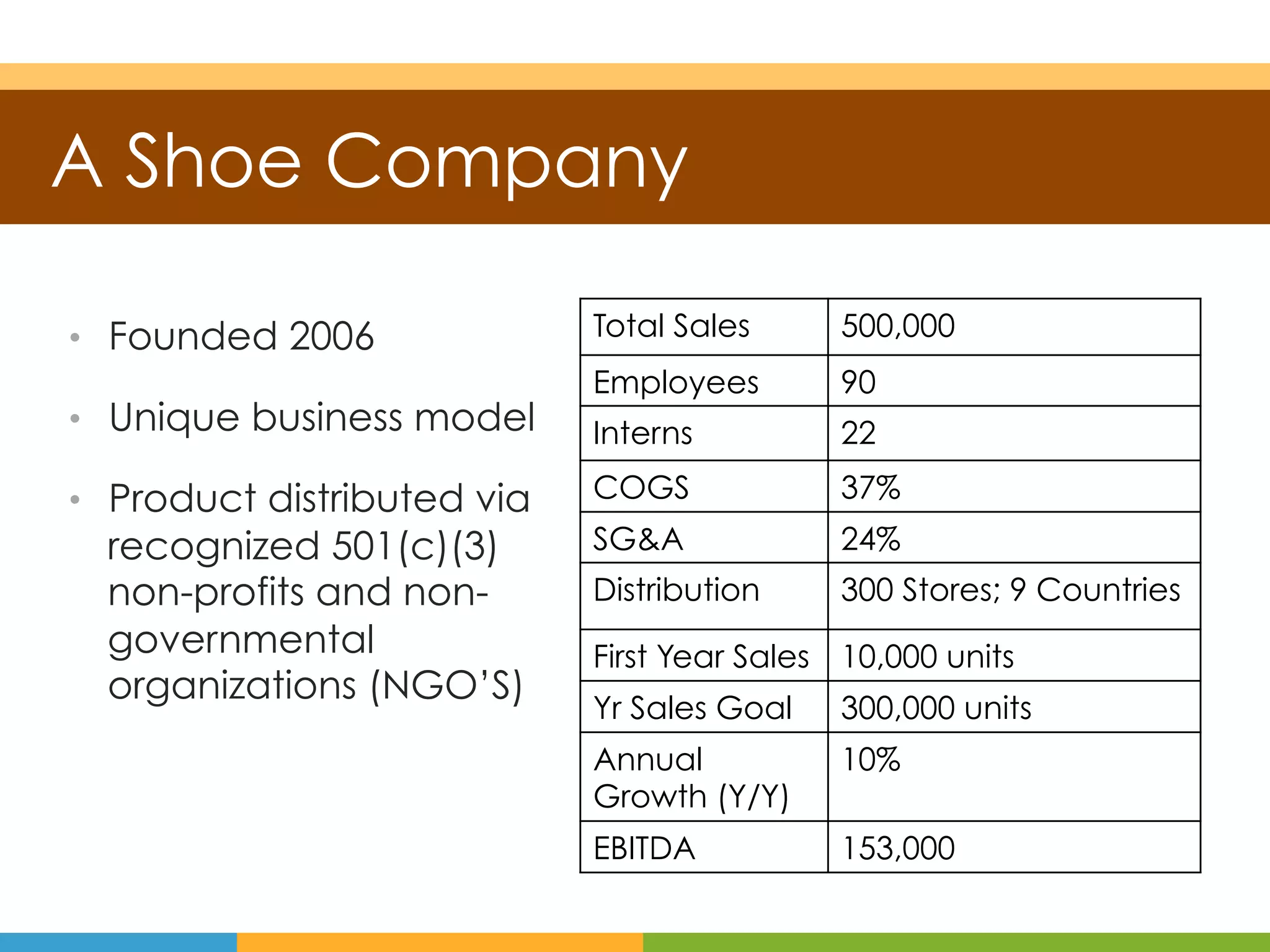
A Shoe Company

•  Founded 2006              Total Sales      500,000
                             Employees        90
•  Unique business model     Interns          22

•  Product distributed via   COGS             37%
  recognized 501(c)(3)       SG&A             24%
  non-profits and non-       Distribution     300 Stores; 9 Countries
  governmental               First Year Sales 10,000 units
  organizations (NGO’S)
                             Yr Sales Goal    300,000 units
                             Annual           10%
                             Growth (Y/Y)
                             EBITDA           153,000
Stories are flight
simulators for the brain
3
Finding Your Story!
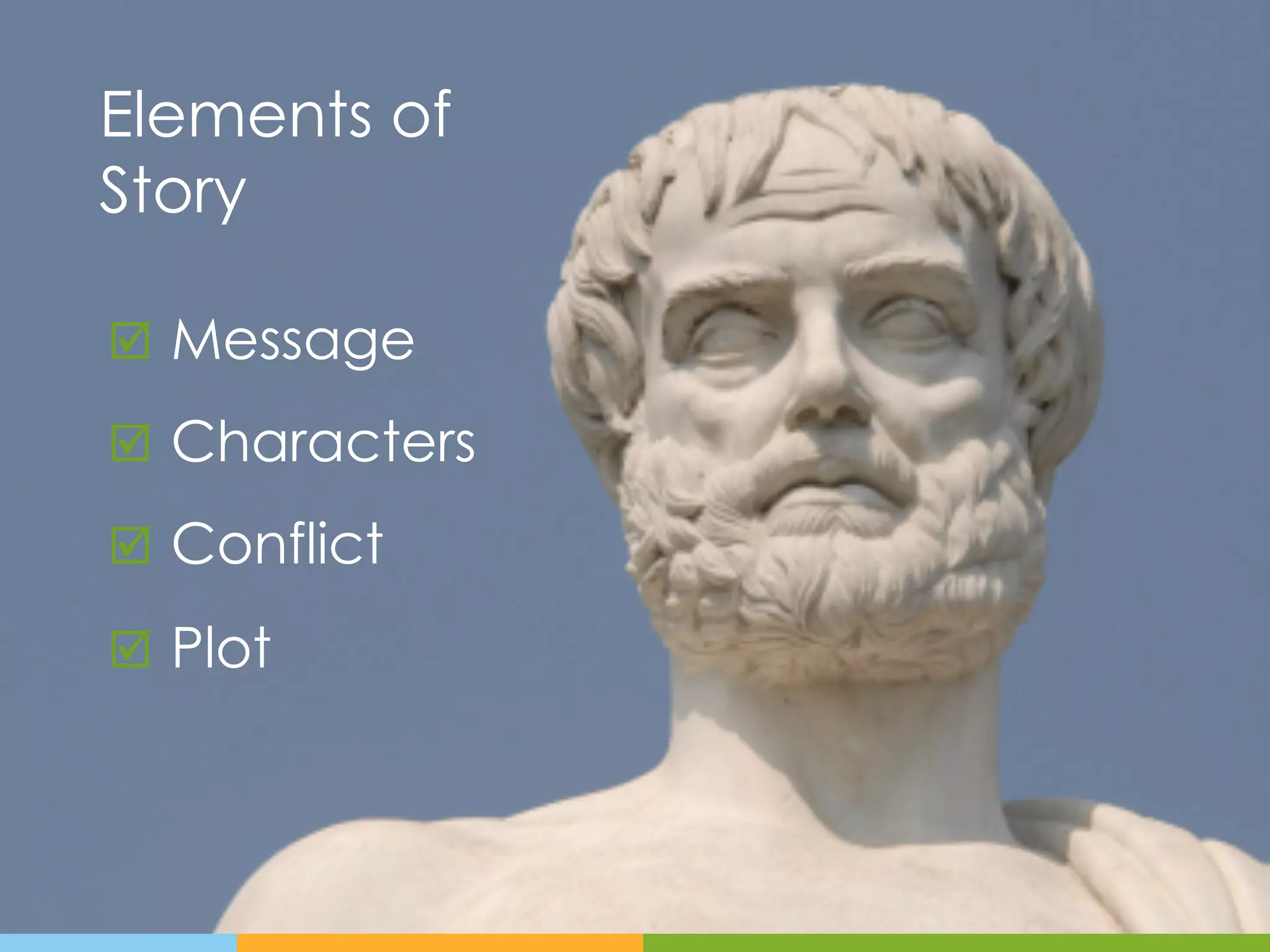
Elements of
Story

þ  Message

þ  Characters

þ  Conflict

þ  Plot
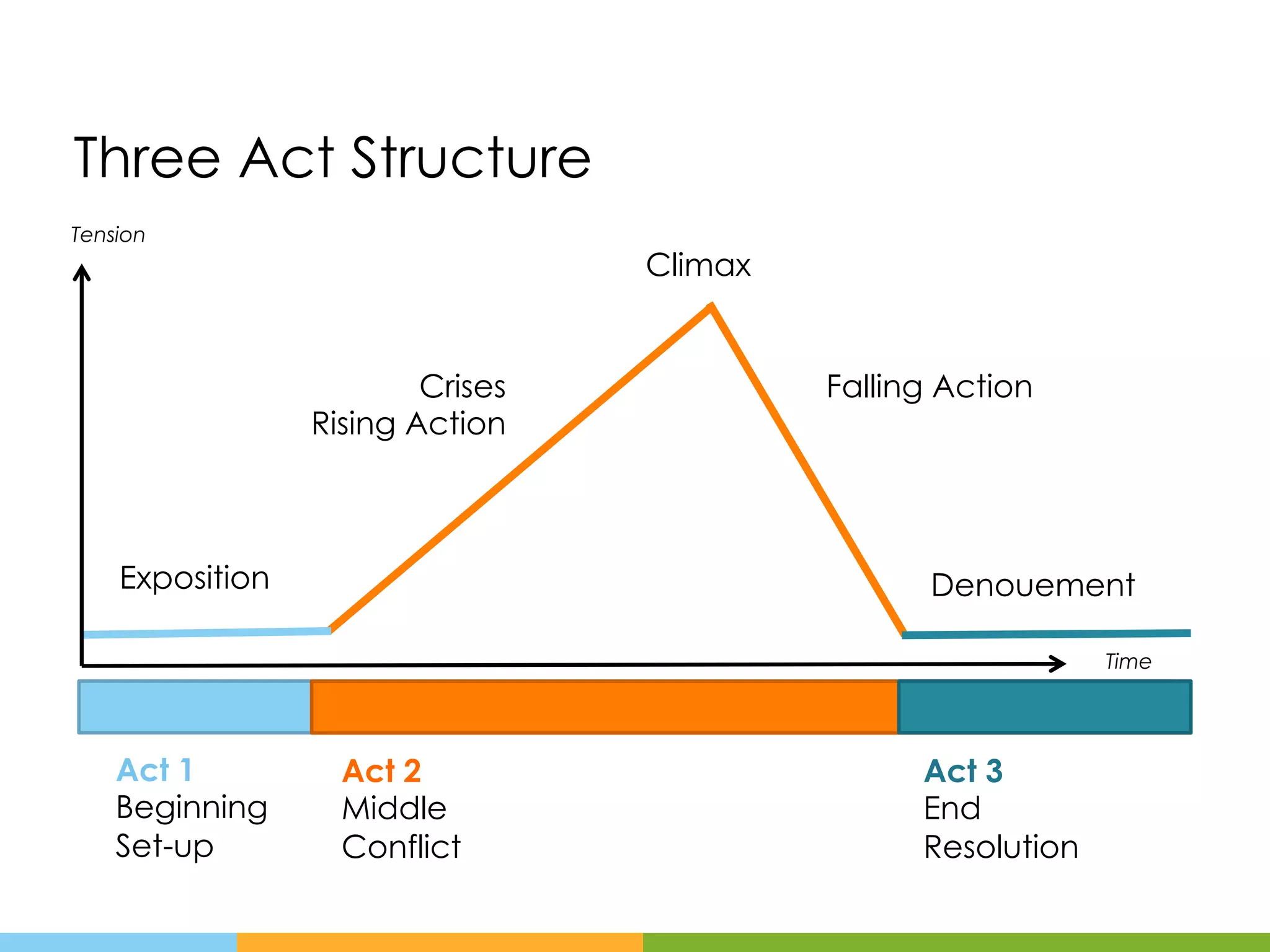
Three Act Structure
Tension
                                  Climax


                         Crises            Falling Action
                 Rising Action


    Exposition                                    Denouement

                                                              Time


    Act 1          Act 2                         Act 3
    Beginning      Middle                        End
    Set-up         Conflict                      Resolution
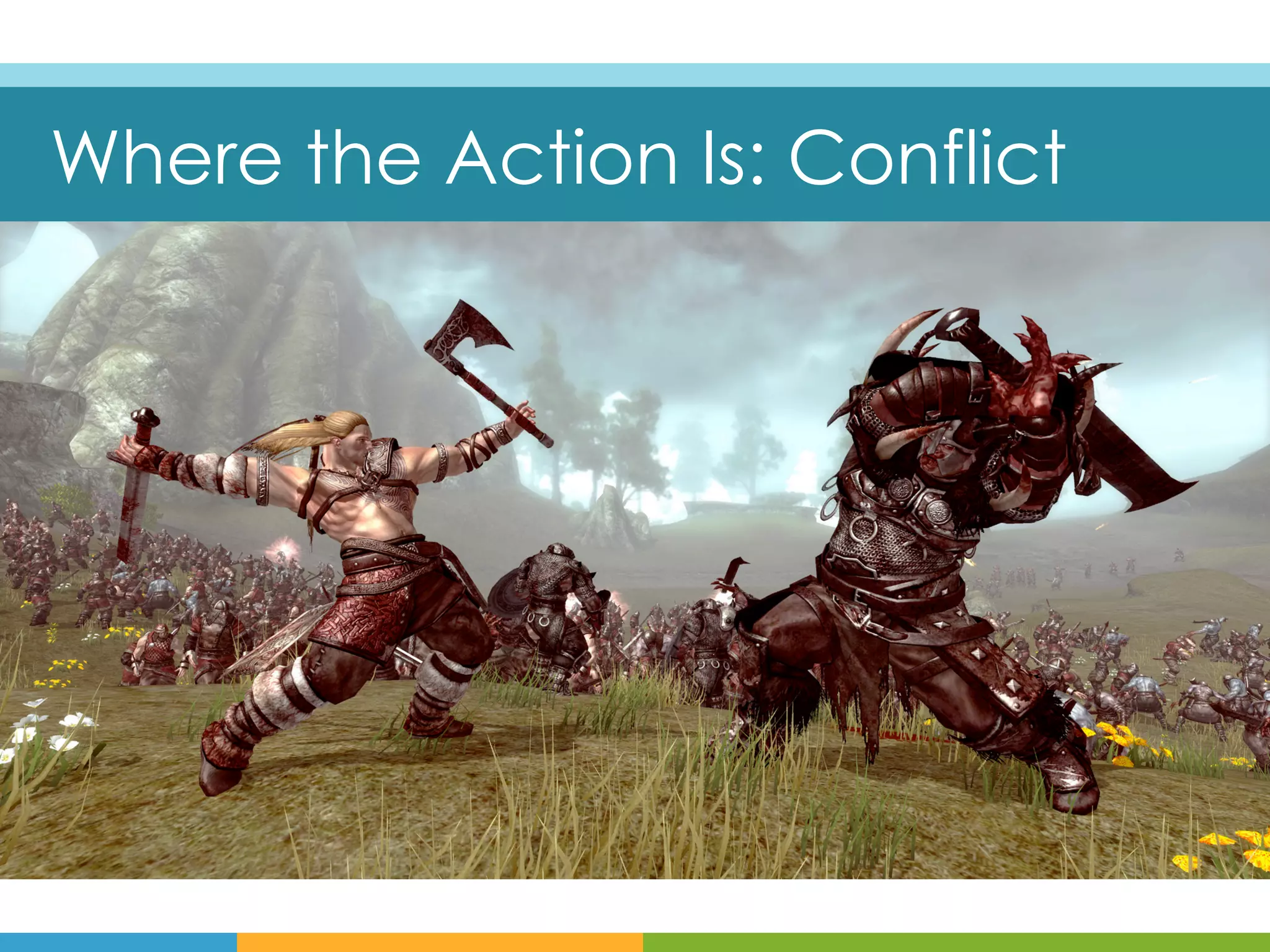
Where the Action Is: Conflict
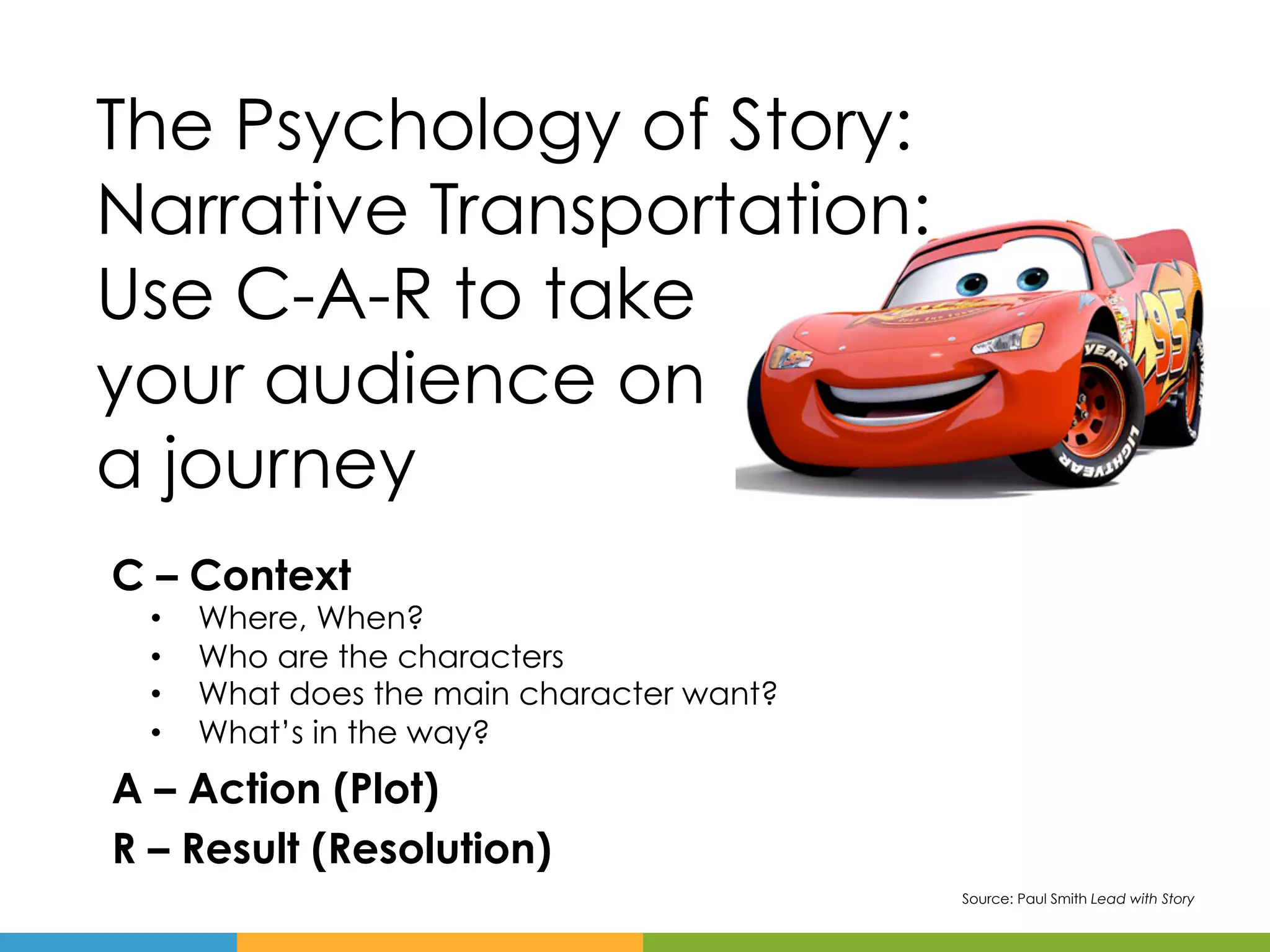
The Psychology of Story:
Narrative Transportation:
Use C-A-R to take
your audience on
a journey
C – Context
  •    Where, When?
  •    Who are the characters
  •    What does the main character want?
  •    What’s in the way?
A – Action (Plot)
R – Result (Resolution)
                                            Source: Paul Smith Lead with Story
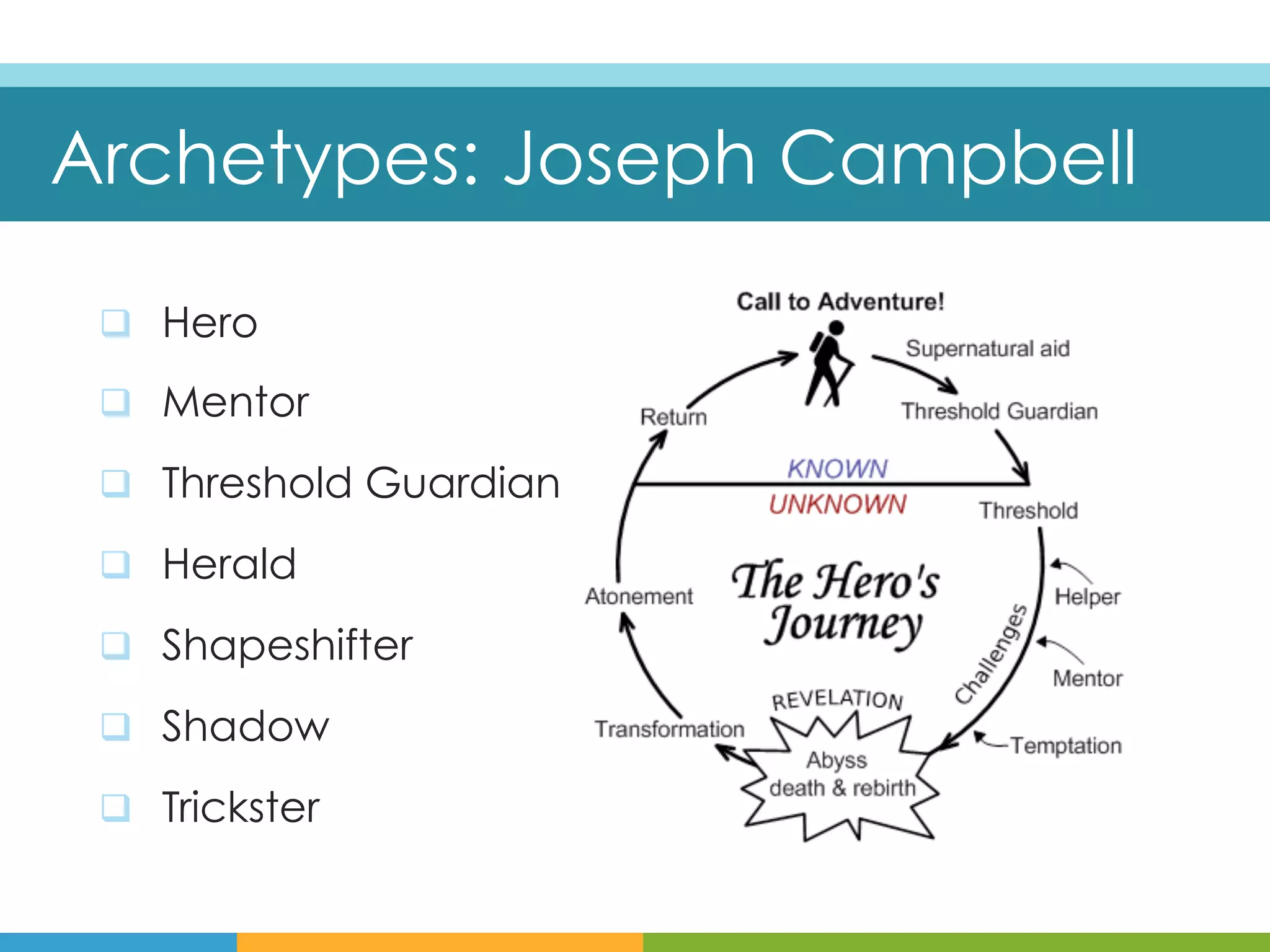
Archetypes: Joseph Campbell

 q  Hero

 q  Mentor

 q  Threshold Guardian

 q  Herald

 q  Shapeshifter

 q  Shadow

 q  Trickster
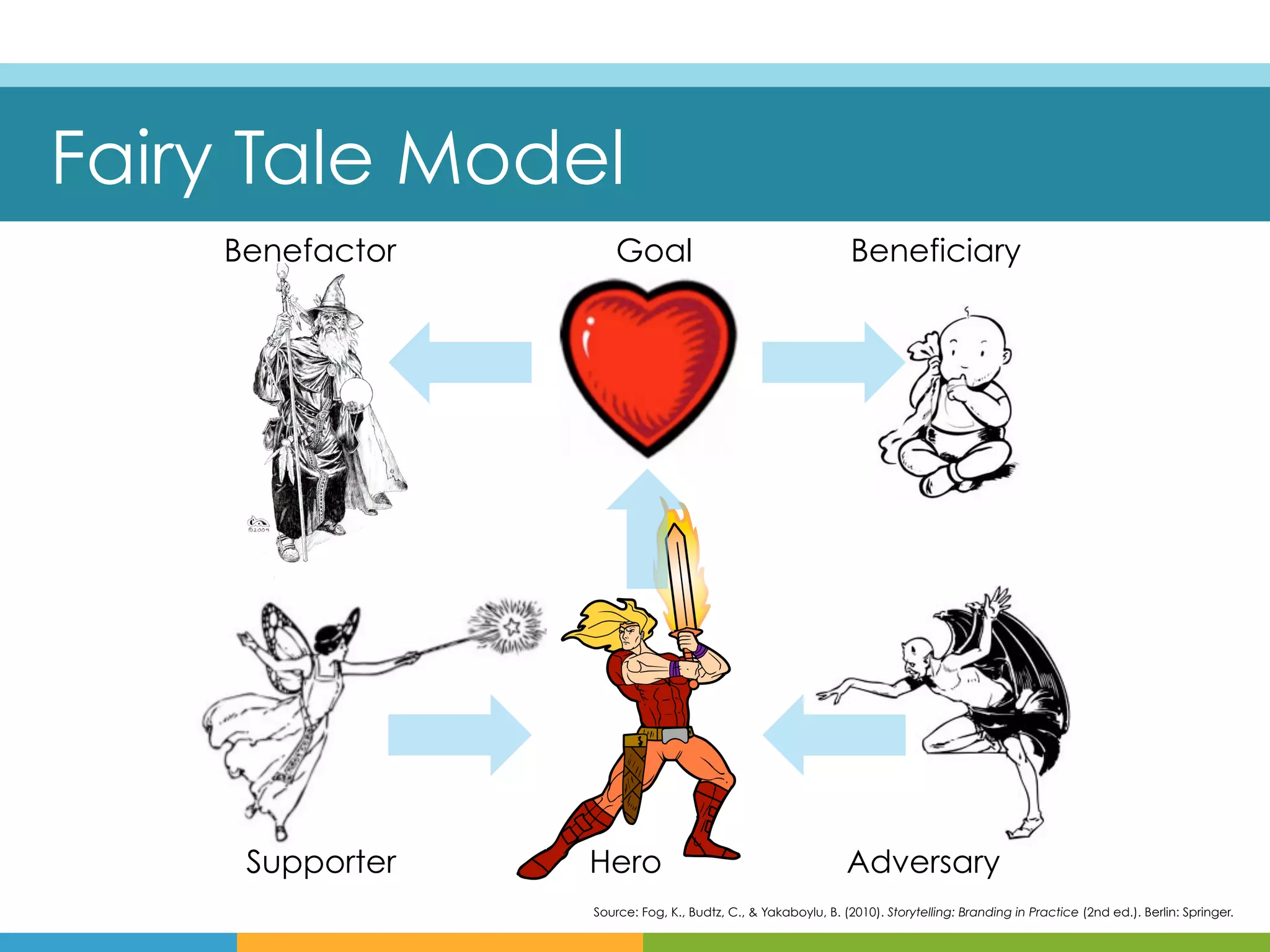
Fairy Tale Model
    Benefactor      Goal                                       Beneficiary


     Supporter   Hero                                         Adversary
                 Source: Fog, K., Budtz, C., & Yakaboylu, B. (2010). Storytelling: Branding in Practice (2nd ed.). Berlin: Springer.
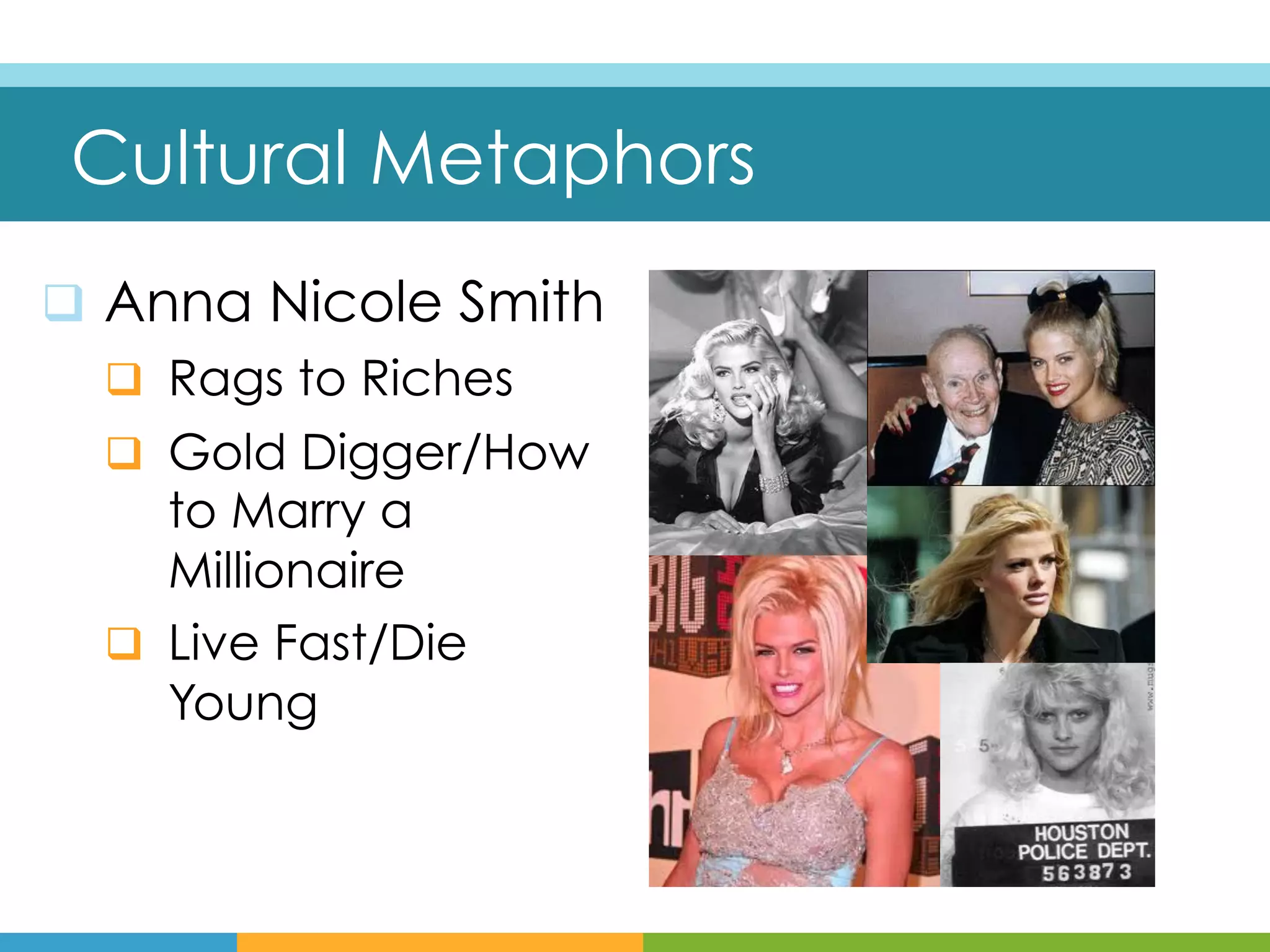
 Cultural Metaphors
q  Anna Nicole Smith
    q  Rags to Riches
    q  Gold Digger/How
        to Marry a
        Millionaire
    q  Live Fast/Die
        Young
3
Finding The Story!
Story Themes

q  The Hero’s Quest --> Entrepreneurial Venture

q  Creation Stories --> Establishment of
  Organization
q  Stories of Transformation --> Coming of Age

q  Stories of Fall and Redemption --> Crisis Phase

q  The Myth of the Crossroads --> Transition Phase
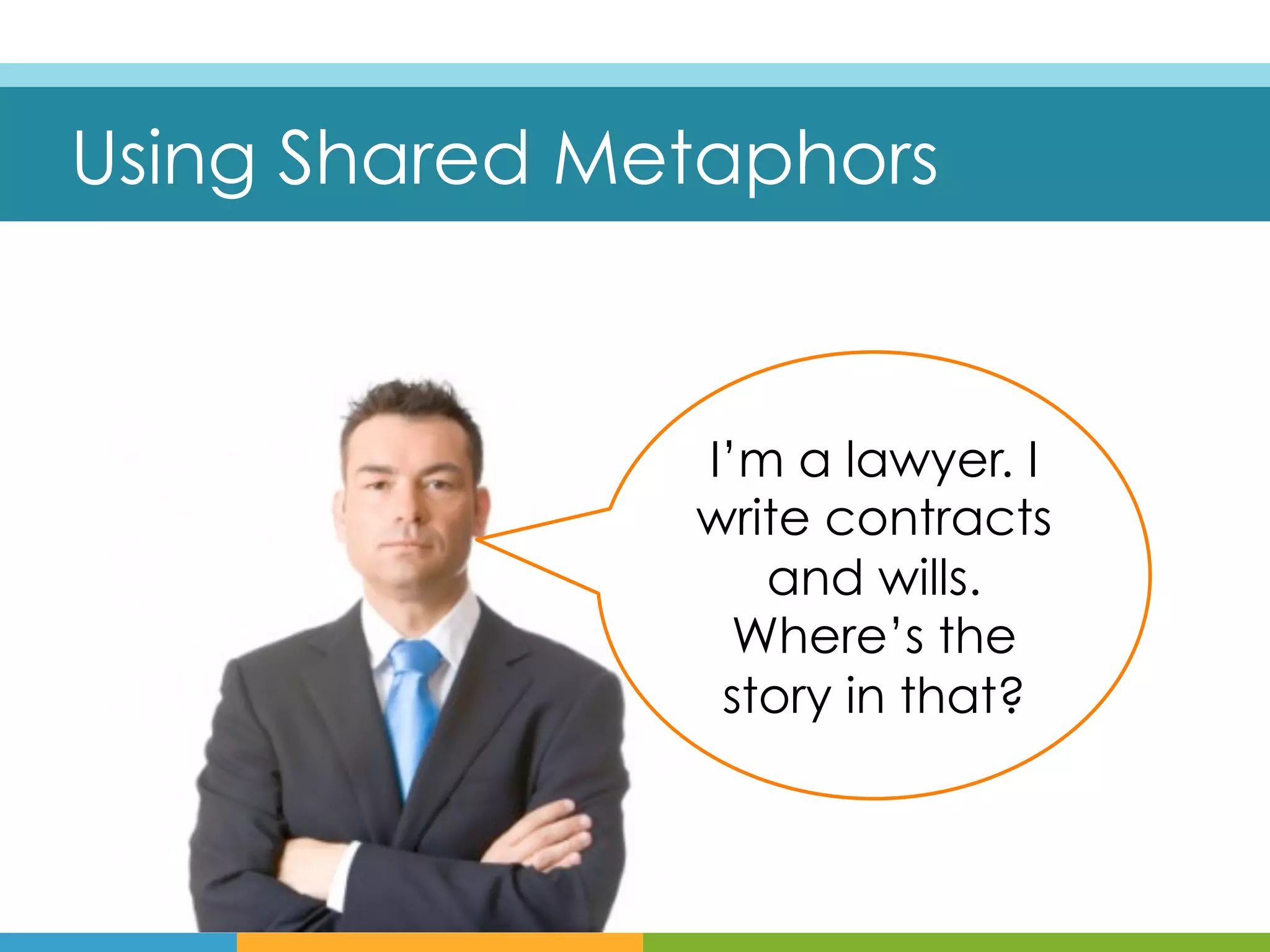
Using Shared Metaphors


               I’m a lawyer. I
               write contracts
                  and wills.
                 Where’s the
                story in that?
The
Family
  Lawyer
Watching over your
       legal health
Questions to ask
  q  Who am I?
  q  Why am I here?
  q  What is my vision?
  q  What do I want to teach people? And
      why?
  q  What values do I want to demonstrate?
      And why?
  q  What do I want my customers to know I
      understand?
One-Sheet Exercise

  q  Story in three sentences
      q  Work from the experience of the image of
          your company or brand

  q  Characters in three sentences
      q  Who are the characters?
      q  Are you a character?
      q  Does place matter?
4
Telling Your Story!
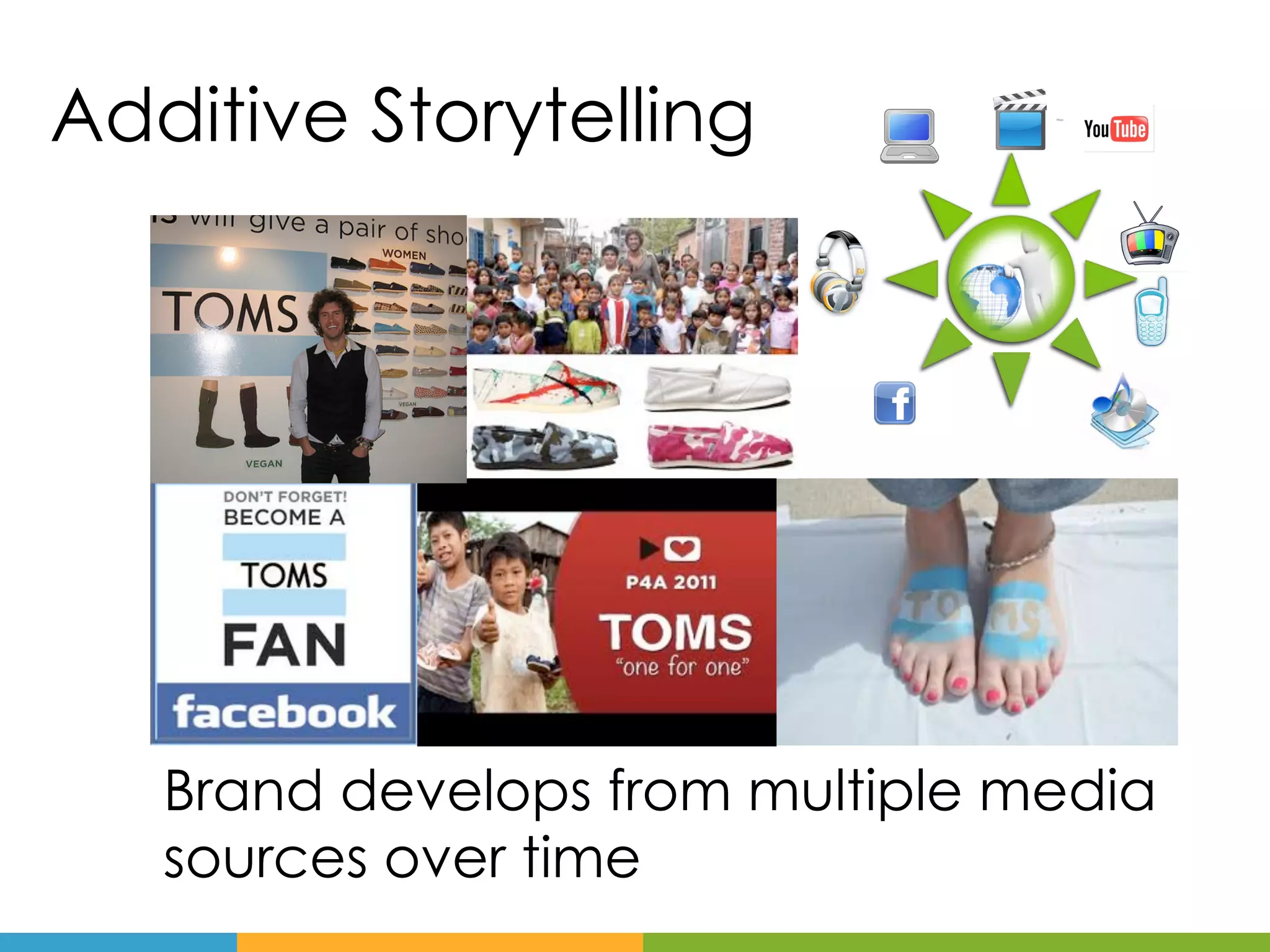
Additive Storytelling


   Brand develops from multiple media
   sources over time
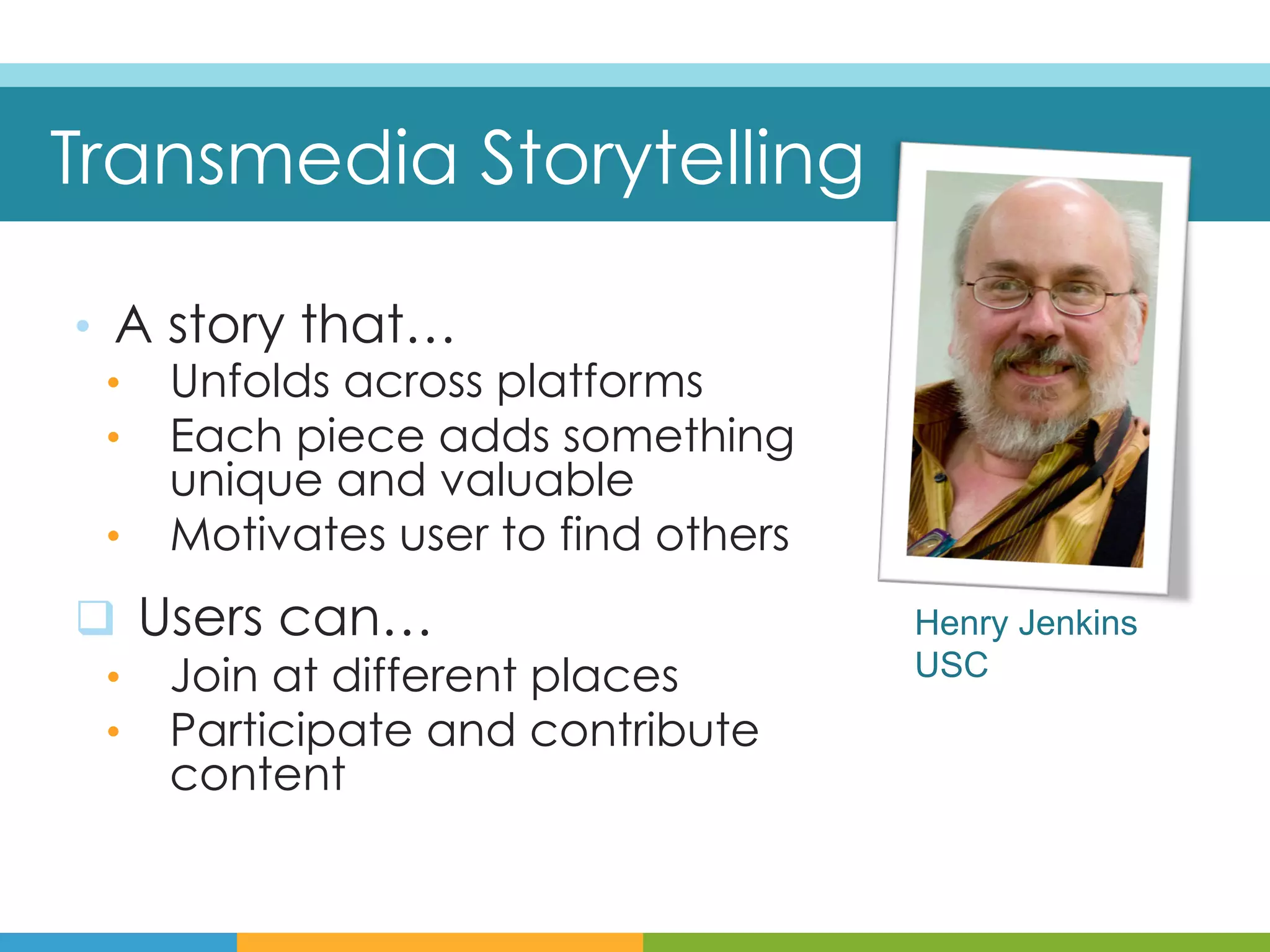
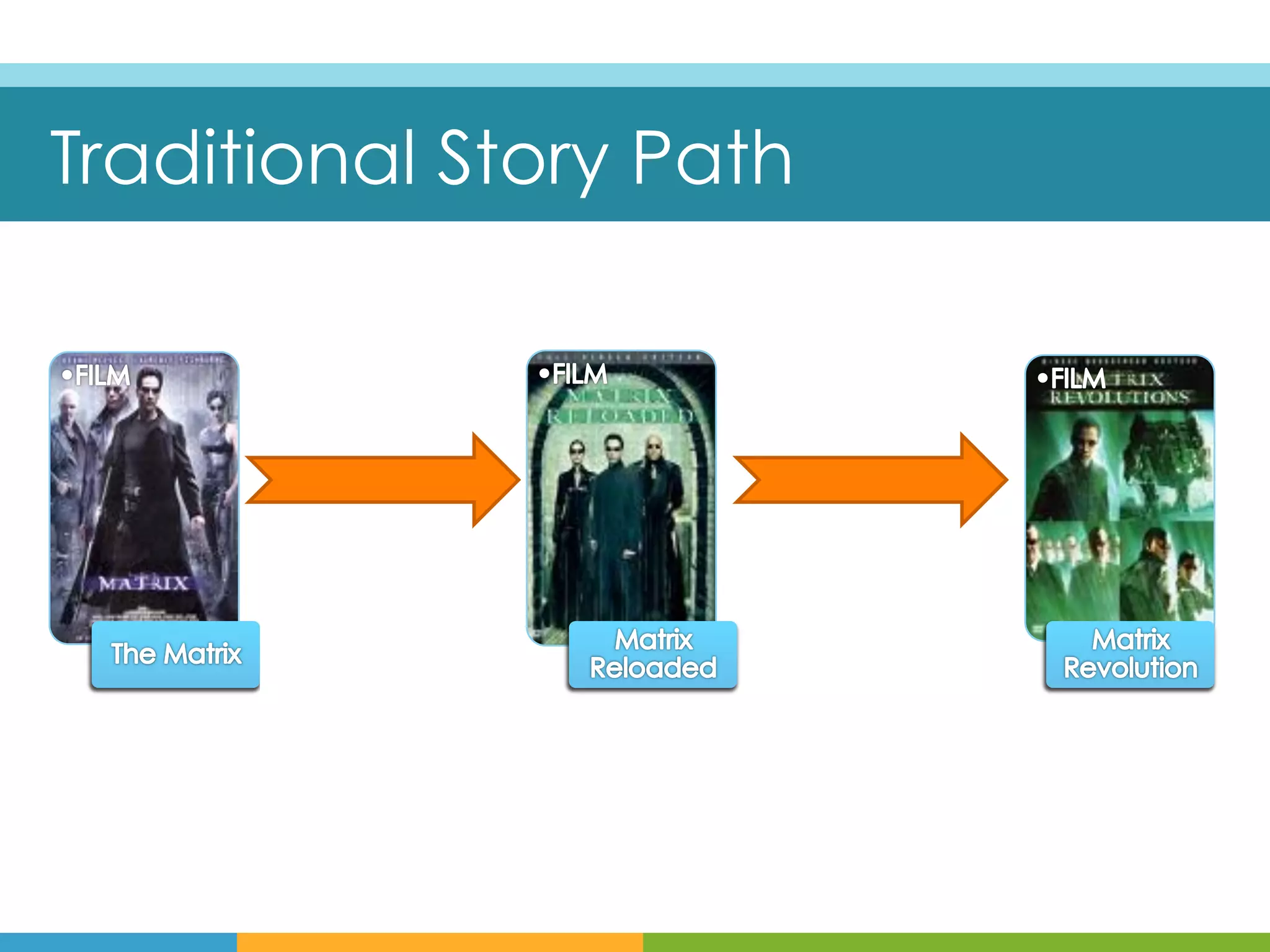
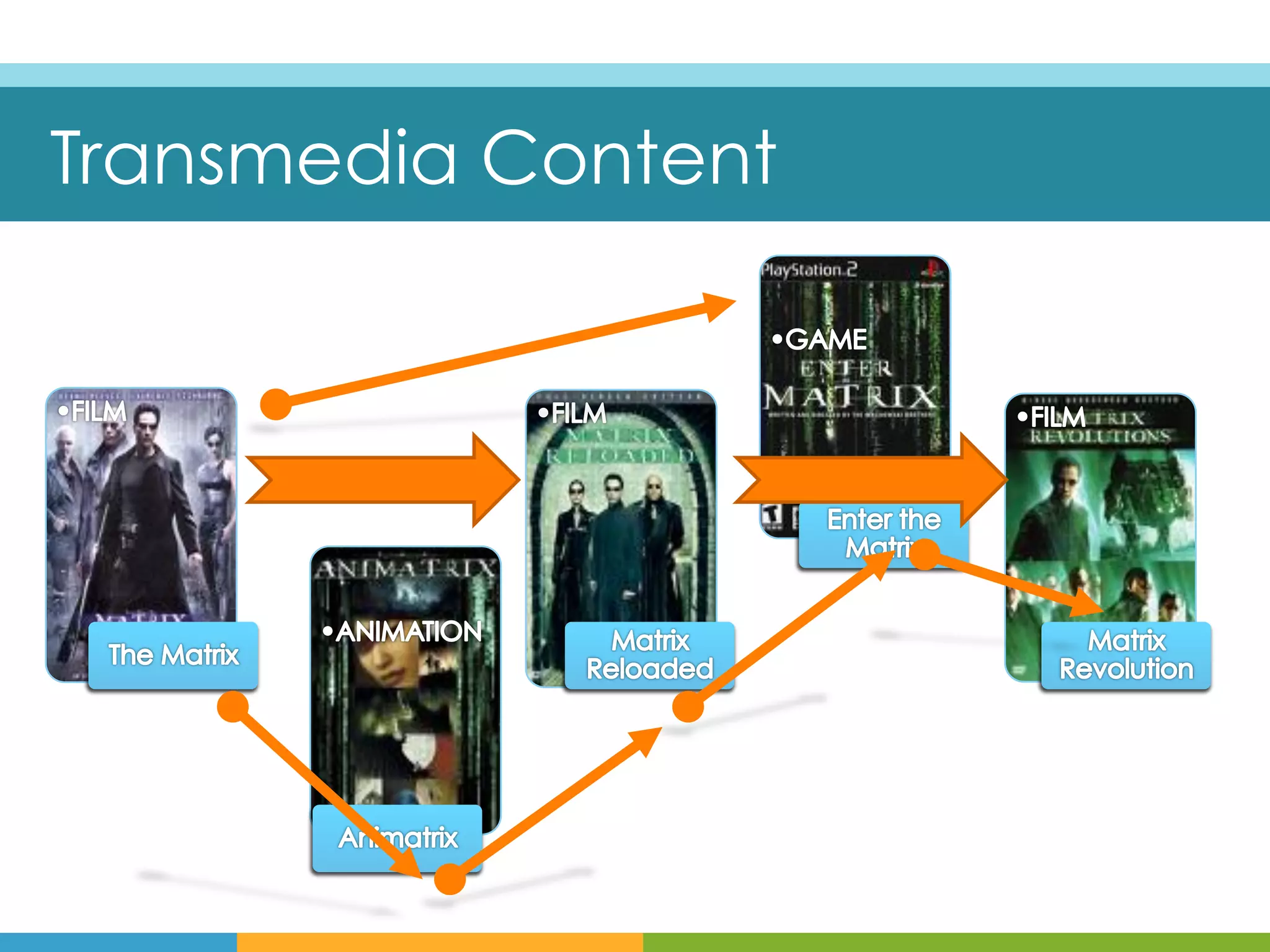
Transmedia Storytelling

•  A story that…
   •  Unfolds across platforms
   •  Each piece adds something
      unique and valuable
   •  Motivates user to find others

q  Users can…                        Henry Jenkins
 •  Join at different places          USC
 •  Participate and contribute
     content
Traditional Story Path
Transmedia Content
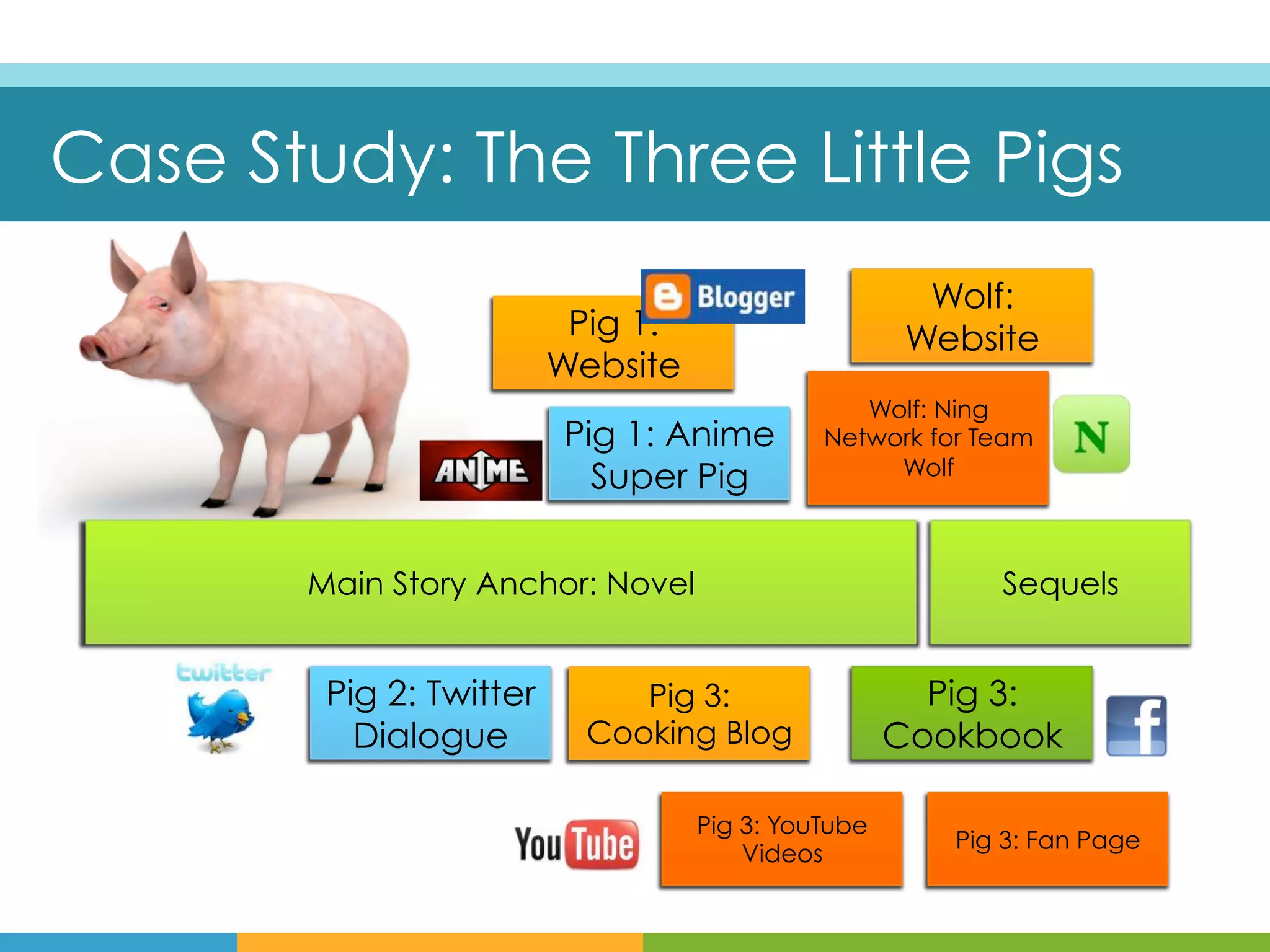
Case Study: The Three Little Pigs
                                                      Wolf:
                          Pig 1:                     Website
                         Website
                                                Wolf: Ning
                         Pig 1: Anime        Network for Team
                                                  Wolf
                           Super Pig


       Main Story Anchor: Novel                           Sequels


        Pig 2: Twitter        Pig 3:                  Pig 3:
          Dialogue         Cooking Blog             Cookbook

                                   Pig 3: YouTube
                                                       Pig 3: Fan Page
                                       Videos
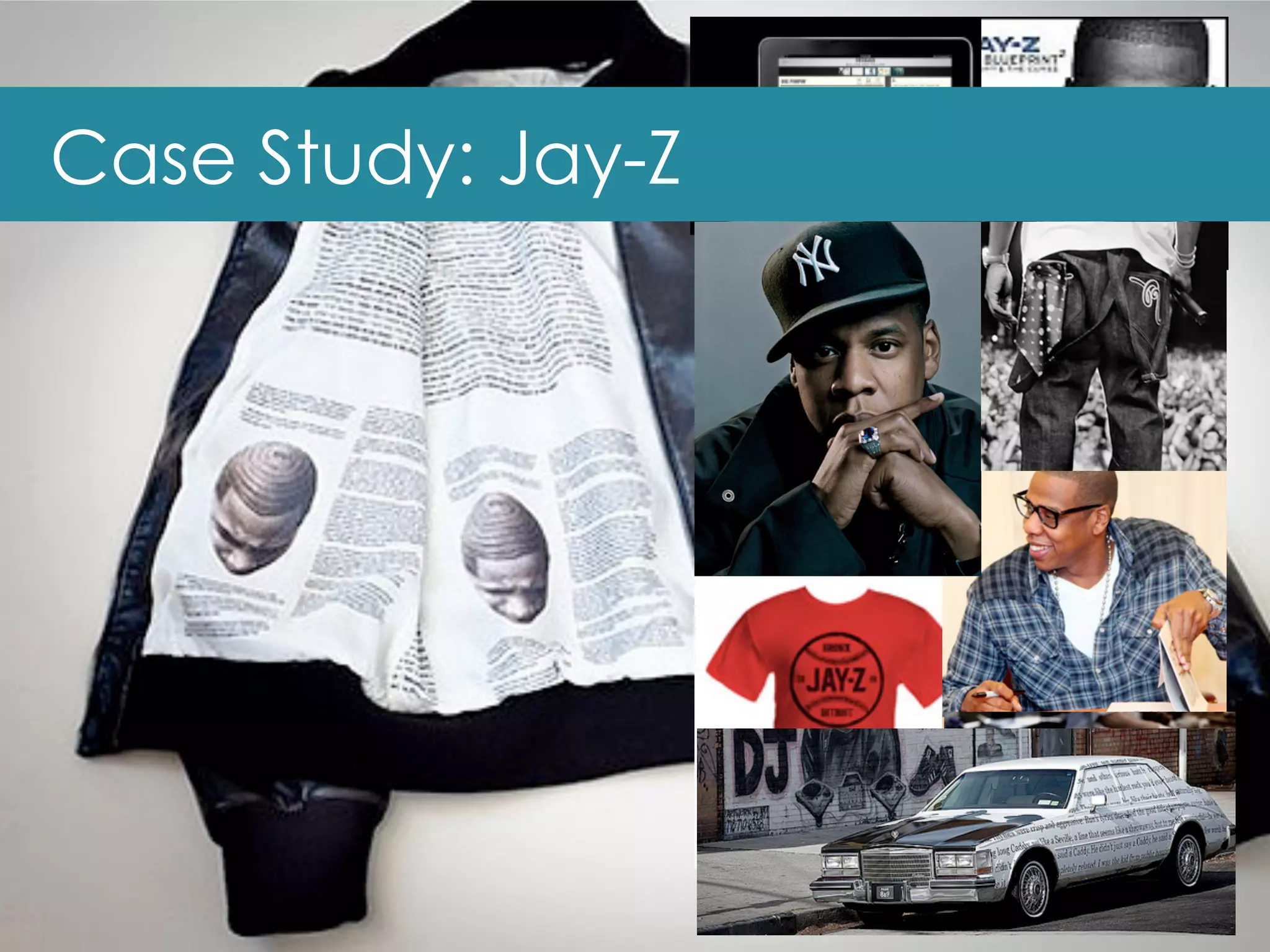
Case Study: Jay-Z
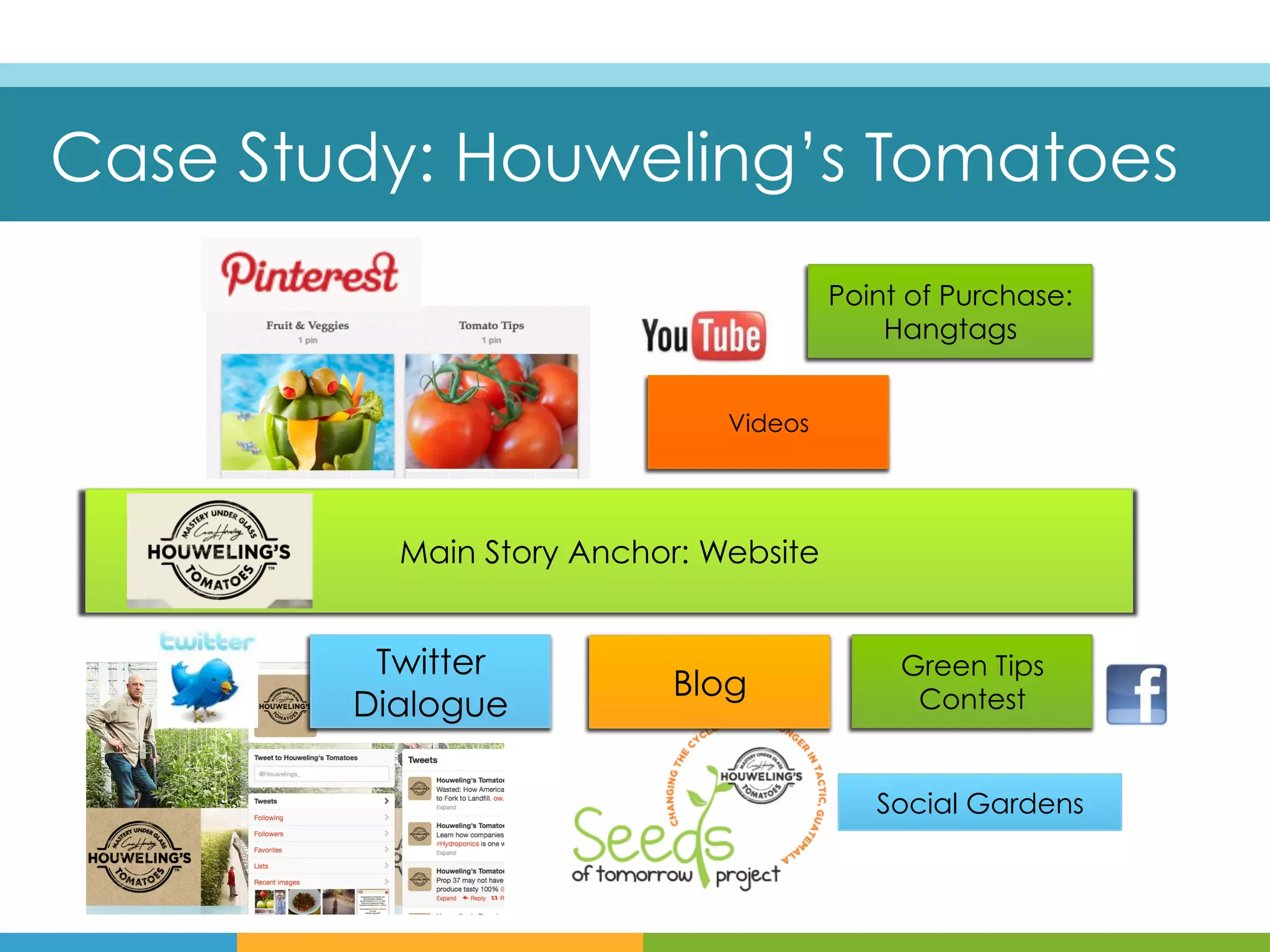
Case Study: Houweling’s Tomatoes
                                       Point of Purchase:
                                           Hangtags


                              Videos


          Main Story Anchor: Website


         Twitter                            Green Tips
                          Blog               Contest
        Dialogue

                                          Social Gardens
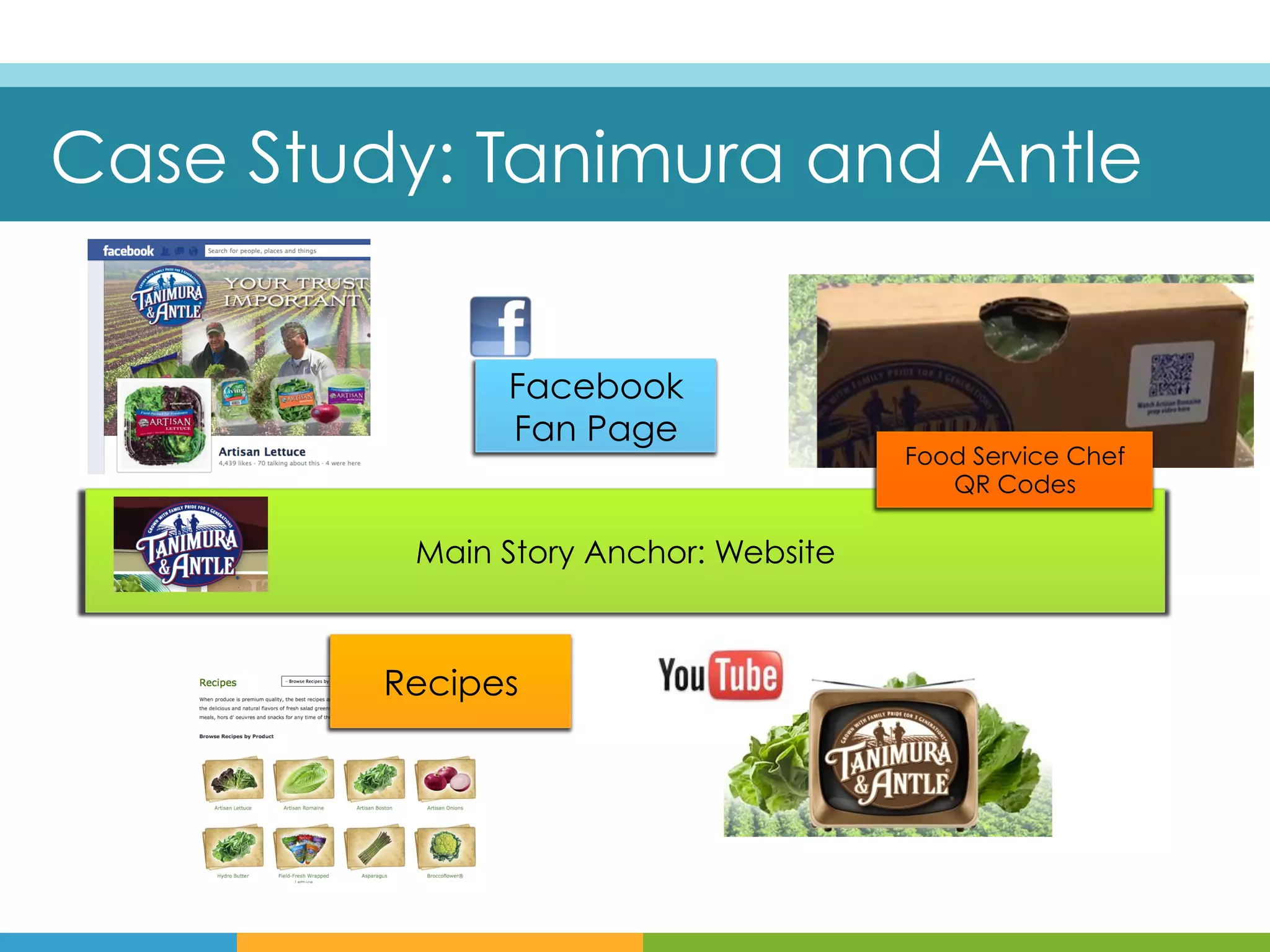
Case Study: Tanimura and Antle


               Facebook
               Fan Page
                                       Food Service Chef
                                          QR Codes

          Main Story Anchor: Website


         Recipes
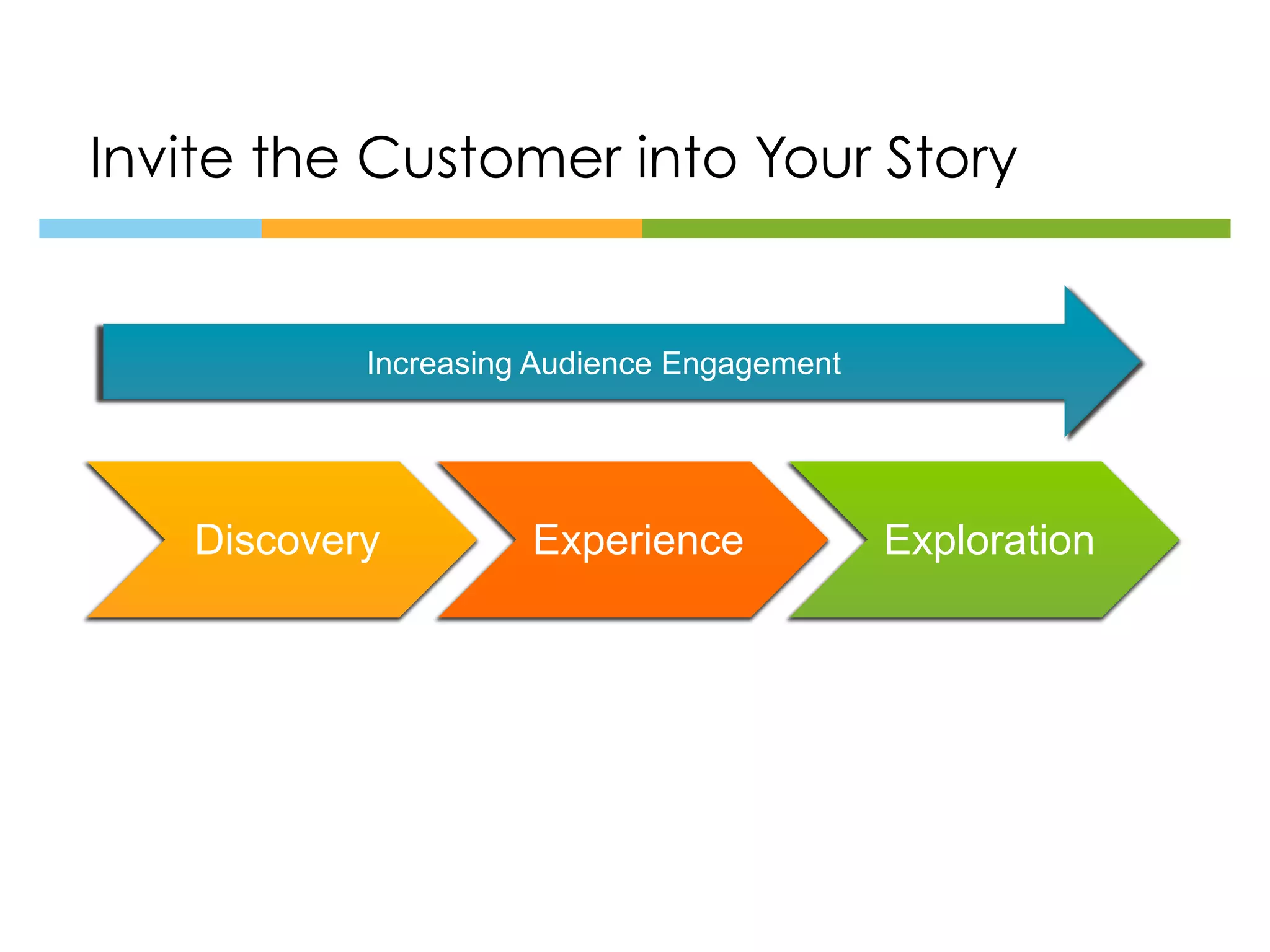
Invite the Customer into Your Story


           Increasing Audience Engagement


   Discovery         Experience             Exploration
There are things we know
     that we know.

There are things we know
  that we don’t know.

   And then there are
the unknown unknowns—
the things we don’t know
     we don’t know.
                  Donald Rumsfeld, 2002
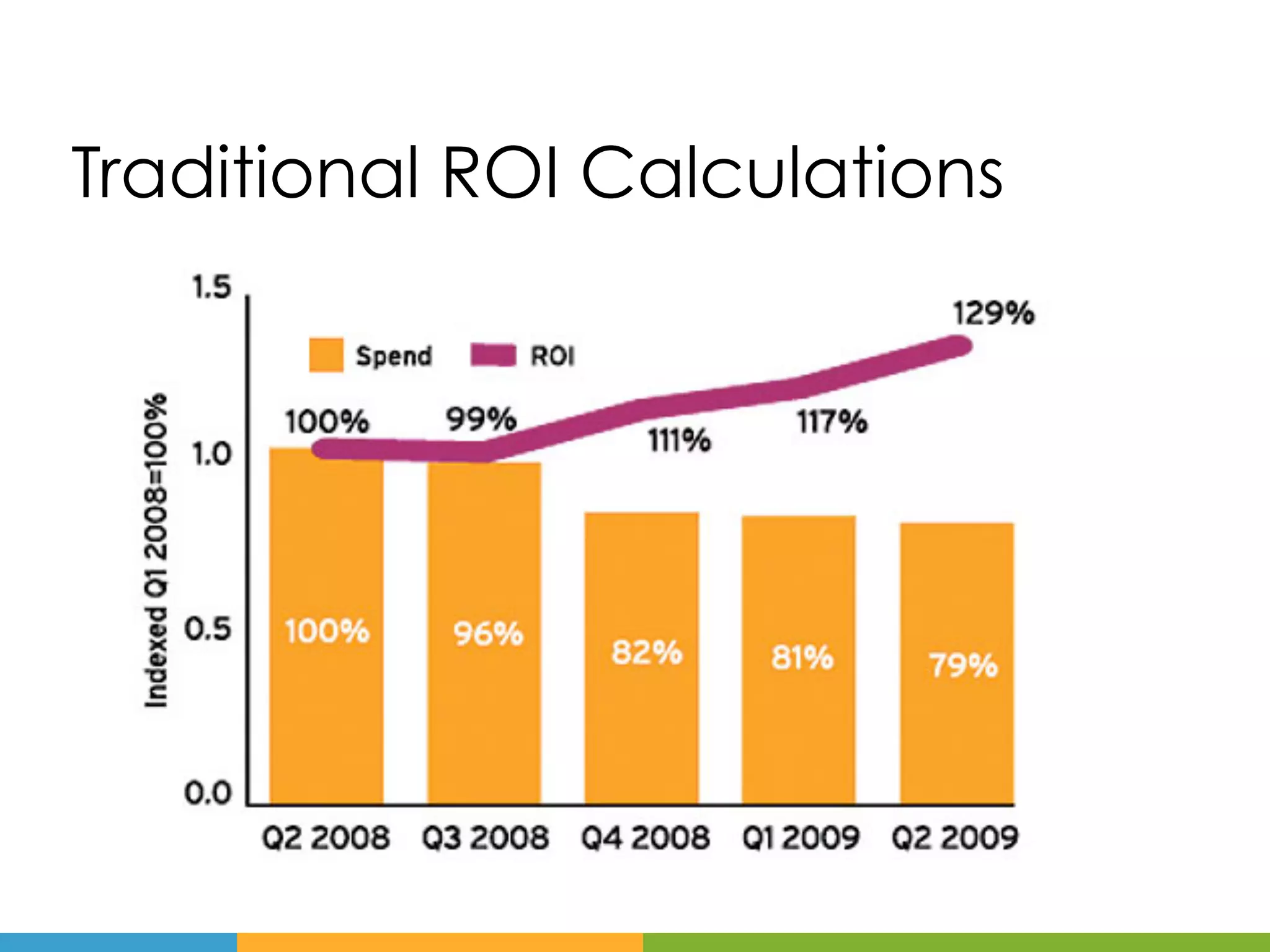
Traditional ROI Calculations
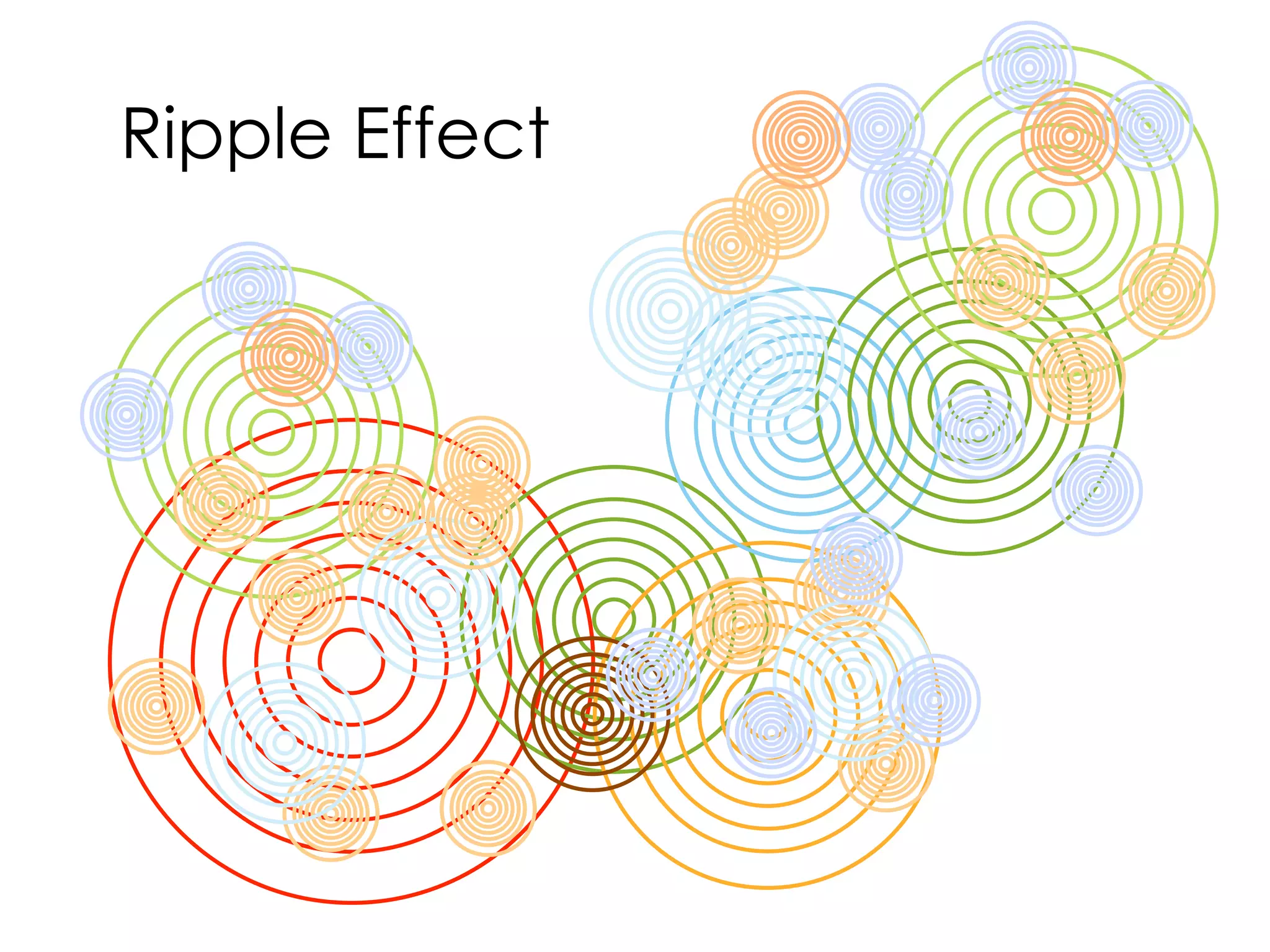
Ripple Effect
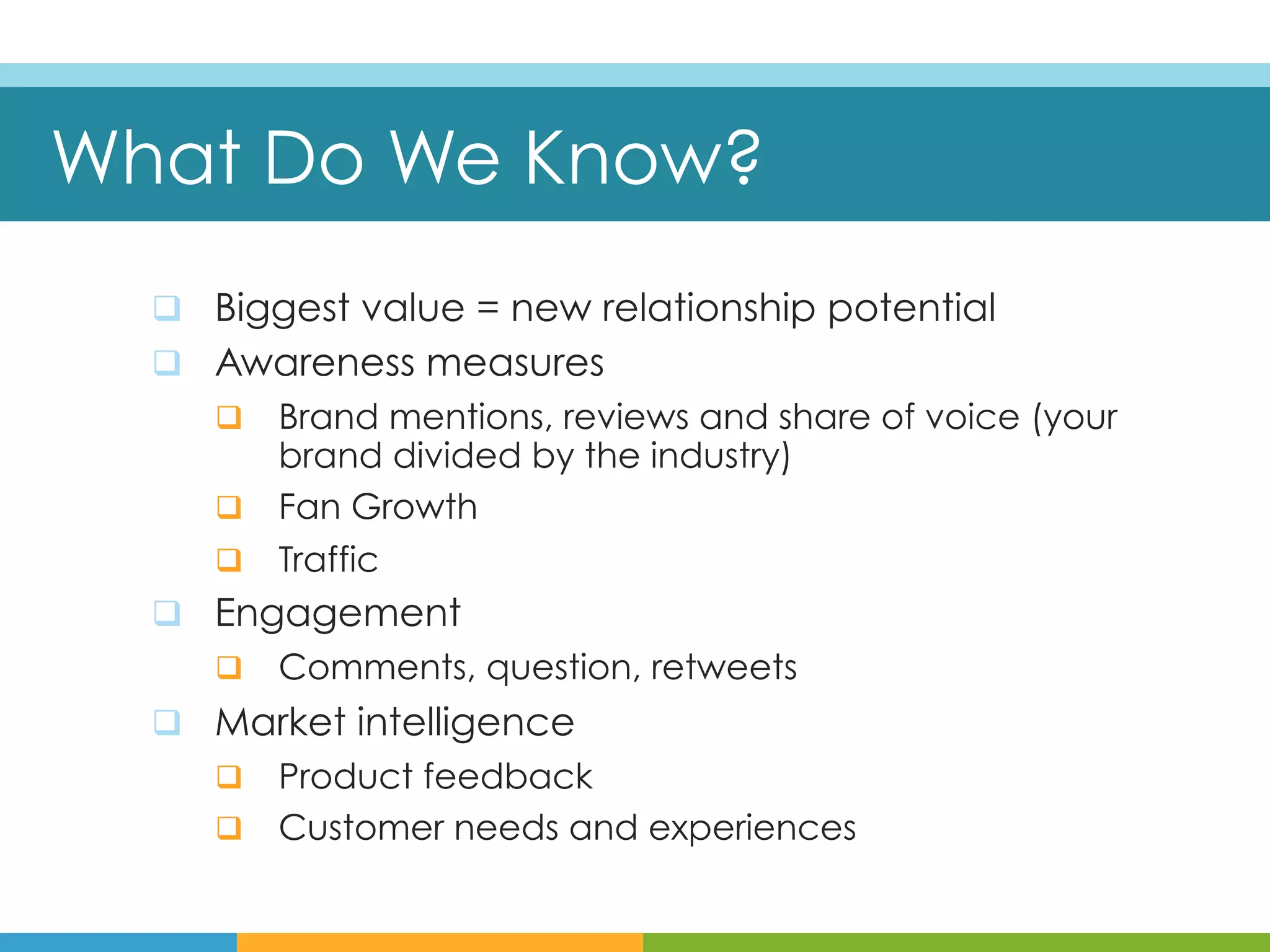
What Do We Know?
  q  Biggest value = new relationship potential
  q  Awareness measures
     q  Brand mentions, reviews and share of voice (your
         brand divided by the industry)
     q  Fan Growth
     q  Traffic
  q  Engagement
     q  Comments, question, retweets
  q  Market intelligence
     q  Product feedback
     q  Customer needs and experiences
4
Where the Rubber
 Meets the Road!
Social media
strategies start with a
 strategy, not with a
   Facebook page
Social Media Strategy

  q  Tools are only useful if you know
      q  what you want to do
      q  what tools will get the job done.

  q  Online networks are like offline ones
      q  People use Twitter, Facebook, blogs, and
          LinkedIn to meet people, get information,
          share resources and connect with colleagues
Social media are are
 not a waste of time
unless you allow them
         to be
Social Media: Total Time Suck?

  q  Social media networks are not a waste of
    time unless you allow them to be
  q  Networking opportunities

  q  Great way to build social capital

  q  Be very clear on WHY you’re doing it and
    the outcomes you want to see
You need a mission
    statement
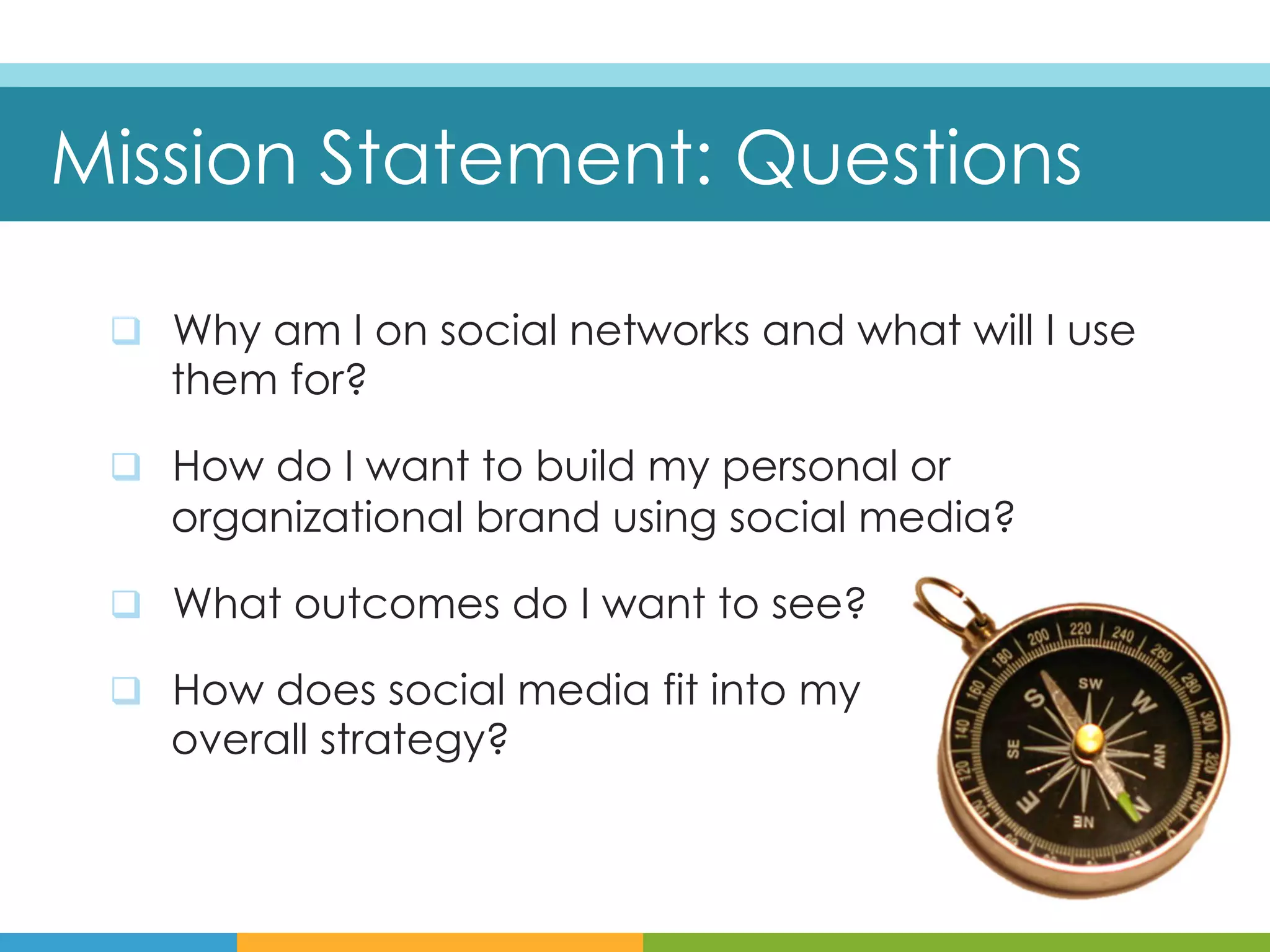
Mission Statement: Questions

 q  Why am I on social networks and what will I use
    them for?

 q  How do I want to build my personal or
    organizational brand using social media?

 q  What outcomes do I want to see?

 q  How does social media fit into my
    overall strategy?
Create a social
 media policy
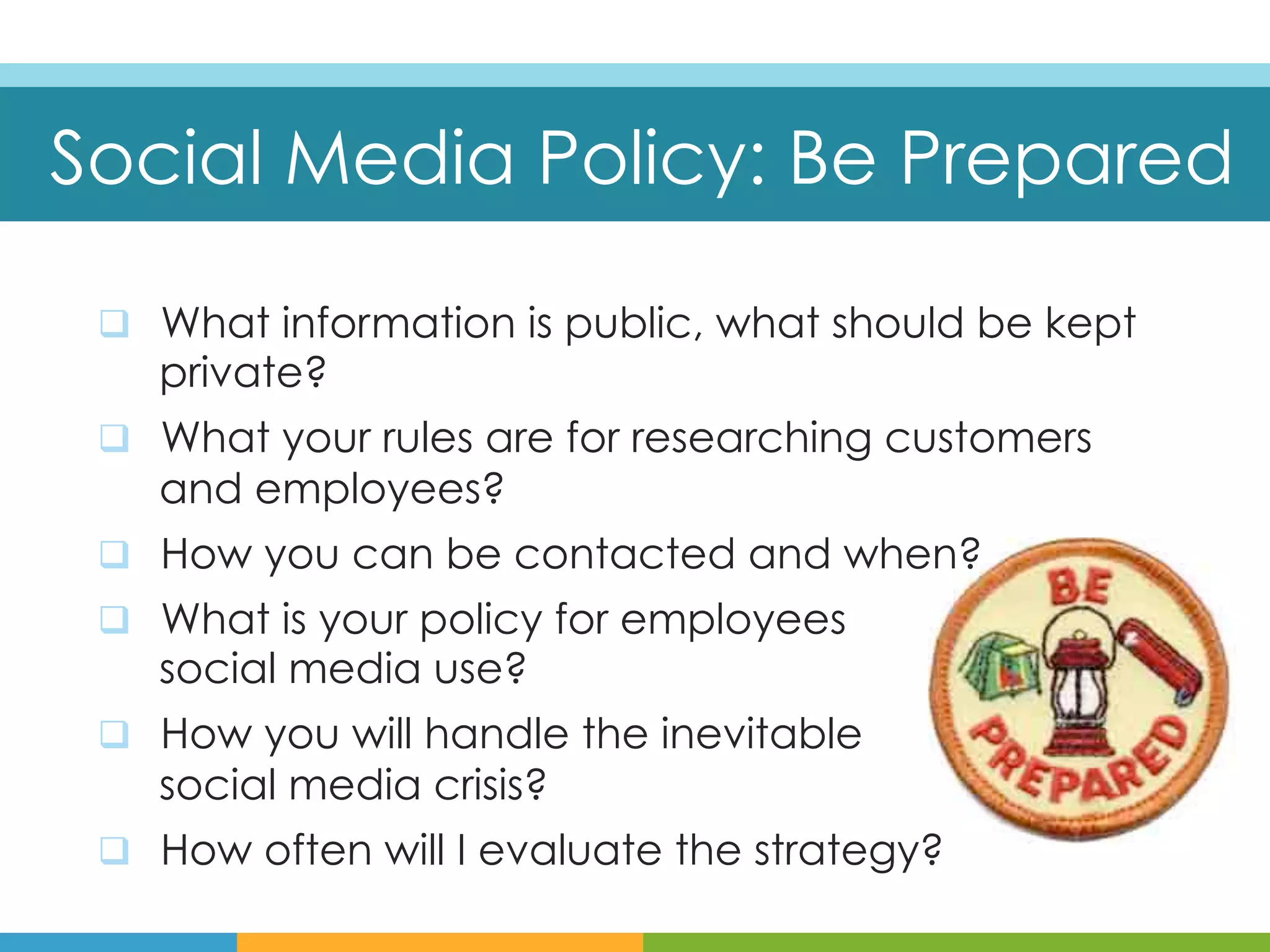
Social Media Policy: Be Prepared

 q  What information is public, what should be kept
    private?
 q  What your rules are for researching customers
    and employees?
 q  How you can be contacted and when?
 q  What is your policy for employees
    social media use?
 q  How you will handle the inevitable
    social media crisis?
 q  How often will I evaluate the strategy?
Choose your tools carefully
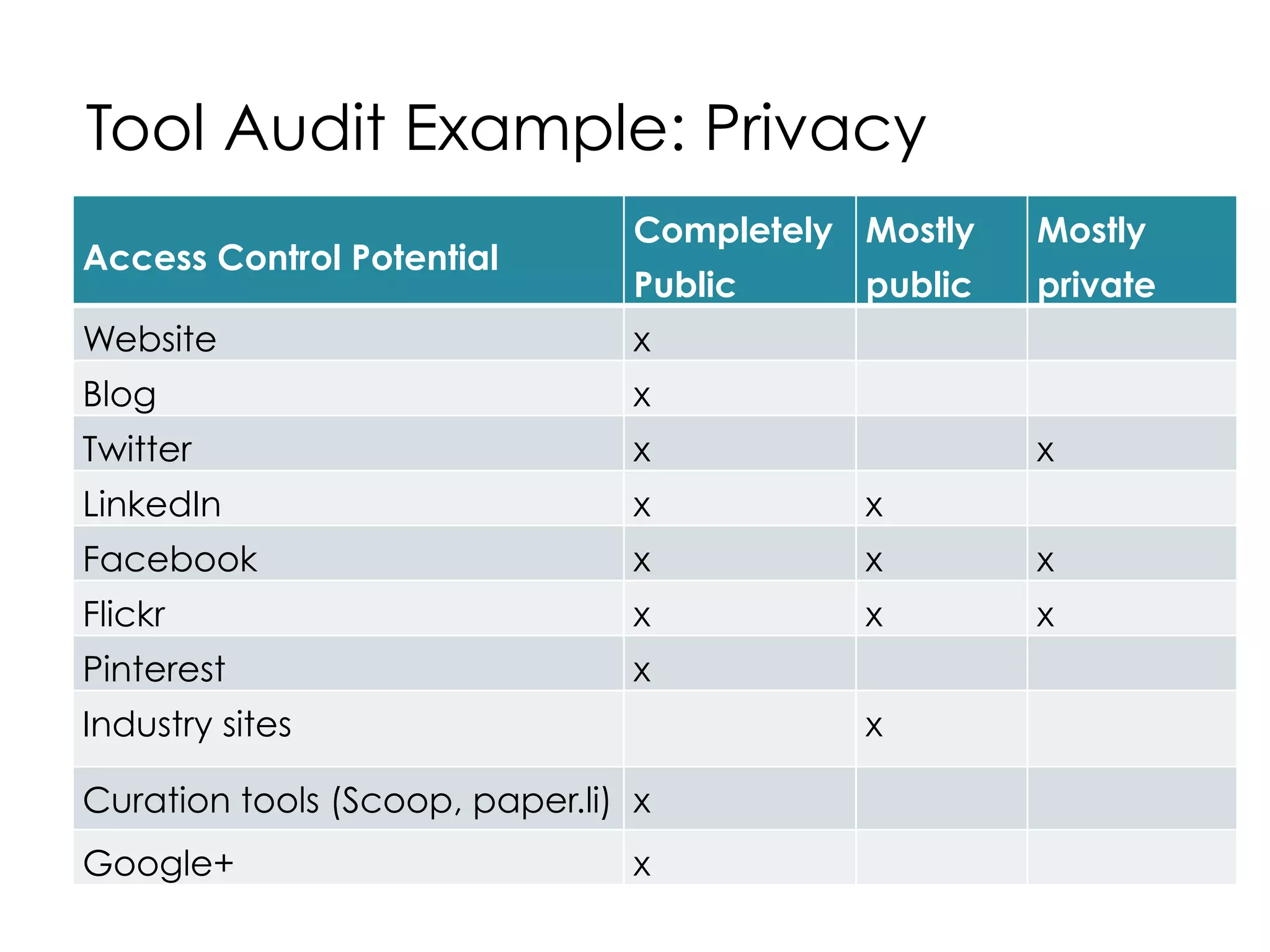
Tool Audit Example: Privacy
                                      Completely Mostly       Mostly
Access Control Potential	

                                      Public	

   public	

   private	

Website	

                            x	


Blog	

                               x	


Twitter	

                            x	


        x	

LinkedIn	

                           x	

        x	


Facebook	

                           x	

        x	

        x	

Flickr	

                             x	

        x	

        x	

Pinterest	

                          x	


Industry sites	


        x	


Curation tools (Scoop, paper.li)	

 x	

Google+	

                            x
Connect your tools so
they feed each other
Build relationships
Think before you
      speak
4
In Conclusion!
Summary
q  New communications means new consumer
   psychology and big competition for attention

q  Story rises above noise by tapping fundamentals
   and emotions

q  Transmedia storytelling extends the power of
   your story and changes ‘selling’ into a valued
   relationship
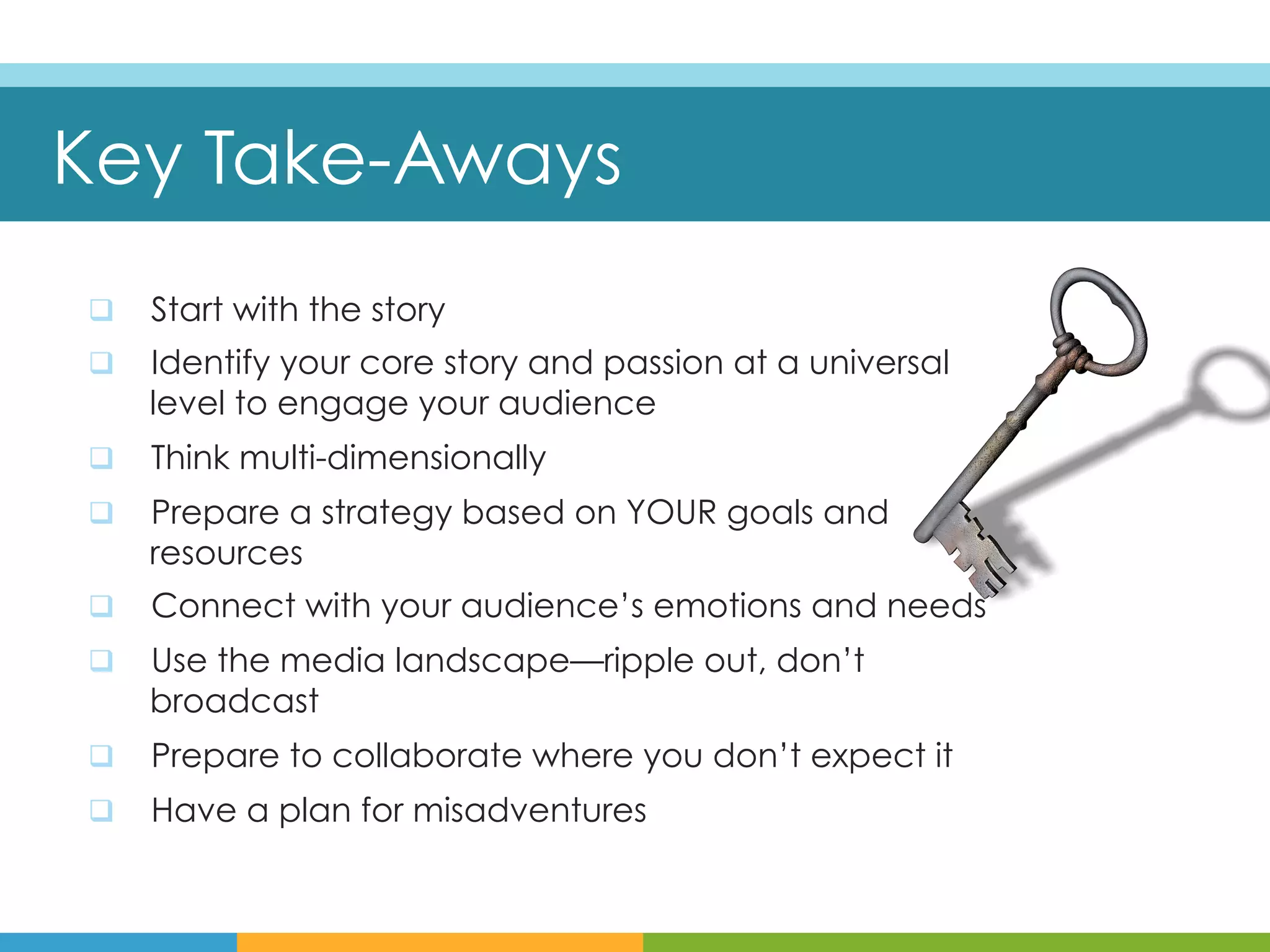
Key Take-Aways
q    Start with the story
q    Identify your core story and passion at a universal
      level to engage your audience
q    Think multi-dimensionally
q    Prepare a strategy based on YOUR goals and
      resources
q    Connect with your audience’s emotions and needs
q    Use the media landscape—ripple out, don’t
      broadcast
q    Prepare to collaborate where you don’t expect it
q    Have a plan for misadventures
My Hopes for You

 q  That you will embrace storytelling
 q  And approach communication in a cross-
    platform, integrated way
 q  So that you take your customers on a journey to
    create the valuable relationships that
 q  builds long-term commitment and loyalty
 q  And increased profitability
Thank You!
         Dr. Pamela Rutledge
Director, Media Psychology Research Center
            November 12, 2012

            @pamelarutledge

Engaging Customers Through Story

  • 1.
    Engaging Consumers in ! Your ! Story Dr. Pamela Rutledge Director, Media Psychology Research Center November 12, 2012 @pamelarutledge
  • 2.
    Overview 1 What’s Happening Out There? 2 What’s in a Story 3 How Do You Find It? 4 What Do You Do With It?
  • 3.
  • 4.
    The Lecture vs.The Cocktail Party
  • 7.
  • 8.
    The New Normal Consumersexpect to participate, be heard, collaborate, get information, and connect. Fast. All the time.
  • 10.
    How Do YouCompete?
  • 11.
  • 12.
    1 Storytelling is Timeless q  Draw on ancient traditions, legends and myths q  Create an authentic connection
  • 13.
    2 Stories Connect People q  Build trust q  Transcend generations q  Engage our emotions q  Inspire us q  Are contagious
  • 14.
    3 Stories Are HowWe Think q  Explain how and why q  Define our values and purpose q  Put us in “Learning Mode” q  Decrease our resistance to persuasion
  • 15.
    4 It’s How We’reWired q  Imagined experiences create real emotion q  Narrative structure provides comfort q  Trigger neural networks of multi- sensory responses: auditory, kinesthetic, and visual
  • 16.
    The shortest distance between people is through story!
  • 17.
    A Shoe Company • Founded 2006 Total Sales 500,000 Employees 90 •  Unique business model Interns 22 •  Product distributed via COGS 37% recognized 501(c)(3) SG&A 24% non-profits and non- Distribution 300 Stores; 9 Countries governmental First Year Sales 10,000 units organizations (NGO’S) Yr Sales Goal 300,000 units Annual 10% Growth (Y/Y) EBITDA 153,000
  • 19.
  • 20.
  • 21.
    Elements of Story þ  Message þ Characters þ  Conflict þ  Plot
  • 22.
    Three Act Structure Tension Climax Crises Falling Action Rising Action Exposition Denouement Time Act 1 Act 2 Act 3 Beginning Middle End Set-up Conflict Resolution
  • 23.
    Where the ActionIs: Conflict
  • 24.
    The Psychology ofStory: Narrative Transportation: Use C-A-R to take your audience on a journey C – Context •  Where, When? •  Who are the characters •  What does the main character want? •  What’s in the way? A – Action (Plot) R – Result (Resolution) Source: Paul Smith Lead with Story
  • 25.
    Archetypes: Joseph Campbell q  Hero q  Mentor q  Threshold Guardian q  Herald q  Shapeshifter q  Shadow q  Trickster
  • 26.
    Fairy Tale Model Benefactor Goal Beneficiary Supporter Hero Adversary Source: Fog, K., Budtz, C., & Yakaboylu, B. (2010). Storytelling: Branding in Practice (2nd ed.). Berlin: Springer.
  • 27.
     Cultural Metaphors q  AnnaNicole Smith q  Rags to Riches q  Gold Digger/How to Marry a Millionaire q  Live Fast/Die Young
  • 29.
  • 30.
    Story Themes q  TheHero’s Quest --> Entrepreneurial Venture q  Creation Stories --> Establishment of Organization q  Stories of Transformation --> Coming of Age q  Stories of Fall and Redemption --> Crisis Phase q  The Myth of the Crossroads --> Transition Phase
  • 31.
    Using Shared Metaphors I’m a lawyer. I write contracts and wills. Where’s the story in that?
  • 32.
    The Family Lawyer Watchingover your legal health
  • 33.
    Questions to ask q  Who am I? q  Why am I here? q  What is my vision? q  What do I want to teach people? And why? q  What values do I want to demonstrate? And why? q  What do I want my customers to know I understand?
  • 34.
    One-Sheet Exercise q  Story in three sentences q  Work from the experience of the image of your company or brand q  Characters in three sentences q  Who are the characters? q  Are you a character? q  Does place matter?
  • 35.
  • 36.
    Additive Storytelling Brand develops from multiple media sources over time
  • 37.
    Transmedia Storytelling •  Astory that… •  Unfolds across platforms •  Each piece adds something unique and valuable •  Motivates user to find others q  Users can… Henry Jenkins •  Join at different places USC •  Participate and contribute content
  • 38.
  • 39.
  • 40.
    Case Study: TheThree Little Pigs Wolf: Pig 1: Website Website Wolf: Ning Pig 1: Anime Network for Team Wolf Super Pig Main Story Anchor: Novel Sequels Pig 2: Twitter Pig 3: Pig 3: Dialogue Cooking Blog Cookbook Pig 3: YouTube Pig 3: Fan Page Videos
  • 41.
  • 42.
    Case Study: Houweling’sTomatoes Point of Purchase: Hangtags Videos Main Story Anchor: Website Twitter Green Tips Blog Contest Dialogue Social Gardens
  • 43.
    Case Study: Tanimuraand Antle Facebook Fan Page Food Service Chef QR Codes Main Story Anchor: Website Recipes
  • 44.
    Invite the Customerinto Your Story Increasing Audience Engagement Discovery Experience Exploration
  • 45.
    There are thingswe know that we know. There are things we know that we don’t know. And then there are the unknown unknowns— the things we don’t know we don’t know. Donald Rumsfeld, 2002
  • 46.
  • 47.
  • 48.
    What Do WeKnow? q  Biggest value = new relationship potential q  Awareness measures q  Brand mentions, reviews and share of voice (your brand divided by the industry) q  Fan Growth q  Traffic q  Engagement q  Comments, question, retweets q  Market intelligence q  Product feedback q  Customer needs and experiences
  • 49.
    4 Where the Rubber Meets the Road!
  • 50.
    Social media strategies startwith a strategy, not with a Facebook page
  • 51.
    Social Media Strategy q  Tools are only useful if you know q  what you want to do q  what tools will get the job done. q  Online networks are like offline ones q  People use Twitter, Facebook, blogs, and LinkedIn to meet people, get information, share resources and connect with colleagues
  • 52.
    Social media areare not a waste of time unless you allow them to be
  • 53.
    Social Media: TotalTime Suck? q  Social media networks are not a waste of time unless you allow them to be q  Networking opportunities q  Great way to build social capital q  Be very clear on WHY you’re doing it and the outcomes you want to see
  • 54.
    You need amission statement
  • 55.
    Mission Statement: Questions q  Why am I on social networks and what will I use them for? q  How do I want to build my personal or organizational brand using social media? q  What outcomes do I want to see? q  How does social media fit into my overall strategy?
  • 56.
    Create a social media policy
  • 57.
    Social Media Policy:Be Prepared q  What information is public, what should be kept private? q  What your rules are for researching customers and employees? q  How you can be contacted and when? q  What is your policy for employees social media use? q  How you will handle the inevitable social media crisis? q  How often will I evaluate the strategy?
  • 58.
  • 59.
    Tool Audit Example:Privacy Completely Mostly Mostly Access Control Potential Public public private Website x     Blog x     Twitter x   x LinkedIn x x   Facebook x x x Flickr x x x Pinterest x     Industry sites   x   Curation tools (Scoop, paper.li) x Google+ x
  • 60.
    Connect your toolsso they feed each other
  • 61.
  • 62.
  • 63.
  • 64.
    Summary q  New communicationsmeans new consumer psychology and big competition for attention q  Story rises above noise by tapping fundamentals and emotions q  Transmedia storytelling extends the power of your story and changes ‘selling’ into a valued relationship
  • 65.
    Key Take-Aways q  Start with the story q  Identify your core story and passion at a universal level to engage your audience q  Think multi-dimensionally q  Prepare a strategy based on YOUR goals and resources q  Connect with your audience’s emotions and needs q  Use the media landscape—ripple out, don’t broadcast q  Prepare to collaborate where you don’t expect it q  Have a plan for misadventures
  • 66.
    My Hopes forYou q  That you will embrace storytelling q  And approach communication in a cross- platform, integrated way q  So that you take your customers on a journey to create the valuable relationships that q  builds long-term commitment and loyalty q  And increased profitability
  • 67.
    Thank You! Dr. Pamela Rutledge Director, Media Psychology Research Center November 12, 2012 @pamelarutledge