


8 Principles for Using Social Media Effectively

Editor's Notes

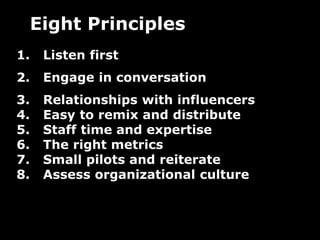
  • #2 http://www.flickr.com/photos/euart/282104427/I’m going to share a brief a high level overview of 8 principles for using social media effectively for external communications strategies. The session tomorrow will be a deeper dive into the how tos.Before we get into the principles, I want to provide some framing.
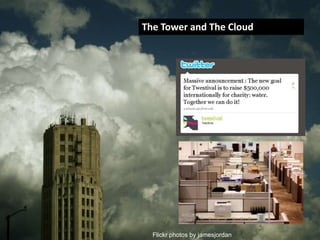
  • #4 http://www.flickr.com/photos/jamesjordan/2751393381/http://www.flickr.com/photos/mkrigsman/3428179614/http://beth.typepad.com/beths_blog/2009/05/mark-pesce-at-cua09-think-like-a-cloud-make-a-storm-kill-the-tower.htmlMark PesceCloud: Used to describe how we're all more closely connected through social networks like Twitter, Facebook, and etc.  And how our connectedness is resulting in new collective behavior that can't be controlled. The same sort of engine which powers Wikipedia can be put to work across a number of different “platforms”. The power of sharing allows individuals to come together in great “clouds” of activity, and allows them to focus their activity around a single task. It’s happening all over the social webThe cloud results from the \"human condition of hyperconnection.\"  Always on Pesce points out that this condition leads to observational learning from watching other people's behaviors online.   Behaviors can be replicated quickly and communities of interest can form around particular topics, or \"clouds\" potential. This is very different from the way most nonprofits work – which more hierarchal - control the message, command and controlWe’re not making a value judgment about one mode of working or the other. The problem is that the Cloud and the Tower are not compatible. Now, one isn’t going to be replaced by the other.The challenge for organizations that want to be successful in using social media – requires understanding when to work like a Tower and when to work like a cloudBut nonprofits need to focus on the interfaces that connect the hierarchy to the cloudIn the 21st century we now have two oppositional methods of organization: the hierarchy and the cloud. Each of them carry with them their own costs and their own strengths. Neither has yet proven to be wholly better than the other. One could make an argument that both have their own roles into the future, and that we’ll be spending a lot of time learning which works best in a given situation. What we have already learned is that these organizational types are mostly incompatible: unless very specific steps are taken, the cloud overpowers the hierarchy, or the hierarchy dissipates the cloud. We need to think about the interfaces that can connect one to the other. That’s the area that all organizations – and very specifically, non-profit organizations – will be working through in the coming years. Learning how to harness the power of the cloud will mark the difference between a modest success and overwhelming one. Yet working with the cloud will present organizational challenges of an unprecedented order. There is no way that any hierarchy can work with a cloud without becoming fundamentally changed by the experience.
  • #21 Over the past five years (http://www.thespohrsaremultiplying.com/), The March of Dimes has used social media to nurture its online community, Share Your Story (http://www.shareyourstory.org). It is one of the better examples of how nonprofits can use social media to empower supporters without having to control it. A few weeks ago, the March of Dimes supporters came out in droves for a networked memorial service for a toddler named Maddie (http://www.thespohrsaremultiplying.com/). The community raised tens of thousands of dollars for the March of Dimes in Maddie's memory as well as covering the funeral costs for the family. The organization did little to stage this event. The organization has embraced openness and inspired their stakeholders to feel empowered enough to take action on their own.http://beth.typepad.com/beths_blog/2009/04/march-for-maddie-a-networked-memorial-service.html
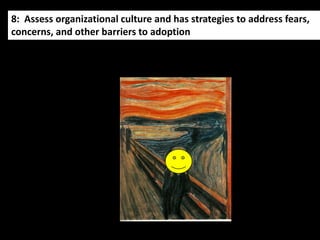
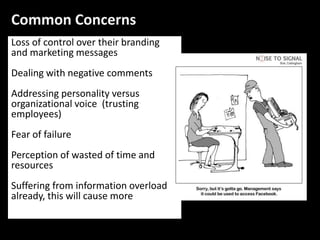
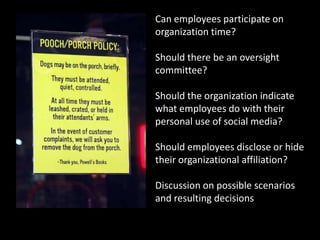
  • #31 The remedy – education, discussion, policyLooks at the opportunity costs if they don’t participateConsider the worse case scenarios and have a policy that addresses
  • #32 http://www.mindomo.com/view.htm?m=5d005d7f82ae13f1a4e7ae756afe900a.flickr.com/photos/axis/1892931/Can employees participate on organization time?Should there be an oversight committee?Should the organization indicate what employees do with their personal use of social media?Should employees disclose or hide their organizational affiliation?Discussion on possible scenarios and resulting decisions