




APA ANNUAL CONVENTION
JULY 31-AUGUST 4, 2013
HONOLULU, HAWAI’I
Media Literacy
An Imperative Not A Luxury
#medialiteracy
Media Literacy:
A Continuum of Engagement
Dr. Pamela Rutledge
Director, Media Psychology Research Center
@pamelarutledge
1
APA ANNUAL CONVENTION
JULY 31-AUGUST 4, 2013
HONOLULU, HAWAI’I
Pamela Rutledge, PhD, MBA
• Director, Media Psychology Research Center
• Faculty, Massachusetts School Of
Professional Psychology and Instructor, UC
Irvine Extension
• Blogger, Psychology Today, Positively Media
• Research interests: narratives, empowerment
and self-efficacy in the new media
environment
• Expert source for the media on psychological
implications of emerging technologies
APA ANNUAL CONVENTION
JULY 31-AUGUST 4, 2013
HONOLULU, HAWAI’I
@pamelarutledge
#medialit
#medialit
#medialit
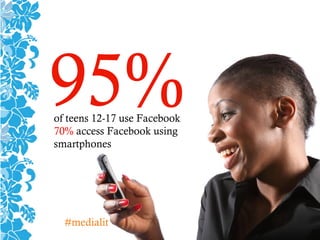
95%of teens 12-17 use Facebook
70% access Facebook using
smartphones
#medialit
6 billionhours of videos watched each month
#medialit
http://www.bgr.com/2012/05/09/mobile-apps-infographic-wake-up-
call/
250billion
2012:
Number of apps
downloaded from
iTunes Store
#medialit
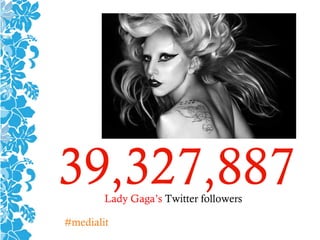
39,327,887Lady Gaga’s Twitter followers
#medialit
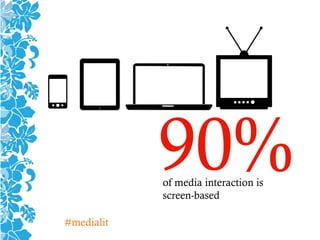
90%of media interaction is
screen-based
#medialit
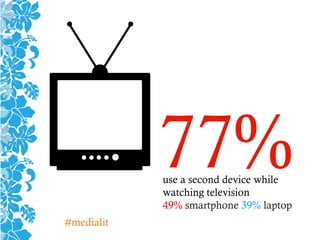
77%use a second device while
watching television
49% smartphone 39% laptop
#medialit
http://janrain.com/blog/expedite-checkout-process-social-login/
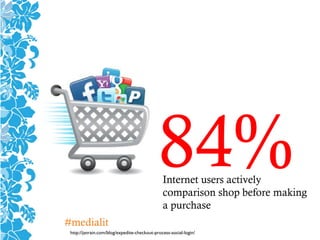
84%Internet users actively
comparison shop before making
a purchase
#medialit
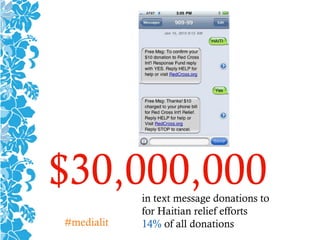
$30,000,000in text message donations to
for Haitian relief efforts
14% of all donations#medialit
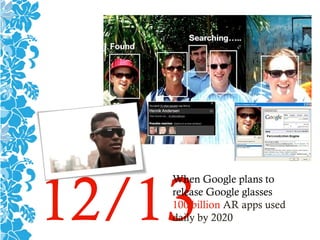
12/13
When Google plans to
release Google glasses
100 billion AR apps used
daily by 2020
APA ANNUAL CONVENTION
JULY 31-AUGUST 4, 2013
HONOLULU, HAWAI’I
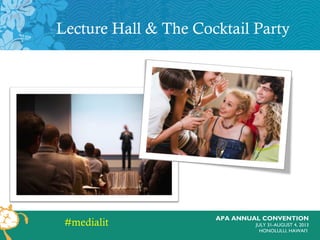
Lecture Hall & The Cocktail Party
#medialit
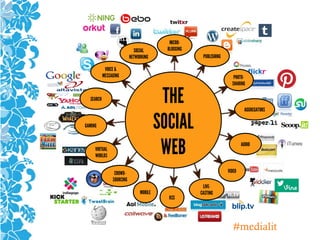
THE
SOCIAL
WEB
SOCIAL
NETWORKING
MICRO-
BLOGGING
PUBLISHING
PHOTO-
SHARING
AUDIO
VIDEO
LIVE-
CASTING
RSS
MOBILE
CROWD-
SOURCING
VIRTUAL
WORLDS
GAMING
VOICE &
MESSAGING
AGGREGATORS
SEARCH
#medialit
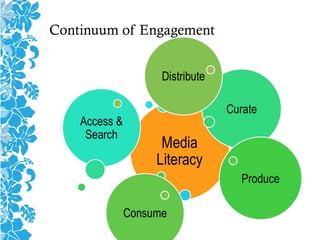
Continuum of Engagement
APA ANNUAL CONVENTION
JULY 31-AUGUST 4, 2013
HONOLULU, HAWAI’I
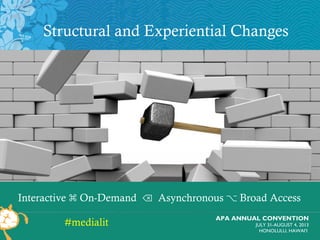
Interactive ⌘ On-Demand ⌫ Asynchronous ⌥ Broad Access
Structural and Experiential Changes
#medialit
APA ANNUAL CONVENTION
JULY 31-AUGUST 4, 2013
HONOLULU, HAWAI’I
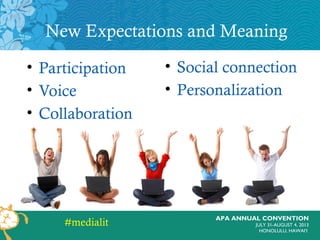
New Expectations and Meaning
• Participation
• Voice
• Collaboration
• Social connection
• Personalization
#medialit
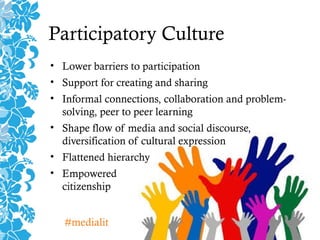
Participatory Culture
• Lower barriers to participation
• Support for creating and sharing
• Informal connections, collaboration and problem-
solving, peer to peer learning
• Shape flow of media and social discourse,
diversification of cultural expression
• Flattened hierarchy
• Empowered
citizenship
#medialit
With
opportunity
#medialit
comes
responsibility
and the need
for new skills
APA ANNUAL CONVENTION
JULY 31-AUGUST 4, 2013
HONOLULU, HAWAI’I
across
the
lifespan
#medialit
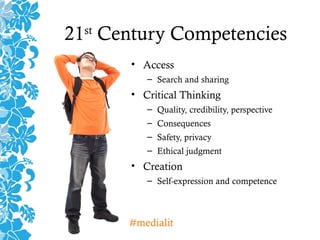
21st
Century Competencies
• Access
– Search and sharing
• Critical Thinking
– Quality, credibility, perspective
– Consequences
– Safety, privacy
– Ethical judgment
• Creation
– Self-expression and competence
#medialit
What’s the hold up?
#medialit
APA ANNUAL CONVENTION
JULY 31-AUGUST 4, 2013
HONOLULU, HAWAI’I
#medialit
APA ANNUAL CONVENTION
JULY 31-AUGUST 4, 2013
HONOLULU, HAWAI’I
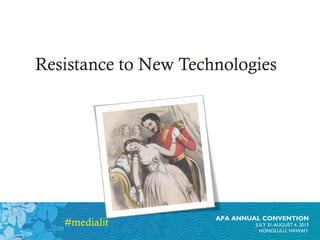
Resistance to New Technologies
#medialit
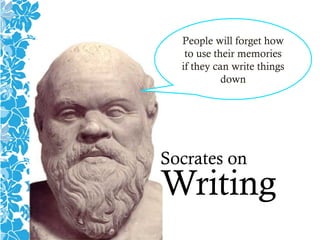
Socrates on
Writing
People will forget how
to use their memories
if they can write things
down
Anthony Comstock on
Dime
Novels
Vile books and papers are …
used by Satan ... to debase,
pervert and turn away from
lofty aims to follow examples
of corruption and criminality
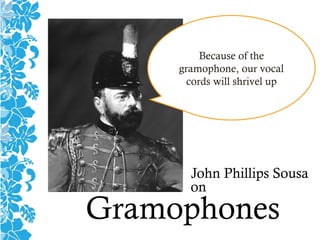
John Phillips Sousa
on
Gramophones
Because of the
gramophone, our vocal
cords will shrivel up
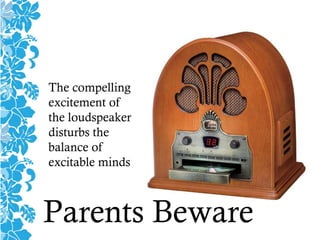
The compelling
excitement of
the loudspeaker
disturbs the
balance of
excitable minds
Parents Beware
Now
APA ANNUAL CONVENTION
JULY 31-AUGUST 4, 2013
HONOLULU, HAWAI’I
The Impact of Moral Panics
• Drive distance between generations
• Become embedded in public policy
• Bias research
• Divert resources away from real problems
and more effective interventions
• Slow adoption of new technology
#medialit
Concerns
• Participation gap
– Unequal access and training
• Transparency
– Learning how media shapes
perceptions
• Ethics
– Public role as media makers
and civic participants
#medialit
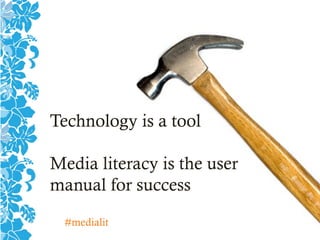
Technology is a tool
Media literacy is the user
manual for success
#medialit
#medialit
It’s our choice.
Media Literacy:
Antidote to Fear
or
Tool for Empowerment?
#medialit
Thank you
Pamela Rutledge
prutledge@mprcenter.org
@pamelarutledge
#medialit

Media Literacy: A Continuum

Editor's Notes

  • #2 Media Literacy: We all agree we need it. Few agree on what it is and even less agree on how to get it. As media technologies become intertwined with every aspect of life, we have a new appreciation for the importance of understanding their impact and learning to use them well. This panel looks at some of the theory, research, and applications in the context of the current media landscape to address the question: “What does it take to participate in today’s digital world and how do we get there?”
  • #3 We are here today to talk about media literacy, not as an academic topic of interest, but as a social and educational imperative. First, we want to ask: What is media literacy? What comes to mind when you think of that? For many people, it conjures up images of concern: Skinny models and negative body image in young women Racial stereotypes that reinforce racial profiling Seduction into a vacuous consumer culture, manipulated by advertisers Cyberstalkers, cyberbullies, and pornography Or maybe …kids developing carpal tunnel syndrome from 24/7 texting
  • #4 My background
  • #5 In other words, media literacy is an antidote to fear.
  • #6 It’s not surprising that people should be fearful. Technology has literally rewired our world and our lives.
  • #7 We didn’t have an Internet until 1994. Facebook didn’t exist before 2004 and now has 95% of teens ages 12 to 17 use Facebook and 70% access it regularly using a smartphone.
  • #8 There was no YouTube until 2007. Now, 6 billion hours of video are watched each month.
  • #9 2003 was a big year. That was when Apple introduced the iTunes store. They didn’t start selling apps, however, until 2008. But in 2012, 250 billion apps had been downloaded from the iTunes store.
  • #10 Twitter was founded in 2006. August 2013, Lady Gaga had over 39 million followers.
  • #11 90% of our media consumption is screen-based. ( Google, 2012 )
  • #12 Not only are we screen based media consumers, but 77% of us use a second device while viewing TV.
  • #13 The Internet is redefining business models. 84% of Internet users comparison shop before they purchase.
  • #14 The Internet is redefining philanthropy. The Red Cross raised $30 million for the Haitian relief efforts from text-messaging alone.
  • #15 Google plans to release their augmented reality glasses this coming December. Even before their release, they have been outlawed in Las Vegas casinos and hackers have developed face recognition software that can pull down all your social network information. And that’s just for starters.
  • #16 From desktop to laptop to tablet to smartphone to augmented reality, technology is mobile, personal and changing fast. We’ve gone from the one to many, lecture hall model of communications to something more resembling a cocktail party. Everyone’s talking to everyone.
  • #17 And they’re doing it everywhere. What does it mean to be a media literate in today’s world?
  • #18 Peer to peer connectivity and real time access to information have fundamentally changed the way people interact with each other and with information. We are no longer just consumers—we are producers, curators, and distributors as well.
  • #19 The change is both structural and experiential. We have real time information, 24/7 access, and the ability to interact and participate.
  • #20 These changes have altered our fundamental assumptions about ourselves and the world. We are no longer content to sit passively by in that lecture hall. Every time someone posts even a LOLcat, they have evidence of their own efficacy and voice. We expect to participate, to collaborate and to have a voice.
  • #21 There are lots of benefits to this new participatory culture Lower barriers to participation Support for creating and sharing Informal connections, collaboration and problem-solving, peer to peer learning Shape flow of media and social discourse, diversification of cultural expression Flattened hierarchy Empowered citizenship
  • #26 Access Search and sharing Critical Thinking Quality, credibility, perspective Consequences Safety, privacy Ethical Judgment Creation Self-expression and competence
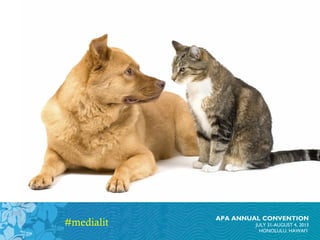
  • #28 It’s our love-hate relationship with media and technology
  • #29 Change challenges our basic assumptions We don’t like change. New stuff means changing. We automatically assume that however we do something today, right now, is the “right” way and is morally superior to any alternatives. So when new stuff shows up, we panic.
  • #31 In the 1870s, the politician Anthony Comstock attempted to have dime novels banned because he believed they led to corruption and crime. As the US Postal Inspector, he objected to anatomy textbooks being sent by mail. “ vile books and papers are branding irons heated in the fire of hell and used by Satan to seer the highest life of the soul. Evil reading debases, degreases and perverts and turns away from lofty aims to follow examples of corruption and criminality
  • #32 The famous marching band leader, John Phillips Sousa wen to the White House to protest the sale of the gramophone because he believed that our vocal chords would shrivel up since people would no longer gather to sing.
  • #33 In the 1930s, Parents were warned that radio would diminish children’s performance in school and that the “compelling excitement of the loudspeaker” would disturb the balance of excitable minds Television, we know, was especially troublesome and was predicted to cause the vulgarization of American culture and destroy the emotional and intellectual capacities of a generation of children, not to mention the promotion of Rock and Roll.
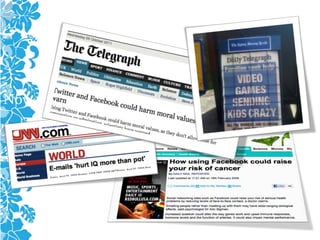
  • #34 Now there’s the Internet and social networks, video games and augmented reality. Headlines: CNN: "Email 'hurts IQ more than pot'," Telegraph: "Twitter and Facebook could harm moral values" Telegraph: "Facebook and MySpace generation 'cannot form relationships' Daily Mail: "How using Facebook could raise your risk of cancer." And the Daily Telegraph “Video Games Sending Kids Crazy.”
  • #35 Moral Panics Drive distance between generations Become embedded in public policy Bias research Divert resources away from real problems and more effective interventions Slow adoption of new technology When public perception is negative, as it has been about media technologies, then both the questions and the funding target the problems not the potential. Journalists write headlines targeting the sensational. It results in reinforcing the perceptions of danger, and doing little to separate fact from fiction.
  • #36 Yet, new technologies are not without legitimate concerns. Participation gap Unequal access and training Transparency Learning how media shapes perceptions Ethics Public role as media makers and civic participants
  • #37 Technology is not going away. It’s like a hammer – you can do good things and bad things with a hammer. Restricting technology is a defensive play and a condescending one. It assumes that the users have no ability to learn or make judgments. It is based on a mass media model of society The alternative: Figure out how technology can help people grow and flourish by facilitating their fundamental goals and motivations
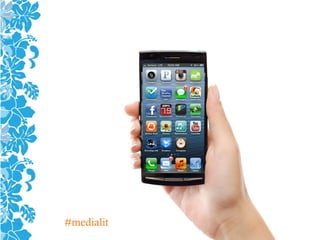
  • #38 How many of you have a smartphone? How many of you had trepidations when you first got it? Ok, now I’d like everyone to get your phones out and pass your phone to the person on your right. How does it feel to be without your phone? What if you need to look something up? Contact someone? See which session is next? Get directions? Send an email? What was worse? Worrying about the impact of getting the phone or the feeling that you can’t do any of the stuff you need to do now that the guy next to you has your phone?
  • #39 How we teach media literacy carries a message about how we view technology. Do we want to empower people to engage competently, ethically and thoughtfully with technology, or do we want to scare the hell out of them? We have a choice.