Natural Gas
Issues and Opportunities
Why Natural Gas?
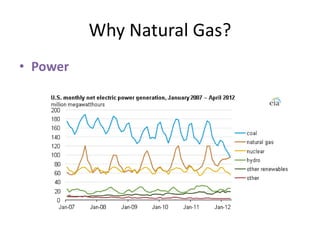
• Power
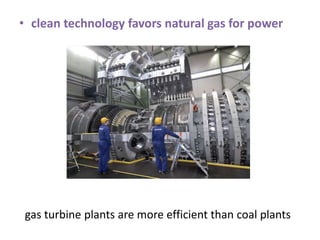
• clean technology favors natural gas for power
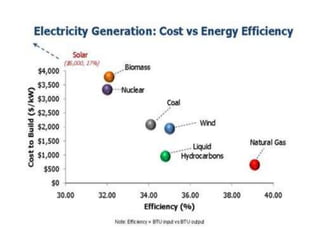
gas turbine plants are more efficient than coal plants
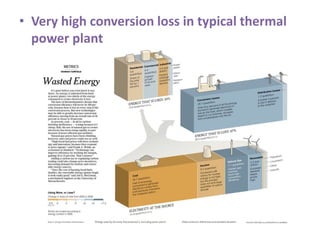
• Very high conversion loss in typical thermal
power plant
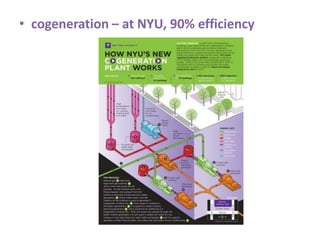
• cogeneration – at NYU, 90% efficiency
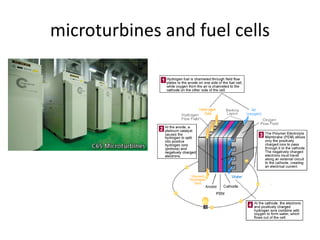
microturbines and fuel cells
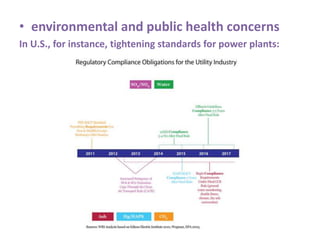
• environmental and public health concerns
In U.S., for instance, tightening standards for power plants:
• including greenhouse gas regulations
• EPA is proposing that new fossil‐fuel‐fired power
plants meet an output‐based standard of 1,000
pounds of CO2 per megawatt‐hour (lb CO2/MWh
gross).
• New natural gas combined cycle (NGCC) power
plant units should be able to meet the proposed
standard without add‐on controls. In fact, based on
available data, EPA believes that nearly all (95%) of
the NGCC units built recently (since 2005) would
meet the standard.
• Of course, regulations to reduce greenhouse
gases, including carbon dioxide, are coming into
greater force all over the world:
• European Union’s cap-and-trade regime
• Australia’s cap-and-trade program
• California (9th largest economy in the world) is instituting
economy-wide cap-and-trade program
• Northeast U.S. states have the Regional Greenhouse Gas
Initiative (RGGI) for CO2 from power plants
• China is piloting cap-and-trade programs; China also
committed at the Copenhagen climate conference in 2009 to
achieving a 40-45% reduction in CO2 emissions per unit of
GDP by 2020 compared with the 2005 level (carbon
intensity)
natural gas prices are low, will rise,
but in a stable manner
“Natural gas continues to be the fuel of choice in many regions
of the world in the electric power and industrial sectors, in
part because of its lower carbon intensity compared with coal
and oil, which makes it an attractive fuel source in countries
where governments are implementing policies to reduce
greenhouse gas emissions, and also because of its significant
price discount relative to oil in many world regions. In
addition, it is an attractive alternative fuel for new power
generation plants because of low capital costs and favorable
thermal efficiencies.” – EIA, International Energy Outlook
2011
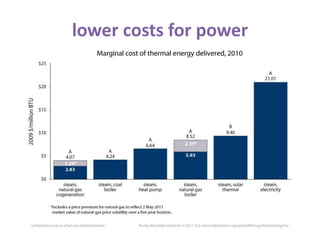
lower costs for power
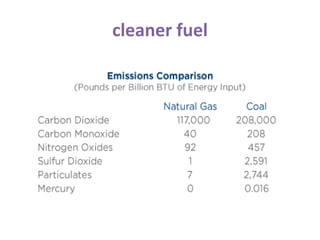
cleaner fuel
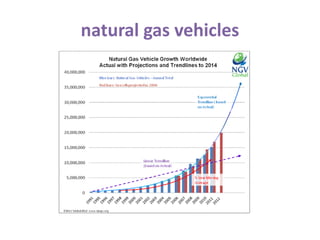
natural gas vehicles
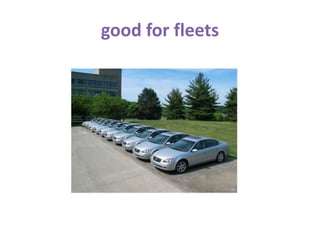
good for fleets
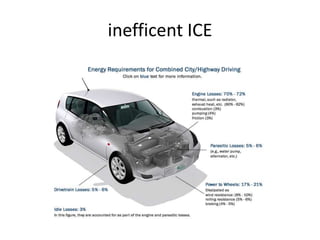
inefficent ICE
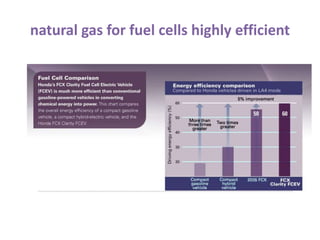
natural gas for fuel cells highly efficient
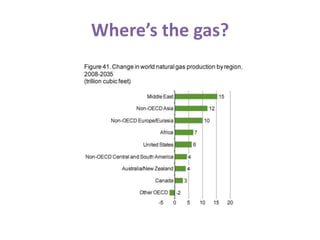
Where’s the gas?
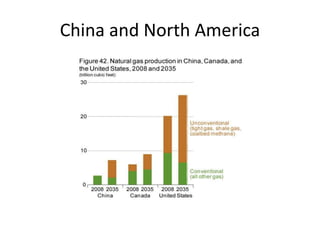
China and North America
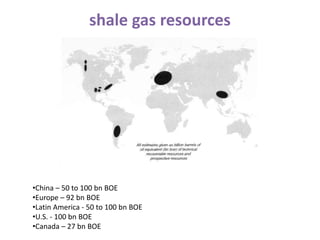
shale gas resources
•China – 50 to 100 bn BOE
•Europe – 92 bn BOE
•Latin America - 50 to 100 bn BOE
•U.S. - 100 bn BOE
•Canada – 27 bn BOE
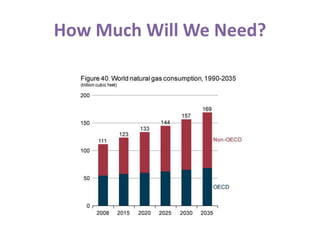
How Much Will We Need?
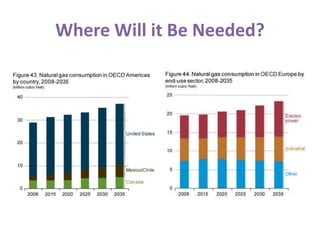
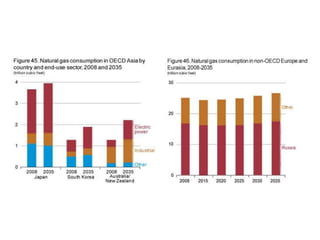
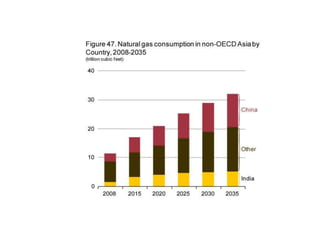
Where Will it Be Needed?
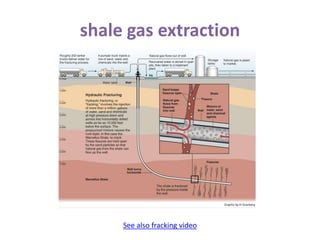
shale gas extraction
See also fracking video
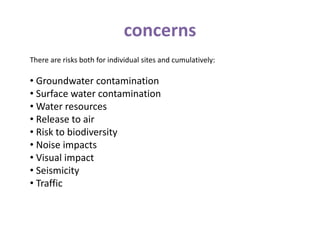
concerns
There are risks both for individual sites and cumulatively:
• Groundwater contamination
• Surface water contamination
• Water resources
• Release to air
• Risk to biodiversity
• Noise impacts
• Visual impact
• Seismicity
• Traffic
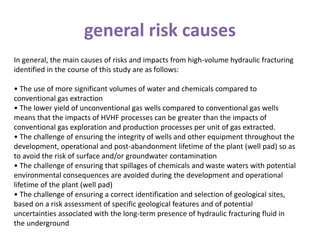
general risk causes
In general, the main causes of risks and impacts from high-volume hydraulic fracturing
identified in the course of this study are as follows:
• The use of more significant volumes of water and chemicals compared to
conventional gas extraction
• The lower yield of unconventional gas wells compared to conventional gas wells
means that the impacts of HVHF processes can be greater than the impacts of
conventional gas exploration and production processes per unit of gas extracted.
• The challenge of ensuring the integrity of wells and other equipment throughout the
development, operational and post-abandonment lifetime of the plant (well pad) so as
to avoid the risk of surface and/or groundwater contamination
• The challenge of ensuring that spillages of chemicals and waste waters with potential
environmental consequences are avoided during the development and operational
lifetime of the plant (well pad)
• The challenge of ensuring a correct identification and selection of geological sites,
based on a risk assessment of specific geological features and of potential
uncertainties associated with the long-term presence of hydraulic fracturing fluid in
the underground
• The potential toxicity of chemical additives and the challenge to develop
greener alternatives
• The unavoidable requirement for transportation of equipment, materials
and wastes to and from the site, resulting in traffic impacts that can be
mitigated but not entirely avoided.
• The potential for development over a wider area than is typical of
conventional gas fields
• The unavoidable requirement for use of plant and equipment during well
construction and hydraulic fracturing, leading to emissions to air and noise
impacts.
highest profile concern:
Poor well design or construction can lead to
subsurface groundwater contamination
arising from aquifer penetration by the well,
the flow of fluids into, or from rock
formations, or the migration of combustible
natural gas to water supplies.
(See recent EU paper: Support to the identification of potential risks for the environment
and human health arising from hydrocarbons operations involving hydraulic fracturing in
Europe)
“Golden Rules”
The International Energy Agency issued its report, Golden Rules for A Golden Age of
Gas, in May of 2012.
“The technology and the know-how already exist for unconventional gas to
be produced in an environmentally acceptable way,” said IEA Executive
Director Maria van der Hoeven. “But if the social and environmental impacts
are not addressed properly, there is a very real possibility that public
opposition to drilling for shale gas and other types of unconventional gas will
halt the unconventional gas revolution in its tracks. The industry must win
public confidence by demonstrating exemplary performance; governments
must ensure that appropriate policies and regulatory regimes are in place.”
Measure, disclose and engage
• Integrate engagement with local communities, residents and other stakeholders
into each phase of a development starting prior to exploration; provide sufficient
opportunity for comment on plans, operations and performance; listen to
concerns and respond appropriately and promptly.
• Establish baselines for key environmental indicators, such as groundwater quality,
prior to commencing activity, with continued monitoring during operations.
• Measure and disclose operational data on water use, on the volumes and
characteristics of waste water and on methane and other air emissions, alongside
full, mandatory disclosure of fracturing fluid additives and volumes.
• Minimise disruption during operations, taking a broad view of social and
environmental responsibilities, and ensure that economic benefits are also felt by
local communities.
Watch where you drill
• Choose well sites so as to minimise impacts on the local community, heritage,
existing land use, individual livelihoods and ecology.
• Properly survey the geology of the area to make smart decisions about where to
drill and where to hydraulically fracture: assess the risk that deep faults or other
geological features could generate earthquakes or permit fluids to pass between
geological strata.
• Monitor to ensure that hydraulic fractures do not extend beyond the gasproducing
formations.
Isolate wells and prevent leaks
• Put in place robust rules on well design, construction, cementing and integrity
testing as part of a general performance standard that gas bearing formations
must be completely isolated from other strata penetrated by the well, in particular
freshwater aquifers.
• Consider appropriate minimum-depth limitations on hydraulic fracturing to
underpin public confidence that this operation takes place only well away from
the water table.
• Take action to prevent and contain surface spills and leaks from wells, and to
ensure that any waste fluids and solids are disposed of properly.
Treat water responsibly
• Reduce freshwater use by improving operational efficiency; reuse or recycle,
wherever practicable, to reduce the burden on local water resources.
• Store and dispose of produced and waste water safely.
• Minimise use of chemical additives and promote the development and use of
more environmentally benign alternatives.
Eliminate venting, minimise flaring and other emissions
• Target zero venting and minimal flaring of natural gas during well completion and
seek to reduce fugitive and vented greenhouse-gas emissions during the entire
productive life of a well.
• Minimise air pollution from vehicles, drilling rig engines, pump engines and
compressors.
Be ready to think big
• Seek opportunities for realising the economies of scale and co-ordinated
development of local infrastructure that can reduce environmental impacts.
• Take into account the cumulative and regional effects of multiple drilling,
production and delivery activities on the environment, notably on water use and
disposal, land use, air quality, traffic and noise.
Ensure a consistently high level of environmental performance
• Ensure that anticipated levels of unconventional gas output are matched by
commensurate resources and political backing for robust regulatory regimes at
the appropriate levels, sufficient permitting and compliance staff, and reliable
public information.
• Find an appropriate balance in policy-making between prescriptive regulation and
performance-based regulation in order to guarantee high operational standards
while also promoting innovation and technological improvement.
• Ensure that emergency response plans are robust and match the scale of risk.
• Pursue continuous improvement of regulations and operating practices.
• Recognise the case for independent evaluation and verification of environmental
performance.
谢谢。
Bill Hewitt, September 24, 2012
For the Elion Resource Group
For more, see To Frack or Not to Frack? and Natural Gas (Revisited)
Also,

Natural gas

  • 1.
  • 2.
  • 3.
    • clean technologyfavors natural gas for power gas turbine plants are more efficient than coal plants
  • 5.
    • Very highconversion loss in typical thermal power plant
  • 6.
    • cogeneration –at NYU, 90% efficiency
  • 7.
  • 8.
    • environmental andpublic health concerns In U.S., for instance, tightening standards for power plants:
  • 9.
    • including greenhousegas regulations • EPA is proposing that new fossil‐fuel‐fired power plants meet an output‐based standard of 1,000 pounds of CO2 per megawatt‐hour (lb CO2/MWh gross). • New natural gas combined cycle (NGCC) power plant units should be able to meet the proposed standard without add‐on controls. In fact, based on available data, EPA believes that nearly all (95%) of the NGCC units built recently (since 2005) would meet the standard.
  • 10.
    • Of course,regulations to reduce greenhouse gases, including carbon dioxide, are coming into greater force all over the world: • European Union’s cap-and-trade regime • Australia’s cap-and-trade program • California (9th largest economy in the world) is instituting economy-wide cap-and-trade program • Northeast U.S. states have the Regional Greenhouse Gas Initiative (RGGI) for CO2 from power plants • China is piloting cap-and-trade programs; China also committed at the Copenhagen climate conference in 2009 to achieving a 40-45% reduction in CO2 emissions per unit of GDP by 2020 compared with the 2005 level (carbon intensity)
  • 11.
    natural gas pricesare low, will rise, but in a stable manner “Natural gas continues to be the fuel of choice in many regions of the world in the electric power and industrial sectors, in part because of its lower carbon intensity compared with coal and oil, which makes it an attractive fuel source in countries where governments are implementing policies to reduce greenhouse gas emissions, and also because of its significant price discount relative to oil in many world regions. In addition, it is an attractive alternative fuel for new power generation plants because of low capital costs and favorable thermal efficiencies.” – EIA, International Energy Outlook 2011
  • 12.
  • 13.
  • 14.
  • 15.
  • 16.
  • 17.
    natural gas forfuel cells highly efficient
  • 18.
  • 19.
  • 20.
    shale gas resources •China– 50 to 100 bn BOE •Europe – 92 bn BOE •Latin America - 50 to 100 bn BOE •U.S. - 100 bn BOE •Canada – 27 bn BOE
  • 21.
    How Much WillWe Need?
  • 22.
    Where Will itBe Needed?
  • 25.
    shale gas extraction Seealso fracking video
  • 26.
    concerns There are risksboth for individual sites and cumulatively: • Groundwater contamination • Surface water contamination • Water resources • Release to air • Risk to biodiversity • Noise impacts • Visual impact • Seismicity • Traffic
  • 27.
    general risk causes Ingeneral, the main causes of risks and impacts from high-volume hydraulic fracturing identified in the course of this study are as follows: • The use of more significant volumes of water and chemicals compared to conventional gas extraction • The lower yield of unconventional gas wells compared to conventional gas wells means that the impacts of HVHF processes can be greater than the impacts of conventional gas exploration and production processes per unit of gas extracted. • The challenge of ensuring the integrity of wells and other equipment throughout the development, operational and post-abandonment lifetime of the plant (well pad) so as to avoid the risk of surface and/or groundwater contamination • The challenge of ensuring that spillages of chemicals and waste waters with potential environmental consequences are avoided during the development and operational lifetime of the plant (well pad) • The challenge of ensuring a correct identification and selection of geological sites, based on a risk assessment of specific geological features and of potential uncertainties associated with the long-term presence of hydraulic fracturing fluid in the underground
  • 28.
    • The potentialtoxicity of chemical additives and the challenge to develop greener alternatives • The unavoidable requirement for transportation of equipment, materials and wastes to and from the site, resulting in traffic impacts that can be mitigated but not entirely avoided. • The potential for development over a wider area than is typical of conventional gas fields • The unavoidable requirement for use of plant and equipment during well construction and hydraulic fracturing, leading to emissions to air and noise impacts.
  • 29.
    highest profile concern: Poorwell design or construction can lead to subsurface groundwater contamination arising from aquifer penetration by the well, the flow of fluids into, or from rock formations, or the migration of combustible natural gas to water supplies. (See recent EU paper: Support to the identification of potential risks for the environment and human health arising from hydrocarbons operations involving hydraulic fracturing in Europe)
  • 30.
    “Golden Rules” The InternationalEnergy Agency issued its report, Golden Rules for A Golden Age of Gas, in May of 2012. “The technology and the know-how already exist for unconventional gas to be produced in an environmentally acceptable way,” said IEA Executive Director Maria van der Hoeven. “But if the social and environmental impacts are not addressed properly, there is a very real possibility that public opposition to drilling for shale gas and other types of unconventional gas will halt the unconventional gas revolution in its tracks. The industry must win public confidence by demonstrating exemplary performance; governments must ensure that appropriate policies and regulatory regimes are in place.”
  • 31.
    Measure, disclose andengage • Integrate engagement with local communities, residents and other stakeholders into each phase of a development starting prior to exploration; provide sufficient opportunity for comment on plans, operations and performance; listen to concerns and respond appropriately and promptly. • Establish baselines for key environmental indicators, such as groundwater quality, prior to commencing activity, with continued monitoring during operations. • Measure and disclose operational data on water use, on the volumes and characteristics of waste water and on methane and other air emissions, alongside full, mandatory disclosure of fracturing fluid additives and volumes. • Minimise disruption during operations, taking a broad view of social and environmental responsibilities, and ensure that economic benefits are also felt by local communities. Watch where you drill • Choose well sites so as to minimise impacts on the local community, heritage, existing land use, individual livelihoods and ecology. • Properly survey the geology of the area to make smart decisions about where to drill and where to hydraulically fracture: assess the risk that deep faults or other geological features could generate earthquakes or permit fluids to pass between geological strata. • Monitor to ensure that hydraulic fractures do not extend beyond the gasproducing formations.
  • 32.
    Isolate wells andprevent leaks • Put in place robust rules on well design, construction, cementing and integrity testing as part of a general performance standard that gas bearing formations must be completely isolated from other strata penetrated by the well, in particular freshwater aquifers. • Consider appropriate minimum-depth limitations on hydraulic fracturing to underpin public confidence that this operation takes place only well away from the water table. • Take action to prevent and contain surface spills and leaks from wells, and to ensure that any waste fluids and solids are disposed of properly. Treat water responsibly • Reduce freshwater use by improving operational efficiency; reuse or recycle, wherever practicable, to reduce the burden on local water resources. • Store and dispose of produced and waste water safely. • Minimise use of chemical additives and promote the development and use of more environmentally benign alternatives. Eliminate venting, minimise flaring and other emissions • Target zero venting and minimal flaring of natural gas during well completion and seek to reduce fugitive and vented greenhouse-gas emissions during the entire productive life of a well. • Minimise air pollution from vehicles, drilling rig engines, pump engines and compressors.
  • 33.
    Be ready tothink big • Seek opportunities for realising the economies of scale and co-ordinated development of local infrastructure that can reduce environmental impacts. • Take into account the cumulative and regional effects of multiple drilling, production and delivery activities on the environment, notably on water use and disposal, land use, air quality, traffic and noise. Ensure a consistently high level of environmental performance • Ensure that anticipated levels of unconventional gas output are matched by commensurate resources and political backing for robust regulatory regimes at the appropriate levels, sufficient permitting and compliance staff, and reliable public information. • Find an appropriate balance in policy-making between prescriptive regulation and performance-based regulation in order to guarantee high operational standards while also promoting innovation and technological improvement. • Ensure that emergency response plans are robust and match the scale of risk. • Pursue continuous improvement of regulations and operating practices. • Recognise the case for independent evaluation and verification of environmental performance.
  • 34.
    谢谢。 Bill Hewitt, September24, 2012 For the Elion Resource Group For more, see To Frack or Not to Frack? and Natural Gas (Revisited) Also,