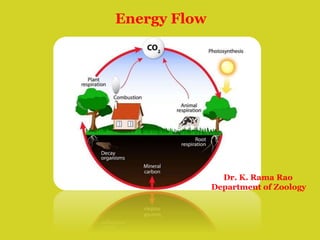
Energy Flow
Dr. K. Rama Rao
Department of Zoology
The existence of living beings such
as plants and animals depends on
the flow of energy in
them. Energy is needed for all the
biotic activities.
The most significant source
of energy for all ecosystems is the
sun.
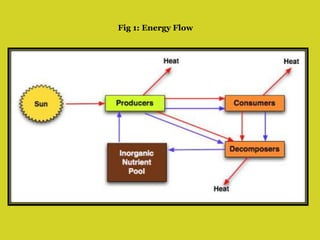
Fig 1: Energy Flow
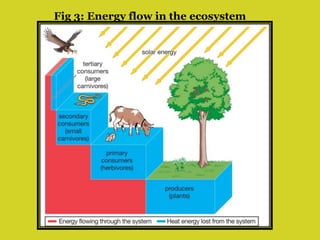
Energy flow is the amount
of energy that moves through a
food chain.
The largest source of energy for
an ecosystem is the sun.
Energy that is not used in
an ecosystem is eventually lost as
heat.
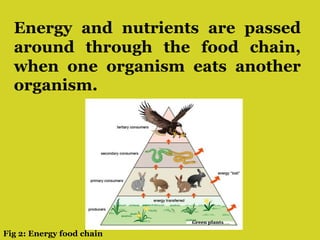
Energy and nutrients are passed
around through the food chain,
when one organism eats another
organism.
Fig 2: Energy food chain
The energy flow takes place via
food chain and food web. During
the process of energy flow in
the ecosystem.
Plants being the producers absorb
sunlight with the help of the
chloroplasts and a part of it is
transformed into chemical energy n
in the process of photosynthesis.
Fig 3: Energy flow in the ecosystem
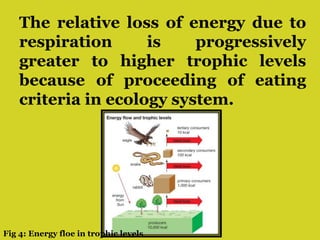
The relative loss of energy due to
respiration is progressively
greater to higher trophic levels
because of proceeding of eating
criteria in ecology system.
Fig 4: Energy floe in trophic levels
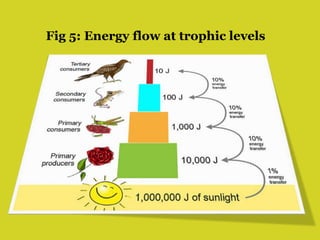
The amount of energy at each
trophic level decreases as it moves
through an ecosystem.
As little as 10 percent of
the energy at any trophic level is
transferred to the next level; the
rest is lost largely through
metabolic processes as heat.
Fig 5: Energy flow at trophic levels
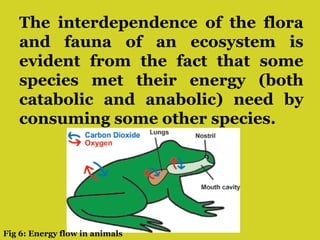
The interdependence of the flora
and fauna of an ecosystem is
evident from the fact that some
species met their energy (both
catabolic and anabolic) need by
consuming some other species.
Fig 6: Energy flow in animals
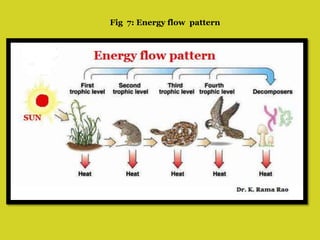
These herbivores are the primary
consumers, which are consumed by
the secondary consumers (the
carnivores).
Some bigger carnivores (the
tertiary consumers) live on the
smaller ones. This energy flow
pattern, from species to species
Fig 7: Energy flow pattern
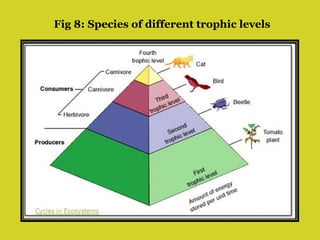
In a simplified way, the sequential
dependence of a species of a higher
trophic level on another of a lower
trophic level for food is termed as
the “food chain” and food web”, as
many species take in, as food,
species of different trophic levels.
Fig 8: Species of different trophic levels
The efficiency of assimilation of energy
is higher at a lower trophic level and
lower at a higher trophic level.
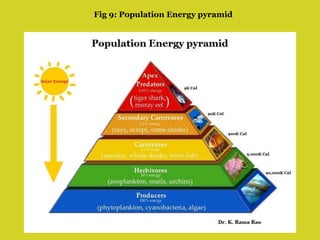
Because of this, the population and the
total mass of a species of lower trophic
level are much larger than that of the
immediate higher trophic level.
The population structure is termed as
“population pyramid”
Fig 9: Population Energy pyramid

Energy flow

  • 1.
    Energy Flow Dr. K.Rama Rao Department of Zoology
  • 2.
    The existence ofliving beings such as plants and animals depends on the flow of energy in them. Energy is needed for all the biotic activities. The most significant source of energy for all ecosystems is the sun.
  • 3.
  • 4.
    Energy flow isthe amount of energy that moves through a food chain. The largest source of energy for an ecosystem is the sun. Energy that is not used in an ecosystem is eventually lost as heat.
  • 5.
    Energy and nutrientsare passed around through the food chain, when one organism eats another organism. Fig 2: Energy food chain
  • 6.
    The energy flowtakes place via food chain and food web. During the process of energy flow in the ecosystem. Plants being the producers absorb sunlight with the help of the chloroplasts and a part of it is transformed into chemical energy n in the process of photosynthesis.
  • 7.
    Fig 3: Energyflow in the ecosystem
  • 8.
    The relative lossof energy due to respiration is progressively greater to higher trophic levels because of proceeding of eating criteria in ecology system. Fig 4: Energy floe in trophic levels
  • 9.
    The amount ofenergy at each trophic level decreases as it moves through an ecosystem. As little as 10 percent of the energy at any trophic level is transferred to the next level; the rest is lost largely through metabolic processes as heat.
  • 10.
    Fig 5: Energyflow at trophic levels
  • 11.
    The interdependence ofthe flora and fauna of an ecosystem is evident from the fact that some species met their energy (both catabolic and anabolic) need by consuming some other species. Fig 6: Energy flow in animals
  • 12.
    These herbivores arethe primary consumers, which are consumed by the secondary consumers (the carnivores). Some bigger carnivores (the tertiary consumers) live on the smaller ones. This energy flow pattern, from species to species
  • 13.
    Fig 7: Energyflow pattern
  • 14.
    In a simplifiedway, the sequential dependence of a species of a higher trophic level on another of a lower trophic level for food is termed as the “food chain” and food web”, as many species take in, as food, species of different trophic levels.
  • 15.
    Fig 8: Speciesof different trophic levels
  • 16.
    The efficiency ofassimilation of energy is higher at a lower trophic level and lower at a higher trophic level. Because of this, the population and the total mass of a species of lower trophic level are much larger than that of the immediate higher trophic level. The population structure is termed as “population pyramid”
  • 17.
    Fig 9: PopulationEnergy pyramid