SOLAR AIR
CONDITIONING
 content
 Introduction
 Why Solar Cooling?
 Working principle
 Advantage
 Disadvantage
 Conclusion
 refferences
Introduction
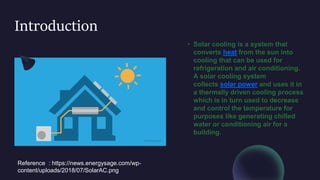
• Solar cooling is a system that
converts heat from the sun into
cooling that can be used for
refrigeration and air conditioning.
A solar cooling system
collects solar power and uses it in
a thermally driven cooling process
which is in turn used to decrease
and control the temperature for
purposes like generating chilled
water or conditioning air for a
building.
Reference : https://news.energysage.com/wp-
content/uploads/2018/07/SolarAC.png
Why Solar Cooling?
• Dramatic increase of air conditioning since the early 80ies
• Cost of energy.
• Issues related to environmental pollution.
• Due to energy production.
• Due to the use of CFC’s and HCFC’s.
• Matches demand with source availability.
• Crucial for improving life standards in developing countries.
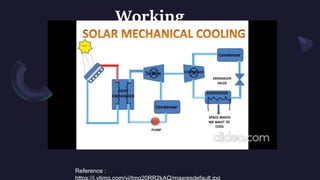
WORKING PRINCIPLE
Working
Reference :
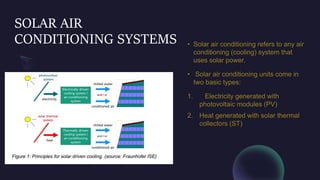
SOLAR AIR
CONDITIONING SYSTEMS
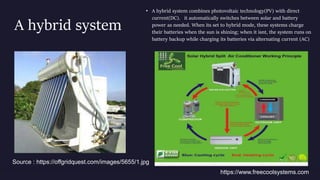
A hybrid system
• A hybrid system combines photovoltaic technology(PV) with direct
current(DC). it automatically switches between solar and battery
power as needed. When its set to hybrid mode, these systems charge
their batteries when the sun is shining; when it isnt, the system runs on
battery backup while charging its batteries via alternating current (AC)
Source : https://offgridquest.com/images/5655/1.jpg
https://www.freecoolsystems.com
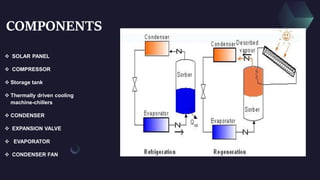
COMPONENTS
 SOLAR PANEL
 COMPRESSOR
 Storage tank
 Thermally driven cooling
machine-chillers
 CONDENSER
 EXPANSION VALVE
 EVAPORATOR
 CONDENSER FAN
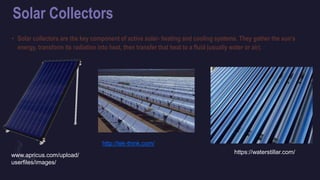
Solar Collectors
• Solar collectors are the key component of active solar- heating and cooling systems. They gather the sun's
energy, transform its radiation into heat, then transfer that heat to a fluid (usually water or air).
http://tek-think.com/
www.apricus.com/upload/
userfiles/images/
https://waterstillar.com/
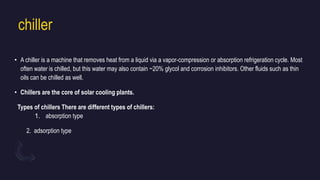
chiller
• A chiller is a machine that removes heat from a liquid via a vapor-compression or absorption refrigeration cycle. Most
often water is chilled, but this water may also contain ~20% glycol and corrosion inhibitors. Other fluids such as thin
oils can be chilled as well.
• Chillers are the core of solar cooling plants.
Types of chillers There are different types of chillers:
1. absorption type
2. adsorption type
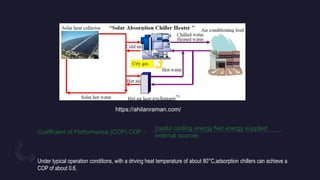
https://ahilanraman.com/
Coefficient of Performance (COP) COP =
Useful cooling energy Net energy supplied
external sources
Under typical operation conditions, with a driving heat temperature of about 80°C,adsorption chillers can achieve a
COP of about 0.6,
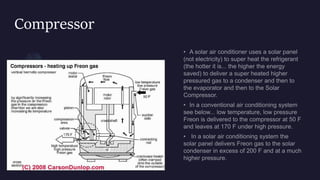
Compressor
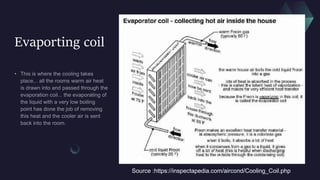
Evaporting coil
Source :https://inspectapedia.com/aircond/Cooling_Coil.php
Advantage
1.Solar energy may be the best way to obtain replenishable power.
2.It proves economical on long run. Solar energy causes very less pollution.
3.Sunlight is totally free. There is of course the initial investment for the equipment. After the initial
capital outlay you won’t be receiving a bill every month for the rest of your life from the electric utility
4. Solar power can generate electricity no matter how remote the area as long as the sun shines there.
Even in areas that are inaccessible to power cables solar power can produce electricity.
5.Solar power is used to charge batteries so that solar powered devices can be used at night.
6.Low Maintenance Costs
7.Technology Development
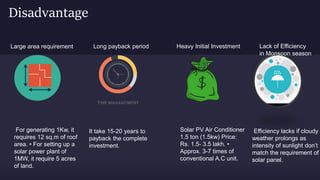
Disadvantage
For generating 1Kw, it
requires 12 sq.m of roof
area. • For setting up a
solar power plant of
1MW, it require 5 acres
of land.
It take 15-20 years to
payback the complete
investment.
Solar PV Air Conditioner
1.5 ton (1.5kw) Price:
Rs. 1.5- 3.5 lakh. •
Approx. 3-7 times of
conventional A.C unit.
Efficiency lacks if cloudy
weather prolongs as
intensity of sunlight don’t
match the requirement of
solar panel.
Large area requirement Long payback period Heavy Initial Investment Lack of Efficiency
in Monsoon season
Conclusion
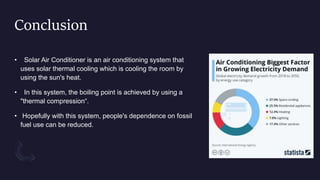
• Solar Air Conditioner is an air conditioning system that
uses solar thermal cooling which is cooling the room by
using the sun's heat.
• In this system, the boiling point is achieved by using a
"thermal compression“.
• Hopefully with this system, people's dependence on fossil
fuel use can be reduced.
refferences
https://whatis.techtarget.com
https://slideplayer.com/slide/6178245/
https://www.intechopen.com/books
https://www.seminarsonly.com
https://www.bluestarindia.com/projects/solar-air-conditioning/
https://www.canstarblue.com.au/appliances/what-is-solar-air-conditioning/
https://en.wikipedia.org/wiki/Solar_air_conditioning
Thank you

Presentation 3 (1) - Copy.pptx

  • 1.
  • 2.
     content  Introduction Why Solar Cooling?  Working principle  Advantage  Disadvantage  Conclusion  refferences
  • 3.
    Introduction • Solar coolingis a system that converts heat from the sun into cooling that can be used for refrigeration and air conditioning. A solar cooling system collects solar power and uses it in a thermally driven cooling process which is in turn used to decrease and control the temperature for purposes like generating chilled water or conditioning air for a building. Reference : https://news.energysage.com/wp- content/uploads/2018/07/SolarAC.png
  • 4.
    Why Solar Cooling? •Dramatic increase of air conditioning since the early 80ies • Cost of energy. • Issues related to environmental pollution. • Due to energy production. • Due to the use of CFC’s and HCFC’s. • Matches demand with source availability. • Crucial for improving life standards in developing countries.
  • 5.
  • 6.
  • 7.
  • 8.
    A hybrid system •A hybrid system combines photovoltaic technology(PV) with direct current(DC). it automatically switches between solar and battery power as needed. When its set to hybrid mode, these systems charge their batteries when the sun is shining; when it isnt, the system runs on battery backup while charging its batteries via alternating current (AC) Source : https://offgridquest.com/images/5655/1.jpg https://www.freecoolsystems.com
  • 9.
    COMPONENTS  SOLAR PANEL COMPRESSOR  Storage tank  Thermally driven cooling machine-chillers  CONDENSER  EXPANSION VALVE  EVAPORATOR  CONDENSER FAN
  • 10.
    Solar Collectors • Solarcollectors are the key component of active solar- heating and cooling systems. They gather the sun's energy, transform its radiation into heat, then transfer that heat to a fluid (usually water or air). http://tek-think.com/ www.apricus.com/upload/ userfiles/images/ https://waterstillar.com/
  • 11.
    chiller • A chilleris a machine that removes heat from a liquid via a vapor-compression or absorption refrigeration cycle. Most often water is chilled, but this water may also contain ~20% glycol and corrosion inhibitors. Other fluids such as thin oils can be chilled as well. • Chillers are the core of solar cooling plants. Types of chillers There are different types of chillers: 1. absorption type 2. adsorption type
  • 12.
    https://ahilanraman.com/ Coefficient of Performance(COP) COP = Useful cooling energy Net energy supplied external sources Under typical operation conditions, with a driving heat temperature of about 80°C,adsorption chillers can achieve a COP of about 0.6,
  • 13.
  • 14.
  • 15.
    Advantage 1.Solar energy maybe the best way to obtain replenishable power. 2.It proves economical on long run. Solar energy causes very less pollution. 3.Sunlight is totally free. There is of course the initial investment for the equipment. After the initial capital outlay you won’t be receiving a bill every month for the rest of your life from the electric utility 4. Solar power can generate electricity no matter how remote the area as long as the sun shines there. Even in areas that are inaccessible to power cables solar power can produce electricity. 5.Solar power is used to charge batteries so that solar powered devices can be used at night. 6.Low Maintenance Costs 7.Technology Development
  • 16.
    Disadvantage For generating 1Kw,it requires 12 sq.m of roof area. • For setting up a solar power plant of 1MW, it require 5 acres of land. It take 15-20 years to payback the complete investment. Solar PV Air Conditioner 1.5 ton (1.5kw) Price: Rs. 1.5- 3.5 lakh. • Approx. 3-7 times of conventional A.C unit. Efficiency lacks if cloudy weather prolongs as intensity of sunlight don’t match the requirement of solar panel. Large area requirement Long payback period Heavy Initial Investment Lack of Efficiency in Monsoon season
  • 17.
    Conclusion • Solar AirConditioner is an air conditioning system that uses solar thermal cooling which is cooling the room by using the sun's heat. • In this system, the boiling point is achieved by using a "thermal compression“. • Hopefully with this system, people's dependence on fossil fuel use can be reduced.
  • 18.
  • 19.