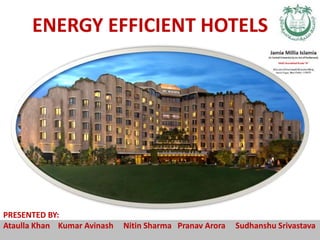
ENERGY EFFICIENT HOTELS
PRESENTED BY:
Ataulla Khan Kumar Avinash Nitin Sharma Pranav Arora Sudhanshu Srivastava
About hotels
- Hotel industry is a large business sector.
- Can play a major role changing the culture of environmental degradation practices to achieve
sustainable growth.
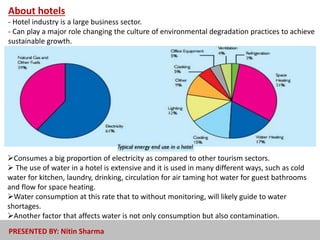
Consumes a big proportion of electricity as compared to other tourism sectors.
 The use of water in a hotel is extensive and it is used in many different ways, such as cold
water for kitchen, laundry, drinking, circulation for air taming hot water for guest bathrooms
and flow for space heating.
Water consumption at this rate that to without monitoring, will likely guide to water
shortages.
Another factor that affects water is not only consumption but also contamination.
PRESENTED BY: Nitin Sharma
Why become a Green Star Hotel?
There are several good reasons
 Join Green Star Hotel and your hotel will be featured
as part of a strong marketing and promotion
activities carried out by the national and
international project partners.
 Through the support of international tourism
organisations and projects the programme and its
certified hotels are also presented prominently in
conferences, trade shows, and international
workshops and on several web portals.
 Market your hotel and its environmental activities
by using the Green Star Hotel brand and marketing
tools.
PRESENTED BY: Nitin Sharma
Protecting the attractions that bring more visitors
to your destination helps ensure the long term
sustainability of your business!!
Saving money
By implementing the Green Star Hotel criteria
system, which also includes complex staff training
measures, your hotel can reduce operating costs
(e.g. reduction of water and energy consumption)
and increase operational efficiency.
Gain a competitive market advantage … promote to a wide audience
You can be confident that you will become more attractive to the growing number of
environmentally friendly tourists. Also the level of satisfaction among your customers will
increase who can actively contribute to the protection of environment without reducing
their level of comfort.
PRESENTED BY: Nitin Sharma
Hotels
Low energy
materials
Sustainable
site
Water
reduction
Energy
optimisation
Waste
management
Superior
indoor
quality
Increased
human
comfort
PRESENTED BY: Nitin Sharma
GRIHA Certification
PRESENTED BY: Nitin Sharma
Sanctioned Site plan should be conforming
to the following:
• Eco-sensitive zone regulations,
• Coastal zone regulations
• Heritage areas
• Water body zones
• Various hazard prone area regulations
SITE PLANNING
Sustainable Site Development
Majority of associates travel by either public transport or use pooled vehicles.
All Hotels consciously promotes cultivation of native plants
More than one third of the Hotel roof area is with a special paint with high Solar
Reflective Index, thereby reducing the cooling demand.
Building Façade and Exterior hardscape is maintained without use of any chemicals.
PRESENTED BY: Nitin Sharma
Low-impact design
 Heat gain in design case be lower
than GRIHA base case.
 At least 50% of total external wall
area on unfavorable orientations
like West, are abutting buffer
zones/service areas.
 Conduct insolation analysis for summer months (typically April to June).
 Insolation has reduced by at least 25% through planting of dense trees next to
critical facades during Summer months (1st April to 30th June) – only in case of up to
G+3 structures.
 Site planning has been done according to site contours - for contours with slopes
equal to or greater than 1:4.
 Demonstrate at least 50% (by area) of such features on site must be preserved.
 Submit layout to demonstrate incorporation of appropriate SUDS strategies for
managing over 90% of the storm water quantity on site.
 Cross ventilation in the naturally
ventilated/mixed- mode ventilation.
 Annual sun path/shading analysis.
PRESENTED BY: Nitin Sharma
Design to mitigate Urban heat island effect
Site surfaces visible to sky are
• Soft paved/covered with high SRI coating (SRI > 0.5) OR
• Shaded by trees OR vegetated pergolas OR solar panels OR
• any combination of these strategies
Net Imperviousness factor of site meets the NBC 2005 norms & the post-construction
storm water discharge from the site is zero.
PRESENTED BY: Nitin Sharma
• 3 meter high barricading around the construction area.
• Wheel washing facility at the vehicular entrance.
• Covering off interaggregate and excavated earth.
• Water sprinkling on fine aggregate(sand) and excavated earth.
• For all DG sets, proper chimneys with outlet facing away from site
• Develop and implement a spill prevention plan (hazardous materials like
• Bitumen, diesel etc. on site.
•No existing mature tree is cut or
•Plant 3 trees for every 1 tree cut of the same native/naturalized species OR
•any combination of these for all mature trees on site
•Increase total number of trees on site by
•25% above the pre-construction phase OR
•Plant 4 trees for every 1 tree cut of the same native/naturalized species
•Preserve top soil during construction, maintain its fertility and use for landscape post-
construction
Construction Management
PRESENTED BY: Ataulla Khan
Energy Efficiency
Some Energy Saving initiatives:
Chiller Plant Optimizer
Heat-Pump System
Solar based Hot water & Steam System
Renewable Energy
LED Lighting
BMS System
Chiller plant optimizer
PRESENTED BY: Ataulla Khan
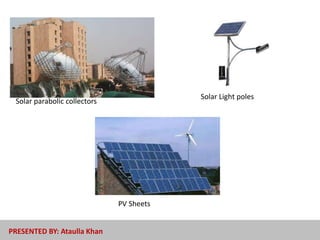
Solar parabolic collectors
PV Sheets
Solar Light poles
PRESENTED BY: Ataulla Khan
Energy efficient lighting (LED Lights for energy efficiency and Zero mercury content) and
light pollution reduction in all hotels.
All hotels have a network based building management system to monitor and control the
HVAC (Heating, Ventilation & Air Conditioning), Lighting, Sub-metering and water management
system.
Digital Valet System: IPAD operated room control system to control Air conditioning,
Lighting, TV etc.
Condensate recovery system
PRESENTED BY: Ataulla Khan
Energy Efficiency
Pressure Independent Control Valve system (PICV) for constant water pressure throughout the
building and AHU coils.
Remote monitoring & control system for all refrigerator temperature.
ITC Sonar is the first hotel to receive carbon credits in the world through the CDM (Clean
Development Mechanism) initiatives of UNFCCC (United Nations Framework Convention
on Climate Change).
PRESENTED BY: Ataulla Khan
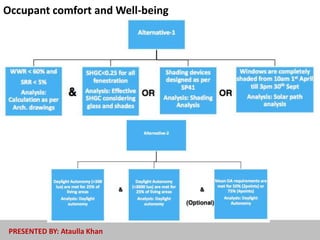
Occupant comfort and Well-being
PRESENTED BY: Ataulla Khan
Artificial lighting levels
As per NBC & Uniformity ratio of 0.4
Meet thermal comfort requirements as per NBC/ASHRAE 55/Indian
- Mandatory adaptive comfort model
- Indoor noise levels not to exceed NBC prescribed levels
• CPCB National Ambient Air Quality Standard (NAAQS) for fresh air quality &
• ASHRAE 62.1-2010/NBC 2005 for fresh air quantity
• Treatment for Outdoor air for PM10 and PM2.5
• Monitoring CO2, Temperature and RH
• All Low-VOC interior paints.
• All Low-VOC adhesives & Sealants and no
use of urea-formaldehyde in composite
wood products
PRESENTED BY: Pranav Arora
Water saving techniques
Water Saving techniques:
Water efficient fixtures
Sewage Treatment Plants
Use of Treated water
Storm water management
Rain water harvesting
Sensor operated fixtures, waterless urinals, dual flush water closets and flow
restrictors (Aerators) for reducing water consumption against LEED® benchmark for
water consumption.
Only treated recycled water is used for flushing, landscape, cooling tower and
miscellaneous cleaning. Drip irrigation system for water efficient landscaping.
Segregation of Black and Grey water for Sewage treatment plant and waste water
recycling. Surplus water to neighbouring areas / communities gardens.
Rain Water Harvesting system to capture Roof and Non-roof rain water
PRESENTED BY: Pranav Arora
Water
PRESENTED BY: Pranav Arora
15% Replacement of OPC with fly ash in structural concrete • 25% Replacement of OPC
with fly ash in structural concrete
Use of fly-ash in 40% of building blocks/bricks
Reduction in combined embodied energy of load-bearing structure and masonry walls
Sustainable Building Materials
PRESENTED BY: Pranav Arora
•Waste segregation at source
•Dedicated, segregated and hygienic storage space for different types of wastes
•Recycling of recyclable wastes (metal, paper, plastic, glass etc)
•Treat organic waste (Kitchen and landscape) on site to convert it into resource
Solid Waste Management
PRESENTED BY: Pranav Arora
•Necessary safety equipment and measures for construction workers
•Drinking water, hygienic working & living conditions and sanitation facility for
construction workers
•Crèche facility for children of construction workers
Adopt measures to create environmental awareness
Socio-Economic Strategies
PRESENTED BY: Pranav Arora
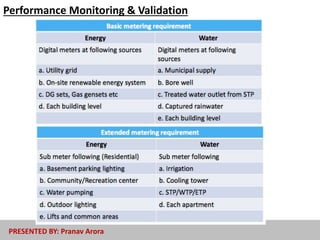
Performance Monitoring & Validation
PRESENTED BY: Pranav Arora
• A GRIHA certified professional involved in the project
• First Mover: Implementation of a technology for the first time
in the country.
• E-waste recycling
• STP technologies which do not use chemicals
• Net-Zero Energy/Water
• Provision of Electric charging points for Electric vehicles
Innovation
PRESENTED BY: Pranav Arora
Case Study
ITC Hotel at Guntur
Project summary
The ITC Hotel building is located at Guntur. The building is of commercial use with 2
Basement floor + Ground floor+ 9 floors. This new commercial use building has an
approximate gross floor area approximate 238,722 square feet, and includes Guest
room, meeting room, reception, Gymnasium, Dining hall, kitchen, Restaurant. The net
air conditioned area of the project is approximate 89,652 square feet.
Modeling methodology
The Proposed Building has been evaluated on the basis of the methodology outlined
in Appendix G, The Performance Rating Method of ASHRAE/IESNA 90.1-2007. Visual
DOE 4.1, a front-end to the DOE-2.1E engine, has been used as the simulation tool.
Annual hourly energy simulations are performed to quantify the anticipated HVAC and
lighting energy savings of the proposed building design. The two building models
(Baseline and Proposed) use identical climate zones, layout, occupancy, plug loads, and
schedules.
PRESENTED BY: Sudhanshu Srivastava
Stereographic Diagram
PRESENTED BY: Sudhanshu Srivastava
Monthly Averages Data
PRESENTED BY: Sudhanshu Srivastava
Climate summary chart
PRESENTED BY: Sudhanshu Srivastava
Model images of the building from Visual DOE
PRESENTED BY: Sudhanshu Srivastava
Climate summary chart
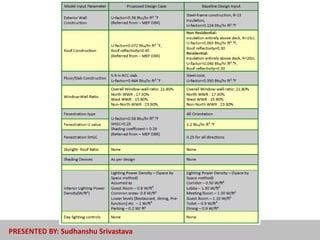
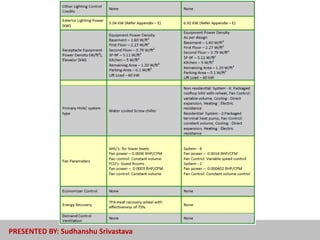
The Baseline building is an ASHRAE 90.1-2007 compliant building based on the
requirements outlined in Appendix G of the Standard. The Baseline building residential
spaces System -2 Packaged terminal Air Conditioner and Non-residential spaces System
6 – Packaged rooftop VAV with reheat. Envelope requirements are based on the
ASHRAE minimum values for a building located in Climate Zone 1 – Hyderabad, India.
No external shading devices are included in the Baseline building model.
The Baseline building performance is the averaged results of simulating the building
with its actual orientation and after rotating the entire building 90, 180, and 270
degrees as ASHRAE 90.1 requires.
The proposed model incorporates all the energy efficient features as designed. The
energy cost savings between the baseline and proposed models is used to determine
the total number of LEED® credit points available under Energy and Atmosphere Credit
1 (EA1) - Optimize Energy Performance. The total number of EA1 points achievable for
the project under LEED_India_NC_2011 rating system is as under:
PRESENTED BY: Sudhanshu Srivastava
LEED_India_NC_2011 Point Distribution
PRESENTED BY: Sudhanshu Srivastava
Case Study
Grand Chola Hotel
at Chennai
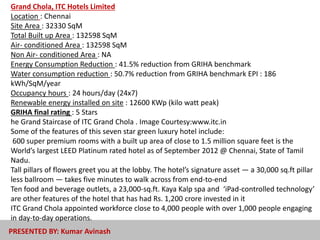
Grand Chola, ITC Hotels Limited
Location : Chennai
Site Area : 32330 SqM
Total Built up Area : 132598 SqM
Air- conditioned Area : 132598 SqM
Non Air- conditioned Area : NA
Energy Consumption Reduction : 41.5% reduction from GRIHA benchmark
Water consumption reduction : 50.7% reduction from GRIHA benchmark EPI : 186
kWh/SqM/year
Occupancy hours : 24 hours/day (24x7)
Renewable energy installed on site : 12600 KWp (kilo watt peak)
GRIHA final rating : 5 Stars
he Grand Staircase of ITC Grand Chola . Image Courtesy:www.itc.in
Some of the features of this seven star green luxury hotel include:
600 super premium rooms with a built up area of close to 1.5 million square feet is the
World’s largest LEED Platinum rated hotel as of September 2012 @ Chennai, State of Tamil
Nadu.
Tall pillars of flowers greet you at the lobby. The hotel’s signature asset — a 30,000 sq.ft pillar
less ballroom — takes five minutes to walk across from end-to-end
Ten food and beverage outlets, a 23,000-sq.ft. Kaya Kalp spa and ‘iPad-controlled technology’
are other features of the hotel that has had Rs. 1,200 crore invested in it
ITC Grand Chola appointed workforce close to 4,000 people with over 1,000 people engaging
in day-to-day operations.
PRESENTED BY: Kumar Avinash
Grand Chola, ITC Hotels Limited
Seven star green luxury hotel include:
600 super premium rooms with a built
up area of close to 1.5 million square feet
is the World’s largest LEED Platinum rated
hotel as of September 2012 @ Chennai,
State of Tamil Nadu.
Location : Chennai
Site Area : 32330 SqM
Total Built up Area : 132598 SqM
Air- conditioned Area : 132598 SqM
Non Air- conditioned Area : NA
Energy Consumption Reduction : 41.5%
reduction from GRIHA benchmark
Water consumption reduction : 50.7% reduction
from GRIHA benchmark EPI : 186 kWh/SqM/year
Occupancy hours : 24 hours/day (24x7)
Renewable energy installed on site : 12600 KWp
GRIHA final rating : 5 Stars
PRESENTED BY: Kumar Avinash
Sustainable Features of ITC Grand Chola
Sustainable Site Planning:
• Existing trees were preserved and transplanted along the periphery of the site
• Excavation and construction started after the monsoon season to prevent soil erosion
and soil run off from the site
• Top soil was preserved and re-used to raise the ground level along the periphery
• Service corridors are planned to cause minimum damage to the site and natural
topography
• Orientation of the building is east west but zoning of the building has been
appropriately done to reduce negative impact of bad orientation
Reduction in water consumption (compared to GRIHA benchmark):
• Reduction in building water consumption by use of low-flow fixtures : 50.7%
• Water recycled and reused within the complex : 90%
• Reduction in landscape water consumption by planting native species of trees and
shrubs and by using efficient
irrigation systems : 62.3%
Passive architectural design strategies adopted in the building:
• Thick stone and AAC block walls to reduce solar heat gain
• Recessed windows to cut direct sun rays and glare inside the building
• 99% of living areas are day-lit and window to wall ratio restricted to 25% to
reduce solar heat gain inside the building
PRESENTED BY: Kumar Avinash
Sustainable Features of ITC Grand Chola
Renewable energy technologies installed
on site:
Installed capacity of wind energy : 12600
KWp
Units of electricity generated annually :
27900000 KWh
Use of low-energy/green materials:
Use of Plywood and MDF boards
manufactured by Uniply, Greenply and
Centuryply certified by SGS and
recyclable fabric
Use of high density composite wood
panels
PRESENTED BY: Kumar Avinash
Sustainable Features of ITC Grand Chola
Reduction in energy consumption (compared to GRIHA
benchmark) while maintaining occupant comfort:
For achieving visual comfort n Energy efficient artificial
lighting design is compliant with ECBC recommendations
Occupancy sensors in rooms to reduce energy
consumption
All electrical fixtures (lights, space conditioners,
appliances) controlled by i-pad to reduce energy
consumption
External shading and efficient glazing to reduce solar
heat gain and have glare-free daylight have been
installed.
For achieving thermal comfort
Building envelope is ECBC compliant, which helps
reduce cooling loads in AC spaces and meets thermal
comfort levels in non AC spaces.
Centralized air conditioning through variable refrigerant
flow technology is installed. Facility of controlling each
indoor unit centrally as well as individually based on
occupancy censor is provided.
Use of AAC blocks in the infill wall system.
PRESENTED BY: Kumar Avinash
Thank you

Energy efficient hotel

  • 1.
    ENERGY EFFICIENT HOTELS PRESENTEDBY: Ataulla Khan Kumar Avinash Nitin Sharma Pranav Arora Sudhanshu Srivastava
  • 2.
    About hotels - Hotelindustry is a large business sector. - Can play a major role changing the culture of environmental degradation practices to achieve sustainable growth. Consumes a big proportion of electricity as compared to other tourism sectors.  The use of water in a hotel is extensive and it is used in many different ways, such as cold water for kitchen, laundry, drinking, circulation for air taming hot water for guest bathrooms and flow for space heating. Water consumption at this rate that to without monitoring, will likely guide to water shortages. Another factor that affects water is not only consumption but also contamination. PRESENTED BY: Nitin Sharma
  • 3.
    Why become aGreen Star Hotel? There are several good reasons  Join Green Star Hotel and your hotel will be featured as part of a strong marketing and promotion activities carried out by the national and international project partners.  Through the support of international tourism organisations and projects the programme and its certified hotels are also presented prominently in conferences, trade shows, and international workshops and on several web portals.  Market your hotel and its environmental activities by using the Green Star Hotel brand and marketing tools. PRESENTED BY: Nitin Sharma
  • 4.
    Protecting the attractionsthat bring more visitors to your destination helps ensure the long term sustainability of your business!! Saving money By implementing the Green Star Hotel criteria system, which also includes complex staff training measures, your hotel can reduce operating costs (e.g. reduction of water and energy consumption) and increase operational efficiency. Gain a competitive market advantage … promote to a wide audience You can be confident that you will become more attractive to the growing number of environmentally friendly tourists. Also the level of satisfaction among your customers will increase who can actively contribute to the protection of environment without reducing their level of comfort. PRESENTED BY: Nitin Sharma
  • 5.
  • 6.
  • 7.
  • 8.
    Sanctioned Site planshould be conforming to the following: • Eco-sensitive zone regulations, • Coastal zone regulations • Heritage areas • Water body zones • Various hazard prone area regulations SITE PLANNING Sustainable Site Development Majority of associates travel by either public transport or use pooled vehicles. All Hotels consciously promotes cultivation of native plants More than one third of the Hotel roof area is with a special paint with high Solar Reflective Index, thereby reducing the cooling demand. Building Façade and Exterior hardscape is maintained without use of any chemicals. PRESENTED BY: Nitin Sharma
  • 9.
    Low-impact design  Heatgain in design case be lower than GRIHA base case.  At least 50% of total external wall area on unfavorable orientations like West, are abutting buffer zones/service areas.  Conduct insolation analysis for summer months (typically April to June).  Insolation has reduced by at least 25% through planting of dense trees next to critical facades during Summer months (1st April to 30th June) – only in case of up to G+3 structures.  Site planning has been done according to site contours - for contours with slopes equal to or greater than 1:4.  Demonstrate at least 50% (by area) of such features on site must be preserved.  Submit layout to demonstrate incorporation of appropriate SUDS strategies for managing over 90% of the storm water quantity on site.  Cross ventilation in the naturally ventilated/mixed- mode ventilation.  Annual sun path/shading analysis. PRESENTED BY: Nitin Sharma
  • 10.
    Design to mitigateUrban heat island effect Site surfaces visible to sky are • Soft paved/covered with high SRI coating (SRI > 0.5) OR • Shaded by trees OR vegetated pergolas OR solar panels OR • any combination of these strategies Net Imperviousness factor of site meets the NBC 2005 norms & the post-construction storm water discharge from the site is zero. PRESENTED BY: Nitin Sharma
  • 11.
    • 3 meterhigh barricading around the construction area. • Wheel washing facility at the vehicular entrance. • Covering off interaggregate and excavated earth. • Water sprinkling on fine aggregate(sand) and excavated earth. • For all DG sets, proper chimneys with outlet facing away from site • Develop and implement a spill prevention plan (hazardous materials like • Bitumen, diesel etc. on site. •No existing mature tree is cut or •Plant 3 trees for every 1 tree cut of the same native/naturalized species OR •any combination of these for all mature trees on site •Increase total number of trees on site by •25% above the pre-construction phase OR •Plant 4 trees for every 1 tree cut of the same native/naturalized species •Preserve top soil during construction, maintain its fertility and use for landscape post- construction Construction Management PRESENTED BY: Ataulla Khan
  • 12.
  • 13.
    Energy Efficiency Some EnergySaving initiatives: Chiller Plant Optimizer Heat-Pump System Solar based Hot water & Steam System Renewable Energy LED Lighting BMS System Chiller plant optimizer PRESENTED BY: Ataulla Khan
  • 14.
    Solar parabolic collectors PVSheets Solar Light poles PRESENTED BY: Ataulla Khan
  • 15.
    Energy efficient lighting(LED Lights for energy efficiency and Zero mercury content) and light pollution reduction in all hotels. All hotels have a network based building management system to monitor and control the HVAC (Heating, Ventilation & Air Conditioning), Lighting, Sub-metering and water management system. Digital Valet System: IPAD operated room control system to control Air conditioning, Lighting, TV etc. Condensate recovery system PRESENTED BY: Ataulla Khan
  • 16.
  • 17.
    Energy Efficiency Pressure IndependentControl Valve system (PICV) for constant water pressure throughout the building and AHU coils. Remote monitoring & control system for all refrigerator temperature. ITC Sonar is the first hotel to receive carbon credits in the world through the CDM (Clean Development Mechanism) initiatives of UNFCCC (United Nations Framework Convention on Climate Change). PRESENTED BY: Ataulla Khan
  • 18.
    Occupant comfort andWell-being PRESENTED BY: Ataulla Khan
  • 19.
    Artificial lighting levels Asper NBC & Uniformity ratio of 0.4 Meet thermal comfort requirements as per NBC/ASHRAE 55/Indian - Mandatory adaptive comfort model - Indoor noise levels not to exceed NBC prescribed levels • CPCB National Ambient Air Quality Standard (NAAQS) for fresh air quality & • ASHRAE 62.1-2010/NBC 2005 for fresh air quantity • Treatment for Outdoor air for PM10 and PM2.5 • Monitoring CO2, Temperature and RH • All Low-VOC interior paints. • All Low-VOC adhesives & Sealants and no use of urea-formaldehyde in composite wood products PRESENTED BY: Pranav Arora
  • 20.
    Water saving techniques WaterSaving techniques: Water efficient fixtures Sewage Treatment Plants Use of Treated water Storm water management Rain water harvesting Sensor operated fixtures, waterless urinals, dual flush water closets and flow restrictors (Aerators) for reducing water consumption against LEED® benchmark for water consumption. Only treated recycled water is used for flushing, landscape, cooling tower and miscellaneous cleaning. Drip irrigation system for water efficient landscaping. Segregation of Black and Grey water for Sewage treatment plant and waste water recycling. Surplus water to neighbouring areas / communities gardens. Rain Water Harvesting system to capture Roof and Non-roof rain water PRESENTED BY: Pranav Arora
  • 21.
  • 22.
  • 23.
    15% Replacement ofOPC with fly ash in structural concrete • 25% Replacement of OPC with fly ash in structural concrete Use of fly-ash in 40% of building blocks/bricks Reduction in combined embodied energy of load-bearing structure and masonry walls Sustainable Building Materials PRESENTED BY: Pranav Arora
  • 24.
    •Waste segregation atsource •Dedicated, segregated and hygienic storage space for different types of wastes •Recycling of recyclable wastes (metal, paper, plastic, glass etc) •Treat organic waste (Kitchen and landscape) on site to convert it into resource Solid Waste Management PRESENTED BY: Pranav Arora
  • 25.
    •Necessary safety equipmentand measures for construction workers •Drinking water, hygienic working & living conditions and sanitation facility for construction workers •Crèche facility for children of construction workers Adopt measures to create environmental awareness Socio-Economic Strategies PRESENTED BY: Pranav Arora
  • 26.
    Performance Monitoring &Validation PRESENTED BY: Pranav Arora
  • 27.
    • A GRIHAcertified professional involved in the project • First Mover: Implementation of a technology for the first time in the country. • E-waste recycling • STP technologies which do not use chemicals • Net-Zero Energy/Water • Provision of Electric charging points for Electric vehicles Innovation PRESENTED BY: Pranav Arora
  • 28.
  • 29.
    Project summary The ITCHotel building is located at Guntur. The building is of commercial use with 2 Basement floor + Ground floor+ 9 floors. This new commercial use building has an approximate gross floor area approximate 238,722 square feet, and includes Guest room, meeting room, reception, Gymnasium, Dining hall, kitchen, Restaurant. The net air conditioned area of the project is approximate 89,652 square feet. Modeling methodology The Proposed Building has been evaluated on the basis of the methodology outlined in Appendix G, The Performance Rating Method of ASHRAE/IESNA 90.1-2007. Visual DOE 4.1, a front-end to the DOE-2.1E engine, has been used as the simulation tool. Annual hourly energy simulations are performed to quantify the anticipated HVAC and lighting energy savings of the proposed building design. The two building models (Baseline and Proposed) use identical climate zones, layout, occupancy, plug loads, and schedules. PRESENTED BY: Sudhanshu Srivastava
  • 30.
  • 31.
    Monthly Averages Data PRESENTEDBY: Sudhanshu Srivastava
  • 32.
    Climate summary chart PRESENTEDBY: Sudhanshu Srivastava
  • 33.
    Model images ofthe building from Visual DOE PRESENTED BY: Sudhanshu Srivastava
  • 34.
    Climate summary chart TheBaseline building is an ASHRAE 90.1-2007 compliant building based on the requirements outlined in Appendix G of the Standard. The Baseline building residential spaces System -2 Packaged terminal Air Conditioner and Non-residential spaces System 6 – Packaged rooftop VAV with reheat. Envelope requirements are based on the ASHRAE minimum values for a building located in Climate Zone 1 – Hyderabad, India. No external shading devices are included in the Baseline building model. The Baseline building performance is the averaged results of simulating the building with its actual orientation and after rotating the entire building 90, 180, and 270 degrees as ASHRAE 90.1 requires. The proposed model incorporates all the energy efficient features as designed. The energy cost savings between the baseline and proposed models is used to determine the total number of LEED® credit points available under Energy and Atmosphere Credit 1 (EA1) - Optimize Energy Performance. The total number of EA1 points achievable for the project under LEED_India_NC_2011 rating system is as under: PRESENTED BY: Sudhanshu Srivastava
  • 35.
  • 36.
  • 37.
  • 38.
  • 39.
    Case Study Grand CholaHotel at Chennai
  • 40.
    Grand Chola, ITCHotels Limited Location : Chennai Site Area : 32330 SqM Total Built up Area : 132598 SqM Air- conditioned Area : 132598 SqM Non Air- conditioned Area : NA Energy Consumption Reduction : 41.5% reduction from GRIHA benchmark Water consumption reduction : 50.7% reduction from GRIHA benchmark EPI : 186 kWh/SqM/year Occupancy hours : 24 hours/day (24x7) Renewable energy installed on site : 12600 KWp (kilo watt peak) GRIHA final rating : 5 Stars he Grand Staircase of ITC Grand Chola . Image Courtesy:www.itc.in Some of the features of this seven star green luxury hotel include: 600 super premium rooms with a built up area of close to 1.5 million square feet is the World’s largest LEED Platinum rated hotel as of September 2012 @ Chennai, State of Tamil Nadu. Tall pillars of flowers greet you at the lobby. The hotel’s signature asset — a 30,000 sq.ft pillar less ballroom — takes five minutes to walk across from end-to-end Ten food and beverage outlets, a 23,000-sq.ft. Kaya Kalp spa and ‘iPad-controlled technology’ are other features of the hotel that has had Rs. 1,200 crore invested in it ITC Grand Chola appointed workforce close to 4,000 people with over 1,000 people engaging in day-to-day operations. PRESENTED BY: Kumar Avinash
  • 41.
    Grand Chola, ITCHotels Limited Seven star green luxury hotel include: 600 super premium rooms with a built up area of close to 1.5 million square feet is the World’s largest LEED Platinum rated hotel as of September 2012 @ Chennai, State of Tamil Nadu. Location : Chennai Site Area : 32330 SqM Total Built up Area : 132598 SqM Air- conditioned Area : 132598 SqM Non Air- conditioned Area : NA Energy Consumption Reduction : 41.5% reduction from GRIHA benchmark Water consumption reduction : 50.7% reduction from GRIHA benchmark EPI : 186 kWh/SqM/year Occupancy hours : 24 hours/day (24x7) Renewable energy installed on site : 12600 KWp GRIHA final rating : 5 Stars PRESENTED BY: Kumar Avinash
  • 42.
    Sustainable Features ofITC Grand Chola Sustainable Site Planning: • Existing trees were preserved and transplanted along the periphery of the site • Excavation and construction started after the monsoon season to prevent soil erosion and soil run off from the site • Top soil was preserved and re-used to raise the ground level along the periphery • Service corridors are planned to cause minimum damage to the site and natural topography • Orientation of the building is east west but zoning of the building has been appropriately done to reduce negative impact of bad orientation Reduction in water consumption (compared to GRIHA benchmark): • Reduction in building water consumption by use of low-flow fixtures : 50.7% • Water recycled and reused within the complex : 90% • Reduction in landscape water consumption by planting native species of trees and shrubs and by using efficient irrigation systems : 62.3% Passive architectural design strategies adopted in the building: • Thick stone and AAC block walls to reduce solar heat gain • Recessed windows to cut direct sun rays and glare inside the building • 99% of living areas are day-lit and window to wall ratio restricted to 25% to reduce solar heat gain inside the building PRESENTED BY: Kumar Avinash
  • 43.
    Sustainable Features ofITC Grand Chola Renewable energy technologies installed on site: Installed capacity of wind energy : 12600 KWp Units of electricity generated annually : 27900000 KWh Use of low-energy/green materials: Use of Plywood and MDF boards manufactured by Uniply, Greenply and Centuryply certified by SGS and recyclable fabric Use of high density composite wood panels PRESENTED BY: Kumar Avinash
  • 44.
    Sustainable Features ofITC Grand Chola Reduction in energy consumption (compared to GRIHA benchmark) while maintaining occupant comfort: For achieving visual comfort n Energy efficient artificial lighting design is compliant with ECBC recommendations Occupancy sensors in rooms to reduce energy consumption All electrical fixtures (lights, space conditioners, appliances) controlled by i-pad to reduce energy consumption External shading and efficient glazing to reduce solar heat gain and have glare-free daylight have been installed. For achieving thermal comfort Building envelope is ECBC compliant, which helps reduce cooling loads in AC spaces and meets thermal comfort levels in non AC spaces. Centralized air conditioning through variable refrigerant flow technology is installed. Facility of controlling each indoor unit centrally as well as individually based on occupancy censor is provided. Use of AAC blocks in the infill wall system. PRESENTED BY: Kumar Avinash
  • 45.