Adding Value to Existing Hotels Through SustainabilityGregoir Chikaher, Director of Global Hotels & Leisure
Sustainable Hotel- Key ConsiderationsA building’s location affects commuting options, local ecosystems, building energy efficiency and much more.  A properly designed and retrofitted envelope helps to maintain the desired indoor conditions and may permit the use of natural ventilation, passive heating, and daylighting.Materials selected for sustainable buildings should have appropriate performance, durability and environmental properties.  Material selection can affect issues ranging from our planet’s resources to occupant comfort and health.Economic and Environmental indicators favour the lowest possible man-made changes to the natural hydrological-cycle.The functionality and energy consumption of a space is highly dependent on the lighting and daylighting design.  A passive system uses the building characteristics to mitigate negative effects of the external environment or to enhance the internal environment.  Efficient mechanical and electrical systems will add value, reduce energy consumption and operational costs and provide better comfort to guests. The resource use of a building is affected by the way in which it is used, operated and maintainedRenewables including solar, ground source heat pumps, PV cells and wind power are necessary to reduce Carbon emissions and for a better planet.
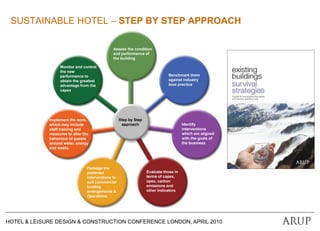
Sustainable hotel – step by step approachAssess the condition and performance of the building  Monitor and control the new performance to obtain the greatest advantage from the capexBenchmark them against industry best practiceStep by Step approachImplement the work, which may include staff training and measures to alter the behaviour of guests around water, energy and waste.Identify interventions which are aligned with the goals of the businessPackage the preferred interventions to suit commercial funding arrangements & OperationsEvaluate those in terms of capex, opex, carbon emissions and other indicators
Step #1Determine your baseline and appropriate level of refurbishmentSurvival Strategy for Existing HotelsWhat is the baseline? FM AuditEnergy AuditWater AuditWaste AuditIndoor Environment AuditLevel of refurbishment
Step #2  Review your building maintenance, housekeeping and energy purchasingSurvival Strategy for Existing HotelsDo you know what’s going on?
Out of control?
Energy purchasingStep #3   Establish your goals and targetsSurvival Strategy for Existing HotelsWhat targets?More BusinessRating System (BREEAM, LEED,...)
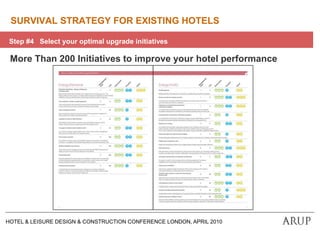
Step #4   Select your optimal upgrade initiativesMore Than 200 Initiatives to improve your hotel performanceSurvival Strategy for Existing Hotels
Survival Strategy for Existing HotelsStep #5   Make Your Survival Strategy Happen
Sustainable hotel - Typical life cycleAuditBenchmarkingDesignRefurbishmentConstructionOperationCommissioning
Sustainable hotel - Energy hierarchyBuilding form and orientation
 Passive ventilation strategy
 Energy management & lighting controls
 Demand control reduced air leakage
 Exposed mass
 Glazing spec
 Thermal storage
 Increased shading
 Increased insulation
 CHP
 Ground source heat pump
 Biomass boilers
 Solar hot water generators
 Wind Turbines – macro/micro
 PV
 Fuel CellsComplianceMinimumZero CarbonKg Carbon saved Per £ spentLow Carbon Building
Sustainable hotel – waste management hierarchyMostFavoured OptionLeastFavoured Option
Sustainable hotel – typical luxury hotel Carbon Reduction Estimate23.5%8%5.5%4.5%4%1.5%Total carbonEmission reductionMechanicalplantElectrical systemsRenewableCHPGlazingimprovements
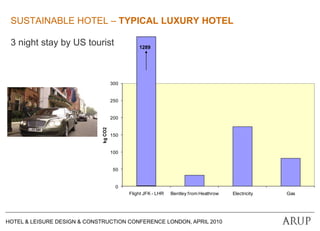
3 night stay by US tourist1289Sustainable hotel – typical luxury hotel
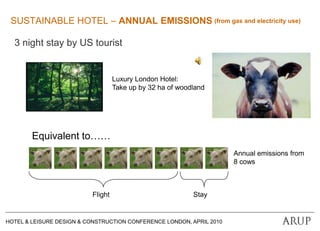
Sustainable hotel – annual emissions(from gas and electricity use)3 night stay by US touristLuxury London Hotel:         Take up by 32 ha of woodlandEquivalent to……Annual emissions from 8 cows FlightStay
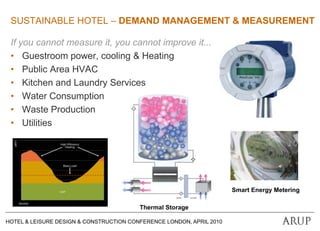
Sustainable hotel – Demand Management & MeasurementIf you cannot measure it, you cannot improve it...Guestroom power, cooling & HeatingPublic Area HVACKitchen and Laundry ServicesWater ConsumptionWaste ProductionUtilitiesSmart Energy MeteringThermal Storage
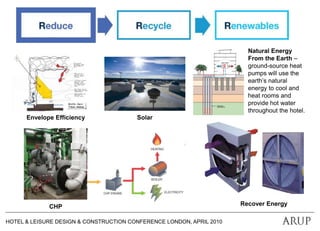
Natural Energy From the Earth – ground-source heat pumps will use the earth’s natural energy to cool and heat rooms and provide hot water throughout the hotel. Envelope EfficiencySolarRecover EnergyCHP
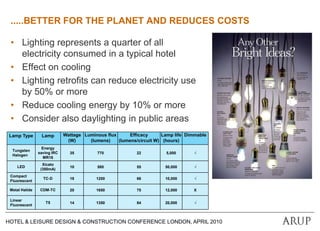
.....better for the Planet and Reduces costsLighting represents a quarter of all electricity consumed in a typical hotelEffect on coolingLighting retrofits can reduce electricity use by 50% or moreReduce cooling energy by 10% or moreConsider also daylighting in public areas

Gregoir Chikaher

  • 1.
    Adding Value toExisting Hotels Through SustainabilityGregoir Chikaher, Director of Global Hotels & Leisure
  • 2.
    Sustainable Hotel- KeyConsiderationsA building’s location affects commuting options, local ecosystems, building energy efficiency and much more. A properly designed and retrofitted envelope helps to maintain the desired indoor conditions and may permit the use of natural ventilation, passive heating, and daylighting.Materials selected for sustainable buildings should have appropriate performance, durability and environmental properties. Material selection can affect issues ranging from our planet’s resources to occupant comfort and health.Economic and Environmental indicators favour the lowest possible man-made changes to the natural hydrological-cycle.The functionality and energy consumption of a space is highly dependent on the lighting and daylighting design. A passive system uses the building characteristics to mitigate negative effects of the external environment or to enhance the internal environment. Efficient mechanical and electrical systems will add value, reduce energy consumption and operational costs and provide better comfort to guests. The resource use of a building is affected by the way in which it is used, operated and maintainedRenewables including solar, ground source heat pumps, PV cells and wind power are necessary to reduce Carbon emissions and for a better planet.
  • 3.
    Sustainable hotel –step by step approachAssess the condition and performance of the building Monitor and control the new performance to obtain the greatest advantage from the capexBenchmark them against industry best practiceStep by Step approachImplement the work, which may include staff training and measures to alter the behaviour of guests around water, energy and waste.Identify interventions which are aligned with the goals of the businessPackage the preferred interventions to suit commercial funding arrangements & OperationsEvaluate those in terms of capex, opex, carbon emissions and other indicators
  • 4.
    Step #1Determine yourbaseline and appropriate level of refurbishmentSurvival Strategy for Existing HotelsWhat is the baseline? FM AuditEnergy AuditWater AuditWaste AuditIndoor Environment AuditLevel of refurbishment
  • 5.
    Step #2 Review your building maintenance, housekeeping and energy purchasingSurvival Strategy for Existing HotelsDo you know what’s going on?
  • 6.
  • 7.
    Energy purchasingStep #3 Establish your goals and targetsSurvival Strategy for Existing HotelsWhat targets?More BusinessRating System (BREEAM, LEED,...)
  • 8.
    Step #4 Select your optimal upgrade initiativesMore Than 200 Initiatives to improve your hotel performanceSurvival Strategy for Existing Hotels
  • 9.
    Survival Strategy forExisting HotelsStep #5 Make Your Survival Strategy Happen
  • 10.
    Sustainable hotel -Typical life cycleAuditBenchmarkingDesignRefurbishmentConstructionOperationCommissioning
  • 11.
    Sustainable hotel -Energy hierarchyBuilding form and orientation
  • 12.
  • 13.
    Energy management& lighting controls
  • 14.
    Demand controlreduced air leakage
  • 15.
  • 16.
  • 17.
  • 18.
  • 19.
  • 20.
  • 21.
  • 22.
  • 23.
    Solar hotwater generators
  • 24.
    Wind Turbines– macro/micro
  • 25.
  • 26.
    Fuel CellsComplianceMinimumZeroCarbonKg Carbon saved Per £ spentLow Carbon Building
  • 27.
    Sustainable hotel –waste management hierarchyMostFavoured OptionLeastFavoured Option
  • 29.
    Sustainable hotel –typical luxury hotel Carbon Reduction Estimate23.5%8%5.5%4.5%4%1.5%Total carbonEmission reductionMechanicalplantElectrical systemsRenewableCHPGlazingimprovements
  • 30.
    3 night stayby US tourist1289Sustainable hotel – typical luxury hotel
  • 31.
    Sustainable hotel –annual emissions(from gas and electricity use)3 night stay by US touristLuxury London Hotel: Take up by 32 ha of woodlandEquivalent to……Annual emissions from 8 cows FlightStay
  • 32.
    Sustainable hotel –Demand Management & MeasurementIf you cannot measure it, you cannot improve it...Guestroom power, cooling & HeatingPublic Area HVACKitchen and Laundry ServicesWater ConsumptionWaste ProductionUtilitiesSmart Energy MeteringThermal Storage
  • 33.
    Natural Energy Fromthe Earth – ground-source heat pumps will use the earth’s natural energy to cool and heat rooms and provide hot water throughout the hotel. Envelope EfficiencySolarRecover EnergyCHP
  • 34.
    .....better for thePlanet and Reduces costsLighting represents a quarter of all electricity consumed in a typical hotelEffect on coolingLighting retrofits can reduce electricity use by 50% or moreReduce cooling energy by 10% or moreConsider also daylighting in public areas

Editor's Notes

  • #22 The embodied energy that went into the original construction make conversions inherently more sustainable than the equivalent built anewEvery building is a complex combination of many processed materials, each of which contributes to the building's total embodied energy. Renovation and maintenance also add to the embodied energy over a building's life.It was thought until recently that the embodied energy content of a building was small compared to the energy used in operating the building over its life. Most effort was therefore put into reducing operating energy by improving the energy efficiency of the building envelope. Research has shown that this is not always the case. Embodied energy can be the equivalent of many years of operational energy.The single most important factor in reducing the impact of embodied energy is to design long life, durable and adaptable buildings.
  • #34 OpenWays, the global provider of mobile-based access-management solutions for the security and hospitality industries, announces an application for smartphones (embedded or mobile web-based) that allows travellers to check-in remotely, bypass the front desk and open the door to their room by simply pressing a “key” icon on their mobile device. Those travelling with an phone, BlackBerry, NOKIA, Android-based or other Windows-based mobile cell phone can securely obtain an encrypted room key in "full data mode" -- as long as they are staying at a hotel that enables the OpenWays mobile key service. The OpenWays solution was introduced in November as a way to enable any of the 4 billion cell phones in the world to receive a dematerialized key via an encrypted acoustic tone to bypass the front desk and access door locks. This ubiquitous solution uses the principle of Crypto Acoustic Credential (CAC™) and text messaging (SMS) to very securely deliver a key to the right user anywhere in the world. The solution is compatible with the major electronic-locking systems and access-control systems. The acoustic key produced is unique, and thanks to OpenWays patents-pending solutions, a fraudulent recording of the key will be made inefficient to open a door.