REUSCITATION
EQUIPMENTS
PRESENTED BY
MS. KIRAN K. KARETHA
M.SC (N), MSN (CCN)
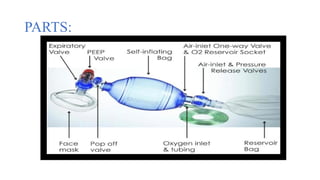
AMBU BAG
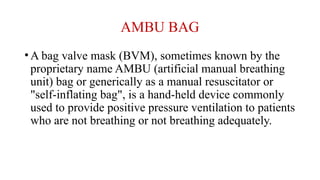
•A bag valve mask (BVM), sometimes known by the
proprietary name AMBU (artificial manual breathing
unit) bag or generically as a manual resuscitator or
"self-inflating bag", is a hand-held device commonly
used to provide positive pressure ventilation to patients
who are not breathing or not breathing adequately.
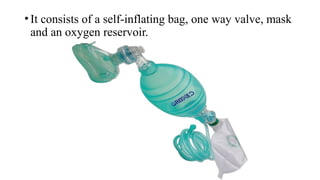
•It consists of a self-inflating bag, one way valve, mask
and an oxygen reservoir.
INDICATION:
•Respiratory failure
•Respiratory arrest
•In case of ventricular failure
•Transfer of critical patients between wards
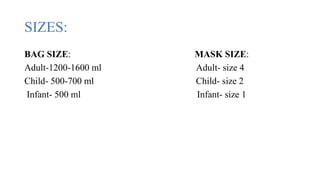
SIZES:
BAG SIZE: MASK SIZE:
Adult-1200-1600 ml Adult- size 4
Child- 500-700 ml Child- size 2
Infant- 500 ml Infant- size 1
PARTS:
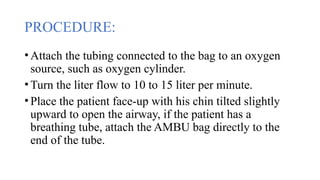
PROCEDURE:
•Attach the tubing connected to the bag to an oxygen
source, such as oxygen cylinder.
•Turn the liter flow to 10 to 15 liter per minute.
•Place the patient face-up with his chin tilted slightly
upward to open the airway, if the patient has a
breathing tube, attach the AMBU bag directly to the
end of the tube.
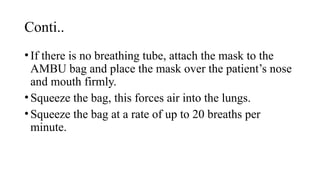
Conti..
•If there is no breathing tube, attach the mask to the
AMBU bag and place the mask over the patient’s nose
and mouth firmly.
•Squeeze the bag, this forces air into the lungs.
•Squeeze the bag at a rate of up to 20 breaths per
minute.
•If there is no breathing tube, attach the mask to the
AMBU bag and place the mask over the patient’s nose
and mouth firmly and squeeze the bag.
•This forces air into the lungs.
•Squeeze the bag at a rate up to 20 breaths a minute.
INDICATIONS
•An AMBU bag is needed when a person goes into
respiratory failure, which means he stops breathing.
• this can occur for a variety of reasons, such as drug
overdose, a severe asthma attack, a head injury or near
drowning.
•If patient is initiating a breath on his own, but
breathing is labored or shallow, an AMBU bag may be
used to make the breath more efficient.
CONTRAINDICATION:
•Upper airway obstruction
•Paralysis
RISKS
•Hyperventilation
•Abdominal distension
LARYNGOSCOPE
•A laryngoscopy is a test healthcare providers perform
to examine the larynx (voice box). They perform this
test with a laryngoscope, a thin tube with lights, that
help them to look closely at the larynx.
•Spanish singing teacher manual Garcia invented the
laryngoscope in 1855.
FEATURES
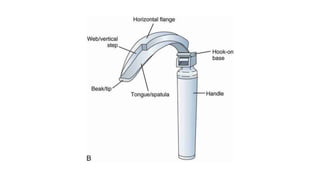
•A laryngoscope has a handle and a smooth, lighted
tube, also called a blade.
•The handle contains a battery pack that supplies power
to a light source inside the blade, which can be straight
or curved and rigid.
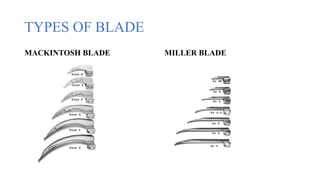
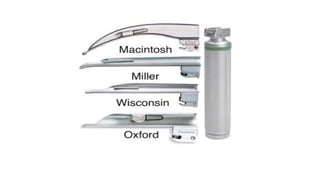
TYPES OF BLADE
MACKINTOSH BLADE MILLER BLADE
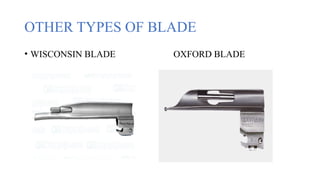
OTHER TYPES OF BLADE
• WISCONSIN BLADE OXFORD BLADE
FUNCTIONS
•To examine the larynx
•To help in insertion of endotracheal tube
TRACHEOSTOMY TUBE
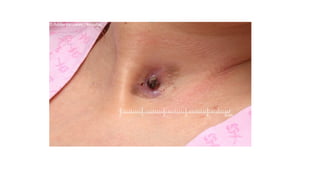
•A tracheostomy tube, also known as a trach tube, is a
catheter that's inserted into the trachea (windpipe) to
help a person breathe and exchange oxygen and carbon
dioxide.
•It's used after a tracheostomy, a surgical procedure that
creates an opening in the neck into the trachea.
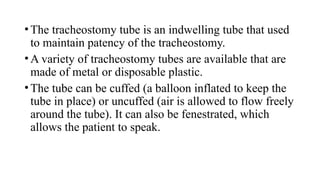
•The tracheostomy tube is an indwelling tube that used
to maintain patency of the tracheostomy.
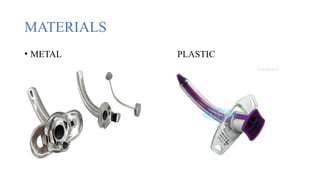
•A variety of tracheostomy tubes are available that are
made of metal or disposable plastic.
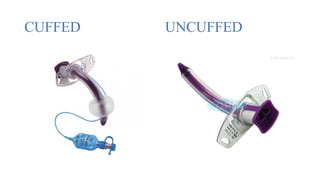
•The tube can be cuffed (a balloon inflated to keep the
tube in place) or uncuffed (air is allowed to flow freely
around the tube). It can also be fenestrated, which
allows the patient to speak.
MATERIALS
• METAL PLASTIC
CUFFED UNCUFFED
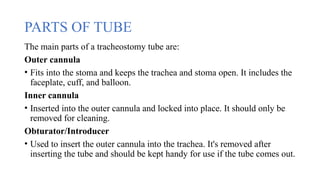
PARTS OF TUBE
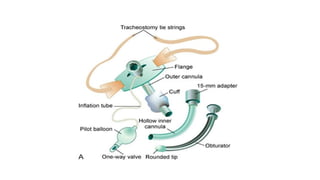
The main parts of a tracheostomy tube are:
Outer cannula
• Fits into the stoma and keeps the trachea and stoma open. It includes the
faceplate, cuff, and balloon.
Inner cannula
• Inserted into the outer cannula and locked into place. It should only be
removed for cleaning.
Obturator/Introducer
• Used to insert the outer cannula into the trachea. It's removed after
inserting the tube and should be kept handy for use if the tube comes out.
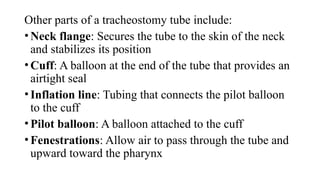
Other parts of a tracheostomy tube include:
•Neck flange: Secures the tube to the skin of the neck
and stabilizes its position
•Cuff: A balloon at the end of the tube that provides an
airtight seal
•Inflation line: Tubing that connects the pilot balloon
to the cuff
•Pilot balloon: A balloon attached to the cuff
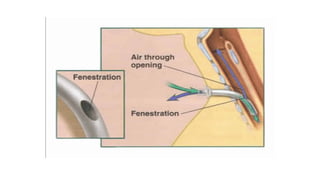
•Fenestrations: Allow air to pass through the tube and
upward toward the pharynx
USES
Blocked airway
•When the airway is blocked by blood or swelling, a
tracheostomy tube can be used to bypass the blockage.
Long-term ventilator use
•When a patient needs to use a ventilator to breathe
long-term, a tracheostomy tube can be used to deliver
oxygen to the lungs.
Conti..
Surgery
•When surgery requires rerouting breathing due to
swelling or blockage in the neck or face, a tracheostomy
tube can be used.
Emergency
•In an emergency, such as after a major injury to the
neck or face, a tracheostomy tube can be used to
immediately open the airway.
COMPLICATIONS
• Bleeding: Bleeding in or around the tracheostomy can occur.
• Air trapped in the chest: Air can become trapped in the
lungs (pneumothorax), between the lungs and chest wall
(pneumomediastinum), or under the skin around the
tracheostomy (subcutaneous emphysema). Pneumothorax
can cause pain, difficulty breathing, or a collapsed lung.
• Damage to the windpipe or surrounding area: The
windpipe, thyroid gland, or nerves in the neck can be
damaged.
Conti..
•Tracheostomy tube blockage: The tube can become
blocked by blood clots, mucus, or pressure from the
airway walls.
•Tube movement: The tube can move out of place.
•Failure to close after removal: The opening may not
close properly after the tube is removed.
•Deep tissue infections: Severe cases can lead to deep
tissue infections or cellulitis.
ENDOTRACHEAL TUBE
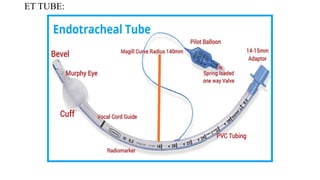
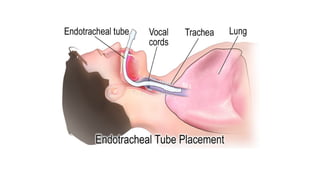
•An endotracheal tube (ETT) is a flexible tube that is
inserted into the trachea (windpipe) through mouth to
help with breathing.
ET TUBE:
ENDOTRACHEAL TUBE SIZES
•The size of an ETT signifies the inner diameter of its
lumen in millimeters.
•Available sizes range from 2.0 to 12.0 mm in 0.5 mm
increments.
•For oral intubations, a 7.0-7.5 ETT is generally
appropriate for an average woman and a 7.5-8.5 ETT
for an average man.
USES
• Surgery: When a patient is under general anesthesia, the lungs
are paralyzed. Intubation allows the tube to be connected to a
mechanical ventilator to assist with breathing.
• Breathing support: An endotracheal tube can support breathing
in patient with severe pneumonia, a head injury, collapsed lung,
respiratory failure, congestive heart failure,
acute respiratory distress syndrome (ARDS), or other conditions
that affect breathing.
Conti..
•Foreign object obstruction: Endotracheal intubation
can help remove a foreign object lodged in the airway.
•Airway protection: An endotracheal tube can prevent
the contents of the stomach from getting into the lungs
during a massive gastrointestinal bleed
ENDOTRACHEAL INTUBATION
•Endotracheal intubation is a medical procedure that
involves inserting a tube into the windpipe (trachea) to
help with breathing.
•It's often performed in a hospital during an emergency
or before surgery.
BEFORE INTUBATION
• Oxygen may be given to increase blood saturation levels.
This ensures there is enough oxygen should the placement
take longer than expected.
• Once the person is unconscious, an oral device may be
inserted in the mouth to keep the tongue out of the way so the
tube can be placed more easily.
• If a procedure is done while a person is awake, an antiemetic
drug may be given to prevent nausea and vomiting.
• An oral anesthetic can help numb the gag reflex.
INTUBATION
•A lighted scope is inserted into the mouth to view the
back of the throat.
•While holding the jaw open, the practitioner will
thread the tube into the throat past the larynx (voice
box) and into the lower trachea.
•The practitioner will check that the tube is properly
placed by first listening to lung and abdominal sounds.
Conti..
•A mobile chest X-ray can help confirm the placement.
• The balloon cuff is inflated to keep the tube from
moving out of place.
•The external part of the tube is taped to the person's
face to avoid slipping.
ENDOTRACHEAL EXTUBATION
•Before removing the tube (extubation) and
disconnecting it from the ventilator, the healthcare
provider will assess whether the person is able to
breathe on their own.
•To be safe, people are generally weaned off ventilation
slowly and continually monitored to ensure that
everything is OK.
Conti..
•Nurses will check their respiratory rate,
level of consciousness, oxygen saturation levels (as
measured by a pulse oximeter), and
arterial blood gasses (ABGs).
•If indications are good, the tape holding the tube on
the face is removed. The balloon cuff is then deflated,
and the tube is firmly and steadily pulled out. The
removal may feel odd, but it is usually not painful.
COMPLICATIONS
•Tracheal bleeding
•Dental injuries
•Oral infections or mouth sores
•Sinusitis (sinus infection)
•Vocal cord injury, sometimes permanent
•Pneumonia
OXYGEN DELIVERY DEVICES
•Oxygen can be administered by nasal cannula, mask
and tent.
•Hyperbaric oxygen therapy involves placing the
patient in an airtight chamber with oxygen under
pressure.
•In the hospital oxygen is supplied to each patient via
an outlet in the wall.
Conti..
•Oxygen is delivered from a central source through a
pipeline in the facility.
•A flow meter attached to the wall outlet accesses the
oxygen.
•A valve regulates the oxygen flow, an attachments may
be connected to provide moisture.
1. LOW-FLOW DEVICES
NASAL CANNULA:
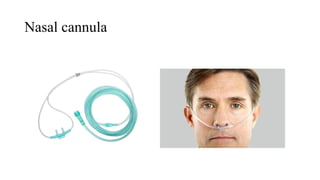
•the nasal cannula is the most common method of
oxygen administration.
•Oxygen is delivered through a flexible catheter that
has two short nasal prongs.
•For the nasal cannula to be most effective, the patient
must breathe through his or her nose.
Nasal cannula
Conti..
•The cannula allows the patient to eat and talk, and it is
generally more comfortable than other methods of
administration.
•Oxygen can be delivered at 1 to 6 lit/min via a nasal
cannula.
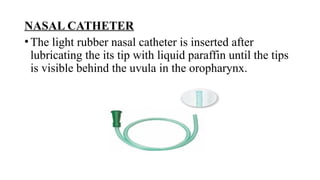
NASAL CATHETER
•The light rubber nasal catheter is inserted after
lubricating the its tip with liquid paraffin until the tips
is visible behind the uvula in the oropharynx.
MASKS:
•Masks are used when a higher oxygen concentration is
needed.
•A disadvantage to masks is that they make some
patient feel claustrophobic. Also, a mask must be
replaced by a cannula for eating.
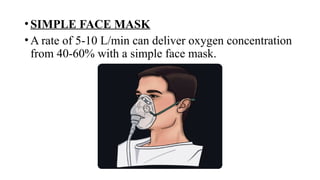
•SIMPLE FACE MASK
•A rate of 5-10 L/min can deliver oxygen concentration
from 40-60% with a simple face mask.
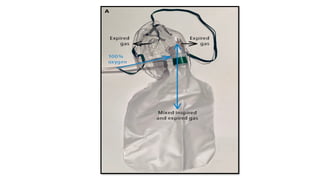
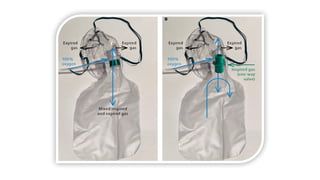
•PARTIAL REBREATHER MASK
•A partial rebreather mask uses a reservoir to capture
some exhaled gas for rebreathing.
•Vents on the sides of the mask allow room air to mix
with oxygen.
•It can deliver oxygen concentration of 50% or greater.
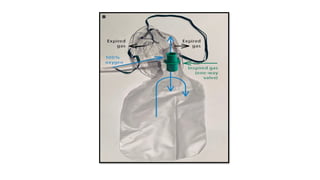
•NON-REBREATHER MASK
• A non rebreather mask has one or both side vents
closed to limit the mixing of room air with oxygen
•The vents open to allow expiration but remain closed
on inspiration.
•The reservoir bag has a valve to store oxygen for
inspiration but does not allow entry of exhaled air.
•It is used to deliver oxygen concentration of 70% to
100%.
2. HIGH FLOW DEVICE
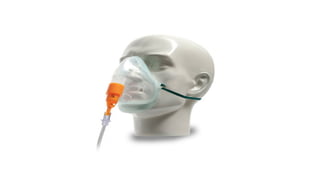
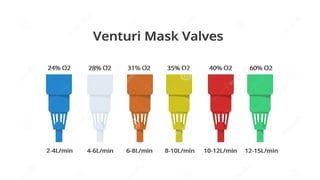
•VENTURI MASK
• A venturi mask is used for the patient who requires
precise percentage of oxygen, such as the patient with
chronic lung diseases with CO2 retention.
•A combination of valves and specific flow rates
determines oxygen concentration.
Conti..
•It fits lightly over the nose and mouth.
•Oxygen flowing at a high velocity in the form of a jet
through a narrow orifice to the base of the mask
creates negative pressure, entraining atmospheric air
through the perforation in the face piece.
THANK YOU

RESUSCITATION EQUIPMENT.pptx FOR NURSING STUDENTS

  • 1.
    REUSCITATION EQUIPMENTS PRESENTED BY MS. KIRANK. KARETHA M.SC (N), MSN (CCN)
  • 2.
    AMBU BAG •A bagvalve mask (BVM), sometimes known by the proprietary name AMBU (artificial manual breathing unit) bag or generically as a manual resuscitator or "self-inflating bag", is a hand-held device commonly used to provide positive pressure ventilation to patients who are not breathing or not breathing adequately.
  • 3.
    •It consists ofa self-inflating bag, one way valve, mask and an oxygen reservoir.
  • 4.
    INDICATION: •Respiratory failure •Respiratory arrest •Incase of ventricular failure •Transfer of critical patients between wards
  • 5.
    SIZES: BAG SIZE: MASKSIZE: Adult-1200-1600 ml Adult- size 4 Child- 500-700 ml Child- size 2 Infant- 500 ml Infant- size 1
  • 6.
  • 7.
    PROCEDURE: •Attach the tubingconnected to the bag to an oxygen source, such as oxygen cylinder. •Turn the liter flow to 10 to 15 liter per minute. •Place the patient face-up with his chin tilted slightly upward to open the airway, if the patient has a breathing tube, attach the AMBU bag directly to the end of the tube.
  • 8.
    Conti.. •If there isno breathing tube, attach the mask to the AMBU bag and place the mask over the patient’s nose and mouth firmly. •Squeeze the bag, this forces air into the lungs. •Squeeze the bag at a rate of up to 20 breaths per minute.
  • 9.
    •If there isno breathing tube, attach the mask to the AMBU bag and place the mask over the patient’s nose and mouth firmly and squeeze the bag. •This forces air into the lungs. •Squeeze the bag at a rate up to 20 breaths a minute.
  • 10.
    INDICATIONS •An AMBU bagis needed when a person goes into respiratory failure, which means he stops breathing. • this can occur for a variety of reasons, such as drug overdose, a severe asthma attack, a head injury or near drowning. •If patient is initiating a breath on his own, but breathing is labored or shallow, an AMBU bag may be used to make the breath more efficient.
  • 11.
  • 12.
  • 13.
    LARYNGOSCOPE •A laryngoscopy isa test healthcare providers perform to examine the larynx (voice box). They perform this test with a laryngoscope, a thin tube with lights, that help them to look closely at the larynx. •Spanish singing teacher manual Garcia invented the laryngoscope in 1855.
  • 14.
    FEATURES •A laryngoscope hasa handle and a smooth, lighted tube, also called a blade. •The handle contains a battery pack that supplies power to a light source inside the blade, which can be straight or curved and rigid.
  • 16.
    TYPES OF BLADE MACKINTOSHBLADE MILLER BLADE
  • 17.
    OTHER TYPES OFBLADE • WISCONSIN BLADE OXFORD BLADE
  • 19.
    FUNCTIONS •To examine thelarynx •To help in insertion of endotracheal tube
  • 20.
    TRACHEOSTOMY TUBE •A tracheostomytube, also known as a trach tube, is a catheter that's inserted into the trachea (windpipe) to help a person breathe and exchange oxygen and carbon dioxide. •It's used after a tracheostomy, a surgical procedure that creates an opening in the neck into the trachea.
  • 21.
    •The tracheostomy tubeis an indwelling tube that used to maintain patency of the tracheostomy. •A variety of tracheostomy tubes are available that are made of metal or disposable plastic. •The tube can be cuffed (a balloon inflated to keep the tube in place) or uncuffed (air is allowed to flow freely around the tube). It can also be fenestrated, which allows the patient to speak.
  • 22.
  • 23.
  • 24.
    PARTS OF TUBE Themain parts of a tracheostomy tube are: Outer cannula • Fits into the stoma and keeps the trachea and stoma open. It includes the faceplate, cuff, and balloon. Inner cannula • Inserted into the outer cannula and locked into place. It should only be removed for cleaning. Obturator/Introducer • Used to insert the outer cannula into the trachea. It's removed after inserting the tube and should be kept handy for use if the tube comes out.
  • 25.
    Other parts ofa tracheostomy tube include: •Neck flange: Secures the tube to the skin of the neck and stabilizes its position •Cuff: A balloon at the end of the tube that provides an airtight seal •Inflation line: Tubing that connects the pilot balloon to the cuff •Pilot balloon: A balloon attached to the cuff •Fenestrations: Allow air to pass through the tube and upward toward the pharynx
  • 28.
    USES Blocked airway •When theairway is blocked by blood or swelling, a tracheostomy tube can be used to bypass the blockage. Long-term ventilator use •When a patient needs to use a ventilator to breathe long-term, a tracheostomy tube can be used to deliver oxygen to the lungs.
  • 29.
    Conti.. Surgery •When surgery requiresrerouting breathing due to swelling or blockage in the neck or face, a tracheostomy tube can be used. Emergency •In an emergency, such as after a major injury to the neck or face, a tracheostomy tube can be used to immediately open the airway.
  • 30.
    COMPLICATIONS • Bleeding: Bleedingin or around the tracheostomy can occur. • Air trapped in the chest: Air can become trapped in the lungs (pneumothorax), between the lungs and chest wall (pneumomediastinum), or under the skin around the tracheostomy (subcutaneous emphysema). Pneumothorax can cause pain, difficulty breathing, or a collapsed lung. • Damage to the windpipe or surrounding area: The windpipe, thyroid gland, or nerves in the neck can be damaged.
  • 31.
    Conti.. •Tracheostomy tube blockage:The tube can become blocked by blood clots, mucus, or pressure from the airway walls. •Tube movement: The tube can move out of place. •Failure to close after removal: The opening may not close properly after the tube is removed. •Deep tissue infections: Severe cases can lead to deep tissue infections or cellulitis.
  • 33.
    ENDOTRACHEAL TUBE •An endotrachealtube (ETT) is a flexible tube that is inserted into the trachea (windpipe) through mouth to help with breathing.
  • 34.
  • 35.
    ENDOTRACHEAL TUBE SIZES •Thesize of an ETT signifies the inner diameter of its lumen in millimeters. •Available sizes range from 2.0 to 12.0 mm in 0.5 mm increments. •For oral intubations, a 7.0-7.5 ETT is generally appropriate for an average woman and a 7.5-8.5 ETT for an average man.
  • 36.
    USES • Surgery: Whena patient is under general anesthesia, the lungs are paralyzed. Intubation allows the tube to be connected to a mechanical ventilator to assist with breathing. • Breathing support: An endotracheal tube can support breathing in patient with severe pneumonia, a head injury, collapsed lung, respiratory failure, congestive heart failure, acute respiratory distress syndrome (ARDS), or other conditions that affect breathing.
  • 37.
    Conti.. •Foreign object obstruction:Endotracheal intubation can help remove a foreign object lodged in the airway. •Airway protection: An endotracheal tube can prevent the contents of the stomach from getting into the lungs during a massive gastrointestinal bleed
  • 38.
    ENDOTRACHEAL INTUBATION •Endotracheal intubationis a medical procedure that involves inserting a tube into the windpipe (trachea) to help with breathing. •It's often performed in a hospital during an emergency or before surgery.
  • 39.
    BEFORE INTUBATION • Oxygenmay be given to increase blood saturation levels. This ensures there is enough oxygen should the placement take longer than expected. • Once the person is unconscious, an oral device may be inserted in the mouth to keep the tongue out of the way so the tube can be placed more easily. • If a procedure is done while a person is awake, an antiemetic drug may be given to prevent nausea and vomiting. • An oral anesthetic can help numb the gag reflex.
  • 40.
    INTUBATION •A lighted scopeis inserted into the mouth to view the back of the throat. •While holding the jaw open, the practitioner will thread the tube into the throat past the larynx (voice box) and into the lower trachea. •The practitioner will check that the tube is properly placed by first listening to lung and abdominal sounds.
  • 42.
    Conti.. •A mobile chestX-ray can help confirm the placement. • The balloon cuff is inflated to keep the tube from moving out of place. •The external part of the tube is taped to the person's face to avoid slipping.
  • 43.
    ENDOTRACHEAL EXTUBATION •Before removingthe tube (extubation) and disconnecting it from the ventilator, the healthcare provider will assess whether the person is able to breathe on their own. •To be safe, people are generally weaned off ventilation slowly and continually monitored to ensure that everything is OK.
  • 44.
    Conti.. •Nurses will checktheir respiratory rate, level of consciousness, oxygen saturation levels (as measured by a pulse oximeter), and arterial blood gasses (ABGs). •If indications are good, the tape holding the tube on the face is removed. The balloon cuff is then deflated, and the tube is firmly and steadily pulled out. The removal may feel odd, but it is usually not painful.
  • 45.
    COMPLICATIONS •Tracheal bleeding •Dental injuries •Oralinfections or mouth sores •Sinusitis (sinus infection) •Vocal cord injury, sometimes permanent •Pneumonia
  • 46.
    OXYGEN DELIVERY DEVICES •Oxygencan be administered by nasal cannula, mask and tent. •Hyperbaric oxygen therapy involves placing the patient in an airtight chamber with oxygen under pressure. •In the hospital oxygen is supplied to each patient via an outlet in the wall.
  • 47.
    Conti.. •Oxygen is deliveredfrom a central source through a pipeline in the facility. •A flow meter attached to the wall outlet accesses the oxygen. •A valve regulates the oxygen flow, an attachments may be connected to provide moisture.
  • 48.
    1. LOW-FLOW DEVICES NASALCANNULA: •the nasal cannula is the most common method of oxygen administration. •Oxygen is delivered through a flexible catheter that has two short nasal prongs. •For the nasal cannula to be most effective, the patient must breathe through his or her nose.
  • 49.
  • 50.
    Conti.. •The cannula allowsthe patient to eat and talk, and it is generally more comfortable than other methods of administration. •Oxygen can be delivered at 1 to 6 lit/min via a nasal cannula.
  • 51.
    NASAL CATHETER •The lightrubber nasal catheter is inserted after lubricating the its tip with liquid paraffin until the tips is visible behind the uvula in the oropharynx.
  • 52.
    MASKS: •Masks are usedwhen a higher oxygen concentration is needed. •A disadvantage to masks is that they make some patient feel claustrophobic. Also, a mask must be replaced by a cannula for eating.
  • 53.
    •SIMPLE FACE MASK •Arate of 5-10 L/min can deliver oxygen concentration from 40-60% with a simple face mask.
  • 54.
    •PARTIAL REBREATHER MASK •Apartial rebreather mask uses a reservoir to capture some exhaled gas for rebreathing. •Vents on the sides of the mask allow room air to mix with oxygen. •It can deliver oxygen concentration of 50% or greater.
  • 56.
    •NON-REBREATHER MASK • Anon rebreather mask has one or both side vents closed to limit the mixing of room air with oxygen •The vents open to allow expiration but remain closed on inspiration. •The reservoir bag has a valve to store oxygen for inspiration but does not allow entry of exhaled air. •It is used to deliver oxygen concentration of 70% to 100%.
  • 59.
    2. HIGH FLOWDEVICE •VENTURI MASK • A venturi mask is used for the patient who requires precise percentage of oxygen, such as the patient with chronic lung diseases with CO2 retention. •A combination of valves and specific flow rates determines oxygen concentration.
  • 60.
    Conti.. •It fits lightlyover the nose and mouth. •Oxygen flowing at a high velocity in the form of a jet through a narrow orifice to the base of the mask creates negative pressure, entraining atmospheric air through the perforation in the face piece.
  • 63.