Sporulation of Bacteria
Dr Akanksha Jain
Bacteria produce several types of spores called gonidia,
sporangiospores, arthrospores (oidia), conidia, cysts
and endospores.
They are highly thick-walled and resistant spores which
are formed in response to adverse environment,
presence of harmful waste products or ageing of
bacterial colony.
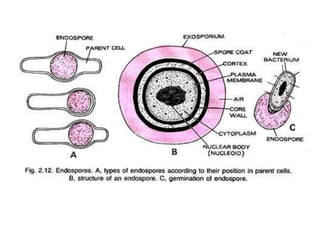
A part of protoplast of the bacterial cell
containing the nuclear body or nucleoid stores
food undergoes dehydration and separates from
the rest by means of mesosome and in growth
of plasma membrane.
It is called endospore primordium. The
primordium secretes a wall around it. More
wall materials are deposited over it by the
surrounding cytoplasm to form the endospore.
The residual cytoplasm and wall of parent
bacterium undergo autolysis.
The liberated endospore is dispersed by air currents
and on germination forms a new bacterium.
Endospores can easily tolerate a temperature of ±
100°C. Toxic chemicals have no effect on them.
The resistant nature of endospores is due to their
thick wall, low water content and the presence of an
anticoagulant chemical known as dipicolinic acid.
Fortunately, only two pathogenic bacteria
Clostridium tetani and Bacillus anthracis produce
endospores.

Endospore

  • 1.
  • 2.
    Bacteria produce severaltypes of spores called gonidia, sporangiospores, arthrospores (oidia), conidia, cysts and endospores. They are highly thick-walled and resistant spores which are formed in response to adverse environment, presence of harmful waste products or ageing of bacterial colony.
  • 4.
    A part ofprotoplast of the bacterial cell containing the nuclear body or nucleoid stores food undergoes dehydration and separates from the rest by means of mesosome and in growth of plasma membrane. It is called endospore primordium. The primordium secretes a wall around it. More wall materials are deposited over it by the surrounding cytoplasm to form the endospore. The residual cytoplasm and wall of parent bacterium undergo autolysis.
  • 5.
    The liberated endosporeis dispersed by air currents and on germination forms a new bacterium. Endospores can easily tolerate a temperature of ± 100°C. Toxic chemicals have no effect on them. The resistant nature of endospores is due to their thick wall, low water content and the presence of an anticoagulant chemical known as dipicolinic acid. Fortunately, only two pathogenic bacteria Clostridium tetani and Bacillus anthracis produce endospores.