Endocrinology
(Pituitary Gland)
By
Mujahid Hussain
Endocrine System
The endocrine system controls body activities by releasing mediator molecules
called Hormones. Hormones released into the bloodstream travel
throughout the body and their results may take hours, but last longer.
Exocrine Glands
– secrete products into ducts which empty into body cavities or body
surface
– sweat, oil, mucous, & digestive glands
Endocrine Glands
– secrete products (hormones) into bloodstream
• pituitary, thyroid, parathyroid, adrenal, pineal
– other organs secrete hormones as a second function
• hypothalamus, thymus, pancreas, ovaries, testes, kidneys, stomach, liver, small
intestine, skin, heart & placenta
Pituitary Gland
Introduction
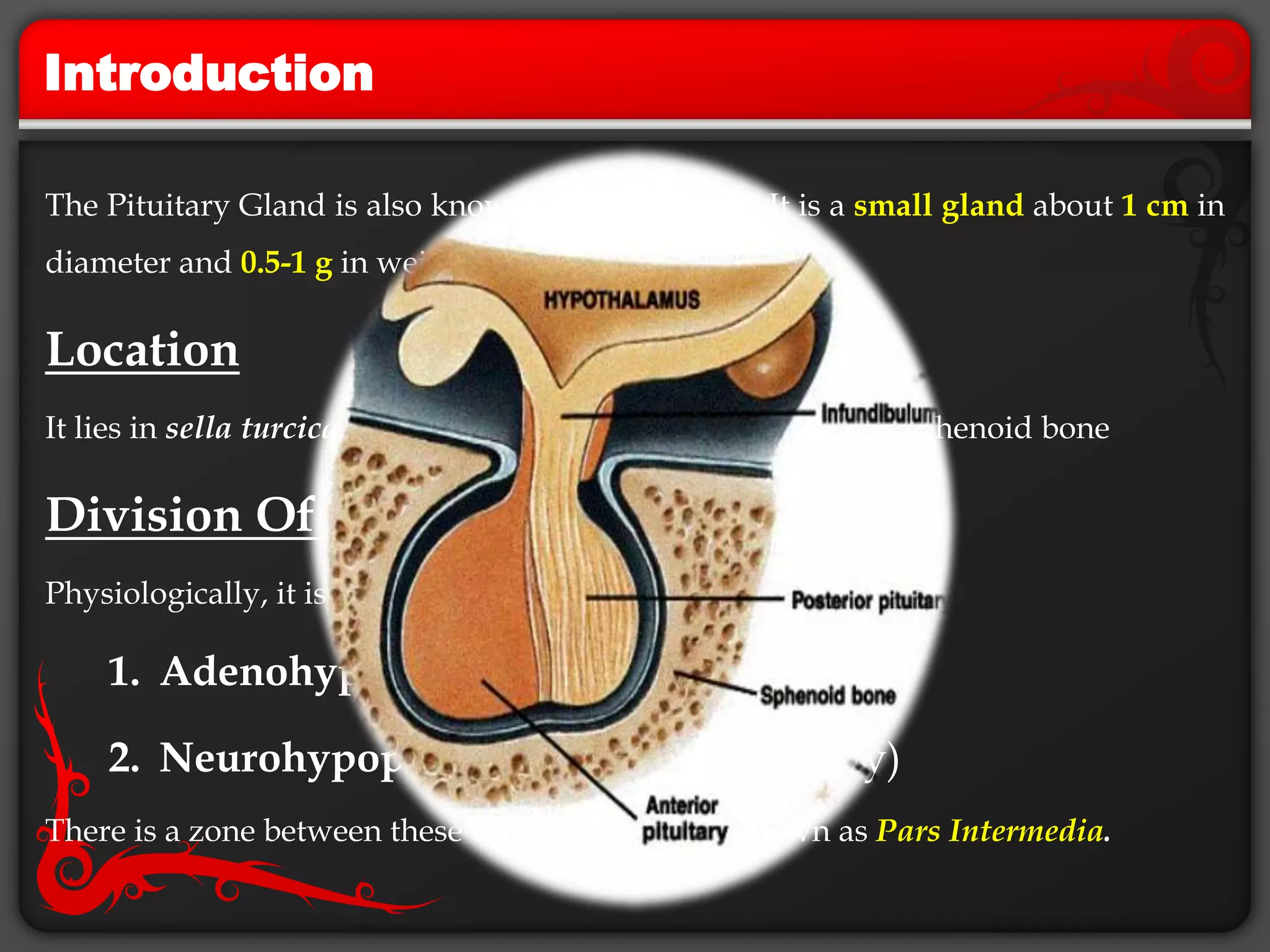
The Pituitary Gland is also known as Hypophysis. It is a small gland about 1 cm in
diameter and 0.5-1 g in weight.
Location
It lies in sella turcica (bony cavity at the base of the brain) of sphenoid bone
Division Of Hypophysis
Physiologically, it is divided into two lobes:
1. Adenohypophysis (anterior pituitary)
2. Neurohypophysis (posterior pituitary)
There is a zone between these divisions which is known as Pars Intermedia.
Origin
Embryologically, two portions of pituitary gland originate from different sources:
 Posterior pituitary is derived from the neural tissues:
 During the embryological development , from the hypothalamic portion
of diencephalon there is an evagination which goes downward and
posteriorly.
 Anterior pituitary is derived from the epithelial tissues:
 It is a derivative of “Rathke’s Pouch”. From the nasopharynx an
epithelial evagination develops in upward direction, eventually this
evagination comes very close to posterior pituitary.
Relationship b/w Hypothalamus & Pituitary Gland
The connection b/w hypothalamus and posterior pituitary is neural connection.
The connection b/w hypothalamus and anterior pituitary is vascular connection.
Hypothalamic Hypophysial Portal System
This system represents the connection between hypothalamus and anterior
pituitary. Hypothalamic arteries enter into hypothalamus and break up into
capillaries and fenestrated capillary network and this capillary network recollects
as long and short hypothalamic hypophysial portal vessels. These veins come down
to anterior pituitary through the pituitary stalk and again break up into another
capillary network which again recollects into general blood circulation.
Why it is called portal system ??? Because one group of arteries breakup into
capillaries which recollects into veins but these veins don’t drain into systemic
circulation, before going to systemic circulation these draining veins again breakup
into capillary network.
Importance of Hypothalamic Hypophysial Portal
System
 The cells of anterior pituitary are controlled by certain factors coming from the
hypothalamus.
 These hypothalamic factors are released by neurons which are a part of
hypothalamic nuclei. These certain factors are taken up by the primary capillary
network and carried through the vascular system into anterior pituitary, from
here these factors go out and influence the cells of anterior pituitary cells.
 There is a small amount of factors which are released by hypothalamic system
into primary capillary network of hypothalamus and these substances don’t get
diluted into systemic circulation rather through the portal they reached directly
into the anterior pituitary.
 If the veins drain directly into general circulation before going into the anterior
pituitary then these factors become very much diluted and they cannot influence
the anterior pituitary cells properly. By this system, hypothalamus controls the
anterior pituitary not through the neural connection but through the vascular
portal system.
Hypothalamus Controls Pituitary Secretions
Almost all secretions by the pituitary is controlled by either hormonal or nervous
signals from the hypothalamus.
 Secretion from the posterior pituitary is controlled by nerve signals that
originate in the hypothalamus and terminate in the posterior pituitary.
 In contrast, secretion by the anterior pituitary is controlled by hormones called
hypothalamic releasing and hypothalamic inhibitory hormones (factors)
secreted within the hypothalamus and reached to the anterior pituitary through
the hypothalamic hypophysial portal vessels.
 The hypothalamus receives signals from many sources in the nervous system.
The hypothalamus is a collecting center for information concerning the internal
well-being of the body, and much of this information is used to control
secretions of the pituitary hormones.
Posterior Pituitary Hormones
Posterior pituitary hormones are synthesized in some nuclei of hypothalamus while
the posterior pituitary gland only stores and release the hormones into the
systemic circulation.
There are two types of nuclei in the hypothalamus responsible for the synthesis of
posterior pituitary hormone:
A) Supraoptic Nucleus  ADH or Vasopressin
B) Paraventricle Nucleus  Oxytocin
90% of the supraoptic nucleus cell bodies produce ADH and 10% of the
paraventricle nucleus may produce oxytocin.
90% of the paraventricle nucleus cell bodies produce oxytocin and 10% of the
supraoptic nucleus may produce ADH.
Cont…
Anti-diuretic hormone (ADH) or Vasopressin
 It acts on smooth muscle cells around blood vessels to cause muscle contraction.
 It acts within the kidneys to decrease water excretion in the urine that’s why it is
also a anti-diuretic hormone because it retains the water from kidney in the
body.
Oxytocin
 It stimulates contraction of smooth muscle cells in breasts which results into milk
ejaculation.
 It stimulates contraction of uterine smooth muscles during labor.
Remember milk synthesis is under control of prolactin but milk ejection
is under control of oxytocin.
Anterior Pituitary Hormones
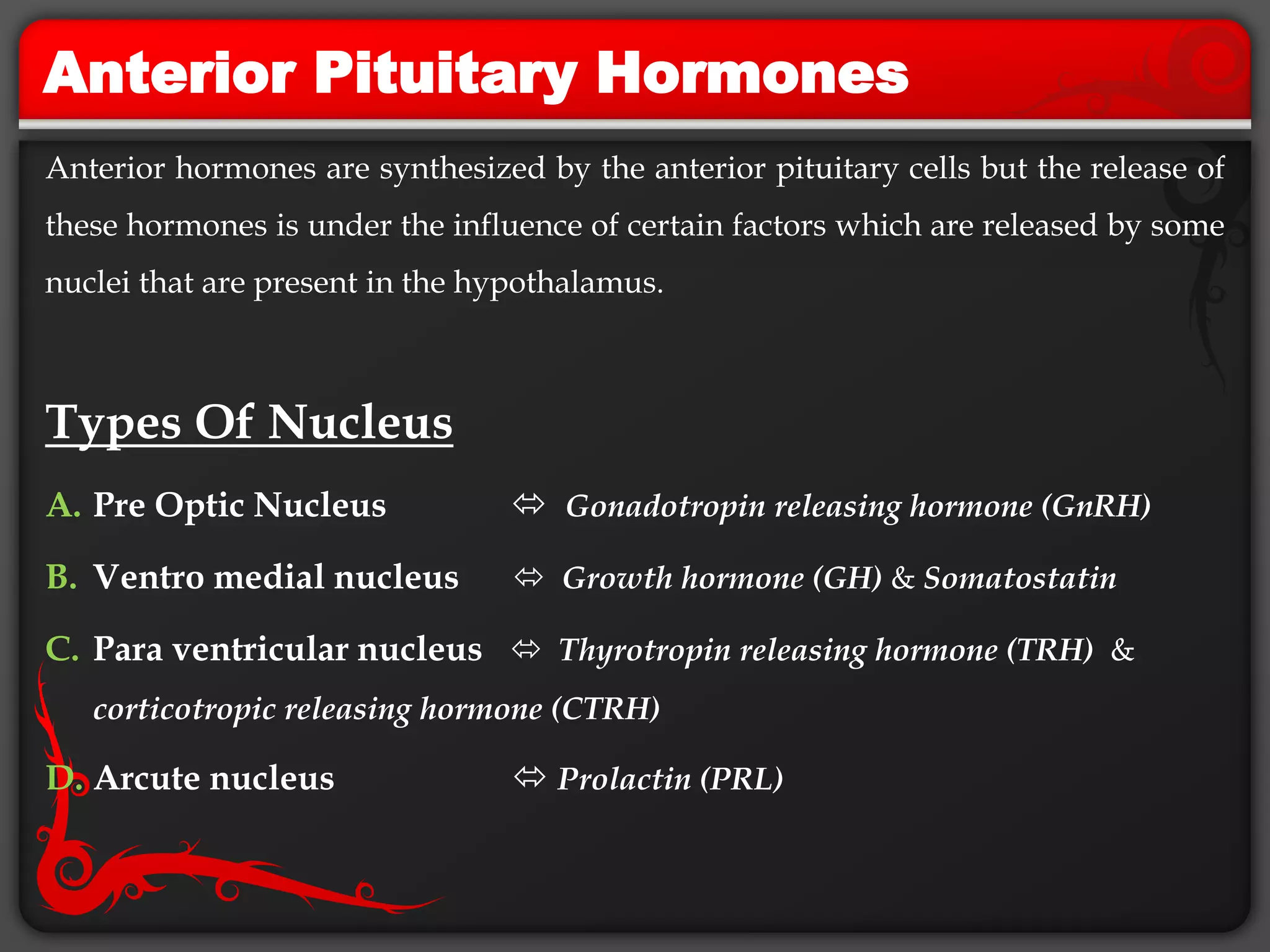
Anterior hormones are synthesized by the anterior pituitary cells but the release of
these hormones is under the influence of certain factors which are released by some
nuclei that are present in the hypothalamus.
Types Of Nucleus
A. Pre Optic Nucleus  Gonadotropin releasing hormone (GnRH)
B. Ventro medial nucleus  Growth hormone (GH) & Somatostatin
C. Para ventricular nucleus  Thyrotropin releasing hormone (TRH) &
corticotropic releasing hormone (CTRH)
D. Arcute nucleus  Prolactin (PRL)
Cont…
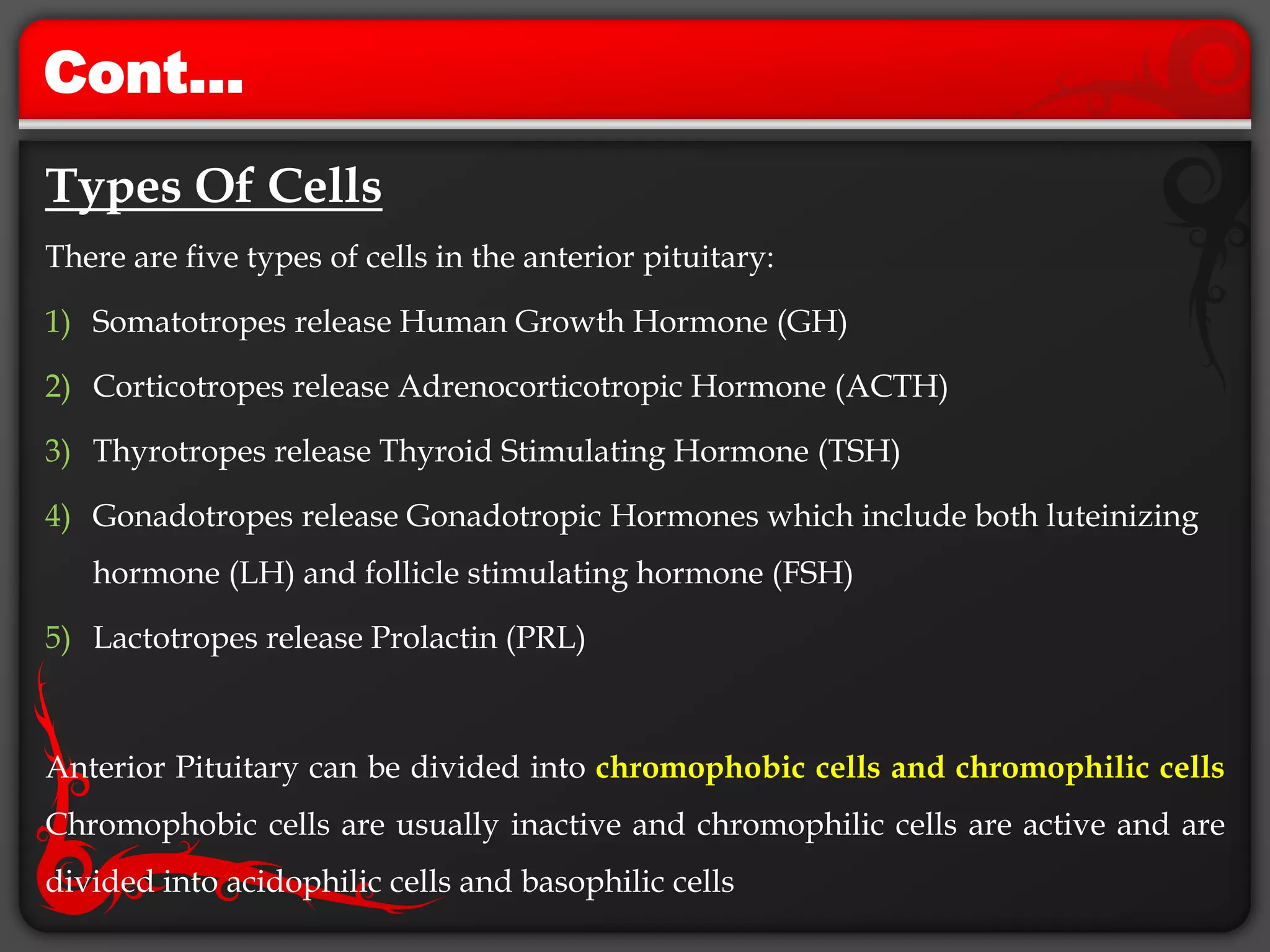
Types Of Cells
There are five types of cells in the anterior pituitary:
1) Somatotropes release Human Growth Hormone (GH)
2) Corticotropes release Adrenocorticotropic Hormone (ACTH)
3) Thyrotropes release Thyroid Stimulating Hormone (TSH)
4) Gonadotropes release Gonadotropic Hormones which include both luteinizing
hormone (LH) and follicle stimulating hormone (FSH)
5) Lactotropes release Prolactin (PRL)
Anterior Pituitary can be divided into chromophobic cells and chromophilic cells
Chromophobic cells are usually inactive and chromophilic cells are active and are
divided into acidophilic cells and basophilic cells

Endocrinology

  • 1.
  • 2.
    Endocrine System The endocrinesystem controls body activities by releasing mediator molecules called Hormones. Hormones released into the bloodstream travel throughout the body and their results may take hours, but last longer. Exocrine Glands – secrete products into ducts which empty into body cavities or body surface – sweat, oil, mucous, & digestive glands Endocrine Glands – secrete products (hormones) into bloodstream • pituitary, thyroid, parathyroid, adrenal, pineal – other organs secrete hormones as a second function • hypothalamus, thymus, pancreas, ovaries, testes, kidneys, stomach, liver, small intestine, skin, heart & placenta
  • 3.
  • 4.
    Introduction The Pituitary Glandis also known as Hypophysis. It is a small gland about 1 cm in diameter and 0.5-1 g in weight. Location It lies in sella turcica (bony cavity at the base of the brain) of sphenoid bone Division Of Hypophysis Physiologically, it is divided into two lobes: 1. Adenohypophysis (anterior pituitary) 2. Neurohypophysis (posterior pituitary) There is a zone between these divisions which is known as Pars Intermedia.
  • 5.
    Origin Embryologically, two portionsof pituitary gland originate from different sources:  Posterior pituitary is derived from the neural tissues:  During the embryological development , from the hypothalamic portion of diencephalon there is an evagination which goes downward and posteriorly.  Anterior pituitary is derived from the epithelial tissues:  It is a derivative of “Rathke’s Pouch”. From the nasopharynx an epithelial evagination develops in upward direction, eventually this evagination comes very close to posterior pituitary.
  • 6.
    Relationship b/w Hypothalamus& Pituitary Gland The connection b/w hypothalamus and posterior pituitary is neural connection. The connection b/w hypothalamus and anterior pituitary is vascular connection. Hypothalamic Hypophysial Portal System This system represents the connection between hypothalamus and anterior pituitary. Hypothalamic arteries enter into hypothalamus and break up into capillaries and fenestrated capillary network and this capillary network recollects as long and short hypothalamic hypophysial portal vessels. These veins come down to anterior pituitary through the pituitary stalk and again break up into another capillary network which again recollects into general blood circulation. Why it is called portal system ??? Because one group of arteries breakup into capillaries which recollects into veins but these veins don’t drain into systemic circulation, before going to systemic circulation these draining veins again breakup into capillary network.
  • 7.
    Importance of HypothalamicHypophysial Portal System  The cells of anterior pituitary are controlled by certain factors coming from the hypothalamus.  These hypothalamic factors are released by neurons which are a part of hypothalamic nuclei. These certain factors are taken up by the primary capillary network and carried through the vascular system into anterior pituitary, from here these factors go out and influence the cells of anterior pituitary cells.  There is a small amount of factors which are released by hypothalamic system into primary capillary network of hypothalamus and these substances don’t get diluted into systemic circulation rather through the portal they reached directly into the anterior pituitary.  If the veins drain directly into general circulation before going into the anterior pituitary then these factors become very much diluted and they cannot influence the anterior pituitary cells properly. By this system, hypothalamus controls the anterior pituitary not through the neural connection but through the vascular portal system.
  • 8.
    Hypothalamus Controls PituitarySecretions Almost all secretions by the pituitary is controlled by either hormonal or nervous signals from the hypothalamus.  Secretion from the posterior pituitary is controlled by nerve signals that originate in the hypothalamus and terminate in the posterior pituitary.  In contrast, secretion by the anterior pituitary is controlled by hormones called hypothalamic releasing and hypothalamic inhibitory hormones (factors) secreted within the hypothalamus and reached to the anterior pituitary through the hypothalamic hypophysial portal vessels.  The hypothalamus receives signals from many sources in the nervous system. The hypothalamus is a collecting center for information concerning the internal well-being of the body, and much of this information is used to control secretions of the pituitary hormones.
  • 9.
    Posterior Pituitary Hormones Posteriorpituitary hormones are synthesized in some nuclei of hypothalamus while the posterior pituitary gland only stores and release the hormones into the systemic circulation. There are two types of nuclei in the hypothalamus responsible for the synthesis of posterior pituitary hormone: A) Supraoptic Nucleus  ADH or Vasopressin B) Paraventricle Nucleus  Oxytocin 90% of the supraoptic nucleus cell bodies produce ADH and 10% of the paraventricle nucleus may produce oxytocin. 90% of the paraventricle nucleus cell bodies produce oxytocin and 10% of the supraoptic nucleus may produce ADH.
  • 10.
    Cont… Anti-diuretic hormone (ADH)or Vasopressin  It acts on smooth muscle cells around blood vessels to cause muscle contraction.  It acts within the kidneys to decrease water excretion in the urine that’s why it is also a anti-diuretic hormone because it retains the water from kidney in the body. Oxytocin  It stimulates contraction of smooth muscle cells in breasts which results into milk ejaculation.  It stimulates contraction of uterine smooth muscles during labor. Remember milk synthesis is under control of prolactin but milk ejection is under control of oxytocin.
  • 11.
    Anterior Pituitary Hormones Anteriorhormones are synthesized by the anterior pituitary cells but the release of these hormones is under the influence of certain factors which are released by some nuclei that are present in the hypothalamus. Types Of Nucleus A. Pre Optic Nucleus  Gonadotropin releasing hormone (GnRH) B. Ventro medial nucleus  Growth hormone (GH) & Somatostatin C. Para ventricular nucleus  Thyrotropin releasing hormone (TRH) & corticotropic releasing hormone (CTRH) D. Arcute nucleus  Prolactin (PRL)
  • 12.
    Cont… Types Of Cells Thereare five types of cells in the anterior pituitary: 1) Somatotropes release Human Growth Hormone (GH) 2) Corticotropes release Adrenocorticotropic Hormone (ACTH) 3) Thyrotropes release Thyroid Stimulating Hormone (TSH) 4) Gonadotropes release Gonadotropic Hormones which include both luteinizing hormone (LH) and follicle stimulating hormone (FSH) 5) Lactotropes release Prolactin (PRL) Anterior Pituitary can be divided into chromophobic cells and chromophilic cells Chromophobic cells are usually inactive and chromophilic cells are active and are divided into acidophilic cells and basophilic cells