Endocrine glands
Presented by Qasim Ali
Reg no; ZO120142031
BS 5th Zoology
Out line
• Definition
• Overview of the Endocrine System
• Endocrine Organs
• Pituitary Gland
• Pineal Gland
• Thyroid gland
• Parathyroid glands
• Pancreas
• Thymus
• Gonads
• Hypothalamus
• References
Endocrine glands
• Definition:
Endocrine glands are glands of
the endocrine system that secrete their
products, hormones, directly into the blood
rather than through a duct.
• The foundations of the endocrine system are
the hormones and glands.
Overview of the Endocrine System
• System of ductless glands that secrete
hormones
–Hormones are ā€œmessenger moleculesā€
–Circulate in the blood
–Act on distant target cells
–Target cells respond to the hormones for
which they have receptors
–The effects are dependent on the
programmed response of the target cells
–Hormones are just molecular triggers
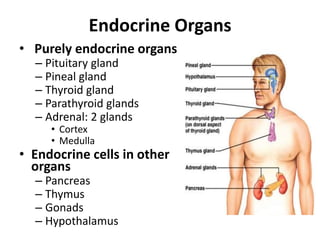
Endocrine Organs
• Purely endocrine organs
– Pituitary gland
– Pineal gland
– Thyroid gland
– Parathyroid glands
– Adrenal: 2 glands
• Cortex
• Medulla
• Endocrine cells in other
organs
– Pancreas
– Thymus
– Gonads
– Hypothalamus
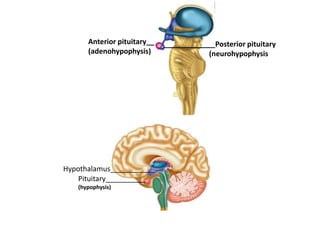
• Pituitary Gland
– A marble-sized gland at the base of the brain
– Controlled by the hypothalamus or other neural
mechanisms and therefore the middle man.
– Exercise appears to be a strong stimulant to the
hypothalamus for the release of all anterior
pituitary hormones
• Posterior Lobe:
Antidiuretic hormone(ADH): Stimulates
reabsorption of water from kidney tubules
Oxytocin: Stimulates utrine contraction and
Brest contraction for milk release.
• Anterior
 Prolactin(PRL)
Production of breast milk .
 Human Growth hormone (HGH)
Growth
Hypo- Dwarfism
Hyper- Gigantism
 Thyroid stimulating hormones (TSH)
Stimulates the thyroid to release thyroxin.
 Adrenocorticotrophic Hormones(ACTH)
Stimulates the adrenal cortex to produce:
Corticosteroids:
mineral corticoids,cortisol ,glucocorticoids,androgens.
Luteinizing hormone (LH)
Brings about ovulation and maintains the
corpus luteum.
Follicle-stimulating hormone (FSH)
Stimulates follicle growth and ovarian
estrogen production; stimulates sperm
production and androgen-binding protein.
Gonadotrophin
Secondary sexual characteristics
Interstitial Cell Stimulating hormones(ICSH)
Works on the somniferous tubules in the testes –
to produce sperm – which take 21 days to
mature.
Hypothalamus___________
Pituitary__________
(hypophysis)
Anterior pituitary__
(adenohypophysis)
_____________Posterior pituitary
(neurohypophysis
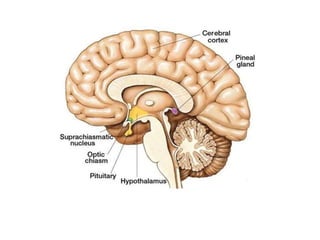
• Pineal Gland
A pea-sized mass of nerve tissue attached by a
stalk to the posterior wall of the third ventricle
of the brain, deep between the cerebral
hemispheres at the back of the skull.
 Melatonin
A hormone produced by the pineal gland in
darkness but not in bright light.
o Informing the brain about night and day,
o Also regulate the sleep cycle.
• Thyroid Gland
The thyroid gland is a very vascular organ
that is located in the neck. It consists of two
lobes, one on each side of the trachea, just
below the larynx or voice box.
– Secretes two hormones
Triiodothyronine (T3)
Thyroxin (T4)
• Regulates metabolism
• increases protein synthesis
• promotes glycolysis, gluconeogenesis, glucose
uptake
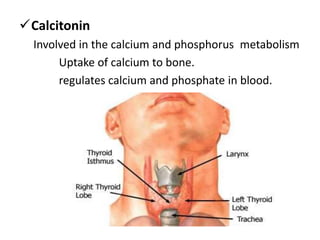
Calcitonin
Involved in the calcium and phosphorus metabolism
Uptake of calcium to bone.
regulates calcium and phosphate in blood.
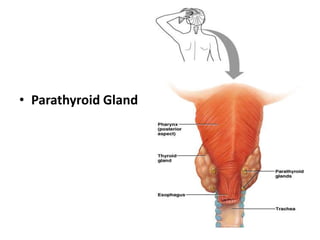
• Parathyroid Gland
Four small masses of epithelial tissue are
embedded in the connective tissue capsule on
the posterior surface of the thyroid glands.
 Secrete Parathyroid hormone
Associated with the growth of muscle and
bone.
Distribution of calcium and phosphate in the
body.
• Parathyroid Gland
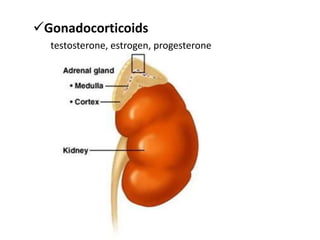
• Adrenal Gland
The adrenal gland is paired that located near
the upper portion of each kidney. Each gland
is divided into an outer cortex and an inner
medulla.
Adrenal Medulla
Situated directly at the top of each kidney and
stimulated by the sympathetic nervous system,
that Secretes
Epinephrine (fight or flight response)
Increase H.R. and B.P.
Increase respiration
Increase metabolic rate
Increase glycogenolysis
Vasodilation
Norepinephrine
House keeping system
Adrenal Cortex
Secretes over 30 different steroid hormones
Mineralocorticoids
ļ‚— Aldosterone
maintains electrolyte balance
Glucocorticoids
ļ‚— Cortisol
Stimulates gluconeogenesis
Mobilization of free fatty acids
Anti-inflammatory agent
Gonadocorticoids
testosterone, estrogen, progesterone
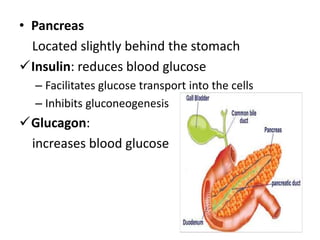
• Pancreas
Located slightly behind the stomach
Insulin: reduces blood glucose
– Facilitates glucose transport into the cells
– Inhibits gluconeogenesis
Glucagon:
increases blood glucose
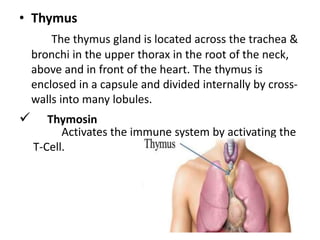
• Thymus
The thymus gland is located across the trachea &
bronchi in the upper thorax in the root of the neck,
above and in front of the heart. The thymus is
enclosed in a capsule and divided internally by cross-
walls into many lobules.
 Thymosin
Activates the immune system by activating the
T-Cell.
• The Gonads
• Testes
– Interstitial cells secrete androgens
– Primary androgen is testosterone
• Maintains secondary sex characteristics
• Helps promote sperm formation
• Ovaries
– Androgens secreted by thecal follicle
• Directly converted to estrogens by follicular granulose cells
– Granulose cells also produce progesterone
– Corpus luteum also secretes estrogen and progesterone
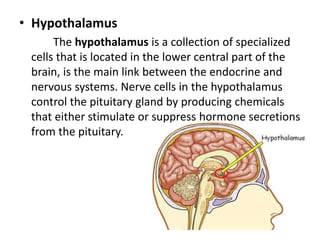
• Hypothalamus
The hypothalamus is a collection of specialized
cells that is located in the lower central part of the
brain, is the main link between the endocrine and
nervous systems. Nerve cells in the hypothalamus
control the pituitary gland by producing chemicals
that either stimulate or suppress hormone secretions
from the pituitary.
• References
http://kidshealth.org/en/teens/endocrine.html#
https://www.pituitary.org.uk/information/what-is-the-
pituitary-gland/endocrine-glands/
http://kidshealth.org/en/teens/endocrine.html#
http://www.ivyroses.com/HumanBody/Endocrine/Endocri
ne_Glands.php
Physiology

Physiology

  • 2.
    Endocrine glands Presented byQasim Ali Reg no; ZO120142031 BS 5th Zoology
  • 3.
    Out line • Definition •Overview of the Endocrine System • Endocrine Organs • Pituitary Gland • Pineal Gland • Thyroid gland • Parathyroid glands • Pancreas • Thymus • Gonads • Hypothalamus • References
  • 4.
    Endocrine glands • Definition: Endocrineglands are glands of the endocrine system that secrete their products, hormones, directly into the blood rather than through a duct. • The foundations of the endocrine system are the hormones and glands.
  • 5.
    Overview of theEndocrine System • System of ductless glands that secrete hormones –Hormones are ā€œmessenger moleculesā€ –Circulate in the blood –Act on distant target cells –Target cells respond to the hormones for which they have receptors –The effects are dependent on the programmed response of the target cells –Hormones are just molecular triggers
  • 6.
    Endocrine Organs • Purelyendocrine organs – Pituitary gland – Pineal gland – Thyroid gland – Parathyroid glands – Adrenal: 2 glands • Cortex • Medulla • Endocrine cells in other organs – Pancreas – Thymus – Gonads – Hypothalamus
  • 7.
    • Pituitary Gland –A marble-sized gland at the base of the brain – Controlled by the hypothalamus or other neural mechanisms and therefore the middle man. – Exercise appears to be a strong stimulant to the hypothalamus for the release of all anterior pituitary hormones • Posterior Lobe: Antidiuretic hormone(ADH): Stimulates reabsorption of water from kidney tubules Oxytocin: Stimulates utrine contraction and Brest contraction for milk release.
  • 8.
    • Anterior  Prolactin(PRL) Productionof breast milk .  Human Growth hormone (HGH) Growth Hypo- Dwarfism Hyper- Gigantism  Thyroid stimulating hormones (TSH) Stimulates the thyroid to release thyroxin.  Adrenocorticotrophic Hormones(ACTH) Stimulates the adrenal cortex to produce: Corticosteroids: mineral corticoids,cortisol ,glucocorticoids,androgens.
  • 9.
    Luteinizing hormone (LH) Bringsabout ovulation and maintains the corpus luteum. Follicle-stimulating hormone (FSH) Stimulates follicle growth and ovarian estrogen production; stimulates sperm production and androgen-binding protein. Gonadotrophin Secondary sexual characteristics Interstitial Cell Stimulating hormones(ICSH) Works on the somniferous tubules in the testes – to produce sperm – which take 21 days to mature.
  • 10.
  • 11.
    • Pineal Gland Apea-sized mass of nerve tissue attached by a stalk to the posterior wall of the third ventricle of the brain, deep between the cerebral hemispheres at the back of the skull.  Melatonin A hormone produced by the pineal gland in darkness but not in bright light. o Informing the brain about night and day, o Also regulate the sleep cycle.
  • 13.
    • Thyroid Gland Thethyroid gland is a very vascular organ that is located in the neck. It consists of two lobes, one on each side of the trachea, just below the larynx or voice box. – Secretes two hormones Triiodothyronine (T3) Thyroxin (T4) • Regulates metabolism • increases protein synthesis • promotes glycolysis, gluconeogenesis, glucose uptake
  • 14.
    Calcitonin Involved in thecalcium and phosphorus metabolism Uptake of calcium to bone. regulates calcium and phosphate in blood.
  • 15.
    • Parathyroid Gland Foursmall masses of epithelial tissue are embedded in the connective tissue capsule on the posterior surface of the thyroid glands.  Secrete Parathyroid hormone Associated with the growth of muscle and bone. Distribution of calcium and phosphate in the body.
  • 16.
  • 17.
    • Adrenal Gland Theadrenal gland is paired that located near the upper portion of each kidney. Each gland is divided into an outer cortex and an inner medulla. Adrenal Medulla Situated directly at the top of each kidney and stimulated by the sympathetic nervous system, that Secretes Epinephrine (fight or flight response) Increase H.R. and B.P. Increase respiration Increase metabolic rate
  • 18.
    Increase glycogenolysis Vasodilation Norepinephrine House keepingsystem Adrenal Cortex Secretes over 30 different steroid hormones Mineralocorticoids ļ‚— Aldosterone maintains electrolyte balance Glucocorticoids ļ‚— Cortisol Stimulates gluconeogenesis Mobilization of free fatty acids Anti-inflammatory agent
  • 19.
  • 20.
    • Pancreas Located slightlybehind the stomach Insulin: reduces blood glucose – Facilitates glucose transport into the cells – Inhibits gluconeogenesis Glucagon: increases blood glucose
  • 21.
    • Thymus The thymusgland is located across the trachea & bronchi in the upper thorax in the root of the neck, above and in front of the heart. The thymus is enclosed in a capsule and divided internally by cross- walls into many lobules.  Thymosin Activates the immune system by activating the T-Cell.
  • 22.
    • The Gonads •Testes – Interstitial cells secrete androgens – Primary androgen is testosterone • Maintains secondary sex characteristics • Helps promote sperm formation • Ovaries – Androgens secreted by thecal follicle • Directly converted to estrogens by follicular granulose cells – Granulose cells also produce progesterone – Corpus luteum also secretes estrogen and progesterone
  • 23.
    • Hypothalamus The hypothalamusis a collection of specialized cells that is located in the lower central part of the brain, is the main link between the endocrine and nervous systems. Nerve cells in the hypothalamus control the pituitary gland by producing chemicals that either stimulate or suppress hormone secretions from the pituitary.
  • 24.