Enabling Translational Medicine with e-Science
Ola Spjuth
ola.spjuth@ki.se
ola.spjuth@farmbio.uu.se
Cancer
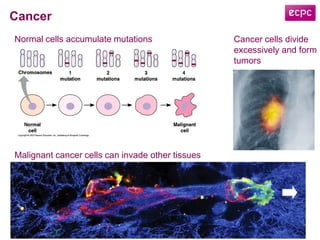
Malignant cancer cells can invade other tissues
Normal cells accumulate mutations Cancer cells divide
excessively and form
tumors
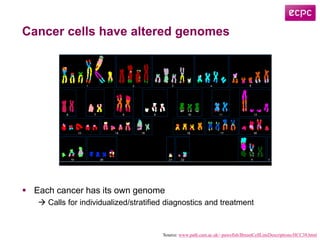
Source: www.path.cam.ac.uk/~pawefish/BreastCellLineDescriptions/HCC38.html
Cancer cells have altered genomes
 Each cancer has its own genome
 Calls for individualized/stratified diagnostics and treatment
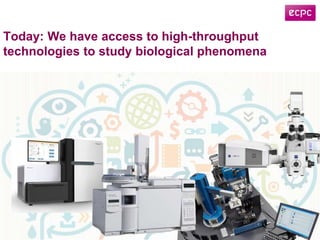
Today: We have access to high-throughput
technologies to study biological phenomena
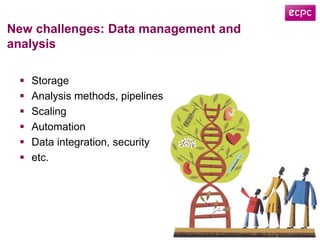
New challenges: Data management and
analysis
 Storage
 Analysis methods, pipelines
 Scaling
 Automation
 Data integration, security
 etc.
Translational medicine
 Aim: Turn Basic Research into
Medicines and Treatments
 “from bench to bedside”
 “from laboratory to clinic”
 Traditionally a slow process
 May take 10 -20 years for original
research to translate to routine
medical practice
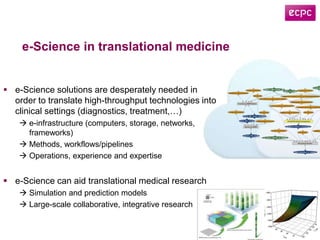
e-Science in translational medicine
 e-Science solutions are desperately needed in
order to translate high-throughput technologies into
clinical settings (diagnostics, treatment,…)
 e-infrastructure (computers, storage, networks,
frameworks)
 Methods, workflows/pipelines
 Operations, experience and expertise
 e-Science can aid translational medical research
 Simulation and prediction models
 Large-scale collaborative, integrative research
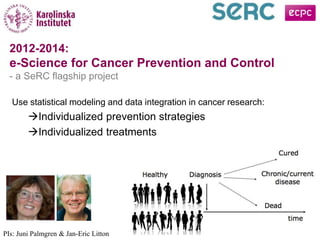
Use statistical modeling and data integration in cancer research:
Individualized prevention strategies
Individualized treatments
2012-2014:
e-Science for Cancer Prevention and Control
- a SeRC flagship project
PIs: Juni Palmgren & Jan-Eric Litton
9
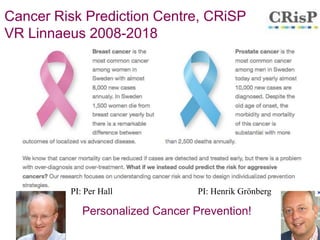
Cancer Risk Prediction Centre, CRiSP
VR Linnaeus 2008-2018
PI: Henrik GrönbergPI: Per Hall
Personalized Cancer Prevention!
Personalized screening; Why?
 Early detection is important.
 Efficiency of current practice for early detection of breast and prostate
cancer is questioned!
We have:
 Organized mammographic screening
 Widespread opportunistic PSA testing
 Rates of detection of slow growing cancers increase
 Beware of over-diagnosis, overtreatment, increasing cost and increase in side
effects!
 Aggressive cancers and mortality do not decrease enough
10
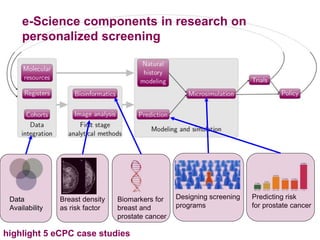
e-Science components in research on
personalized screening
highlight 5 eCPC case studies
Data
Availability
Breast density
as risk factor
Biomarkers for
breast and
prostate cancer
Predicting risk
for prostate cancer
Designing screening
programs
Data Integration
SAIL – Sample Availability System
12
• Overview of data – what is available
• Plan studies, investigate data available for subset of patients/samples
across data archives such as biobanks
O. Spjuth et al.
“Enabling integrative cross-
biobank research: the SAIL
method for harmonizing
and linking biomedical and
clinical data across
disparate data archives”
Eur J Hum Genet. 2015
Aug 26. [Epub ahead of
print]
Data
Availability
Breast density as risk factor
Imaging technology and computational techniques
Keith Humphreys
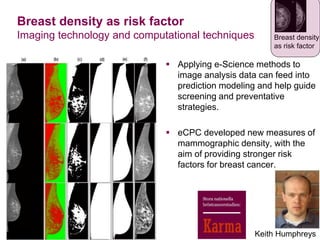
 Applying e-Science methods to
image analysis data can feed into
prediction modeling and help guide
screening and preventative
strategies.
 eCPC developed new measures of
mammographic density, with the
aim of providing stronger risk
factors for breast cancer.
Breast density
as risk factor
Biomarker discovery and validation
 Validated genetic and protein markers conveying prostate
cancer risk
 Studied genomic profile of breast cancers
Data-intensive bioinformatics making use of
national HPC e-Infrastructures (SNIC)
Biomarkers for
breast and
prostate cancer
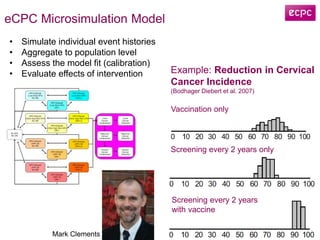
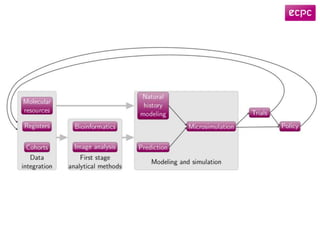
eCPC Microsimulation Model
• Simulate individual event histories
• Aggregate to population level
• Assess the model fit (calibration)
• Evaluate effects of intervention Example: Reduction in Cervical
Cancer Incidence
(Bodhager Diebert et al. 2007)
Screening every 2 years only
Vaccination only
Screening every 2 years
with vaccine
Mark Clements
eScience and eCPC microsimulation
 Used OpenMP/MPI or PGAS for Bayesian calibration of the
microsimulation on HPC
 Compared HPC with MapReduce for the microsimulation
 Trans-compile from C++ to WebAssembly/JavaScript for
microsimulation on the browser
 Compared client-server and client-only web interfaces for the
microsimulation
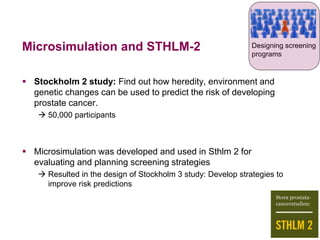
Microsimulation and STHLM-2
 Stockholm 2 study: Find out how heredity, environment and
genetic changes can be used to predict the risk of developing
prostate cancer.
 50,000 participants
 Microsimulation was developed and used in Sthlm 2 for
evaluating and planning screening strategies
 Resulted in the design of Stockholm 3 study: Develop strategies to
improve risk predictions
Designing screening
programs
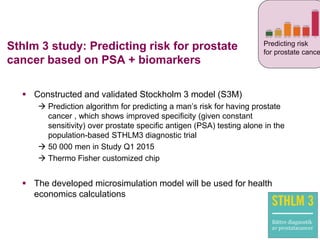
Sthlm 3 study: Predicting risk for prostate
cancer based on PSA + biomarkers
 Constructed and validated Stockholm 3 model (S3M)
 Prediction algorithm for predicting a man’s risk for having prostate
cancer , which shows improved specificity (given constant
sensitivity) over prostate specific antigen (PSA) testing alone in the
population-based STHLM3 diagnostic trial
 50 000 men in Study Q1 2015
 Thermo Fisher customized chip
 The developed microsimulation model will be used for health
economics calculations
Predicting risk
for prostate cance
2015: eCPC sharpens the focus on
translational medicine
 Adding new prioritized field: Clinical sequencing
 How can new high-throughput sequencing technologies aid cancer
diagnostics and treatments?
 Joint collaboration, SeRC and eSSENCE
PI: Juni Palmgren
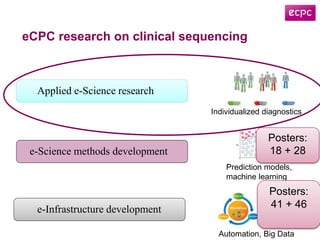
eCPC research on clinical sequencing
e-Infrastructure development
Automation, Big Data
e-Science methods development
Prediction models,
machine learning
Applied e-Science research
Individualized diagnostics
Posters:
18 + 28
Posters:
41 + 46
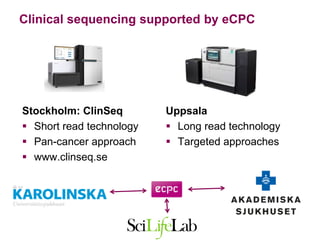
Clinical sequencing supported by eCPC
Stockholm: ClinSeq
 Short read technology
 Pan-cancer approach
 www.clinseq.se
Uppsala
 Long read technology
 Targeted approaches
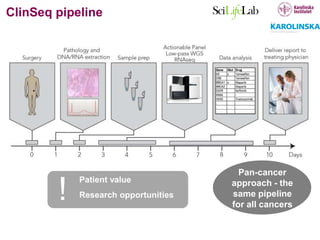
ClinSeq pipeline
Patient value
Research opportunities!
Pan-cancer
approach - the
same pipeline
for all cancers
E-science in ClinSeq
 HPC / distributed computing
 Bioinformatic pre-procesing in CLINSEQ: 15 Gb raw data per patient
(~100 CPU hours / patient)
 Automated bioinformatic pipeline that run in cluster environment (e.g.
UPPMAX)
 Machine learning and computational statistics: Methods
development and application
 Supervised and unsupervised learning across multiple types of high-
dimensional data
 Biomarker discovery (robust methods for variable selection): definition
of robust sets of clinically relevant biomarkers
 Integration of in-house data with public DBs and data sets
 The Cancer Genome Atlas (TCGA), clinically relevant mutations
(COSMIC, ClinVar)
ClinSeq in breast cancer
 Results suggests that routine clinical biomarkers could be
replaced with DNA and RNA sequencing-based diagnostics
 The ClinSeq profile add value by providing more detailed
diagnostic information (subtype, mutations, transcriptomic
grade)
 Prospective validation study is planned (N=500)
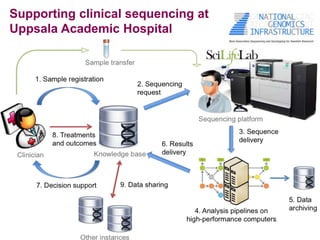
Supporting clinical sequencing at
Uppsala Academic Hospital
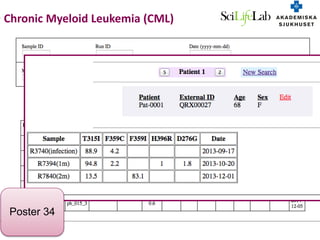
Chronic Myeloid Leukemia (CML)
Poster 34
e-Science in eCPC clinical sequencing in
Uppsala
 Construct and automate pipelines on HPC and Cloud
 Transfer results into database system
 Structured data (variants, tables, visualizations, data files etc.)
 Inside hospital domain with clinical phenotypes (future)
 Security – sensitive personal information
 Encrypt and archive raw data
 Build up knowledge base for future predictive modeling
 Now: In pilot production at UAH
 Future: Extend to other cancers and genomic regions
eCPC involvements
 NIASC – The Nordic Information for Action e-Science Center of
Excellence (http://nordicehealth.se/, 2014-1018)
 Integrated Nordic research in population-based cancer screening
 generic eScience infrastructure
 eScience-based predictive algorithm within a national screening
program
 PhenoMeNal H2020 project (start Sept. 1st 2015)
 clinical metabolomics
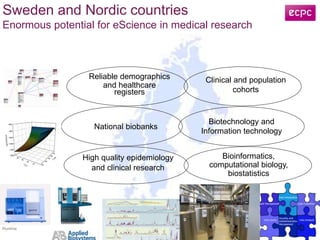
Sweden and Nordic countries
Enormous potential for eScience in medical research
National biobanks
Reliable demographics
and healthcare
registers
High quality epidemiology
and clinical research
Clinical and population
cohorts
Biotechnology and
Information technology
Bioinformatics,
computational biology,
biostatistics
www.ecpc.e-science.se
- Thank you -

Enabling Translational Medicine with e-Science

  • 1.
    Enabling Translational Medicinewith e-Science Ola Spjuth ola.spjuth@ki.se ola.spjuth@farmbio.uu.se
  • 2.
    Cancer Malignant cancer cellscan invade other tissues Normal cells accumulate mutations Cancer cells divide excessively and form tumors
  • 3.
    Source: www.path.cam.ac.uk/~pawefish/BreastCellLineDescriptions/HCC38.html Cancer cellshave altered genomes  Each cancer has its own genome  Calls for individualized/stratified diagnostics and treatment
  • 4.
    Today: We haveaccess to high-throughput technologies to study biological phenomena
  • 5.
    New challenges: Datamanagement and analysis  Storage  Analysis methods, pipelines  Scaling  Automation  Data integration, security  etc.
  • 6.
    Translational medicine  Aim:Turn Basic Research into Medicines and Treatments  “from bench to bedside”  “from laboratory to clinic”  Traditionally a slow process  May take 10 -20 years for original research to translate to routine medical practice
  • 7.
    e-Science in translationalmedicine  e-Science solutions are desperately needed in order to translate high-throughput technologies into clinical settings (diagnostics, treatment,…)  e-infrastructure (computers, storage, networks, frameworks)  Methods, workflows/pipelines  Operations, experience and expertise  e-Science can aid translational medical research  Simulation and prediction models  Large-scale collaborative, integrative research
  • 8.
    Use statistical modelingand data integration in cancer research: Individualized prevention strategies Individualized treatments 2012-2014: e-Science for Cancer Prevention and Control - a SeRC flagship project PIs: Juni Palmgren & Jan-Eric Litton
  • 9.
    9 Cancer Risk PredictionCentre, CRiSP VR Linnaeus 2008-2018 PI: Henrik GrönbergPI: Per Hall Personalized Cancer Prevention!
  • 10.
    Personalized screening; Why? Early detection is important.  Efficiency of current practice for early detection of breast and prostate cancer is questioned! We have:  Organized mammographic screening  Widespread opportunistic PSA testing  Rates of detection of slow growing cancers increase  Beware of over-diagnosis, overtreatment, increasing cost and increase in side effects!  Aggressive cancers and mortality do not decrease enough 10
  • 11.
    e-Science components inresearch on personalized screening highlight 5 eCPC case studies Data Availability Breast density as risk factor Biomarkers for breast and prostate cancer Predicting risk for prostate cancer Designing screening programs
  • 12.
    Data Integration SAIL –Sample Availability System 12 • Overview of data – what is available • Plan studies, investigate data available for subset of patients/samples across data archives such as biobanks O. Spjuth et al. “Enabling integrative cross- biobank research: the SAIL method for harmonizing and linking biomedical and clinical data across disparate data archives” Eur J Hum Genet. 2015 Aug 26. [Epub ahead of print] Data Availability
  • 13.
    Breast density asrisk factor Imaging technology and computational techniques Keith Humphreys  Applying e-Science methods to image analysis data can feed into prediction modeling and help guide screening and preventative strategies.  eCPC developed new measures of mammographic density, with the aim of providing stronger risk factors for breast cancer. Breast density as risk factor
  • 14.
    Biomarker discovery andvalidation  Validated genetic and protein markers conveying prostate cancer risk  Studied genomic profile of breast cancers Data-intensive bioinformatics making use of national HPC e-Infrastructures (SNIC) Biomarkers for breast and prostate cancer
  • 15.
    eCPC Microsimulation Model •Simulate individual event histories • Aggregate to population level • Assess the model fit (calibration) • Evaluate effects of intervention Example: Reduction in Cervical Cancer Incidence (Bodhager Diebert et al. 2007) Screening every 2 years only Vaccination only Screening every 2 years with vaccine Mark Clements
  • 16.
    eScience and eCPCmicrosimulation  Used OpenMP/MPI or PGAS for Bayesian calibration of the microsimulation on HPC  Compared HPC with MapReduce for the microsimulation  Trans-compile from C++ to WebAssembly/JavaScript for microsimulation on the browser  Compared client-server and client-only web interfaces for the microsimulation
  • 17.
    Microsimulation and STHLM-2 Stockholm 2 study: Find out how heredity, environment and genetic changes can be used to predict the risk of developing prostate cancer.  50,000 participants  Microsimulation was developed and used in Sthlm 2 for evaluating and planning screening strategies  Resulted in the design of Stockholm 3 study: Develop strategies to improve risk predictions Designing screening programs
  • 19.
    Sthlm 3 study:Predicting risk for prostate cancer based on PSA + biomarkers  Constructed and validated Stockholm 3 model (S3M)  Prediction algorithm for predicting a man’s risk for having prostate cancer , which shows improved specificity (given constant sensitivity) over prostate specific antigen (PSA) testing alone in the population-based STHLM3 diagnostic trial  50 000 men in Study Q1 2015  Thermo Fisher customized chip  The developed microsimulation model will be used for health economics calculations Predicting risk for prostate cance
  • 20.
    2015: eCPC sharpensthe focus on translational medicine  Adding new prioritized field: Clinical sequencing  How can new high-throughput sequencing technologies aid cancer diagnostics and treatments?  Joint collaboration, SeRC and eSSENCE PI: Juni Palmgren
  • 21.
    eCPC research onclinical sequencing e-Infrastructure development Automation, Big Data e-Science methods development Prediction models, machine learning Applied e-Science research Individualized diagnostics Posters: 18 + 28 Posters: 41 + 46
  • 22.
    Clinical sequencing supportedby eCPC Stockholm: ClinSeq  Short read technology  Pan-cancer approach  www.clinseq.se Uppsala  Long read technology  Targeted approaches
  • 23.
    ClinSeq pipeline Patient value Researchopportunities! Pan-cancer approach - the same pipeline for all cancers
  • 24.
    E-science in ClinSeq HPC / distributed computing  Bioinformatic pre-procesing in CLINSEQ: 15 Gb raw data per patient (~100 CPU hours / patient)  Automated bioinformatic pipeline that run in cluster environment (e.g. UPPMAX)  Machine learning and computational statistics: Methods development and application  Supervised and unsupervised learning across multiple types of high- dimensional data  Biomarker discovery (robust methods for variable selection): definition of robust sets of clinically relevant biomarkers  Integration of in-house data with public DBs and data sets  The Cancer Genome Atlas (TCGA), clinically relevant mutations (COSMIC, ClinVar)
  • 25.
    ClinSeq in breastcancer  Results suggests that routine clinical biomarkers could be replaced with DNA and RNA sequencing-based diagnostics  The ClinSeq profile add value by providing more detailed diagnostic information (subtype, mutations, transcriptomic grade)  Prospective validation study is planned (N=500)
  • 26.
    Supporting clinical sequencingat Uppsala Academic Hospital
  • 27.
    Chronic Myeloid Leukemia(CML) Poster 34
  • 28.
    e-Science in eCPCclinical sequencing in Uppsala  Construct and automate pipelines on HPC and Cloud  Transfer results into database system  Structured data (variants, tables, visualizations, data files etc.)  Inside hospital domain with clinical phenotypes (future)  Security – sensitive personal information  Encrypt and archive raw data  Build up knowledge base for future predictive modeling  Now: In pilot production at UAH  Future: Extend to other cancers and genomic regions
  • 29.
    eCPC involvements  NIASC– The Nordic Information for Action e-Science Center of Excellence (http://nordicehealth.se/, 2014-1018)  Integrated Nordic research in population-based cancer screening  generic eScience infrastructure  eScience-based predictive algorithm within a national screening program  PhenoMeNal H2020 project (start Sept. 1st 2015)  clinical metabolomics
  • 30.
    Sweden and Nordiccountries Enormous potential for eScience in medical research National biobanks Reliable demographics and healthcare registers High quality epidemiology and clinical research Clinical and population cohorts Biotechnology and Information technology Bioinformatics, computational biology, biostatistics
  • 31.