

Computing and Data in
Precision Oncology
Warren A. Kibbe, Ph.D.
Professor, Biostats & Bioinformatics
Chief Data Officer, Duke Cancer Institute
warren.kibbe@duke.edu
@wakibbe
@supercomputing
#sc19
#DataSharing
#ComputationalPhenomics
#PrecisionOncology
Personal & Professional Background
• PhD in Chemistry at Caltech, Postdoc in
molecular genetics of RAS
• Cancer research for 20+ years - cancer
informatics, data science, healthcare
• Faculty in the Feinberg School of Medicine at
Northwestern for 15+ years
• Director NCI CBIIT 2013-2017; NCI CIO
2013-2017; Acting NCI Deputy Director for
Data Science 2016-2017
• Lost three grandparents to cancer, father to
cancer in 2019
Take homes
• Biology, cancer is a grand challenge
• Computation, ML, High Dimensional
Modeling is crucial for understanding
cancer
• Advances in biology, human health,
and implementation science are all
needed
• Scaling is a hard problem
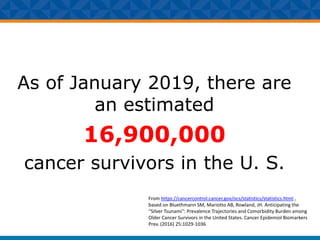
As of January 2019, there are
an estimated
16,900,000
cancer survivors in the U. S.
From https://cancercontrol.cancer.gov/ocs/statistics/statistics.html ,
based on Bluethmann SM, Mariotto AB, Rowland, JH. Anticipating the
''Silver Tsunami'': Prevalence Trajectories and Comorbidity Burden among
Older Cancer Survivors in the United States. Cancer Epidemiol Biomarkers
Prev. (2016) 25:1029-1036
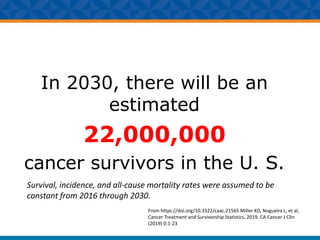
In 2030, there will be an
estimated
22,000,000
cancer survivors in the U. S.
From https://doi.org/10.3322/caac.21565 Miller KD, Nogueira L, et al,
Cancer Treatment and Survivorship Statistics, 2019. CA Cancer J Clin
(2019) 0:1-23
Survival, incidence, and all-cause mortality rates were assumed to be
constant from 2016 through 2030.
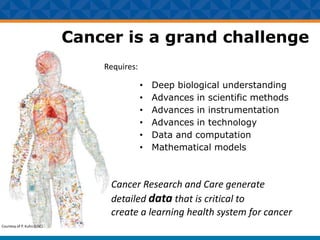
(10,000+ patient tumors and increasing)
Courtesy of P. Kuhn (USC)
2006-2015:
A Decade of Illuminating the
Underlying Causes of Primary
Untreated Tumors Omics
Characterization
Cancer is a grand challenge
• Deep biological understanding
• Advances in scientific methods
• Advances in instrumentation
• Advances in technology
• Data and computation
• Mathematical models
Cancer Research and Care generate
detailed data that is critical to
create a learning health system for cancer
Requires:
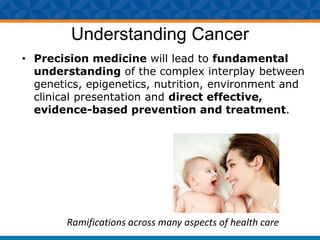
Understanding Cancer
• Precision medicine will lead to fundamental
understanding of the complex interplay between
genetics, epigenetics, nutrition, environment and
clinical presentation and direct effective,
evidence-based prevention and treatment.
Ramifications across many aspects of health care
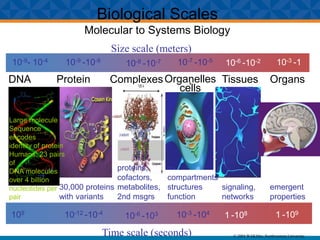
Biological Scales
Molecular to Systems Biology
DNA
Large molecule
Sequence
encodes
identity of protein
Humans: 23 pairs
of
DNA molecules
over 4 billion
nucleotides per
pair
Protein
109 10-12 -10-4
Complexes
30,000 proteins
with variants
proteins,
cofactors,
metabolites,
2nd msgrs
10-6 -103
Organelles,
cells
10-3 -104
Tissues
1 -108
Organs
1 -109
10-9- 10-4 10-9 -10-8
10-8 -10-7 10-7 -10-5
10-6 -10-2 10-3 -1
Size scale (meters)
Time scale (seconds)
compartments
structures
function
signaling,
networks
emergent
properties
© 2004 WAKibbe, Northwestern University
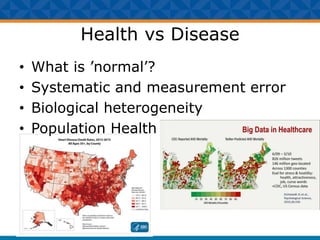
Health vs Disease
• What is ’normal’?
• Systematic and measurement error
• Biological heterogeneity
• Population Health
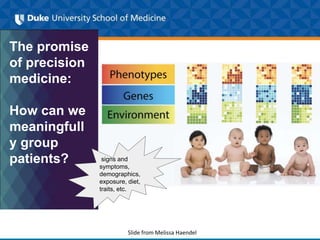
The promise
of precision
medicine:
How can we
meaningfull
y group
patients? signs and
symptoms,
demographics,
exposure, diet,
traits, etc.
Slide from Melissa Haendel
Biology and Medicine are now
data intensive enterprises
Scale is rapidly changing
Technology, data, computing and
IT are pervasive in the lab, the
clinic, in the home, and across the
population
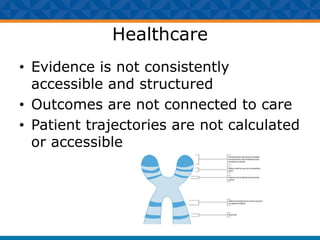
Healthcare
• Evidence is not consistently
accessible and structured
• Outcomes are not connected to care
• Patient trajectories are not calculated
or accessible
Healthcare
• More data is ‘digital first’ every day
• Decision aids are needed
• Good UX and responsive computing
and analytics are critical for
improving health outcomes
LEARNING HEALTH SYSTEMS
“Science, informatics, incentives, and
culture are aligned for continuous
improvement and innovation, with best
practices seamlessly embedded in the
delivery process and new knowledge
captured as an integral by-product of the
delivery experience.”
—Institute of Medicine
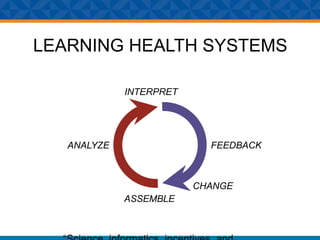
ASSEMBLE
ANALYZE
INTERPRET
FEEDBACK
CHANGE
LEARNING HEALTH SYSTEMS
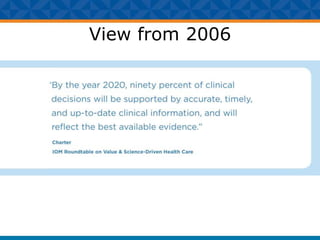
View from 2006
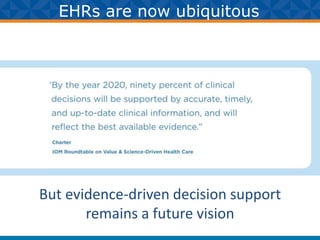
EHRs are now ubiquitous
But evidence-driven decision support
remains a future vision
Real World Evidence
• Needs big data!
• Needs population representation
• Need epidemiologists and
statisticians to understand the
potential biases in representation
• EHRs, NLP, Machine Learning can
power real world evidence learning
• Critical for a Learning Health
System
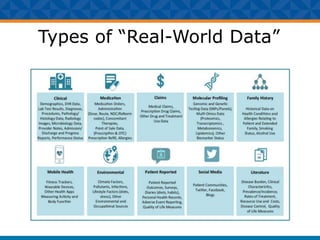
Types of “Real-World Data”
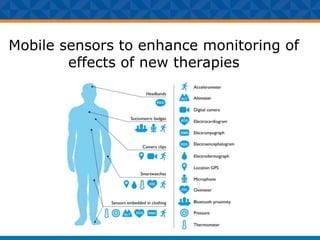
Mobile sensors to enhance monitoring of
effects of new therapies
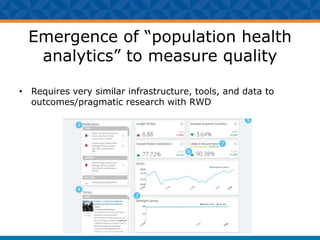
Emergence of “population health
analytics” to measure quality
• Requires very similar infrastructure, tools, and data to
outcomes/pragmatic research with RWD
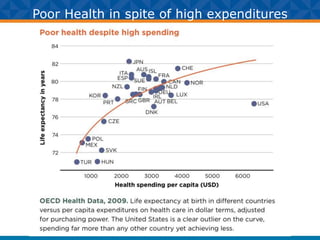
Poor Health in spite of high expenditures
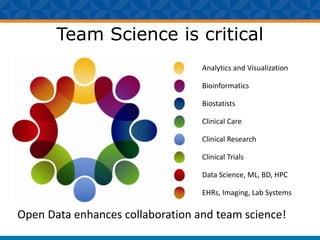
Team Science is critical
Clinical Trials
Biostatists
Bioinformatics
Clinical Care
Clinical Research
EHRs, Imaging, Lab Systems
Data Science, ML, BD, HPC
Analytics and Visualization
Open Data enhances collaboration and team science!
A brief history
• Eric Stahlberg and Jason Paragas
discussed the potential for a joint HPC-
focused collaboration between NCI and DOE
after SC14
• Winter – Spring of 2015 started fleshing out
a potential set of pilots
• First public presentation to the NIH HPC
Scientific Management workgroup in 8/2015
• Presented to FNLAC (NCI FACA) in 9/2015
• First Cancer Workshop at SC15
• Presented to NCI Director and DOE
Secretary 12/2015
26
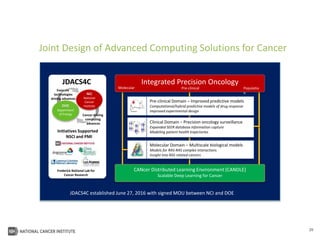
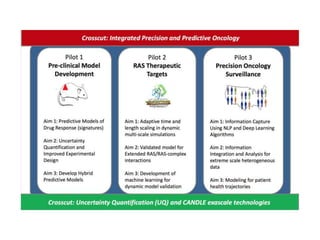
Integrated Precision Oncology
Joint Design of Advanced Computing Solutions for Cancer
NCI
National
Cancer
InstituteDOE
Department
of Energy Cancer driving
computing
advances
Exascale
technologies
driving advances
Initiatives Supported
NSCI and PMI
Molecular Domain – Multiscale biological models
Models for RAS-RAS complex interactions
Insight into RAS related cancers
Pre-clinical Domain – Improved predictive models
Computational/hybrid predictive models of drug response
Improved experimental design
Clinical Domain – Precision oncology surveillance
Expanded SEER database information capture
Modeling patient health trajectories
CANcer Distributed Learning Environment (CANDLE)
Scalable Deep Learning for Cancer
Molecular Pre-clinical Populatio
n
Frederick National Lab for
Cancer Research
JDACS4C
JDACS4C established June 27, 2016 with signed MOU between NCI and DOE
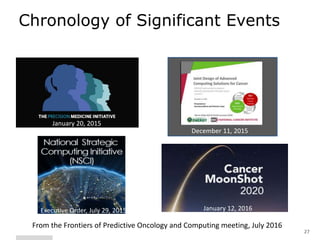
Chronology of Significant Events
27
Executive Order, July 29, 2015
January 20, 2015
January 12, 2016
December 11, 2015
From the Frontiers of Predictive Oncology and Computing meeting, July 2016
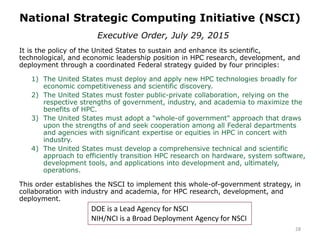
National Strategic Computing Initiative (NSCI)
28
Executive Order, July 29, 2015
It is the policy of the United States to sustain and enhance its scientific,
technological, and economic leadership position in HPC research, development, and
deployment through a coordinated Federal strategy guided by four principles:
1) The United States must deploy and apply new HPC technologies broadly for
economic competitiveness and scientific discovery.
2) The United States must foster public-private collaboration, relying on the
respective strengths of government, industry, and academia to maximize the
benefits of HPC.
3) The United States must adopt a "whole-of government" approach that draws
upon the strengths of and seek cooperation among all Federal departments
and agencies with significant expertise or equities in HPC in concert with
industry.
4) The United States must develop a comprehensive technical and scientific
approach to efficiently transition HPC research on hardware, system software,
development tools, and applications into development and, ultimately,
operations.
This order establishes the NSCI to implement this whole-of-government strategy, in
collaboration with industry and academia, for HPC research, development, and
deployment.
DOE is a Lead Agency for NSCI
NIH/NCI is a Broad Deployment Agency for NSCI
29
Precision Medicine Initiative (PMI)
January 30, 2015
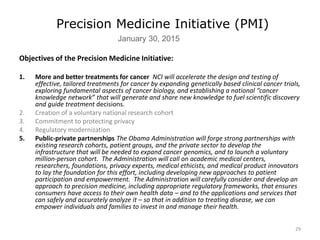
Objectives of the Precision Medicine Initiative:
1. More and better treatments for cancer NCI will accelerate the design and testing of
effective, tailored treatments for cancer by expanding genetically based clinical cancer trials,
exploring fundamental aspects of cancer biology, and establishing a national “cancer
knowledge network” that will generate and share new knowledge to fuel scientific discovery
and guide treatment decisions.
2. Creation of a voluntary national research cohort
3. Commitment to protecting privacy
4. Regulatory modernization
5. Public-private partnerships The Obama Administration will forge strong partnerships with
existing research cohorts, patient groups, and the private sector to develop the
infrastructure that will be needed to expand cancer genomics, and to launch a voluntary
million-person cohort. The Administration will call on academic medical centers,
researchers, foundations, privacy experts, medical ethicists, and medical product innovators
to lay the foundation for this effort, including developing new approaches to patient
participation and empowerment. The Administration will carefully consider and develop an
approach to precision medicine, including appropriate regulatory frameworks, that ensures
consumers have access to their own health data – and to the applications and services that
can safely and accurately analyze it – so that in addition to treating disease, we can
empower individuals and families to invest in and manage their health.
NCI Precision Oncology – Extending
the Frontiers
30
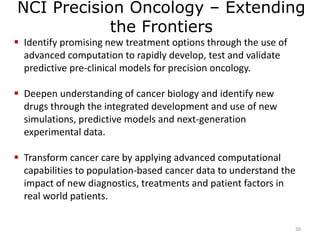
 Identify promising new treatment options through the use of
advanced computation to rapidly develop, test and validate
predictive pre-clinical models for precision oncology.
 Deepen understanding of cancer biology and identify new
drugs through the integrated development and use of new
simulations, predictive models and next-generation
experimental data.
 Transform cancer care by applying advanced computational
capabilities to population-based cancer data to understand the
impact of new diagnostics, treatments and patient factors in
real world patients.
DOE Exascale Computing –
Extending the Frontiers
31
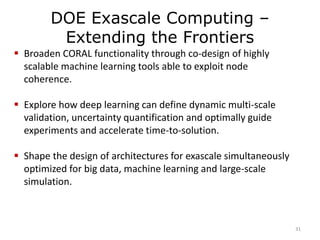
 Broaden CORAL functionality through co-design of highly
scalable machine learning tools able to exploit node
coherence.
 Explore how deep learning can define dynamic multi-scale
validation, uncertainty quantification and optimally guide
experiments and accelerate time-to-solution.
 Shape the design of architectures for exascale simultaneously
optimized for big data, machine learning and large-scale
simulation.
32
Cancer Moonshot
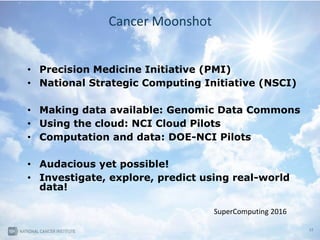
• Precision Medicine Initiative (PMI)
• National Strategic Computing Initiative (NSCI)
• Making data available: Genomic Data Commons
• Using the cloud: NCI Cloud Pilots
• Computation and data: DOE-NCI Pilots
• Audacious yet possible!
• Investigate, explore, predict using real-world
data!
SuperComputing 2016
Cancer Moonshot is using MLDA
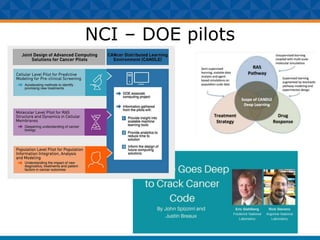
NCI – DOE pilots
Machine Learning and Data Analytics
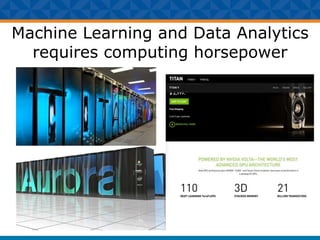
requires computing horsepower
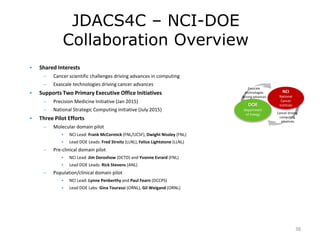
JDACS4C – NCI-DOE
Collaboration Overview
38
• Shared Interests
– Cancer scientific challenges driving advances in computing
– Exascale technologies driving cancer advances
• Supports Two Primary Executive Office Initiatives
– Precision Medicine Initiative (Jan 2015)
– National Strategic Computing Initiative (July 2015)
• Three Pilot Efforts
– Molecular domain pilot
• NCI Lead: Frank McCormick (FNL/UCSF), Dwight Nissley (FNL)
• Lead DOE Leads: Fred Streitz (LLNL), Felice Lightstone (LLNL)
– Pre-clinical domain pilot
• NCI Lead: Jim Doroshow (DCTD) and Yvonne Evrard (FNL)
• Lead DOE Leads: Rick Stevens (ANL)
– Population/clinical domain pilot
• NCI Lead: Lynne Penberthy and Paul Fearn (DCCPS)
• Lead DOE Labs: Gina Tourassi (ORNL), Gil Weigand (ORNL)
NCI
National
Cancer
InstituteDOE
Department
of Energy Cancer driving
computing
advances
Exascale
technologies
driving advances
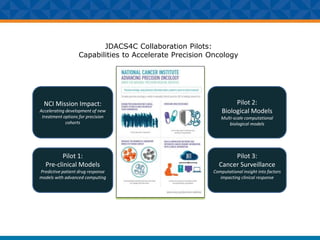
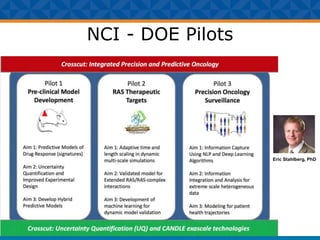
JDACS4C Collaboration Pilots:
Capabilities to Accelerate Precision Oncology
NCI Mission Impact:
Accelerating development of new
treatment options for precision
cohorts
Pilot 1:
Pre-clinical Models
Predictive patient drug response
models with advanced computing
Pilot 2:
Biological Models
Multi-scale computational
biological models
Pilot 3:
Cancer Surveillance
Computational insight into factors
impacting clinical response
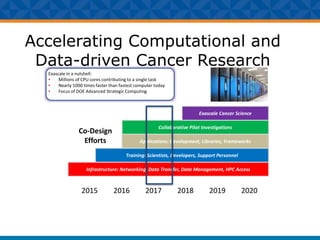
Accelerating Computational and
Data-driven Cancer Research
Exascale in a nutshell:
• Millions of CPU cores contributing to a single task
• Nearly 1000 times faster than fastest computer today
• Focus of DOE Advanced Strategic Computing
Infrastructure: Networking, Data Transfer, Data Management, HPC Access
2015 2016 2017 2018 2019 2020
Training: Scientists, Developers, Support Personnel
Applications: Development, Libraries, Frameworks
Collaborative Pilot Investigations
Exascale Cancer Science
Co-Design
Efforts
NCI - DOE Pilots
Eric Stahlberg, PhD
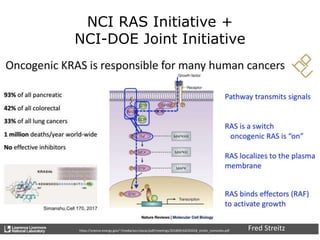
NCI RAS Initiative +
NCI-DOE Joint Initiative
https://science.energy.gov/~/media/ascr/ascac/pdf/meetings/201809/ASCR2018_streitz_nomovies.pdf Fred Streitz
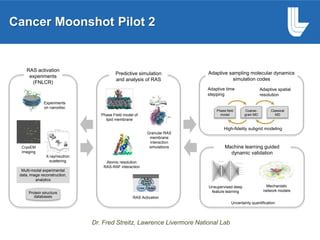
Multi-modal experimental
data, image reconstruction,
analytics
Adaptive spatial
resolution
Adaptive time
stepping
High-fidelity subgrid modeling
Experiments
on nanodisc
CryoEM
imaging
X-ray/neutron
scattering
Protein structure
databases
Adaptive sampling molecular dynamics
simulation codes
Unsupervised deep
feature learning
Uncertainty quantification
Mechanistic
network models
RAS activation
experiments
(FNLCR)
Phase field
model
Coarse-
grain MD
Classical
MD
Machine learning guided
dynamic validation
Granular RAS
membrane
interaction
simulations
Atomic resolution
RAS-RAF interaction
RAS Activation
Predictive simulation
and analysis of RAS
Phase Field model of
lipid membrane
Cancer Moonshot Pilot 2
Dr. Fred Streitz, Lawrence Livermore National Lab
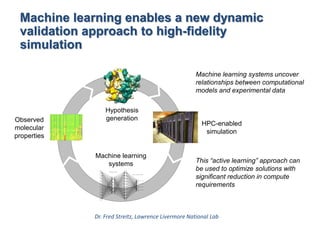
Machine learning enables a new dynamic
validation approach to high-fidelity
simulation
Hypothesis
generation
Machine learning
systems
HPC-enabled
simulation
Observed
molecular
properties
Machine learning systems uncover
relationships between computational
models and experimental data
This “active learning” approach can
be used to optimize solutions with
significant reduction in compute
requirements
Dr. Fred Streitz, Lawrence Livermore National Lab
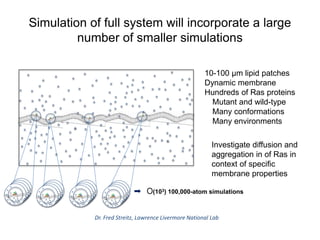
Simulation of full system will incorporate a large
number of smaller simulations
O(103) 100,000-atom simulations
10-100 µm lipid patches
Dynamic membrane
Hundreds of Ras proteins
Mutant and wild-type
Many conformations
Many environments
Investigate diffusion and
aggregation in of Ras in
context of specific
membrane properties
Dr. Fred Streitz, Lawrence Livermore National Lab
Multi-disciplinary team from FNLCR, LLNL,
LANL, ORNL and ANL
Argonne National Lab: Prasanna Balaprakash, Tom Brettin, FangFang Xia
FNLCR / NCI Team: Frantz Jean-Francois, Frank McCormick, Dhirendra Simanshu,
Eric Stahlberg, Andy Stephen, Tommy Turbyville, Debanjan Goswami
Oak Ridge National Lab: , Pratul K. Agarwal, Debsindhu Bhowmik, Arvind
Ramanathan, Blake A. Wilson, Christopher B. Stanley
Lawrence Livermore National Lab: Harsh Bhatia, Barry Belmont, Tim Carpenter,
Francesco Di Natale, Jim Glosli, Helgi Ingolfsson, Piyush Karande, Felice
Lightstone, Tomas Oppelstrup, Liam Stanton, Michael Surh, Sachin Talathi, Brian Van
Essen, Yue Yang, Xiaohua Zhang
Los Alamos National Lab: Angel Garcia, Christoph Jungans, Cesar Lopez, Chris
Neale, Danny Perez, Sandrasegaram Gnanakaran, Tim Travers, Art Voter
Dr. Fred Streitz, Lawrence Livermore National Lab
48
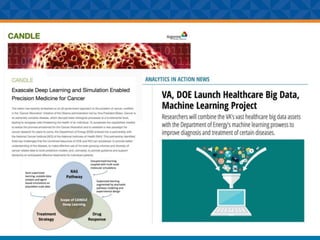
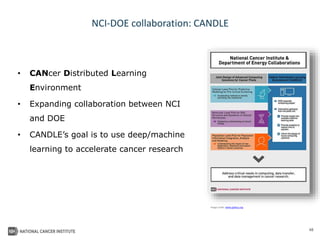
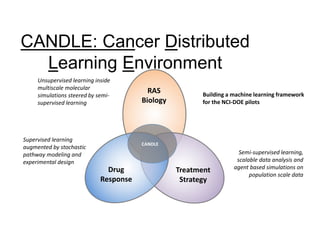
NCI-DOE collaboration: CANDLE
• CANcer Distributed Learning
Environment
• Expanding collaboration between NCI
and DOE
• CANDLE’s goal is to use deep/machine
learning to accelerate cancer research
image credit: www.globus.org
CANDLE: Cancer Distributed
Learning Environment
RAS
Biology
Treatment
Strategy
Drug
Response
CANDLE
Unsupervised learning inside
multiscale molecular
simulations steered by semi-
supervised learning
Supervised learning
augmented by stochastic
pathway modeling and
experimental design
Semi-supervised learning,
scalable data analysis and
agent based simulations on
population scale data
Building a machine learning framework
for the NCI-DOE pilots
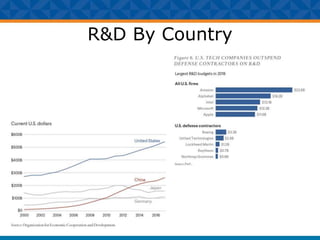
Is the US able to keep up?
R&D By Country
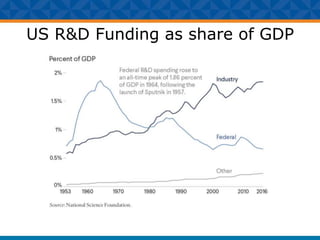
US R&D Funding as share of GDP
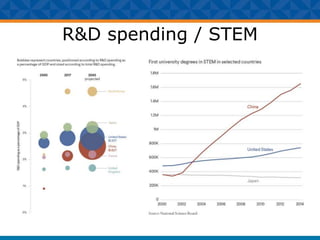
R&D spending / STEM
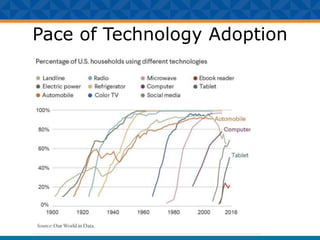
Pace of Technology Adoption
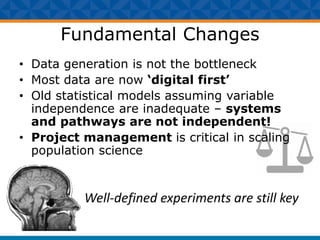
Fundamental Changes
• Data generation is not the bottleneck
• Most data are now ‘digital first’
• Old statistical models assuming variable
independence are inadequate – systems
and pathways are not independent!
• Project management is critical in scaling
population science
Well-defined experiments are still key
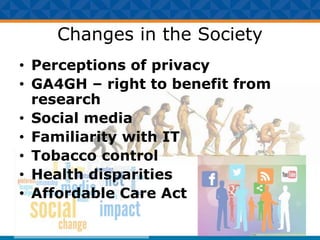
Changes in the Society
• Perceptions of privacy
• GA4GH – right to benefit from
research
• Social media
• Familiarity with IT
• Tobacco control
• Health disparities
• Affordable Care Act
Cancer Moonshot
“…it is of critical national importance
that we …double the rate of progress
in the fight against cancer- and put
ourselves on a path to achieve in just
5 years research and treatment gains
that otherwise might take a decade or
more…”
WHAT IS “DATA SCIENCE”?
Knowledge among computer scientists
about how to think of and approach the
analysis of data is limited, just as the
knowledge of computing environments
by statisticians is limited. A merger of the
knowledge bases would produce a
powerful force for innovation.
—Bill Cleveland on Data Science (2001)
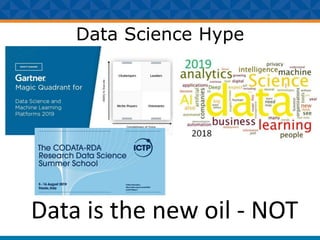
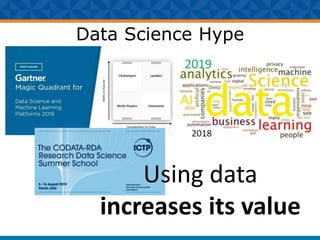
Data Science Hype
Data is the new oil - NOT
Data Science Hype
Using data
increases its value
Cancer Genomics
• Several distinct molecular forms of
cancer at each organ site
• The genomic abnormalities of each
cancer are unique
• The same molecular abnormalities
are found in cancers that arise in
different organs
Our understanding of biology, cancer, and intervention is changing!
Genomics, Data resources, and
clinical trials are changing
• NCI Cancer Genomic Data Commons
• Umbrella and basket clinical trials
such as NCI MATCH and Pediatric
MATCH
65
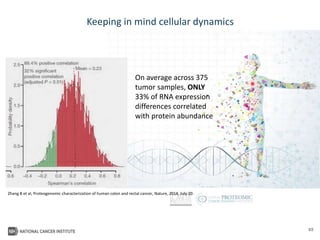
Keeping in mind cellular dynamics
On average across 375
tumor samples, ONLY
33% of RNA expression
differences correlated
with protein abundance
Zhang B et al, Proteogenomic characterization of human colon and rectal cancer, Nature, 2014, July 20.
Genomics is the beginning of
precision medicine, not the end!
Questions?
Warren Kibbe, Ph.D.
warren.kibbe@duke.edu
@wakibbe

Super computing 19 Cancer Computing Workshop Keynote

  • 1.
    Computing and Datain Precision Oncology Warren A. Kibbe, Ph.D. Professor, Biostats & Bioinformatics Chief Data Officer, Duke Cancer Institute warren.kibbe@duke.edu @wakibbe @supercomputing #sc19 #DataSharing #ComputationalPhenomics #PrecisionOncology
  • 2.
    Personal & ProfessionalBackground • PhD in Chemistry at Caltech, Postdoc in molecular genetics of RAS • Cancer research for 20+ years - cancer informatics, data science, healthcare • Faculty in the Feinberg School of Medicine at Northwestern for 15+ years • Director NCI CBIIT 2013-2017; NCI CIO 2013-2017; Acting NCI Deputy Director for Data Science 2016-2017 • Lost three grandparents to cancer, father to cancer in 2019
  • 3.
    Take homes • Biology,cancer is a grand challenge • Computation, ML, High Dimensional Modeling is crucial for understanding cancer • Advances in biology, human health, and implementation science are all needed • Scaling is a hard problem
  • 4.
    As of January2019, there are an estimated 16,900,000 cancer survivors in the U. S. From https://cancercontrol.cancer.gov/ocs/statistics/statistics.html , based on Bluethmann SM, Mariotto AB, Rowland, JH. Anticipating the ''Silver Tsunami'': Prevalence Trajectories and Comorbidity Burden among Older Cancer Survivors in the United States. Cancer Epidemiol Biomarkers Prev. (2016) 25:1029-1036
  • 5.
    In 2030, therewill be an estimated 22,000,000 cancer survivors in the U. S. From https://doi.org/10.3322/caac.21565 Miller KD, Nogueira L, et al, Cancer Treatment and Survivorship Statistics, 2019. CA Cancer J Clin (2019) 0:1-23 Survival, incidence, and all-cause mortality rates were assumed to be constant from 2016 through 2030.
  • 6.
    (10,000+ patient tumorsand increasing) Courtesy of P. Kuhn (USC) 2006-2015: A Decade of Illuminating the Underlying Causes of Primary Untreated Tumors Omics Characterization Cancer is a grand challenge • Deep biological understanding • Advances in scientific methods • Advances in instrumentation • Advances in technology • Data and computation • Mathematical models Cancer Research and Care generate detailed data that is critical to create a learning health system for cancer Requires:
  • 7.
    Understanding Cancer • Precisionmedicine will lead to fundamental understanding of the complex interplay between genetics, epigenetics, nutrition, environment and clinical presentation and direct effective, evidence-based prevention and treatment. Ramifications across many aspects of health care
  • 9.
    Biological Scales Molecular toSystems Biology DNA Large molecule Sequence encodes identity of protein Humans: 23 pairs of DNA molecules over 4 billion nucleotides per pair Protein 109 10-12 -10-4 Complexes 30,000 proteins with variants proteins, cofactors, metabolites, 2nd msgrs 10-6 -103 Organelles, cells 10-3 -104 Tissues 1 -108 Organs 1 -109 10-9- 10-4 10-9 -10-8 10-8 -10-7 10-7 -10-5 10-6 -10-2 10-3 -1 Size scale (meters) Time scale (seconds) compartments structures function signaling, networks emergent properties © 2004 WAKibbe, Northwestern University
  • 10.
    Health vs Disease •What is ’normal’? • Systematic and measurement error • Biological heterogeneity • Population Health
  • 11.
    The promise of precision medicine: Howcan we meaningfull y group patients? signs and symptoms, demographics, exposure, diet, traits, etc. Slide from Melissa Haendel
  • 12.
    Biology and Medicineare now data intensive enterprises Scale is rapidly changing Technology, data, computing and IT are pervasive in the lab, the clinic, in the home, and across the population
  • 13.
    Healthcare • Evidence isnot consistently accessible and structured • Outcomes are not connected to care • Patient trajectories are not calculated or accessible
  • 14.
    Healthcare • More datais ‘digital first’ every day • Decision aids are needed • Good UX and responsive computing and analytics are critical for improving health outcomes
  • 15.
    LEARNING HEALTH SYSTEMS “Science,informatics, incentives, and culture are aligned for continuous improvement and innovation, with best practices seamlessly embedded in the delivery process and new knowledge captured as an integral by-product of the delivery experience.” —Institute of Medicine
  • 16.
  • 17.
  • 18.
    EHRs are nowubiquitous But evidence-driven decision support remains a future vision
  • 19.
    Real World Evidence •Needs big data! • Needs population representation • Need epidemiologists and statisticians to understand the potential biases in representation • EHRs, NLP, Machine Learning can power real world evidence learning • Critical for a Learning Health System
  • 20.
  • 21.
    Mobile sensors toenhance monitoring of effects of new therapies
  • 22.
    Emergence of “populationhealth analytics” to measure quality • Requires very similar infrastructure, tools, and data to outcomes/pragmatic research with RWD
  • 23.
    Poor Health inspite of high expenditures
  • 24.
    Team Science iscritical Clinical Trials Biostatists Bioinformatics Clinical Care Clinical Research EHRs, Imaging, Lab Systems Data Science, ML, BD, HPC Analytics and Visualization Open Data enhances collaboration and team science!
  • 25.
    A brief history •Eric Stahlberg and Jason Paragas discussed the potential for a joint HPC- focused collaboration between NCI and DOE after SC14 • Winter – Spring of 2015 started fleshing out a potential set of pilots • First public presentation to the NIH HPC Scientific Management workgroup in 8/2015 • Presented to FNLAC (NCI FACA) in 9/2015 • First Cancer Workshop at SC15 • Presented to NCI Director and DOE Secretary 12/2015
  • 26.
    26 Integrated Precision Oncology JointDesign of Advanced Computing Solutions for Cancer NCI National Cancer InstituteDOE Department of Energy Cancer driving computing advances Exascale technologies driving advances Initiatives Supported NSCI and PMI Molecular Domain – Multiscale biological models Models for RAS-RAS complex interactions Insight into RAS related cancers Pre-clinical Domain – Improved predictive models Computational/hybrid predictive models of drug response Improved experimental design Clinical Domain – Precision oncology surveillance Expanded SEER database information capture Modeling patient health trajectories CANcer Distributed Learning Environment (CANDLE) Scalable Deep Learning for Cancer Molecular Pre-clinical Populatio n Frederick National Lab for Cancer Research JDACS4C JDACS4C established June 27, 2016 with signed MOU between NCI and DOE
  • 27.
    Chronology of SignificantEvents 27 Executive Order, July 29, 2015 January 20, 2015 January 12, 2016 December 11, 2015 From the Frontiers of Predictive Oncology and Computing meeting, July 2016
  • 28.
    National Strategic ComputingInitiative (NSCI) 28 Executive Order, July 29, 2015 It is the policy of the United States to sustain and enhance its scientific, technological, and economic leadership position in HPC research, development, and deployment through a coordinated Federal strategy guided by four principles: 1) The United States must deploy and apply new HPC technologies broadly for economic competitiveness and scientific discovery. 2) The United States must foster public-private collaboration, relying on the respective strengths of government, industry, and academia to maximize the benefits of HPC. 3) The United States must adopt a "whole-of government" approach that draws upon the strengths of and seek cooperation among all Federal departments and agencies with significant expertise or equities in HPC in concert with industry. 4) The United States must develop a comprehensive technical and scientific approach to efficiently transition HPC research on hardware, system software, development tools, and applications into development and, ultimately, operations. This order establishes the NSCI to implement this whole-of-government strategy, in collaboration with industry and academia, for HPC research, development, and deployment. DOE is a Lead Agency for NSCI NIH/NCI is a Broad Deployment Agency for NSCI
  • 29.
    29 Precision Medicine Initiative(PMI) January 30, 2015 Objectives of the Precision Medicine Initiative: 1. More and better treatments for cancer NCI will accelerate the design and testing of effective, tailored treatments for cancer by expanding genetically based clinical cancer trials, exploring fundamental aspects of cancer biology, and establishing a national “cancer knowledge network” that will generate and share new knowledge to fuel scientific discovery and guide treatment decisions. 2. Creation of a voluntary national research cohort 3. Commitment to protecting privacy 4. Regulatory modernization 5. Public-private partnerships The Obama Administration will forge strong partnerships with existing research cohorts, patient groups, and the private sector to develop the infrastructure that will be needed to expand cancer genomics, and to launch a voluntary million-person cohort. The Administration will call on academic medical centers, researchers, foundations, privacy experts, medical ethicists, and medical product innovators to lay the foundation for this effort, including developing new approaches to patient participation and empowerment. The Administration will carefully consider and develop an approach to precision medicine, including appropriate regulatory frameworks, that ensures consumers have access to their own health data – and to the applications and services that can safely and accurately analyze it – so that in addition to treating disease, we can empower individuals and families to invest in and manage their health.
  • 30.
    NCI Precision Oncology– Extending the Frontiers 30  Identify promising new treatment options through the use of advanced computation to rapidly develop, test and validate predictive pre-clinical models for precision oncology.  Deepen understanding of cancer biology and identify new drugs through the integrated development and use of new simulations, predictive models and next-generation experimental data.  Transform cancer care by applying advanced computational capabilities to population-based cancer data to understand the impact of new diagnostics, treatments and patient factors in real world patients.
  • 31.
    DOE Exascale Computing– Extending the Frontiers 31  Broaden CORAL functionality through co-design of highly scalable machine learning tools able to exploit node coherence.  Explore how deep learning can define dynamic multi-scale validation, uncertainty quantification and optimally guide experiments and accelerate time-to-solution.  Shape the design of architectures for exascale simultaneously optimized for big data, machine learning and large-scale simulation.
  • 32.
    32 Cancer Moonshot • PrecisionMedicine Initiative (PMI) • National Strategic Computing Initiative (NSCI) • Making data available: Genomic Data Commons • Using the cloud: NCI Cloud Pilots • Computation and data: DOE-NCI Pilots • Audacious yet possible! • Investigate, explore, predict using real-world data! SuperComputing 2016
  • 33.
  • 34.
  • 35.
    Machine Learning andData Analytics requires computing horsepower
  • 38.
    JDACS4C – NCI-DOE CollaborationOverview 38 • Shared Interests – Cancer scientific challenges driving advances in computing – Exascale technologies driving cancer advances • Supports Two Primary Executive Office Initiatives – Precision Medicine Initiative (Jan 2015) – National Strategic Computing Initiative (July 2015) • Three Pilot Efforts – Molecular domain pilot • NCI Lead: Frank McCormick (FNL/UCSF), Dwight Nissley (FNL) • Lead DOE Leads: Fred Streitz (LLNL), Felice Lightstone (LLNL) – Pre-clinical domain pilot • NCI Lead: Jim Doroshow (DCTD) and Yvonne Evrard (FNL) • Lead DOE Leads: Rick Stevens (ANL) – Population/clinical domain pilot • NCI Lead: Lynne Penberthy and Paul Fearn (DCCPS) • Lead DOE Labs: Gina Tourassi (ORNL), Gil Weigand (ORNL) NCI National Cancer InstituteDOE Department of Energy Cancer driving computing advances Exascale technologies driving advances
  • 39.
    JDACS4C Collaboration Pilots: Capabilitiesto Accelerate Precision Oncology NCI Mission Impact: Accelerating development of new treatment options for precision cohorts Pilot 1: Pre-clinical Models Predictive patient drug response models with advanced computing Pilot 2: Biological Models Multi-scale computational biological models Pilot 3: Cancer Surveillance Computational insight into factors impacting clinical response
  • 40.
    Accelerating Computational and Data-drivenCancer Research Exascale in a nutshell: • Millions of CPU cores contributing to a single task • Nearly 1000 times faster than fastest computer today • Focus of DOE Advanced Strategic Computing Infrastructure: Networking, Data Transfer, Data Management, HPC Access 2015 2016 2017 2018 2019 2020 Training: Scientists, Developers, Support Personnel Applications: Development, Libraries, Frameworks Collaborative Pilot Investigations Exascale Cancer Science Co-Design Efforts
  • 42.
    NCI - DOEPilots Eric Stahlberg, PhD
  • 43.
    NCI RAS Initiative+ NCI-DOE Joint Initiative https://science.energy.gov/~/media/ascr/ascac/pdf/meetings/201809/ASCR2018_streitz_nomovies.pdf Fred Streitz
  • 44.
    Multi-modal experimental data, imagereconstruction, analytics Adaptive spatial resolution Adaptive time stepping High-fidelity subgrid modeling Experiments on nanodisc CryoEM imaging X-ray/neutron scattering Protein structure databases Adaptive sampling molecular dynamics simulation codes Unsupervised deep feature learning Uncertainty quantification Mechanistic network models RAS activation experiments (FNLCR) Phase field model Coarse- grain MD Classical MD Machine learning guided dynamic validation Granular RAS membrane interaction simulations Atomic resolution RAS-RAF interaction RAS Activation Predictive simulation and analysis of RAS Phase Field model of lipid membrane Cancer Moonshot Pilot 2 Dr. Fred Streitz, Lawrence Livermore National Lab
  • 45.
    Machine learning enablesa new dynamic validation approach to high-fidelity simulation Hypothesis generation Machine learning systems HPC-enabled simulation Observed molecular properties Machine learning systems uncover relationships between computational models and experimental data This “active learning” approach can be used to optimize solutions with significant reduction in compute requirements Dr. Fred Streitz, Lawrence Livermore National Lab
  • 46.
    Simulation of fullsystem will incorporate a large number of smaller simulations O(103) 100,000-atom simulations 10-100 µm lipid patches Dynamic membrane Hundreds of Ras proteins Mutant and wild-type Many conformations Many environments Investigate diffusion and aggregation in of Ras in context of specific membrane properties Dr. Fred Streitz, Lawrence Livermore National Lab
  • 47.
    Multi-disciplinary team fromFNLCR, LLNL, LANL, ORNL and ANL Argonne National Lab: Prasanna Balaprakash, Tom Brettin, FangFang Xia FNLCR / NCI Team: Frantz Jean-Francois, Frank McCormick, Dhirendra Simanshu, Eric Stahlberg, Andy Stephen, Tommy Turbyville, Debanjan Goswami Oak Ridge National Lab: , Pratul K. Agarwal, Debsindhu Bhowmik, Arvind Ramanathan, Blake A. Wilson, Christopher B. Stanley Lawrence Livermore National Lab: Harsh Bhatia, Barry Belmont, Tim Carpenter, Francesco Di Natale, Jim Glosli, Helgi Ingolfsson, Piyush Karande, Felice Lightstone, Tomas Oppelstrup, Liam Stanton, Michael Surh, Sachin Talathi, Brian Van Essen, Yue Yang, Xiaohua Zhang Los Alamos National Lab: Angel Garcia, Christoph Jungans, Cesar Lopez, Chris Neale, Danny Perez, Sandrasegaram Gnanakaran, Tim Travers, Art Voter Dr. Fred Streitz, Lawrence Livermore National Lab
  • 48.
    48 NCI-DOE collaboration: CANDLE •CANcer Distributed Learning Environment • Expanding collaboration between NCI and DOE • CANDLE’s goal is to use deep/machine learning to accelerate cancer research image credit: www.globus.org
  • 49.
    CANDLE: Cancer Distributed LearningEnvironment RAS Biology Treatment Strategy Drug Response CANDLE Unsupervised learning inside multiscale molecular simulations steered by semi- supervised learning Supervised learning augmented by stochastic pathway modeling and experimental design Semi-supervised learning, scalable data analysis and agent based simulations on population scale data Building a machine learning framework for the NCI-DOE pilots
  • 52.
    Is the USable to keep up?
  • 53.
  • 54.
    US R&D Fundingas share of GDP
  • 55.
  • 56.
  • 57.
    Fundamental Changes • Datageneration is not the bottleneck • Most data are now ‘digital first’ • Old statistical models assuming variable independence are inadequate – systems and pathways are not independent! • Project management is critical in scaling population science Well-defined experiments are still key
  • 58.
    Changes in theSociety • Perceptions of privacy • GA4GH – right to benefit from research • Social media • Familiarity with IT • Tobacco control • Health disparities • Affordable Care Act
  • 59.
    Cancer Moonshot “…it isof critical national importance that we …double the rate of progress in the fight against cancer- and put ourselves on a path to achieve in just 5 years research and treatment gains that otherwise might take a decade or more…”
  • 60.
    WHAT IS “DATASCIENCE”? Knowledge among computer scientists about how to think of and approach the analysis of data is limited, just as the knowledge of computing environments by statisticians is limited. A merger of the knowledge bases would produce a powerful force for innovation. —Bill Cleveland on Data Science (2001)
  • 61.
    Data Science Hype Datais the new oil - NOT
  • 62.
    Data Science Hype Usingdata increases its value
  • 63.
    Cancer Genomics • Severaldistinct molecular forms of cancer at each organ site • The genomic abnormalities of each cancer are unique • The same molecular abnormalities are found in cancers that arise in different organs Our understanding of biology, cancer, and intervention is changing!
  • 64.
    Genomics, Data resources,and clinical trials are changing • NCI Cancer Genomic Data Commons • Umbrella and basket clinical trials such as NCI MATCH and Pediatric MATCH
  • 65.
    65 Keeping in mindcellular dynamics On average across 375 tumor samples, ONLY 33% of RNA expression differences correlated with protein abundance Zhang B et al, Proteogenomic characterization of human colon and rectal cancer, Nature, 2014, July 20.
  • 66.
    Genomics is thebeginning of precision medicine, not the end!
  • 67.

Editor's Notes

  • #11 We now have tools to let us both understand social determinants of health and build ‘early warning systems’ to identify people who are have acute medical issues
  • #18 By the year 2020, ninety percent of clinical decisions will be supported by accurate, timely, and up-to-date clinical information, and will reflect the best available evidence.” Charter IOM Roundtable on Value & Science-Driven Health Care
  • #19 By the year 2020, ninety percent of clinical decisions will be supported by accurate, timely, and up-to-date clinical information, and will reflect the best available evidence.” Charter IOM Roundtable on Value & Science-Driven Health Care
  • #24 OECD Health Data, 2009. Life expectancy at birth in different countries versus per capita expenditures on health care in dollar terms, adjusted for purchasing power. The United States is a clear outlier on the curve, spending far more than any other country yet achieving less.
  • #27 Overview slide to put pieces in context. Joint Design for Advanced Computing Solutions for Cancer (JDACS4C) Three year pilot collaboration between NCI and DOE involving to advance cancer research through application of large scale computing while providing design input for future large scale computing systems to DOE Program is in its first year Program enabled by National Strategic Computing Initiative and Precision Medicine Initiative DOE brings computational expertise and capability with their infrastructure NCI brings subject matter expertise and sources of data Program involves four DOE national laboratories (Argonne, Lawrence Livermore, Los Alamos, and Oak Ridge) Frederick National Laboratory, NCI Division of Cancer Treatment and Diagnostics, Division of Cancer Control and Population Sciences Three representative/exploratory pilot projects selected, one in each of the molecular, pre-clinical and population domains. Program builds on established national priorities in understanding RAS cancers, developing pre-clinical models, and building network of cancer patient information Pilots explore direction and inform/guide future investments for using increasing amounts of advanced computing accelerate cancer and health research. Insight being shared across NIH institutes and centers CANDLE (Cancer Distributed Learning Environment) is a DOE Exascale Computing Project and will deliver an open source environment over the 4 years Early engagement occurring on NIH campus to involve growing numbers of scientists and research challenges in the development of the environment
  • #32 Or for #1 - machine learning tools including deep learning" or state only deep learning if everyone will focus exclusively on DL Or for #2… alternative – “Integration of mechanistic biological simulations with deep learning to create quantified predictions”.
  • #40 Maps JDACS4C pilots onto NCI efforts for advancing precision oncology. Demonstrates alignment with organizational interests.
  • #41 Left this slide in to provide perspective and context for technical motivation – data, training, collaborative design, leading to exascale cancer science
  • #45   Biochemical/biophysical properties of fully processed KRAS4b RAS on nanodiscs Lipid composition of RAS:membrane interaction RAS:RAF binding in the context of nanodisc membranes  Structure of RAS on membranes Crystallography of KRAS, and KRAS:effector complexes NMR of KRAS bound to nanodiscs X-ray/neutron scattering of KRAS on nanodiscs Cryo-EM imaging of KRAS protein complexes (+effectors)   Dynamics of RAS in membranes Supported bilayers in vitro Live cell imaging with single molecule tracking Adaptive spatial resolution (e.g., sub-grid modeling) Propagating both coarse-grained and classical (atomistic) MD information, we aim to maintain the highest fidelity possible at the point of interactions while capturing long distance effects Multiple time scales By judiciously switching between spatial scales we enable investigation of timescales that are orders of magnitude longer than possible with fine-scale simulation alone. Automated hypothesis generation and dynamic validation We will efficiently and accurately explore, e.g., possible interaction sequences by coupling Machine Learning techniques with large-scale predictive simulation. Extreme scale simulation Requried novel computational algorithms and techniques will be developed for use on Sierra-class architectures, and will be designed for exascale. Deep learning algorithms Powerful pattern recognition tools will accelerate our predictive simulation capability by giving rapidly identifying, e.g., the time or region where a sub-grid model is needed or by logically exploring an intractably large decision tree. Uncertainty quantification Application of our extensive capability will be tested in the new (highly uncertain) world of biology and healthcare, leading to new insights and the development of new methods Scalable statistical inference tools The continued convergence of data analytics and predictive simulation as we approach exascale will require statistical tools that scale far beyond what is current, requiring the development of new strategies.
  • #62 Be careful of the hype. The promise is solid, but the snakeoil is real
  • #63 Be careful of the hype. The promise is solid, but the snakeoil is real