Lessons Learned in Scaling up –
Implications for LHSs
Warren A. Kibbe, Ph.D.
Professor, Biostats & Bioinformatics
Chief Data Officer, Duke Cancer Institute
warren.kibbe@duke.edu
@wakibbe
Take homes
• Data should be liquid
• Data sharing needs to scale
• Consent is a process
• Precision Medicine means many
common diseases will be a collection
of rare diseases
We need to learn from every patient
(10,000+ patient tumors and increasing)
Courtesy of P. Kuhn (USC)
2006-2015:
A Decade of Illuminating the
Underlying Causes of Primary
Untreated Tumors Omics
Characterization
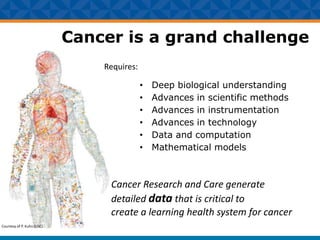
Cancer is a grand challenge
• Deep biological understanding
• Advances in scientific methods
• Advances in instrumentation
• Advances in technology
• Data and computation
• Mathematical models
Cancer Research and Care generate
detailed data that is critical to
create a learning health system for cancer
Requires:
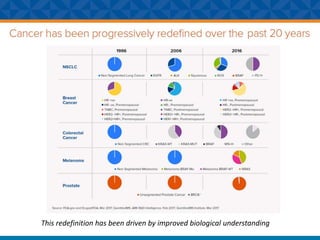
This redefinition has been driven by improved biological understanding
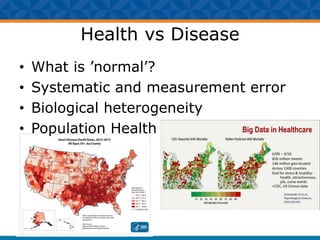
Health vs Disease
• What is ’normal’?
• Systematic and measurement error
• Biological heterogeneity
• Population Health
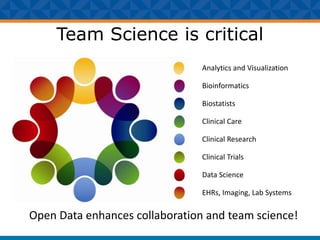
Team Science is critical
Clinical Trials
Biostatists
Bioinformatics
Clinical Care
Clinical Research
EHRs, Imaging, Lab Systems
Data Science
Analytics and Visualization
Open Data enhances collaboration and team science!
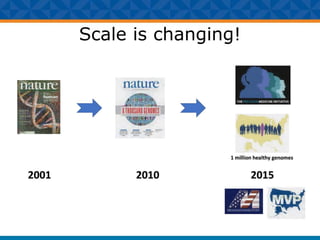
Scale is changing!
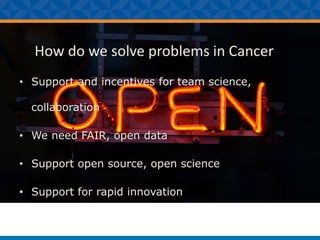
How do we solve problems in Cancer
• Support and incentives for team science,
collaboration
• We need FAIR, open data
• Support open source, open science
• Support for rapid innovation
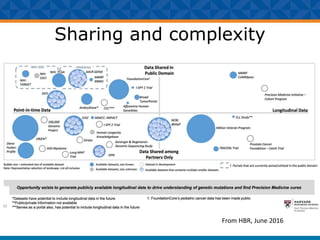
From HBR, June 2016
Sharing and complexity
Data Liquidity
• Data that is electronic ‘at birth’ is
ideal. Lab data, sensor data, modern
imaging
• Manual annotation reduces liquidity,
stops scaling, automation
• Manual processes are an investment
– one to carefully make
Asking pathologists, nurses, clinicians, care team members to
denote outcomes already present in labs, images, automated or
automatable feeds introduces costs, errors, and impedes scaling
Machine Learning
• Large data sets, particularly
population-based with a well-
annotated comparator set, are ideal
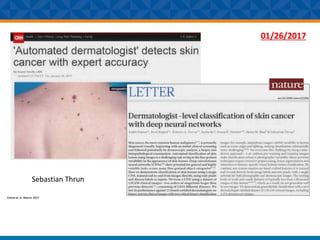
• Machine Learning and Deep Learning
on image features is feasible,
accurate, reproducible and scalable
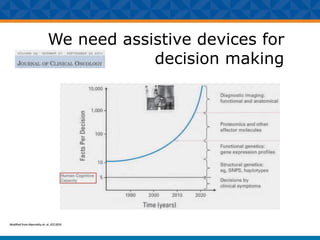
We need assistive devices for
decision making
Sebastian Thrun
Biology and Medicine are now
data intensive enterprises
Scale is rapidly changing
Technology, data, computing and
IT are pervasive in the lab, the
clinic, in the home, and across the
population
Data liquidity in healthcare is key
Questions?
Warren Kibbe, Ph.D.
warren.kibbe@duke.edu
@wakibbe

Lessons learned in scaling up

  • 1.
    Lessons Learned inScaling up – Implications for LHSs Warren A. Kibbe, Ph.D. Professor, Biostats & Bioinformatics Chief Data Officer, Duke Cancer Institute warren.kibbe@duke.edu @wakibbe
  • 2.
    Take homes • Datashould be liquid • Data sharing needs to scale • Consent is a process • Precision Medicine means many common diseases will be a collection of rare diseases We need to learn from every patient
  • 3.
    (10,000+ patient tumorsand increasing) Courtesy of P. Kuhn (USC) 2006-2015: A Decade of Illuminating the Underlying Causes of Primary Untreated Tumors Omics Characterization Cancer is a grand challenge • Deep biological understanding • Advances in scientific methods • Advances in instrumentation • Advances in technology • Data and computation • Mathematical models Cancer Research and Care generate detailed data that is critical to create a learning health system for cancer Requires:
  • 4.
    This redefinition hasbeen driven by improved biological understanding
  • 5.
    Health vs Disease •What is ’normal’? • Systematic and measurement error • Biological heterogeneity • Population Health
  • 6.
    Team Science iscritical Clinical Trials Biostatists Bioinformatics Clinical Care Clinical Research EHRs, Imaging, Lab Systems Data Science Analytics and Visualization Open Data enhances collaboration and team science!
  • 7.
  • 8.
    How do wesolve problems in Cancer • Support and incentives for team science, collaboration • We need FAIR, open data • Support open source, open science • Support for rapid innovation
  • 9.
    From HBR, June2016 Sharing and complexity
  • 10.
    Data Liquidity • Datathat is electronic ‘at birth’ is ideal. Lab data, sensor data, modern imaging • Manual annotation reduces liquidity, stops scaling, automation • Manual processes are an investment – one to carefully make Asking pathologists, nurses, clinicians, care team members to denote outcomes already present in labs, images, automated or automatable feeds introduces costs, errors, and impedes scaling
  • 11.
    Machine Learning • Largedata sets, particularly population-based with a well- annotated comparator set, are ideal • Machine Learning and Deep Learning on image features is feasible, accurate, reproducible and scalable
  • 12.
    We need assistivedevices for decision making
  • 13.
  • 14.
    Biology and Medicineare now data intensive enterprises Scale is rapidly changing Technology, data, computing and IT are pervasive in the lab, the clinic, in the home, and across the population Data liquidity in healthcare is key
  • 15.

Editor's Notes

  • #5 +ve –ve protein expression levels, ALK- Anaplastic lymphoma kinase, Squamous is a cell type (epidermoid),
  • #6 We now have tools to let us both understand social determinants of health and build ‘early warning systems’ to identify people who are have acute medical issues
  • #8 The scale of genomics, population science and data science is dramatically changing!
  • #13 But people can make effective decisions on the same number of factors…
  • #14 How can we use machine learning and other techniques to reduce cognitive overload?