Dr.Samin Sameed
Psychiatrist, KIMS HOSPITAL KOCHI,Kerala
contact- 9743474568
 Cannabinoids are a group of chemicals which activate
the body’s cannabinoid receptors.
Endogenous Herbal Synthetic
History
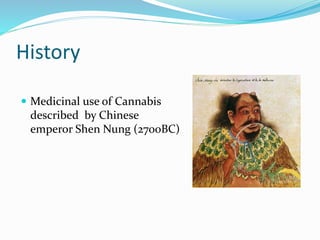
 Medicinal use of Cannabis
described by Chinese
emperor Shen Nung (2700BC)
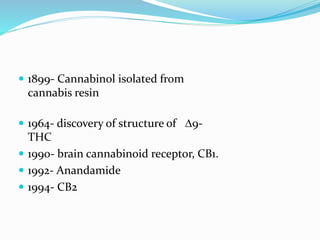
 1899- Cannabinol isolated from
cannabis resin
 1964- discovery of structure of D9-
THC
 1990- brain cannabinoid receptor, CB1.
 1992- Anandamide
 1994- CB2
 1994- Rimonabant –CB1 blocker.
 1995- 2-AG
 1996- FAAH discovered.
Raphael Mechoulam and Yeheel
Gaoni
Raphael Mechoulam
Getting high!
 Cannabis acting on a neural pathway involving
cannabinoids endogenous to the human brain
ENDOCANNABINOIDS
 THC acid is the
predominant form of the
plant THC, and this is
readily converted to THC
upon heating, such as
when cannabis is smoked.
 Estimates suggest that 20
to 80 µg of THC reach the
brain after one smokes a
marijuana cigarette
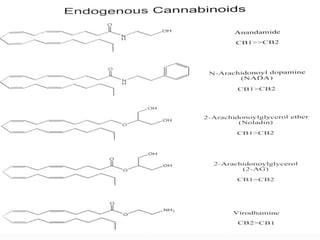
Endocannabinoids
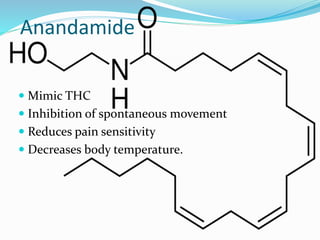
Anandamide
 Mimic THC
 Inhibition of spontaneous movement
 Reduces pain sensitivity
 Decreases body temperature.
Others
 2-arachidonylglycerol (2-AG)
 N-arachidonyldopamine (NADA)
 2-arachidonoyl glycerol ether (noladin ether),
 Virodhamine
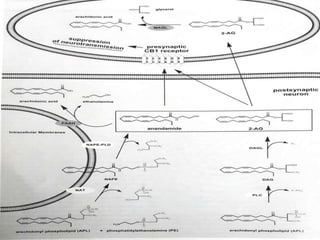
Bio synthesis
 Arachidonic acid -building block
 Endocannabinoids are not stored in synaptic vesicles for
later use, but are synthesized on demand
 Endocannabinoids are highly lipophilic and thus poorly
soluble in cerebrospinal fluid (CSF)
 Converts anandamide to arachidonic acid and
ethanolamine
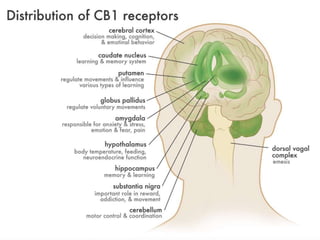
 Found in regions of the brain where CB1 receptors are
predominant
 Inhibitors of FAAH -analgesic effects and reduce anxiety in
animal models,
Cannabinoid receptors
 CB1 receptors
 axons and nerve termini, with little present on neuronal
dendrites and the cell body.
 presynaptic rather than postsynaptic side of the neuronal
cleft .
 CB2 - expressed on the surface of white blood cells of the
immune system,
Cannabinoid mechanisms
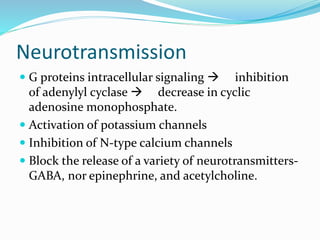
Neurotransmission
 G proteins intracellular signaling  inhibition
of adenylyl cyclase  decrease in cyclic
adenosine monophosphate.
 Activation of potassium channels
 Inhibition of N-type calcium channels
 Block the release of a variety of neurotransmitters-
GABA, nor epinephrine, and acetylcholine.
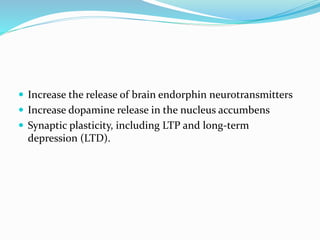
 Increase the release of brain endorphin neurotransmitters
 Increase dopamine release in the nucleus accumbens
 Synaptic plasticity, including LTP and long-term
depression (LTD).

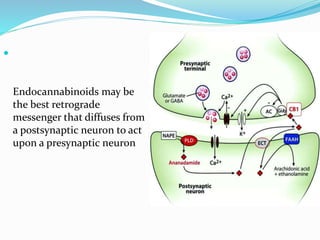
Endocannabinoids may be
the best retrograde
messenger that diffuses from
a postsynaptic neuron to act
upon a presynaptic neuron
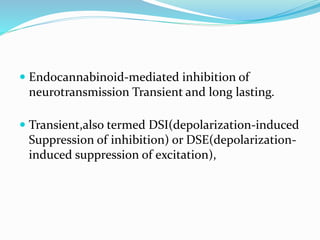
 Endocannabinoid-mediated inhibition of
neurotransmission Transient and long lasting.
 Transient,also termed DSI(depolarization-induced
Suppression of inhibition) or DSE(depolarization-
induced suppression of excitation),
Anxiety and Mood
 Tranquillizing effect
 Loss of signaling by the
endocannabinoid system appears
to promote anxiety-like states.
 Anandamide and 2-AG were
found to increase in the
amygdala immediately following
exposure of mice to stress
 Enhancing levels of endocannabinoids may represent a
therapeutic target for anxiety
 Novel FAAH inhibitors reduce anxiety-like behaviors
 Cannabinoid interacts with 5HT1A receptors and this
interaction seems to be involved in its anxiolytic-like
effects
CB1 Antagonist-Rimonabant
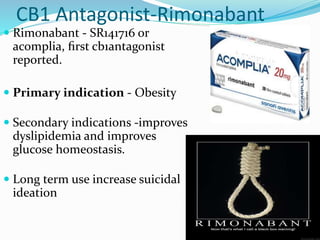
 Rimonabant - SR141716 or
acomplia, first cb1antagonist
reported.
 Primary indication - Obesity
 Secondary indications -improves
dyslipidemia and improves
glucose homeostasis.
 Long term use increase suicidal
ideation
 CB1 receptor activation enhance alcohol consumption while
blocking these receptors decreases consumption
 The usefulness of CB1 antagonism in smoking cessation has
been investigated in the STRATUS-US trial
Addiction
 Mice deficient in CB1 receptors - resistant
to the behavioral effects of cannabinoids
 Increase the release of dopamine in the
nucleus accumbens,
 Rats with a preference to alcohol have
decreased FAAH activity
Psychosis
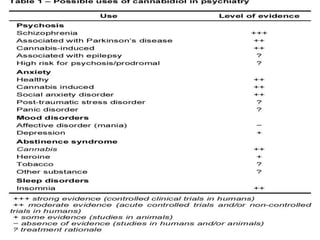
 Cannabis use -worsens psychosis in schizophrenia,
 Heavy use –schizophrenia
 Increase the release of dopamine
 Elevated levels of anandamide in CSF.
 Elevated CB1 receptor levels in postmortem brain -
dorsolateral prefrontal cortex and cingulate cortex
Feeding
 Increased appetite – “munchies”
 Depend on CB1 receptors
present in the hypothalamus
 CB1 receptor antagonist,
rimonabant, appears to
facilitate weight loss by blocking
cannabinoid signaling.
Brain Injury and Pain
 2-AG appears neuroprotective, reducing
brain edema, infarct size, and cell
death, while improving functional
outcomes.
 Regulate pain perception
 FAAH inhibitors improved motor
symptoms in a mouse model of
Parkinson's disease
 CB1 receptor plays an important role in these effects
as the analgesic effects of cannabinoid drugs are lost
when CB1 antagonist rimonabant is given
 Mediate stress-induced analgesia
Alzheimer’s disease
 Analysis of postmortem brains
from patients with AD-
Upregulation of CB2
receptors
endocannabinoid-degrading
enzyme,
fatty acid amide hydrolase
(FAAH) in glial cells
associated with senile Plaques.
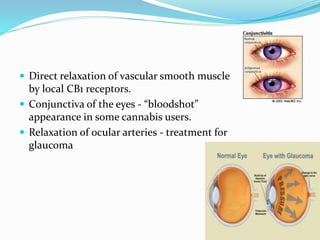
 Direct relaxation of vascular smooth muscle
by local CB1 receptors.
 Conjunctiva of the eyes - “bloodshot”
appearance in some cannabis users.
 Relaxation of ocular arteries - treatment for
glaucoma
 Synthetic 9 THC Dronabinol is approved in the US for
treatment of nausea and vomiting associated with
chemotherapy as well as an appetite stimulate in AIDS.
References
 108-115:James Sadock,Viginia Alcott Sadock.
Comprehensive text book of psychiatrty.
 10.1192/bjp.178.2.116 Published 1 February 2001
 Pharmacol Rev. 2006 Sep; 58(3): 389–462.
 Br J Pharmacol. 2012 Apr;165(8):2485-96. doi:
10.1111/j.1476-5381.2011.01445.x.
 Alexandre S. Crippa, Antonio Waldo Zuardi, Jaime E. C.
Hallak:Therapeutical use of the cannabinoids in psychiatry
 Kenmackie;cannabinoid receptors as therapeutic targets
Endocannabinoids..

Endocannabinoids..

  • 1.
    Dr.Samin Sameed Psychiatrist, KIMSHOSPITAL KOCHI,Kerala contact- 9743474568
  • 2.
     Cannabinoids area group of chemicals which activate the body’s cannabinoid receptors. Endogenous Herbal Synthetic
  • 3.
    History  Medicinal useof Cannabis described by Chinese emperor Shen Nung (2700BC)
  • 4.
     1899- Cannabinolisolated from cannabis resin  1964- discovery of structure of D9- THC  1990- brain cannabinoid receptor, CB1.  1992- Anandamide  1994- CB2
  • 5.
     1994- Rimonabant–CB1 blocker.  1995- 2-AG  1996- FAAH discovered.
  • 6.
    Raphael Mechoulam andYeheel Gaoni Raphael Mechoulam
  • 7.
    Getting high!  Cannabisacting on a neural pathway involving cannabinoids endogenous to the human brain ENDOCANNABINOIDS
  • 8.
     THC acidis the predominant form of the plant THC, and this is readily converted to THC upon heating, such as when cannabis is smoked.  Estimates suggest that 20 to 80 µg of THC reach the brain after one smokes a marijuana cigarette
  • 9.
  • 10.
    Anandamide  Mimic THC Inhibition of spontaneous movement  Reduces pain sensitivity  Decreases body temperature.
  • 11.
    Others  2-arachidonylglycerol (2-AG) N-arachidonyldopamine (NADA)  2-arachidonoyl glycerol ether (noladin ether),  Virodhamine
  • 13.
    Bio synthesis  Arachidonicacid -building block  Endocannabinoids are not stored in synaptic vesicles for later use, but are synthesized on demand  Endocannabinoids are highly lipophilic and thus poorly soluble in cerebrospinal fluid (CSF)
  • 14.
     Converts anandamideto arachidonic acid and ethanolamine  Found in regions of the brain where CB1 receptors are predominant  Inhibitors of FAAH -analgesic effects and reduce anxiety in animal models,
  • 15.
    Cannabinoid receptors  CB1receptors  axons and nerve termini, with little present on neuronal dendrites and the cell body.  presynaptic rather than postsynaptic side of the neuronal cleft .  CB2 - expressed on the surface of white blood cells of the immune system,
  • 16.
  • 17.
    Neurotransmission  G proteinsintracellular signaling  inhibition of adenylyl cyclase  decrease in cyclic adenosine monophosphate.  Activation of potassium channels  Inhibition of N-type calcium channels  Block the release of a variety of neurotransmitters- GABA, nor epinephrine, and acetylcholine.
  • 18.
     Increase therelease of brain endorphin neurotransmitters  Increase dopamine release in the nucleus accumbens  Synaptic plasticity, including LTP and long-term depression (LTD).
  • 19.
     Endocannabinoids may be thebest retrograde messenger that diffuses from a postsynaptic neuron to act upon a presynaptic neuron
  • 20.
     Endocannabinoid-mediated inhibitionof neurotransmission Transient and long lasting.  Transient,also termed DSI(depolarization-induced Suppression of inhibition) or DSE(depolarization- induced suppression of excitation),
  • 22.
    Anxiety and Mood Tranquillizing effect  Loss of signaling by the endocannabinoid system appears to promote anxiety-like states.  Anandamide and 2-AG were found to increase in the amygdala immediately following exposure of mice to stress
  • 23.
     Enhancing levelsof endocannabinoids may represent a therapeutic target for anxiety  Novel FAAH inhibitors reduce anxiety-like behaviors  Cannabinoid interacts with 5HT1A receptors and this interaction seems to be involved in its anxiolytic-like effects
  • 24.
    CB1 Antagonist-Rimonabant  Rimonabant- SR141716 or acomplia, first cb1antagonist reported.  Primary indication - Obesity  Secondary indications -improves dyslipidemia and improves glucose homeostasis.  Long term use increase suicidal ideation
  • 25.
     CB1 receptoractivation enhance alcohol consumption while blocking these receptors decreases consumption  The usefulness of CB1 antagonism in smoking cessation has been investigated in the STRATUS-US trial
  • 26.
    Addiction  Mice deficientin CB1 receptors - resistant to the behavioral effects of cannabinoids  Increase the release of dopamine in the nucleus accumbens,  Rats with a preference to alcohol have decreased FAAH activity
  • 27.
    Psychosis  Cannabis use-worsens psychosis in schizophrenia,  Heavy use –schizophrenia  Increase the release of dopamine  Elevated levels of anandamide in CSF.  Elevated CB1 receptor levels in postmortem brain - dorsolateral prefrontal cortex and cingulate cortex
  • 28.
    Feeding  Increased appetite– “munchies”  Depend on CB1 receptors present in the hypothalamus  CB1 receptor antagonist, rimonabant, appears to facilitate weight loss by blocking cannabinoid signaling.
  • 29.
    Brain Injury andPain  2-AG appears neuroprotective, reducing brain edema, infarct size, and cell death, while improving functional outcomes.  Regulate pain perception  FAAH inhibitors improved motor symptoms in a mouse model of Parkinson's disease
  • 30.
     CB1 receptorplays an important role in these effects as the analgesic effects of cannabinoid drugs are lost when CB1 antagonist rimonabant is given  Mediate stress-induced analgesia
  • 31.
    Alzheimer’s disease  Analysisof postmortem brains from patients with AD- Upregulation of CB2 receptors endocannabinoid-degrading enzyme, fatty acid amide hydrolase (FAAH) in glial cells associated with senile Plaques.
  • 32.
     Direct relaxationof vascular smooth muscle by local CB1 receptors.  Conjunctiva of the eyes - “bloodshot” appearance in some cannabis users.  Relaxation of ocular arteries - treatment for glaucoma
  • 33.
     Synthetic 9THC Dronabinol is approved in the US for treatment of nausea and vomiting associated with chemotherapy as well as an appetite stimulate in AIDS.
  • 34.
    References  108-115:James Sadock,ViginiaAlcott Sadock. Comprehensive text book of psychiatrty.  10.1192/bjp.178.2.116 Published 1 February 2001  Pharmacol Rev. 2006 Sep; 58(3): 389–462.  Br J Pharmacol. 2012 Apr;165(8):2485-96. doi: 10.1111/j.1476-5381.2011.01445.x.  Alexandre S. Crippa, Antonio Waldo Zuardi, Jaime E. C. Hallak:Therapeutical use of the cannabinoids in psychiatry  Kenmackie;cannabinoid receptors as therapeutic targets

Editor's Notes

  • #3 Produced in human bodies, herbal present in cannabis,
  • #5 Anand-first endogenous brain endocannabinoid..
  • #6 Cb1 blockerdeveloped, 95, second endocannabinoid. 96-fatty acid amide hydrolase endocannabinoid degrading enzyme.
  • #7 1964- identified THC
  • #10 Greatest slectivity to CB1 receptor. anand-, folowed by NADA and noladin ether. Virodhamine prefers CB2 receptors and has only partial agonist activity at CB1. 2- AG no discrimination between CB1 and 2.
  • #11 Anandamide- mechoulam discovered-lipid produced endogenously in the brain that could activate cannabinoid receptors and function as neurotransmitter. Derived from sanskrit word ananda- translates as BLISS!
  • #13 Anandamide synth- 2 step process. The enzyme NAT transfers arachidonic acid chain from phospholipid (APL) to phosphatidylethanolamine, producing NAPE(N-arachidonyl phosphatidyl ethanolamine) a 2nd enzyme, NAPe-PLD generates anandamide., 2 Ag synthesized similarly in 2 steps by enzymes PLC and DAGL. Dag(sn-1 acyl 2 arachidonyl glycerol Phospho lipase C. And dagl(diacyl glycerol lipases)
  • #14 Used as building block. Endocannabinoids cross the synaptic cleft to to act on cannabinoid receptors, a transporter is belived to help in this.
  • #15 Enzyme-Do not have the undesirable effects of THC
  • #16  CB 1- the most abundant G-protein coupled receptors in the brain Presyn-suggesting a role in regulation of neurotransmission. CB2- small amounts in the brain stem.
  • #17 Humans or animals who recive large doses of THC develop catalepsy, reduction of spontanos movt, unnatual postues,believed to be due to action of cannabinoids in basal ganglia. Cerebellum.
  • #18 Cb1 associated with G protiens, activation of cb1 also causes activation of potassium channels. And
  • #19 Implicated in , endogenous morphine") are endogenous opioid inhibitory neuropeptides nucleus accumbens - - reward center relevant to addiction and learning In neuroscience, synaptic plasticity is the ability of synapses to strengthen or weaken over time, in response to increases or decreases in their activity. Plastic change also results from the alteration of the number of neurotransmitter receptors located on asynapse. Long-term potentiation[edit] Long-term potentiation, commonly referred to as LTP, is an increase in synaptic response following potentiating pulses of electrical stimuli that sustains at a level above the baseline response for hours or longer.  Brief activation of an excitatory pathway can produce what is known as long-term depression (LTD) of synaptic transmission in many areas of the brain. LTD is induced by a minimum level of postsynaptic depolarization and simultaneous increase in the intracellular calcium concentration at the postsynaptic neuron
  • #20 A typical presynaptic neuron containing dopamine or glutamate releases its nT, leading to depolarization of the post synaptic neuron. The second neuron can release endocannabinoid which diffuses across the synaptic cleft and inhibits further neurotransmitter release from presynaptic neuron.
  • #21 relies on generation of endocannabinoids following increases in intracellular Calcium, Short duration, lasting tens of seconds,localized
  • #23 Endocannabinoid ntmission regulator of anxiety?, in animals, CB1 receptor-deficient animals exhibit more pronounced anxiety behavior when expose D, tone shock- amouse model employed when tone coupled with shock, exp to tone, froze in anticipation of shock. Nolonger paired- extinction. Animals without cb1 – did not have this extinction- exp endocan nt mediate ability to forget anxiety associated wth painful memory.
  • #24 2. reduce the breakdown of anandamide and
  • #25 Cann recept blocker. Freq side effect- anxiety and depressiob
  • #26 CB1 receptor blockade may decrease the strength of specific environmental cues associated with receiving nicotine
  • #27 Have reduced addiction to and withdrawal from opiates Cb1 deficient animals decreased alcohol intake,
  • #28 Heavy use lead to development of, psychotic symptoms,or due to vulnerability? , accelerated development of schizophrenia.,? Signaling increase dopamine- which normalized with clinical improvement
  • #29 Foll drug ingestion- appetite stimulant ,endo cannob levels increase in hypothalamus and limbic system when animals deprived of food. Studies have shown that.
  • #30 Mouse models of traumatic brain injury. Chronic pain,. Neurotransmission via the endocannabinoid pathway is
  • #31 Stress assoc with decreased pain perception eg in military.
  • #32 The immunohistochemical Administration of Dronabinol (a pharmaceutical preparation based on THC) for six weeks has been recently reported as very useful for the treatment of both the severity of disturbed behaviour and anorexia in food-refusing patients with AD and other dementias
  • #33 Vasodialattaion extends to conjunctivaof eyes leading to blood shot appearance .