Patient adherence – what’s the problem?
John Weinman | Professor of Psychology as applied to medicine
King’s College London
John Weinman
Institute of Pharmaceutical Sciences,
Kings College London
PATIENT ADHERENCE
What’s the problem?
The problem of non-adherence
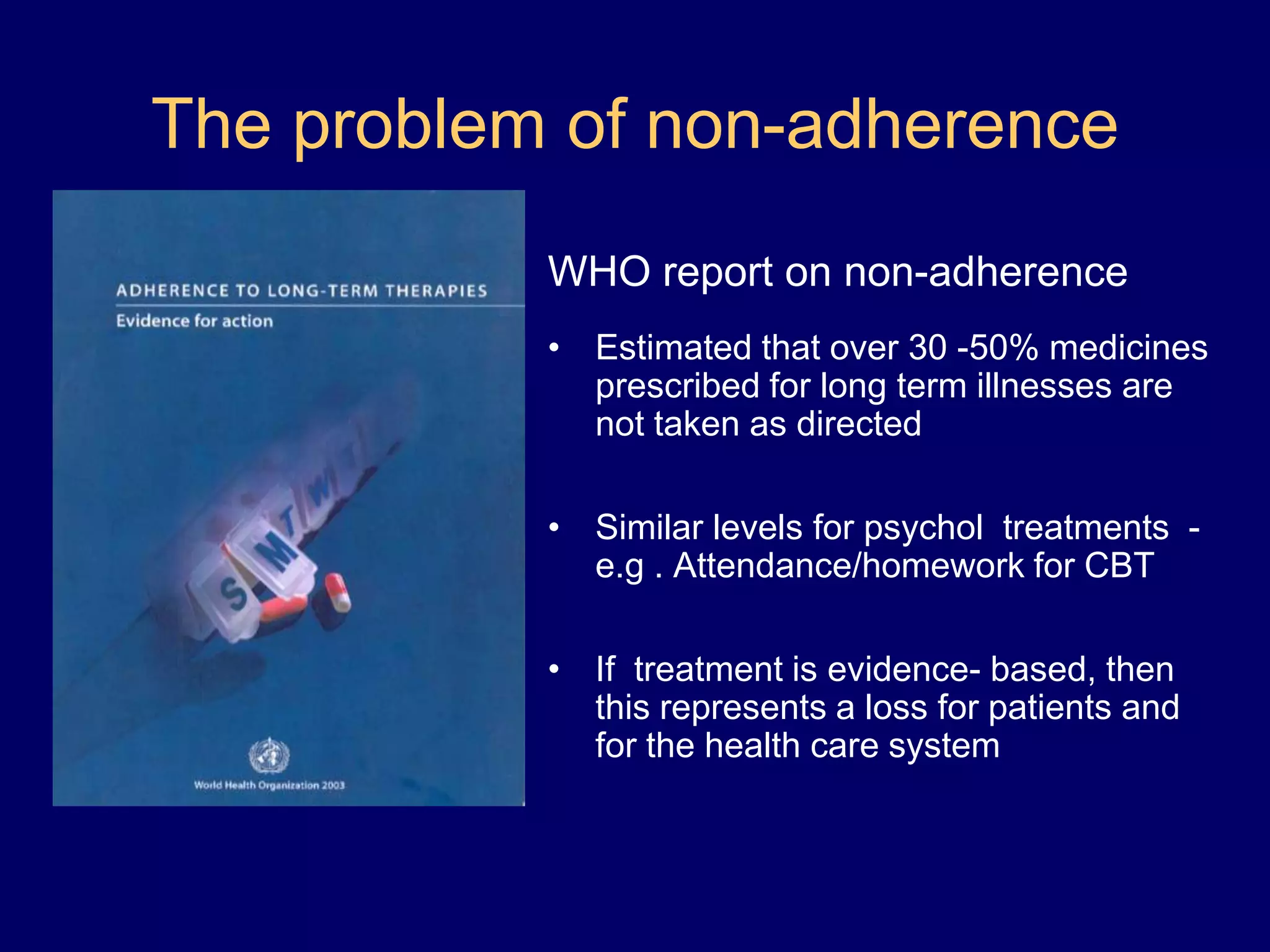
WHO report on non-adherence
• Estimated that over 30 -50% medicines
prescribed for long term illnesses are
not taken as directed
• Similar levels for psychol treatments -
e.g . Attendance/homework for CBT
• If treatment is evidence- based, then
this represents a loss for patients and
for the health care system
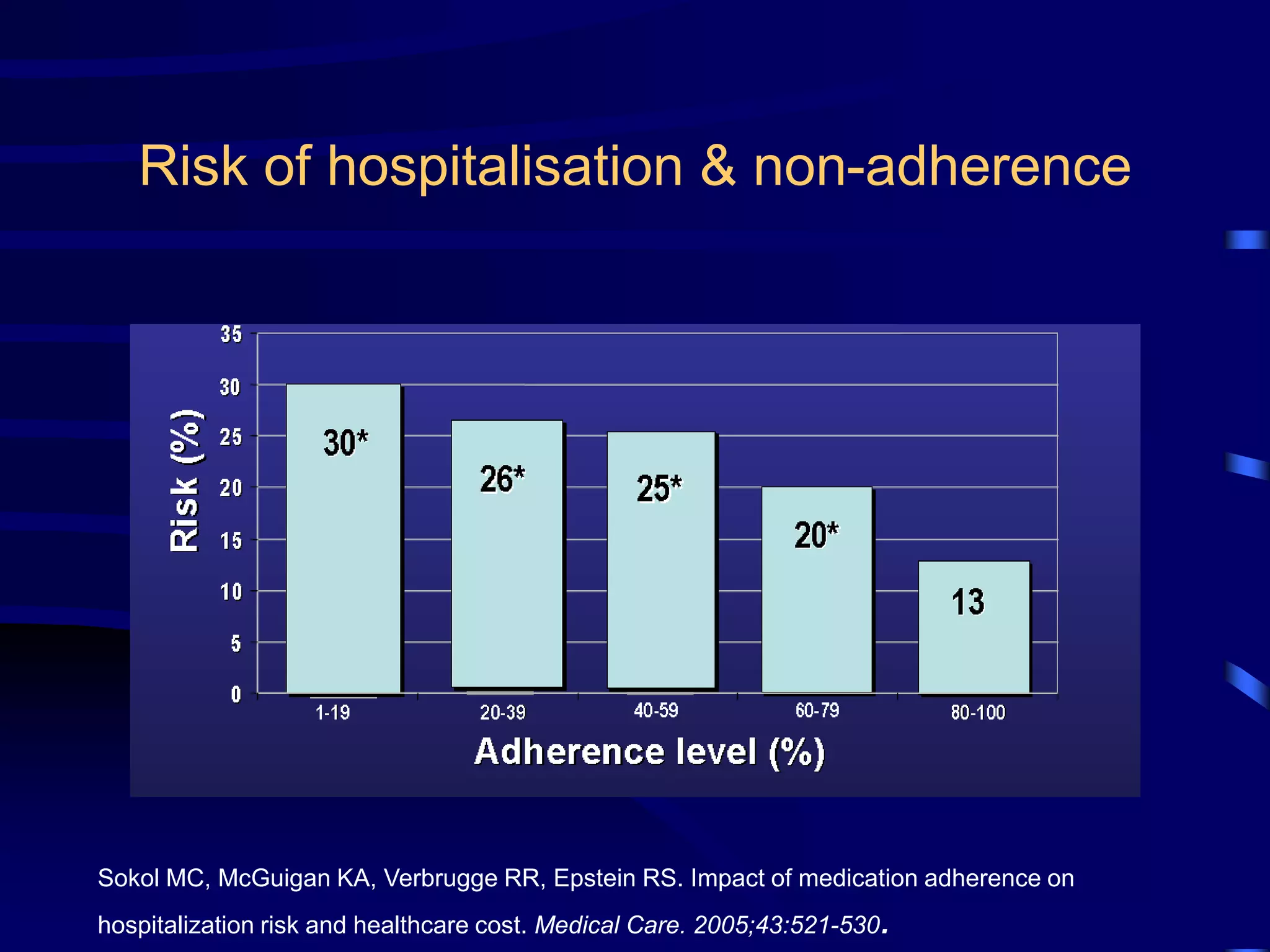
Risk of hospitalisation & non-adherence
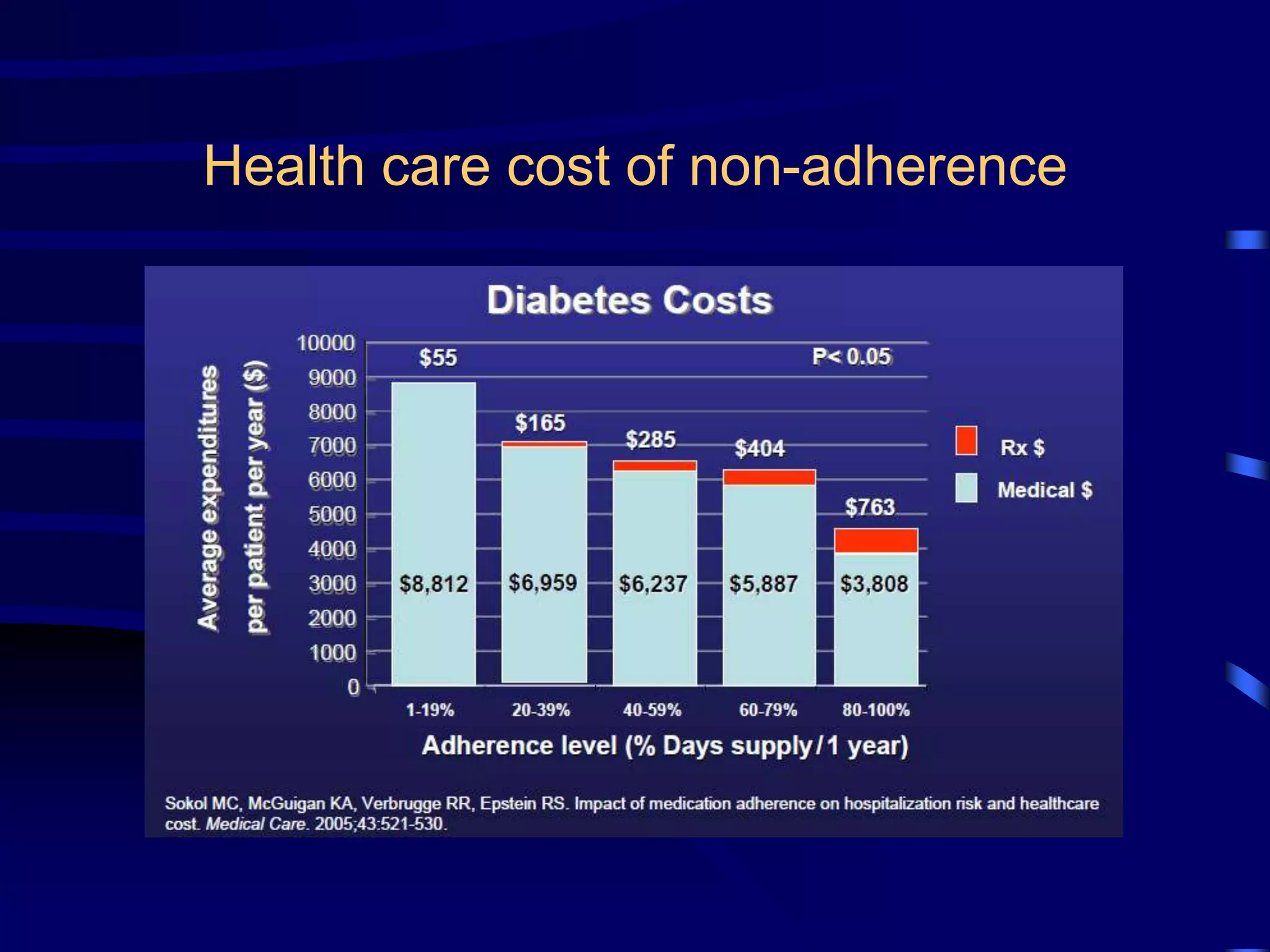
Sokol MC, McGuigan KA, Verbrugge RR, Epstein RS. Impact of medication adherence on
hospitalization risk and healthcare cost. Medical Care. 2005;43:521-530.
Health care cost of non-adherence
CAUSES
OF
NON-ADHERENCE
• Common myths
• Current evidence
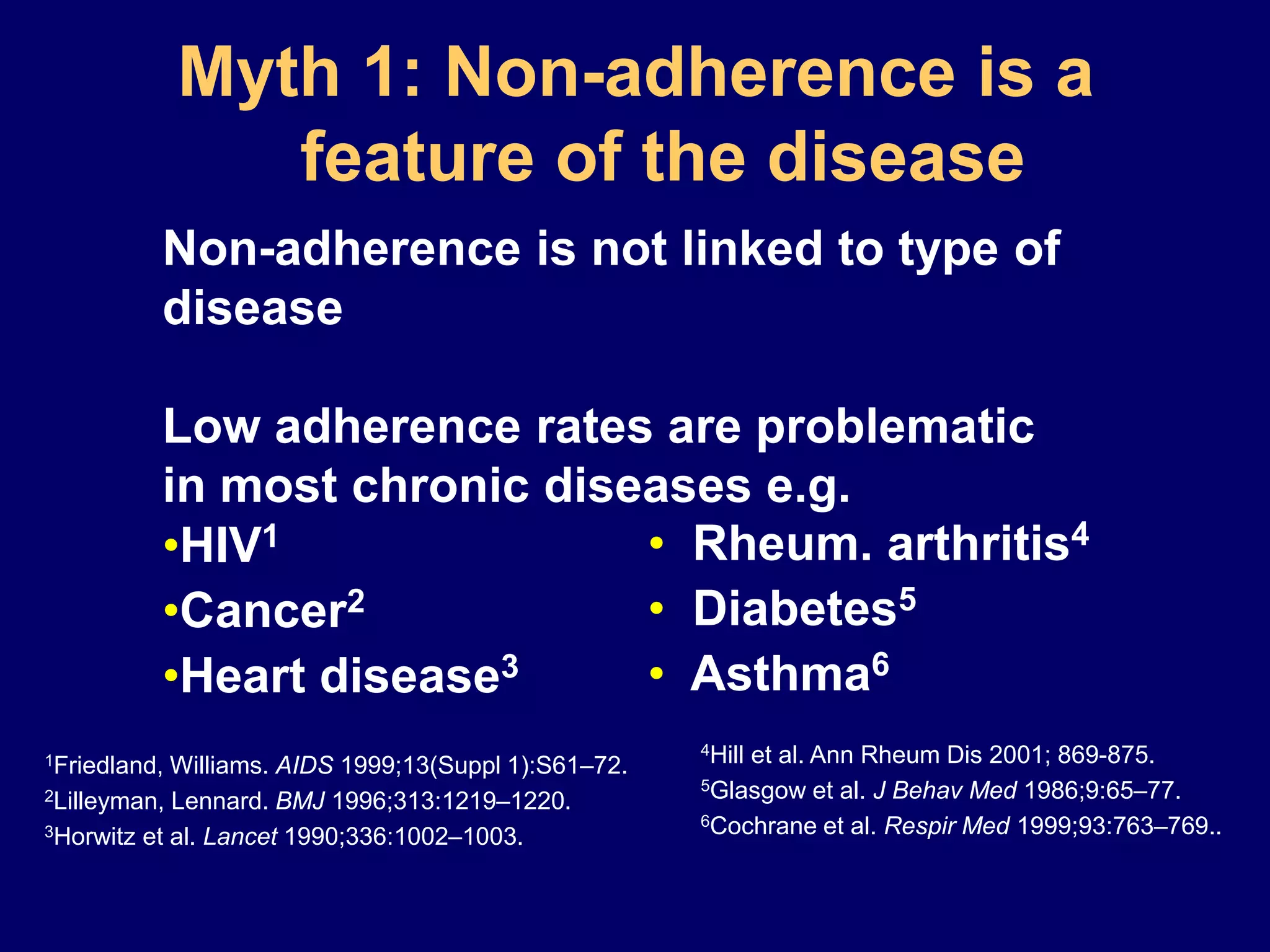
Myth 1: Non-adherence is a
feature of the disease
Non-adherence is not linked to type of
disease
Low adherence rates are problematic
in most chronic diseases e.g.
•HIV1
•Cancer2
•Heart disease3
1Friedland, Williams. AIDS 1999;13(Suppl 1):S61–72.
2Lilleyman, Lennard. BMJ 1996;313:1219–1220.
3Horwitz et al. Lancet 1990;336:1002–1003.
• Rheum. arthritis4
• Diabetes5
• Asthma6
4Hill et al. Ann Rheum Dis 2001; 869-875.
5Glasgow et al. J Behav Med 1986;9:65–77.
6Cochrane et al. Respir Med 1999;93:763–769..
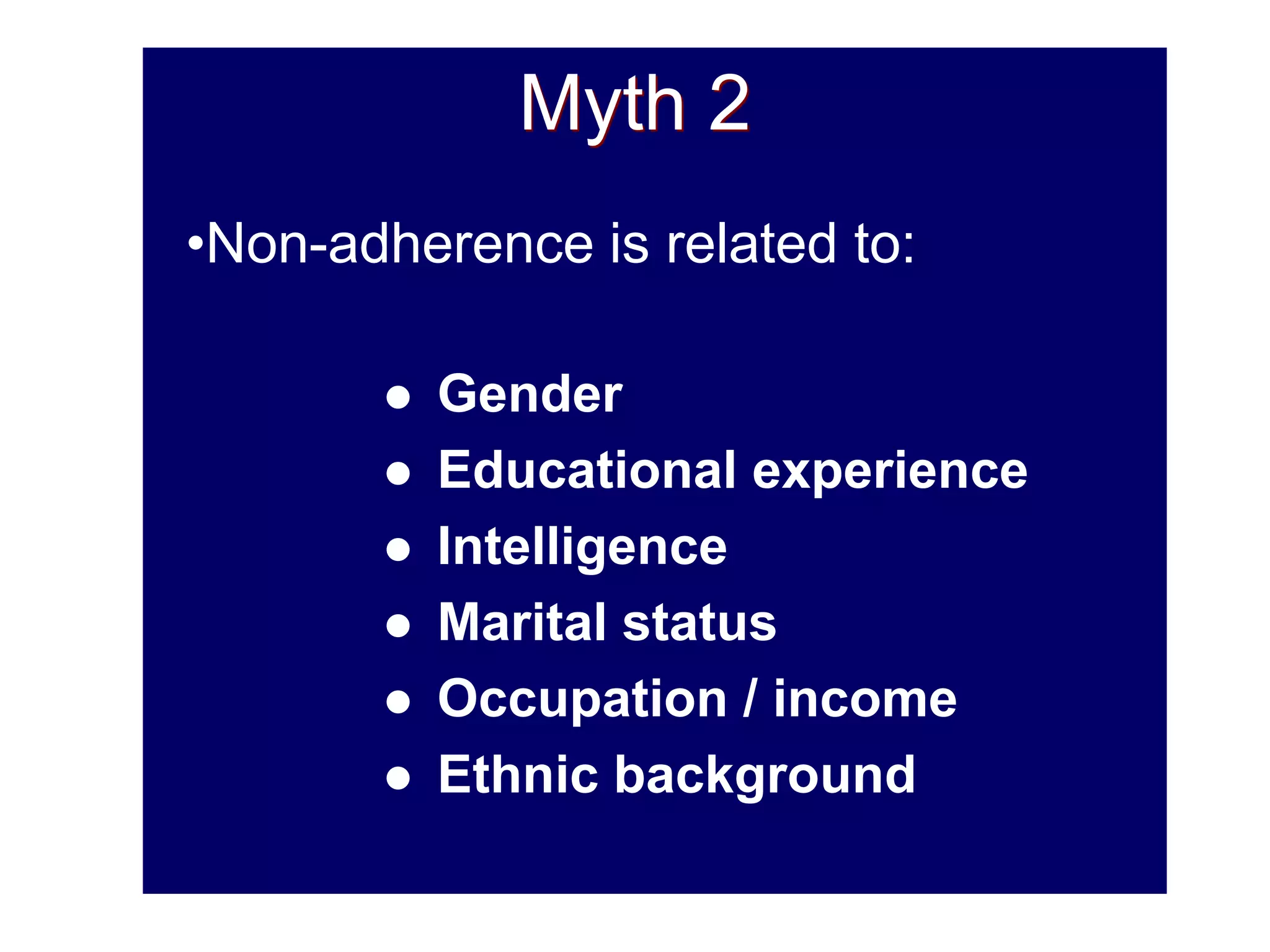
Myth 2
•Non-adherence is related to:
 Gender
 Educational experience
 Intelligence
 Marital status
 Occupation / income
 Ethnic background
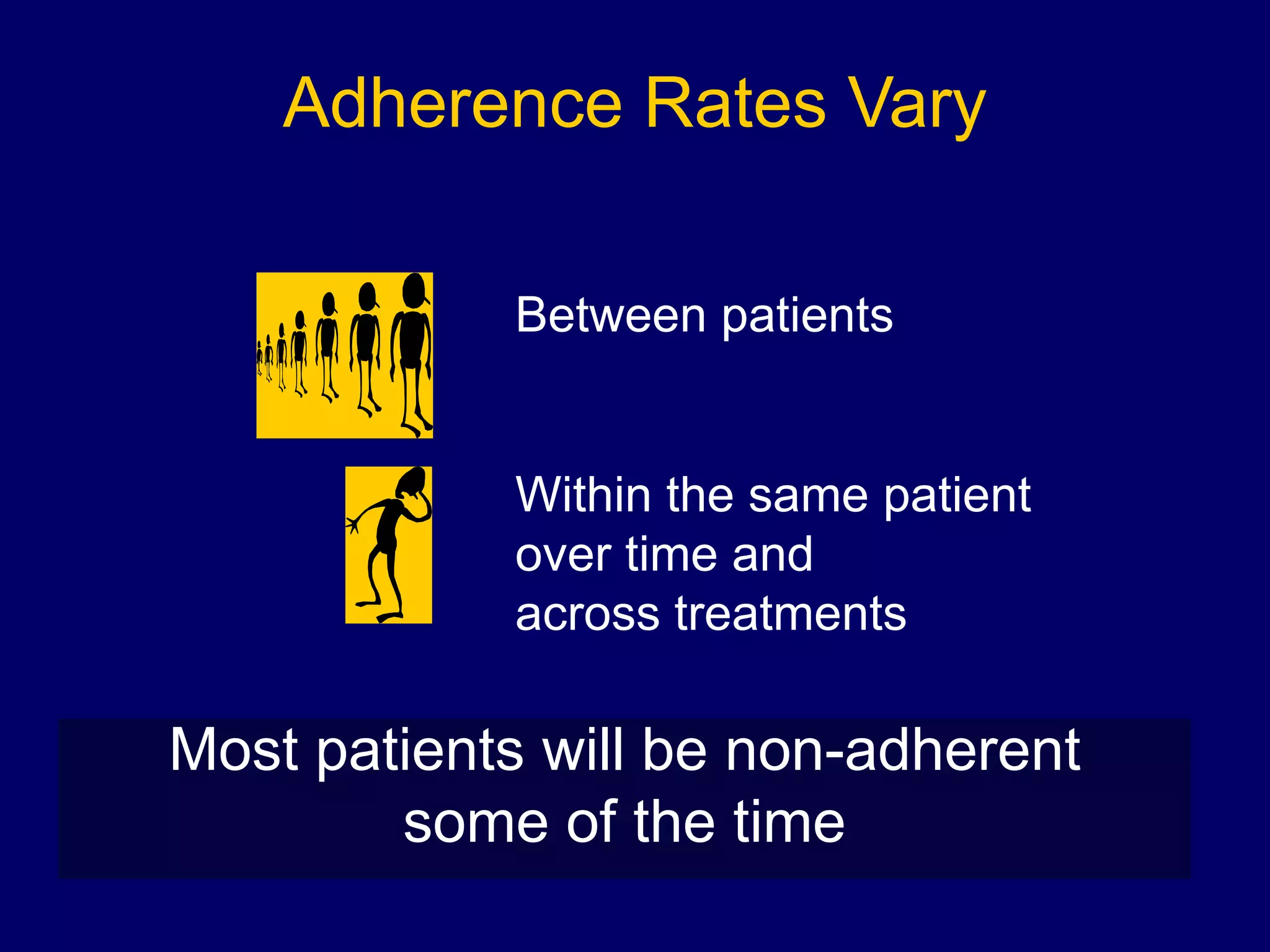
Most patients will be non-adherent
some of the time
Adherence Rates Vary
Between patients
Within the same patient
over time and
across treatments
Myth 3
•Non-adherence is easily fixed by : -
 Providing information
 Providing reminders
 Being authoritative
 Fear arousal
ADHERENCE INTERVENTIONS
Cochrane review:
Haynes et al (2008)
“Current methods of improving adherence are mostly
complex and not very effective, so that the full benefits
of treatment cannot be realized.
High priority should be given to fundamental and applied
research concerning innovations to assist patients to
follow medication prescriptions for long-term disorders”
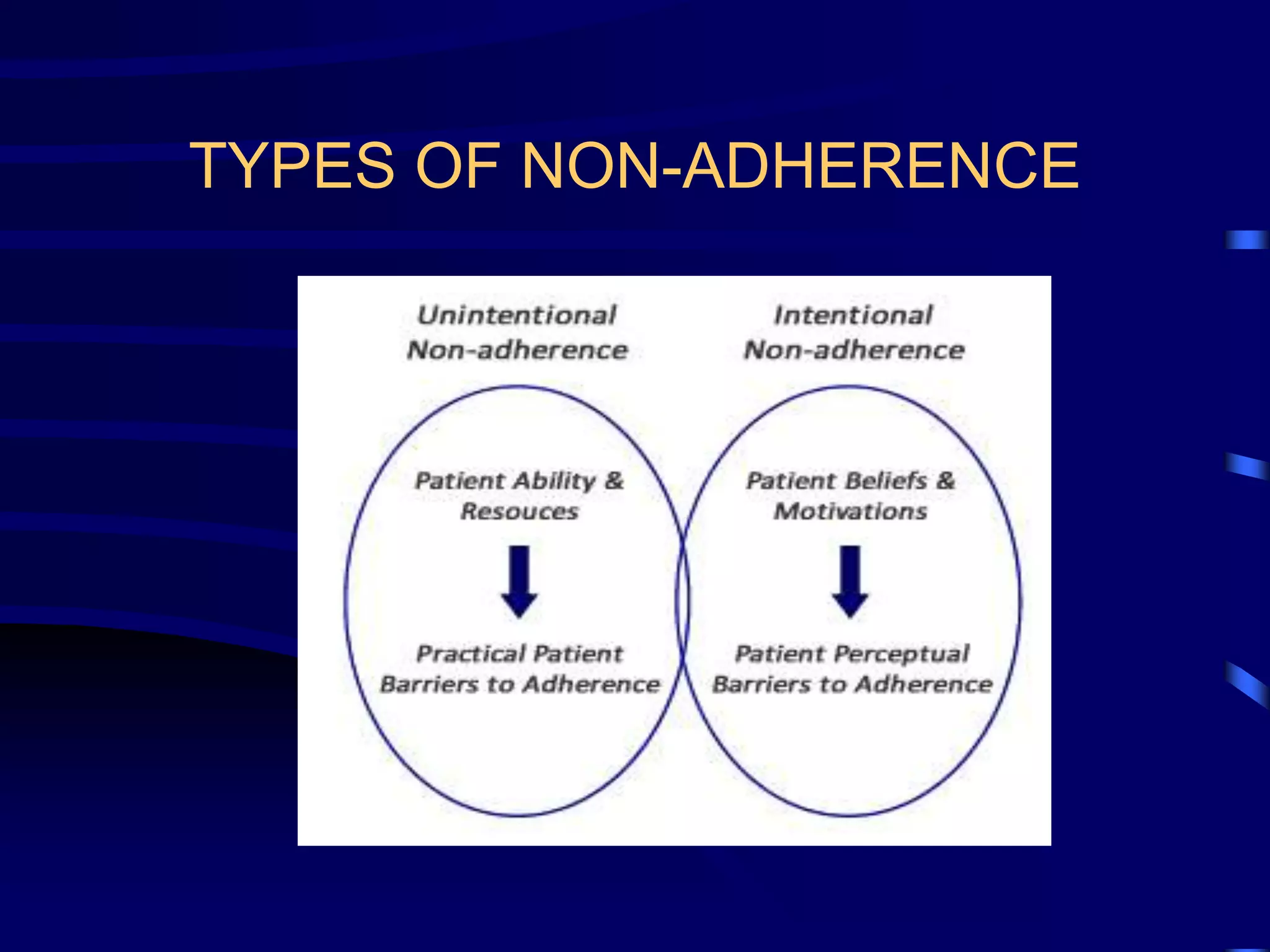
• Need to understand types and
causes of non-adherence
•Need to tailor interventions to take
account of this
•Develop & test theoretical models
TYPES OF NON-ADHERENCE
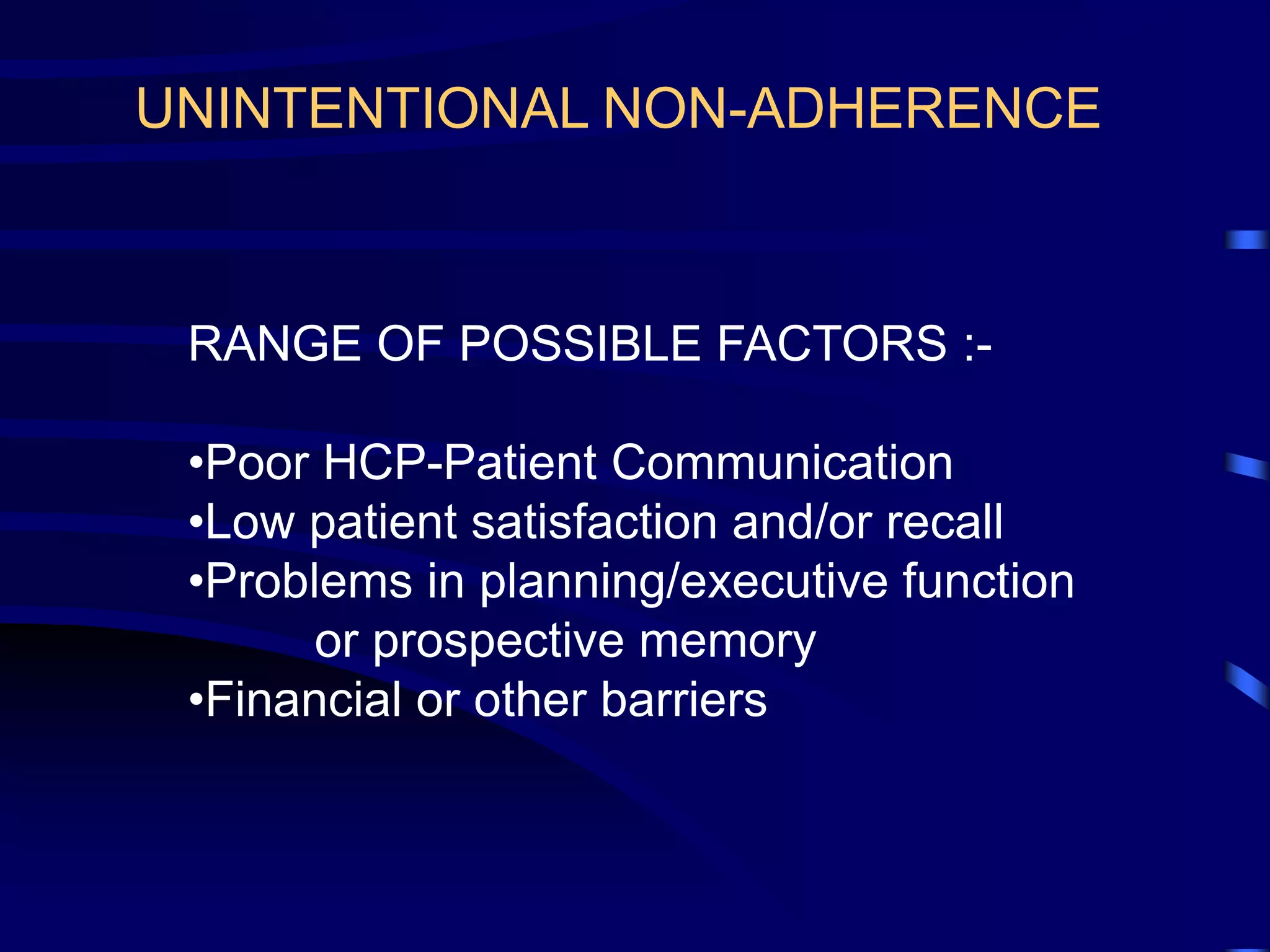
RANGE OF POSSIBLE FACTORS :-
•Poor HCP-Patient Communication
•Low patient satisfaction and/or recall
•Problems in planning/executive function
or prospective memory
•Financial or other barriers
UNINTENTIONAL NON-ADHERENCE
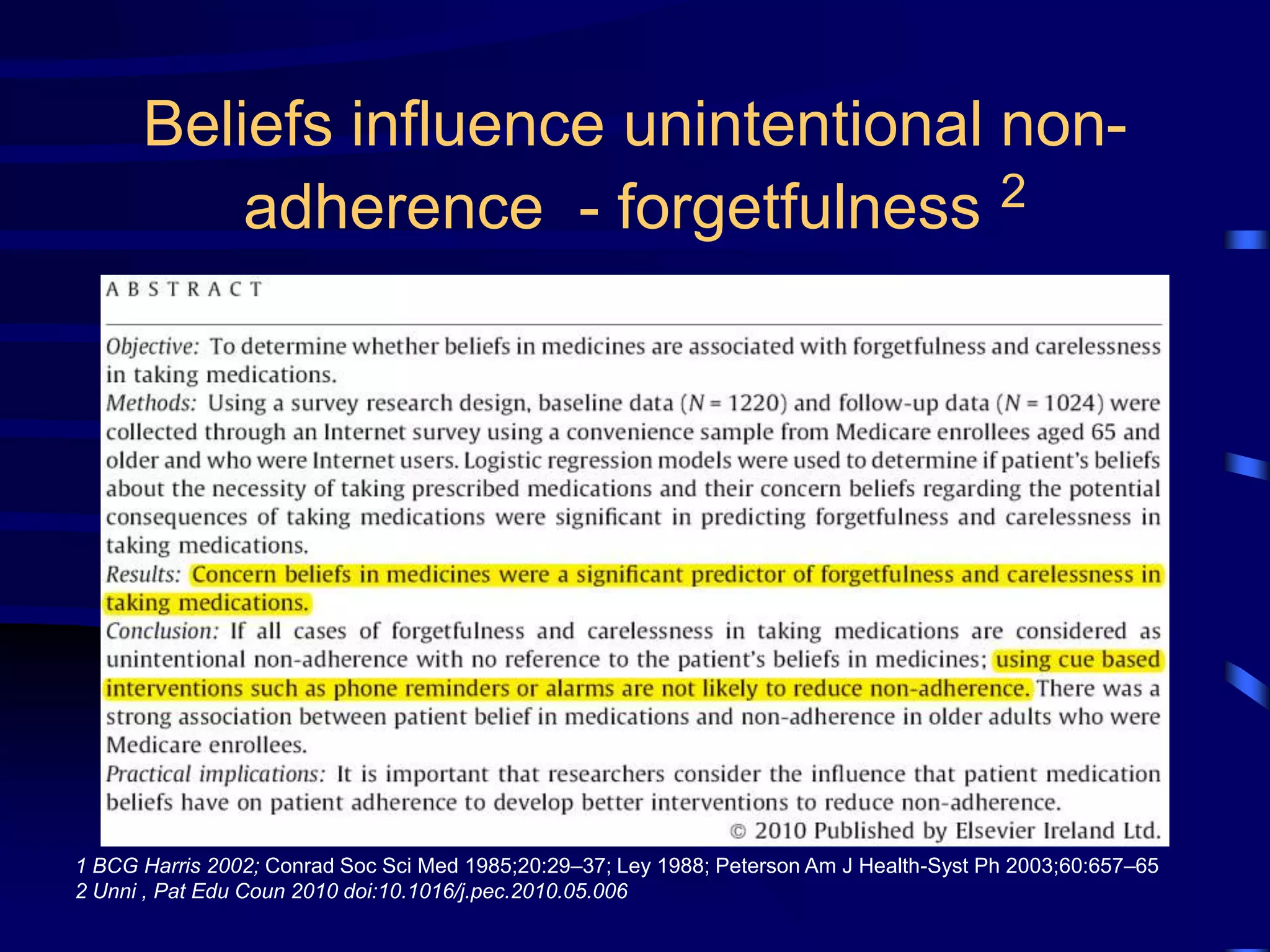
Beliefs influence unintentional non-
adherence - forgetfulness 2
1 BCG Harris 2002; Conrad Soc Sci Med 1985;20:29–37; Ley 1988; Peterson Am J Health-Syst Ph 2003;60:657–65
2 Unni , Pat Edu Coun 2010 doi:10.1016/j.pec.2010.05.006
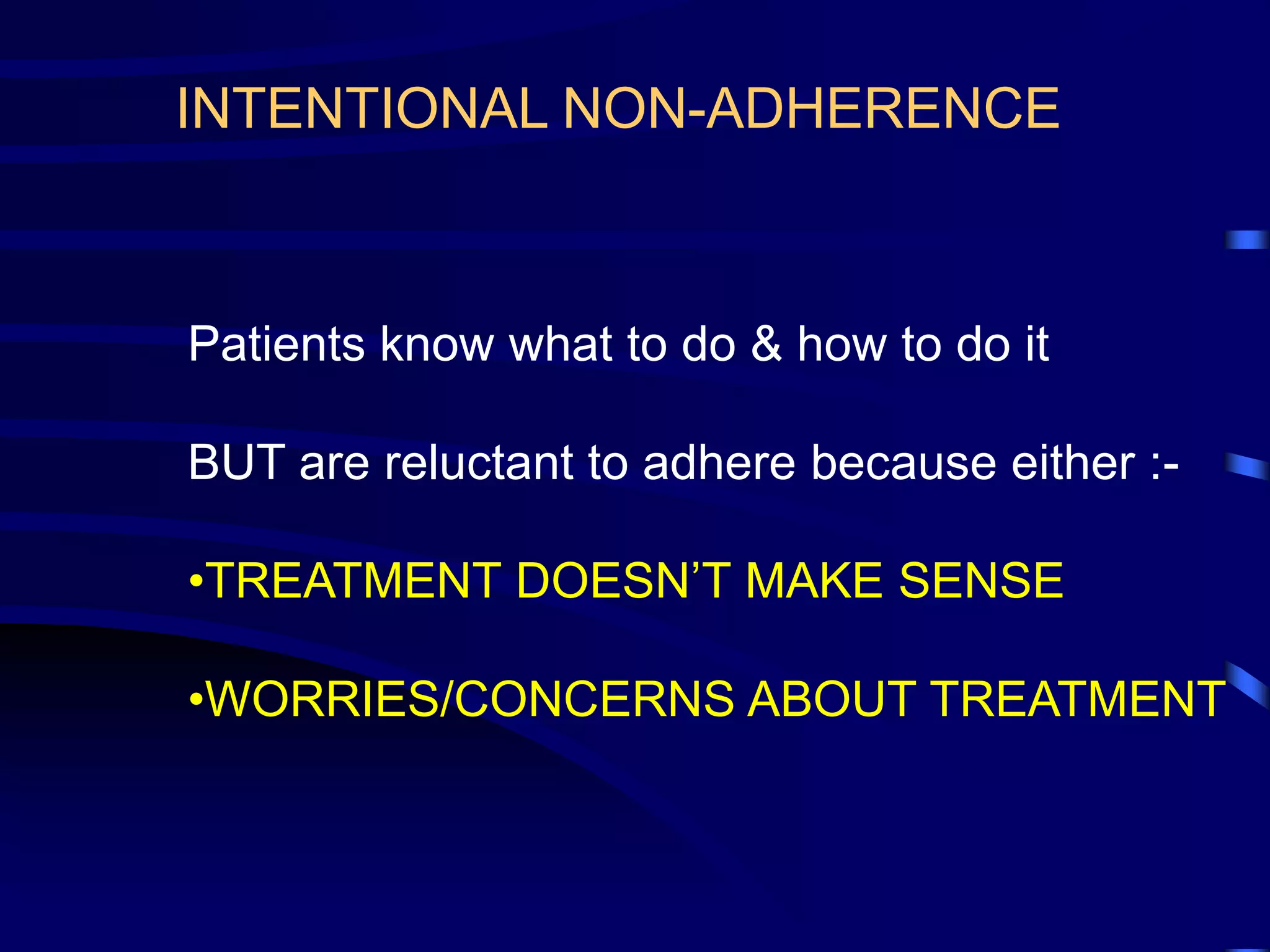
Patients know what to do & how to do it
BUT are reluctant to adhere because either :-
•TREATMENT DOESN’T MAKE SENSE
•WORRIES/CONCERNS ABOUT TREATMENT
INTENTIONAL NON-ADHERENCE
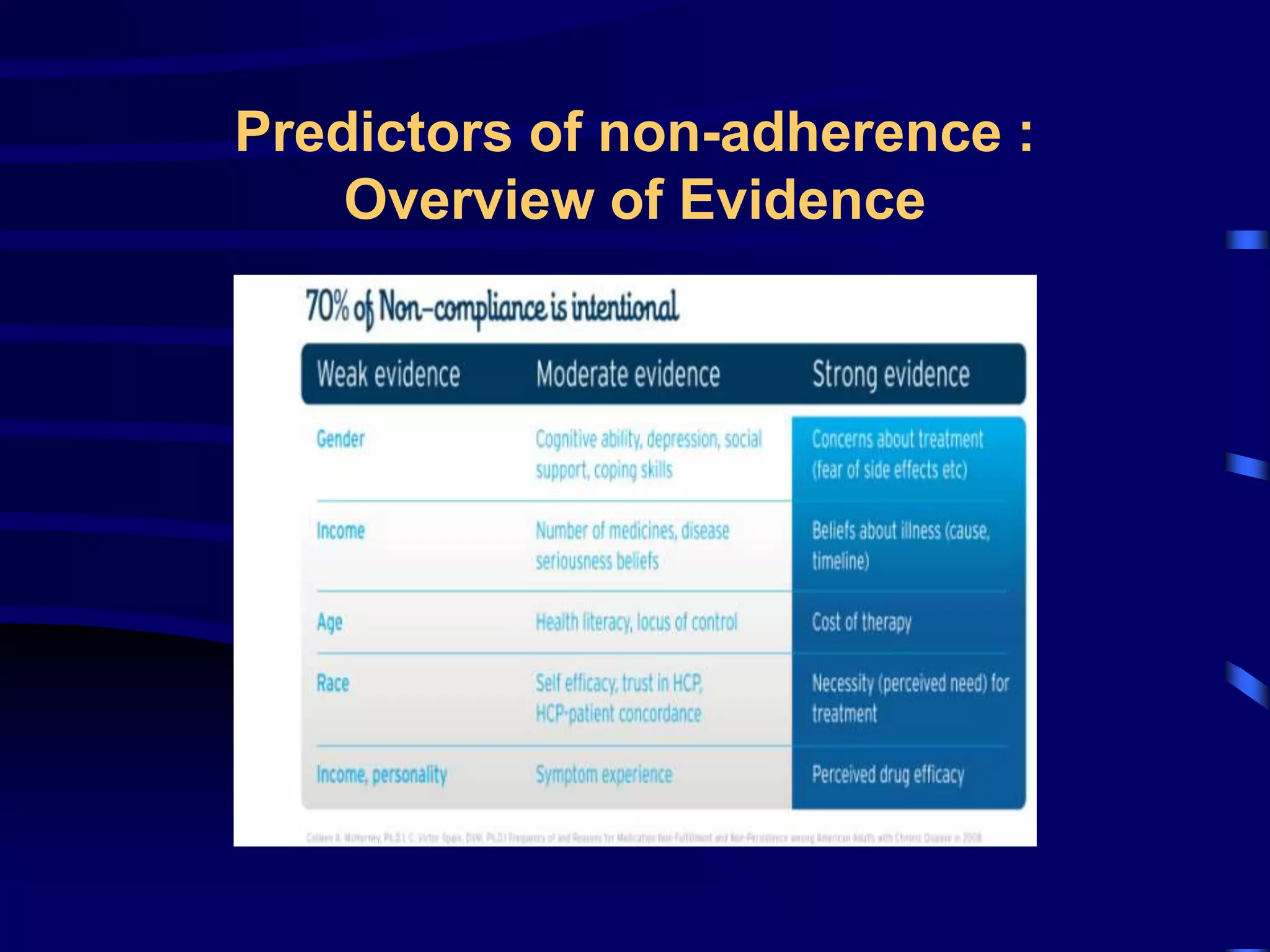
Predictors of non-adherence :
Overview of Evidence
What are the key beliefs
influencing adherence to
treatment?
1) Patients’ perceptions of illness
2) Patients’ perceptions of
treatment
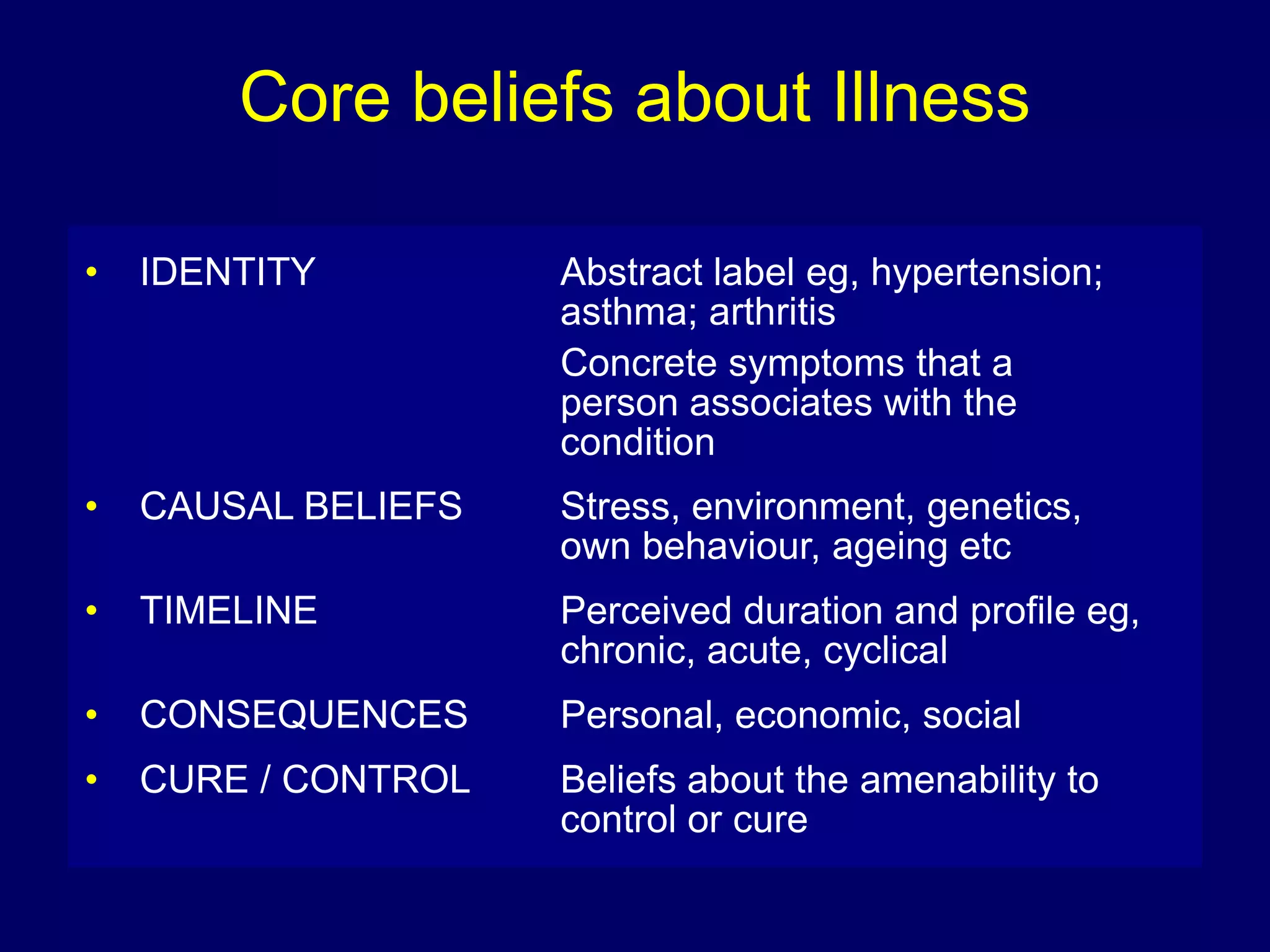
Core beliefs about Illness
• IDENTITY Abstract label eg, hypertension;
asthma; arthritis
Concrete symptoms that a
person associates with the
condition
• CAUSAL BELIEFS Stress, environment, genetics,
own behaviour, ageing etc
• TIMELINE Perceived duration and profile eg,
chronic, acute, cyclical
• CONSEQUENCES Personal, economic, social
• CURE / CONTROL Beliefs about the amenability to
control or cure
ILLNESS PERCEPTION &
treatment adherence
• Some illness perceptions are associated with
treatment adherence in some conditions :-
e.g. - causal beliefs predict adherence behaviour in post- MI
- timeline beliefs predict preventer medication
adherence in asthma etc
- causal, timeline & control beliefs predict adherence to
CBT for Psychosis (Freeman et al, in press)
• BUT – illness beliefs per se are not strong
predictors of treatment adherence – need to
consider more proximal predictors (ie
patients’ beliefs re. treatment)
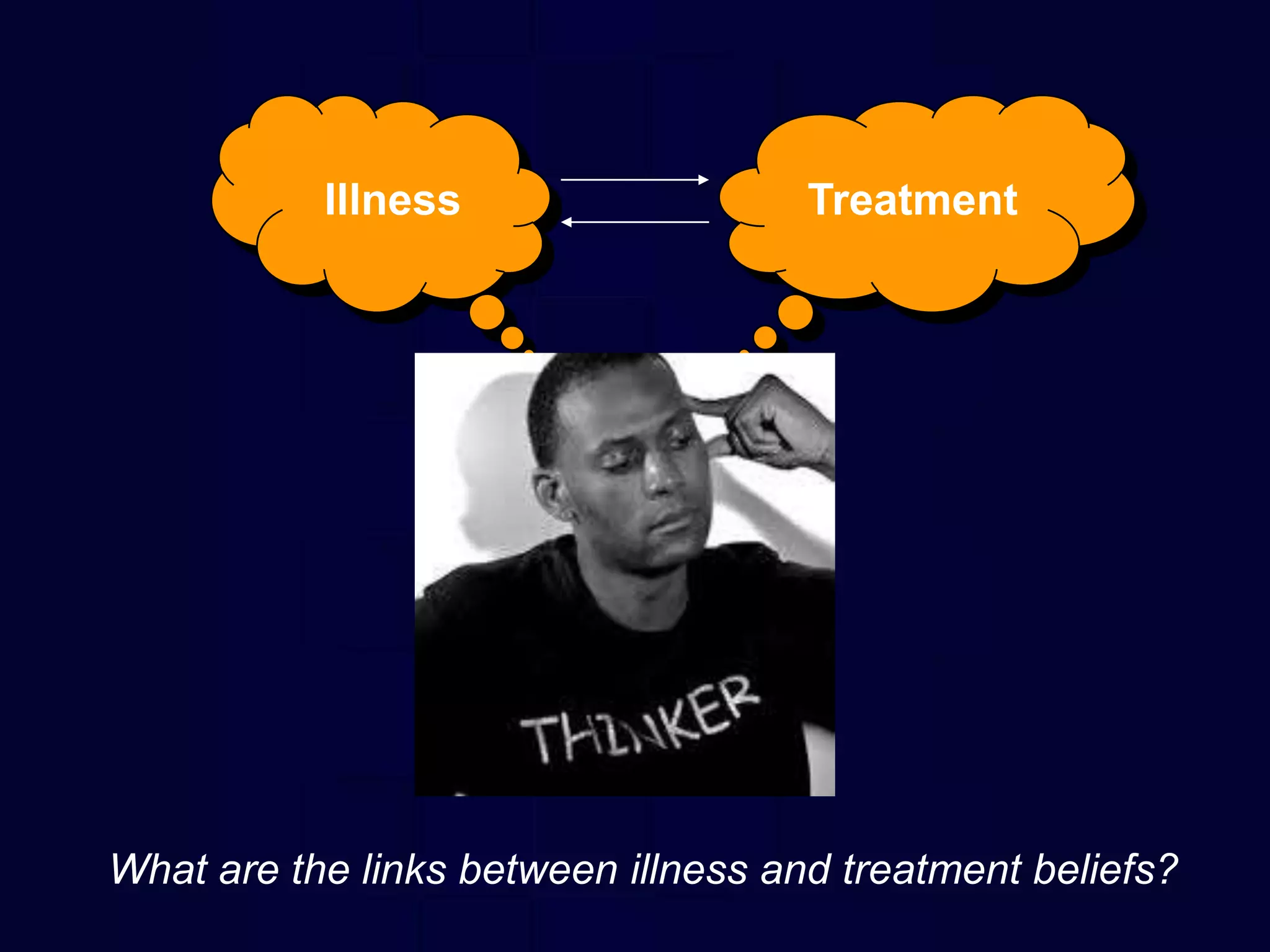
TreatmentIllness
What are the links between illness and treatment beliefs?
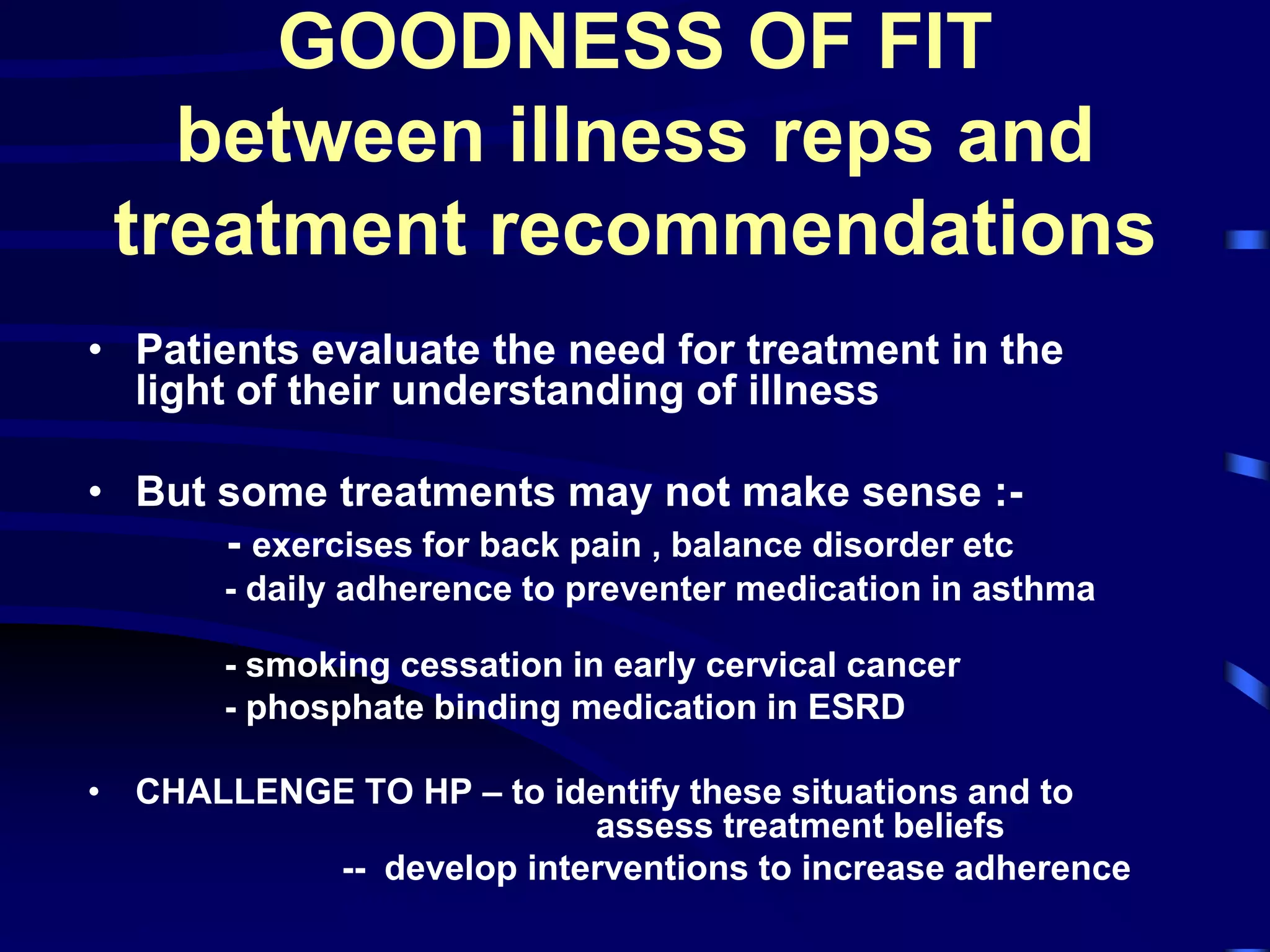
GOODNESS OF FIT
between illness reps and
treatment recommendations
• Patients evaluate the need for treatment in the
light of their understanding of illness
• But some treatments may not make sense :-
- exercises for back pain , balance disorder etc
- daily adherence to preventer medication in asthma
- smoking cessation in early cervical cancer
- phosphate binding medication in ESRD
• CHALLENGE TO HP – to identify these situations and to
assess treatment beliefs
-- develop interventions to increase adherence
goodness of fit and increase motivation to
adhere
TREATMENT BELIEFS:
What is the patient's perspective ?
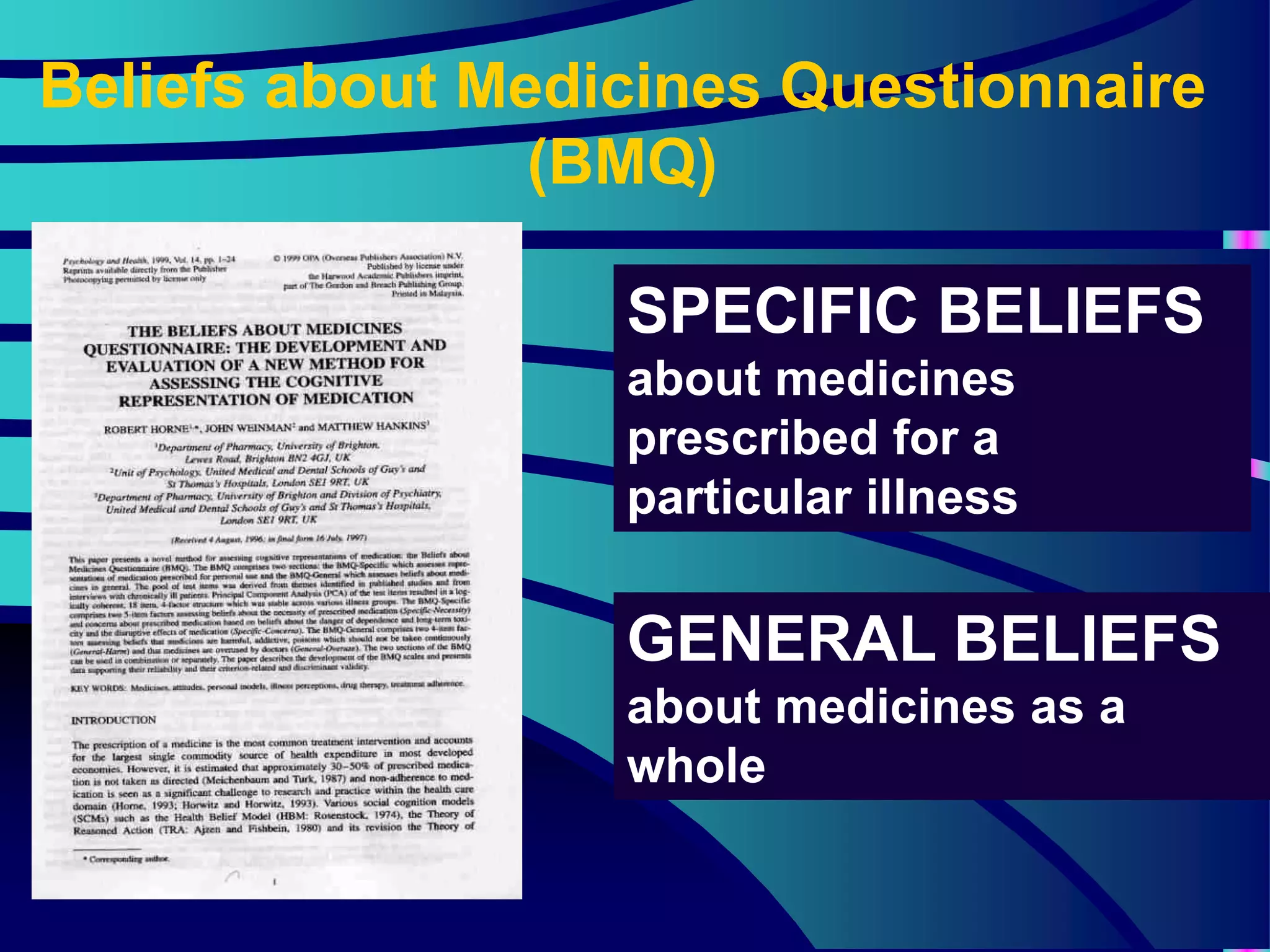
Beliefs about Medicines Questionnaire
(BMQ)
GENERAL BELIEFS
about medicines as a
whole
SPECIFIC BELIEFS
about medicines
prescribed for a
particular illness
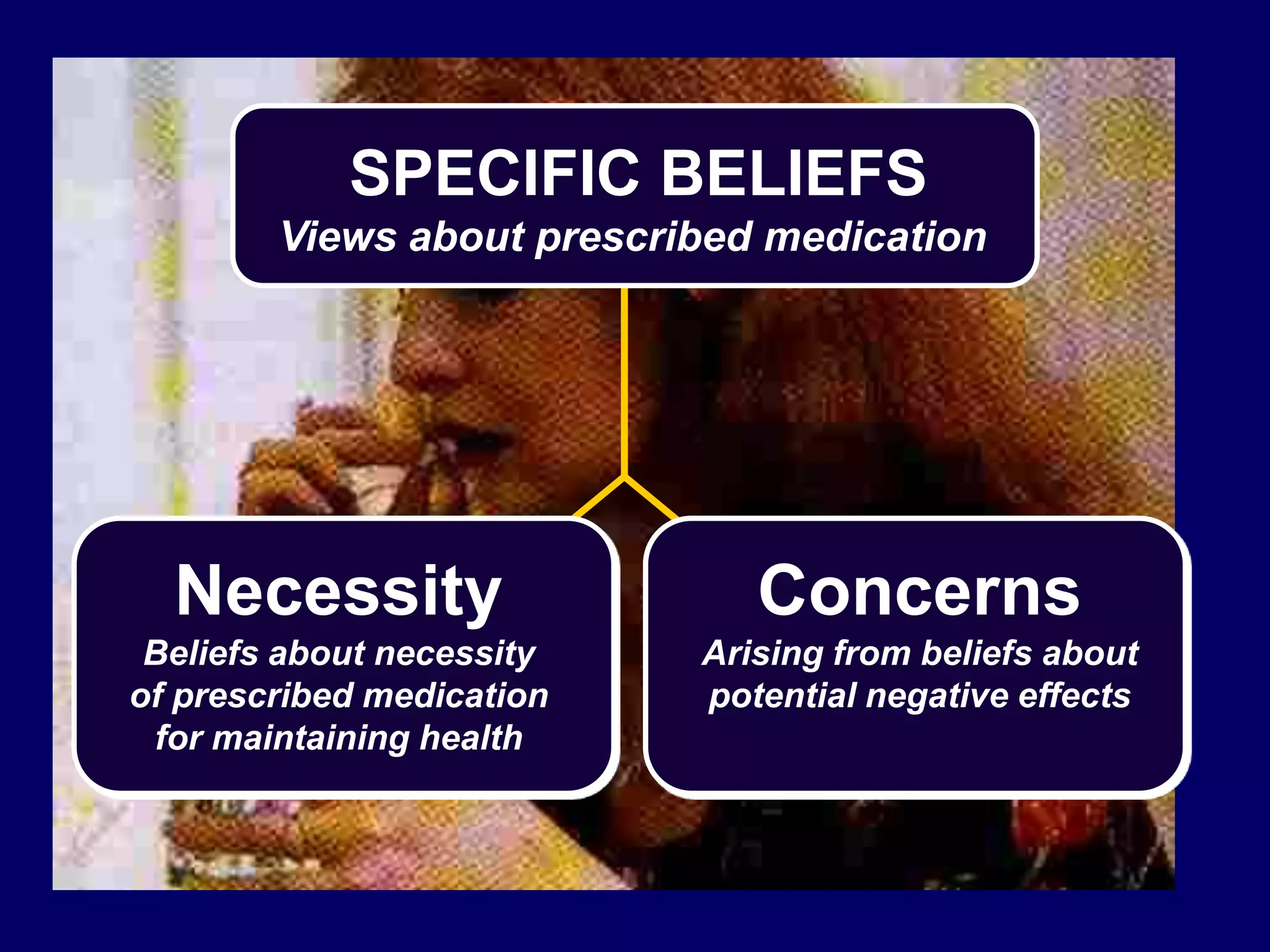
SPECIFIC BELIEFS
Views about prescribed medication
Necessity
Beliefs about necessity
of prescribed medication
for maintaining health
Concerns
Arising from beliefs about
potential negative effects
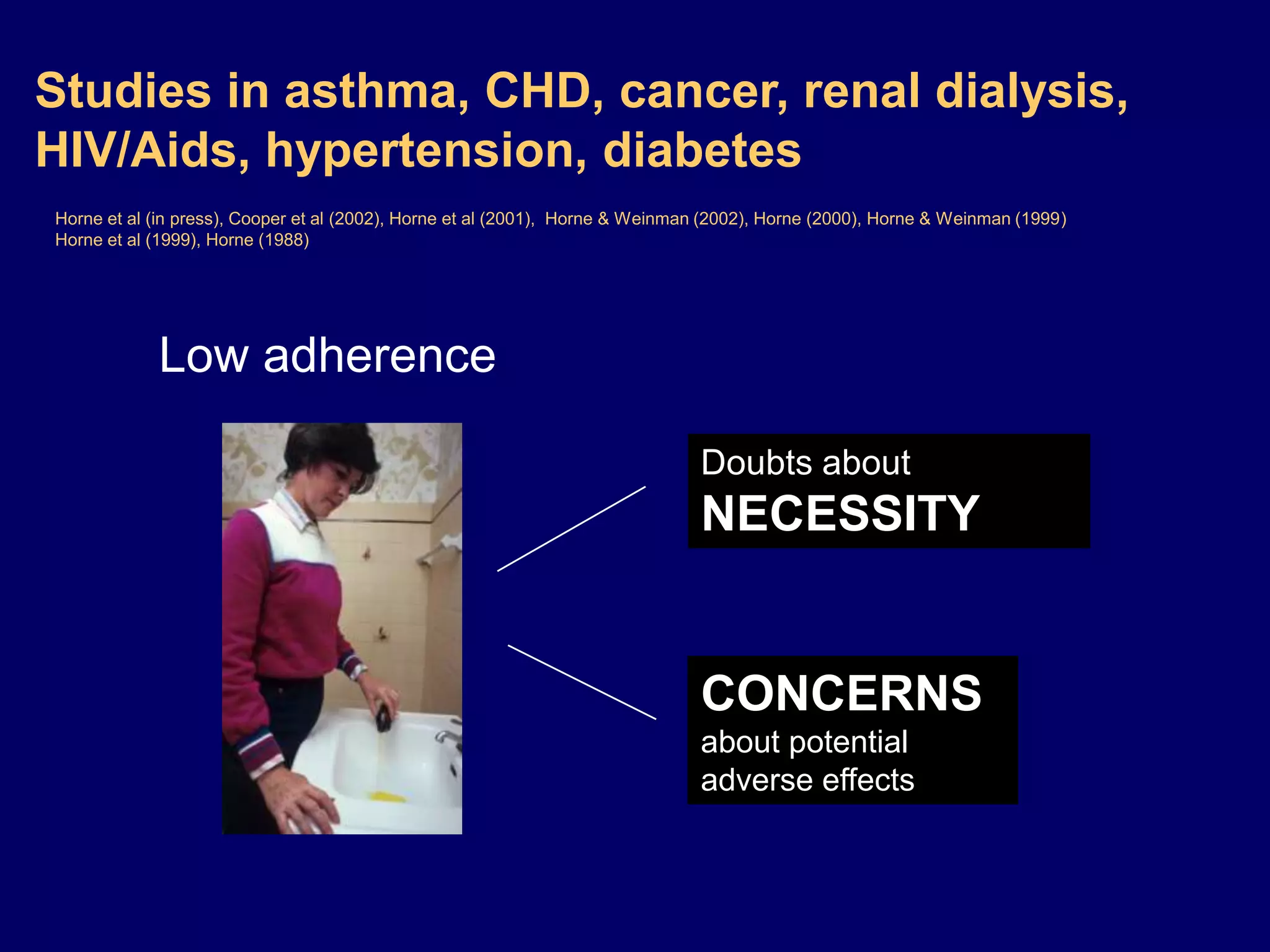
Low adherence
Doubts about
NECESSITY
CONCERNS
about potential
adverse effects
Studies in asthma, CHD, cancer, renal dialysis,
HIV/Aids, hypertension, diabetes
Horne et al (in press), Cooper et al (2002), Horne et al (2001), Horne & Weinman (2002), Horne (2000), Horne & Weinman (1999)
Horne et al (1999), Horne (1988)
SUMMARY
• Influence adherence
• Have an internal logic
• Are influenced by symptoms
• May differ from the ‘medical view’
• May be based on mistaken beliefs/premises
• May not be disclosed in consultation
• Are not set in stone and can be changed
Patients’ beliefs about their illness and
treatment
Implications for health
care ?
1. Use the consultation to
anticipate and plan
2. Interventions to :-
- improve goodness of fit
- improve understanding of
illness and treatment
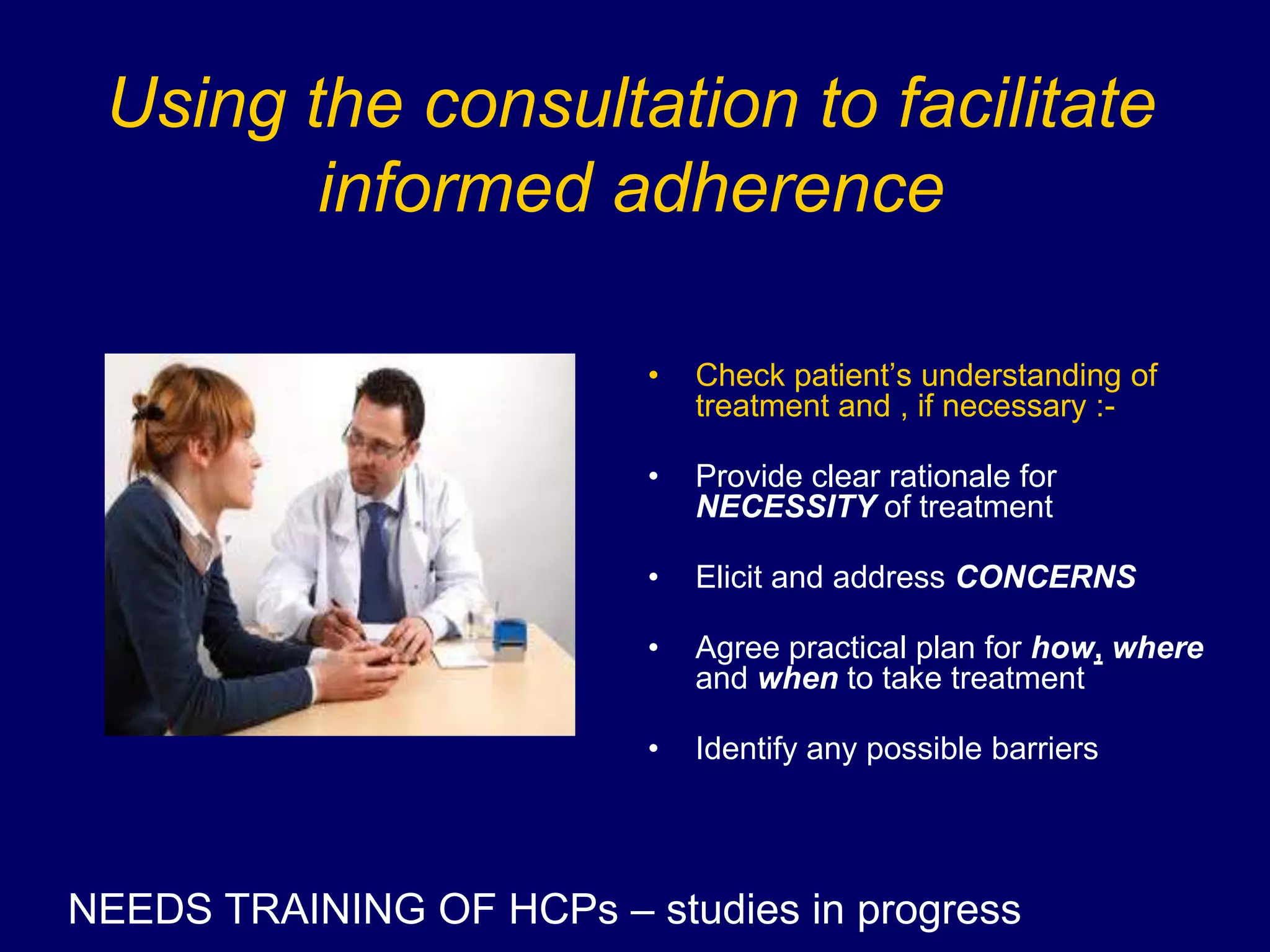
Using the consultation to facilitate
informed adherence
• Check patient’s understanding of
treatment and , if necessary :-
• Provide clear rationale for
NECESSITY of treatment
• Elicit and address CONCERNS
• Agree practical plan for how, where
and when to take treatment
• Identify any possible barriers
NEEDS TRAINING OF HCPs – studies in progress
Interventions to improve
adherence
Now a number of successful approaches which
are based on a good understanding of patients’ beliefs,
using different media, such as :-
• text messaging
• web-based interactive programmes
• phone based support
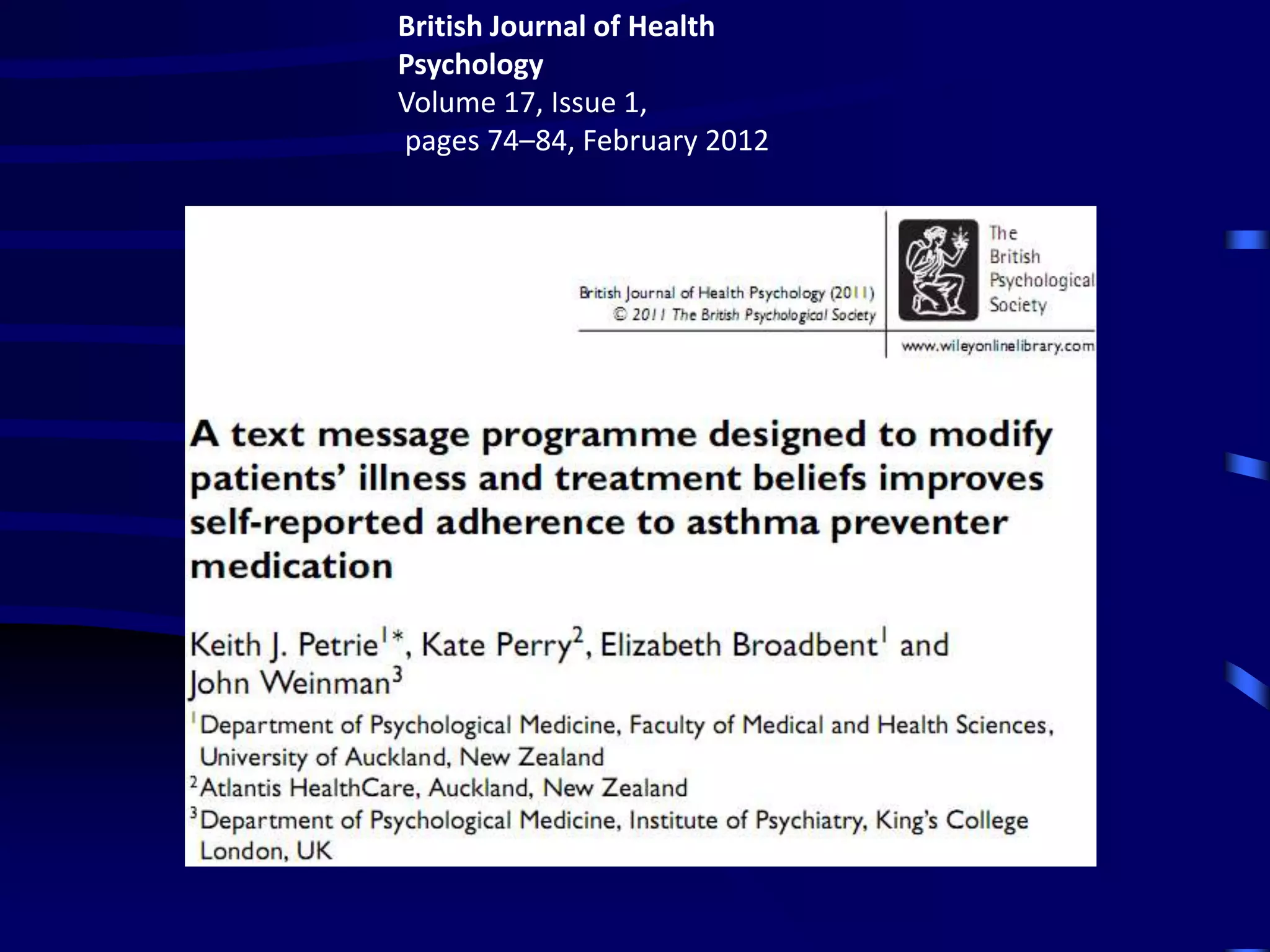
British Journal of Health
Psychology
Volume 17, Issue 1,
pages 74–84, February 2012
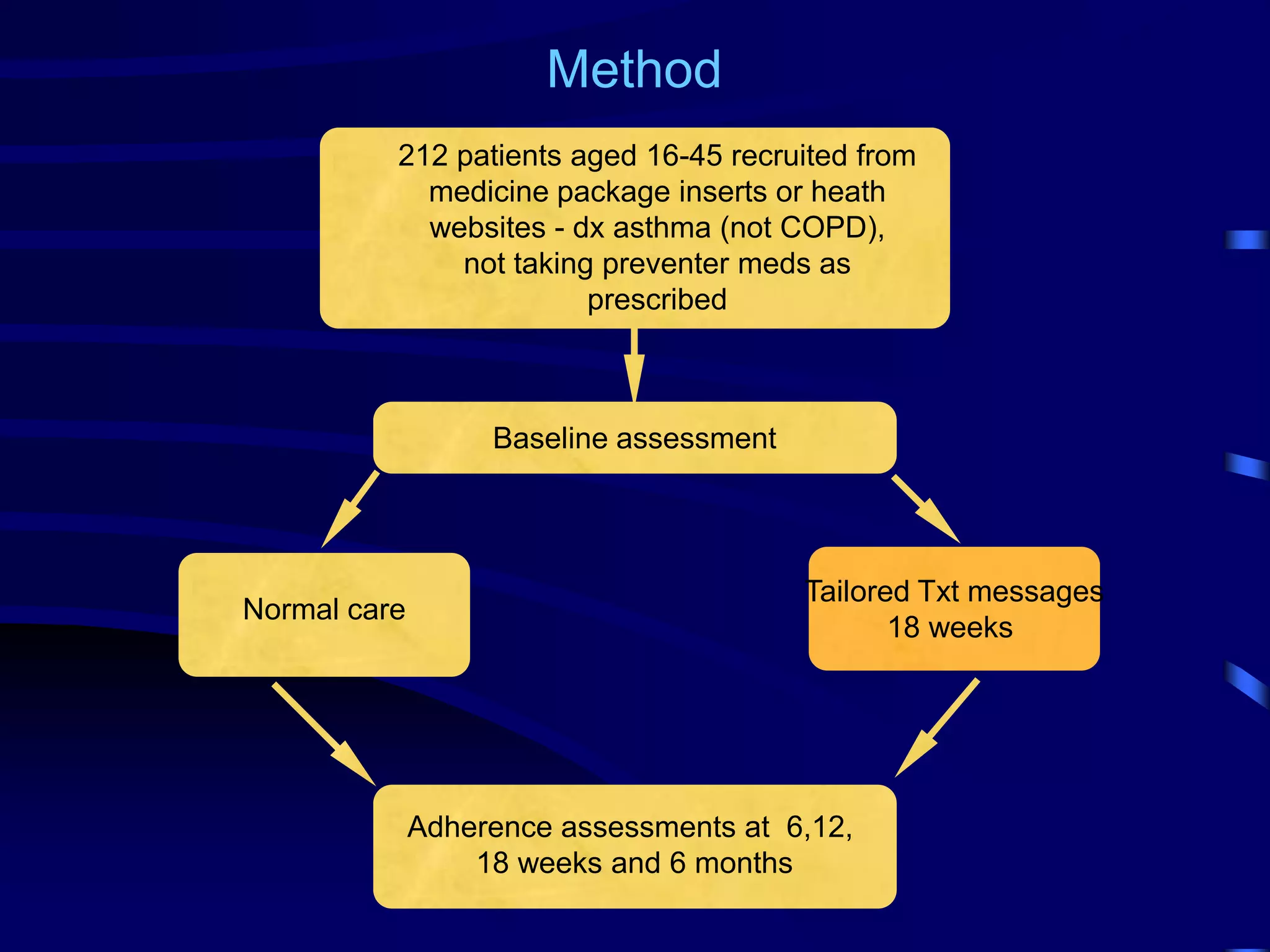
Method
212 patients aged 16-45 recruited from
medicine package inserts or heath
websites - dx asthma (not COPD),
not taking preventer meds as
prescribed
Normal care
Tailored Txt messages
18 weeks
Baseline assessment
Adherence assessments at 6,12,
18 weeks and 6 months
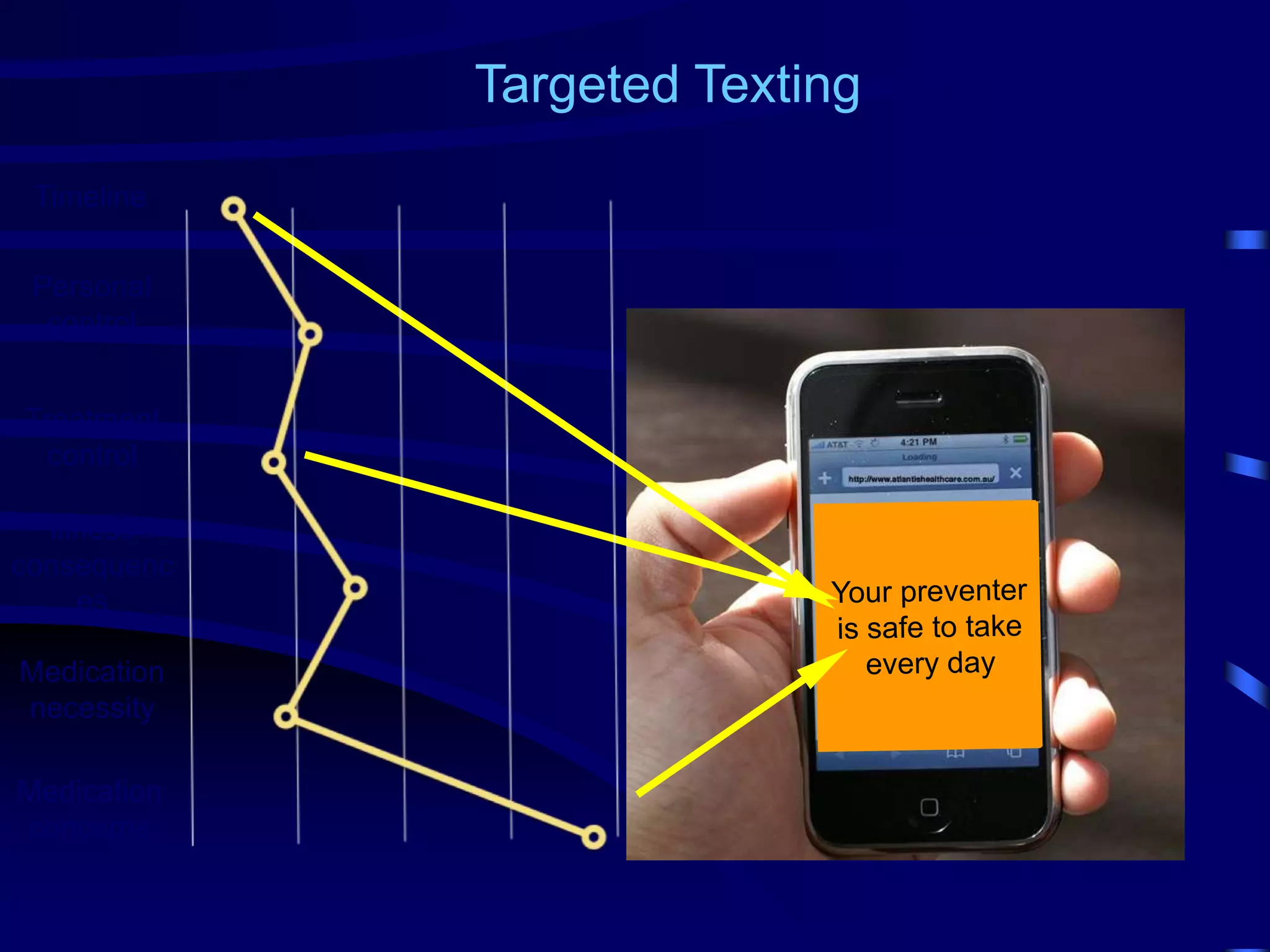
Timeline
Personal
control
Treatment
control
Illness
consequenc
es
Medication
necessity
Medication
concerns
Targeted Texting
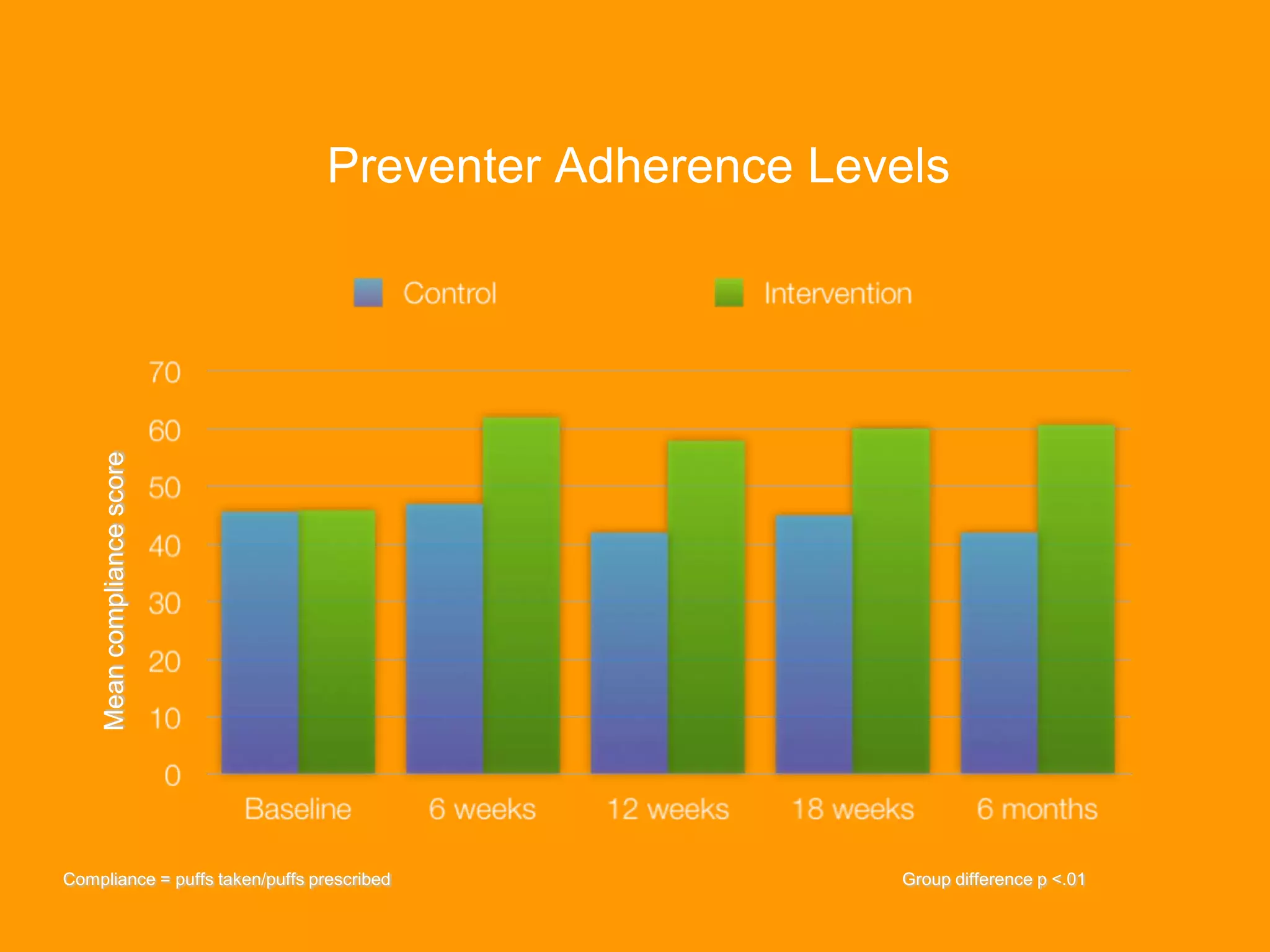
Preventer Adherence Levels
Meancompliancescore
Compliance = puffs taken/puffs prescribed Group difference p <.01
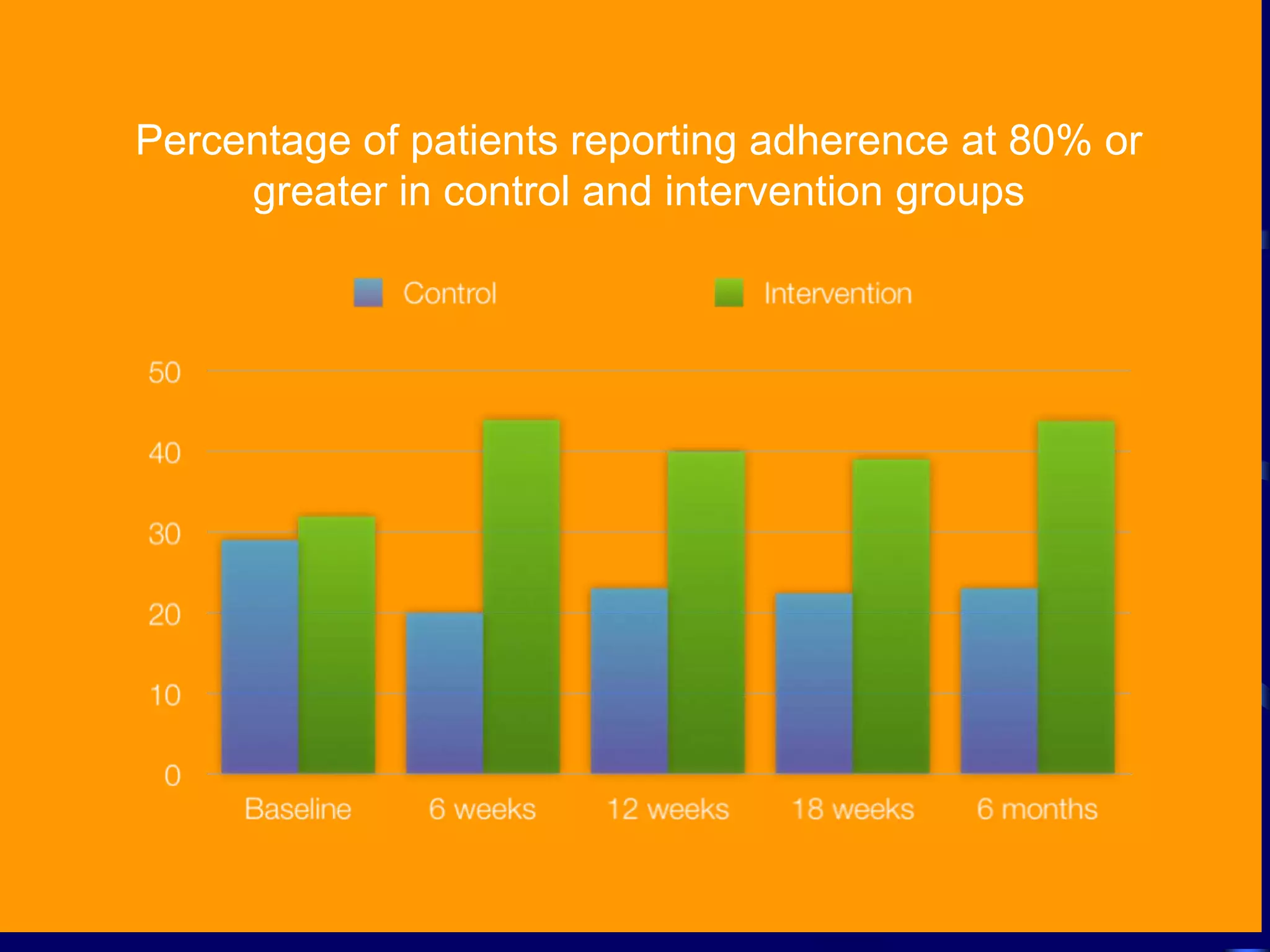
Percentage of patients reporting adherence at 80% or
greater in control and intervention groups
Conclusions
• A better understanding of patients
perspectives of illness and treatment is key to
understanding adherence
• This approach offers a framework for
identifying and addressing the key barriers to
adherence to medication
• Urgent need to
•1. develop interventions which can be
delivered in routine consultations
•2 provide patients with better access to
specialist tailored interventions

Patient adherence – what’s the problem?

  • 1.
    Patient adherence –what’s the problem? John Weinman | Professor of Psychology as applied to medicine King’s College London
  • 2.
    John Weinman Institute ofPharmaceutical Sciences, Kings College London PATIENT ADHERENCE What’s the problem?
  • 3.
    The problem ofnon-adherence WHO report on non-adherence • Estimated that over 30 -50% medicines prescribed for long term illnesses are not taken as directed • Similar levels for psychol treatments - e.g . Attendance/homework for CBT • If treatment is evidence- based, then this represents a loss for patients and for the health care system
  • 4.
    Risk of hospitalisation& non-adherence Sokol MC, McGuigan KA, Verbrugge RR, Epstein RS. Impact of medication adherence on hospitalization risk and healthcare cost. Medical Care. 2005;43:521-530.
  • 5.
    Health care costof non-adherence
  • 6.
  • 7.
    Myth 1: Non-adherenceis a feature of the disease Non-adherence is not linked to type of disease Low adherence rates are problematic in most chronic diseases e.g. •HIV1 •Cancer2 •Heart disease3 1Friedland, Williams. AIDS 1999;13(Suppl 1):S61–72. 2Lilleyman, Lennard. BMJ 1996;313:1219–1220. 3Horwitz et al. Lancet 1990;336:1002–1003. • Rheum. arthritis4 • Diabetes5 • Asthma6 4Hill et al. Ann Rheum Dis 2001; 869-875. 5Glasgow et al. J Behav Med 1986;9:65–77. 6Cochrane et al. Respir Med 1999;93:763–769..
  • 8.
    Myth 2 •Non-adherence isrelated to:  Gender  Educational experience  Intelligence  Marital status  Occupation / income  Ethnic background
  • 9.
    Most patients willbe non-adherent some of the time Adherence Rates Vary Between patients Within the same patient over time and across treatments
  • 10.
    Myth 3 •Non-adherence iseasily fixed by : -  Providing information  Providing reminders  Being authoritative  Fear arousal
  • 11.
    ADHERENCE INTERVENTIONS Cochrane review: Hayneset al (2008) “Current methods of improving adherence are mostly complex and not very effective, so that the full benefits of treatment cannot be realized. High priority should be given to fundamental and applied research concerning innovations to assist patients to follow medication prescriptions for long-term disorders”
  • 12.
    • Need tounderstand types and causes of non-adherence •Need to tailor interventions to take account of this •Develop & test theoretical models
  • 13.
  • 14.
    RANGE OF POSSIBLEFACTORS :- •Poor HCP-Patient Communication •Low patient satisfaction and/or recall •Problems in planning/executive function or prospective memory •Financial or other barriers UNINTENTIONAL NON-ADHERENCE
  • 15.
    Beliefs influence unintentionalnon- adherence - forgetfulness 2 1 BCG Harris 2002; Conrad Soc Sci Med 1985;20:29–37; Ley 1988; Peterson Am J Health-Syst Ph 2003;60:657–65 2 Unni , Pat Edu Coun 2010 doi:10.1016/j.pec.2010.05.006
  • 16.
    Patients know whatto do & how to do it BUT are reluctant to adhere because either :- •TREATMENT DOESN’T MAKE SENSE •WORRIES/CONCERNS ABOUT TREATMENT INTENTIONAL NON-ADHERENCE
  • 17.
    Predictors of non-adherence: Overview of Evidence
  • 18.
    What are thekey beliefs influencing adherence to treatment? 1) Patients’ perceptions of illness 2) Patients’ perceptions of treatment
  • 19.
    Core beliefs aboutIllness • IDENTITY Abstract label eg, hypertension; asthma; arthritis Concrete symptoms that a person associates with the condition • CAUSAL BELIEFS Stress, environment, genetics, own behaviour, ageing etc • TIMELINE Perceived duration and profile eg, chronic, acute, cyclical • CONSEQUENCES Personal, economic, social • CURE / CONTROL Beliefs about the amenability to control or cure
  • 21.
    ILLNESS PERCEPTION & treatmentadherence • Some illness perceptions are associated with treatment adherence in some conditions :- e.g. - causal beliefs predict adherence behaviour in post- MI - timeline beliefs predict preventer medication adherence in asthma etc - causal, timeline & control beliefs predict adherence to CBT for Psychosis (Freeman et al, in press) • BUT – illness beliefs per se are not strong predictors of treatment adherence – need to consider more proximal predictors (ie patients’ beliefs re. treatment)
  • 22.
    TreatmentIllness What are thelinks between illness and treatment beliefs?
  • 23.
    GOODNESS OF FIT betweenillness reps and treatment recommendations • Patients evaluate the need for treatment in the light of their understanding of illness • But some treatments may not make sense :- - exercises for back pain , balance disorder etc - daily adherence to preventer medication in asthma - smoking cessation in early cervical cancer - phosphate binding medication in ESRD • CHALLENGE TO HP – to identify these situations and to assess treatment beliefs -- develop interventions to increase adherence goodness of fit and increase motivation to adhere
  • 24.
    TREATMENT BELIEFS: What isthe patient's perspective ?
  • 25.
    Beliefs about MedicinesQuestionnaire (BMQ) GENERAL BELIEFS about medicines as a whole SPECIFIC BELIEFS about medicines prescribed for a particular illness
  • 26.
    SPECIFIC BELIEFS Views aboutprescribed medication Necessity Beliefs about necessity of prescribed medication for maintaining health Concerns Arising from beliefs about potential negative effects
  • 27.
    Low adherence Doubts about NECESSITY CONCERNS aboutpotential adverse effects Studies in asthma, CHD, cancer, renal dialysis, HIV/Aids, hypertension, diabetes Horne et al (in press), Cooper et al (2002), Horne et al (2001), Horne & Weinman (2002), Horne (2000), Horne & Weinman (1999) Horne et al (1999), Horne (1988)
  • 28.
    SUMMARY • Influence adherence •Have an internal logic • Are influenced by symptoms • May differ from the ‘medical view’ • May be based on mistaken beliefs/premises • May not be disclosed in consultation • Are not set in stone and can be changed Patients’ beliefs about their illness and treatment
  • 29.
    Implications for health care? 1. Use the consultation to anticipate and plan 2. Interventions to :- - improve goodness of fit - improve understanding of illness and treatment
  • 30.
    Using the consultationto facilitate informed adherence • Check patient’s understanding of treatment and , if necessary :- • Provide clear rationale for NECESSITY of treatment • Elicit and address CONCERNS • Agree practical plan for how, where and when to take treatment • Identify any possible barriers NEEDS TRAINING OF HCPs – studies in progress
  • 31.
    Interventions to improve adherence Nowa number of successful approaches which are based on a good understanding of patients’ beliefs, using different media, such as :- • text messaging • web-based interactive programmes • phone based support
  • 32.
    British Journal ofHealth Psychology Volume 17, Issue 1, pages 74–84, February 2012
  • 33.
    Method 212 patients aged16-45 recruited from medicine package inserts or heath websites - dx asthma (not COPD), not taking preventer meds as prescribed Normal care Tailored Txt messages 18 weeks Baseline assessment Adherence assessments at 6,12, 18 weeks and 6 months
  • 34.
  • 35.
    Preventer Adherence Levels Meancompliancescore Compliance= puffs taken/puffs prescribed Group difference p <.01
  • 36.
    Percentage of patientsreporting adherence at 80% or greater in control and intervention groups
  • 37.
    Conclusions • A betterunderstanding of patients perspectives of illness and treatment is key to understanding adherence • This approach offers a framework for identifying and addressing the key barriers to adherence to medication • Urgent need to •1. develop interventions which can be delivered in routine consultations •2 provide patients with better access to specialist tailored interventions