© Fraunhofer · Seite 1
Prof. Dr. Boris Otto · Pune · October 7th, 2015
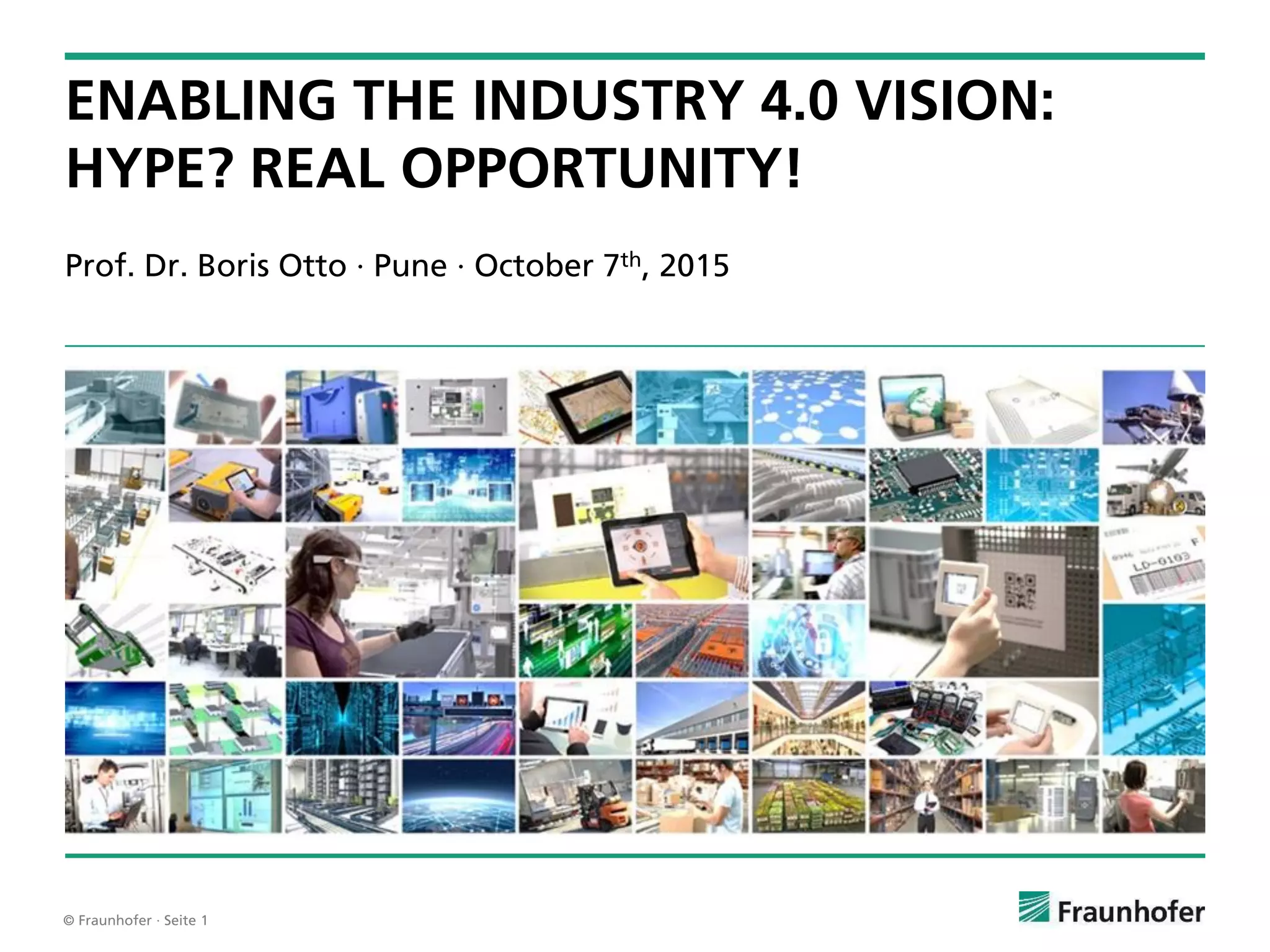
ENABLING THE INDUSTRY 4.0 VISION:
HYPE? REAL OPPORTUNITY!
© Fraunhofer · Seite 2
AGENDA
 Towards a »Smart Service Welt«
 Industry 4.0 and Smart Manufacturing
 Data as the Key Resource
© Fraunhofer · Seite 3
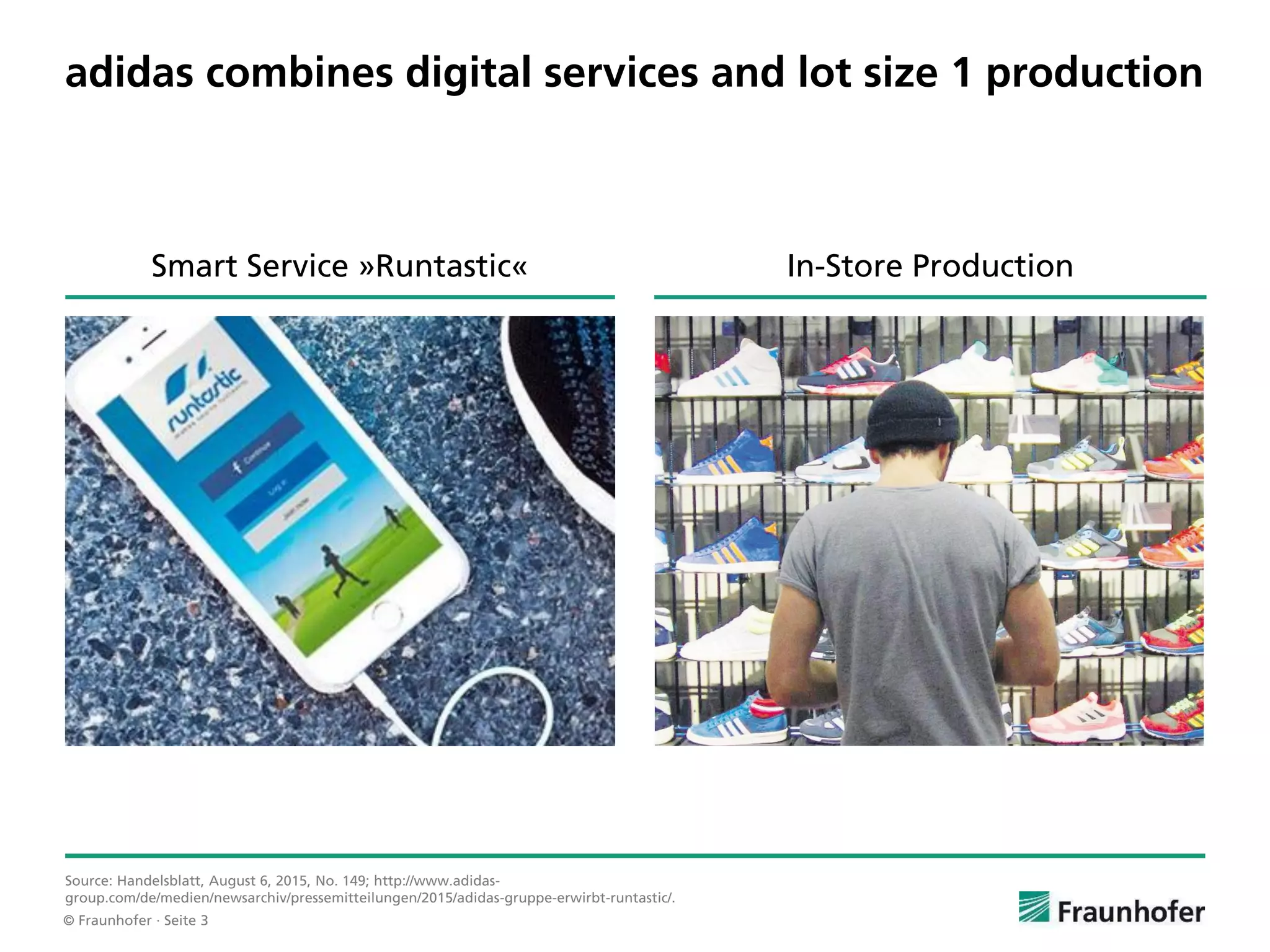
adidas combines digital services and lot size 1 production
Source: Handelsblatt, August 6, 2015, No. 149; http://www.adidas-
group.com/de/medien/newsarchiv/pressemitteilungen/2015/adidas-gruppe-erwirbt-runtastic/.
In-Store ProductionSmart Service »Runtastic«
© Fraunhofer · Seite 4
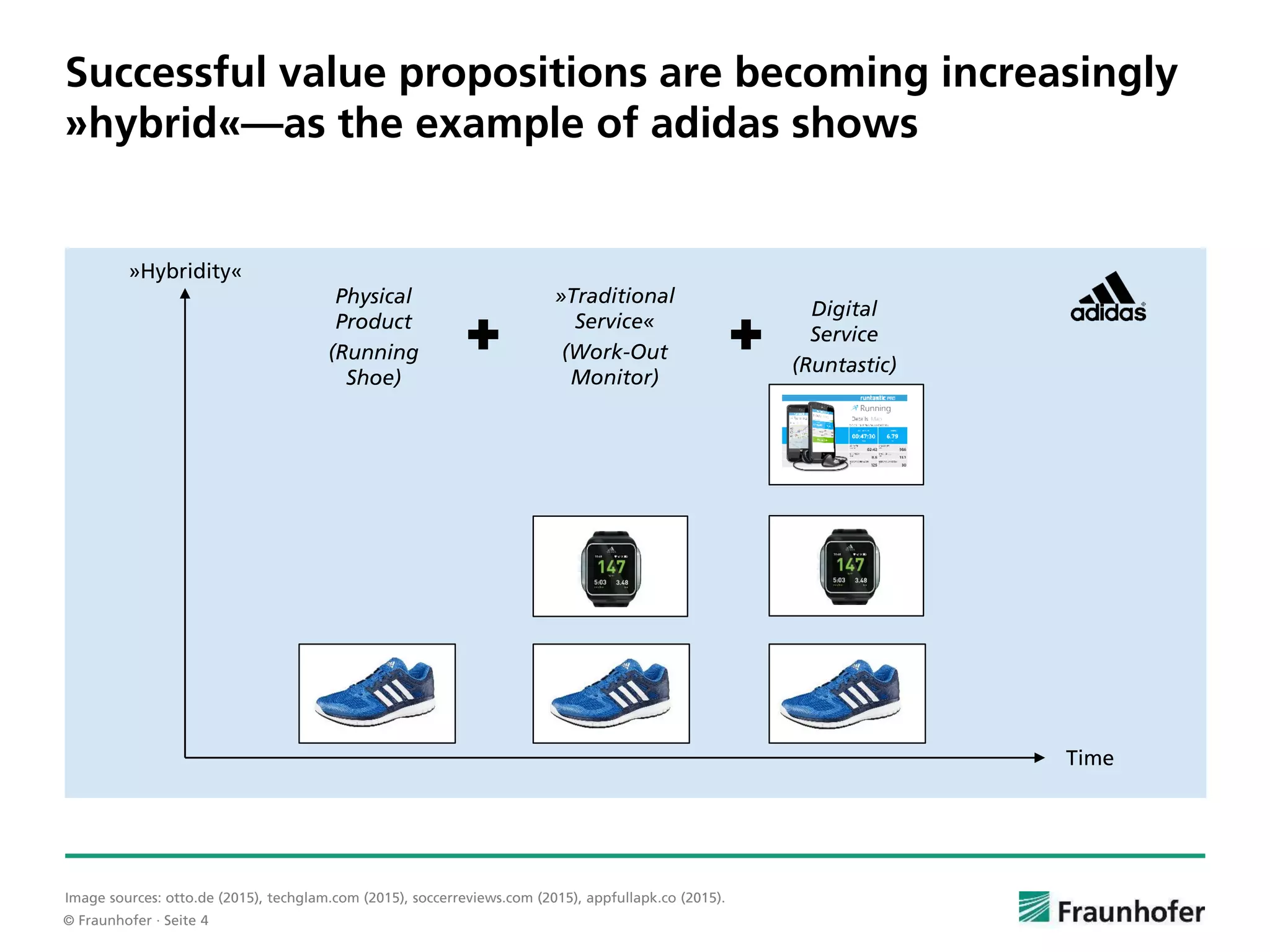
Successful value propositions are becoming increasingly
»hybrid«—as the example of adidas shows
Image sources: otto.de (2015), techglam.com (2015), soccerreviews.com (2015), appfullapk.co (2015).
Time
»Hybridity«
Physical
Product
(Running
Shoe)
»Traditional
Service«
(Work-Out
Monitor)
Digital
Service
(Runtastic)
© Fraunhofer · Seite 5
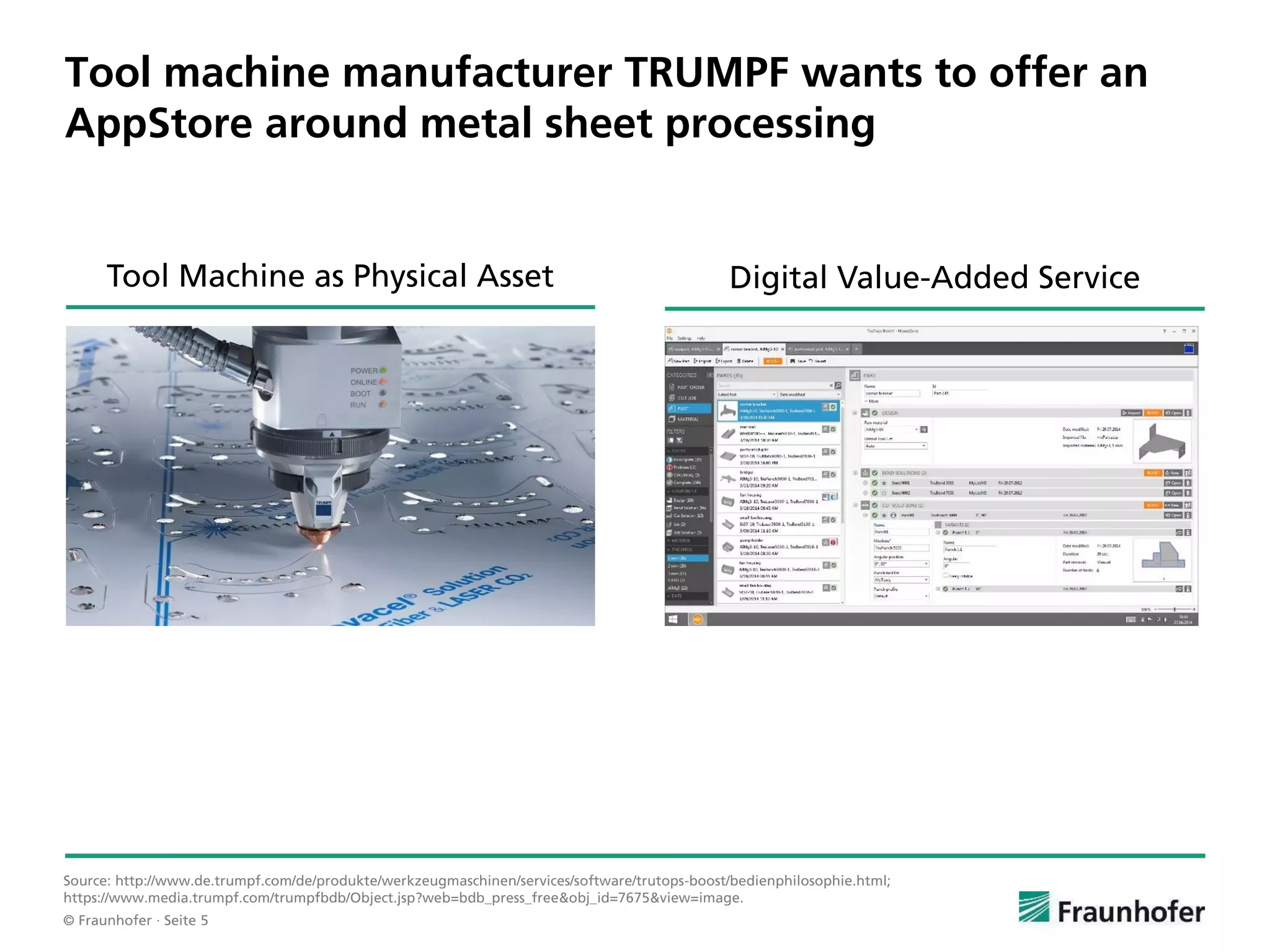
Tool machine manufacturer TRUMPF wants to offer an
AppStore around metal sheet processing
Tool Machine as Physical Asset Digital Value-Added Service
Source: http://www.de.trumpf.com/de/produkte/werkzeugmaschinen/services/software/trutops-boost/bedienphilosophie.html;
https://www.media.trumpf.com/trumpfbdb/Object.jsp?web=bdb_press_free&obj_id=7675&view=image.
© Fraunhofer · Seite 6
Digital products follow a platform architecture logic
 Services can be separated from
physical platforms
 Architectural layers are de-coupled
 Products turn to platforms—and
vice-versa
 Ecosystems form around platforms
 Innovation happens in co-opetition
modes
Digital Business Architecture Principles of the Digital Economy
SMART PRODUCTS
SMART SPACES
SMART DATA
SMART SERVICES
Source: Working Group Smart Service Welt (2015).
© Fraunhofer · Seite 7
Agricultural machinery manufacturers are driving
comprehensive digital farming solutions
Precision Farming Value Creation in Ecosystems
Image sources: wiwo (2015), traction-magazin.de (2014).
Source: Beecham Research Ltd. (2014).
Digital
Farming
Ecosystem
Machine
Providers
Crop Science
Companies
Farmers
Wholesale
Technology
Providers
Influencers
© Fraunhofer · Seite 8
Source: Working Group Smart Service Welt (2015), Ernst & Young (2011).
The »Smart Service Welt« is a response to changing
customer needs
End-to-End Customer Process
Individualization
Ubiquity of Service Consumption
Information Transparency
© Fraunhofer · Seite 9
AGENDA
 Towards a »Smart Service Welt«
 Industry 4.0 and Smart Manufacturing
 Data as the Key Resource
© Fraunhofer · Seite 10
The implications on production and supply chain
processes are tremendous
No. of Variants
Production
Volume per
Variant
1850
1913
1955
1980
2000
Source: Koren (2010), cited in Bauernhansl (2014).
Image sources: https://en.wikipedia.org (2015), https://www.impulse.de (2015), audi.de (2015), o2.co.uk (2015), computerbild.de (2015).
Ford Model T
VW Beetle
Production
Audi Configurator
Mass
Production
Individualization
»Shareconomy«
Complexity
Globalization
iPhone
3D Printed Car
© Fraunhofer · Seite 11
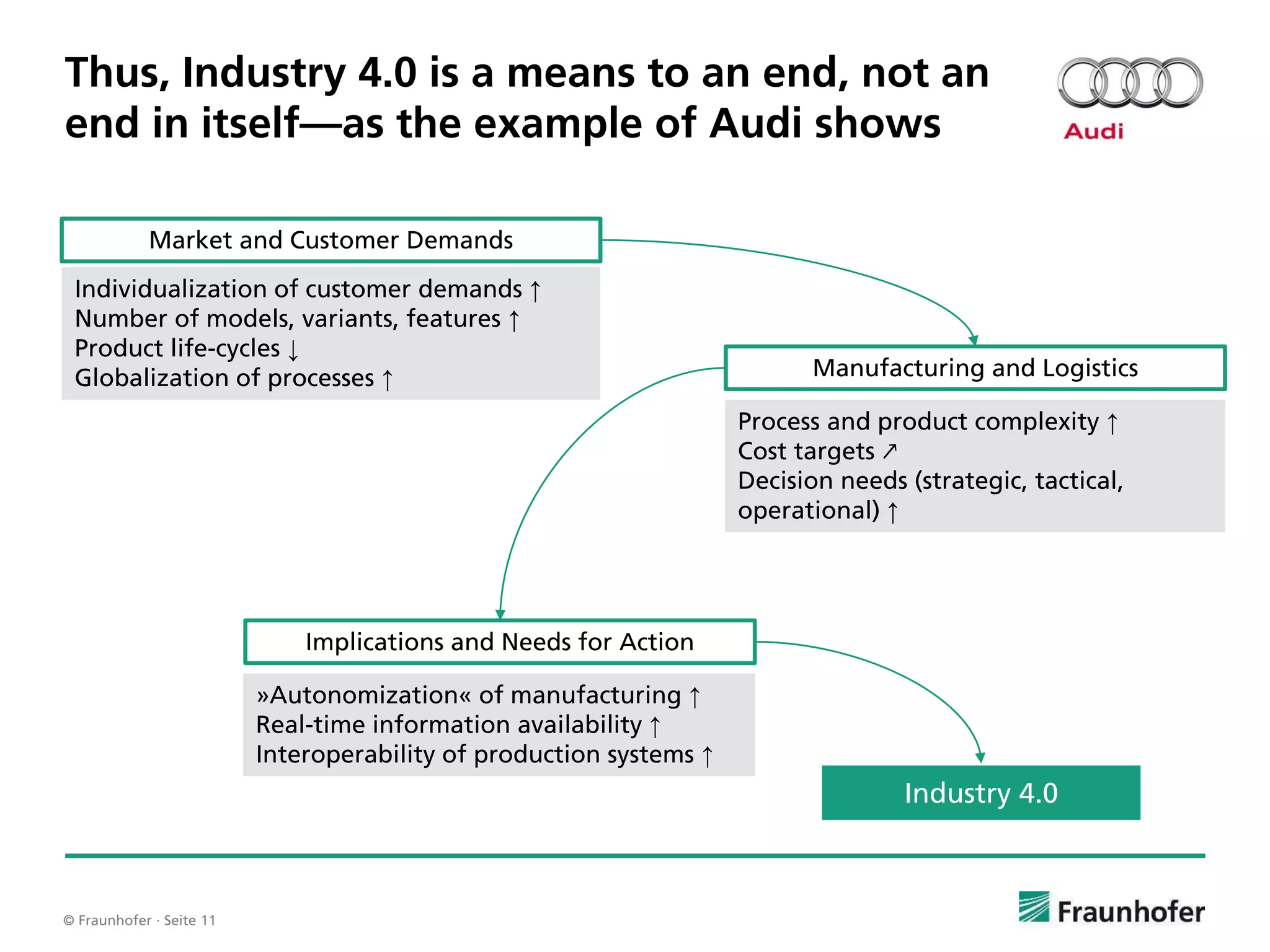
Thus, Industry 4.0 is a means to an end, not an
end in itself—as the example of Audi shows
Individualization of customer demands ↑
Number of models, variants, features ↑
Product life-cycles ↓
Globalization of processes ↑
Process and product complexity ↑
Cost targets ↗
Decision needs (strategic, tactical,
operational) ↑
»Autonomization« of manufacturing ↑
Real-time information availability ↑
Interoperability of production systems ↑
Market and Customer Demands
Manufacturing and Logistics
Implications and Needs for Action
Industry 4.0
© Fraunhofer · Seite 12
Industry 4.0 enables smart manufacturing through cyber-
physical systems and decentralized control
Solution Components
 Cyber-physical systems
 Self-configuration
 Virtual representation
 Context-aware
information management
Benefits
 Increased flexibility and
agility
 Coping with complexityNew customer order: We need an
extra shift on Saturday.
I need to go home
now. Who can
take over my
orders?
I have to be at the goods
issue in 2 hours!
I‘m booked out till
Friday!
Sorry, I‘m not
available on Saturday.
I can work on
Saturday.
Magazine will be
empty soon, please refill!
© Fraunhofer · Seite 13
Industry 4.0 enables smart manufacturing in electric car
production
Solution Components
 All objects and items are interconnected
 Assembly parts find their way on their
own through production
 Redundant manufacturing capacities are
autonomously distributing work loads
among each other
Benefits
 No central control systems required
 Dynamic system reaction in case of exceptions
 High scalability of all production processes
Source: SMART FACE-Project Consortium (2014).
Supported by
© Fraunhofer · Seite 14
Industry 4.0 enables smart intralogistics
 Small autonomous transport units (shuttles)
replace inflexible conveyor technology
 Cellular transport systems (CTS) follow self-
control principle
 CTS uses swarm intelligence for handling
complex transport tasks.
 Autonomous transport management
 Increase of:
 Changeability
 Scalability and Flexibility
 Logistics performance where it is required!
© Fraunhofer · Seite 15
Industry 4.0 increases and efficiency in the warehouse
Solution Components
 Autonomous navigation in the shelf
 No lift needed
 Flexible deployment of rack racers
 85 percent 3D printed components
Benefits
 Functional and cost advantages compared to
state-of-the-art
 Increased flexibility of storage systems
 Reduced fixed costs
 No bottleneck through lift, thus reduced storage
cycle times
Source: Fraunhofer IML (2014).
© Fraunhofer · Seite 16
Industry 4.0 is a design principle for the industrial
enterprise of the future
Industry 4.0
Connectivity
Autonomy
Human-
Machine-
Interaction
Virtual
Entities
Modularity
Real-Time
Capability
© Fraunhofer · Seite 17
AGENDA
 Towards a »Smart Service Welt«
 Industry 4.0 and Smart Manufacturing
 Data as the Key Resource
© Fraunhofer · Seite 18
Data is the strategic resource to link Smart Services and
Smart Manufacturing
Information flow
Public
Data
Data from the
Value Chain
Commercial
Services
Industrial
Services
Individualization
End-to-End
Customer Process
Ecosystem
Ubiquity
Smart Data
Management
Interoperability
Human-Machine-
Collaboration
Autonomous
Systems
Internet of Things
Customer
Production
Networks
Logistics
Networks
Smart ServicesDataSmart Manufacturing
Material flow.Legend:
© Fraunhofer · Seite 19
The Industrial Data Space aims at a »Network of Trusted
Data«
Sovereignty
Data and ServicesTrustworthiness
Certified Members
Decentralization
Federated Architecture
Openness
Neutral and User-Driven
Governance
Common Rules of the
Game
Scalability
Network Effects
Ecosystem
Platform and Services
Security
Data Exchange
© Fraunhofer · Seite 20
The Industrial Data Space is driven by industry and
supported by the German Federal Government
Chartered Organization Founders Governmental Research Grant
 Reference Architecture Model
 Use Case Pilot Implementations
© Fraunhofer · Seite 21
Prof. Dr. Boris Otto
Fraunhofer IML & ISST
Boris.Otto@iml.fraunhofer.de
https://de.linkedin.com/pub/boris-otto/1/1b5/570
https://twitter.com/drborisotto
https://www.xing.com/profile/Boris_Otto
http://www.researchgate.net/profile/Boris_Otto
Thank you very much for your attention!
© Fraunhofer · Seite 22
Prof. Dr. Boris Otto · Pune · October 7th, 2015
ENABLING THE INDUSTRY 4.0 VISION:
HYPE? REAL OPPORTUNITY!

Enabling the Industry 4.0 vision: Hype? Real Opportunity!

  • 1.
    © Fraunhofer ·Seite 1 Prof. Dr. Boris Otto · Pune · October 7th, 2015 ENABLING THE INDUSTRY 4.0 VISION: HYPE? REAL OPPORTUNITY!
  • 2.
    © Fraunhofer ·Seite 2 AGENDA  Towards a »Smart Service Welt«  Industry 4.0 and Smart Manufacturing  Data as the Key Resource
  • 3.
    © Fraunhofer ·Seite 3 adidas combines digital services and lot size 1 production Source: Handelsblatt, August 6, 2015, No. 149; http://www.adidas- group.com/de/medien/newsarchiv/pressemitteilungen/2015/adidas-gruppe-erwirbt-runtastic/. In-Store ProductionSmart Service »Runtastic«
  • 4.
    © Fraunhofer ·Seite 4 Successful value propositions are becoming increasingly »hybrid«—as the example of adidas shows Image sources: otto.de (2015), techglam.com (2015), soccerreviews.com (2015), appfullapk.co (2015). Time »Hybridity« Physical Product (Running Shoe) »Traditional Service« (Work-Out Monitor) Digital Service (Runtastic)
  • 5.
    © Fraunhofer ·Seite 5 Tool machine manufacturer TRUMPF wants to offer an AppStore around metal sheet processing Tool Machine as Physical Asset Digital Value-Added Service Source: http://www.de.trumpf.com/de/produkte/werkzeugmaschinen/services/software/trutops-boost/bedienphilosophie.html; https://www.media.trumpf.com/trumpfbdb/Object.jsp?web=bdb_press_free&obj_id=7675&view=image.
  • 6.
    © Fraunhofer ·Seite 6 Digital products follow a platform architecture logic  Services can be separated from physical platforms  Architectural layers are de-coupled  Products turn to platforms—and vice-versa  Ecosystems form around platforms  Innovation happens in co-opetition modes Digital Business Architecture Principles of the Digital Economy SMART PRODUCTS SMART SPACES SMART DATA SMART SERVICES Source: Working Group Smart Service Welt (2015).
  • 7.
    © Fraunhofer ·Seite 7 Agricultural machinery manufacturers are driving comprehensive digital farming solutions Precision Farming Value Creation in Ecosystems Image sources: wiwo (2015), traction-magazin.de (2014). Source: Beecham Research Ltd. (2014). Digital Farming Ecosystem Machine Providers Crop Science Companies Farmers Wholesale Technology Providers Influencers
  • 8.
    © Fraunhofer ·Seite 8 Source: Working Group Smart Service Welt (2015), Ernst & Young (2011). The »Smart Service Welt« is a response to changing customer needs End-to-End Customer Process Individualization Ubiquity of Service Consumption Information Transparency
  • 9.
    © Fraunhofer ·Seite 9 AGENDA  Towards a »Smart Service Welt«  Industry 4.0 and Smart Manufacturing  Data as the Key Resource
  • 10.
    © Fraunhofer ·Seite 10 The implications on production and supply chain processes are tremendous No. of Variants Production Volume per Variant 1850 1913 1955 1980 2000 Source: Koren (2010), cited in Bauernhansl (2014). Image sources: https://en.wikipedia.org (2015), https://www.impulse.de (2015), audi.de (2015), o2.co.uk (2015), computerbild.de (2015). Ford Model T VW Beetle Production Audi Configurator Mass Production Individualization »Shareconomy« Complexity Globalization iPhone 3D Printed Car
  • 11.
    © Fraunhofer ·Seite 11 Thus, Industry 4.0 is a means to an end, not an end in itself—as the example of Audi shows Individualization of customer demands ↑ Number of models, variants, features ↑ Product life-cycles ↓ Globalization of processes ↑ Process and product complexity ↑ Cost targets ↗ Decision needs (strategic, tactical, operational) ↑ »Autonomization« of manufacturing ↑ Real-time information availability ↑ Interoperability of production systems ↑ Market and Customer Demands Manufacturing and Logistics Implications and Needs for Action Industry 4.0
  • 12.
    © Fraunhofer ·Seite 12 Industry 4.0 enables smart manufacturing through cyber- physical systems and decentralized control Solution Components  Cyber-physical systems  Self-configuration  Virtual representation  Context-aware information management Benefits  Increased flexibility and agility  Coping with complexityNew customer order: We need an extra shift on Saturday. I need to go home now. Who can take over my orders? I have to be at the goods issue in 2 hours! I‘m booked out till Friday! Sorry, I‘m not available on Saturday. I can work on Saturday. Magazine will be empty soon, please refill!
  • 13.
    © Fraunhofer ·Seite 13 Industry 4.0 enables smart manufacturing in electric car production Solution Components  All objects and items are interconnected  Assembly parts find their way on their own through production  Redundant manufacturing capacities are autonomously distributing work loads among each other Benefits  No central control systems required  Dynamic system reaction in case of exceptions  High scalability of all production processes Source: SMART FACE-Project Consortium (2014). Supported by
  • 14.
    © Fraunhofer ·Seite 14 Industry 4.0 enables smart intralogistics  Small autonomous transport units (shuttles) replace inflexible conveyor technology  Cellular transport systems (CTS) follow self- control principle  CTS uses swarm intelligence for handling complex transport tasks.  Autonomous transport management  Increase of:  Changeability  Scalability and Flexibility  Logistics performance where it is required!
  • 15.
    © Fraunhofer ·Seite 15 Industry 4.0 increases and efficiency in the warehouse Solution Components  Autonomous navigation in the shelf  No lift needed  Flexible deployment of rack racers  85 percent 3D printed components Benefits  Functional and cost advantages compared to state-of-the-art  Increased flexibility of storage systems  Reduced fixed costs  No bottleneck through lift, thus reduced storage cycle times Source: Fraunhofer IML (2014).
  • 16.
    © Fraunhofer ·Seite 16 Industry 4.0 is a design principle for the industrial enterprise of the future Industry 4.0 Connectivity Autonomy Human- Machine- Interaction Virtual Entities Modularity Real-Time Capability
  • 17.
    © Fraunhofer ·Seite 17 AGENDA  Towards a »Smart Service Welt«  Industry 4.0 and Smart Manufacturing  Data as the Key Resource
  • 18.
    © Fraunhofer ·Seite 18 Data is the strategic resource to link Smart Services and Smart Manufacturing Information flow Public Data Data from the Value Chain Commercial Services Industrial Services Individualization End-to-End Customer Process Ecosystem Ubiquity Smart Data Management Interoperability Human-Machine- Collaboration Autonomous Systems Internet of Things Customer Production Networks Logistics Networks Smart ServicesDataSmart Manufacturing Material flow.Legend:
  • 19.
    © Fraunhofer ·Seite 19 The Industrial Data Space aims at a »Network of Trusted Data« Sovereignty Data and ServicesTrustworthiness Certified Members Decentralization Federated Architecture Openness Neutral and User-Driven Governance Common Rules of the Game Scalability Network Effects Ecosystem Platform and Services Security Data Exchange
  • 20.
    © Fraunhofer ·Seite 20 The Industrial Data Space is driven by industry and supported by the German Federal Government Chartered Organization Founders Governmental Research Grant  Reference Architecture Model  Use Case Pilot Implementations
  • 21.
    © Fraunhofer ·Seite 21 Prof. Dr. Boris Otto Fraunhofer IML & ISST Boris.Otto@iml.fraunhofer.de https://de.linkedin.com/pub/boris-otto/1/1b5/570 https://twitter.com/drborisotto https://www.xing.com/profile/Boris_Otto http://www.researchgate.net/profile/Boris_Otto Thank you very much for your attention!
  • 22.
    © Fraunhofer ·Seite 22 Prof. Dr. Boris Otto · Pune · October 7th, 2015 ENABLING THE INDUSTRY 4.0 VISION: HYPE? REAL OPPORTUNITY!