© Fraunhofer
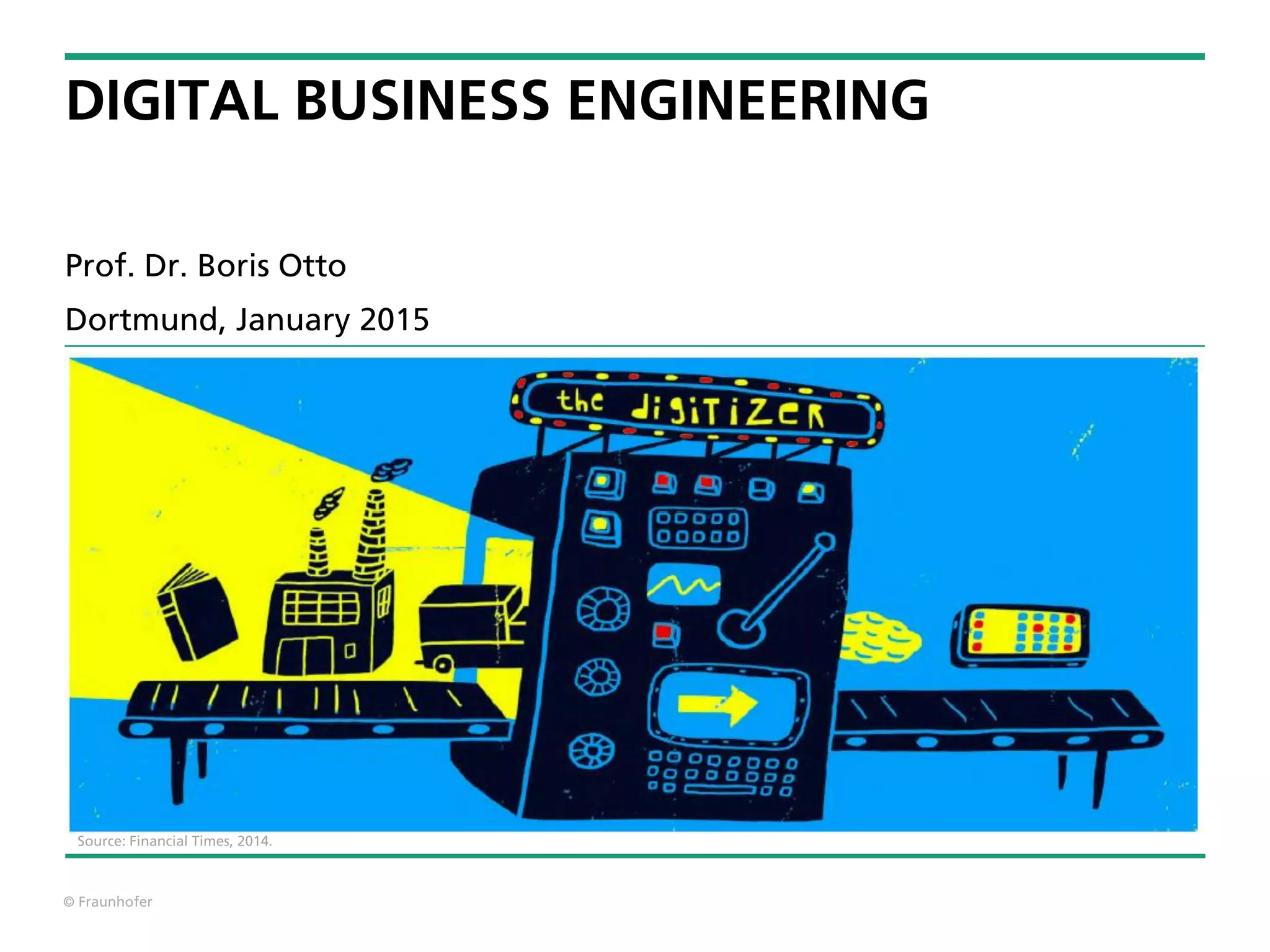
DIGITAL BUSINESS ENGINEERING
Prof. Dr. Boris Otto
Dortmund, January 2015
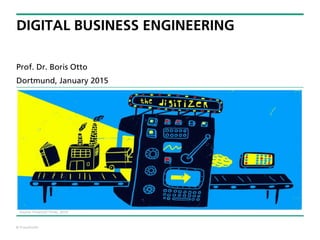
Source: Financial Times, 2014.
© Fraunhofer
CONTENT
 Digitization
 Digital Business Engineering Approach
 Business Benefits
© Fraunhofer
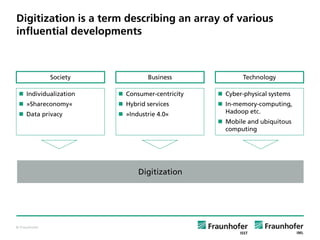
Digitization is a term describing an array of various
influential developments
Society Business Technology
 Individualization
 »Shareconomy«
 Data privacy
 Consumer-centricity
 Hybrid services
 »Industrie 4.0«
 Cyber-physical systems
 In-memory-computing,
Hadoop etc.
 Mobile and ubiquitous
computing
Digitization
© Fraunhofer
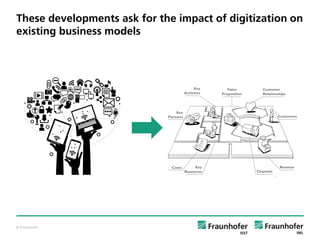
These developments ask for the impact of digitization on
existing business models
© Fraunhofer
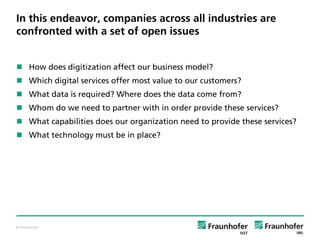
In this endeavor, companies across all industries are
confronted with a set of open issues
 How does digitization affect our business model?
 Which digital services offer most value to our customers?
 What data is required? Where does the data come from?
 Whom do we need to partner with in order provide these services?
 What capabilities does our organization need to provide these services?
 What technology must be in place?
© Fraunhofer
CONTENT
 Digitization
 Digital Business Engineering Approach
 Business Benefits
© Fraunhofer
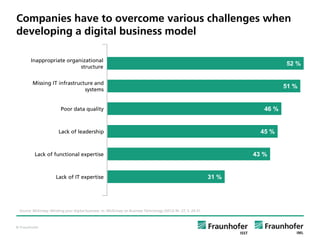
Companies have to overcome various challenges when
developing a digital business model
52 %
Inappropriate organizational
structure
51 %
Missing IT infrastructure and
systems
46 %Poor data quality
45 %Lack of leadership
43 %Lack of functional expertise
31 %Lack of IT expertise
Source: McKinsey: Minding your digital business. In: MicKinsey on Business Technology (2012) Nr. 27, S. 24-31.
© Fraunhofer
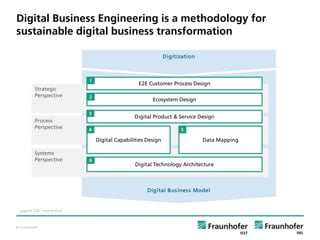
Digital Business Engineering is a methodology for
sustainable digital business transformation
Digitization
Digital Business Model
Strategic
Perspective
Process
Perspective
Systems
Perspective
E2E Customer Process Design
Ecosystem Design
Digital Product & Service Design
Digital Capabilities Design Data Mapping
Digital Technology Architecture
1
2
3
4 5
6
Legend: E2E - End-to-End.
© Fraunhofer
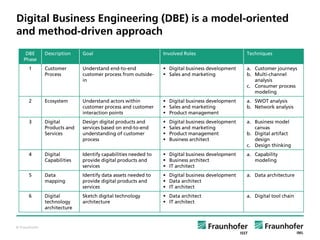
Digital Business Engineering (DBE) is a model-oriented
and method-driven approach
DBE
Phase
Description Goal Involved Roles Techniques
1 Customer
Process
Understand end-to-end
customer process from outside-
in
 Digital business development
 Sales and marketing
a. Customer journeys
b. Multi-channel
analysis
c. Consumer process
modeling
2 Ecosystem Understand actors within
customer process and customer
interaction points
 Digital business development
 Sales and marketing
 Product management
a. SWOT analysis
b. Network analysis
3 Digital
Products and
Services
Design digital products and
services based on end-to-end
understanding of customer
process
 Digital business development
 Sales and marketing
 Product management
 Business architect
a. Business model
canvas
b. Digital artifact
design
c. Design thinking
4 Digital
Capabilities
Identify capabilities needed to
provide digital products and
services
 Digital business development
 Business architect
 IT architect
a. Capability
modeling
5 Data
mapping
Identify data assets needed to
provide digital products and
services
 Digital business development
 Data architect
 IT architect
a. Data architecture
6 Digital
technology
architecture
Sketch digital technology
architecture
 Data architect
 IT architect
a. Digital tool chain
© Fraunhofer
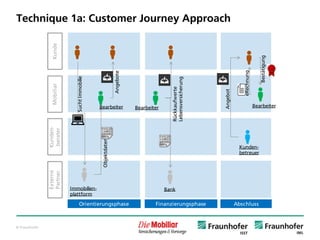
Technique 1a: Customer Journey Approach
Orientierungsphase Finanzierungsphase Abschluss
KundeMobiliar
Kunden-
berater
Externe
Partner
Immobilien-
plattform
SuchtImmobilie
Objektdaten
Angebote
Rückkaufwerte
Lebensversicherung
Bank
Angebot
Bestätigung
eRechnung
Bearbeiter
Kunden-
betreuer
BearbeiterBearbeiter
© Fraunhofer
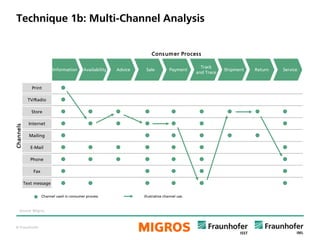
Technique 1b: Multi-Channel Analysis
Channel used in consumer process illustrative channel use.
Information Advice Return ServiceShipment
Track
and Trace
SaleAvailability Payment
Print
TV/Radio
Mailing
Store
Internet
E-Mail
Phone
Fax
Text message
Channels
Consumer Process
Source: Migros.
© Fraunhofer
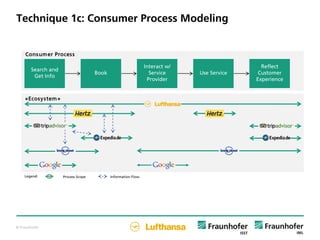
Technique 1c: Consumer Process Modeling
«Ecosystem»
Information Flow.Process Scope
Interact w/
Service
Provider
Use Service
Reflect
Customer
Experience
Book
Search and
Get Info
Consumer Process
Legend:
© Fraunhofer
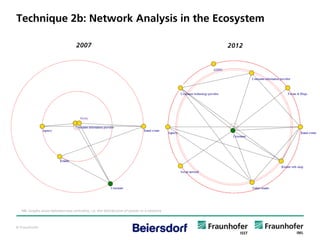
Technique 2b: Network Analysis in the Ecosystem
2007
Media
2012
NB: Graphs show betweenness centrality, i.e. the distribution of power in a network.
© Fraunhofer
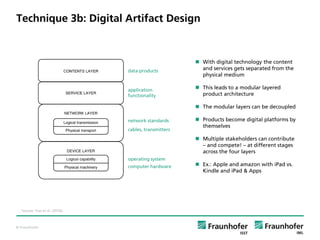
Technique 3b: Digital Artifact Design
 With digital technology the content
and services gets separated from the
physical medium
 This leads to a modular layered
product architecture
 The modular layers can be decoupled
 Products become digital platforms by
themselves
 Multiple stakeholders can contribute
– and compete! – at different stages
across the four layers
 Ex.: Apple and amazon with iPad vs.
Kindle and iPad & Apps
cables, transmitters
network standards
application
functionality
data products
computer hardware
operating system
Source: Yoo et al. (2010).
© Fraunhofer
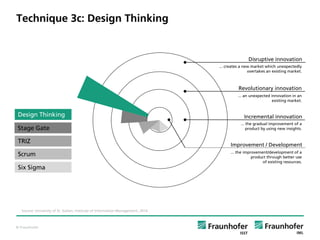
Technique 3c: Design Thinking
Design Thinking
Stage Gate
TRIZ
Six Sigma
Scrum
Improvement / Development
Incremental innovation
Revolutionary innovation
Disruptive innovation
... creates a new market which unexpectedly
overtakes an existing market.
... an unexpected innovation in an
existing market.
... the gradual improvement of a
product by using new insights.
... the improvement/development of a
product through better use
of existing resources.
Source: University of St. Gallen, Institute of Information Management, 2014.
© Fraunhofer
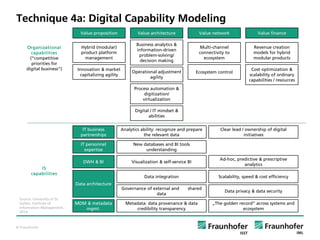
Technique 4a: Digital Capability Modeling
Hybrid (modular)
product platform
management
Innovation & market
capitalizing agility
Value proposition
Business analytics &
information-driven
problem-solving/
decision making
Operational adjustment
agility
Process automation &
digitization/
virtualization
Digital / IT mindset &
abilities
Value architecture
Multi-channel
connectivity to
ecosystem
Value network
Revenue creation
models for hybrid
modular products
Cost optimization &
scalability of ordinary
capabilities / resources
Value finance
Organizational
capabilities
(“competitive
priorities for
digital business”)
IS
capabilities
Ecosystem control
Clear lead / ownership of digital
initiatives
IT business
partnerships
Analytics ability: recognize and prepare
the relevant data
Metadata: data provenance & data
credibility transparency
MDM & metadata
mgmt.
„The golden record“ across systems and
ecosystem
New databases and BI tools
understanding
IT personnel
expertise
Ad-hoc, predictive & prescriptive
analytics
Visualization & self-service BIDWH & BI
Data integration
Data privacy & data security
Scalability, speed & cost efficiency
Data architecture
Governance of external and shared
data
Source: University of St.
Gallen, Institute of
Information Management,
2014.
© Fraunhofer
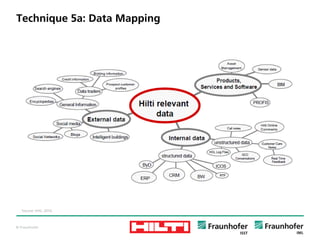
Technique 5a: Data Mapping
Source: Hilti, 2014.
© Fraunhofer
CONTENT
 Digitization
 Digital Business Engineering Approach
 Business Benefits
© Fraunhofer
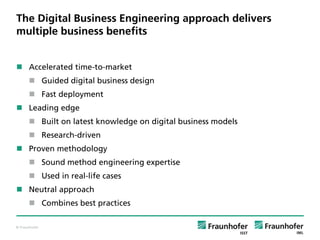
The Digital Business Engineering approach delivers
multiple business benefits
 Accelerated time-to-market
 Guided digital business design
 Fast deployment
 Leading edge
 Built on latest knowledge on digital business models
 Research-driven
 Proven methodology
 Sound method engineering expertise
 Used in real-life cases
 Neutral approach
 Combines best practices
© Fraunhofer
DIGITAL BUSINESS ENGINEERING
Prof. Dr. Boris Otto
Dortmund, January 2015
Source: Financial Times, 2014.

Digital Business Engineering

  • 1.
    © Fraunhofer DIGITAL BUSINESSENGINEERING Prof. Dr. Boris Otto Dortmund, January 2015 Source: Financial Times, 2014.
  • 2.
    © Fraunhofer CONTENT  Digitization Digital Business Engineering Approach  Business Benefits
  • 3.
    © Fraunhofer Digitization isa term describing an array of various influential developments Society Business Technology  Individualization  »Shareconomy«  Data privacy  Consumer-centricity  Hybrid services  »Industrie 4.0«  Cyber-physical systems  In-memory-computing, Hadoop etc.  Mobile and ubiquitous computing Digitization
  • 4.
    © Fraunhofer These developmentsask for the impact of digitization on existing business models
  • 5.
    © Fraunhofer In thisendeavor, companies across all industries are confronted with a set of open issues  How does digitization affect our business model?  Which digital services offer most value to our customers?  What data is required? Where does the data come from?  Whom do we need to partner with in order provide these services?  What capabilities does our organization need to provide these services?  What technology must be in place?
  • 6.
    © Fraunhofer CONTENT  Digitization Digital Business Engineering Approach  Business Benefits
  • 7.
    © Fraunhofer Companies haveto overcome various challenges when developing a digital business model 52 % Inappropriate organizational structure 51 % Missing IT infrastructure and systems 46 %Poor data quality 45 %Lack of leadership 43 %Lack of functional expertise 31 %Lack of IT expertise Source: McKinsey: Minding your digital business. In: MicKinsey on Business Technology (2012) Nr. 27, S. 24-31.
  • 8.
    © Fraunhofer Digital BusinessEngineering is a methodology for sustainable digital business transformation Digitization Digital Business Model Strategic Perspective Process Perspective Systems Perspective E2E Customer Process Design Ecosystem Design Digital Product & Service Design Digital Capabilities Design Data Mapping Digital Technology Architecture 1 2 3 4 5 6 Legend: E2E - End-to-End.
  • 9.
    © Fraunhofer Digital BusinessEngineering (DBE) is a model-oriented and method-driven approach DBE Phase Description Goal Involved Roles Techniques 1 Customer Process Understand end-to-end customer process from outside- in  Digital business development  Sales and marketing a. Customer journeys b. Multi-channel analysis c. Consumer process modeling 2 Ecosystem Understand actors within customer process and customer interaction points  Digital business development  Sales and marketing  Product management a. SWOT analysis b. Network analysis 3 Digital Products and Services Design digital products and services based on end-to-end understanding of customer process  Digital business development  Sales and marketing  Product management  Business architect a. Business model canvas b. Digital artifact design c. Design thinking 4 Digital Capabilities Identify capabilities needed to provide digital products and services  Digital business development  Business architect  IT architect a. Capability modeling 5 Data mapping Identify data assets needed to provide digital products and services  Digital business development  Data architect  IT architect a. Data architecture 6 Digital technology architecture Sketch digital technology architecture  Data architect  IT architect a. Digital tool chain
  • 10.
    © Fraunhofer Technique 1a:Customer Journey Approach Orientierungsphase Finanzierungsphase Abschluss KundeMobiliar Kunden- berater Externe Partner Immobilien- plattform SuchtImmobilie Objektdaten Angebote Rückkaufwerte Lebensversicherung Bank Angebot Bestätigung eRechnung Bearbeiter Kunden- betreuer BearbeiterBearbeiter
  • 11.
    © Fraunhofer Technique 1b:Multi-Channel Analysis Channel used in consumer process illustrative channel use. Information Advice Return ServiceShipment Track and Trace SaleAvailability Payment Print TV/Radio Mailing Store Internet E-Mail Phone Fax Text message Channels Consumer Process Source: Migros.
  • 12.
    © Fraunhofer Technique 1c:Consumer Process Modeling «Ecosystem» Information Flow.Process Scope Interact w/ Service Provider Use Service Reflect Customer Experience Book Search and Get Info Consumer Process Legend:
  • 13.
    © Fraunhofer Technique 2b:Network Analysis in the Ecosystem 2007 Media 2012 NB: Graphs show betweenness centrality, i.e. the distribution of power in a network.
  • 14.
    © Fraunhofer Technique 3b:Digital Artifact Design  With digital technology the content and services gets separated from the physical medium  This leads to a modular layered product architecture  The modular layers can be decoupled  Products become digital platforms by themselves  Multiple stakeholders can contribute – and compete! – at different stages across the four layers  Ex.: Apple and amazon with iPad vs. Kindle and iPad & Apps cables, transmitters network standards application functionality data products computer hardware operating system Source: Yoo et al. (2010).
  • 15.
    © Fraunhofer Technique 3c:Design Thinking Design Thinking Stage Gate TRIZ Six Sigma Scrum Improvement / Development Incremental innovation Revolutionary innovation Disruptive innovation ... creates a new market which unexpectedly overtakes an existing market. ... an unexpected innovation in an existing market. ... the gradual improvement of a product by using new insights. ... the improvement/development of a product through better use of existing resources. Source: University of St. Gallen, Institute of Information Management, 2014.
  • 16.
    © Fraunhofer Technique 4a:Digital Capability Modeling Hybrid (modular) product platform management Innovation & market capitalizing agility Value proposition Business analytics & information-driven problem-solving/ decision making Operational adjustment agility Process automation & digitization/ virtualization Digital / IT mindset & abilities Value architecture Multi-channel connectivity to ecosystem Value network Revenue creation models for hybrid modular products Cost optimization & scalability of ordinary capabilities / resources Value finance Organizational capabilities (“competitive priorities for digital business”) IS capabilities Ecosystem control Clear lead / ownership of digital initiatives IT business partnerships Analytics ability: recognize and prepare the relevant data Metadata: data provenance & data credibility transparency MDM & metadata mgmt. „The golden record“ across systems and ecosystem New databases and BI tools understanding IT personnel expertise Ad-hoc, predictive & prescriptive analytics Visualization & self-service BIDWH & BI Data integration Data privacy & data security Scalability, speed & cost efficiency Data architecture Governance of external and shared data Source: University of St. Gallen, Institute of Information Management, 2014.
  • 17.
    © Fraunhofer Technique 5a:Data Mapping Source: Hilti, 2014.
  • 18.
    © Fraunhofer CONTENT  Digitization Digital Business Engineering Approach  Business Benefits
  • 19.
    © Fraunhofer The DigitalBusiness Engineering approach delivers multiple business benefits  Accelerated time-to-market  Guided digital business design  Fast deployment  Leading edge  Built on latest knowledge on digital business models  Research-driven  Proven methodology  Sound method engineering expertise  Used in real-life cases  Neutral approach  Combines best practices
  • 20.
    © Fraunhofer DIGITAL BUSINESSENGINEERING Prof. Dr. Boris Otto Dortmund, January 2015 Source: Financial Times, 2014.